
The Gold That Does Not Warm
You are standing in front of something that does not want to be beautiful for you. That is the first thing you notice, even before you understand what you are looking at. The gold does not glow the way gold is supposed to glow — warm, inviting, promising depth behind it. This gold is flat. This gold is a wall. It bounces light back at you with the indifference of a mirror that has decided not to reflect your face but something else entirely, something that was there before you arrived and will remain long after you leave. You step closer, instinctively, the way you step closer to anything that unsettles you, hoping proximity will dissolve the strangeness. It does not. The eyes find you.

This is the thing no one warns you about. The eyes in these images do not look at the world the way human eyes look at the world. They do not scan, do not flicker, do not carry the small negotiations of social vision — the glance that softens, the gaze that retreats when it has stayed too long. These eyes are still in a way that living eyes never are. They are fixed not on a point in space but on something behind space, through it, and incidentally through you. You are not the object of their attention. You are an obstacle they have chosen not to bother removing. The confrontation is absolute and utterly impersonal, which is somehow more disturbing than hostility would be.
A man sits in a darkened room staring at a woman’s photograph pinned to a wall. He has been looking at it for hours. At a certain point he realizes the photograph is looking back — not because anything has changed in the image, but because he has finally become still enough to feel what the image was always doing. That stillness, that realization, is the entry point to understanding what Byzantine art asks of the body before it asks anything of the mind.
Most of what we call art asks to be consumed. It positions itself within the logic of the viewer’s pleasure, orients itself toward the eye that approaches it, offers its best angle, its most accessible emotion. Even confrontational modern art operates within this framework — it provokes, but provocation is still a form of address, still a transaction between the work and the person looking. Byzantine art refuses this transaction entirely. It does not address you. It pre-exists you. The Virgin Hodegetria, the Pantocrator gazing down from the dome, the processions of saints rendered in tesserae so small they disappear into pure chromatic field when you step back — none of these were made to be appreciated. They were made to be present. The distinction is not subtle. It changes everything about how your body orients itself in front of them.
There is a specific physical discomfort that accompanies this realization, something in the chest or the back of the throat. You may have felt it without naming it — that slight vertigo in front of an icon, that impulse to look away and the simultaneous impossibility of looking away, as though you have been addressed in a language you do not speak but your nervous system somehow recognizes. The gold that does not warm, the faces that do not soften, the proportions that refuse the reassurance of anatomical correctness — these are not failures of skill or products of primitive technique. They are the result of a civilization making deliberate and sophisticated choices about what images are for, choices so foreign to the assumptions we carry into museums and churches that we experience them as uncanny rather than as what they actually are: a radically different theory of vision, of presence, of what it means for a human face to appear on a surface and demand to be seen in return.
An Empire That Refused to Die
There is a specific kind of stubbornness that looks, from the outside, like survival. You have seen it in people who should have collapsed years ago but instead grew denser, more concentrated, as though loss itself were a refining process. Byzantium was that kind of entity. Not an empire that endured in spite of its wounds, but one that converted each wound into theological certainty, each military defeat into liturgical reinforcement, each territorial shrinkage into a more compressed and therefore more intense sense of who it was.
When Constantine dedicated his new city on the Bosphorus in 330 AD, he was not simply moving a capital. He was performing an act of symbolic substitution so audacious it would take centuries to fully comprehend. Rome, the eternal city, was being doubled — or rather, superseded — by a city that claimed to be more Rome than Rome itself. The Second Rome. The city protected by the Virgin. The navel of sacred geography. And the extraordinary fact is that this claim was not abandoned when the circumstances that might have justified it began to erode. It was intensified.
This is precisely what Mircea Eliade described in his analysis of sacred time, most rigorously developed in The Myth of the Eternal Return from 1949. Eliade argued that archaic religious consciousness does not move forward through history but returns, cyclically and obsessively, to an originary sacred moment — what he called the illud tempus, the primordial time of first creation. Profane time, the time of empires falling and borders shifting, is not real time. It is noise. What is real is the eternal template to which all human action must conform or be meaningless. Byzantium did not merely resemble this structure. It institutionalized it. The emperor was not a political leader managing contingent circumstances. He was the living icon of Christ’s sovereignty on earth, his role fixed, his gestures prescribed, his very body a theological argument. When the empire lost Egypt in 641, when it lost Syria and Palestine to the Arab expansion, when it watched the Bulgarians press to within sight of Constantinople’s walls, none of this constituted, in the Byzantine symbolic imagination, evidence of failure. It constituted the tribulation that sacred time demands before renewal.
This is not delusion, or not simply delusion. It is a technology of psychological coherence under conditions of relentless historical pressure. A man stands in the Hagia Sophia — completed under Justinian in 537, the largest enclosed space in the world for nearly a thousand years — and looks upward at the dome that seems to float without support, at the gold tessera that dissolve the walls into light, and he does not experience himself as the subject of a declining state. He experiences himself as the temporary resident of eternity. The architecture is doing something to his nervous system that no political rhetoric could accomplish. It is relocating him outside history.
This is why Byzantium lasted. Not through military genius, not through economic dominance — though it had periods of both — but through an unbroken capacity to make its citizens feel that what they were defending was not territory but reality itself. By 1453, when Mehmed II’s Ottoman forces finally breached the walls that Theodosius had built in the fifth century, the empire had shrunk to little more than the city itself and a few coastal fragments. Its population was a fraction of what it had once been. Its last emperor, Constantine XI, reportedly died fighting in the streets, his body never conclusively identified. And yet the theological and artistic inheritance that this diminished, besieged entity had been generating for eleven centuries did not end with the breach. It migrated. Into Russian Orthodoxy. Into the iconographic imagination of the entire Christian East. Into the gold-saturated visual language that would trouble and fascinate Western painters for generations.
The city fell. The symbol refused the appointment.

The Theology of the Visible
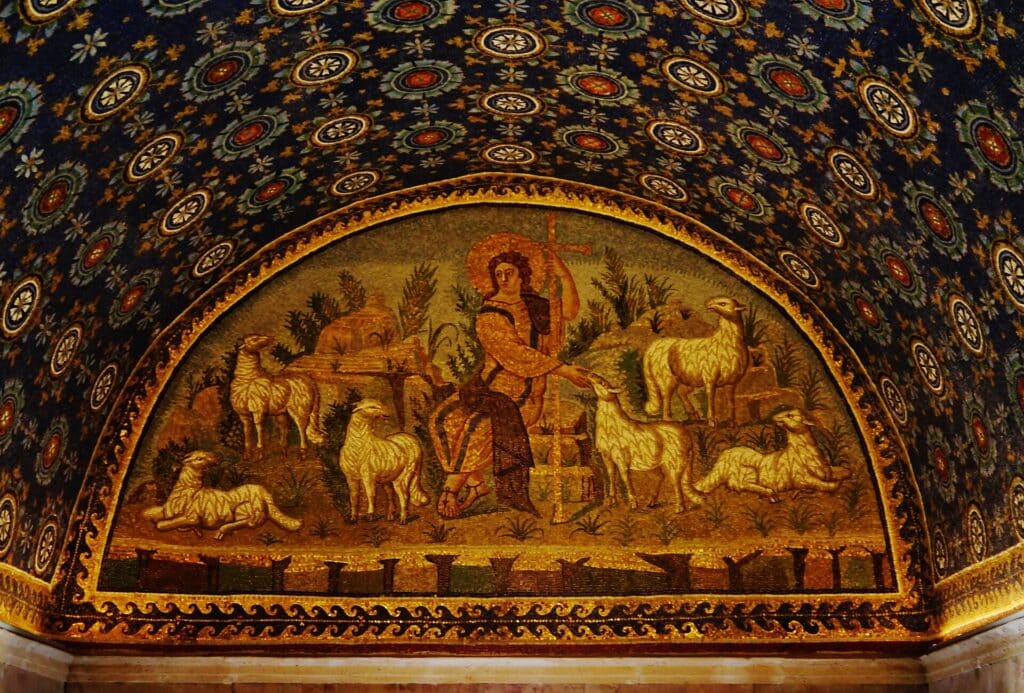
There is a moment, standing before a Byzantine icon, when you realize that looking at it the way you look at a painting is a fundamental category error. You are not supposed to admire it. You are not supposed to interpret it. You are supposed to be seen by it.
This is not metaphor. It is the precise theological position that emerged, bloodied and clarified, from one of the most violent intellectual crises in Christian history. Beginning in 726 AD, when Emperor Leo III ordered the destruction of a revered image of Christ at the Chalke Gate in Constantinople, the Byzantine world tore itself apart over a question that sounds, to modern ears, almost bureaucratic: can God be depicted? What followed was not a dispute about aesthetics. It was a dispute about the nature of reality.
The Iconoclasts — those who destroyed images — were not philistines. Their argument was philosophically rigorous. To represent the divine in matter, they insisted, was either to circumscribe the uncircumscribable, reducing God to finite form, or to confuse the human and divine natures of Christ in ways the Council of Chalcedon in 451 had explicitly condemned. Either way, the icon was a theological crime. Empress Irene convened the Second Council of Nicaea in 787 AD precisely to answer this charge, and the answer the council gave was not a compromise. It was a counter-ontology.
The defenders of images, led intellectually by figures like Theodore of Studion and the patriarch Nikephoros, made a distinction that changes everything: between latria, the worship due to God alone, and proskynesis, the veneration directed toward an image. But beneath this liturgical distinction lay something far more radical. The icon, they argued, does not merely resemble its prototype. It participates in it. The relationship between image and archetype is not representational but real — a channel of presence, not a record of absence.
Hans Belting, in his landmark 1990 study Likeness and Presence, demonstrated with forensic precision how this theological position restructured the entire function of the image in the pre-modern world. The icon was not art in any sense the Renaissance would later recognize. It was, in Belting’s formulation, a living presence — an object whose power derived not from the skill of its maker but from the ontological link it maintained with what it depicted. This is why Byzantine craftsmen were not celebrated as artists. To draw attention to the hand that made the image was to corrupt the image’s claim. The maker effaced himself precisely because the image was not his.
What this dismantles is an assumption so deep in Western culture that most people never notice they are making it: that an image is expression. That it carries the mark of a subject who felt something, saw something, chose to render it this way rather than that way. In Byzantium, this logic was not just absent — it was actively refused. The gold ground that flattens space in every icon is not a stylistic choice. It is a theological statement: there is no perspective here because perspective implies a viewer standing somewhere, at a distance, looking in. The icon refuses that geometry. It addresses you. It is already here, in the space you occupy.
This is what makes the Iconoclast crisis so much more than a church dispute. It forced Byzantine civilization to articulate, with philosophical precision, what it believed an image to be at the most fundamental level. And its answer — that the visible can participate in the invisible without collapsing the distinction between them — is a position that Western modernity has never seriously entertained. We inherited from the Renaissance the idea that the image is a window, and from Romanticism the idea that it is a mirror. Byzantium proposed something stranger: that it is a door, already open, whether you chose to walk through it or not.
Figures That Do Not Cast Shadows
There is a figure standing in front of you, and it does not acknowledge the light. No shadow falls from its feet. No cheekbone catches the afternoon. The robe it wears does not crease under gravity but flows in patterns that obey a different logic entirely, one closer to music than to physics. You are looking at it and it is looking back at you, fully, without the slight angle of avoidance that real faces carry. It meets you straight on, and the meeting is uncomfortable in a way you cannot immediately name.
This is not a failure of observation. The artists who built these images understood the human form with the same precision as anyone who has spent years studying it. They made a choice, and the choice was systematic, repeated across centuries, across geographies, across materials — mosaic, fresco, ivory, enamel, illuminated manuscript — with a consistency that rules out accident and demands interpretation.
Erwin Panofsky, in his 1927 essay Perspective as Symbolic Form, argued something that remains underappreciated in its full radicalism: that perspective is not a discovery of how things look, but a decision about who is doing the looking. The Renaissance construction of linear perspective, with its single vanishing point, its horizon line, its geometry that collapses all space toward one eye, is a philosophical statement disguised as a technique. It places the individual human body at the center of the visible world and makes all of reality converge toward that body. Everything recedes from you, which means everything exists in relation to you. You are the measure.
Byzantine art refuses this entirely, and the refusal is older than the Renaissance assertion by a thousand years. The gold background is the first and most absolute statement. Gold does not belong to any atmosphere. It does not change with the hour or the season. It is not the sky at noon or the sky at dusk. It is the annihilation of the sky altogether, the removal of any context that would place a figure inside a world governed by weather, by time, by the particular angle of a sun that rises and sets over human affairs. The figure exists in front of the gold the way a thought exists in front of silence — not located, not contingent.
Then there is inverse perspective, the most disorienting formal choice to a modern eye. Rather than converging toward the viewer, the lines of objects diverge outward, as if the geometry emanates from the image toward you rather than from you toward it. A throne, a table, an architectural element — the lines that would, in a Renaissance painting, draw your gaze inward instead push the object forward, toward the world you inhabit. The sacred is not retreating into depth for you to follow. It is advancing. You are not the origin of the gaze. You are its destination.
The elongated figures, the necks stretched, the fingers thinned to an almost impossible delicacy, the heads slightly enlarged, do not describe bodies under the conditions of physical existence. They describe something that has passed through physical existence and arrived somewhere else. A man who has fasted until the flesh becomes translucent. A hand that has stopped being useful and become purely expressive. The body rendered as a direction rather than a fact.
And that frontal gaze, which you feel across the room before you understand it, which persists even when you move to the side, which seems to track you not because the eyes are painted with any optical trick but because they were never looking at a specific point in the first place — that gaze was never meant to see you as you are, situated in your particular afternoon, in your body, in your contingent and temporary presence. It was meant to address something it understood as permanent in you, which you may or may not still believe is there.
The Icon as a Mirror That Lies
You stand in front of it long enough and something begins to shift. Not the image — the image never moves, that is precisely the point — but something in the space between your eyes and the gold. You came looking for recognition, the way you always do when you stand before a face, and instead you found instruction. This is what the icon was always doing, even when no one admitted it.
There is a particular kind of disorientation that happens in the small hours, when you catch your reflection in a darkened window and for a fraction of a second you do not know who you are looking at. The face is yours and it is also not yours. It precedes you, somehow, and you have to rush to catch up with it, to reassemble the story that makes you legible to yourself. That gap — that half-second of non-recognition — is not a malfunction. It is the ordinary condition of selfhood, perpetually constructing itself in the presence of external images. The Byzantine icon knew this long before psychology had a name for it.
A woman goes through her grandmother’s letters and finds a story she has told herself for thirty years attributed to someone she never met. The memory she believed was hers turns out to be a transmission, something passed down through repetition until it calcified into personal experience. She does not know whether to feel robbed or simply more porous than she imagined. The icon works by the same mechanism, but with institutional intention behind it. It does not offer you a reflection. It offers you a model. The gold ground that eliminates all shadow, all spatial depth, all circumstantial atmosphere — that is not an aesthetic choice. It is a theological argument: there is no context here, no moment, no contingency. This face exists outside of time and it is what you are supposed to become.
Jacques Lacan, writing in 1949 on the formation of the self, described the moment an infant sees itself in a mirror and misrecognizes a unified image as its own identity. The self, in this reading, is always a fiction borrowed from an external surface. The icon functions as exactly this kind of surface, but the misrecognition is not accidental — it is engineered. When a monk prostrated himself before a painted face in an eighth-century monastery cell, the image he was confronting was not documenting holiness. It was prescribing it. The flattened perspective, the elongated proportions, the eyes that are too large for any human skull — these are not failures of technical skill. Byzantine artists who could render drapery with extraordinary precision chose not to render faces with anatomical accuracy because accuracy would have implied individuality, which would have implied contingency, which would have implied that the sacred could be other than it is.
The Iconoclast controversy that tore the Byzantine world apart between 726 and 843 was not, at its core, a theological dispute about idolatry. It was a crisis of image-power. The emperors who ordered icons destroyed understood perfectly what icons were doing to the population. They were producing a parallel loyalty, a devotional bond that ran not through imperial channels but directly between the individual and the sacred face. To destroy the icon was to destroy that mirror and force everyone to see themselves only in the reflection that power authorized.
When the Empress Theodora finally restored icon veneration in 843 — the event the Orthodox Church still commemorates as the Triumph of Orthodoxy — what was restored was not merely a devotional practice. What was restored was a specific technology of self-formation, a way of looking that produces, over time, a looking subject shaped by what it was given to see. You stand in front of the image. The image stands in front of what you could be. Between those two positions, you are expected to disappear.
A vision curated by a filmmaker, not an algorithm
In this video I explain our vision
The Craftsman Who Had No Name
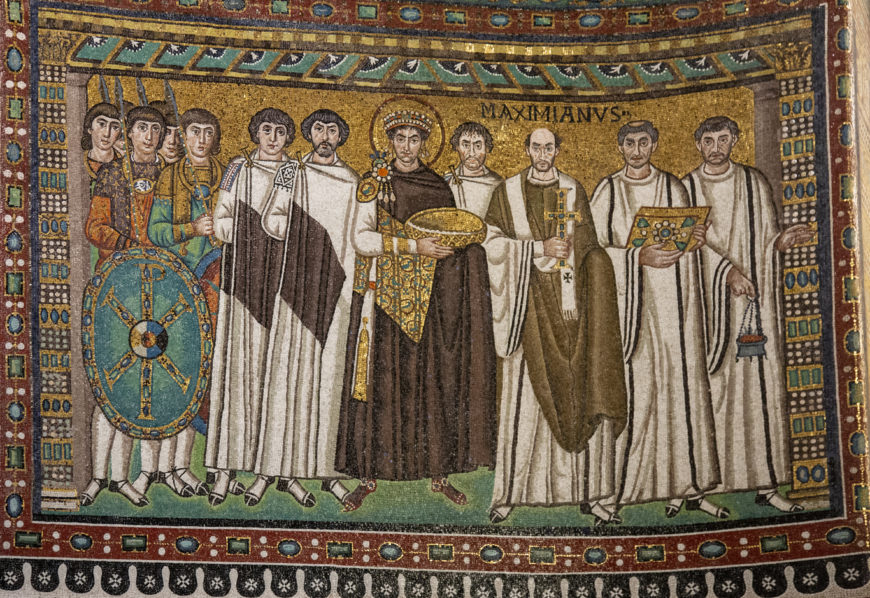
You walk into a room and someone asks you who painted it. The question feels natural, inevitable, as if the name were the final piece that makes the object real. Without it, something remains unsettled, incomplete. We have been trained, across centuries of Western aesthetic culture, to need that name the way we need a face on a voice.
Byzantine art offers no such comfort. The monk who spent three years grinding lapis lazuli into the blue mantle of a Virgin, whose hands trembled slightly at the mouth’s corner because he had fasted for forty days before touching the board, left nothing behind except the image itself. No signature. No self-portrait hidden in a corner. No anecdote recorded by an admiring pupil. Giorgio Vasari built the entire architecture of Western art history on the premise that genius has a biography, that the work is inseparable from the life of its maker. Byzantine culture would have found this deeply confused, in the same way you might find it confused if someone asked you the name of the wind that carried a particular prayer upward.
Walter Benjamin argued in 1935 that the aura of a work of art — that trembling quality of presence, of here and now, of irreducible singularity — was being destroyed by mechanical reproduction. He was right about the direction of modern culture. But he missed something, or perhaps only had access to half the picture. Byzantine art achieved aura not through the assertion of individual authorship but through its complete erasure. The icon was not diminished by anonymity. It was consecrated by it. The author’s disappearance was not a loss but a ritual act, a deliberate voiding of the self so that something else could pass through. Benjamin’s argument depended on the artwork being the trace of a singular human hand. Byzantine theology located the power of sacred images in precisely the opposite: the hand that made it had ceased to matter.
There is something almost unbearable in imagining that labor. Months of work on a surface no larger than your torso. The preparation of the wood alone — seasoning, priming, layering gesso in strokes counted like prayers — could take longer than most modern projects from conception to completion. The gold leaf applied in sheets so thin they dissolved in breath. And at the end of it, nothing. No name recorded. No place in any list. The craftsman returned to the silence from which he came, and the image remained, and the image was what mattered.
The philosopher Simone Weil, writing in the early 1940s in her notebooks later published as Gravity and Grace, described what she called decreation — the active stripping away of the self as a spiritual act, not self-destruction but self-effacement, making room for something that cannot enter where the ego is already crowded. This is not the same as self-denial in the punitive sense. It is closer to what a musician does when the technique disappears and only the music remains. Byzantine anonymous production was decreation institutionalized, built into the very structure of how art was made and understood.
What we call artistic identity — the brand, the style, the recognizable hand — is a relatively recent and remarkably specific cultural invention. The Renaissance required it because the Renaissance was also inventing a new kind of human subject, one whose inner life was legible and marketable. But for a thousand years of extraordinary visual production, across an empire that stretched from Ravenna to Anatolia, the self of the maker was considered not only irrelevant but potentially contaminating. To sign an icon was, in a sense, to pollute it.
And still those images hold you. Still they look back. The name was never what was doing the looking.
What the West Buried and Called Progress
There is a particular kind of confidence that only comes from having already decided the outcome. The Renaissance art historian Giorgio Vasari wrote his Lives of the Artists in 1550 with exactly that confidence, arranging centuries of human creativity into a single ascending line that began in Greek antiquity, collapsed into medieval darkness, and gloriously resurged in Florence. Byzantine art appears in that account as a symptom of stagnation, a frozen moment before the thaw, and Vasari’s vocabulary is clinical in its dismissal: maniera greca, the Greek manner, spoken as a diagnosis. What he was really constructing was not a history of art but a founding myth of Western superiority, and he was doing it with such elegance that generations of scholars simply inherited the verdict without examining the trial.
The narrative of perspective as progress is almost irresistible because it wears the costume of the obvious. You look at a Byzantine icon and then at a Masaccio fresco, and something in your trained eye says: one came before, one came after, one is more advanced. But this is not perception. It is ideology dressed as vision. Georges Duby, in his foundational work on medieval aesthetics, was precise about this: the visual choices of Byzantine art were not failures to achieve naturalism but deliberate refusals of it. The gold ground that so often strikes the modern viewer as naive was a theological statement about the uncreated light of divinity, a space existing outside of time and therefore outside of shadow, recession, and mortal geometry. To read this as incompetence is like accusing a poet of not being able to write in prose.
Edward Said never wrote specifically about Byzantine art, but the framework he constructed in Orientalism in 1978 applies with uncomfortable precision. Said described how the West organized its sense of self by defining what it was not, projecting onto the cultural other a set of qualities — static, decorative, spiritual in an excessive way, lacking rationality — that served to make Western dynamism and rationality appear natural rather than constructed. Byzantine art absorbed every one of these projections. It became the Orient within European history, the thing that had to be overcome and left behind for modernity to feel like arrival rather than choice. The suppression was not incidental. It was structural.
What was actually buried in this operation was a coherent visual epistemology. A man stands before an icon in a church in Thessaloniki. The figure in the image does not recede from him. It faces him with enormous, flattened eyes that seem to hold him rather than observe him. There is no vanishing point because there is no horizon from which the viewer is assumed to be looking. The image addresses him from a space that has no elsewhere. This is not primitive. This is a different theory of the relationship between the viewer and the sacred, one in which proximity is not achieved through illusion but through presence. When linear perspective arrived and placed the viewer at a measurable distance from a represented world, it also, quietly, placed God at that same measurable distance. The infinite became manageable. The sacred became scenery.
What the Renaissance narrative needed to call progress was in fact a reorganization of power, a reassignment of authority from the sacred to the human subject, from the vertical to the horizontal. This is not without its own grandeur. But it required a sacrifice that was never acknowledged as such. The Byzantine image had to become a mistake, an awkward attempt at something it was never attempting, so that its actual achievement — the construction of a visual language for the irreducible otherness of the divine — could be forgotten rather than refused. Forgetting is cleaner than refusal. It does not leave a scar you have to explain.
The Gaze That Has Not Closed
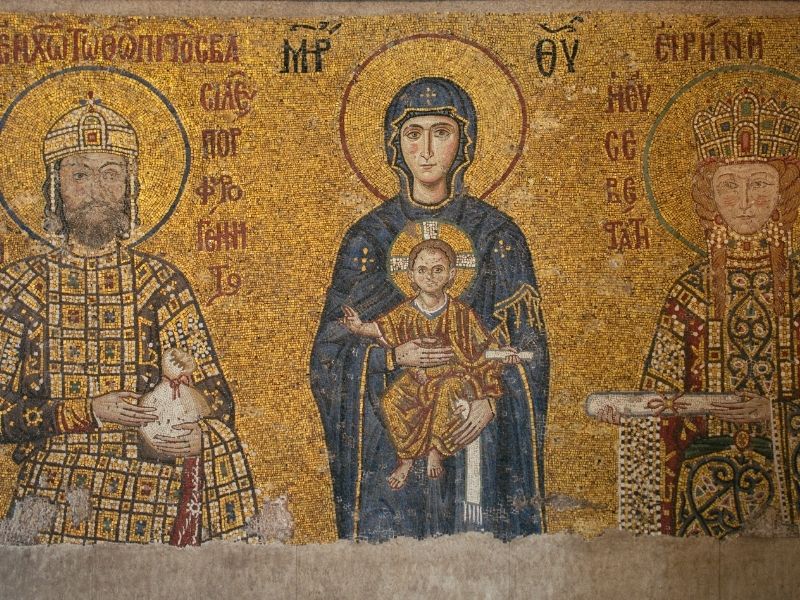
You are standing in front of a screen right now, and something is looking back at you. Not watching — looking. The distinction matters more than it seems.
After the Iconoclast period collapsed in 843, after decades of smashed faces and plastered walls and the theological violence of deciding whether God could be seen, the mosaicists returned to the Hagia Sophia and completed what the destroyers had interrupted. The Pantocrator they placed in the apse looks outward with an expression that has defeated every adjective thrown at it across twelve centuries. Not kind. Not severe. Not distant. Present in a way that refuses the comfort of category. The right hand is raised, not in greeting but in something closer to recognition — as if the gesture acknowledges that you were always already there, that the moment of encounter was always waiting for you to arrive at it.
Byzantine theological aesthetics were never about beauty in the decorative sense. John of Damascus, writing in the eighth century precisely in defense of images, argued that the icon was a site of ontological participation — not a representation of the sacred but a threshold into it. The image did not depict God; it made God available to encounter. This is why the face always looks outward. Not to survey the viewer but to hold them. To insist on a relationship that the viewer cannot easily exit.
There is a scene that belongs to many lives, though most would not describe it this way: a woman enters a vast space that has been a place of prayer for longer than any living person can fully grasp, looks up, and finds herself looked at in return by a face that does not blink, does not soften, does not perform. She does not pray. She simply stops, suspended in something she will spend years failing to name. What she experienced was not nostalgia and not faith in any doctrinal sense. It was the shock of being addressed by something that predates every category she uses to organize her inner life.
Hans Belting spent much of his career — culminating in his landmark 1994 work Likeness and Presence — tracing the history of the image before the era of art, arguing that sacred images functioned not as artworks to be admired but as presences to be encountered. The distinction is precise and devastating when you sit with it. An artwork asks you to evaluate it. A presence asks you to respond. The Pantocrator was never interested in your aesthetic opinion.
And now consider what has replaced it. The profile picture that shifts every few weeks. The algorithmic feed that learns what keeps your eyes moving and serves it back to you with mechanical efficiency. The notification that pulses with the logic of variable reinforcement, which behavioral psychologists since B.F. Skinner have identified as the most powerful mechanism for sustaining compulsive attention. The digital image economy is, among other things, a system for producing the feeling of being seen without the cost of actually being encountered. You look, you are looked at, and nothing is demanded of you. No stillness. No response. No transformation.
What the Iconoclasts feared, perhaps without fully knowing it, was not the image itself but what the image required of those who stood before it. Destruction was easier than the sustained discomfort of being held in a gaze that did not negotiate. The mosaic gold ground that surrounds every Byzantine figure was not decorative — it was the elimination of spatial depth, the refusal of recession, the insistence that the figure inhabit the same plane as the viewer. There is nowhere to retreat to. The encounter is total or it is nothing.
The Pantocrator completed in the ninth century is still there, still looking, with the particular patience of something that has already outlasted every ideology that declared it obsolete.
🏛️ Sacred Art and the Medieval Visual World
Byzantine Art does not exist in isolation — it is part of a vast visual and spiritual tradition that shaped centuries of Western and Eastern culture. These related articles illuminate the broader context of medieval aesthetics, religious symbolism, and architectural grandeur that both preceded and followed the Byzantine era.
Medieval Art: History and Meaning
Medieval Art: History and Meaning explores the rich symbolic language that permeated European visual culture from late antiquity through the Gothic period. Byzantine aesthetics were a fundamental pillar of this tradition, influencing iconography, color theology, and sacred composition across the entire medieval world. Understanding medieval art as a whole provides an essential framework for appreciating the unique contributions of Byzantium.
GO TO THE SELECTION: Medieval Art: History and Meaning
Romanesque Art: History and Characteristics
Romanesque Art: History and Characteristics traces the visual style that absorbed and transformed many Byzantine influences as they spread westward into Europe. The hieratic figures, golden backgrounds, and spiritual intensity of Byzantine mosaics left a profound mark on Romanesque painters and sculptors. Comparing these two traditions reveals how sacred artistic forms migrated, evolved, and took on new regional meanings.
GO TO THE SELECTION: Romanesque Art: History and Characteristics
Medieval Sculpture: History and Iconography
Medieval Sculpture: History and Iconography delves into the three-dimensional expression of the same theological and symbolic codes that Byzantine art rendered in mosaic and fresco. The rigid frontality and spiritual expressiveness characteristic of Byzantine figures reappear in carved tympana and column statues across medieval Europe. This article offers a compelling parallel reading of sacred imagery translated into stone.
GO TO THE SELECTION: Medieval Sculpture: History and Iconography
Gothic Cathedrals: History and Symbolism
Gothic Cathedrals: History and Symbolism examines the architectural and spiritual movement that gradually displaced the Byzantine-inflected Romanesque style, yet retained its deeply symbolic visual vocabulary. The luminous, heaven-reaching interiors of Gothic cathedrals echo the Byzantine aspiration to transform material space into a vision of the divine. Tracing this continuity helps reveal how Byzantine theology of light persisted long after the empire itself had faded.
GO TO THE SELECTION: Gothic Cathedrals: History and Symbolism
Discover the Art of Independent Cinema on Indiecinema
Just as Byzantine mosaics captured the transcendent in gold and light, independent cinema seeks the extraordinary in the hidden corners of human experience. On Indiecinema streaming you will find a carefully curated selection of visionary films that challenge, illuminate, and inspire — works of art that refuse to be forgotten. Explore our catalog and let independent cinema open new windows onto the world.
👉 EXPLORE THE CATALOG: Watch Indie Films in Streaming
A vision curated by a filmmaker, not an algorithm
In this video I explain our vision

