
The Stranger Who Draws Your Face
You are sitting at a table in a village square you have lived in your whole life, and a man you have never seen before is sketching you. You did not agree to this. You did not pose. He simply looked at you long enough, with that particular quality of attention that feels almost aggressive in its patience, and his hand began to move. When he turns the paper toward you, something happens that you were not prepared for: you recognize yourself more completely than you do in any mirror. Not because the likeness is photographic, but because he has caught something you have spent years not looking at directly — the specific gravity of your tiredness, the way your hands rest as though they have given up expecting anything extraordinary. You feel seen and, in the same instant, slightly violated. Who gave him the right?

This is the question Carlo Levi spent his entire adult life answering, not abstractly, but through the act of living it. Born in Turin in 1902 into a prosperous Jewish family embedded in the intellectual and antifascist currents of northern Italy, Levi trained as a physician but practiced medicine the way some people practice religion — intermittently, intensely, and always in service of something larger than the profession itself. He was a painter before he was a writer, and this matters enormously, because the painter’s eye is not the novelist’s eye. The novelist constructs interiority from the outside in. The painter arrests a surface and trusts that the depth will bleed through. When Mussolini’s regime sent Levi into internal exile in 1935, confining him to Aliano, a remote village in the Basilicata region of southern Italy — a place so isolated it existed almost outside modern Italian history — he brought both eyes with him.
What he found there was not picturesque poverty. It was an entire civilization that had been systematically excluded from the narrative of the Italian nation-state. The peasants of Basilicata did not consider themselves Italian in any meaningful sense. Levi recorded one of them saying, with no bitterness, simply as a statement of geographic and metaphysical fact, that Christ had stopped at Eboli — that is, at the boundary where Roman roads ended and the south began, where Christianity and modernity had arrived only as rumor, where the state appeared only in the form of taxes and conscription. This was not folklore. This was a precise description of what the sociologist Robert Putnam would later, in his 1993 study Making Democracy Work, identify as centuries of structural abandonment creating what he called an almost geological difference in civic culture between northern and southern Italy. Levi arrived at this conclusion not through surveys but through the daily act of looking.
And here is where the violation and the gift become inseparable. The outsider — the confined man, the northern Jew, the trained physician who had no business being there — was precisely the figure capable of seeing what the inhabitants could no longer see because they were inside it. Antonio Gramsci, who was dying in a fascist prison during the same years Levi was painting peasant faces in Aliano, had already theorized this in his Prison Notebooks: the subaltern cannot easily narrate their own condition from within the logic of the dominant culture, because that logic has colonized the very language available to them. It takes a specific kind of displacement — not superiority, but dislocation — to find the angle from which the invisible becomes visible. Levi was displaced by force. The regime intended this as punishment. What it produced instead was the conditions for one of the most morally serious works of witness in twentieth-century European literature.
The book that came out of that exile, published in 1945 as Christ Stopped at Eboli, sold over one million copies and was translated into dozens of languages. But the numbers are almost beside the point. The real question the book poses, and that Levi’s life poses, is whether the act of representing another human being — their face, their land, their silence — can ever be innocent, and whether the answer to that question changes depending on where you were standing when you first picked up the brush.
The Smartphone Woman
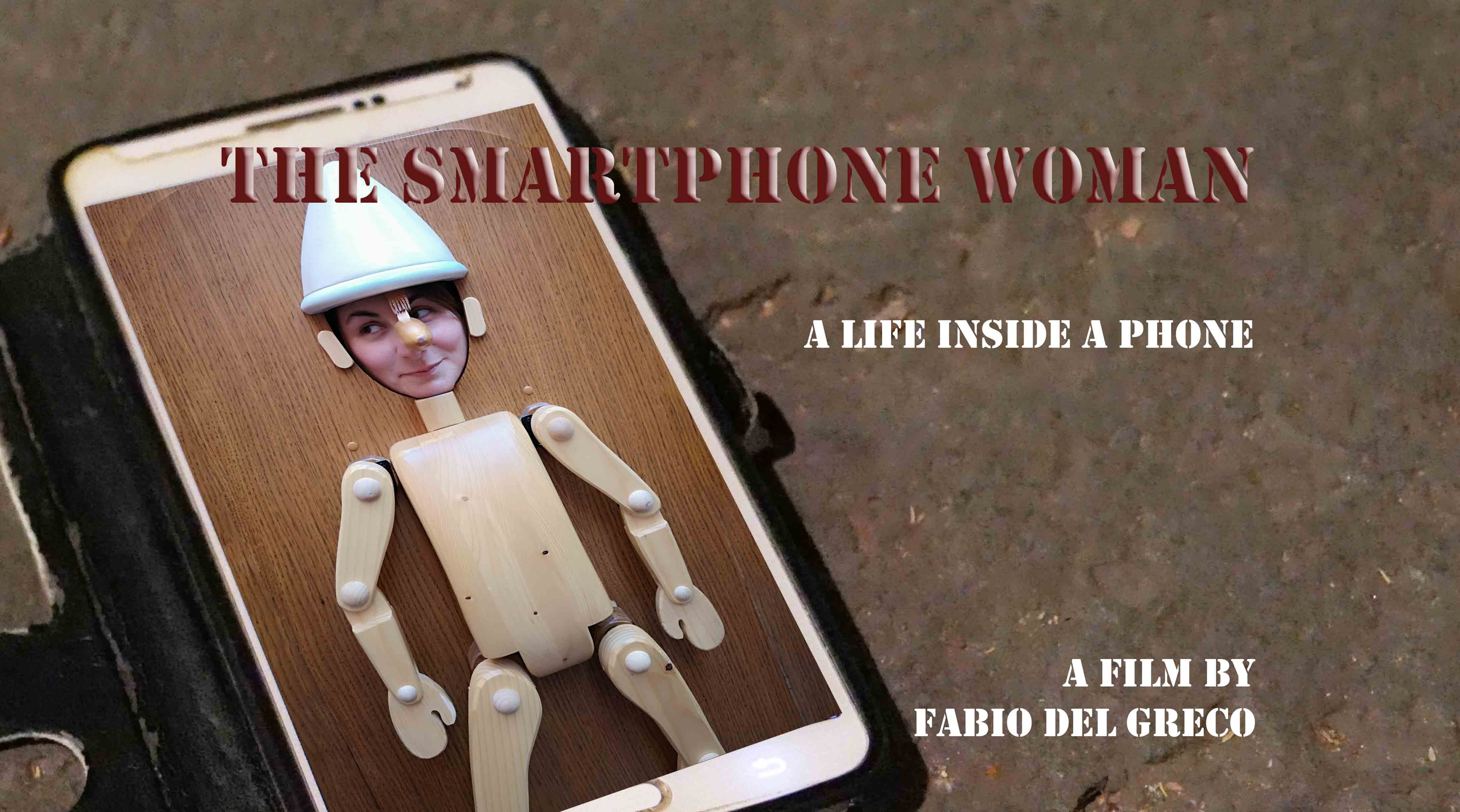
Drama, thriller, dark comedy, by Fabio Del Greco, Italy 2020.
On a bridge over the Tiber River, an elderly and severely ill man has decided to end his life, but an unusual discovery changes his mind: he comes across a lost smartphone. Intrigued, he decides to return home and watch the videos contained within it. On the screen, a series of videos unfold, telling the story of a woman who has emigrated from southern Italy to Rome to work as a teacher in schools and her struggles with integration in a social reality she cannot fully grasp.
"The Smartphone Woman" is a realistic tale of a woman's life and her complex relationship with an "infernal" city. It portrays the challenges she faces, her connection to her origins, the social discomfort she discovers in the outskirts, and the eerie presence of the ghosts of ancient Roman empire. Fabio Del Greco employs a fragmented style, using pieces of "real life" shot with the smartphone, to construct a narrative that ambiguously oscillates between fiction and truth. This creates a captivating exploration of the discomfort and alienation within the bustling city, contrasting with the peaceful village life from which the protagonist hails. The film is constructed with a variety of heterogeneous characters and situations, an emotional kaleidoscope, weaving between evenings of exploration in the Eternal City and daily struggles. Realistic smartphone-shot videos are alternated with a narrative thread reminiscent of film noir and, ultimately, surrealism in the finale. On screen, a succession of grotesque characters unfolds, representing the director's vision of a tumultuous humanity. The film's potency lies in the emotion it manages to convey and in the protagonist's naive perspective. "The Smartphone Woman" is a must-see for enthusiasts of independent and experimental cinema.
LANGUAGE: italian
SUBTITLES: English, French, German, Portuguese, Spanish
A Physician, a Painter, a Prisoner of the South
You already know the type. You have met him at a dinner party, or in a waiting room, or in the middle of an argument about something that matters — the person who refuses to be just one thing. The doctor who paints on weekends is a cliché, yes, but Carlo Levi was not a cliché. He was born in Turin in 1902 into a Jewish bourgeois family that breathed culture the way other families breathe air, and what the city gave him was not a single vocation but a method: look closely, then look again, then find the hidden structure beneath what the eye first accepts.
He studied medicine at the University of Turin and graduated in 1924, the same year Mussolini consolidated his grip on Italian political life with a violence that was still being dressed up as order. Levi practiced briefly, but the encounter with the body — its systems, its failures, its stubborn insistence on surviving — never left his thinking. It inflected everything: the way he would later describe peasant faces as landscapes, the way he understood suffering not as metaphor but as a diagnosable condition produced by specific historical causes. At the same time, he was painting. He had been forming himself in the orbit of the Sei di Torino, a group of painters working against the official aesthetic of the regime, drawing instead from the French post-impressionist tradition, from Cézanne’s structural color, from a vision of the human figure that refused heroic distortion. His canvases from the late 1920s and early 1930s are dense, unsentimentalized, almost clinical in their attention to presence — portraits that do not flatter, landscapes that do not console.
What made Levi dangerous to the regime was not primarily his art. It was his political clarity. He was a founding member of Giustizia e Libertà, the anti-fascist movement organized in Paris in 1929 by Carlo Rosselli — a movement that understood fascism not as a temporary aberration but as the logical product of liberal Italy’s failures, of a ruling class that had chosen order over justice so many times that it had finally produced a system in which order and injustice were the same thing. Levi was arrested for the first time in 1934, released, arrested again, and in 1935 sentenced to internal exile, or confino, the regime’s preferred method for dealing with intellectuals it could not simply ignore. He was sent to Lucania — the region now called Basilicata — to a village called Aliano, in terrain so remote and so stripped of the modern Italian state’s presence that it might as well have been another century.
This is the mechanism that the regime did not fully calculate. Confinement was meant to silence, to isolate, to bury a man in irrelevance. Instead, it placed a trained physician and a practicing painter inside a world that had never been properly seen by anyone with the tools to record it. The peasants of Aliano lived under a sky that Rome had never claimed, under a cosmology that predated the unified Italian state by millennia, and they were dying — of malaria, of poverty, of a structural abandonment so total it had taken on the quality of a natural fact. Levi treated them as their doctor, painted them as their portraitist, and began, slowly, to understand that what he was witnessing was not backwardness but a different, older civilization that the modern Italian state had chosen not to see because seeing it would have required admitting the depth of its own failure.
Antonio Gramsci, writing from his own imprisonment in those same years, had diagnosed the Southern Question as a constructed ignorance — the North’s deliberate mythologization of the South as primitive, as pre-political, as incapable of history. Levi arrived in Lucania having read none of what would become the Prison Notebooks, because they did not yet exist in published form. He arrived, instead, with his eyes open and his hands trained to render what they found.

Christ Stopped at Eboli and the Geography of Abandonment
You have probably never thought of yourself as someone who exists outside of history. You wake up, you check the news, you participate in the daily metabolism of dates and events and consequences — the feeling of being inside time, carried by it, accountable to it, is so continuous that it functions like gravity, invisible and total. Carlo Levi arrived in Lucania in 1935 as a political exile, banished by the Fascist regime to a village called Aliano, and what he found there was something that permanently fractured his understanding of what history actually is and who it belongs to.
The book he wrote from that experience, published in 1945, opens with a sentence that functions less like a literary device and more like a geological fact: “Christ stopped at Eboli.” Eboli is a town in Campania, just north of the region. What Levi meant — what the peasants themselves had told him, in their own words, with no bitterness and no self-pity, simply as description — was that Christianity, Roman civilization, the state, progress, and history had all traveled as far as that point and then turned back. Everything south of it had been left outside the jurisdiction of the human. “We’re not Christians,” they told him, using the word the way it was used in that world, meaning not the baptized versus the unbaptized but simply the people who count versus the people who do not. They said it about themselves.
Levi was a physician and a painter before he became a writer, and this is not a biographical footnote — it is the structural key to how he reads a landscape. He approached Lucania with the diagnostic patience of a doctor and the visual precision of a painter, and what he diagnosed was not poverty in the economic sense, not underdevelopment in the measurable sense, but something far more radical: a civilizational exclusion so old and so total that it had become internalized as metaphysics. The peasants did not feel abandoned by modernity. They did not experience themselves as waiting for it. They simply lived in a temporal order that modernity had never entered, organized around the earth, around the seasons, around a pantheistic relationship to nature that preceded and ignored every institutional structure the Italian state had ever erected. Antonio Gramsci, writing from a Fascist prison cell during roughly the same years, had been trying to theorize exactly this — the Southern Question, the way the Italian ruling class had constructed the Mezzogiorno as an internal colony, a reservoir of cheap labor and political inertia, its people dismissed as primitive, barbaric, incapable of historical agency. What Levi added to Gramsci’s structural analysis was something Gramsci’s prison walls prevented him from providing: proximity, phenomenology, the face of the thing.
The theoretical weight of the title functions like a theorem. If Christ stopped at Eboli, then the entire civilizational apparatus that traveled in his wake — Roman law, Enlightenment rationality, liberal statehood, capitalist modernity — also stopped there. The state was not experienced in Lucania as governance or protection. It arrived as conscription, as taxation, as malaria left untreated, as land reforms promised and never delivered, as the slow hemorrhage of emigration that drained the villages of every generation that might have transformed them. Between 1876 and 1915, more than five million people left southern Italy for the Americas. Five million people voting with their bodies against a civilization that had never voted for them.
What Levi understood — and what makes the book still feel like a wound rather than a document — is that abandonment does not look like absence. It looks like presence without recognition. The state was there. The church was there. The roads existed. But none of it had made contact with the actual lives of the people, in the way that a hand extended toward someone and then withdrawn at the last moment is not generosity. It is a more precise form of cruelty.
The Peasant as Philosophical Category
There is a moment in the life of an exiled man, confined to a village in the deep south of Italy, when he stops trying to understand the peasants around him through the categories he brought with him and begins, instead, to be unsettled by them. Carlo Levi arrived in Aliano in 1935 carrying the full weight of a Turin education — medicine, painting, antifascist politics, the implicit assumption that history moves forward and that human beings, whatever their circumstances, are fundamentally individual subjects navigating that forward movement. What he found instead were people for whom none of those assumptions held. Not because they were backward, not because civilization had not yet reached them, but because they operated from within a completely different structure of being — one that did not merely predate the Enlightenment but actively contradicted it at every pressure point.
The peasants of Lucania in Christ Stopped at Eboli, published in 1945, do not experience time as a line. They experience it as a loop, or more precisely as a depth — a vertical relationship with recurrence rather than a horizontal relationship with progress. The agricultural calendar was not a background condition of their lives but its fundamental grammar. Planting and dying and the return of rain were not metaphors for anything; they were the actual structure of reality. When Levi writes that for these people “Christ stopped at Eboli,” he is not making a complaint about abandonment, though abandonment is real and documented. He is identifying an ontological border. The Christian individual, the rational subject, the citizen with rights and a future — these things stopped somewhere north of them. What persisted was older, denser, harder to name.
The animism Levi observed was not superstition in the sense that the word implies a failed attempt at rationality. It was a coherent relationship with matter, with illness, with the dead, and with forces that do not resolve into human will. The women who practiced folk medicine, the rituals performed at the edge of fields, the understanding that certain plants and certain silences carried agency — these were not remnants of ignorance awaiting correction. They were the expression of a world in which the individual had never been separated from the environment the way Descartes separated it in 1637, the way the Kantian subject separated it in the Critique of Pure Reason in 1781. The pre-individual is not the sub-individual. It is a different answer to a question that Western philosophy decided, at a specific historical moment, to answer only one way.
This is where Levi becomes genuinely disruptive, not merely moving. Giambattista Vico had already argued in the Scienza Nuova of 1725 that human history contains fundamentally different modes of consciousness — the poetic, the mythical, the rational — and that modernity’s error was to treat only the last as real. Ernesto de Martino, who spent years doing fieldwork in the same southern regions Levi described, would later argue in La Terra del Rimorso in 1961 that what Western observers called magical thinking was in fact a sophisticated crisis-management system — a way of containing the terror of losing one’s presence in the world. What Levi had intuited through direct contact, de Martino would theorize with the precision of ethnography: the peasant relationship to existence was not a deficit but a form.
The reader who encounters this argument today and feels nothing more than intellectual interest is the one who should pause. Because the Enlightenment assumption that Levi’s peasants destabilize is not a historical relic. It is the operating system running silently beneath the way you organize your days, defend your choices, and believe, without having decided to believe it, that your life is a project moving toward something — that you are, above all, an individual subject with a legible future. Levi did not write a book about southern Italy. He wrote a book about what you have not questioned yet, and what the questioning might cost.
Paint What the Empire Ignores

There is a moment when you stand in front of one of his painted faces and feel the uncomfortable sensation that the subject is studying you rather than the other way around. The eyes in Levi’s portraits do not ask for your sympathy. They do not perform suffering for the sake of your conscience. They simply look back, with a gravity that precedes your arrival in the room and will outlast your departure from it. This is not a small thing to accomplish with pigment and canvas, and it is not an accident. It is the result of a man who had understood, long before he picked up a brush in the Lucanian dust, that visibility itself is a political act.
Levi had been painting since the 1920s, trained alongside the Turin group that included figures like Felice Casorati, and he exhibited regularly through the years when Italian modernism was negotiating its uneasy coexistence with Fascist cultural policy. But the paintings he produced during and after his confinement in Aliano between 1935 and 1936 belong to a different category entirely. They are not the work of a politically engaged intellectual visiting poverty from a safe aesthetic distance. They are the record of someone who cooked, ate, practiced medicine without a license, buried the dead, and listened to the same silences that the peasants listened to, and then went home and tried to put a face to what he had witnessed. The difference between those two positions, the observer and the participant, is the entire difference in what the canvases communicate.
What centralized power requires, to function without interruption, is that certain populations remain abstract. Rome, in 1936, did not need the individual faces of Gagliano’s inhabitants. It needed a demographic, a territory, a labor source, a statistic in a colonial calculus that stretched from the Mezzogiorno to Africa. The visual logic of empire is always the same: the administered must remain a category, never a person. Levi’s portraits attacked this logic at its foundation. He painted Giulia Venere, the woman who kept his house and who appears in his prose as a figure of almost mythological complexity, with the same seriousness he would have brought to a bourgeois commission in Turin. He gave the same weight to the wrinkles, the posture, the expression, as any portraitist would give to a subject who was considered historically worthy of being remembered. This is the act the paintings perform: they insist on historical worthiness for people the state had structurally erased.
His use of color reinforces this. The palette is not picturesque. He does not romanticize the landscape into the warm, amber-soaked tones that northern European painters used when they depicted the south, turning poverty into scenery. His Lucania is ochre and gray and a specific shade of dusty green that reads less as beauty and more as geological fact. The land does not comfort the figures who inhabit it, and the figures do not decorate the land. They coexist in a relationship that is both ancient and indifferent to aesthetic pleasure, and Levi paints that relationship without softening either term. Antonio Gramsci, writing from prison in the same years, had analyzed the Southern Question as a structural problem of Italian capitalism, a deliberate underdevelopment maintained to serve northern industrial interests. Levi’s canvases arrive at the same conclusion through the language of form and pigment rather than dialectical materialism. The two men never met to compare notes, but they were diagnosing the same body.
The refusal of aesthetic distance is, in the end, what makes the paintings disturbing rather than merely moving. Moving art keeps you at the correct remove. It allows you to feel, and then to leave. Disturbing art implicates you in what you have seen. It follows you out of the room, not because it is violent or grotesque, but because it has made a claim on your recognition that you cannot easily discharge by feeling bad for a moment and then continuing your day. Levi’s subjects look back at you because he insisted, with every technical decision he made, that they had the right to.
A vision curated by a filmmaker, not an algorithm
In this video I explain our vision
The Words That Made Rome Uncomfortable
There is a particular kind of discomfort that a book produces not when it is wrong, but when it is too precisely right about something no one in power wants named. When Christ Stopped at Eboli appeared in 1945, the Italian political establishment received it with the cautious enthusiasm one reserves for a gift that secretly embarrasses the recipient. The left celebrated Levi as a martyr of antifascism, a physician-painter-writer who had suffered exile under Mussolini and returned with evidence of the regime’s brutality. The right resented the portrait of a southern peasantry living outside the reach of the state and the nation. Both readings were, in their own way, an act of self-defense.
The Italian Communist Party, which in the postwar years fashioned itself as the natural home of the oppressed south, had a specific problem with Levi’s book that it never quite resolved publicly. Antonio Gramsci, who had died in 1937 after years in fascist prisons, had spent considerable intellectual energy on the Southern Question, arguing in his Prison Notebooks that the peasant masses of the Mezzogiorno were a revolutionary force requiring organization and political consciousness. Levi’s peasants were not waiting to be organized. They existed in a dimension that preceded and perhaps survived politics altogether. When Levi wrote that the peasants of Aliano lived in a world of magic, of ancient spirits, of a relationship to death and the earth that had nothing to do with Rome or Turin or any capital city’s ideological project, he was not romanticizing poverty. He was reporting it. And that report made the Gramscian framework look, at minimum, incomplete. A party that needed the south as a symbol of injustice to be corrected found in Levi’s testimony a south that might not consent to being corrected on anyone else’s terms.
The nationalist mythologies of the right faced a different wound. The idea of a unified Italy, which had been sold to the world since the Risorgimento of the 1860s as the triumphant consolidation of a single people, collapsed against Levi’s pages. The peasants he described did not consider themselves Italian in any meaningful sense. The state was a distant, extractive force that took their sons for wars they did not understand and their grain for taxes they could not afford. When Levi documented this not as anomaly but as structure, he implicitly indicted not just fascism but the entire architecture of Italian unification, going back ninety years. That was not a comfortable claim in 1945, when Italy needed a usable past and a coherent national identity to rebuild itself around. Levi offered neither.
What happened next followed the predictable logic of cultural digestion. The book was praised, taught, canonized, and gradually defused. By the time it entered school curricula, it had been safely reclassified as a humanist document, a testament to the dignity of the poor, a moving personal memoir. The edges that had made Rome uncomfortable were sanded down through repetition. This is the fate that Roberto De Martino, the ethnologist who worked in the same southern territories in the 1950s and whose Sud e Magia appeared in 1959, understood with clinical clarity: the dominant culture absorbs the subaltern account by aestheticizing it, turning its political charge into pathos. A peasant’s relationship to the evil eye becomes folklore. A region’s structural abandonment becomes a literary atmosphere.
Levi himself watched this happen. He continued writing, continued painting, continued his political work as a senator in the years before his death in 1975, but there is in his later essays a quality of someone speaking into a room that has learned, very efficiently, how to listen without hearing. The discomfort his work produced never disappeared. It simply migrated, intact, into the present, where the southern question remains statistically legible in every unemployment report, every emigration wave, every infrastructure gap between Naples and Milan, waiting for a political language precise enough to hold it.
The Future Is Always Someone Else’s Promise
There is a particular kind of speech that politicians give in places they only visit during election years. You have heard it, or something close to it. The microphone crackles, the crowd is thin but present, and the words arrive in the future tense — roads that will be built, hospitals that will open, young people who will no longer need to leave. The verb “will” does all the work, carrying within it both a promise and its own secret negation, because the future tense asks nothing of the present speaker. Carlo Levi understood this grammar before most political theorists had a name for it. He watched it operate in the villages of Lucania in 1935 and 1936, and what he saw was not backwardness or underdevelopment in any neutral sense — it was a system that required abandonment to function, and required the language of rescue to disguise that requirement.
The mechanism Levi identified in Christ Stopped at Eboli, published in 1945, was structural, not accidental. The peasants of Gagliano were not forgotten by the Italian state — they were known, counted, taxed, conscripted, and then left to the malaria and the dust. The state’s presence was extractive and its absence was managed. This is the distinction that makes Levi’s observation still unbearable to sit with: the south was not a blind spot in the national vision but a deliberate peripheral position, assigned and maintained. Antonio Gramsci, writing from prison in roughly the same years, described the Southern Question as a colonial relationship internal to the nation itself, a metropolis feeding on a territory it publicly mourned. The mourning was part of the system. The grief performed by Rome over Calabrian poverty was the same gesture as the future-tense speech at the crumbling piazza — it produced sympathy without producing change, and sympathy without change is a form of sedation.
What makes this logic so durable is that it does not require conspiracy. It requires only that the institutions which allocate infrastructure, credit, education, and medical resources continue to operate according to existing gradients of power, while officials continue to speak of those gradients as temporary and correctable. The sociologist Robert Merton, writing in 1949 in Social Theory and Social Structure, gave this dynamic a formal structure: when institutions persistently fail to deliver the cultural goals they publicly endorse, the populations they fail develop what he called retreatism or rebellion, but the institutions themselves rarely examine their own role in producing that failure. They name the symptom — emigration, poverty, civic disengagement — and then propose programs to address it, programs whose funding is always provisional and whose timelines always extend beyond the next political cycle.
This is not a southern Italian problem from the mid-twentieth century. It is the operating logic of every peripheral community that has been told its turn is coming. It is visible in the deindustrialized towns of northern England where the promises of regeneration have been renewed across four decades without the factories returning. It is visible in the rural counties of the American Midwest where hospital closures accelerate while campaign advertisements speak of revitalization. It is visible in the banlieues outside Paris, in the peripheries of Buenos Aires, in the mining regions of South Africa’s Northern Cape — wherever a state has decided, through the allocation of its real resources rather than its rhetorical ones, that certain populations are not the future it is building toward, but the cost it is managing.
Levi was not a systems theorist. He was a painter and a doctor who wrote from inside a specific exile, in a specific ravine, under a specific olive tree. But the particular has a way of becoming unbearably general when the writer is precise enough, and Levi was precise. He did not write about poverty as a condition. He wrote about the experience of being placed outside history by a power that continued to speak your name while facing permanently away from you — and in that precision, he described something that millions of people today would recognize not as metaphor but as the texture of their Tuesday morning.
The Face You Were Never Supposed to See
There is a particular kind of terror in being drawn. Not photographed, not documented, not filed — drawn. Someone has chosen to sit still long enough to look at you, to trace the specific weight of your jaw, the way exhaustion has resettled itself around your eyes, the particular angle at which a life of stone floors and bad harvests has bent your spine. Carlo Levi did this in the Basilicata, in Grassano and Aliano, between 1935 and 1936, with brushes and pigment he had to acquire through permission and patience. The peasants who sat for him had never been looked at this way. They had been counted, taxed, conscripted, and occasionally pitied. But they had not been seen.
This is a distinction that most political philosophy refuses to make precise, because the moment you make it precise, an enormous amount of social machinery becomes indefensible. To be counted is to be reducible. To be seen is to be specific, resistant to reduction, expensive in ways that bureaucracies cannot afford. Simone Weil, writing in 1943 in what would become The Need for Roots, argued that the most fundamental of human needs is the need to be recognized as a person — not as a category, not as a problem, but as an irreplaceable node in a web of obligations and attention. What Levi did with his brushes was precisely this, and he did it as an exile, as someone who had been stripped of his institutional legitimacy, which paradoxically was the only thing that made it possible. He had no agenda. He was not there to improve anyone. He was there because he had been sent away, and in that enforced idleness, he discovered that paying attention was itself an act.
The faces he painted are not beautiful in the way that humanitarian portraiture tends to manufacture beauty — that soft-focus dignity designed to make the viewer feel generous rather than implicated. They are specific. An old woman in black with hands that look like they belong to a different century. A man who seems to be waiting for something he has long stopped expecting to arrive. A child whose expression carries a seriousness that childhood in the industrialized north would not produce for another decade, if ever. Levi painted approximately one hundred works during his confinement, and when Christ Stopped at Eboli was published in 1945, those visual images translated into prose with the same refusal of sentimentality. The book sold across Europe. The faces multiplied. And still the south remained, in Italian political discourse, the question no one wanted to answer honestly.
Antonio Gramsci had already understood, from his own prison cell between 1929 and 1935, that the southern peasantry constituted what he called a subaltern class — not simply poor, but structurally prevented from representing themselves, dependent on intellectuals who either patronized them or ignored them. Levi, who knew Gramsci’s trajectory if not yet his unpublished notebooks, arrived at something adjacent from a different direction: not through theory but through proximity, through sharing water shortages and malarial summers and the particular silence of people who have learned that speech directed at power costs more than it returns.
What it costs to be seen is something the peasants of Aliano understood better than Levi did when he arrived. To be visible is to be targetable. To be named is to be summoned. The history of the south is partly a history of the consequences of visibility — of land registries that arrived with new taxes, of census officials who were followed by draft notices, of priests and doctors who reported to prefects. Invisibility had been, for generations, a form of protection. And then a man arrived with paints and a notebook and the strange assumption that their faces were worth the trouble of being accurately recorded, and something shifted in that exchange that neither the Italian state nor the postwar literary establishment ever quite knew what to do with, because it could not be administered, only witnessed.
🌿 Voices from the Margins: Italy’s Intellectual Rebels
Carlo Levi occupies a singular place in Italian intellectual history: painter, writer, and political exile, he transformed his forced confinement in southern Italy into one of the most powerful testimonies of the twentieth century. The articles below explore figures and currents that share with Levi a commitment to the periphery, the oppressed, and the imagination as a form of resistance.
Antonio Gramsci: vita e pensiero politico
Antonio Gramsci, like Carlo Levi, was imprisoned by the fascist regime and used that forced isolation to produce some of the most original political thought of the century. His concept of cultural hegemony and the role of the ‘organic intellectual’ resonates deeply with Levi’s own mission to give voice to the silent peasants of Lucania. Reading Gramsci alongside Levi reveals a shared belief that the margins of Italy hold truths that the center refuses to see.
GO TO THE SELECTION: Antonio Gramsci: vita e pensiero politico
Sardinian Culture: History Traditions and Identity
The culture of Sardinia, with its ancient traditions, linguistic distinctiveness, and history of marginalization, offers a vital parallel to the southern Italian world that Levi documented in Christ Stopped at Eboli. Like the peasants of Lucania, Sardinian communities preserved a way of life largely ignored by the modern Italian state, existing outside the boundaries of official history. Exploring Sardinian identity helps illuminate the broader southern question that haunted Levi throughout his life.
GO TO THE SELECTION: Sardinian Culture: History Traditions and Identity
Grazia Deledda: Life and Works
Grazia Deledda, the Nobel Prize-winning Sardinian novelist, shares with Carlo Levi a profound commitment to portraying rural Italian communities with dignity and unflinching honesty. Her works depict a world governed by archaic customs, collective guilt, and a spiritual relationship with the land that modernity threatens to erase. Like Levi, Deledda turned geographical remoteness into universal literature.
GO TO THE SELECTION: Grazia Deledda: Life and Works
Cesare Pavese and Poetry: Hard Labor
Cesare Pavese, one of Levi’s closest friends and his editor at Einaudi, also grappled with the tension between the intellectual world of Turin and the myth of the rural South. His poetry collection Hard Labor explores themes of solitude, work, and landscape in a language stripped of ornament, echoing Levi’s own painterly and documentary gaze. Together, Levi and Pavese represent a generation of Italian intellectuals who sought redemption in the encounter with a forgotten Italy.
GO TO THE SELECTION: Cesare Pavese and Poetry: Hard Labor
Discover Independent Cinema on Indiecinema
If these voices from the margins of history and literature have stirred something in you, Indiecinema is the place to continue your journey. Our streaming platform curates independent and auteur films that share the same spirit of resistance, curiosity, and human depth you find in Carlo Levi’s work. Explore our catalog and let cinema open new doors to the world’s forgotten stories.
👉 EXPLORE THE CATALOG: Watch Indie Films in Streaming
A vision curated by a filmmaker, not an algorithm
In this video I explain our vision

