
The Senate Floor as Mirror
You are standing at a podium, and the room is not listening — not really. The faces arranged before you carry the practiced neutrality of people who have already decided, who arrived with conclusions tucked into their jacket pockets like folded receipts. You are speaking anyway, because the speaking is the point, because somewhere in the architecture of the occasion there exists an ancient agreement that the words delivered in this room carry weight that words spoken elsewhere do not. You feel it in your chest before you feel it in your mind: the strange gravity of a space that has been designated, by collective human agreement, as a place where language is supposed to matter. And underneath that feeling, barely acknowledged, is the knowledge that the room could turn on you at any moment — not with violence, not necessarily, but with the particular cruelty of formal disregard, the withdrawal of the very gravity you are borrowing.

This is the emotional architecture that Rome built in stone and precedent for roughly five centuries before a man named Marcus Tullius Cicero walked into it in 63 BCE and made it something else entirely. Born in 106 BCE in Arpinum, a small hill town southeast of Rome, Cicero was what the Roman aristocracy called a novus homo — a new man, meaning a man without ancestors who had held high office, meaning a man who had arrived at power carrying nothing but his own ability to speak. This was not a minor disadvantage in a system where bloodline functioned as a kind of preemptive credential, where the consulship had been passed between the same forty or fifty families for generations like a piece of inherited furniture. Cicero did not inherit the room. He had to convince the room, every single time, that he deserved to stand in it.
What he discovered in that process — and this is the thing that makes him permanently uncomfortable to read — is that political freedom and political performance are not merely related. They are structurally identical. The freedom to speak in the Roman Senate was not a condition that existed prior to the speech; it was a claim that had to be enacted and re-enacted continuously, inside the speech itself. This is what classical scholars have underappreciated in focusing so relentlessly on Cicero’s philosophical works like De Re Publica or De Legibus: his most penetrating political thinking happened not in the treatises but in the moment of delivery, in the way he understood the Senate floor as a space where the definition of liberty was being renegotiated with every session. Res publica, for Cicero, was not an abstraction. It was a practice, and a fragile one.
The fragility was not incidental. Rome in the first century BCE was a republic experiencing the particular vertigo of an institution that has outgrown the assumptions it was built on. The machinery designed for a city-state was now operating an empire of roughly fifty million people spread across three continents. The Senate’s authority, technically advisory rather than legislative, depended entirely on a shared willingness to behave as though it were sovereign — a collective performance of legitimacy that required every participant to keep pretending simultaneously. What Cicero grasped, and what gave his speeches their extraordinary nervous energy, is that the moment one person stops pretending, the entire structure becomes visible as a structure, and visibility of that kind is not illuminating — it is destabilizing.
He understood performance not as falseness but as the medium through which genuine political reality gets constituted. This is why the Catilinarian orations, delivered in November and December of 63 BCE against Lucius Sergius Catilina and his alleged conspiracy, are not primarily documents of historical accusation. They are documents of a man using language to hold a room together against the centrifugal force of its own fear, knowing that if the performance fails, the thing the performance was sustaining will cease to exist.
Bruto
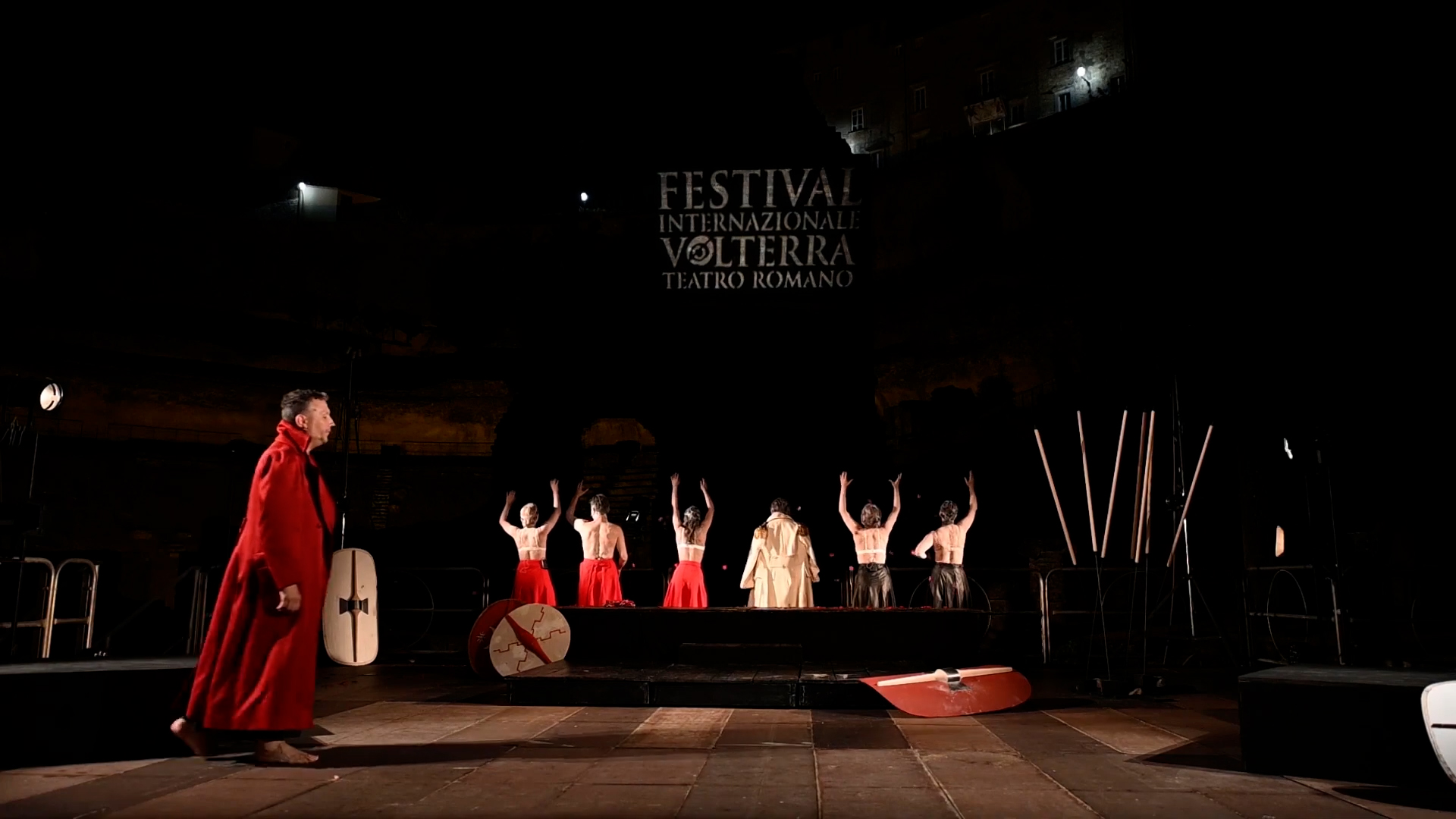
Theatrical show, by Nicola Fano e Simon Domenico Migliorini, Italy, 2022
The protagonist is Brutus, the celebrated instigator, along with Cassius, of the conspiracy of the Ides of March in 44 B.C., the assassin of Caesar. He enters the stage calling loudly for Cassius, his alter ego: we find ourselves in Philippi, where both conspirators have already fought and lost against the troops of Marcus Antonius, who has become the guarantor of justice towards Caesar and Rome. The story written in books materializes on stage with the words of Shakespeare, infinite, immortal, eternal words. The spectator listens, a symbolic battlefield and dead bodies appear before him, on which Brutus, defeated, wounded, almost dying, crawls and invokes and looks around bewildered, shocked at the appearance of the ghost of Caesar.
Brutus is Simone Migliorini, who speaks, moans, shouts, modulates those phrases of Shakespearean tragedy and makes them his own, as they have been generated, also in the adaptation from Shakespeare's "Julius Caesar" by the playwright Nicola Fano, who worked on the text focusing on the most controversial figure, that of the leader of the conspirators, the assassin of Caesar, specifically for Migliorini, who has studied and deepened the text and characters. But here Brutus, as the show unfolds, also becomes Macbeth, also Henry V, both tyrants, both assassins, soldiers, courageous or cowardly, great or infamous, in a flow of words and famous phrases, spoken, planted, recited, whispered, shouted by Simone Migliorini who with this performance confirms himself as a high-level interpreter. What strikes is the protagonist's ability to transform himself, from time to time, from Brutus into other characters, even into Marcus Antonius. A change of costume is enough for him, on stage. And it is here that Brutus looks into Antony's eyes and Antony scrutinizes Brutus, doubled by the same actor in a virtuosity that is extremely congenial to him. The actor is capable of being, at the same time, the one who kills and the one who exalts the killed; the one who is prey to doubts and remorse but is proud of his love for Rome and its freedom, and the one who exalts and celebrates the slain Caesar before the people, holding his will in his hand, in the famous Oration that has always been the flagship of the greatest actors.
LANGUAGE: Italian
SUBTITLES: English, Spanish, French, German, Portuguese
Cicero's Rome and the Mechanics of Republican Liberty
You are sitting in a room where everyone else belongs and you do not, and you know it the moment you walk through the door — not because anyone tells you, but because the room itself was built without you in mind. Marcus Tullius Cicero walked into that room in 106 BCE, born in Arpinum, a small hill town southeast of Rome, to a family of equestrian rank with no senatorial blood and no ancestral masks to hang in the atrium. The masks mattered enormously. Roman aristocratic families displayed the wax death portraits of their distinguished ancestors in the entrance halls of their homes, a practice that announced lineage as political currency, and Cicero had none of it. He was what the Romans called a novus homo — a new man — a category that functioned less as a neutral description and more as a permanent asterisk attached to every achievement he would ever produce.
What made his ascent possible was not the dismantling of that system but his extraordinary willingness to master it completely. He moved through the cursus honorum — the sequential ladder of Roman public offices — with a precision that bordered on obsession: quaestor in 75 BCE, aedile, praetor, and then consul in 63 BCE, reaching the highest elected office in the Republic at the earliest age the law permitted. But to understand what that ascent actually meant requires stripping away the democratic vocabulary that modern observers reflexively apply to it. The Roman res publica was not a democracy in any sense that would satisfy contemporary political theory. It was a formalized competition among overlapping aristocratic networks, where the Senate — composed of men who had held magistracies and therefore largely reproduced themselves — exercised preponderant authority over foreign policy, provincial governance, and public finance, while the popular assemblies, the comitia, operated under structural conditions that weighted votes by property class, meaning that the wealthiest citizens voted first and the outcome was frequently decided before the poorest centuries were ever called.
Polybius, the Greek historian writing in Rome around 150 BCE, described the Republic’s constitution as a mixed government balancing monarchical, aristocratic, and democratic elements in the consuls, Senate, and assemblies respectively, and he admired this balance as the secret of Roman stability. What he was actually describing, with more accuracy than he perhaps intended, was a system designed to prevent any single faction from monopolizing power while ensuring that power itself never drifted too far from the men who held land, commanded armies, and controlled credit. The tension was real, but it was a managed tension — a controlled pressure valve that released just enough popular energy to sustain legitimacy without ever threatening the fundamental distribution of authority.
Cicero understood this architecture with the lucidity of an outsider who had been forced to study what insiders could afford to take for granted. His treatise De Re Publica, composed around 54 BCE and partially recovered from a palimpsest in the Vatican in 1820 by the scholar Angelo Mai, articulates a vision of the Republic as a community defined by shared law and common interest — res publica as res populi, the thing of the people. But the philosophical elegance of that definition coexisted, without apparent discomfort, with his practical commitment to senatorial supremacy and his deep suspicion of what he called the populares, the politicians who mobilized mass sentiment as a lever against aristocratic prerogative. He was not being hypocritical in any simple sense. He was being Roman, which meant inhabiting a political culture where the language of collective freedom and the practice of elite gatekeeping were not experienced as contradictions but as two faces of the same civic order — an order he had fought so hard and so precisely to enter that questioning its premises would have required him to question the meaning of his own life.

Libertas as Contested Property
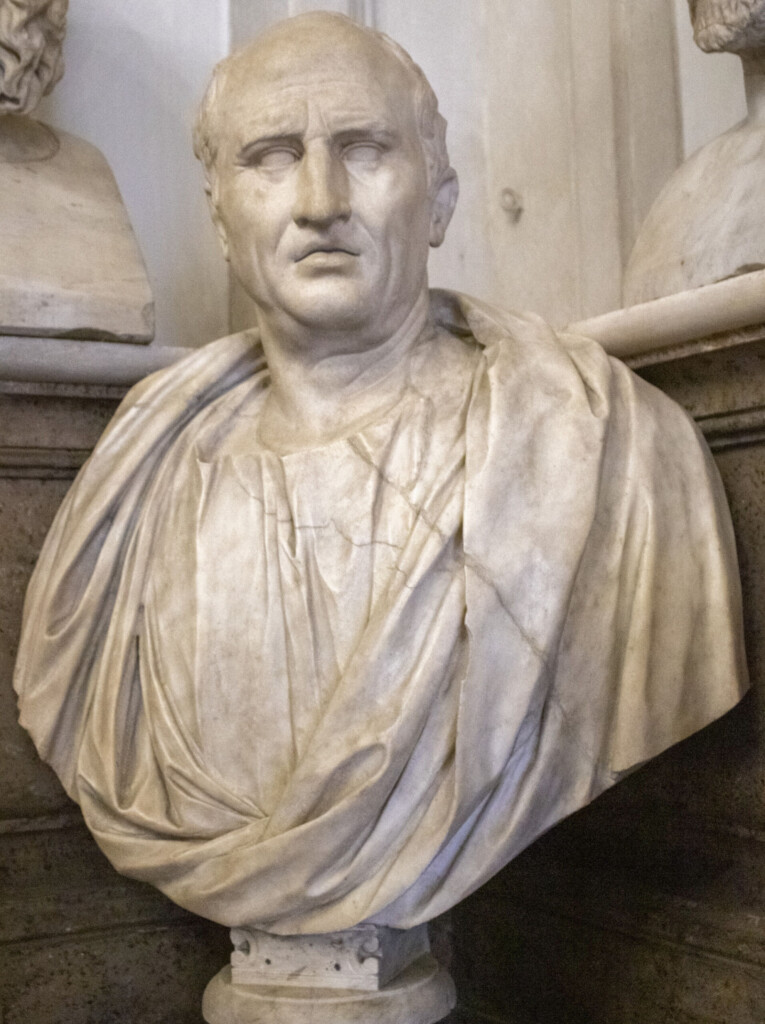
You are told, from the earliest age you can remember absorbing political language, that freedom is the condition from which everything else follows — the ground floor, the baseline, the thing that precedes law rather than being produced by it. This is the founding myth of Western political self-understanding, and Cicero helped engineer it so precisely that we have never fully escaped the blueprint.
In De Re Publica, composed between 54 and 51 BCE during one of the most turbulent decades of the late Republic, Cicero constructs a theory of the res publica not as a neutral arrangement of citizens but as an organism whose health depends on the correct distribution of authority across unequal parts. The mixed constitution he admires — drawn partly from Polybius but made distinctly Roman — is not designed to give everyone an equal share of liberty. It is designed to give each social stratum the precise quantity of liberty appropriate to its function. The Senate deliberates, the magistrates command, the assemblies consent, and the whole structure holds not because freedom is shared but because its unequal distribution is rendered invisible by its apparent regularity.
Libertas in Republican Rome was a legal status before it was anything else. To be liber was to be not a slave, but the distance between that formal negative definition and any substantive political power was vast and traversed by countless gradations of rank, wealth, ancestry, and patronage. The freed slave technically possessed libertas but remained bound by ties of obligation to a former master that Roman law formalized under the term obsequium — a word that means deference, compliance, a body still oriented toward another will. Cicero knew this architecture intimately. His own ascent from Arpinum, from the equestrian order, through the cursus honorum to the consulship of 63 BCE, was not a story of freedom expanding to include him. It was a story of his learning, with exceptional precision, exactly which hierarchies to navigate and which ones to perform loyalty toward.
What makes De Re Publica philosophically dangerous rather than merely conservative is that Cicero does not defend hierarchy as an unfortunate necessity. He defends it as the condition of liberty’s survival. In Book I, through the voice of Scipio Aemilianus, he argues that a commonwealth without gradation collapses into what he calls licentia — the undifferentiated appetite of the crowd mistaking its impulses for rights. The argument is seductive precisely because it contains a genuine observation: unstructured power does tend to consume itself. But the seduction lies in what the argument quietly accomplishes, which is the transformation of social inequality into a philosophical prerequisite for freedom itself. Once that move is made, any challenge to hierarchy can be reframed as a threat to the liberty it supposedly protects.
This paradox did not stay in Rome. It migrated through Augustine, through Aquinas, and arrived with remarkable structural fidelity in the political theory of the seventeenth and eighteenth centuries, where thinkers designing republics for new nations were working, consciously or not, from the same load-bearing assumption: that ordered liberty requires a class of people whose role is to order it. When Edmund Burke in 1790 defended the inherited structures of English society against revolutionary dissolution, he was not inventing a position. He was quoting Cicero in the language of his own moment.
The founding paradox that Cicero crystallized is not that free societies contain unfreedom — every society does that with varying degrees of honesty. The paradox is that the philosophical vocabulary used to name and defend freedom was constructed from the beginning to make certain forms of unfreedom definitionally invisible. A slave owner in Virginia in 1787 could read Cicero on liberty and feel not the friction of contradiction but the comfort of recognition.
Eloquence as Political Weapon and Personal Trap
You are standing at the edge of a crowd in the Roman Forum, and the man speaking has not raised his voice once. He does not need to. The silence that falls over several thousand people is itself a kind of violence, the violence of being made to feel, against your will, that this stranger understands your grievance better than you do.
Cicero understood something that most political theorists have spent centuries struggling to articulate: that the difference between the man who commands and the man who persuades is not a moral distinction but a structural one. In De Oratore, composed in 55 BCE during a period of enforced withdrawal from public life, he constructed a portrait of the ideal Roman citizen that was inseparable from the act of speaking well. The work is framed as a dialogue, which is itself a rhetorical performance, and its central figure, Crassus, argues that genuine eloquence is not a technical skill but a form of civic philosophy — a synthesis of legal knowledge, ethical formation, and psychological acuity deployed in service of the republic. To persuade, in this framework, is to exercise the highest form of freedom available to a Roman: the freedom to shape collective judgment without resorting to force.
What this model concealed was the dependency it created. A man whose authority rests entirely on the quality of his speech is a man whose survival depends on never going silent. Cicero’s political existence was not built on land, or military command, or hereditary prestige — the three foundations that actually governed Roman power in its most material form. It was built on the accumulated effect of public performances, each one required to sustain the credibility of the last. When Quintilian, writing roughly a century after Cicero’s death in his Institutio Oratoria, constructed his twelve-volume theory of rhetorical education, he placed Cicero at the apex of the entire tradition — not as a historical figure but as a living standard, a benchmark against which every subsequent attempt at public speech would be measured and found wanting. This elevation was also a kind of fossilization.
The trap embedded in Cicero’s own ideal was one he could not have seen from inside it, because it was the ideal itself that generated the trap. De Oratore insists that the orator must be a good man — the phrase vir bonus dicendi peritus, a good man skilled in speaking, recurs throughout Roman rhetorical theory like a moral guarantee. But the political world in which Cicero actually operated made no such guarantee. The Senate that applauded the Catilinarian orations in 63 BCE did not applaud his moral courage; it applauded a performance that resolved its own fear. When Pompey and Caesar and Crassus reorganized Roman power through the First Triumvirate the following year, Cicero’s eloquence could not touch them, because they had removed themselves from the arena where eloquence counted. His words had no purchase on men who had decided that persuasion was for those who lacked legions.
There is a particular cruelty in the situation of a man who has built his entire identity around a capacity that his enemies have simply chosen to regard as irrelevant. Cicero’s exile in 58 BCE, engineered by Clodius Pulcher partly in retaliation for the execution of the Catilinarian conspirators, was not a refutation of his arguments — it was a demonstration that the political system had shifted to a register in which arguments no longer governed outcomes. The letters he wrote during that exile, collected in Ad Familiares and Ad Atticum, are among the most psychologically exposed documents to survive from the ancient world, and what they expose is not weakness but the cost of having invested everything in a model of citizenship that required the republic to remain functional in order to redeem its promises.
The Stoic Inheritance and Its Distortion
You are sitting with a book you have read before, certain you understand it, and then a single sentence stops you cold — not because it is new, but because you have been reading it wrong for years. Cicero writes, in the Tusculan Disputations of 45 BCE, that the wise man alone is free, that freedom is not a legal condition but a state of the soul uncorrupted by passion, unshaken by circumstance. The sentence feels generous, even liberating. It is, on closer examination, one of the most consequential acts of philosophical camouflage in Western history.
The Stoics who preceded him — Chrysippus above all, whose encyclopedic systematization of Stoic doctrine in the third century BCE shaped the entire tradition — had developed the concept of inner freedom as a response to the political fragility of the Hellenistic world. When empire swallows republics and the citizen has no meaningful assembly to attend, the philosopher offers a new territory: the self. Epictetus would later name this the dichotomy of control, but the move was already fully operational in Chrysippus: distinguish what is yours from what is not, and locate your freedom entirely in the former. This is not cowardice dressed as wisdom. It is a serious metaphysical claim. But it carries a political consequence that its inheritors rarely declared aloud.
Cicero absorbs this framework selectively and at a precise biographical moment. The Tusculan Disputations were written during his forced retirement from public life under Caesar’s dominance, in a villa at Tusculum where philosophy served as the only form of action still available to him. The timing is not incidental — it is constitutive. A man who had spent thirty years arguing that the res publica was the only arena in which a human being could fully realize virtue now needed a philosophy that made retirement bearable without making it shameful. He found one, but in finding it he bent it. He retained the Stoic vocabulary of inner freedom while quietly detaching it from the Stoic insistence on cosmopolitan duty. What remained was the consolation without the obligation, the dignity of the sage without the demand that the sage act.
The distortion is subtle enough that it survived intact into Augustine, into the medieval contemptus mundi tradition, into every subsequent century that needed philosophical permission to withdraw from collective life while preserving the feeling of moral seriousness. When Hannah Arendt argued in The Human Condition in 1958 that the modern retreat into interiority represented a fundamental impoverishment of political existence, she was diagnosing a wound whose infection began here, in these particular villas, in this particular act of consolatory reading.
What makes the Ciceronian version of Stoic freedom dangerous is not that it is wrong about the soul. It is that it is persuasive enough to foreclose a question before it is asked. If the truly free person is the one who has mastered their inner life regardless of external circumstances, then tyranny becomes a merely external condition — inconvenient, perhaps painful, but philosophically irrelevant to one’s real status as a free being. The slave who has achieved Stoic equanimity is freer than the master driven by appetite. This claim has a genuine philosophical power. It also happens to make political resistance against the master structurally unnecessary.
Cicero knew this tension. In De Re Publica, written only a decade earlier when the republic still appeared salvageable, he had insisted that the interior life of the philosopher was parasitic on the political order that made philosophy possible in the first place — that the sage who retreated from civic life was borrowing tranquility he had not paid for. The Tusculan Cicero never refutes this earlier Cicero.
A vision curated by a filmmaker, not an algorithm
In this video I explain our vision
The Catiline Orations and the Violence Hidden in Legal Order

You are sitting in a chamber where the rules are being followed perfectly, and somehow a man is about to be killed without a trial. The votes are counted, the rhetoric is impeccable, the procedure is observed down to its last comma — and the result is an extrajudicial execution carried out in the name of the very law that prohibits extrajudicial execution. This is not a paradox. It is the architecture.
In 63 BCE, a senator named Lucius Sergius Catilina organized what Cicero, then consul, described as a conspiracy to burn Rome, massacre the Senate, and seize the state. Whether the threat was as catastrophic as Cicero claimed has been debated by historians for two millennia — Sallust wrote his account of it within a generation of the events, and even he registered the ambiguity of Catiline’s motivations, the genuine desperation of Rome’s indebted classes, the convenience of the timing for Cicero’s political legacy. What is not ambiguous is what Cicero did with the Senate’s response. He invoked the senatus consultum ultimum, a constitutional instrument dating to at least 121 BCE when it was used against Gaius Gracchus, which authorized the consuls to take whatever measures necessary to protect the state. Five Roman citizens were strangled in the Tullianum prison without trial, without appeal, without the protections that Roman law explicitly guaranteed to every citizen. Cicero called it salvation. He spent the rest of his life arguing it had been lawful.
The philosophical architecture behind that argument is more revealing than the act itself. Cicero had spent years synthesizing Stoic natural law theory with Roman constitutional practice — his De Re Publica, written around 54 BCE, insists that the true republic is bound together not by walls or armies but by agreement on justice and shared interest in the law. Yet the senatus consultum ultimum is precisely a mechanism for suspending that agreement in the name of preserving it. The law withdraws itself to protect itself. Rights are cancelled to protect rights. The citizen body is told that the temporary disappearance of its legal protections is the highest expression of those protections. Giorgio Agamben spent considerable energy in his 2003 work Stato di Eccezione tracing exactly this structure through two thousand years of Western governance — the state of exception not as a rupture in legal order but as the hidden hinge on which legal order actually turns.
What Cicero gave the Western tradition was not merely an argument but a template. Every liberal democracy that has suspended habeas corpus, authorized detention without charge, or classified torture as enhanced interrogation has reached for the same grammatical structure: the emergency that authorizes the exception, the exception that proves the rule was never absolute, the rule that was never absolute becoming the rule again once the emergency is declared over by the same authority that declared it. The USA PATRIOT Act passed in October 2001 was 342 pages long and was available to most senators for fewer than 48 hours before the vote. The legal language was precise. The procedure was observed. The result was a framework of surveillance and detention that operated for years outside the constitutional protections it claimed to be defending.
What makes Cicero’s case so uncomfortable is not that he was a hypocrite — comfortable distance from hypocrisy is always available to a reader separated by two millennia. What makes it uncomfortable is that he believed himself completely. His four Catilinarian orations, delivered in the Senate and before the people, are not the cynical productions of a man who knows he is dismantling the law while invoking it. They are the work of someone who has genuinely fused legal form with moral necessity so thoroughly that the gap between them has closed — and in that closure, the violence required to maintain legal order becomes invisible to the man performing it most fluently.
Exile, Return, and the Self That Legislation Cannot Protect
You are reading his letters from Thessalonica in 58 BCE, and what you find is not a statesman in temporary retreat but a man who has ceased to exist. The prose unravels. Cicero writes to Atticus in a register that has no precedent in the rest of his correspondence — not philosophical resignation, not strategic patience, but something closer to infantile collapse. He cannot eat. He cannot think. He describes himself as a body without function, which is, for him, not a metaphor but a precise diagnosis.
The exile was engineered by Publius Clodius Pulcher, the tribune who passed the lex Clodia de capite civis Romani in 58 BCE, directly targeting Cicero for the extrajudicial executions of the Catilinarian conspirators in 63 BCE. Legally, the move was brilliant in its cruelty: it used Cicero’s proudest act — the defense of the Republic — as the instrument of his destruction. His property was confiscated, his house on the Palatine demolished, and on its ruins Clodius consecrated a shrine to Libertas, the goddess of freedom. The irony was not accidental. It was a public statement, inscribed in stone and ritual, that the man who called himself the savior of Roman liberty had in fact been its enemy. Whether or not that charge was true matters less than what it did to Cicero’s sense of himself, which depended entirely on the opposite being publicly recognized.
What the Epistulae ad Atticum reveal, across the roughly eighteen months of his absence, is that Cicero had no interior architecture capable of surviving the removal of public validation. He had read Plato. He had lectured on the Stoic indifference to external fortune. He had written, with apparent conviction, about the rational soul’s capacity for autarky. None of it held. The letters show a man who had constructed his entire self-conception on the theater of civic recognition — the consulship, the applause in the Forum, the legal victories, the phrase he used obsessively and embarrassingly in his own speeches, “the consensus of all good men.” Strip away the audience and there was no performance, and strip away the performance and there was, apparently, no Cicero.
Georg Wilhelm Friedrich Hegel, writing in the Phenomenology of Spirit in 1807, described consciousness as fundamentally relational — the self constituted not from within but through recognition by another. What Cicero’s breakdown in Thessalonica dramatizes, nearly two millennia earlier, is precisely this structure exposed in extremis. His freedom, such as it was, had never been an internal condition. It was a social contract, renewed daily by the presence of crowds, by the weight of the toga, by the acoustics of a courtroom. When those were taken, the freedom simply was not there to fall back on, because it had never been stored anywhere.
The Senate voted for his recall in 57 BCE, and he returned to Rome to an ovation he described in terms indistinguishable from ecstasy. The letters from the return period are almost unreadable in a different way — not because of despair but because of the sheer velocity of self-reconstruction, the speed with which the collapse is papered over and the public mask reassembled. He does not process what happened to him. He buries it under fresh performances. His speech Post Reditum in Senatu opens with an extended meditation on gratitude, but gratitude directed entirely outward, at those who engineered his return, as if the self that was restored were their creation rather than his own.
The legislation that Clodius used against him was overturned. The shrine to Libertas was dismantled. The house was rebuilt at public expense. And yet something in that sequence reveals the actual architecture of Roman freedom as Cicero had lived it: a freedom that required official demolition and official reconstruction to exist at all, passing through the hands of the state on its way to the individual, never originating there.
Assassination and the Freedom That Was Never Transferred
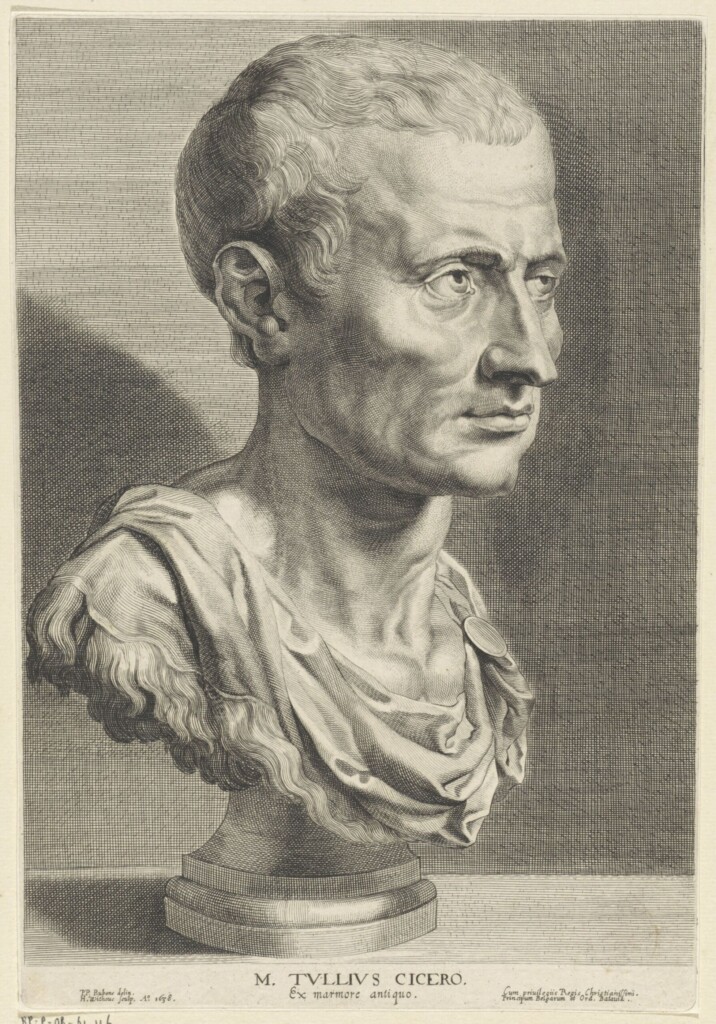
You are sitting at a writing desk in a seaside villa, composing letters you already know will not save you. The soldiers are coming. You have written fourteen speeches in less than a year, each one more ferocious than the last, naming the man who wants you dead as a drunk, a fraud, a tyrant dressed in borrowed purple. The words are brilliant. The words are useless. You order your litter carried toward the coast, change your mind, turn back, and meet the centurions on the road near Formiae on December 7th, 43 BCE. You extend your neck from the curtain yourself. This is not defeat through miscalculation. This is what happens when the instrument you trusted — the Senate, the law, the accumulated dignity of republican procedure — has already been hollowed out from the inside, and you kept filing legal briefs in an empty building.
The Philippics, all fourteen of them delivered or circulated between September 44 and April 43 BCE, represent something stranger than political courage. They represent a man performing the full rites of republican deliberation in a theater where the audience has already left. Cicero modeled them consciously on Demosthenes, the Athenian orator who warned Athens against Philip of Macedon and watched Athens fall anyway. The echo was not lost on Cicero — he chose the name deliberately, as if to say: I know exactly how this ends, and I will speak anyway. But Demosthenes could at least claim that Athens had the structural capacity to resist if it chose. By 44 BCE, Rome did not. Julius Caesar had already demonstrated that the consulship, the Senate, the tribunes, the courts could all be operated like a puppet theater by a single figure with a loyal army. What Antony was seizing was not power — it was the machinery for manufacturing the appearance of legitimacy, and Cicero’s Philippics were a desperate attempt to contest that machinery using only the vocabulary it had already swallowed.
Hannah Arendt, writing in On Revolution in 1963, identified something the entire Western tradition of political thought keeps misreading in moments like this one: the difference between liberation and freedom. Liberation is the act of breaking a tyrannical constraint. Freedom, in Arendt’s precise sense, is the construction of a new public space where power is genuinely shared, where action is genuinely plural, where no single will can collapse the whole architecture. The American founders, she argued, partially understood this distinction and still failed to complete it — they built institutions capable of limiting power without building the participatory structures that would have made those institutions self-renewing from below. Rome never even reached that partial understanding. The Republic Cicero was defending had always concentrated its real decisions in an oligarchy of families whose commitment to liberty was inseparable from their commitment to their own domination. When Cicero invoked libertas, he was not describing a condition available to the urban poor, to slaves, to the Italian allies who had bled for Roman expansion, or to the populations of the provinces. He was describing the freedom of a specific class to govern without a monarch above them — which is a real freedom, and a real loss when it ends, but not the founding of a free order in any transferable sense.
What dies on that road near Formiae is therefore not simply a man or a political career or even a republic. What dies is the last articulate voice for a version of freedom that was always already too narrow to survive its own contradictions, spoken in a language so powerful that Western civilization spent two thousand years mistaking the eloquence for the thing itself, teaching Cicero’s sentences to generation after generation of students as the grammar of liberty, long after the lesson they actually contain had become impossible to ignore.
🏛️ Freedom, Power, and the Art of Living Well
Cicero’s life and thought stand at the crossroads of political philosophy, rhetoric, and the eternal question of how a free person ought to live. These related articles explore the thinkers and traditions that echo Cicero’s deepest concerns: the nature of liberty, the ethics of power, the examined life, and the courage to speak truth.
John Locke: Life and Works
John Locke built his political philosophy on the idea that freedom is not a gift from the state but a natural condition of every human being. His Second Treatise of Government, much like Cicero’s writings on the republic, argues that legitimate power must be grounded in consent and the protection of individual rights. Reading Locke alongside Cicero reveals a profound continuity in Western thinking about liberty and the limits of authority.
GO TO THE SELECTION: John Locke: Life and Works
Niccolò Machiavelli: Life and Political Thought
Niccolò Machiavelli transformed the ancient Roman tradition of political thought into something colder and more unsettling, stripping away the moral idealism that Cicero had placed at the heart of statecraft. Where Cicero believed that the good orator and the good man were inseparable, Machiavelli argued that effective power demanded a willingness to act beyond conventional virtue. The contrast between the two thinkers defines one of the great fault lines in the history of political philosophy.
GO TO THE SELECTION: Niccolò Machiavelli: Life and Political Thought
Pierre Hadot: Life and Works
Pierre Hadot revealed that ancient philosophy was not merely an intellectual exercise but a set of spiritual practices aimed at transforming the way one lives. His work on figures like Cicero’s Stoic contemporaries shows how philosophy functioned as a daily discipline of attention, freedom, and self-mastery. For Hadot, the ancient ideal of wisdom was inseparable from the practice of liberty understood as inner sovereignty.
GO TO THE SELECTION: Pierre Hadot: Life and Works
John Stuart Mill: Life and Works
John Stuart Mill inherited from the Roman tradition a passionate commitment to freedom of thought and expression, developing it into one of the most rigorous liberal philosophies of the modern era. His essay On Liberty confronts the same tyranny of conformity that Cicero feared in the decline of the Roman republic, arguing that individual freedom is the condition of all genuine human flourishing. Mill and Cicero together form a long arc of Western thought in which political liberty and intellectual courage are inseparable.
GO TO THE SELECTION: John Stuart Mill: Life and Works
Cinema That Asks the Same Questions Cicero Asked
If Cicero’s struggle for freedom, meaning, and moral courage resonates with you, Indiecinema offers a curated selection of independent and world cinema that explores these same timeless themes with depth and artistic vision. Discover films that dare to question power, celebrate the examined life, and refuse easy answers — streaming now on Indiecinema.
👉 EXPLORE THE CATALOG: Watch Indie Films in Streaming
A vision curated by a filmmaker, not an algorithm
In this video I explain our vision

