
The Landlord at the Door
The notice is in your hand before you have finished reading it. A single sheet, official letterhead, the kind of language that turns a home into a legal category. You are being asked to vacate. The word “vacate” does something particular — it implies the space was always empty of you, that your presence was a temporary atmospheric condition, a weather pattern that has now passed. You stand at the threshold, half inside and half out, and the threshold itself becomes the argument. This side is yours. That side is theirs. Except the paper in your hand says otherwise, and the paper has weight because somewhere behind it stands a system of courts, sheriffs, registries, and historical decisions that decided, long before you were born, how property moves between human beings and why some claims survive and others dissolve.

John Locke published the Second Treatise of Government in 1689, though he had been writing it for nearly a decade, during years of political crisis in England that made the question of legitimate authority feel genuinely mortal. He did not publish under his own name. The text emerged into a world where getting the answer wrong could cost you considerably more than a house. What he was answering — the question that drives every page of that work — was not primarily about the architecture of government. That came later, almost as a consequence. The foundational question was more primitive and more brutal: who gets to say what belongs to whom, and what gives that saying its force.
This is the question your eviction notice is also answering, whether you asked it or not.
Locke’s argument begins not with law or with kings but with labor. A person who works a piece of land, who breaks it and shapes it and draws from it, has mixed something of themselves into it — their time, their effort, the irretrievable hours of a finite life. That mixture, Locke argued in Chapter Five of the Treatise, creates entitlement. Property is not assigned from above by a sovereign’s grace. It grows outward from the body, from the physical fact of doing. This was a radical claim in 1689, when most property derived its legitimacy from inheritance, royal grant, or conquest, and when the idea that a common person’s labor could generate a moral claim on the world was not obvious but subversive.
Yet there is a problem that appears almost immediately in Locke’s reasoning, one that his admirers have spent three centuries managing and his critics have spent three centuries amplifying. The labor theory of appropriation requires that there be land available to labor upon. Locke assumed what he called a proviso — that there must be “enough and as good left in common for others.” In 1689, with European colonialism actively converting entire continents into claimed territory, this proviso was not a safeguard. It was a fiction. The land was not open. It had never been open. It was occupied, cultivated, and understood as belonging by people whose forms of ownership Locke’s framework was structurally unable to recognize, because they did not resemble the individualist, enclosing, improving model he used to define legitimate appropriation.
Standing at your threshold with that notice, you are living inside a system that is the direct institutional descendant of those original decisions. The chain of title on any piece of land in the Western world, followed back far enough, terminates not in an act of labor but in an act of force — a treaty that was violated, a commons that was enclosed, a colonial claim that named emptiness where there was none. Locke gave that system its philosophical vocabulary. He told it a story about itself in which the violence at the origin was replaced by a gardener with dirt on his hands.
The question is whether the story was ever meant to describe reality, or whether it was always meant to justify it.
Slow Life
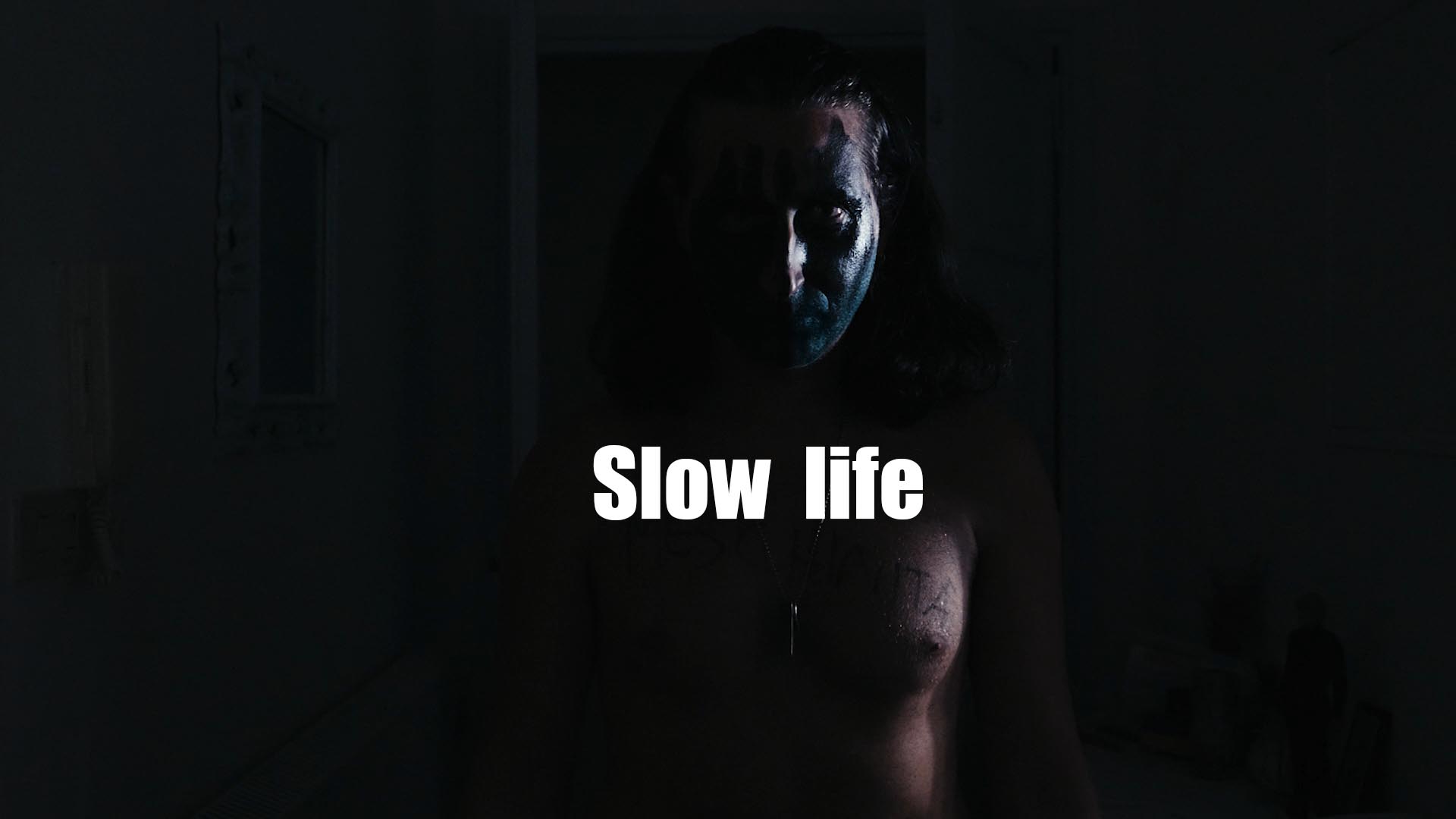
Drama, comedy, thriller, by Fabio Del Greco, Italy, 2021.
Lino Stella takes a period of vacation from his alienating job to devote himself to relaxation and his passion: drawing comics. But he did not foresee certain disturbing elements: the intrusive administrator of the building where he lives, the postman who delivers crazy fines and tax bills, an overbearing security guard, a very enterprising real estate agent, the old lady downstairs who raises the feline colony of the condominium. These characters will make his vacation hell.
Food for thought
The larger a social group is, the more rules and bureaucracy are needed, which often do not respect the individual. You have to learn to live with annoying people, but sometimes the social pressure and arrogance can become intolerable. The only laws that always come to our aid are the laws of Nature.
LANGUAGE: Italian
SUBTITLES: English, Spanish, French, German, Portuguese
1689 and the Argument That Wore a Mask
The book arrived without a name on it. Published in 1689, the year William of Orange had already taken the English throne, the Two Treatises of Government bore no author, no confession of purpose, no acknowledgment that the arguments inside had been sharpened for a particular fight. Locke would not publicly admit to writing it until the dedication he added to his will, decades later, when the danger had passed and the victory was secure. That silence was not modesty. It was architecture.
To read the Second Treatise as a timeless meditation on natural rights and the consent of the governed is to accept the disguise as the face. Quentin Skinner spent the better part of his intellectual career dismantling exactly this habit, arguing in Foundations of Modern Political Thought and elaborated through his methodological essays collected in Visions of Politics that every text is an intervention — that to understand what a thinker said, you must first reconstruct what they were doing, what speech act they were performing, against whom and toward what end. The meaning of a political text is never simply what it says. It is what it does in the moment it appears.
What the Second Treatise was doing in 1689 was providing retrospective justification for a transfer of power that had already occurred. William’s invasion of November 1688, the flight of James II, the parliamentary settlement that followed — these events needed a philosophical vocabulary that could make them look like something other than what they were: a coup dressed in constitutional clothing, backed by a Protestant aristocracy terrified of Catholic succession and the centralization of royal authority. Locke handed them that vocabulary. Natural rights, the dissolution of government, the right of resistance — these were not abstract propositions. They were surgical instruments designed to cut through the legitimacy of Stuart absolutism and leave behind something that looked like reason rather than rebellion.
The timing matters with uncomfortable precision. Locke had been writing what would become the Two Treatises in the early 1680s, almost certainly in connection with the Exclusion Crisis — the parliamentary struggle to bar James, Duke of York, from the throne on account of his Catholicism. The first treatise demolished the divine-right theory of Robert Filmer, whose Patriarcha had given the royalist position its most coherent form. The second constructed an alternative theory of legitimate government from the ground up. By the time these arguments reached print, they had aged roughly a decade, but history had caught up to them. The revolution that Locke’s arguments had been written to theoretically enable had actually happened. The text was published into a world that had already done what it argued for, and it retroactively made that world intelligible to itself.
This retroactive function is what gives the Second Treatise its peculiar double nature — at once a work of genuine philosophical construction and a document of political crisis management. The universalist language, the appeal to reason, the claim that these principles applied to all men in all conditions, served a specific rhetorical purpose: to lift a historically contingent arrangement out of history and present it as the discovery of something permanent. What was in fact the settlement preferred by Whig landowners and Protestant merchant interests appeared, in Locke’s framing, as the natural conclusion of reason itself.
Skinner’s methodology insists that recognizing this does not diminish the text. It sharpens it. The arguments become more interesting, not less, when you understand that they were produced under pressure, aimed at specific targets, calibrated to specific audiences. A weapon that also happens to contain genuine ideas about political legitimacy is more revealing than either a pure weapon or a pure philosophy. Locke’s mask was not a lie. It was a strategy, and strategies, unlike lies, have consequences that outlast the moment they were designed for.

Labor Mixed With Earth
You reach down and pull an apple from the branch. That simple gesture, Locke tells you in the fifth chapter of the Second Treatise, is the moment property is born. Not through decree, not through conquest, not through the blessing of a king — but through the act itself, through the physical fact of your hand meeting the fruit. You have mixed your labor with what nature provided, and in doing so you have extended something of yourself into the world. What was common becomes yours.
The argument is elegant in the way that arguments with hidden load-bearing walls are always elegant. Locke begins from a premise almost impossible to refuse: you own yourself. Your body is yours, your capacities are yours, your effort is yours. When that effort reaches outward and transforms something — when you clear a field, plant a seed, carry water — the transformation carries your ownership with it. The labor acts as a kind of dye that colors the thing worked upon. The earth was God’s gift to mankind in common, yes, but it was given to be used, and use requires appropriation. A world where no one could claim anything would be a world where no one could eat, and a God who forbids eating by forbidding property would be a contradiction. So property follows from self-ownership as inevitably as the harvest follows from the planting.
Locke adds two constraints that seem to keep this from becoming a license for unlimited accumulation. First, the spoilage proviso: you may take only as much as you can use before it rots. Taking more would be waste, and waste is a kind of theft from the common stock. Second, the sufficiency proviso: you may appropriate from the commons only when “enough, and as good” is left for others. These two conditions together suggest that property in the state of nature is modest, proportional, constrained by natural limits. The picture Locke paints is almost pastoral — a man gathering what he needs, no more, the commons remaining generous for everyone else.
But then money enters the argument, and the architecture shifts in ways Locke presents as smooth and logical while something far more consequential is quietly occurring. By consenting to use money — a durable token that does not spoil — men have consented to unlimited accumulation. Gold does not rot. Therefore the spoilage proviso disappears. And if one man accumulates vastly more than another, and the commons shrinks, Locke tells us this inequality was implicitly agreed to by everyone who accepted coin. The pastoral image dissolves without Locke announcing that it has dissolved.
C.B. Macpherson, writing in 1962 in The Political Theory of Possessive Individualism, performed the most consequential forensic examination this argument has ever received. What Macpherson demonstrated, with a patience that reads like controlled fury, is that Locke’s theory only functions coherently if one assumes a society where wage labor already exists — where some men sell their labor to others and thereby alienate the product of that labor entirely. When a man hired by another digs a ditch, Locke tells us the ditch belongs to the man who hired him, not to the man who dug. The labor was purchased; the ownership transferred at the moment of employment. This seems to Locke like a minor clarification. To Macpherson, it is the entire game. It means that the labor theory of property, supposedly derived from universal natural law, actually presupposes a specific historical arrangement: the wage labor market of seventeenth-century England.
The argument that claims to ground property rights in nature is already saturated with the social relations it pretends to explain. Capitalism is not the conclusion Locke reaches. It is the premise he buried at the foundation so deep that it would take three centuries to excavate.
The Proviso That Was Never Enforced
You are standing at the edge of what used to be a tree line. Last year there were oaks here, and the year before that, and for as long as anyone in the village could remember. Now there are stakes in the ground with orange tape between them, and somewhere a surveyor’s number corresponding to a deed corresponding to a name you do not know. The trees are not gone yet but they are already property, which means they are already gone.
Locke watched this happen too, in the sense that he built the philosophical infrastructure that makes it possible to watch it without intervening. In Chapter Five of the Second Treatise, published in 1689, he introduces what later commentators would call the Lockean proviso: the condition that private appropriation through labor is legitimate only when “enough and as good” is left in common for others. It sounds like a constraint. It reads, on first encounter, like a guardrail. The forest can be claimed, but only if the claiming does not exhaust the forest for everyone else. A man may take what he can use, but the commons must remain comfortably intact on the other side of his taking.
This is the proviso that was never enforced, because Locke himself was the first to dismantle it, and he did so in the same chapter, within the same argument, before the reader has had time to feel reassured. The mechanism is money. Once Locke introduces the convention of currency — a durable, non-perishable store of value that men have “by mutual consent” agreed to accept — the spoilage limitation that had been propping up the proviso disappears entirely. Before money, you could only legitimately accumulate what you could consume before it rotted. After money, you can accumulate indefinitely, because coins do not decay. The “enough and as good” condition quietly ceases to function. Locke does not announce its removal. He simply builds a logical bridge across it, and the reader arrives on the other side of the proviso without noticing the crossing.
C.B. Macpherson diagnosed this structural move in 1962 in The Political Theory of Possessive Individualism with a precision that has never quite been matched. He argued that Locke’s theory is not a theory of natural equality temporarily constrained by property rights — it is a theory of unlimited accumulation that uses the language of natural equality as a legitimating surface. The proviso was always ornamental. Its function was rhetorical: to make the reader feel that a limit existed, so that when the limit dissolved it would do so without scandal. Macpherson’s phrase “possessive individualism” names the ideology that Locke was not merely describing but producing — the idea that a man’s person and his capacities are his own property, and that this self-ownership is the foundational political fact from which everything else follows.
What this means concretely is that the moment money enters Locke’s argument, the forest by which you are standing belongs to whoever has the legal title, regardless of whether anyone else is left with an equivalent forest. The “enough and as good” has been answered by abstraction: there is enough value circulating somewhere in the monetary system for others to purchase their own equivalent. The commons becomes a market, and a market, by definition, is always sufficient because it is always open — to those who can pay.
Jeremy Waldron, writing in The Right to Private Property in 1988, attempted a more charitable reconstruction of the proviso, arguing that Locke’s framework still generates duties of sufficiency even after money enters the picture. But Waldron’s reading requires Locke to be more consistent than the text actually is. The argument on the page does not hold that line. What it holds is the orange tape between the stakes, taut against the wind, marking where the reasoning ended and the clearing began.
Consent of the Governed, Silence of the Dispossessed
You stay on land you did not choose, surrounded by a government you did not elect, governed by laws passed before you were born. According to Locke, this is consent. Your presence is your signature. The mere act of living somewhere, of walking its roads and breathing its air, constitutes tacit agreement to the authority that controls it. He is explicit about this in the Second Treatise: every man who hath any possession or enjoyment of any part of the dominions of any government doth thereby give his tacit consent. The elegance of this move is considerable. Locke dissolves the problem of obligation by making geography do the work of politics. You are here, therefore you agree.
The immediate question this raises is not philosophical but territorial. What happens when the people already living on the land are not the ones whose consent is being theorized? What happens when the framework of tacit consent is applied not to subjects of an existing government but to the justification for replacing one order of life with another entirely?
Barbara Arneil’s 1996 study John Locke and America reconstructs with documentary precision what was long treated as merely incidental — that the Second Treatise was not a general theory of government with colonial applications, but a text whose intellectual architecture was built partly from and for the specific problem of English land claims in the Americas. Locke worked for the Earl of Shaftesbury, was secretary to the Lords Proprietors of Carolina, and was involved directly in drafting the Fundamental Constitutions of Carolina in 1669. His theory of property was not written in detachment from these interests. The labor theory of value, in which ownership derives from mixing one’s labor with natural resources, performed a function that extended well beyond resolving disputes between English landowners.
The indigenous peoples of North America, in Locke’s framework, occupied land but could not be said to own it in any politically meaningful sense, because they had not improved it through agricultural cultivation of the European kind. The land was, by his definition, waste — available to those who would make it productive. This was not a careless metaphor. It was a mechanism. By defining legitimate property through a specific mode of economic transformation, Locke constructed a framework in which entire civilizations, entire systems of land relationship built over millennia, simply did not register. They were, in the precise technical sense of his own vocabulary, invisible.
Tacit consent, in this light, takes on a different character entirely. For it to function as a theory of legitimate governance, it requires subjects who are recognizable as political actors — people whose presence counts, whose staying or leaving means something. The populations deemed to have forfeited land rights through insufficient improvement could not simultaneously be theorized as consenting to the governments displacing them. They were outside the frame at the moment property was assigned, and inside the frame only when their labor or their bodies became relevant to the colonial economy. Consent was never on offer.
What makes this more than historical grievance is that the structure of the argument remains intact in ways that outlasted its original context. The idea that political legitimacy is conferred by remaining, by not actively resisting or departing, still circulates through democratic theory as though it were neutral. Charles Beitz and later theorists of global justice would spend the better part of the late twentieth century trying to disentangle what is genuinely universal in liberal consent theory from what was baked in by the historical conditions of its formation. The task proved harder than expected, because the problem was not accidental contamination. It was structural. Locke’s theory of consent was never designed to account for people whose relationship to land did not resemble an English agricultural smallholding, and that omission was not an oversight waiting to be corrected.
A vision curated by a filmmaker, not an algorithm
In this video I explain our vision
The State of Nature Was Never Innocent

Picture a man standing at the edge of a field he has never touched, measuring it with his eyes, already calculating what it might yield. He has not yet put his hands in the soil. He has not yet claimed anything. And yet something in his posture belongs to ownership — the tilt of the head, the narrowing gaze, the stillness of someone who is already deciding. This is Locke’s state of nature before the first word of it is written: not a wilderness, but a waiting room for property.
The state of nature in the Second Treatise is presented as a condition of perfect freedom and equality, governed by a law of reason that every human being can, in principle, access and obey. There is no sovereign, no magistrate, no enforced contract — and yet, Locke insists, it is not chaos. People respect each other’s persons and possessions. They punish transgressors proportionately. They reason their way toward cooperation. The description is so orderly, so already civilized in its inner logic, that one begins to wonder what exactly political society is supposed to add. The answer, of course, is enforcement — but the more revealing question is what kind of person Locke imagined already inhabiting this pre-political Eden. He is industrious, rational, Protestant in his relationship to labor and conscience, capable of reading natural law as if it were scripture. He is, in every meaningful sense, an English property owner waiting for institutions to catch up with his virtue.
Thomas Hobbes, writing just decades earlier in Leviathan in 1651, had imagined the same absence of government and arrived at something unrecognizable to Locke: a war of all against all, life solitary, poor, nasty, brutish, and short. The divergence is not empirical — neither man was describing an observed reality — it is temperamental and political. Hobbes had lived through civil war and wanted a sovereign strong enough to prevent its return. Locke had lived through the aftermath and wanted institutions strong enough to constrain a sovereign who had become a tyrant. Each man projected backward from his terror. The state of nature is always the photographic negative of the political nightmare each thinker most wants to avoid.
Jean-Jacques Rousseau would invert the image again in 1755 in the Discourse on Inequality, populating the pre-social world not with industrious Lockean reasoners but with solitary, peaceful, pre-linguistic creatures whose suffering begins precisely when property and comparison enter the scene. For Rousseau, civilization is the corruption. Locke’s natural man, already calculating and comparing, is for Rousseau already fallen. This is not merely a philosophical disagreement about anthropology. It is a dispute about which human qualities count as natural and which are socially produced — a dispute no thought experiment can settle, because every thought experiment smuggles in the social conditions of its author.
The anthropologist Marshall Sahlins made this point with uncomfortable precision when he argued that the “original affluent society” of hunter-gatherers worked far fewer hours than the economists of scarcity assumed, because they had fewer desires, not fewer resources. The implication is that scarcity itself — the condition that makes Lockean labor and Hobbesian competition feel inevitable — is a cultural artifact, not a natural baseline. What Locke called the inconveniences of the state of nature were largely inconveniences for people who already lived inside a market imagination.
None of this makes Locke dishonest in any simple sense. The state of nature was never intended as history. But it functioned as history — it naturalized a specific social order by placing its preconditions outside society, in a time before time. When you locate the origins of private property and rational consent in a condition that precedes all institutions, you make those things look like discoveries rather than inventions, like something found in the field rather than built upon it.
Revolution as a Property Clause
You are standing outside a government building with a handwritten sign, and someone in a suit tells you that what you are doing does not constitute a legitimate grievance. Not in those exact words, perhaps. But the message arrives precisely: your complaint does not meet the threshold. You do not own enough of what is being taken from you to qualify for the formal vocabulary of injury.
Locke’s right of revolution is the passage most frequently quoted by people who have never read the Second Treatise carefully. It sounds like an open door. A people wronged by their government may, in the final instance, dissolve it. The social contract can be revoked. Sovereignty returns to the people. These phrases circulate with the warmth of universal emancipation, and they have been doing so since 1689, when the Treatise was published in the immediate aftermath of the Glorious Revolution — a revolution, it bears noting, conducted almost entirely by landowners and aristocrats transferring power among themselves.
The architecture beneath those phrases is considerably more precise. The rights Locke names as the objects of government’s protection are life, liberty, and estate. That triad is not accidental. Estate is property in the specific sense: land, goods, accumulated wealth. The right of revolution is triggered when government violates natural rights, but natural rights, within the internal logic of the text, reach their fullest and most elaborated form in the domain of property. Locke spends more of Chapter Five explaining why property rights are natural and pre-political than he spends on any other single topic in the book. The emotional center of his system is not the person in the abstract. It is the person who has mixed their labor with the earth and created a stake.
When he writes, in paragraph 222, that the legislature acts against the trust placed in them if they invade the property of the subject, the word invade carries a precise legal weight. It refers to seizure, confiscation, taxation without consent, the kind of violation that people with property recognize immediately as violation because it removes something measurable from their possession. What it does not name is poverty sustained by law. What it does not name is exclusion enforced by custom. What it does not name is a life shortened by labor with no stake in the earth.
The person outside the government building with the handwritten sign is expressing something real. But Locke’s framework has no mechanism to translate that reality into a legitimate trigger for revolution unless the complaint can be rendered as a property violation. A life impoverished by the structure of a wage system, a liberty constrained by the unavailability of material resources, these do not register in his language as political injuries in the same register as a tax levied without parliamentary consent. They register, if at all, as misfortunes.
C.B. Macpherson, whose 1962 study The Political Theory of Possessive Individualism remains the most precise dissection of this architecture, argued that Locke’s theory is built on a prior assumption: that the rational and industrious — those who have accumulated property through labor and exchange — are the full moral actors in political society. The rest are present, technically protected, but not the primary subjects of the political contract. Their lives and liberties are protected in principle; their estates do not exist in the relevant sense.
This is why the right of revolution, written as universal, functions structurally as a property clause. It is not that Locke wanted the poor to suffer. It is that the logic of his system simply did not build a ladder between their condition and the concept of legitimate political injury. The trigger for dissolution is a sufficiently grave violation of what is yours. And what is yours, in any enforceable sense, depends on what you already had before the government moved against you.
The Grammar We Inherited
Jefferson had the manuscript open on his desk, or something close enough to it that the difference barely matters. When he wrote that all men are endowed with certain unalienable rights, and listed among them life, liberty, and the pursuit of happiness, he was performing a substitution so elegant it looked like an improvement. Locke’s original triad — life, liberty, and estate — had named the thing plainly. Property. The material condition of independence. The acre that made the vote possible, the fence that made the person legible to the state. Jefferson swapped that word out and inserted something that sounded more elevated, more universal, more becoming of a republic that wanted to believe it had transcended mere accumulation. What he concealed in that gesture was the degree to which the entire architecture beneath the new phrase still rested on Locke’s foundation: the idea that legitimate government exists to protect what individuals already possess, that the self arrives at the social contract already loaded with entitlements, that freedom is fundamentally a condition of non-interference with what is yours.
The substitution was not dishonest in any simple sense. Jefferson believed it. But belief can be the most effective form of concealment. By the time the Declaration circulated, Lockean grammar had become so natural that it no longer needed to cite itself. It had passed into the ambient logic of political speech, the invisible syntax inside which arguments about rights, sovereignty, and legitimacy moved without anyone noticing the structure that made those arguments possible in the first place. C. B. Macpherson traced this process with clinical precision in his 1962 study of possessive individualism, demonstrating that the Lockean subject — the self as owner, first of its own person, then of its labor, then of whatever that labor extracted from the world — was not a neutral description of human nature but a specific historical construction, one that the seventeenth century produced and the eighteenth enshrined as self-evident truth.
Self-evident. That phrase in the Declaration is doing enormous work. It marks the point where argument stops and assumption begins, where the political becomes the natural. Locke himself prepared that move, spending long chapters of the Second Treatise proving what he then treated as requiring no proof: that property precedes government, that consent is the source of obligation, that the individual is the irreducible unit of political life. By the time the American republic institutionalized these claims, they had been repeated so many times across so many documents that questioning them felt less like philosophy and more like eccentricity.
And so the inheritance settled in. The grammar is everywhere now, inside arguments made by people who have never read a sentence of Locke and would not recognize his name as the origin of their intuitions. When someone insists that taxation is confiscation, they are speaking Locke. When a court frames liberty primarily as freedom from state interference rather than as a capacity requiring material conditions to exist, it is reasoning inside the Second Treatise. When political debate defaults to the question of how much government intervention is legitimate rather than who decided that intervention was the deviation requiring justification, the Lockean frame is doing its quiet work, defining what counts as a question worth asking and what falls outside the edge of the thinkable.
The deepest power of a foundational text is not what it argues but what it eventually makes unnecessary to argue. Locke’s Second Treatise succeeded so completely that its core commitments migrated out of political philosophy and into the background radiation of modern common sense — the air inside which liberal democracy breathes, mostly without examining what it is breathing.
⚖️ Power, Rights, and the Architecture of Political Thought
Locke’s Second Treatise of Government stands as one of the founding pillars of liberal political philosophy, exploring natural rights, legitimate authority, and the social contract. The articles below trace the intellectual terrain surrounding Locke’s ideas, from the nature of power and sovereignty to the philosophical roots of resistance and civil society.
Hobbes’s Leviathan: Meaning and Analysis
Hobbes's Leviathan presents a vision of political authority rooted in fear and the surrender of individual freedoms to an absolute sovereign, offering a striking counterpoint to Locke’s more optimistic theory of natural rights. Where Locke imagines government as a trust that can be revoked, Hobbes sees the social contract as an irrevocable escape from the brutal state of nature. Reading both thinkers together illuminates the fundamental tensions at the heart of modern political thought.
GO TO THE SELECTION: Hobbes’s Leviathan: Meaning and Analysis
Thomas Hobbes: Life and Political Thought
Thomas Hobbes‘s life and political thought provide essential context for understanding the seventeenth-century debates in which Locke intervened. Hobbes’s experiences of civil war and political instability shaped a philosophy that prioritized order above liberty, making him Locke’s most important philosophical adversary. Understanding Hobbes’s intellectual biography helps clarify why Locke’s arguments for limited government and the right of revolution were so revolutionary in their time.
GO TO THE SELECTION: Thomas Hobbes: Life and Political Thought
Wollstonecraft’s A Vindication of the Rights of Woman
Mary Wollstonecraft‘s A Vindication of the Rights of Woman directly extends Lockean principles of natural rights and rational autonomy to the question of women’s political and social equality. Wollstonecraft argued that if reason is the basis of rights, then women, equally endowed with reason, cannot be justly excluded from political life. Her work reveals both the liberating potential and the historical blind spots of Locke’s foundational framework.
GO TO THE SELECTION: Wollstonecraft’s A Vindication of the Rights of Woman
Banal Evil and Radical Evil: Kant and Arendt
The distinction between banal evil and radical evil, as theorized by Kant and Hannah Arendt, raises urgent questions about what happens when political authority is stripped of its moral legitimacy. Locke’s insistence on the right to resist tyrannical government implies a constant ethical vigilance over the uses of power, a theme Arendt explored with devastating clarity in the twentieth century. Together, these thinkers form a critical tradition demanding that citizens never surrender their moral judgment to the state.
GO TO THE SELECTION: Banal Evil and Radical Evil: Kant and Arendt
Discover Independent Cinema on Indiecinema
If these explorations of political philosophy and the nature of power have stirred your thinking, Indiecinema streaming offers a curated selection of independent films that interrogate authority, freedom, and the social contract in bold and unexpected ways. Join us to discover cinema that asks the questions mainstream culture prefers to leave unanswered.
👉 EXPLORE THE CATALOG: Watch Indie Films in Streaming
A vision curated by a filmmaker, not an algorithm
In this video I explain our vision

