
The Object That Refuses to Decorate
You walk into the atrium and it stops you before you have decided to stop. It is not beautiful, exactly — not in any way your body was prepared for. A mass of oxidized steel and compacted fabric, perhaps two meters tall, tilts at an angle that suggests either catastrophic failure or deliberate menace, and for several seconds you stand with your hands slightly away from your sides, the way people stand when they are not sure whether something is about to fall. You look for a label. You look for the label the way you would look for an exit sign in a burning building — not because you want to read it, but because you need something to tell you how to feel.

That reflex is not accidental, and it is not a sign of ignorance. It is the accumulated residue of several centuries of contract between an object and its audience, a contract that contemporary sculpture has been systematically dismantling since at least the early 1960s. The traditional agreement was legible and generous: the sculpture signified, the viewer received. A bronze general on a plinth told you where power resided. A marble pietà told you that grief was ennobling. The pedestal itself was a grammatical device — it lifted the object out of your world and into a realm of intended meaning, saving you from the obligation to interrogate your discomfort or decide what was being asked of you. Auguste Rodin already began to corrode this grammar when he refused the pedestal for the original installation of The Burghers of Calais in 1895, insisting that the figures stand at street level, among the bodies of the living. The city fathers of Calais protested. They understood instinctively that removing the elevation destroyed the consolation.
Donald Judd formalized what Rodin had sensed. In his 1965 essay “Specific Objects,” Judd argued that the inherited European syntax of sculpture — composition, representation, relational arrangement of parts — had become a kind of lie, a way of imposing hierarchies of meaning on material that had its own irreducible presence. His stacks of factory-produced galvanized iron, installed flush against gallery walls through the late sixties and into the seventies, refused metaphor with a severity that many viewers experienced as hostility. There was nothing to decode. The object was precisely what it appeared to be, which is a far more radical demand than it sounds, because it meant that every feeling of unease the viewer brought to it was the viewer’s own problem to examine.
What shifted in the encounter was the direction of the question. Before, sculpture asked you to look. Now it began to ask why you were looking, and what looking meant for a body standing in a specific room at a specific historical moment. When Louise Bourgeois began exhibiting her Cells series in the early 1990s — enclosed cage-like structures housing objects from personal trauma, perfume bottles, mirrors, garments, fragments of text — the discomfort they generated was not aesthetic but diagnostic. The work did not represent psychological entrapment; it replicated its conditions spatially, so that approaching it meant entering a zone of someone else’s anguish without permission, without the frame of narrative that would have made that entry acceptable.
The accusation you feel standing before something you cannot categorize is not that you lack sophistication. It is something older and more destabilizing than that. It is the suggestion that your need for categories is itself a symptom — of a trained incapacity to tolerate presence without administration, to sit with an object that refuses to perform its own legibility. Every contemporary sculpture that genuinely works is, in some sense, a patient interrogation of why you require it to explain itself before you will agree to be affected by it, and what that requirement says about the structures that educated your attention.
Studio 2091
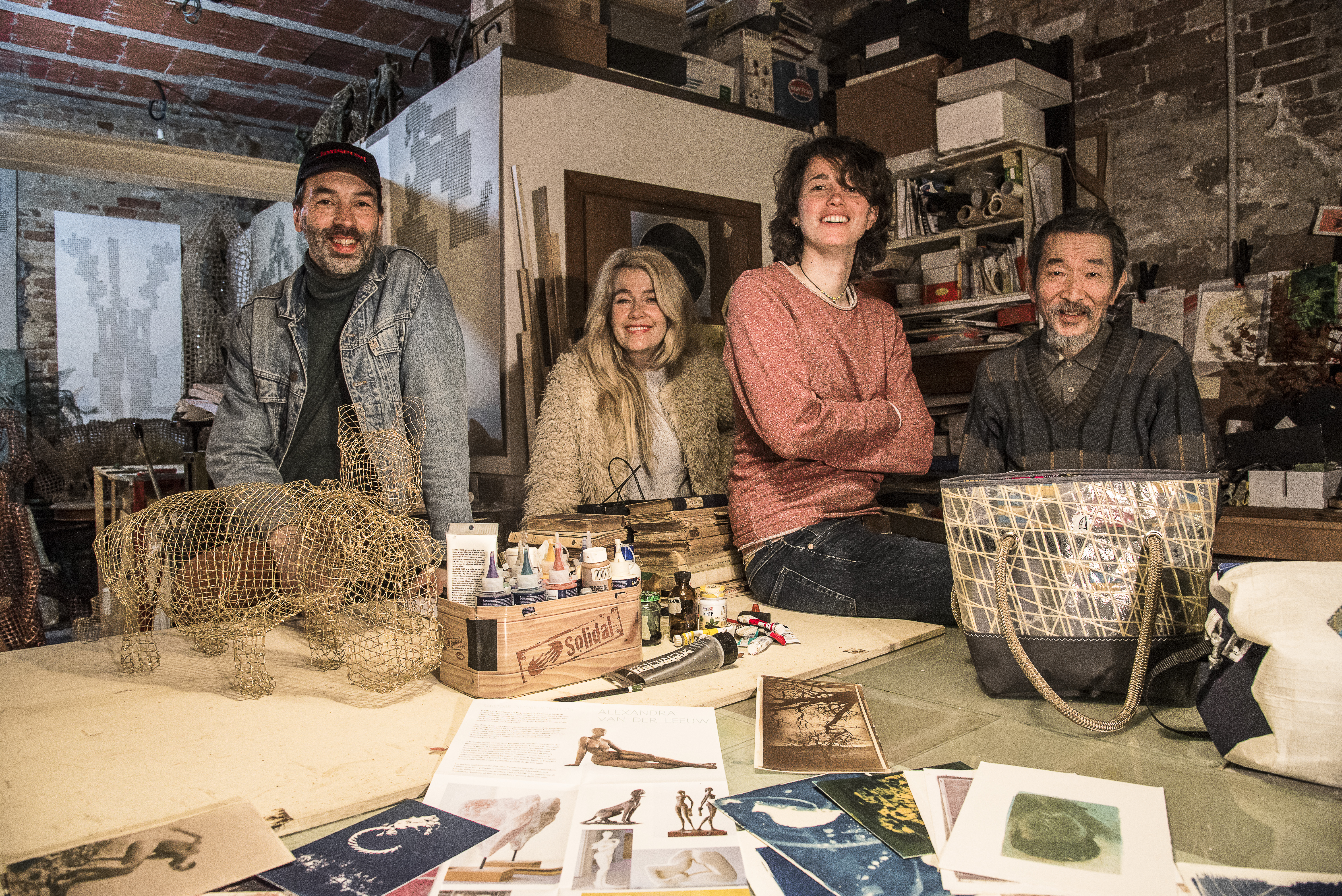
Documentary, by Naù Germoglio, Italy, 2020
In a former warehouse on the ground floor of the civic number "2091", in the district of “Santa Croce” in Venice, two sculptors, a craftswoman and an alchemist-photographer work together. It is a 65 square meters space with two windows overlooking a small canal. It is called "STUDIO2091" and it is a unique example of creative co-working space where there is no wifi connection, the cellphones work very bad, there are no tables for meetings, nor computers.
His "tenants" carry out only manual activities related to art and crafts. Each of them has a different reason to live in Venice, a beautiful and unique city, yet expensive, problematic, overrun by mass tourism and high tide. The photographer-alchemist Andrea Buffolo, who was born in Switzerland,is the only one who has spent almost all his life in the historical center of Venice. Japanese sculptor Masaru Kashiwagi chose to live in Venice 35 years ago, because he considers it the only city in the world perfect for an artist; the craftswoman Camilla Morelli was born and raised in Valtellina ( a valley in the Lombardy region of northern Italy), and although she grew up in the mountains, she chose to live in Venice to enjoy the proximity to the sea; the Dutch painter and sculptor Alexandra Van der Leeuw lives on the island half of the year carrying on a family tradition. The four protagonists of the documentary film chose to live in Venice because here,and only here, they succeed in being themselves, realizing themselves and feeling free.
SUBTITLES: English, Spanish, French, German, Portuguese
When the Pedestal Disappeared
You walk into a room and something is sitting on the floor. Not displayed. Not elevated. Just there, the way a person sits on the floor, the way a stone sits in a field. Your first instinct is to look for the platform, the plinth, the frame — the visual signal that tells you this object has been authorized, that someone with institutional power has declared it worthy of your attention. When the signal is missing, you feel briefly illegitimate yourself, as though you have entered without permission.
The pedestal was never an innocent piece of furniture. When Auguste Rodin placed The Burghers of Calais in 1889, he fought bitterly against the municipal commission that demanded the figures be elevated on a traditional plinth — heroes displayed above the crowd, legible as monuments. Rodin wanted them at ground level, shuffling toward their own execution at eye height with the living, their anguish communicable rather than commemorated. He lost that fight for decades. The work was finally installed at street level, posthumously, in 1924, six years after his death. The argument he had started was not about aesthetics. It was about whether sculpture existed to ratify power or to disturb the body that stood before it.
Constantin Brancusi carried that disturbance into a different register entirely. His pedestals, famously, became part of the sculpture — the Endless Column of 1938 rising from Romanian earth in Târgu Jiu as something that could not be separated into object and support. He did not abolish the pedestal; he contaminated it, made it impossible to say where the art object ended and the structural logic of display began. This contamination was a philosophical move as much as a formal one: it exposed the pedestal as fiction, as a social agreement dressed up as necessity. Once seen as fiction, it could not be unseen.
The moment the fiction fully collapsed carries a specific date and a specific room. In 1965, Donald Judd published his essay “Specific Objects” in Arts Yearbook 8, articulating what was already being made: three-dimensional work that refused the inherited languages of both painting and sculpture, that sat on the floor or protruded from the wall without apology, without hierarchy, without the upward gesture that had organized Western sculpture since antiquity. Judd’s stacks and Carl Andre‘s floor pieces — Andre’s Equivalent VIII, 120 firebricks arranged in a rectangle directly on the gallery floor in 1966 — did not invite contemplation of heroic verticality. They asked your body to navigate around them, to become spatially aware of itself in relation to matter that occupied the same horizontal plane you stood on.
What collapsed with the pedestal was the entire symbolic grammar of the monument: the idea that sculpture’s purpose was to make permanent what power wished to declare eternal. Richard Serra understood this as industrial fact rather than artistic gesture. His prop pieces of the late 1960s — lead plates held in place by rolled lead poles, no welds, no fasteners, only the physics of weight and friction — made precariousness the structural principle. These were objects that could fall, that existed in temporary equilibrium, that made no claim to permanence. The monument promises that what it commemorates will outlast the body standing before it. Serra’s early work promised nothing except the present moment of gravitational negotiation.
The human body, once this happened, could no longer position itself as spectator safely below or before the work. Anne Truitt had already understood by 1963 that color applied to tall, simple wooden forms at human scale would function like presence rather than representation — her works stand the way people stand, not the way idols are installed. The sculpture had become a neighbor rather than an authority, and the viewer, deprived of the upward gaze that had always organized the relationship between citizen and monument, found themselves suddenly without the posture that told them how to feel.

Minimalism as a Philosophical Aggression
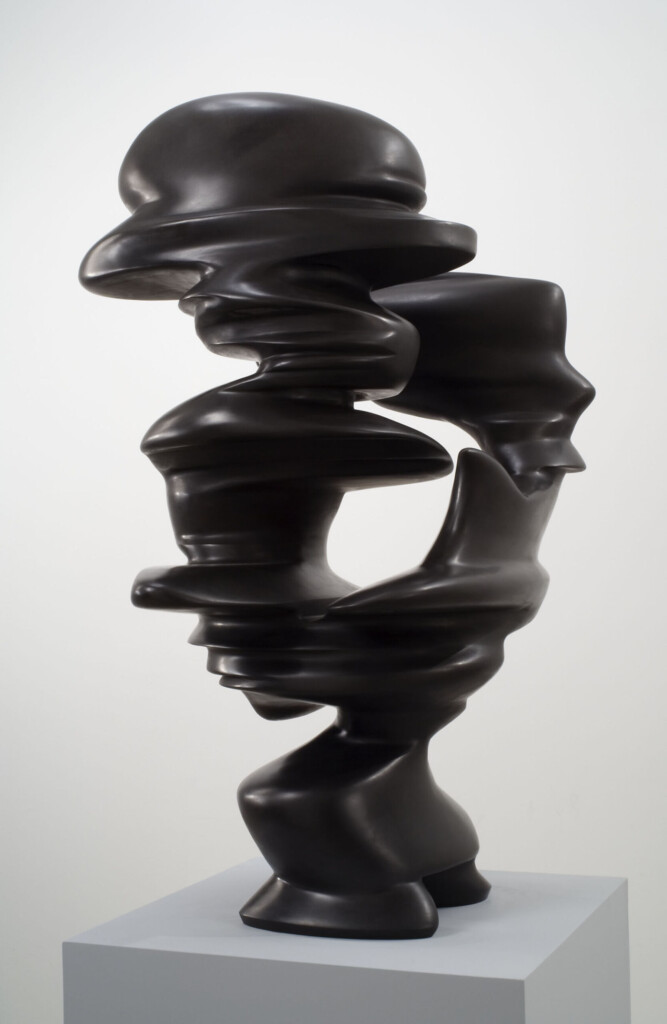
You are standing in a room where nothing asks anything of you, and that is precisely the problem. The steel box does not represent power — it is power, manufactured to tolerances tighter than most human relationships, repeated eight times across the floor at intervals that feel neither arbitrary nor inevitable. You are not being invited to interpret it. You are being informed, quietly and without appeal, that interpretation is no longer the contract on offer.
Donald Judd published “Specific Objects” in 1965 as a polemic disguised as an art-critical survey, and its central act of aggression was terminological. He did not call what he was making sculpture. Sculpture carried too much history in its spine — the vertical figure, the plinth, the implied interiority, the suggestion that matter was standing in for something else. Judd wanted objects that terminated at their own surfaces, things whose meaning was exhausted by their material fact: anodized aluminum, galvanized iron, Plexiglas in colors that referenced industrial signage rather than painting. The philosophical move here was not nihilism but something closer to a surgical removal — the extraction of metaphor from the body of the object, leaving it to bleed presence rather than symbol.
Robert Morris, working through the same decade but thinking through Maurice Merleau-Ponty‘s phenomenology of embodied perception, pushed this further into territory that implicated the viewer as structural component. His 1966 essay “Notes on Sculpture” in Artforum argued that the meaning of a work was not fixed within it but produced in the dynamic relationship between the object’s gestalt and the moving, breathing, spatially situated body of the person encountering it. This was not a generous invitation. It was a transfer of responsibility so total it bordered on accusation — suddenly you were not a receiver of meaning but its generator, which meant that standing passively in front of a large gray polyhedron was not neutrality but a kind of ontological failure of nerve.
What Minimalism was actually attacking, beneath all the industrial materials and the refusal of pedestal logic, was the social arrangement that galleries and museums had normalized since the nineteenth century: the bourgeois viewer arriving with cultivated sensibility intact, ready to decode what the artist had encoded, leaving spiritually enriched and fundamentally unchanged. Michael Fried recognized the threat immediately, publishing “Art and Objecthood” in 1967 as a counter-assault in which he accused Minimalist work of “theatricality” — meaning that it required the viewer’s physical presence to complete itself, which he saw as a corruption, a surrender to time and contingency that real art transcended. He was right about the diagnosis and wrong about the verdict. That theatricality was precisely the weapon.
The choice of industrial fabrication was not aesthetic preference but institutional provocation. When Judd began having his works manufactured by companies in New Jersey rather than making them by hand, he was dismantling the mythology of the artist’s touch — the hand as guarantor of authenticity, of individual vision transmitted through material into the receptive consciousness of the beholder. By 1970, his stacks and progressions were coming off factory floors indistinguishable from components of commercial architecture, and this indistinguishability was the point. The gallery wall against which a Judd unit was mounted became suddenly visible as wall, as institutional architecture, as a specific kind of room built for a specific kind of social performance with its own codes of behavior and exclusion.
What followed from this recognition could not be contained within aesthetics. If the space itself was the argument, then who controlled the space controlled the argument, and the history of who had controlled those spaces — which collectors, which institutions, which national narratives about culture and civilization — was no longer a background condition but the subject matter itself, buried inside every sightline the work forced you to calculate.
The Body as Material and Casualty
You are standing in a gallery in Milan in 1961, and a man is selling tins. Ninety of them, each labeled “Artist’s Shit,” each priced by weight at the current market rate for gold. Piero Manzoni was not being provocative in the cheap sense — he was issuing a diagnosis. If the art world would buy anything bearing the artist’s name, then what was being sold was never the object. It was the body behind it, the biological fact of a human being who had been designated significant. The tin could contain anything. The signature was the content.
What Manzoni began as corrosive irony, Arte Povera transformed into a full epistemological position. By the late 1960s, artists across Italy — Jannis Kounellis, Mario Merz, Giovanni Anselmo — were dismantling the boundary between the artwork and the material conditions of life itself. Germano Celant, who named and theorized the movement in 1967, described it as a liberation from the cultural and social mystification of art, a return to the pre-symbolic, to matter that had not yet been colonized by exchange value. Lead, coal, soil, live animals brought into exhibition spaces — these were not metaphors. They were the things themselves, insisting on their own presence before any aesthetic frame could organize them into meaning.
Joseph Beuys extended this logic into something more dangerous: autobiography as sculptural material. His claim that a Tatar tribe rescued him after his plane crashed in Crimea in 1944, wrapping him in felt and fat to keep him alive, may or may not be literally true — military records suggest a different sequence of events. What matters is that Beuys understood myth as a form-giving force, and he built an entire sculptural language around those two materials. Felt and fat recur throughout his practice not as symbols but as thermal facts, as substances that hold warmth, that insulate against death. When he wrapped a grand piano in felt, he was not commenting on music. He was asking what it costs a body to survive, and whether survival changes what the body is permitted to become.
Ana Mendieta took no shelter in myth. Her Silueta series, begun in 1973 and continued for over a decade, consisted of her own body pressed into earth, sand, and grass — silhouettes that recorded a presence by marking its departure. She had been sent from Cuba to the United States at age twelve through Operation Peter Pan, separated from her family, placed in Iowa foster care. The work does not announce this. It does not need to. The shape of a woman dissolving into landscape carries the specific weight of someone who learned early that belonging is revocable. Mendieta was not representing displacement; she was using her flesh as the instrument through which displacement could leave a mark on the world before it vanished entirely.
The institution arrived, as it always does, slightly too late and precisely on time. By the 1980s, galleries and museums had developed a sophisticated apparatus for receiving work built from suffering — framing it, lighting it, insuring it, contextualizing it in catalog essays that transformed biographical trauma into aesthetic lineage. The body, which had been introduced into sculpture precisely to resist the commodity form, found itself remarkably portable once the market understood that authenticity was its own category of luxury. A Beuys felt suit sold at auction for hundreds of thousands of dollars. The felt does not keep anyone warm inside a climate-controlled saleroom. What is being purchased is the idea of a body that once survived something — the trace of extremity, sanitized into collectibility.
This is the particular cruelty of institutional recuperation: it does not distort the work. It simply places it somewhere the work cannot breathe, and calls the stillness dignity.
Identity, Geography, and the Canon's Blind Spots
You walk into a major retrospective of postwar sculpture at a museum whose name you already trust, and somewhere around the third room you realize that every object in every case, on every plinth, came from within a triangle drawn between New York, London, and Düsseldorf. The curators have done nothing dishonest. They have simply repeated, with institutional confidence, a story that was always partial, offered it as though it were total, and relied on your willingness to receive it that way.
The canonical narrative of contemporary sculpture was not discovered — it was commissioned. When Clement Greenberg wrote his influential essays in the 1940s and 1950s shaping how three-dimensional work would be evaluated, he was writing from a specific postal code with a specific set of studio friendships and a very particular anxiety about American cultural authority relative to Europe. When the major survey texts followed — from Rosalind Krauss’s “Passages in Modern Sculpture” in 1977 to subsequent institutional catalogues that borrowed her framework — they mapped a geography of significance that happened to overlap almost perfectly with the geography of the market. The coincidence was too convenient to be accidental.
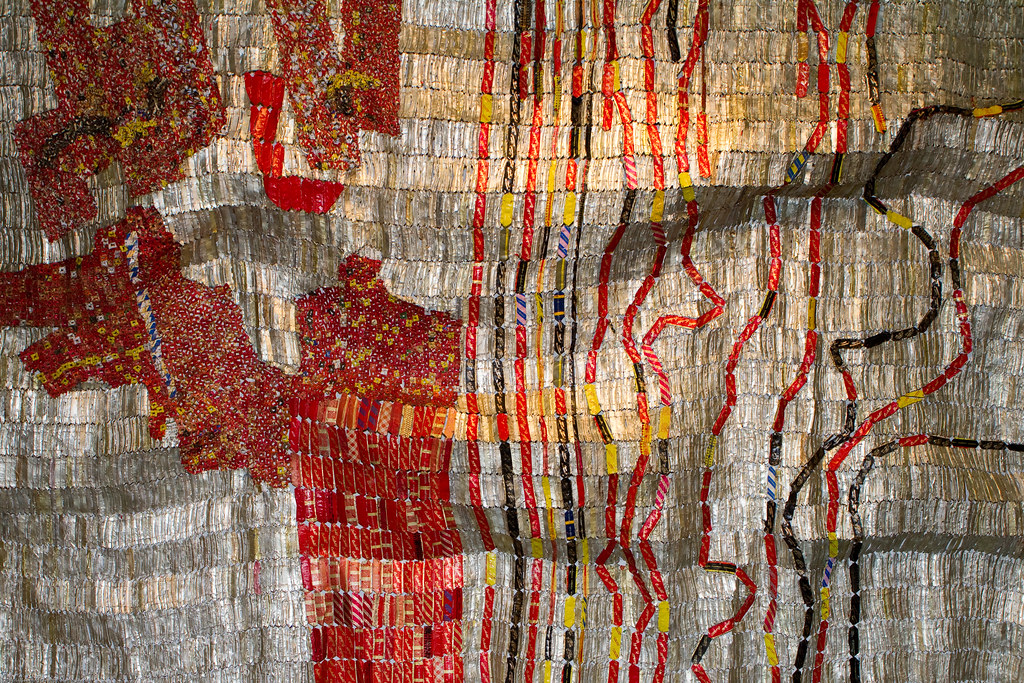
El Anatsui had been working in Nigeria and Ghana since the 1970s, producing sculptures from aluminum bottle caps and copper wire — hundreds of thousands of fragments stitched into cascading metallic sheets that could drape, shift, and breathe differently in every installation. The work engaged directly with colonial trade routes: the bottle caps came from local distilleries, themselves remnants of economic systems imposed from outside. It was formally rigorous, materially inventive, and philosophically dense. It was also almost entirely invisible to the Western critical establishment until the 2000s, not because it lacked sophistication, but because the infrastructure for reading it — the curators, the journals, the biennials with purchasing power — had no institutional incentive to travel in that direction. When the work finally entered major collections, it was described as emerging, as though something that had been developing for three decades had only just begun.
Doris Salcedo in Bogotá was doing something no sculptor in New York was attempting with equivalent rigor: making absence physically present. Her “Atrabilarios” works of 1992 to 2004 embedded shoes belonging to the disappeared — victims of Colombian political violence — behind membranes of animal fiber sutured directly into the gallery wall. The shoes were real. The people were gone. The seam was surgical. This was not metaphor operating at a safe aesthetic distance; it was forensic grief made structural. Yet for years Salcedo remained a figure known mainly in specialized curatorial circles, while sculptors working in roughly adjacent conceptual territory in Western Europe received decade-defining retrospectives and permanent collection acquisitions on a different timeline entirely.
Lee Ufan, associated with the Japanese Mono-ha movement that coalesced around 1968 and 1969, was exploring the relational energy between natural and industrial materials — stones placed against steel plates, the space between them treated as active substance rather than empty interval — at exactly the same moment that minimalism was being codified and celebrated in American galleries. Mono-ha was not minimalism’s Japanese cousin. It operated from an entirely different philosophical substrate, drawing on notions of encounter and incompletion that had no direct equivalent in Western phenomenology. The two practices emerged simultaneously, without mutual influence, from different intellectual worlds. But only one of them entered the sculpture textbooks written in the 1970s and 1980s, and the selection was not made on aesthetic grounds.
What makes this erasure structurally interesting rather than merely unjust is that it required active maintenance. Parallel practices do not disappear on their own. They require sustained institutional indifference, journal editors who never assign the review, grant committees that fund the familiar, biennials that invite the already-legible. The canon is not a passive record of what was important. It is a system of repeated choices, each one small enough to seem innocent, accumulating into something that looks, from a sufficient distance, exactly like history.
A vision curated by a filmmaker, not an algorithm
In this video I explain our vision
The Market Mechanism and the Sculpture's Social Life

You are standing in the auction room and the lot has not yet appeared on the paddle screens when you already know the price will be obscene. The knowledge arrives not as a calculation but as a body sensation, the particular atmospheric pressure of a room where money has already decided what it wants before the auctioneer opens his mouth. What Christie’s sold on the evening of May 15, 2019, was ostensibly a stainless-steel rabbit, ninety-one centimeters tall, cast in 1986 by Jeff Koons from an inflatable toy purchased at a party supply store. The hammer fell at $91.1 million. What actually changed hands that night had almost nothing to do with steel or with sculpture’s centuries-long negotiation between mass and meaning.
Thorstein Veblen understood this transaction decades before it was possible. In “The Theory of the Leisure Class,” published in 1899, he described how luxury objects function not as things consumed but as performances staged for an audience of social rivals. The price of an object, beyond a certain threshold, becomes the object’s primary content. The steel rabbit did not cost $91.1 million because it represented ninety-one million dollars’ worth of artistic vision or material labor. It cost that because only the possession of something that costs that much can communicate a specific quantity of social dominance to a specific stratum of people who understand the denomination.
Pierre Bourdieu‘s field theory sharpens this further into something almost surgical. In “Distinction,” published in 1979, Bourdieu demonstrated that taste is never innocent, never free-floating, never the private encounter between a sensitive individual and an object. Taste is a form of capital, measurable and convertible, operating inside structured fields where agents compete for legitimacy and position. The contemporary sculpture market is precisely such a field, one in which financial capital and cultural capital have fused so completely that they are now largely indistinguishable. A collector who buys a monumental work for the lobby of a financial headquarters is not decorating a space. He is converting one form of capital into another, making liquid wealth solid and solid wealth legible to everyone who walks through the glass doors.
What happened to sculpture structurally during the 1980s and 1990s was not simply that prices rose. The auction economy installed a new temporal logic inside the object itself. A painting or a sculpture now exists simultaneously in two timelines: the time of its making, which is historical and fixed, and the time of its market biography, which is continuous, updatable, and in many cases more culturally consequential than its production. When Koons’s Rabbit was resold in 2019 having spent thirty-three years in private hands, it reentered public consciousness not as an aesthetic argument but as a financial event. The sculpture’s “social life,” to use Arjun Appadurai’s framing from “The Social Life of Things” in 1986, had eclipsed its object life entirely.
This is not a corruption of some purer original state. Sculpture has always been entangled with power and its symbols — from the colossal portraits of Roman emperors placed in civic centers to enforce ideological submission, to the bronze equestrian monuments that eighteenth-century European capitals erected to manufacture national mythology. The difference is that those objects made power visible by depicting it, while the contemporary market object makes power visible by becoming it. The Rabbit does not represent wealth. It is wealth, walking upright on steel legs through a temperature-controlled storage facility in Delaware, depreciating for tax purposes while appreciating for status purposes, the two operations running simultaneously inside the same hollow body.
Invisible curators are always the most powerful ones, because they need no institutional mandate, no critical endorsement, no museum wall. They operate through the movement of money, and the sculptures that survive their selection are not necessarily the ones that said something new about what it means to be human — they are the ones that proved durable as instruments of conversion between one register of power and another.
Public Space as Contested Terrain
You walk past the same bronze general every morning for twenty years and you stop seeing him. That is precisely the point. The invisibility is not a failure of attention — it is the monument doing its job, which is to naturalize a particular version of history until it feels like weather, like gravity, like something that was always already there before you arrived.
When hundreds of Confederate statues were pulled from their pedestals across American cities in the summer of 2020, the reaction from those who opposed their removal revealed something more than nostalgia. It revealed how deeply people had confused the permanence of an object with the validity of a claim. A statue of Jefferson Davis does not merely commemorate a man; it performs an ongoing argument about who the public square was built to honor, whose grief it was designed to accommodate, whose body was ever supposed to move through it comfortably. The Lost Cause mythology encoded in those monuments was never incidental to their civic function — it was the function, installed in bronze and stone precisely because those materials suggest eternity.
The dispute over Richard Serra’s Tilted Arc offers a different anatomy of the same problem. Commissioned by the General Services Administration and installed in Federal Plaza in New York City in 1981, the massive curved steel wall was removed in 1989 following years of petitions from office workers who described it as oppressive, as something that cut the plaza in half and made them feel watched or confined. Serra argued, correctly under the terms of site-specific art, that removing the work destroyed it — that Tilted Arc was not a transportable object but a relationship between material, body, and site. The federal judge ruled against him. What the case exposed was not simply a conflict between artistic intention and public comfort, but the unresolved question of who gets to define what a public space is for. The office workers who signed petitions understood the plaza as a place of passage and lunch breaks. Serra had reconceived it as a perceptual apparatus. Neither vision was neutral, and the law, by ruling that the government retained the right to remove art it had commissioned, quietly confirmed that public space is always administered rather than shared.
Kara Walker’s A Subtlety, installed inside the former Domino Sugar refinery in Brooklyn in 2014, pressed this further with an almost savage precision. The work — a colossal sugar-coated sphinx bearing the exaggerated features of a Black woman, surrounded by smaller figures of children molded from molasses — occupied a site that had been built on the labor of enslaved people in Caribbean cane fields. Walker did not bring history to the space; she forced the space to confess the history it had been built on top of. The sphinx’s monumental scale echoed the tradition of public commemoration while inverting its terms entirely: here was a Black female body made enormous, made permanent, made impossible to walk past without reckoning with what refinement, in the economic and racial sense, has always cost. That visitors photographed themselves in front of it striking playful poses, inadvertently reenacting the very dynamic of objectification the work was interrogating, was not a failure of the artwork — it was the artwork completing its circuit.
What these three moments share is the proof that sculpture in public space is never a gift to the public. It is always a proposition about which public, about which memory deserves to calcify into stone or steel or sugar. The long Western tradition of equestrian statuary placed power literally above eye level, so that citizens had to look up — a posture that the body learns before the mind does. Louise Bourgeois understood that scale and placement encode psychological coercion when she described her own towering spider sculptures as simultaneously protective and predatory, a mother who shelters and who traps.
Digital Fabrication and the Authorship Fracture
You are watching someone spend four million dollars on an object that was never touched by the person whose name it carries. The file was generated through parametric algorithms, refined by a studio team of twelve engineers, output through industrial robotic arms, and signed at the end by an artist who may have approved a render on a screen somewhere in the process. This is not a hypothetical scandal. This is the normalized production workflow of several of the most commercially successful sculptural practices operating today, and the market has decided, collectively and without much embarrassment, that it does not care.
The question this raises is not ethical but ontological. When Walter Benjamin wrote in 1935 that mechanical reproduction strips the artwork of its aura — that irreducible quality of singular presence rooted in a specific time and place — he was describing photography and film, technologies that copy an original. What he could not fully anticipate was a condition in which there is no original to copy, in which the work is born already distributed, already plural, already without a first instance that precedes its reproductions. A sculpture produced from a digital file and printed in an edition of five has no ur-object from which the others descend. All five are the file made physical, and the file belongs to no moment, no body, no hand.
The romantic myth of the sculptor’s hand carries extraordinary economic weight precisely because it is nowhere examined. The market for blue-chip sculpture operates on an implicit theology: that some portion of the artist’s consciousness, labor, or vision has been transferred into the object through physical contact, and that this transfer is what justifies the price differential between a cast bronze and a poster reproduction of it. This theology was already being quietly dismantled long before algorithms entered the room. Auguste Rodin employed dozens of praticiens who carved and finished his marble works while he rarely touched the stone himself, yet the mythology of his singular creative hand became the cornerstone of his market value and remains unchallenged in auction catalogues today.
What algorithmic fabrication does is not introduce a new dishonesty but make the old one structurally undeniable. When the design software is doing the formal decision-making — optimizing topology, generating surface variation, resolving structural load — the question of where the artist’s creative act begins and ends becomes genuinely unanswerable rather than merely inconvenient. Refik Anadol’s large-scale data sculptures, produced through machine learning systems trained on millions of images, raise this in acute form: the aesthetic choices are emergent properties of the model’s training data, not selections made by a human sensibility in the conventional sense. The work is real, often physically overwhelming, and the authorship is irreducibly diffuse.
This diffusion creates a fault line running directly through the institutional infrastructure that assigns value to contemporary sculpture. Museums acquire works because of the name attached; the name derives its authority from a story of individual vision; that story depends on a conception of authorship that the production process no longer supports. The institution and the market are, in this sense, running on credit — on a narrative borrowed from an earlier economy of making that the current one has already spent. The collector buying an algorithmically generated sculpture for seven figures is not purchasing an object touched by genius; they are purchasing the legal fiction of that touch, the contractual trace of a name in a certificate of authenticity.
What remains genuinely open is whether presence itself — Benjamin’s aura, displaced and dispersed — might reconstitute around something other than the hand: around the conceptual threshold where a human decided what question to ask the machine, or around the physical fact of an object in a room with a body, regardless of how it arrived there, carrying weight and surface and shadow in ways that no file can fully predict.
🗿 Sculpture, Space, and the Language of Form
Contemporary sculpture does not exist in isolation: it emerges from a long dialogue between art history, aesthetics, and the restless ambition of artists who redefined what an object in space could mean. These related articles trace the intellectual and visual roots that nourish the world of three-dimensional art, from the philosophy of the sublime to the theory of artistic fields.
Ernst Gombrich: Life and Works
Ernst Gombrich dedicated his life to understanding how images work and how artistic traditions evolve through imitation and innovation. His accessible yet rigorous approach to art history offers an essential framework for anyone seeking to understand how contemporary sculpture broke from and built upon the past.
GO TO THE SELECTION: Ernst Gombrich: Life and Works
Pierre Bourdieu and the Artistic Field
Pierre Bourdieu‘s analysis of the artistic field reveals the social forces and power dynamics that shape artistic production, recognition, and value. Understanding his thought is crucial for placing contemporary sculpture within the broader cultural and institutional landscape that determines which artists rise to prominence.
GO TO THE SELECTION: Pierre Bourdieu and the Artistic Field
Matisse and the Papiers Découpés: Art in Old Age
Henri Matisse‘s late experiment with cut paper — the papiers découpés — stands as one of the most radical reinventions of form in twentieth-century art, blurring the boundaries between painting, sculpture, and pure spatial composition. His creative daring in old age is a vivid lesson in how artistic form can be continuously reimagined.
GO TO THE SELECTION: Matisse and the Papiers Découpés: Art in Old Age
Herbert Marcuse and Art: The Aesthetic Dimension
Herbert Marcuse‘s reflections on art and the aesthetic dimension explore how artistic practice can resist the flattening pressures of modern society and open spaces of genuine human freedom. His philosophical perspective provides a provocative lens through which to interpret the critical and emancipatory aspirations of contemporary sculptors.
GO TO THE SELECTION: Herbert Marcuse and Art: The Aesthetic Dimension
Discover Art and Culture on Indiecinema
If these articles have sparked your curiosity about art, form, and creative vision, Indiecinema streaming is the ideal place to continue your journey. Explore our curated selection of independent films and documentaries that bring the world of contemporary art, sculpture, and cultural history to life in ways that only cinema can.
👉 EXPLORE THE CATALOG: Watch Indie Films in Streaming
A vision curated by a filmmaker, not an algorithm
In this video I explain our vision

