
The Hand Before the Concept
You are holding a piece of wood that is not yet anything. Your hands move across the grain the way a reader moves across a sentence they do not yet understand — slowly, with pressure, waiting for resistance to tell them where the meaning is. The chisel finds a knot and stops. You adjust. Not because a theory told you to adjust, but because your palm registered the density before your brain had a word for it. This is the oldest form of knowledge on earth, and it has no proper name in any philosophy department, which is perhaps the most damning fact about philosophy departments.

There is a particular kind of intelligence that lives entirely below the threshold of articulation. The neurologist Frank Wilson documented this in his 1998 work The Hand, tracking the anatomical and evolutionary evidence that the human brain did not develop and then reach down to animate the hand — rather, the hand’s increasing complexity over millions of years forced the brain to grow in order to keep up. Cognition did not precede making. Making preceded cognition. The thumb’s opposition, the finger’s sensitivity to micro-vibrations in material, the wrist’s capacity for torque — these physical facts shaped the architecture of human thought from the outside in. The hand was not the instrument of an idea. The hand was the origin of one.
What this means, concretely, is that every time someone sat down to theorize about art — Plato in the fourth century BCE declaring that craftsmen were mere imitators of ideal forms, several rungs below philosophers on the ladder of truth — they were using a brain that owed its very structure to the craftsmen they were dismissing. There is something almost comic about this, and something genuinely tragic. The abstraction was biting the hand that built it.
Plato’s contempt for the artisan was not incidental to his philosophy. It was foundational. In the Republic, the craftsman occupies the lowest tier of his ideal city precisely because his knowledge is bound to the particular — this bowl, this sandal, this specific curvature of fired clay — rather than ascending toward the universal. What Plato could not account for, or perhaps could not afford to account for, was that the particular is not a degraded form of the universal. It is its only available address. A potter who has thrown ten thousand bowls knows something about the behavior of clay under centrifugal force that no proposition in any language can fully capture. The knowledge is in the calibration of pressure, in the reading of wobble, in the almost unconscious decision to wet the hands at a precise moment. It is real knowledge. It is irreducible knowledge. And it leaves no text behind.
This is the condition that made craft philosophically invisible for centuries: it could not write itself down. The medieval guilds of Europe — the stonemasons, goldsmiths, and weavers who constructed the physical world of an entire civilization — transmitted their knowledge through apprenticeship, through proximity, through the silent grammar of watching a master’s hands and then imitating until the motion became native. What they knew died when they died, unless someone else had already absorbed it through the body. Richard Sennett, in The Craftsman published in 2008, called this tacit knowledge — borrowing Michael Polanyi‘s term, but pressing it further into the social and ethical consequences of a society that systematically devalued what could not be written in a proposal or measured in a deliverable. The tragedy Sennett was diagnosing was not nostalgia for a simpler time. It was the structural consequence of having built institutions of knowledge that could only recognize knowledge in the forms those institutions already knew how to process.
But the wood does not care about any of this. The knot is still there. Your hands are still adjusting.
Studio 2091
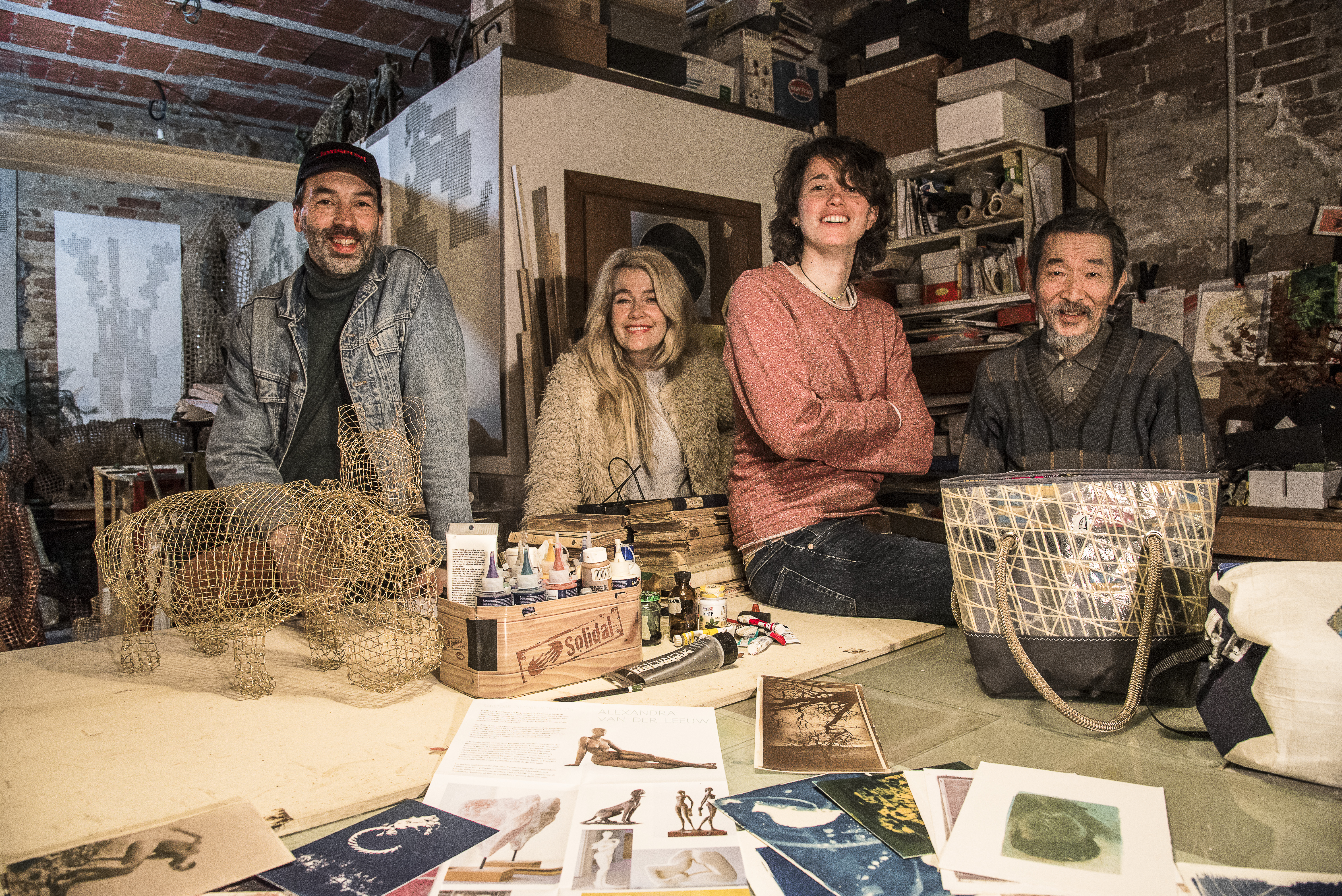
Documentary, by Naù Germoglio, Italy, 2020
In a former warehouse on the ground floor of the civic number "2091", in the district of “Santa Croce” in Venice, two sculptors, a craftswoman and an alchemist-photographer work together. It is a 65 square meters space with two windows overlooking a small canal. It is called "STUDIO2091" and it is a unique example of creative co-working space where there is no wifi connection, the cellphones work very bad, there are no tables for meetings, nor computers.
His "tenants" carry out only manual activities related to art and crafts. Each of them has a different reason to live in Venice, a beautiful and unique city, yet expensive, problematic, overrun by mass tourism and high tide. The photographer-alchemist Andrea Buffolo, who was born in Switzerland,is the only one who has spent almost all his life in the historical center of Venice. Japanese sculptor Masaru Kashiwagi chose to live in Venice 35 years ago, because he considers it the only city in the world perfect for an artist; the craftswoman Camilla Morelli was born and raised in Valtellina ( a valley in the Lombardy region of northern Italy), and although she grew up in the mountains, she chose to live in Venice to enjoy the proximity to the sea; the Dutch painter and sculptor Alexandra Van der Leeuw lives on the island half of the year carrying on a family tradition. The four protagonists of the documentary film chose to live in Venice because here,and only here, they succeed in being themselves, realizing themselves and feeling free.
SUBTITLES: English, Spanish, French, German, Portuguese
How the Enlightenment Split Making from Thinking
You are handed a blueprint you did not design, told to execute it faithfully, and the moment you execute it beautifully, someone else signs the work. This is not a contemporary anxiety about authorship — it is an institutional arrangement that was engineered with remarkable precision over the course of roughly a century, beginning somewhere around the 1740s, and the blueprint for that arrangement was philosophical before it was bureaucratic.
The Greeks had never cleanly separated the hand from the mind. Techne — the word that gives us both “technique” and “technology” — described a form of knowing that lived inside doing. When Aristotle distinguished techne from episteme in the Nicomachean Ethics, he was not demoting it; he was mapping different territories of intelligence. A shipwright who could read the grain of wood, predict how a hull would behave in a following sea, and adjust his joinery accordingly possessed knowledge that was no less rigorous for being embodied. The separation that followed was not a refinement of Aristotle’s taxonomy — it was a violent simplification of it.
Immanuel Kant‘s Critique of Judgment, published in 1790, is the document that crystallizes the rupture. Kant distinguishes “free beauty” from “dependent beauty,” and within that framework, art produced for pay or utility operates under a fundamental handicap — it answers to an external purpose, which for Kant contaminates aesthetic purity. The artisan, however skilled, is in a condition of what Kant calls “mechanical art,” a phrase he uses without apology to indicate a lesser category of human making. Genius, in his account, belongs exclusively to fine art, and fine art is precisely that which cannot be taught or transmitted through practice — it descends, or it does not come at all. The effect of this formulation on the institutional landscape of Europe was not subtle.
The Académie Royale de Peinture et de Sculpture, founded in Paris in 1648, had already begun the work of separating painters and sculptors from the guild system — physically removing them from the trades, granting them proximity to the court, and redefining their labor as intellectual rather than manual. By the time the École des Beaux-Arts consolidated its curriculum in the early nineteenth century, the hierarchy was fully architecturalized: drawing from classical models, theoretical composition, historical narrative — these were the legitimate pursuits. Ornament, joinery, textile work, ceramic glazing — these were what you did if your mind could not ascend. The distinction between the fine arts and the decorative arts was not discovered; it was legislated.
What this legislation accomplished was a kind of epistemological dispossession. Entire categories of skill — the dyer’s knowledge of mordants and fiber, the cabinetmaker’s understanding of how humidity moves through figured walnut, the glassblower’s reading of heat through color — were reclassified as mere execution. Knowledge that had taken generations to accumulate and that could not be fully verbalized, because its medium was the body and the material rather than the sentence, was declared not to count as knowledge at all. Richard Sennett, in The Craftsman published in 2008, identifies this as a pathology specific to modernity: the inability to grant cognitive dignity to tacit knowledge, to understanding that is inseparable from the act of making.
The consequences arrived not as philosophy but as wages, as social address, as whose name appeared on the invoice and whose did not. The craftsman who spent four years learning to lay marquetry so that the grain formed a continuous optical illusion across a drawer front was, by the new taxonomy, performing a mechanical operation. The painter who produced a vast allegorical ceiling in six months was exercising genius. That the ceiling cracked and the drawer still opens without protest three hundred years later was not the kind of evidence the new epistemology had any mechanism for receiving.

The Guild System as Suppressed Epistemology

You are handed a chisel on your first day, and you are told nothing. You watch. You carry. You clean. For months, sometimes a year, you do not touch the stone that matters — and this is not hazing, not hierarchy for its own sake. It is epistemology. The knowledge being transmitted cannot survive being spoken aloud, because it does not live in language. It lives in the wrist, in the eye, in the moment of resistance a material offers just before it yields, and that moment has no synonym.
Medieval guild structures — the Florentine Arte della Lana, the Parisian jurandes, the London livery companies that held legal charters by the twelfth century — were not trade associations in the contemporary sense. They were custodial systems for a category of knowledge that academic philosophy had not yet developed the vocabulary to name. What we would later call tacit knowledge, the concept Michael Polanyi spent the better part of the 1950s trying to articulate in works like Personal Knowledge, was already being institutionally protected and transmitted six hundred years earlier, by men who could not have defined it but who understood instinctively that it would die if it were left unguarded. The guild did not merely regulate wages and market access. It structured the conditions under which knowing was possible.
The apprenticeship period was not preliminary to the craft. It was the craft in its most fundamental form: the cultivation of perception before production. A goldsmith’s apprentice in fifteenth-century Bruges spent years learning to see before he learned to make, training his senses to detect what no instrument of the time could measure — the temperature of a flame by its color, the purity of an alloy by its smell when cut, the structural integrity of a joint by the sound it made under pressure. This was empirical investigation, conducted without the apparatus of what Francis Bacon would later, in 1620, codify as the scientific method. The workshop preceded the laboratory not chronologically but philosophically, establishing that knowledge emerges from disciplined contact with resistant matter, not from detached observation.
What the Enlightenment did to this system was not simply to displace it economically. It delegitimized it ontologically. The sharp division Descartes installed between res cogitans and res extensa — thinking substance and extended matter — made it philosophically incoherent to claim that genuine knowledge could originate in the hands. If mind and body were categorically separate, then what the craftsman’s body knew could not, by definition, constitute real knowledge. It was mere mechanical routine, reproducible by anyone trained sufficiently, or eventually by no one at all since a machine would do it better. The guild’s suppression in France was formalized by the Allarde and Le Chapelier laws of 1791, justified in the language of economic liberty, but the conceptual groundwork had been laid a century earlier. You do not dismantle an institution without first making it intellectually invisible.
This is where the historical injury becomes precise. It was not that industrialization destroyed craftsmanship — steam power and the loom cannot be held responsible for a philosophical decision. The injury was that a specific theory of mind rendered invisible an entire category of human knowing, and the economic transformation that followed confirmed the verdict. When the Encyclopédie of Diderot and d’Alembert devoted its magnificent illustrated plates to the mechanical arts in the 1750s, it was performing a kind of rescue operation, insisting that the techniques of the dyer, the glassblower, and the printer deserved documentation alongside the theorems of mathematics. But documentation is already a concession to loss. You write down what you fear will not survive in the body.
The master who never explained anything was not withholding. He was acknowledging that some knowledge refuses the medium of words and will die the moment you attempt the translation.
Richard Sennett and the Cognition Embedded in Repetition
You are halfway through learning something when your hands stop needing your permission. A glassblower working a 2,200-degree gather of molten silica does not think about the angle of rotation — the angle thinks itself through years of accumulated negotiation between the body and the material, a dialogue so dense with history it has become reflex. This is not a romantic image. It is a cognitive fact that mainstream psychology has systematically undervalued, because it does not appear on any standardized test and cannot be extracted from the person who holds it.
Richard Sennett, in his 2008 book The Craftsman, dismantles the inherited Enlightenment assumption that thinking precedes and governs making. The classical model — Descartes’ res cogitans elevated above res extensa, mind as master, hand as servant — has never accurately described what happens inside a workshop. Sennett’s argument is not sentimental nostalgia for premodern labor. It is a clinical observation: the hand, over time, becomes a problem-solving organ in its own right, encoding solutions that the brain cannot always articulate. The skilled craftsperson often cannot tell you why they made a particular adjustment. The knowing lives below the verbal threshold, which is precisely why it cannot be transferred by instruction alone.
The ten-thousand-hour figure, popularized and subsequently distorted by decades of self-help literature, was drawn from Anders Ericsson’s research on deliberate practice published in the early 1990s. What the popularizers buried was Ericsson’s insistence that those hours are not neutral repetition — they are repetition structured by feedback, failure, and incremental correction. Sennett takes this further: the accumulation is not of automatic responses but of a vast internal library of problems encountered and partially or fully solved, a library that reshapes the practitioner’s perception itself. A master cabinetmaker does not see a piece of wood the way an apprentice does. They see a history of grain behaviors, a catalogue of past splits and resistances, a set of potentials and warnings invisible to untrained vision. Perception has been rebuilt from the inside.
This has implications that most discussions of intelligence refuse to follow to their logical end. The dominant Western framework has measured cognitive capacity almost exclusively through linguistic and logical-mathematical aptitude — the two dimensions privileged in Howard Gardner’s own critique of IQ testing, though Gardner’s 1983 theory of multiple intelligences was itself quickly domesticated by educators who used it to make every child feel talented without restructuring what actually gets rewarded. What craft mastery reveals is a form of intelligence that is non-transferable by language, non-assessable by examination, and non-separable from the material context in which it developed. It is, in the strictest sense, untestable by the instruments society has built to determine human worth.
The institutional consequence of this blind spot is not abstract. Vocational training programs across Europe and North America were gutted systematically through the latter half of the twentieth century, precisely as cognitive prestige concentrated around university credentialing. Germany stands as an anomaly: its dual apprenticeship system, which pairs workplace training with technical schooling and has remained structurally intact since the postwar reconstruction, produces skilled tradespeople whose economic productivity the OECD has documented as central to German manufacturing’s global competitiveness. The system works not because Germany is culturally predisposed to discipline, which is the comfortable myth, but because it institutionally validates a form of knowing that elsewhere gets classified as lesser.
What craft intelligence destabilizes is the hierarchy of knowing itself — the quiet assumption that the person who can explain what they know occupies a higher order of mind than the person who can only demonstrate it. Explanation is a form of translation, and all translation loses something. The glassblower who cannot tell you why the piece survived the annealing process while the previous one shattered is not intellectually deficient. They are in possession of knowledge that language has not yet found a way to carry, and may never find.
The Arts and Crafts Movement as Misread Nostalgia
You are handed a beautifully bound copy of “The Stones of Venice” and told it is a lament for a lost world. That framing is so comfortable, so easily absorbed, that almost no one stops to notice it is also entirely wrong.
John Ruskin published that work in three volumes between 1851 and 1853, and what he was actually doing — beneath the architectural description, beneath the Gothic revival aesthetics — was constructing a forensic account of how a civilization degrades its workers by removing from them the capacity to make decisions. The chapter on the nature of Gothic is not a piece of medieval nostalgia. It is a clinical argument: that the imperfection visible in hand-carved stonework is not a flaw to be corrected but the legible trace of a human mind at work, making choices, encountering resistance, solving problems in real time. The moment you standardize the outcome and eliminate deviation, you have not improved the product — you have erased the worker’s cognitive presence from it entirely. Ruskin was not mourning cathedrals. He was describing what it costs a human being to produce something they are not allowed to think about.
William Morris absorbed this and built an entire political economy around its implications. By the 1880s he had moved well past decorative wallpaper and textile revival — he was writing essays and delivering lectures that situated craft production as a form of dignity that industrial capitalism had made structurally impossible. “Useful Work versus Useless Toil,” published in 1885, makes the argument without softening: that work which offers no creative engagement to the person performing it is not work at all in any meaningful sense but a form of slow mutilation dressed in the language of productivity. The Arts and Crafts movement that coalesced around him and through the network of guilds established in the late 1880s — the Century Guild in 1882, the Art Workers’ Guild in 1884, the Arts and Crafts Exhibition Society in 1888 — was not a collection of aesthetes playing with looms. It was a coordinated attempt to demonstrate, through actual production, that the relationship between a human being and the thing they make is not incidental to human psychology but central to it.
What makes the parallel with Marx so unsettling is not that the two traditions agreed on solutions — they emphatically did not — but that they were diagnosing the same wound from opposite ends of the body. Marx’s concept of estranged labor, developed in the Economic and Philosophic Manuscripts of 1844, identifies four dimensions of alienation, one of which is the worker’s separation from the product: the object leaves the worker’s hands and becomes something foreign, something owned by another, something that exercises power over its own maker. The Gothic stonecutter that Ruskin described had authorship over the decision — the angle of the chisel, the depth of the cut, the resolution of an unforeseen problem in the grain of the stone. The factory operative in Birmingham in 1880 had no such authorship. The object that emerged from the line was not theirs in any sense that touched their sense of self.
What neither tradition fully anticipated was how thoroughly this condition would migrate upward through the social hierarchy rather than being solved within it. The administrative worker of the late twentieth century, generating reports whose conclusions were predetermined by the metrics their supervisors had already decided to care about, inhabits the same structural position as the piece-rate factory hand — except with better lighting and the added cruelty of being told they are engaged in meaningful knowledge work. The guild movement tried to preserve authorship by shrinking the scale of production. What it could not account for is a world in which the erasure of authorship becomes the dominant organizational logic regardless of whether the hands are holding a shuttle or a spreadsheet, and whether the ceiling above them is a Victorian mill or a glass-walled open-plan floor designed, very deliberately, to feel like freedom.
A vision curated by a filmmaker, not an algorithm
In this video I explain our vision
Mingei, 柳宗悦, and the Politics of Anonymous Beauty

You are holding a rice bowl. It was made somewhere in rural Korea, probably in the nineteenth century, by someone whose name was never recorded anywhere, and it is one of the most beautiful objects you have ever seen. You do not know why. The glaze has run unevenly down one side. The rim is not quite level. By every criterion your education has given you for evaluating art — intentionality, authorship, conceptual originality, the signature as certificate of significance — this object should not move you. And yet it does, with a force that signed canvases hanging in climate-controlled rooms rarely manage.
Yanagi Soetsu encountered exactly this experience in 1914 when he first saw Korean folk ceramics, and spent the next three decades trying to account for it philosophically. What emerged from that effort was mingei — a term he coined in 1925, compressing the Japanese words for “people” and “craft” — a framework that proposed something genuinely radical: that the highest aesthetic experiences available to human beings might be embedded not in the singular masterwork produced by the celebrated individual, but in the anonymous, the utilitarian, the endlessly repeated. His 1926 essay collection and the subsequent 1928 founding of a mingei movement with potters Hamada Shoji and Kawai Kanjiro constituted a direct attack on the Western Romantic inheritance that had defined artistic value through the uniqueness of the creator’s vision since at least Vasari’s Lives of the Artists in 1550.
The philosophical mechanism Yanagi reached for was Buddhist, specifically the concept of tariki — “other-power” — the idea that the most profound states are not achieved through individual striving but through a kind of surrender to forces larger than personal intention. When a craftsperson makes the same bowl ten thousand times for functional use, the ego’s interference gradually diminishes. The hand learns to move without the self watching itself move. Yanagi argued that this evacuation of self-consciousness was precisely what produced beauty — not the artist’s unique gesture but the absence of the artist as a distinct, asserting subject. The object becomes beautiful in the way a river stone becomes smooth: through a process that exceeds any single will.
This is a destabilizing proposition for any culture built around intellectual property law, gallery attribution, and the auction market’s dependence on provenance. The entire apparatus of Western art valuation since the Renaissance rests on the premise that a work’s worth is indexical to its maker’s identity — that knowing who made something changes what it is. Arthur Danto articulated this dependency most clearly in his 1981 The Transfiguration of the Commonplace, where he argued that the institutional and biographical context surrounding an object is what converts it into art. Yanagi’s mingei objects expose the limit of that argument by being genuinely indifferent to it. They do not know they are beautiful. They were made to carry rice, store salt, wrap bodies against cold. Their beauty arrived unbidden, through function and repetition and the grain of local materials, and it persists regardless of whether any institution certifies it.
There is a political edge to this that Yanagi himself did not always reckon cleanly with. His collection of Korean and Okinawan folk objects occurred against the backdrop of Japanese imperial occupation of both territories. The very anonymity he celebrated was partly a product of colonial conditions under which individual artisans had little access to the kind of recognition that might have preserved their names. Celebrating anonymous beauty without confronting the structures that enforced that anonymity risks aestheticizing dispossession — transforming historical violence into a condition for refined contemplation. Craft philosopher Glenn Adamson noted this tension directly in his 2013 The Invention of Craft, arguing that mingei’s universalizing aesthetics sometimes served to depoliticize the very labor relations it claimed to honor.
What mingei leaves intact, even after that critique, is a genuine question that the Western signature system still cannot answer: whether the name attached to a beautiful thing is its cause or merely its bureaucratic trace.
The Museum as the Craft Object's Coffin
You walk into a room where light falls at a calculated angle onto a ceramic bowl sealed behind glass, and you understand immediately that you are not supposed to touch it. The prohibition is the point. The distance is the message. What the institution has done, with extraordinary care and considerable expense, is remove the object from every condition that once gave it meaning and present that removal as reverence.
When Henry Cole and the Board of Trade established the Museum of Manufactures in 1852 — later to become the Victoria and Albert — the stated intention was educational: to elevate public taste, to close the gap between British industrial production and the superior decorative traditions of continental Europe exposed so brutally at the Great Exhibition of 1851. The logic was reformist, almost utilitarian. But the mechanism chosen was entombment. Objects made by hand for use, for daily negotiation with the physical world, were extracted from circulation and placed under the sovereignty of aesthetic contemplation. The bowl that a family in Staffordshire had eaten from, repaired, handed down, and eventually broken was replaced in the cultural imagination by its museum-perfect twin, untouched, undamaged, eternal — and therefore no longer a bowl in any functional sense, but a proposition about what bowls should be.
Walter Benjamin saw this operation clearly, though he described it in the register of reproduction rather than preservation. What he called the aura of an object — its embeddedness in a particular place, a particular history of hands and uses — is not protected by the museum; it is converted by the museum into something else entirely, into the performance of aura, which is a fundamentally different thing. The authentic object behind glass radiates a kind of theatrical authenticity, which is to say it radiates nothing at all except the institution’s authority to declare it significant. The craft object’s original authority came from the opposite direction: not from declaration, but from accumulated use, from the way a handle had worn smooth in a specific grip, from the crack repaired with lead or kintsugi gold that recorded a moment of breakage someone had decided to survive.
The anthropologist Alfred Gell argued in his 1998 work Art and Agency that objects are not passive recipients of meaning but active participants in social relationships — they have what he called distributed personhood, carrying within them the traces of their makers, their users, their entire relational history. The museum severs these relations surgically. It does not preserve the object; it preserves the object’s corpse. What remains is the material substrate, the clay and glaze and form, stripped of the network of dependency and use that constituted the object’s actual existence as a human artifact. A quilt behind glass is no longer a quilt. It is evidence that a quilt once existed.
There is something more troubling underneath this, something the institution cannot acknowledge without undermining its own authority. The objects most aggressively collected and preserved tend to be the ones made by people who had no expectation of being collected, who made things to be used until they broke and then replaced. Folk pottery, vernacular furniture, peasant textiles — these entered the museum precisely because industrial production had rendered them obsolete and therefore picturesque. The institution arrived in the same historical moment as the factory, and it is not accidental that the two share a patron: the state’s interest in documenting what capital has destroyed. Preservation and destruction are not opposites in this economy; they are consecutive gestures of the same hand, one erasing the living practice, the other framing its remains.
What no museum catalogue can replicate is the epistemology embedded in the making — the knowledge that lives only in the relationship between a trained body and resistant material, knowledge that cannot be extracted from practice and stored behind glass because it was never located in the object to begin with.
Mastery Without an Audience
You are alone in a room with something that is not yet what it will become, and no one is watching. The material resists. Your hands know something your mind hasn’t caught up to yet. There is no documentation of this moment, no frame around it, no metric by which its value can be measured against anything else happening simultaneously in the world. And here, in this unobserved interval, something either happens or it doesn’t.
The cultural machinery surrounding contemporary making has systematically colonized exactly this interval. What was once the interior space of practice — where the work taught the worker, where failure was formative rather than embarrassing — has been turned outward, made legible, given a timestamp and a caption and an audience measured in numbers that refresh every few seconds. Richard Sennett, in The Craftsman published in 2008, argued that genuine skill requires a minimum of ten thousand hours of absorption into a discipline before the hand begins to think autonomously. What he identified was not a technique but a tempo — a biological and cognitive rhythm that cannot be compressed, performed, or streamed. The tragedy is not that people lack time. The tragedy is that the interval has been filled with the obligation to demonstrate that the interval is happening.
Performance theory offered its own account of this pressure long before social media made it structural. Erving Goffman’s 1959 analysis in The Presentation of Self in Everyday Life described how human beings manage impressions across a front stage and a back region — and what he identified as threatening to social coherence was precisely the collapse of that distinction. When the backstage is abolished, when the rehearsal becomes the show, the self has nowhere to reconstitute itself. The craftsperson operating under continuous visibility is in the same position: the studio becomes a set, the making becomes content, and the actual cognitive labor of working through uncertainty gets edited out in favor of a timeline of competence.
There is a word in Japanese aesthetic philosophy — shokunin — that carries no clean translation into English. It refers to a craftsperson who has devoted themselves so completely to a practice that the distinction between the person and the work becomes philosophically unstable. The shokunin does not make objects; the shokunin is the condition under which objects of a certain quality can exist. What this concept quietly refuses is the idea that skill is a property that can be displayed. Skill, in this register, is not a performance but a form of presence — one that requires, structurally, the absence of an external gaze to achieve its deepest operations.
Simone Weil, writing in the early 1940s in what would become The Need for Roots, described the experience of factory labor as spiritually annihilating not primarily because of physical conditions but because it severed workers from the capacity to exercise attention in its fullest sense. Attention, for Weil, was not concentration — it was a kind of radical receptivity, a willingness to be changed by what you encounter rather than simply processing it. The craftsperson who is documenting the process has redirected that attention outward, toward the future viewer, and in doing so has fundamentally altered the nature of the cognitive act they are performing. They are no longer attending to the material. They are attending to the image of themselves attending to the material.
What visibility culture cannot metabolize is the maker who refuses the frame entirely — not as a political gesture, not as a brand of austere authenticity, but simply because the work requires it. The unseen condition is not a sacrifice. It is the structural prerequisite for a certain quality of attention that produces, across centuries and traditions, the objects that outlast the names of those who made them — things held in museums without biographical placards, found in attics without provenance, recognized immediately by the hands as something made by someone who was, in the moment of making, completely and irrecoverably alone with the work.
🛠️ The Art of Making: Craft, Beauty, and Human Mastery
Craftsmanship as an art form raises profound questions about the relationship between skill, intention, and aesthetic meaning. From the restoration of cultural heritage to the philosophical underpinnings of artistic creation, these articles explore how human hands and minds transform raw material into lasting culture.
Cultural Heritage Restoration: History and Methods
The restoration of cultural heritage is itself a form of craftsmanship that demands both technical precision and philosophical awareness. This article traces the history and methods of conservation, exploring how restorers navigate the tension between preserving the original and interpreting its meaning for future generations. It is an essential reflection on what it means to care for the works human hands have made.
GO TO THE SELECTION: Cultural Heritage Restoration: History and Methods
Ernst Gombrich: Life and Works
Ernst Gombrich devoted his life to understanding how images are made and perceived, situating craftsmanship at the very heart of art history. His work explores the psychological and cultural mechanisms that transform skilled making into shared aesthetic experience. Reading Gombrich means asking why some objects made by human hands endure as art while others fade into mere utility.
GO TO THE SELECTION: Ernst Gombrich: Life and Works
Comics as Art Form: History and Theory
Comics as an art form challenge conventional hierarchies between fine art and popular craft, revealing how sequential drawing demands extraordinary discipline and vision. This article traces the history and theory of the medium, from its origins as commercial entertainment to its recognition as a legitimate form of artistic expression. It is a vivid reminder that craftsmanship can flourish in unexpected creative territories.
GO TO THE SELECTION: Comics as Art Form: History and Theory
Pierre Bourdieu and the Artistic Field
Pierre Bourdieu‘s analysis of the artistic field offers a sociological lens through which to understand how craft and art are valued, legitimized, or dismissed by cultural institutions. His framework reveals the hidden power structures that determine which forms of making are celebrated as high art and which are relegated to mere manual skill. This article is indispensable for anyone wishing to understand the politics behind aesthetic judgment.
GO TO THE SELECTION: Pierre Bourdieu and the Artistic Field
Discover the Cinema of Craft and Creation on Indiecinema
If these reflections on craftsmanship, beauty, and artistic philosophy have stirred your curiosity, Indiecinema is the streaming platform where cinema itself becomes a handmade object of thought. Explore our curated selection of independent and auteur films that treat filmmaking as a true art form, with the same devotion and rigor that the greatest artisans have always brought to their work.
👉 EXPLORE THE CATALOG: Watch Indie Films in Streaming
A vision curated by a filmmaker, not an algorithm
In this video I explain our vision

