
The Social Contract Hidden Inside Every Legend
You are eight years old and someone older than you — a cousin, a neighbor, an uncle with a taste for theater — leans close in a darkened room and tells you about the woman who appears on roads at night, her white dress soaked through, her face turned just slightly away. You don’t ask whether it’s true. The question doesn’t form. Something in the telling has already bypassed the rational checkpoint and lodged itself somewhere older, somewhere that doesn’t traffic in evidence. What was transferred to you in that moment was not a story. It was a jurisdiction.

Legends have always been misread as entertainment, as cultural decoration, as the primitive residue of minds that hadn’t yet learned to explain lightning or disease through mechanism rather than will. This is one of the most comfortable and most ruinous misunderstandings that modernity produced. A legend is not a failed attempt at science. It is a fully successful attempt at governance — internal, communal, and largely invisible to those it governs. The people who repeat these narratives are not confused about the nature of reality. They are, often without knowing it, administering a shared code about what exists, what is permitted, and what must be kept out of the light.
Émile Durkheim argued in The Elementary Forms of Religious Life, published in 1912, that what societies call sacred is not a quality found in objects or beings themselves but a projection of collective force — a way that the group stamps its authority onto the world by declaring certain things untouchable, certain thresholds absolute. The sacred, in his account, is the social made cosmic. What he observed in the ritual systems of Australian Aboriginal communities applies with disturbing precision to the ghost story told in a Mexican village, the cautionary tale about the forest that survives in Romanian oral tradition, the urban legend that circulates in São Paulo apartment buildings about the thirteenth floor. Each of these is a collective representation — Durkheim’s term for the mental objects that a society holds in common, that no individual invented and no individual can simply discard. They are heavier than personal belief because they don’t belong to any single person.
What the legend encodes is rarely what it appears to be about. The woman in the white dress is not, at bottom, about a woman or a dress or a road. She is about the boundary between domestic safety and unsanctioned movement, about what happens to femininity that refuses containment, about the community’s need to make certain kinds of transgression feel cosmically punished rather than merely socially disapproved. The horror is the mechanism. Terror is how the contract gets signed without a pen ever touching paper. And because the signing happens below the level of conscious agreement, the clause cannot be challenged the way a written rule can be challenged — you cannot argue with the cold feeling in your stomach when the story is told well.
Sociologist Eviatar Zerubavel, in his 1991 work The Fine Line, mapped the human compulsion to draw absolute distinctions between categories that are, in practice, deeply ambiguous — the living and the dead, the clean and the contaminated, the human and the monstrous. Legends cluster precisely at these borders. They are not generated randomly. They erupt wherever the community has drawn a line it cannot rationally defend but cannot emotionally afford to abandon. The monster does not appear in the open field. It appears in the doorway, in the threshold, at the edge of the village, in the hour between darkness and dawn. Topology in legends is never accidental. The geography of fear maps exactly onto the geography of what the community has agreed, silently and collectively, it cannot afford to question.
This is what the child in the dark room receives and does not know they have received: a map of what their world requires them never to look at directly.
The Witches of Mount Sciliar
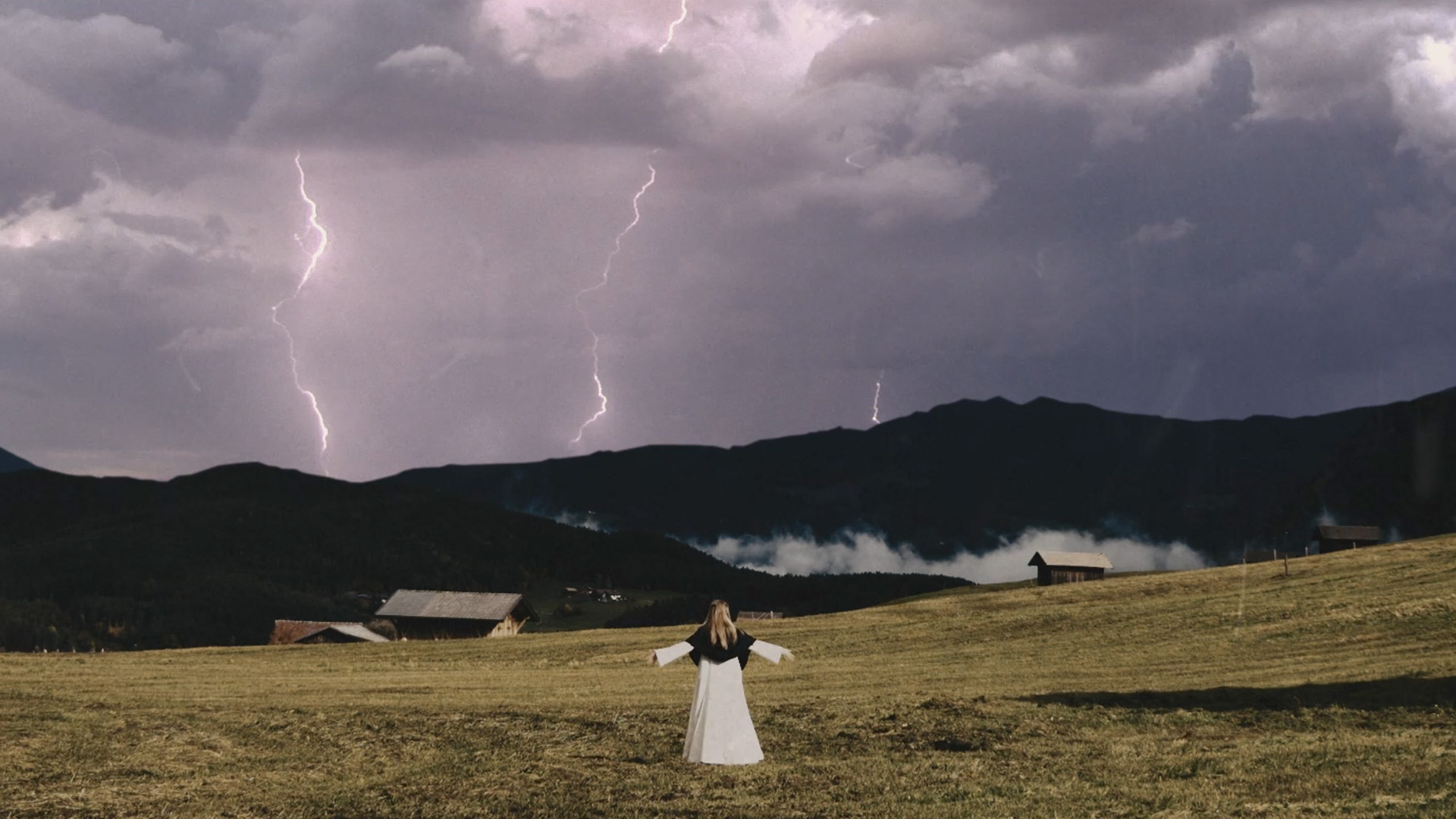
Docufiction, by Andrea Dalfino, 2022, Italy.
The Witches of Scillar is a documentary that delves deeply into the trials that took place in Alto Adige, in Castel Presule and surrounding areas at the beginning of the 16th century, following which more than 10 were condemned to the stake on charges of witchcraft, becoming the real and precursors of the infamous Witch Hunt. Starting from the analysis of the historical context and intertwining local legends with actual events and analyzing the locations of the events with the help and guidance of experts, this film offers a new historical perspective on what happened, culminating with the exposition of what remains of the witches in South Tyrol today and how the crimes of the inquisition are judged in retrospect today.
Alto Adige is a land full of mystery, where history and legend are intertwined, with its magical and fascinating scenarios that push the mind and imagination to wander, investigate, discover. Here is the Sciliar, a suggestive mountain massif located in the natural park of the same name against the backdrop of the Dolomites, and no other mountain is so full of myths and legends as this one, on which it is said that fairy creatures and spirits of all sorts live , and in the Middle Ages it was held up as a meeting place for witches and devils. Here, during the time of the Inquisition, 10 women accused of witchcraft were tried and killed. Director Andrea Dalfino made the documentary The Witches of the Sciliar, enriching the film with fictional scenes that retrace the intricate events of the Fiè trial.
LANGUAGE: Italian
SUBTITLES: English, Spanish, French, German, Portuguese
Myth as the First Form of Political Control
You are sitting in a temple — not as a worshipper, exactly, but as someone who has run out of alternatives. The harvest failed. The river rose wrong. Someone in the village died badly and no one knows why. The priest steps forward, and what he offers you is not comfort in any simple sense. What he offers you is causality. He tells you that the gods demanded something, that the order of things was disrupted, that the suffering you are experiencing is the legible consequence of a legible transgression. The suffering had a reason. And the reason, it turns out, requires his interpretation to be understood.
This is not incidental to the history of myth. It is the hinge on which the whole architecture turns. Georges Dumézil, whose three-volume Mythe et épopée published between 1968 and 1973 reshaped the study of Indo-European cultures, demonstrated that across civilizations as geographically distant as Vedic India, ancient Rome, and pre-Christian Scandinavia, the same structural division kept appearing: sacred sovereignty at the top, warrior function in the middle, and productive labor at the base. What stunned scholars was not merely the structural parallel but the mythological machinery built to make it seem inevitable. The gods themselves were organized this way. Jupiter, Mars, and Quirinus in Rome. Mitra-Varuna, Indra, and the Ashvins in the Rigveda. Odin, Thor, and Freyr in the Norse pantheon. The cosmos had already made the decision. Human hierarchy was simply its faithful reflection.
This is the specific genius of narrative as a tool of control: it relocates the origin of social arrangement outside of human decision. Laws can be challenged because laws are made by people. But if the three-part division of society is embedded in the story of how reality itself was structured at the moment of creation, then questioning it is not political dissent — it is metaphysical error, a misunderstanding of the nature of things. The priests who maintained the sacred fire in Vedic ritual were not just performing ceremony. They were embodying proof. Their function existed because the universe required it. To question the priest was to question the design of the cosmos, and that was not a grievance anyone could file.
What made this system extraordinarily durable was its capacity to absorb contradiction without collapsing. When a king behaved badly, the myth did not indict the institution of kingship — it produced a story about the king’s personal failure to embody the sacred trust. The structure remained untouched. Mauss, working decades before Dumézil in his 1925 Essai sur le don, noticed something adjacent to this in gift economies: the moral weight attached to reciprocity was so saturated with mythological meaning that what looked like a voluntary exchange was in fact an obligation enforced by supernatural sanction. The gift was never just a gift. It was a performance of cosmological alignment, and to refuse it was to break something that preceded human law entirely.
What gets called mythology in retrospect was, in its living moment, closer to what we would now call constitutional law — except unwritten, unquestionable, and guarded by the only people who had memorized its full text. Literacy concentrations in priestly classes across Mesopotamia, Egypt, and early Mesoamerican civilizations were not accidental. The ability to read and write the sacred narratives was itself a form of territorial enclosure. Knowledge of the myth was not broadcast; it was rationed. And what the general population received was the emotional residue of stories whose structural logic remained deliberately opaque — enough to feel the weight of the sacred, never enough to examine its load-bearing walls.
The terrifying elegance of this arrangement is that it required no conspiracy to perpetuate.

The Dark Myth as Psychological Quarantine
You already know what it feels like to stand at the edge of something you are not supposed to want. The feeling arrives before the thought does — a pull toward the wrong person, a satisfaction at someone else’s misfortune, a rage so clean it almost feels like joy. And then, almost simultaneously, the internal machinery kicks in: shame, rationalization, the practiced art of not quite acknowledging what just moved through you. You have been performing this maneuver your entire life without ever asking who built the stage.
Sigmund Freud identified in 1919, in his essay “Das Unheimliche,” a precise quality of terror that is not produced by the foreign but by the familiar gone wrong — the uncanny, that particular dread triggered by what should have remained hidden but has returned to the surface. His central claim was that the most disturbing figures in folklore were not inventions of pure imagination but projections of repressed interior content: the double, the automaton, the severed hand that moves on its own are each a piece of psychic material the conscious mind has refused to integrate, animated and thrown outward onto a fictional screen. What the culture cannot bear to name in itself, it names in the monster.
Ernest Jones, writing in 1931 in “On the Nightmare,” pushed this architecture into anthropological territory with uncomfortable precision. His analysis of incubus and succubus legends — the nocturnal demons who paralyze and violate sleepers across European, Arabic, and West African traditions simultaneously — revealed not a shared supernatural event but a shared psychological crisis. These creatures appear with remarkable consistency wherever human communities have needed to simultaneously preserve strict sexual codes and survive the existence of desire that violates them. The demon becomes the author of what the person cannot claim as their own will. This is not metaphor. It is a genuinely functional social technology: the legend provides a container for an experience that would otherwise fracture both the individual’s self-image and the community’s moral architecture.
What makes this particularly worth examining is that the quarantine is never neutral. When a culture decides which impulses require monstrous vessels, it is making a political decision dressed in supernatural clothing. Grief that refuses to end becomes the ghost who will not leave — and in doing so transforms mourning from a legitimate human duration into a pathological attachment requiring ritual correction. Female sexual appetite becomes the lamia, the strix, the succubus — projections that accomplish something remarkably efficient: they allow male desire to remain unmarked and natural while female desire acquires scales and claws. The monster does not simply absorb the impulse. It condemns it.
Rebellion follows the same mechanism with even greater ideological efficiency. Georges Dumézil’s comparative mythological work across Indo-European traditions, particularly in “Mitra-Varuna” published in 1940, demonstrated that the figures positioned as cosmic transgressors — those who challenge divine or social order — are almost invariably endowed with genuine power before their demonization. Loki is genuinely creative before he becomes the agent of apocalypse. Prometheus does deliver fire. The transgressor in dark myth is rarely portrayed as simply wrong — they are portrayed as dangerously right about something the order cannot afford to admit. The monster must be made seductive before it can be made monstrous, because what is being quarantined is not evil but unauthorized competence, unauthorized grief, unauthorized hunger.
This means every culture’s archive of dark myths functions simultaneously as a map of its suppressions. To read the monsters of any historical moment is to read what that community was actively refusing to metabolize — and therefore what it was building tremendous invisible pressure to contain. The Puritan witch trials of 1692 produced not one uniform monster but a very specific one: women with social friction, widows with property, the elderly outside networks of dependence. The supernatural charge simply designated who was already disturbing the arrangement.
The Fabrication of the Villain Across Cultures
You have met the villain before you understood what a villain was. The figure arrived early — in the story told at the edge of your bed, in the shape moving through the forest at the back of every tale — and it carried a face that was never quite one of yours. That distance was not accidental. The outsider’s features, the stranger’s gait, the woman who lived beyond the village boundary: these were not borrowed from imagination but harvested from social life and pressed into mythic form with extraordinary deliberateness, culture after culture, century after century, until the fabrication became invisible beneath the weight of its own repetition.
René Girard spent the better part of four decades mapping this mechanism with the precision of a surgeon. In his 1972 work La Violence et le Sacré and later in Le Bouc Émissaire in 1982, he demonstrated that communities do not generate the scapegoat accidentally — they require one structurally, the way a pressure valve requires a release point. When internal tensions accumulate to an unbearable pitch, the group converges on a figure who differs just enough from the norm to bear the weight of collective accusation without triggering the solidarity that would protect an insider. The mythology produced afterward is not a record of what happened. It is a laundering operation, transforming an act of communal violence into a story of cosmic necessity.
The features assigned to the mythic villain are therefore not random. They map precisely onto the characteristics of whoever occupies the least protected social position at any given historical moment. In medieval European communities, the woman who lived alone, who owned knowledge of herbs and animal behavior, who had no husband to translate her existence into legible social categories, became the witch not because witchcraft existed but because she existed outside the structures that would have made her explainable and therefore safe. The great witch trials of the sixteenth and seventeenth centuries — the Malleus Maleficarum published in 1487 setting the template, the executions in Salem in 1692 providing its American repetition — were not aberrations in an otherwise rational cultural history. They were the mythic mechanism made bureaucratic, the scapegoat function industrialized.
The heretic occupied the same structural position in religious communities. It was never the content of the heterodox belief that drove the persecution, because inquisitors frequently had difficulty articulating exactly what the condemned had taught. What mattered was the departure from consensus, the body that refused to mirror the collective back to itself. The Cathars of southern France, systematically destroyed in the Albigensian Crusade launched in 1209, were absorbed into the mythology of Christendom as agents of darkness not because their theology was demonstrably more violent or more dangerous than the theology that exterminated them, but because they had organized an alternative social coherence that made the dominant one feel contingent rather than inevitable.
What no culture has found easy to confess is that the monster it names in its mythology is always a portrait of what it fears discovering about itself. The violence attributed to the outsider — the poisoning of wells, the ritual killing, the pact with destructive forces — is precisely the kind of violence the community is already practicing or contemplating. Projection this systematic does not arise from individual psychology. It arises from a collective need to assign a grammar to suffering, to insist that harm has an author with a face that can be expelled. The myth of the Jewish poisoner circulating through plague-era Europe in the 1340s did not emerge despite the fact that Jews were being massacred; it emerged to authorize the massacre already under way, to lend it the dignity of a moral response rather than the nakedness of a panic.
Every culture draws its darkness from the same well, and every culture insists the darkness comes from somewhere else entirely.
When Legend Becomes Historical Record
You are sitting in a university seminar room in 1847 when Jules Michelet places his hand on the lectern and tells a room full of young Frenchmen that Joan of Arc was the living embodiment of the French nation’s soul — not a military commander with tactical pragmatism and documented supply chain demands, but a mystical vessel for collective identity. The students write it down. It enters their notebooks, then their dissertations, then the syllabi of the Third Republic’s public schools, and by 1920 it is carved into stone outside Reims Cathedral. What began as a rhetorical decision inside a historian’s argument has become load-bearing architecture for a civilization’s self-image.
The medieval chronicle was not a neutral record. When Geoffrey of Monmouth composed his Historia Regum Britanniae around 1138, he constructed a Trojan origin for the British people, tracing lineage from a figure named Brutus who supposedly founded London as a second Troy. Geoffrey had no credible sources for this. He cited a mysterious ancient book that no subsequent scholar has ever located, which is either the most convenient lost artifact in literary history or an outright fabrication. Yet for four centuries, this genealogy functioned as legal and political currency — used to justify territorial claims, dynastic marriages, and the divine legitimacy of English kings. William Camden in 1586 began dismantling it in his Britannia, yet even as Camden’s scholarship exposed the seams, the mythology persisted in parliamentary debates about sovereignty. Truth, once it has served power long enough, develops a kind of institutional immunity to correction.
The Enlightenment produced historians who believed they were finally separating fact from fable, deploying reason as a solvent against superstition. Edward Gibbon‘s The Decline and Fall of the Roman Empire, published between 1776 and 1789, is precisely this kind of monument — erudite, source-heavy, methodologically rigorous by any eighteenth-century standard. And yet embedded within its framework is an interpretive mythology: the idea that Christianity was itself a civilizational pathology, a weakening agent that rotted Rome from the inside. Gibbon selected, weighted, and arranged evidence to make decline feel inevitable, morally legible, almost deserved. Later historians spent generations untangling what was documentation from what was philosophical argument wearing the costume of documentation. The myth of Rome’s Christian collapse shaped European anti-clericalism, German Romanticism’s pagan nostalgia, and eventually furnished rhetorical scaffolding for movements that found in a dying empire a usable mirror.
Nation-states in the nineteenth century needed usable mirrors more urgently than they needed accuracy. When German philologists like the Brothers Grimm published their Kinder- und Hausmärchen in 1812, presenting collected folk tales as the authentic expression of a unified Germanic folk spirit, they were performing an act of cultural consolidation disguised as preservation. Many of the stories had been gathered from educated, French-speaking informants. Several had direct French literary antecedents in Charles Perrault‘s 1697 collection. The Grimms revised subsequent editions to remove Catholic elements, intensify violence against women who transgressed domesticity, and scrub French lexical influences from the text — not because the originals were impure, but because the originals did not serve the ethnic narrative the collection was being asked to authorize. What the public received was an artifact that felt ancient and organically Germanic precisely because it had been so carefully engineered to feel that way.
Historiography’s deepest problem is not that people lie but that institutions remember selectively, and selective memory, repeated across enough textbooks and enough generations, becomes indistinguishable from what happened. The Venetian Republic maintained for centuries that its founding in 421 AD was a divine act of providence, a city born from the sea by God’s design — when the actual settlement was a slow, unglamorous accumulation of refugees fleeing Lombard invasions across decades of mudflat misery. The providential origin story appeared in official chronicles, was read aloud at civic ceremonies, and shaped Venice’s foreign policy self-conception for a thousand years, because a city that God founded cannot be occupied without cosmic transgression.
A vision curated by a filmmaker, not an algorithm
In this video I explain our vision
The Emotional Architecture of Fear in Dark Narratives

You are sitting at the edge of something you cannot name yet — a story someone has just finished telling you in a low voice, in a kitchen, with the lights slightly too dim, and you feel it before you understand it. That sensation is not accidental. It was engineered, possibly thousands of years before either of you was born.
Paul Ekman’s cross-cultural research, conducted across six continents and published in landmark form in his 1972 work on universal facial expressions, demonstrated something that should have unsettled anthropology far more than it did: the emotional responses to certain stimuli are not learned. They are pre-installed. Fear, disgust, and awe appear in the faces of isolated Papua New Guinean communities and Manhattan commuters in statistically identical configurations. The muscles do not lie and they do not need a shared culture to fire. What Ekman could not fully answer — though the implication sits like a stone in his data — is what happens when a narrative tradition discovers this and begins to use it deliberately.
Dark myths do not produce their effect through a single emotion. They sequence emotions the way a skilled composer sequences intervals, exploiting the fact that disgust arriving after awe produces a fundamentally different neurological signature than disgust arriving first. The structure of the werewolf myth is not arbitrary: there is first wonder at the transformation, then the slow crawl of wrongness, then the violent rupture. The sequence matters more than any individual image. Aristotle noticed the mechanical precision of catharsis in tragedy but did not press far enough into why the sequence itself — not the content — is what breaks the audience open. The order is the message.
Compliance is the word most people would resist here, and the resistance is telling. We prefer to believe that mythic fear is aesthetic — that we experience the creature in the dark as a kind of pleasurable shudder and nothing more. But compliance in the anthropological sense does not require conscious obedience. When a culture saturates its children with narratives in which transgression is followed by a specific sequence of dread, then physical revulsion, then annihilation, those children do not merely learn a story. They acquire a somatic grammar. The body learns what wrongness feels like before the mind has a word for the rule being enforced. Mary Douglas, in Purity and Danger published in 1966, traced how pollution taboos across vastly different cultures produce identical disgust responses at the moment of boundary violation — not because people have been told to feel disgust, but because the mythic architecture has already wired the association into the nervous system long before any explicit prohibition was needed.
Awe is the most underestimated tool in this sequence. It arrives first, reliably, because awe suspends critical evaluation. Jonathan Haidt’s moral psychology research identifies awe as a state that temporarily dissolves the boundaries of the self, producing what he calls a feeling of being in the presence of something vast. The dark myth always opens with that vastness — the god, the monster, the inexplicable rupture in the ordinary world — and it is precisely while the listener is dissolved in that openness that the subsequent emotional payload is delivered. You cannot reject what enters while your defenses are structurally offline.
What makes this uncomfortable is not that it was done to you once, in childhood, by a campfire or a grandmother’s voice. What makes it uncomfortable is that the emotional architecture has been so thoroughly internalized that you now do it to yourself. The myths you carry have become autonomous. They generate the sequence — awe, then wrongness, then the cold drop of dread — without any external narrator required, triggered by situations that resemble the original mythic template close enough to activate the chain but never close enough for you to recognize what is happening before the compliance has already occurred.
Modernity’s Secular Myths and Their Inherited Darkness
You are standing in a supermarket aisle, staring at a bottle of detergent whose label promises not merely clean clothes but a kind of moral restoration — whiteness as virtue, purity as achievement, the domestic act transfigured into something almost devotional. Nothing about this strikes you as unusual. That is precisely the problem.
Roland Barthes understood in 1957, when he published Mythologies, that the most dangerous myths are not the ones dressed in robes and thunder. They are the ones wearing the face of the obvious. He called this operation “naturalization” — the process by which history, with all its conflicts and contradictions and deliberate choices, is made to appear as nature, as the way things simply are. The advertising image, the political speech, the sports hero, the family photograph in a magazine — each one quietly erases its own construction, presenting itself as innocent, inevitable, self-evident. What Barthes diagnosed as a semiological trick in mid-century France has since metastasized into the operating system of an entire civilization.
National identity is perhaps where this inheritance burns most visibly. Every nation-state that exists today was assembled through violence, negotiation, and the deliberate erasure of competing memories, yet each presents itself through a mythology of organic emergence — the people who were always there, the land that always belonged to them, the culture that grew naturally from the soil rather than being imposed through centuries of administrative force. Benedict Anderson, writing in Imagined Communities in 1983, showed that nations are not discovered but invented, constructed through print capitalism and shared narrative rather than through any biological or geographical necessity. And yet the emotional charge citizens feel toward these invented communities is indistinguishable from what earlier peoples felt toward sacred cosmologies. The flag does not merely represent the state; it carries numinous weight, it demands reverence, it can make a grown person weep in an airport terminal for reasons they would struggle to articulate.
Consumer culture performs the same operation with the grammar of personal salvation. The mythology of the self-made individual — autonomous, aspirational, perpetually improvable — carries the structural logic of the hero journey with the theological content quietly removed. You are invited to understand your life as a narrative of transformation in which the correct purchases, the correct lifestyle signals, the correct alignment with the right brand identities, position you on the ascending arc toward a fulfillment that is always just ahead of you. This is not coincidentally similar to the eschatological promise of religious myth; it is that promise, recoded in the language of consumer freedom. The darkness embedded here is different from the darkness of a creation myth involving primordial chaos — it is subtler, operating through desire rather than fear, but it carries the same structural function: it tells you that you are incomplete, that the world is structured around a lack in you, and that the path to wholeness runs through submission to a system that defines the terms of arrival.
What makes secular myths particularly resistant to exposure is their claim to have already done the work of demystification. Modernity defines itself in opposition to superstition, to unreason, to the credulities of pre-Enlightenment consciousness — and this self-definition is itself a myth, perhaps the most consequential one. The Enlightenment did not dismantle the mythic structure of Western thought; it redirected mythic energy toward Progress, toward Science as redemptive force, toward History as a story with a legible direction and a destination worth the suffering of every generation that did not live to see it arrive. Auguste Comte’s positivism, which reached its full articulation in the 1840s with his Cours de philosophie positive, simply replaced the theological stages of human development with scientific ones — the structure of sacred time remained entirely intact beneath the secular surface.
The darkness that persists in these modern formations is not decorative or residual. It is structural, woven into the very logic of myths that present themselves as liberation while quietly reproducing the oldest human patterns of submission, longing, and deferred fulfillment.
What Survives When a Legend Dies

You stop believing in the monster under the bed sometime around age nine, but you never quite stop checking the floor before you swing your legs down in the dark — and that gap between disbelief and behavior is precisely where the afterlife of a dead myth lives.
When a legend loses its credibility, what collapses is the narrative shell, the named figure, the specific geography, the ritual context. What does not collapse is the emotional groove that the myth carved into the people who carried it. Carl Jung argued in “The Archetypes and the Collective Unconscious,” published in 1934, that the psyche does not dissolve its contents when it stops believing in them — it relocates them. The energy bound inside a myth, the fear, the reverence, the compulsive fascination with transgression and punishment, migrates laterally into whatever adjacent structure can bear the weight. The word he used was “psychic residue,” and it functions less like a fading memory and more like groundwater: invisible on the surface, still moving beneath it, still shaping what grows above.
The archaeological record makes this migration strikingly visible. The Sanctuary of Demeter at Eleusis, where initiates underwent the Mysteries between roughly 1500 BCE and 392 CE, was not abandoned when Theodosius I banned pagan rites. It was converted. A Christian church was built inside the Telesterion’s ruins, and local devotional practice continued at the site with different iconography but structurally identical emotional content — descent, loss, hidden knowledge, return. The form died. The groove remained. Researchers excavating sites across pre-Christian Britain have found the same pattern repeatedly: standing stones incorporated into church walls, sacred springs capped and rededicated to saints, the spatial logic of the old cult preserved inside the new one like a skeleton inside a different body.
This is not syncretism in the comfortable, pluralistic sense the word usually carries. It is closer to what the anthropologist Pascal Boyer described in “Religion Explained” in 2001 as the brain’s inability to fully decommission counterintuitive agents once it has built neural infrastructure around them. Minds that spent generations modeling a spirit of a particular spring do not simply uninstall that model when the official doctrine changes. They patch it. They rename the agent, reassign its moral valence, and continue using the underlying cognitive machinery — which is why so many early Church councils spent extraordinary energy condemning specific local practices rather than generic paganism, because the practices were too precisely located, too bodily embedded, to dissolve through abstraction.
What this reveals about dark myths in particular is that their darkness is not incidental to their survival mechanism — it is the mechanism. Terror and transgression produce stronger memory encoding than neutral information, a principle confirmed by James McGaugh’s research at UC Irvine in the 1990s on the role of the amygdala in emotional memory consolidation. A story about a saint’s virtue is replaceable. A story about a woman who drowned her children and now walks the riverbank calling their names in the dark is not replaceable — it burns into the substrate of a community’s shared imagination and sits there, waiting for the next available vessel. When the specific legend is disavowed, the dread it encoded does not evaporate; it attaches to whatever the culture next designates as the site of its unresolved anxiety about death, contamination, or moral failure.
The legend dies in the sense that no one repeats its specific name anymore, no one performs its specific ritual, no one points at its specific hill and warns their children. But the shape it pressed into collective feeling endures the way a hand pressed into clay endures after the hand is gone — not as a presence, but as an absence that perfectly remembers one.
🌑 Where Myths Are Born: Darkness, Memory and Legend
Legends are not mere stories — they are the living memory of humanity’s deepest fears, desires, and attempts to explain the unknown. Dark myths in particular emerge from the shadowy border between the sacred and the terrifying, where culture, psychology, and the supernatural intertwine. The articles below explore the roots of this primordial storytelling instinct from multiple angles.
Ernst Cassirer and Myth: Philosophy of Symbolic Forms
Ernst Cassirer argued that myth is not a primitive error but a fundamental symbolic form through which human beings structure reality. His philosophy of symbolic forms reveals how dark legends encode collective anxieties and cultural truths that rational language alone cannot express. Understanding myth as symbol is essential to grasping why dark stories endure across centuries and civilizations.
GO TO THE SELECTION: Ernst Cassirer and Myth: Philosophy of Symbolic Forms
Mircea Eliade and the Myth of the Eternal Return
Mircea Eliade‘s exploration of the myth of the eternal return illuminates how archaic peoples used mythic narratives to escape the terror of linear time and historical suffering. Dark myths in particular served as ritual frameworks that transformed chaos and death into cyclical, meaningful events. Eliade’s work remains one of the most powerful keys to decoding the origins of legend and sacred horror.
GO TO THE SELECTION: Mircea Eliade and the Myth of the Eternal Return
The Vampire Myth: History and Symbolism
The vampire myth stands as one of the most enduring dark legends in Western culture, rooted in ancient fears of death, contamination, and the return of the dead. Its origins span Slavic folklore, pre-Christian ritual, and deep psychological anxieties about boundaries between the living and the deceased. Tracing this myth reveals how legends crystallize around the most primal human experiences of loss and the uncanny.
GO TO THE SELECTION: The Vampire Myth: History and Symbolism
The Uncanny in Freud: The Unheimliche
Freud’s concept of the Unheimliche — the uncanny — offers a crucial psychological lens for understanding why certain myths and legends provoke a distinctly disturbing sensation of familiarity and dread. Dark myths often work precisely by making the familiar strange, transforming known spaces and figures into sources of existential unease. Freud’s analysis helps explain the psychological mechanism at the very heart of myth-making and collective legend.
GO TO THE SELECTION: The Uncanny in Freud: The Unheimliche
Discover the Cinema That Dares to Tell Darker Truths
If these themes of legend, myth, and the shadowy origins of storytelling resonate with you, Indiecinema is the streaming platform where independent cinema explores exactly these depths. From films steeped in folklore to works that confront the darkest corners of the human psyche, Indiecinema offers a curated world of stories that mainstream platforms never dare to tell. Come and explore — the labyrinth awaits.
👉 EXPLORE THE CATALOG: Watch Indie Films in Streaming
A vision curated by a filmmaker, not an algorithm
In this video I explain our vision

