
The Wall That Stares Back
You stand in front of it and something shifts. Not the pleasant disorientation of encountering beauty, not the mild vertigo of scale — something more unsettling, more personal. The wall is looking back at you. The figures painted across it are not performing for your gaze. They are not arranged to please or to welcome. They are going about the business of existing, enormous and indifferent to your presence, and yet somehow their indifference is the most accusatory thing you have ever felt from a painting. You came to look at art. You leave wondering what art was looking at in you.

This is what Diego Rivera built. Not murals in the decorative sense — not images applied to walls the way wallpaper is applied, to soften surfaces and fill silence. What Rivera built were arguments made of pigment and plaster, arguments so large and so public that they could not be avoided, could not be moved to a private collection, could not be locked behind an admission fee and insulated by the hushed reverence of a gallery. He painted on the walls of government buildings, hospitals, hotels, schools — on the very architecture of civic life — and he painted into those walls the people that civic life had consistently refused to see. Indigenous workers. Campesinos bent under colonial labor. Women grinding corn in postures that carry ten thousand years of repetition. He made them enormous. He made them permanent. He made them impossible to walk past without reckoning.
The central tension in everything Rivera ever painted is not political in the narrow sense that critics who want to dismiss him prefer. It is ontological. It is about who gets to exist at scale. For centuries, the monumental tradition in Western art had reserved size for power — for emperors, generals, saints, allegorical virtues rendered in marble and gold leaf. To be painted large was to matter. To be painted small, to be part of the background, a face in the crowd, a body bent at the margins of a composition, was to be decorative humanity — texture, not subject. Rivera understood this grammar of size with the precision of someone who had studied in Europe, who had absorbed Cézanne and Picasso and the Italian Renaissance fresco tradition and then turned all of it, weaponized it, toward a different purpose. He returned to Mexico in 1921 after fourteen years abroad and began to paint the people who had never been painted large, and the result was not celebration. It was confrontation.
Walter Benjamin, writing in 1936 in his essay on the work of art in the age of mechanical reproduction, argued that what distinguished certain art was its capacity to carry an “aura” — a presence tied to place, to uniqueness, to the unrepeatable encounter. Rivera’s murals do something stranger than that. They are fixed, they are local, they cannot be reproduced without losing the quality that makes them function. But their aura is not the aura of the sacred object. It is the aura of the accusation. You cannot hang them in your living room and neutralize them. You cannot reduce them to a postcard. They require you to stand in front of them in the place where they were made, in the social context they were made to address, and that context does not release you from its implications simply because you arrived as a tourist.
What happens when the dispossessed are painted large enough to be impossible to ignore? The history of the twentieth century is partly the history of different answers to that question — answers given by patrons who commissioned Rivera and then tried to destroy his work, by governments that celebrated him and surveilled him, by audiences who stood where you are standing now and felt what you are feeling: that peculiar guilt of being seen by something that was not painted for you.
Don Barry: A Quixotic Exploration

Docufiction, Experimental, by Paul Smart, Mexico, 2026.
Don Barry: A Quixotic Exploration is a debut feature that places the biography of an eighty-year-old experimental filmmaker and artist, Barry Gerson, within the metanarrative of Miguel de Cervantes’ Don Quixote. Don Barry was filmed in the city of Guanajuato during the 51st edition of the Cervantino Festival, as well as during the vibrant Day of the Dead celebrations held in the city’s UNESCO-listed tunnels. The film honors the director’s long friendship with artist Barry Gerson, drawing inspiration from Cervantes’ Don Quixote. Paul Smart’s directorial choices create something new that celebrates life and goes beyond conventional storytelling. A search for magic in our real lives. A moving film about the meaning of life, art, and death. Not to be missed.
Paul Smart is a proud outsider filmmaker with a long history of film screenings. In the 1980s, he emerged in New York’s vibrant youth art scene, working in theater production and later filmmaking, before retreating to rural upstate New York, in the Catskill Mountains, where he made a living writing and screening independent films in old parish halls for rural audiences, many of whom had never seen a film.
LANGUAGE: English
SUBTITLES: Spanish, French, German, Portuguese
A Body Born Into Contradiction
He was born in December 1886 into a country that had made an art form of forgetting. Guanajuato, the city of his birth, sat at the center of a Mexico that Porfirio Díaz had spent years constructing as a theater of modernity — railways imported from Europe, mansions built in the French style, a ruling class that wore its whiteness like armor against the indigenous blood running just beneath the skin of the nation. The Porfiriato was not simply a political regime. It was an epistemology. It decided what was visible and what was not, who counted as civilization and who counted as its raw material.
Rivera’s family occupied one of those impossible positions that Porfirian society produced in abundance and then refused to acknowledge. His father was a rural schoolteacher with liberal politics and European ancestry; his mother carried a bloodline that moved through Spanish colonialism and Jewish converso roots. He was born a twin, and his brother José Carlos died before their second birthday — a loss that his mother never fully survived emotionally, and that left Diego as a child already marked by the shadow of an absence he had not chosen and could not explain. To grow up as the surviving half of something that was supposed to be whole is to carry a specific kind of incompleteness that does not announce itself but organizes everything else around it.
Frantz Fanon, writing in the 1950s about the psychological architecture of colonial societies, described a particular fracture that forms in the consciousness of people who belong to cultures that have been systematically devalued — a splitting between the self the colonial world will recognize and the self that actually exists. This fracture, Fanon argued in The Wretched of the Earth, does not produce a neutral confusion. It produces a rage looking for form. Rivera was not colonized in the way Fanon’s Algerian subjects were colonized, but the Mexico of his childhood operated on analogous logic: indigenous heritage was something to be overcome, mixed blood was something to be managed, and the correct posture for anyone with ambition was to perform the European and suppress everything else.
What made Rivera different was not that he escaped this structure. It was that he drew in spite of it, and drawing gave him access to a kind of knowledge the structure could not fully contain. By the time he was ten years old, his draftsmanship was so pronounced that in 1896 he received a scholarship to the Academy of San Carlos in Mexico City, the oldest art institution in the Americas, founded in 1785. He was simultaneously too young, too provincial, and too gifted to be dismissed. The academy trained artists in the European tradition, which meant it trained them to look at Mexico through imported eyes — to paint like Spaniards, to admire like Frenchmen, to organize the visual world according to hierarchies of beauty that placed everything indigenous at the bottom.
A child prodigy inside an institution like that is not simply educated. He is processed. The question is whether the processing is total. For Rivera it was not, because the contradiction he carried in his body — the twin who died, the liberal father, the converso blood, the indigenous country outside every window that the academy pretended was merely picturesque — could not be resolved by learning to paint in the manner of the European masters. The contradiction was structural. It would follow him to Europe, it would survive his years in Spain and France and Italy, it would be waiting for him when he returned to Mexico in 1921 and found a country that had torn itself apart in revolution and was now trying to decide what it actually was.
You cannot paint your way out of a fracture like that. But sometimes, if the fracture runs deep enough, you can paint through it — and what comes out the other side is something no academy would have thought to teach.

Europe as a Mirror That Distorts
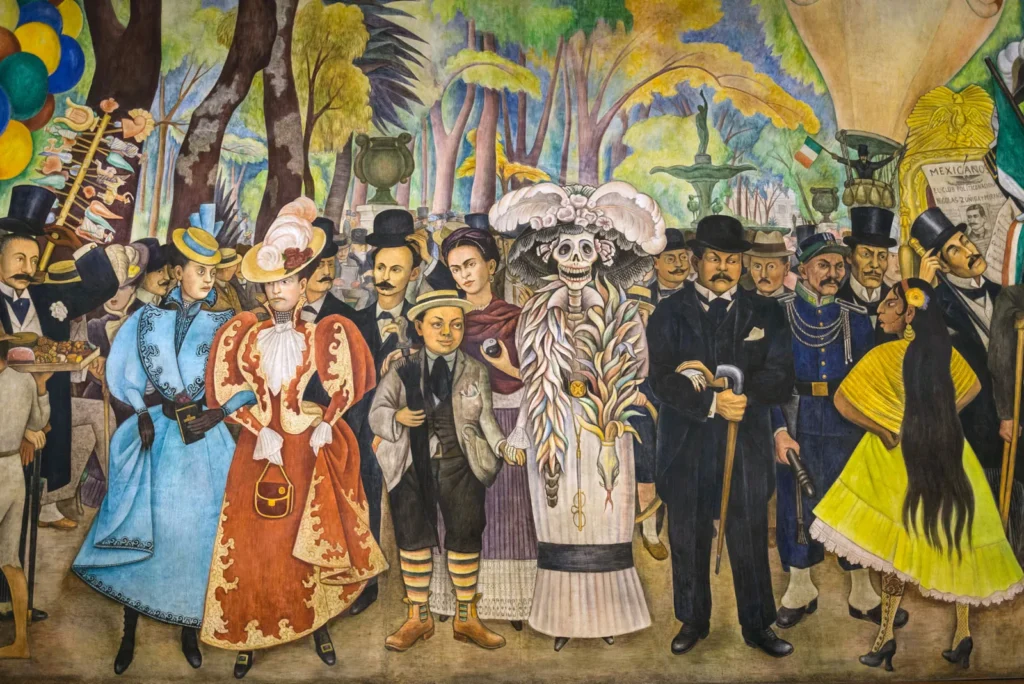
He arrived in Madrid with a government scholarship and the hunger of someone who has never been allowed to eat freely. The year was 1907, and Rivera was twenty-one years old, carrying inside him the twin inheritance of Mexican colonial education and a native visual instinct that no academy had yet managed to fully domesticate. Spain received him as it receives all promising provincials: with a kind of tolerant condescension that passes for generosity. He studied under Eduardo Chicharro, learned the techniques, absorbed the light of Velázquez in the Prado, and understood almost immediately that mastery of another tradition is not the same as belonging to it.
Paris came next, and Paris in 1909 was the most seductive trap ever constructed for a young artist from the periphery. The city was consuming everything — African masks, Oceanic carvings, Aztec codices — and metabolizing it all into European modernity, stripping each object of its origin and redistributing the aesthetic energy as innovation. Rivera walked into this machinery willingly. He painted in the Cubist mode with genuine conviction, sharing studios and arguments with Picasso, spending evenings in conversation with Modigliani, whose own displacement from Livorno to Montparnasse had produced a different kind of wound. They were all exiles of some kind, but not all exiles carry the same weight.
Edward Said, writing in “Culture and Imperialism” in 1993, described what happens when an artist from a colonized culture encounters the metropolitan center: there is always a moment of seduction followed by a moment of distortion, a point at which the mirror of European culture shows you a reflection that is almost yours but never entirely. The artist must decide whether to accept the distortion as truth or to recognize it for what it is. Most accept it, because acceptance is rewarded and resistance is invisible. Rivera, for nearly a decade, accepted it.
His Cubist paintings from this period are genuinely accomplished. They are also, in retrospect, the work of a man speaking fluently in a language that carries none of his memories. The forms are correct, the fractures deliberate, the planes angular and controlled. But something in them is borrowed in the deepest sense — not stolen, not imitated, but borrowed from a house whose architecture was built on premises that had nothing to do with the Mexican plateau, the murals of Teotihuacan, the visual grammar of a civilization that predated the entire Western tradition Rivera was now serving.
The rupture did not come suddenly. It came through accumulation. A journey to Italy in 1920 brought him face to face with the frescoes of Giotto in Padua, with the great narrative walls of the Italian Renaissance, and something shifted in him that no theoretical argument could have produced. Here was monumental public painting, painting that belonged to a wall, to a community, to a purpose beyond the gallery and the collector. The scale was political before it was aesthetic. He stood before those images and recognized, perhaps for the first time with his whole body rather than just his intellect, that art could occupy physical space the way a revolution occupies a street.
And the revolution was happening without him. Since 1910, Mexico had been tearing itself apart and rebuilding, Zapata and Villa moving across the landscape like figures from a mural that had not yet been painted. Rivera was reading the news from Paris, arguing about cylinder volumes and pictorial plane, while his own country was undergoing the most violent and generative transformation in its history. The distance was not only geographic. It was the distance Said identified as the core wound of cultural displacement: the sensation of being absent from the only event that truly concerns you, because you were busy learning to speak in someone else’s voice.
The Fresco as Political Weapon
There is a wall you have walked past a thousand times without stopping. You know it is there the way you know a scar on your own hand — present, unremarkable, absorbed into the routine of passing through. Then one morning something shifts in the light, or in you, and you stop. And what you see is not decoration. What you see is an argument.
This is what happened to an entire nation when Rivera returned to Mexico in 1921 after more than a decade of European formation. He came back not as a painter returning home but as a man who had decided that the wall itself was a political instrument, that scale was not aesthetic ambition but democratic necessity. A canvas in a gallery speaks to those who enter galleries. A wall speaks to everyone who must pass through a public building to eat, to learn, to petition the state for what is owed them. The distinction is not trivial. It is the entire thesis.
José Vasconcelos understood this with the instincts of someone who had read Plato and Rousseau and still believed in the transformative power of images on illiterate populations. As Education Minister under President Álvaro Obregón, he commissioned Rivera and a generation of muralists to cover the walls of the new republic with its own history — not the history the Porfiriato had curated, all European facades and indigenous erasure, but something rawer and more dangerous. Rivera threw himself into encaustic first, experimenting with ancient wax-based techniques at the Escuela Nacional Preparatoria, before committing fully to fresco — the method of wet plaster and permanent pigment, the method that demands you know what you are saying before you say it, because there is no revision once the wall dries.
The Secretaría de Educación Pública murals, executed between 1923 and 1928 across more than 1,500 square meters, are not a celebration. They are a seizure. Walter Benjamin, writing his Theses on the Philosophy of History in 1940, argued that historical materialism does not reconstruct the past as it actually was but instead seizes hold of a memory as it flashes up in a moment of danger. The revolutionary, for Benjamin, does not inherit history — he ambushes it. Rivera was doing precisely this on those walls years before Benjamin found the words. He was taking the pre-Columbian world, the colonial violence, the peasant labor, the Indigenous marketplace, and refusing to let the ruling class own the narrative of what Mexico was or had been. He was, in Benjamin’s terms, brushing history against the grain.
The National Palace cycle, begun in 1929, extends this insurgency across an even more monumental surface. The central staircase mural alone collapses centuries into a single visual argument: the civilization that existed before conquest is presented not as primitive antecedent but as sophisticated peer, equal in complexity to anything Europe produced. Hernán Cortés appears not as a heroic discoverer but as a figure of calculated destruction. The priests of the Inquisition burn books. The hacienda owners measure out land that belongs, by moral weight if not legal title, to the people standing beneath it. Rivera is not commemorating. Commemoration is what victors do with the past of the defeated. He is doing something more unsettling — he is insisting that the defeated past is not past at all, that it presses against the present with unreleased pressure, that justice deferred is not justice concluded.
Benjamin wrote that every document of civilization is simultaneously a document of barbarism. Rivera painted this. He painted it at a scale you could not avoid, in a building you could not bypass, with colors that did not fade into the politeness of oil on canvas in a private collection. He made the wall answer back.
Detroit, Rockefeller, and the Limits of Patronage

The smell of industrial solvent and wet plaster filled the Garden Court of the Detroit Institute of Arts for most of 1932 and into 1933, and Rivera worked in a kind of ferocious sustained attention that alarmed even his assistants. He was painting the walls of a room dedicated to the machines that built America’s automobile empire, and he was doing so with the money of Edsel Ford. Twenty-seven panels. Conveyor belts rendered with the precision of technical diagrams. Workers whose faces hold no triumph, only the contained exhaustion of bodies synchronized to production rhythms they did not choose. The murals are enormous — the north and south walls alone stretch nearly twelve meters each — and they produce in the viewer something close to vertigo, the sensation of being inside a process too large to see from any single position.
What Rivera understood about Detroit, and what made the commission genuinely dangerous, is that beauty and critique can inhabit the same surface simultaneously without one canceling the other. He painted the River Rouge plant not as celebration and not as condemnation but as fact — a fact so rendered that the viewer cannot look away and cannot rest easy. The workers are brown and tan and pale, bodies of every origin feeding the same machine. The chemicals division panel includes figures in gas masks that, if you look long enough, begin to resemble soldiers. Nobody at the Ford Motor Company noticed in time, or perhaps nobody wanted to notice. The murals were completed. They survived. They are there today.
Pierre Bourdieu argued, across the accumulated weight of his sociology — in The Rules of Art, in Distinction, in the essays collected through the 1990s — that cultural fields operate through a logic of consecration, where institutions grant legitimacy to works and in doing so absorb them, neutralize their force, and reproduce the very hierarchies they appeared to challenge. The patron does not need to censor. The patron only needs to own. And what is owned can be, at the appropriate moment, destroyed.
The Rockefeller Center commission came in 1933, and the logic Bourdieu would later theorize played out with a brutality so naked it might have seemed like a mistake, except that it wasn’t. Nelson Rockefeller had commissioned Rivera to paint a mural in the lobby of 30 Rockefeller Plaza, a building that announced itself as a monument to capitalist modernity. Rivera accepted. He painted. And somewhere in the upper register of that enormous composition, among figures representing human history and the struggle toward a better future, he placed a recognizable face — the face of Lenin, surrounded by workers, holding the hands of soldiers and ordinary men as though the revolution were not over but pending.
Rockefeller wrote Rivera a letter asking him to replace the portrait with an anonymous face. Rivera refused. He offered to balance Lenin with a portrait of Lincoln, as though the problem were symmetry rather than content. Rockefeller stopped the work. Rivera was escorted from the building. In February 1934, in the middle of the night, the mural was destroyed — chipped from the wall in pieces, the plaster hauled away.
What was destroyed was not just paint. What was destroyed was the illusion that power can fund its own critique without eventually moving to extinguish it. The symbolic violence Bourdieu describes is not metaphorical — in this case it was literal, physical, irreversible. And the terms of the destruction have repeated themselves with structural consistency ever since: the museum that defunds the exhibition when the board objects, the biennial that removes the work after diplomatic pressure, the residency that quietly declines to renew after the artist speaks too clearly. Rivera’s mural vanished from the wall of Rockefeller Center, but it left behind the architecture of a question that institutional culture has never been able to answer without implicating itself.
A vision curated by a filmmaker, not an algorithm
In this video I explain our vision
Frida, the Body, and the Politics of Intimacy
There is a photograph — not staged, not composed for posterity — in which they stand side by side and she barely reaches his shoulder. He is enormous in every sense the word allows: physically, socially, ideologically. She is small and precise and dressed in Tehuana cloth that announces itself before she speaks. They are looking in different directions. This is not incidental. This is the entire story.
Rivera’s politics were always, structurally, about the crowd. The wall demanded collectivity — it demanded a vision of humanity as mass, as movement, as historical force. The individual body in his murals is almost never isolated; it exists as part of a tide, a class, a destiny. Frida Kahlo painted almost exclusively herself. Not narcissism — something more radical and more unsettling than narcissism. She painted the body as the only territory that could not be collectivized, the only surface on which history wrote its wounds without the consolation of solidarity. Her spine broken by a bus that shattered her pelvis at eighteen, she returned again and again to the fact of individual suffering as a political statement Rivera’s aesthetic philosophy could not absorb. Pain, she insisted with every canvas, does not belong to the movement. It belongs to the person.
Simone de Beauvoir, writing in The Second Sex in 1949, argued that even within relationships between people who explicitly reject bourgeois convention, the structural asymmetries of power reproduce themselves through the most intimate gestures — through who waits, who travels, who is permitted to be difficult, whose suffering is aestheticized by the other and whose is treated as raw material. She was not writing about Rivera and Kahlo, but she might as well have been. Rivera’s infidelities were numerous, documented, and treated by his own account as expressions of an expansive nature incompatible with monogamy. Kahlo’s infidelities — including her relationship with Leon Trotsky, whom Rivera had sheltered in Coyoacán — were treated, including by Rivera himself, as wounds he had suffered. The same act, performed by two bodies in different positions of cultural authority, produces two entirely different moral meanings. This is not psychology. This is power geometry.
They married in 1929, divorced in 1939, remarried in 1940, and remained in each other’s gravitational field until her death in 1954. What held them was not romance in any conventional sense. It was something closer to mutual recognition of a kind so rare it overrode destruction. He understood what she was doing. She understood what he was doing. They did not agree. A man who stood before a man being electrocuted in a Detroit factory and painted it as collective tragedy could not fully inhabit the logic of a woman who painted her miscarriage as a private apocalypse witnessed by no one. And yet he championed her work, insisted on her genius when the art world was still deciding whether she was merely his remarkable wife, organized her first solo exhibition in Mexico in 1953, and wept at her bedside when it was clear she would not recover.
What their relationship unmasks is the impossible demand that revolutionary politics has always made on the people who try to live inside it: that the private be dissolved into the public, that personal suffering be legible only insofar as it connects to collective struggle, that the body matter as symbol rather than as the specific, unrepeatable thing it is. Kahlo refused this. And her refusal — which Rivera loved and could not contain — cost both of them something that has no clean political name.
De Beauvoir would have recognized it immediately. The tension between the person who theorizes liberation and the person who has to live inside a body that hurts is not resolved by shared ideology. It is merely restaged with more articulate combatants.
The Indian, the Machine, and the Myth Rivera Built
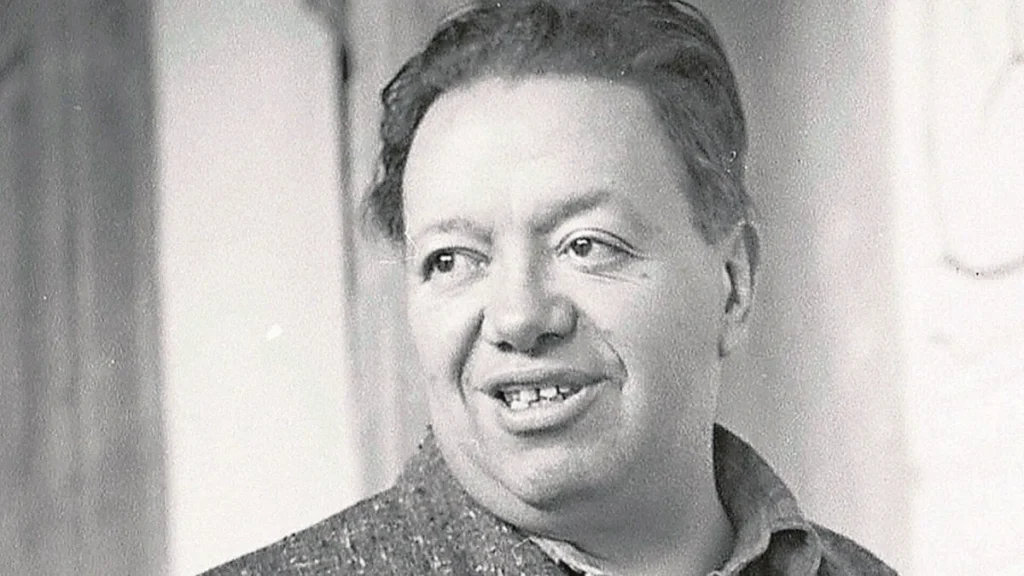
There is a particular kind of love that turns its object to stone. You have seen it operating in museums, in national anthems, in the way a country decides which faces belong on its currency. It does not hate what it venerates. It simply removes it from time, suspending it in a posture of eternal dignity that the living can never quite inhabit.
Rivera understood this mechanism intuitively, and he used it with a painter’s precision and a propagandist’s purpose. Look at the murals long enough and something begins to disquiet you beneath the beauty. The indigenous figures he rendered across thousands of square feet of Mexican public walls are magnificent — broad-shouldered, serene, rooted in the earth like old trees. They grind corn and carry cacao and perform ceremony with the unhurried confidence of people who have never been defeated. The pigment glows. The forms are monumental. And the people depicted are, in a very specific sense, nowhere. They exist outside history, suspended in a mythological present that has been carefully cleansed of conquest, disease, dispossession, and the ongoing, grinding poverty that Rivera himself witnessed and documented in his notebooks.
Octavio Paz, who was nobody’s comfortable critic, identified this dynamic with surgical clarity. In “The Labyrinth of Solitude,” published in 1950, he argued that Mexican nationalism had constructed a relationship with the indigenous past that was fundamentally necrophilic — a worship of the dead that allowed the living indigenous population to remain invisible and subordinate. The pre-Columbian world was elevated precisely because it was over. It could be celebrated without threatening the mestizo political class that had inherited colonial structures while draping itself in Aztec imagery. Rivera’s murals, for all their radical rhetoric, participated in this same economy of symbolic elevation and practical abandonment.
Stuart Hall, writing decades later in his foundational work on representation and cultural identity, would have recognized the operation immediately. Hall argued throughout his career — most pointedly in the essays collected in “Representation: Cultural Representations and Signifying Practices” — that to represent a group is always to exercise power over it, even when the intention is sympathetic. The image is never neutral. It selects, it frames, it fixes. And what Rivera’s extraordinary visual intelligence fixed, repeatedly and with breathtaking skill, was an image of indigenous Mexico as noble, ancient, and essentially decorative to the national narrative — beautiful raw material for a modern state still deciding what it wanted to be.
This is the uncomfortable seam running through the grandeur. A man walks through a market carrying something heavy on his back, and the weight is painted so that it reads not as exploitation but as dignity, as continuity, as proof of an unbroken civilization. The painting is not wrong, exactly. The dignity is real. But the framing does something else: it aestheticizes a condition that might otherwise demand political response rather than artistic contemplation. When suffering is rendered noble enough, the impulse to end it can quietly dissolve into admiration.
Rivera was not unconscious of these tensions. He was a man who contained contradictions the way large bodies contain weather — noisily and at great pressure. He genuinely believed in the revolutionary potential of indigenous Mexican culture. He also needed it, as a visual vocabulary, as a political credential, as proof of an authenticity that his Paris years and his European education and his complicated relationships with power had perpetually put in question. The Indian in his murals served Rivera’s ideological project as much as — sometimes more than — it served the Indian.
What does it mean to paint the oppressed as eternal rather than as people living in the particular injury of a particular moment? It means, among other things, that you get to decide what they represent. And that decision, however generously made, is still a decision made by someone who goes home afterward to a house in San Angel, with a Diego Rivera on the wall.
What the Paint Cannot Cover
There is a wall in Mexico City where the plaster has begun to separate from the stone beneath it. You can see it if you look closely enough — a fine network of cracks running through the painted surface like a map of something that was always going to break. The pigment in the upper corner has faded to a ghostly wash, and where moisture has seeped through from outside, a figure’s face has partially dissolved into the wall itself, returning to the mineral anonymity from which it was summoned. This is what time does to permanence. This is what the material world does to the ambitions of those who believed that beauty, applied with enough force and enough faith, could alter the conditions of the living.
Rivera painted walls because he believed walls were where history was held hostage. The easel painting, framed and hung in a collector’s salon, was already a defeat — art converted into property, into status, into the decorative confirmation of everything it might have opposed. The mural was supposed to be different. Public, unavoidable, owned by no one in particular and therefore belonging to everyone. The logic was seductive and not entirely wrong. But Susan Sontag, writing in 2003 in Regarding the Pain of Others, identified the central wound in this kind of faith with a precision that still stings: the image of suffering, no matter how honestly rendered, no matter how politically motivated, does not by itself produce the will to end suffering. It produces, at best, awareness. And awareness, she argued, is not action. It is the precondition of action that never quite arrives.
Rivera knew this tension and lived inside it without resolving it. He painted the exploited and the exploiters on the same wall, the campesino’s broken hands beside the industrialist’s ledger, as if proximity on plaster could produce in the viewer what decades of economic violence had failed to produce in reality: moral clarity sufficient to generate revolt. And the murals are extraordinary. Standing beneath them, you feel the specific weight of a vision that refused to make peace with the world as given. A woman grinding corn becomes a cosmological act. A factory floor becomes a theology of labor. The scale alone — Rivera completed over two thousand square meters of mural surface across his lifetime — constitutes a kind of argument, a refusal to let the marginalized remain small in the space they inhabit.
But the crack in the plaster is also an argument. The moisture is also an argument. There is a scene that stays with you long after you have left the building — a man standing before a painted crowd, his back to you, looking at faces that look back at him from the wall with an expression of complete recognition, as if the painted people know something about him that he has not yet admitted to himself. The painted crowd does not move. They have never moved. They are waiting, with the infinite patience of pigment, for something that the painting cannot provide.
This is not Rivera’s failure. It may be the condition of all art that takes the world seriously — the condition Sontag was circling when she wrote that the vast catalogue of human suffering does not, in itself, instruct us in how to respond. The instruction has to come from somewhere else, from a place the image can point toward but never reach. In the Palacio Nacional, in Detroit, in Rockefeller Center before the hammers came, Rivera pointed. He pointed with enormous hands, with faces that occupy the full moral weight of a human life, with colors that were chosen not to soothe but to insist. And in the corner of one wall, almost at the edge of the frame, a painted hand reaches outward into the space where the mural ends and the unfinished world begins — and the reaching itself, urgent and unresolved, is the most honest thing Rivera ever said.
🎨 Art, Revolution, and the Power of Vision
Diego Rivera’s monumental murals transformed walls into political manifestos and cultural mirrors, bridging ancient traditions with radical modern thought. Like all great visionaries, Rivera did not work in isolation — his art drew from deep wells of mythology, esoteric symbolism, and social upheaval. These related articles explore the broader universe of ideas that shaped and echo his extraordinary legacy.
Masterpieces of Rebellion and Counterculture Cinema
Rivera’s work was never merely decorative — it was an act of rebellion against political and aesthetic norms. This article on masterpieces of counterculture cinema explores how visual art and film have long served as vehicles for dissent, much as Rivera’s murals challenged the ruling classes of his era. The parallel between the painted wall and the cinema screen as revolutionary canvases is both striking and illuminating.
GO TO THE SELECTION: Masterpieces of Rebellion and Counterculture Cinema
Hannah Arendt: the Philosopher Who Unmasked the Banality of Evil
Hannah Arendt‘s unflinching analysis of power, ideology, and the human capacity for both evil and resistance resonates deeply with Rivera’s political muralism. Rivera spent his life depicting the oppressed and confronting the powerful through imagery of extraordinary force, just as Arendt confronted power through philosophical clarity. Together, their legacies remind us that art and thought are inseparable from political courage.
GO TO THE SELECTION: Hannah Arendt: the Philosopher Who Unmasked the Banality of Evil
Mass Social Homologation Today
Rivera fiercely opposed the homogenization of culture under capitalism, a theme he painted repeatedly across the walls of Mexico and the United States. This article on mass social homologation examines how modern societies suppress individual and collective identity in favor of conformity — a struggle Rivera made viscerally visible in his monumental public works. Understanding this dynamic enriches our reading of his murals as urgent, living documents.
GO TO THE SELECTION: Mass Social Homologation Today
Universal Consciousness
Rivera’s murals frequently evoked a sense of cosmic unity, weaving together indigenous cosmologies, Marxist ideals, and universal human struggles into sweeping visual narratives. This exploration of universal consciousness invites us to reflect on how great artists tap into shared archetypes that transcend culture and history. Rivera’s vision was never merely Mexican — it was profoundly and intentionally human.
GO TO THE SELECTION: Universal Consciousness
Discover Independent Cinema on Indiecinema
If Diego Rivera’s boundary-defying vision inspires you to seek art that challenges, provokes, and transforms, Indiecinema streaming is your next destination. Our curated catalog of independent films brings you the same fearless spirit — stories that refuse to conform and images that refuse to be forgotten. Join us and discover cinema that, like Rivera’s murals, paints the world as it truly is and as it could be.
👉 EXPLORE THE CATALOG: Watch Indie Films in Streaming
A vision curated by a filmmaker, not an algorithm
In this video I explain our vision

