
The Shadow That Precedes the Body
You are sitting in the dark when something changes. Not on the screen — in the room. The air shifts the way it shifts before a storm, that peculiar drop in atmospheric pressure that the body registers before the mind catches up. You cannot point to what moved. The image in front of you contains nothing threatening: a corridor, a staircase, a rectangle of pale light at the end of a hallway. And yet your hands have tightened on the armrests because something is coming, and the fact that you cannot see it yet is precisely what makes it unbearable.

This is not a trick of the editing, not a musical cue — though those exist too and do their work. This is something older and more merciless: the intuition that presence does not require a body, that what approaches can be felt before it can be named. The cinema discovered this early and has been exploiting and misunderstanding it in roughly equal measure ever since. Most directors treat the invisible as a problem to be solved, a before that must be cashed in with an after. The monster arrives. The threat becomes legible. The audience releases its breath. But a handful of filmmakers understood that legibility is precisely the moment power drains away, that the shadow stretching across a wall carries more ontological weight than whatever casts it.
Edmund Burke wrote in 1757, in his Philosophical Enquiry into the Origin of Our Ideas of the Sublime and Beautiful, that obscurity is essential to terror — that to make anything very terrible, uncertainty seems in general to be necessary. Burke was writing about poetry and landscape, about the Alps seen through fog and Milton’s Death, that shape without shape, but he was describing a mechanism that the moving image would later inhabit with extraordinary precision. The eye wants to complete what it is given. When it cannot, the nervous system fills the gap with something worse than any image the filmmaker could provide, something tailored from the viewer’s own private architecture of dread.
This is why silence is not the absence of sound but a kind of presence with its own mass and temperature. The corridor that contains nothing visible is not empty — it is full of implication, full of the viewer’s own projections thrown forward into space like scouts. German Expressionism at its peak understood this not as aesthetic choice but as epistemological position: what you see is never the most dangerous thing in the frame. The most dangerous thing is what the frame refuses to show you, what it withholds with the discipline of a skilled interrogator who knows that silence produces confession faster than any question.
By 1922, the language of cinematic shadow had been formalized enough that critics and theorists could argue about it. Béla Balázs, the Hungarian film theorist whose 1924 work Der sichtbare Mensch laid the groundwork for serious film aesthetics, was already identifying how the close-up and the manipulation of light created what he called the physiognomy of things — the idea that objects and spaces in film had faces, expressions, interior lives that could be photographed. Shadow was not absence. Shadow was a character, and like all characters, it told you more through what it concealed than through what it declared.
The cinema has always been haunted by its own technical conditions. It is light projected through moving frames onto a flat surface, and what it shows is never really there — it is, in the most literal sense, a ghost of what was once in front of a lens. A filmmaker who grasps this is working in alignment with the medium’s essential nature. One who ignores it is fighting the material, trying to make a window when the instrument was always, from its first flickering second, a mirror held up in a dark room where the person looking is never entirely sure what they are seeing and what they have summoned from somewhere inside themselves.
Nosferatu
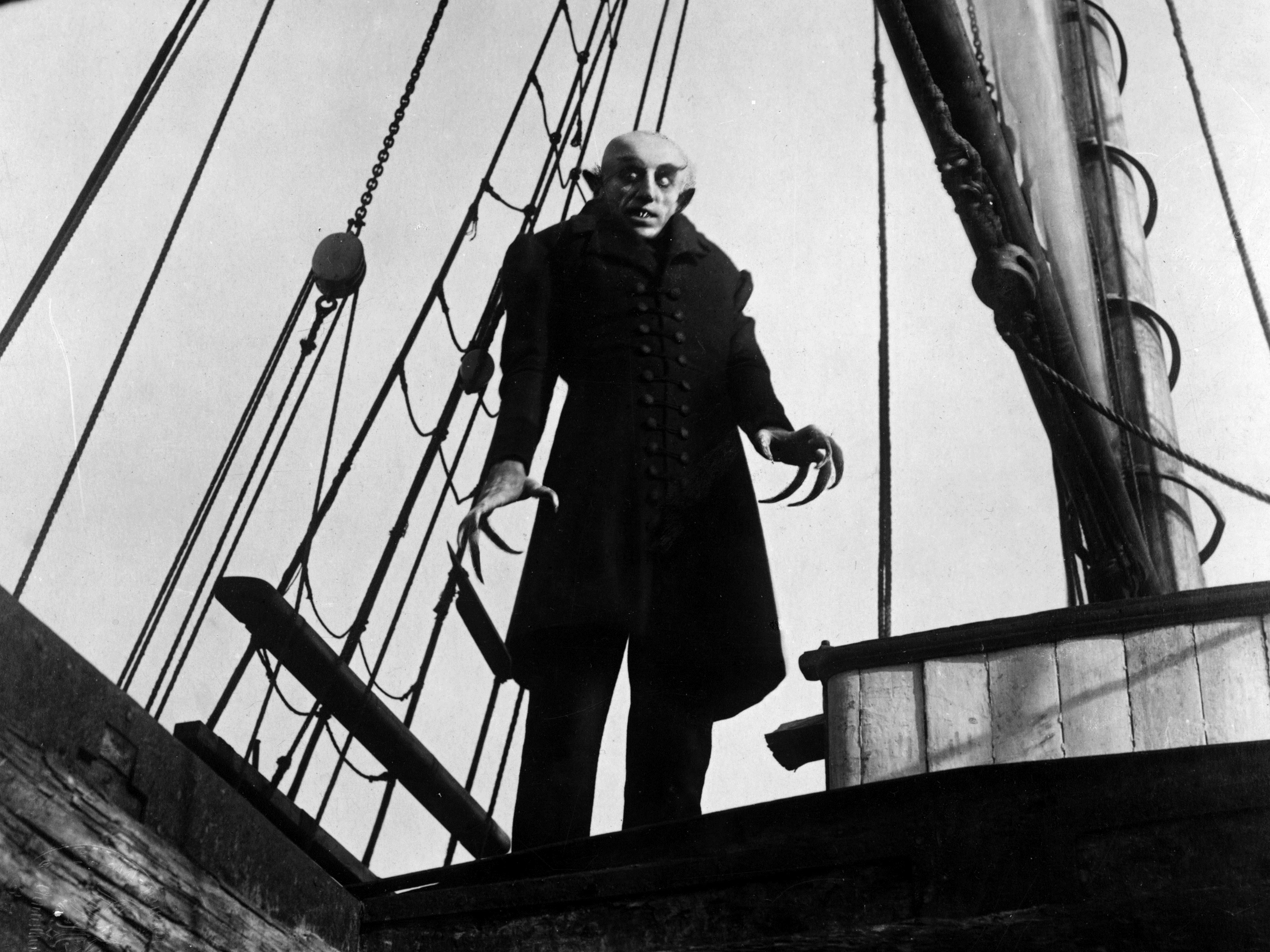
When a young real estate agent, Thomas Hutter, goes to the castle to close a deal, Orlok is attracted by his blood and decides to follow him to his hometown. The arrival of the count causes a series of mysterious deaths and spreads panic among the inhabitants.
Murnau, through evocative images and disturbing atmospheres, creates a work that goes far beyond the simple adaptation of Stoker's novel. The film explores universal themes such as the fear of death, isolation and the loss of humanity. The production of Nosferatu was characterized by some legal difficulties due to the copyright of Bram Stoker's novel. Despite this, Murnau and his crew managed to make a film of great visual impact. The choice of Max Schreck to play Count Orlok was ingenious. His cadaverous appearance and his unnatural movements have made the character of Orlok one of the iconic monsters in the history of cinema. Over the years, Nosferatu has become a cult film, influencing generations of filmmakers and becoming a reference point for the horror genre. The image of Count Orlok, with his elongated nails and sunken eyes, has become an icon of horror cinema.
Murnau's Camera as Philosophical Instrument
You are watching a street that doesn’t know it’s being watched. The camera drifts between bodies, leans into a doorway without asking permission, rises above a crowd as though curiosity itself had grown legs — and something in you registers this not as a technical flourish but as a violation of a contract you didn’t know you’d signed. The cinema, up until that moment in the mid-1920s, had been a theater with one wall missing: fixed, frontal, polite. What Murnau did between 1924 and 1927 was not improve the camera. He changed what the camera was allowed to claim about the world.
The entfesselte Kamera — the unchained camera — emerged from a specific technical frustration and became something philosophically irreversible. Karl Freund, the cinematographer who operated alongside Murnau on The Last Laugh in 1924, mounted the apparatus to his chest, strapped it to bicycles, submerged it, suspended it from overhead rigs. The mechanics are documented, photographed, celebrated in film history courses. What gets mentioned far less is the epistemological wager embedded in every one of those movements. A fixed camera asserts that the world is stable, knowable, available for inspection from a single authoritative point. A camera that moves through space, that approaches and retreats and tilts and swoons, is making an entirely different claim: that perception is partial, located, embodied, and therefore always already incomplete.
William James, writing in his Principles of Psychology in 1890, had argued that consciousness does not arrive in discrete units but flows — that the mind is not a series of photographs but a stream, continuous and directional. Murnau appears never to have read James directly, and the intellectual influence cannot be traced through any correspondence or interview. The convergence is something more disturbing than influence: it suggests that both men were working against the same false image of the mind, the same inherited fiction that knowing something means holding it still long enough to see it whole. The mobile frame refuses that fiction in the same way that James refused associationist psychology — not by replacing one theory with another, but by destroying the premise that made the theory feel necessary.
What the unchained camera introduces into cinema is the phenomenological fact of a body in space. Edmund Husserl, in his Ideen zu einer reinen Phänomenologie published in 1913, had insisted that consciousness is always consciousness of something — always directed, always situated. Merleau-Ponty would push this further in 1945 with the Phénoménologie de la perception, arguing that perception is not something the mind does to the world but something the body performs within it. Murnau arrived at the same destination through celluloid: the camera in The Last Laugh does not observe the old hotel doorman from outside his experience. It inhabits the spatial logic of his humiliation, leans with him, staggers with him in the drunk scene through a subjective distortion of the frame that had never been attempted with such sustained commitment. The viewer does not watch a man lose his dignity. The viewer loses orientation alongside him, which is an entirely different transaction.
This is why describing the entfesselte Kamera as a stylistic innovation misses what was actually at stake. Style is a choice made within an established language. What Murnau was doing was grammatical — he was rewriting what a shot is permitted to mean. A static frame implies an observer who stands outside the event, sovereign and unaffected. The moment the frame moves with desire, with fear, with the weight of a body ascending a staircase, it concedes that there is no outside. The observer is always inside the event, always implicated, always arriving too late or too close or from the wrong angle to claim the whole picture.

What Weimar Germany Could Not Look At
You are sitting in a cinema in Berlin in 1922, and the man on screen has no shadow. Not because the film’s technicians forgot, or because the light was wrong, but because someone decided, with cold deliberation, that showing you a man without a shadow was the most honest thing they could do with the medium. You do not yet have the vocabulary for what you are seeing. You only know that it is true.
Germany in 1918 did not lose a war. That is not what the culture decided to remember. The culture decided instead that it had been betrayed from within — stabbed in the back, as the phrase went, by Jews, by socialists, by anyone whose existence could absorb the weight of an unbearable fact. The Dolchstoßlegende was not a fringe conspiracy; it was the emotional infrastructure of an entire nation’s refusal to look directly at its own defeat. Field Marshal Hindenburg repeated it before the Reichstag in 1919 as though stating arithmetic. When a society develops a mythology this total, this rapidly, it is not suffering from ignorance. It is suffering from an excess of unbearable knowledge.
What German Expressionism understood — before anyone had the theoretical apparatus to say so clearly — is that a culture under this kind of pressure does not stop seeing. It displaces. The shadow on the wall is not a metaphor for something the character fears. It is what the character actually is, stripped of the social costume that ordinary lighting would restore. Georg Wilhelm Pabst, working in the same decade and the same city as Murnau, once remarked that the German audience of those years could not sustain irony — they needed allegory because allegory kept the truth at one remove, bearable, framed. The screen had become a confessional booth in which nobody had to say anything directly.
Six million unemployed by 1932 is a number that appears in economic histories as a cause, but it was also a daily texture of humiliation — men in suits standing in queues, men who had been officers, engineers, teachers, standing in a kind of public nakedness that the Wilhelmine social order had promised would never come for them. Siegfried Kracauer, writing in 1927 in his essay on the salaried masses, described the new German white-collar worker as someone who had purchased, on installment, an identity that the economy could repossess at any moment. The horror was not poverty. The horror was the exposure — the sudden visibility of a self that had been entirely constructed from institutional belonging.
Murnau’s visual grammar addresses exactly this. The architecture in his films is never backdrop. It is diagnostic. The staircases are too steep, the doorways too narrow, the rooms too tall for the people inside them — a spatial language that encodes a specific historical experience of being made small by systems that were built, ostensibly, to shelter you. When his camera tilts upward past a character to hold on an empty ceiling, it is not aesthetics. It is the articulation of a social vertigo that the Weimar Republic’s citizens felt every morning they opened a newspaper whose front page was denominated in figures of hyperinflation so large they had passed beyond comprehension into abstraction.
What cannot be looked at directly migrates. It finds the peripheral vision, the dream architecture, the angle of light that arrives before the object does. A culture that has learned to displace reality into shadow and allegory does not do so out of cowardice — it does so because the nervous system is adaptive, because consciousness has a threshold, and because the ones who survived the trenches came home already expert in the art of not quite seeing what was directly in front of them.
The Tyranny of the Visible
You have seen something you cannot describe. Not because language fails you — because the thing itself refused to be fully present, pulled back at the last moment, left you with the sensation of a door closing just as you reached for the handle. The experience is not loss. It is something closer to the proof that what you almost touched was real.
Walter Benjamin argued in 1935 and published in 1936 that the mechanical reproduction of images destroys what he called the aura — that singular, irreducible quality of presence belonging to an original artwork embedded in a specific time and a specific place. A painting has aura because it exists once, somewhere, in a room you must travel to enter. Reproduce it a million times and you have killed the distance, which means you have killed the reverence, which means you have killed the object’s power to reach back at you across that distance. Benjamin saw this as politically ambiguous but structurally inevitable: the camera strips the halo from things by making them endlessly available.
What Murnau’s cinema does is the precise opposite, and the inversion is not incidental but structural. His camera does not capture the world and make it available — it withholds the world and makes it scarce. Consider what the lens refuses in film after film: the face of the creature in Nosferatu is almost never shown at the moment of maximum dread, replaced by a shadow that climbs a staircase and speaks through the geometry of its own absence. The mechanism is not restraint born of limited technology. It is a deliberate grammar of deprivation, a choice made in the editing room and on the set to engineer the precise sensation Benjamin described as lost — the feeling that something is present that cannot be fully grasped.
This is what makes Murnau’s relationship to reproduction genuinely strange. His films were always already reproductions — celluloid copies struck from a negative, played in theaters across Germany, America, later the world. The aura Benjamin mourned had no original to mourn in the first place. And yet audiences in 1922, watching Nosferatu in Berlin, and audiences watching the same film a century later, report the same qualitative experience: something that should not be visible almost becomes visible and then retreats, and the retreat is worse than the image would have been. Benjamin’s logic assumes that presence destroys mystery. Murnau’s practice demonstrates that absence manufactures it from nothing, on demand, inside a mechanical medium that theoretically forbids such effects.
The philosopher Georges Didi-Huberman, writing on the image in his 1992 study Ce que nous voyons, ce qui nous regarde, offers a term that partially names what Murnau achieves: the image that looks back. For Didi-Huberman, certain visual objects hold within them a gaze directed outward at the viewer, a kind of optical reciprocity that unsettles the assumption that seeing is a sovereign act of the one who watches. What Murnau adds to this is temporal: the image that looks back does so at the moment of its own disappearance, turning to face you as it exits the frame. The aura is not in the thing — it is in the angle at which the thing leaves.
This means Murnau solved, practically and without naming it, a problem that Benjamin could only articulate theoretically. The question was never whether mechanical reproduction destroys presence. The question was whether presence can be constructed architecturally, through the deliberate engineering of thresholds — through light placed exactly where it will fail, through a frame cropped at the border where understanding would begin, through movement arrested one second before the revealing. What gets produced in that arrested second is not a gap in the film — it is the aura itself, assembled in real time, inside the viewer, by the very mechanism Benjamin believed had made such assembly impossible.
Nosferatu and the Mechanics of Dread
You are watching Ellen’s face before you see the count. Her expression does the arriving for him — the eyes widening not toward the camera but toward something the frame refuses to contain, the body recoiling from an edge the screen will not show you. And in that refusal, something older than cinema activates inside you, something that knows, from long biological habit, that the unseen predator is always more dangerous than the visible one.
What Murnau understood in 1922 — and what took psychoanalytic theory decades to articulate with comparable precision — is that the architecture of fear is built from negative space. The count does not materialize so much as accumulate, arriving first as shadow on a wall, then as the terror in Hutter’s written account, then as the impossible geometry of a body that moves without the mechanics of movement. By the time the audience confronts him directly, the mind has already constructed something more monstrous than any image could sustain. The film’s structural genius is that it forces the viewer to become complicit in manufacturing its own horror.
Sigmund Freud, writing in 1919 in his essay “Das Unheimliche,” identified a specific category of psychological disturbance that arises not from the foreign and threatening but from the familiar that has been displaced — the heimlich, the domestic, the homely, suddenly discovered to contain something that should not be there. The German word is almost untranslatable because it carries both meanings simultaneously: the cozy and the concealed, the known and the secretly harbored. What Freud described was not the monster at the end of the corridor but the moment you realize the corridor itself has changed shape. Nosferatu operates entirely within this frequency. Count Orlok does not invade from outside the culture’s comfort — he emerges from inside its most intimate structures, from the bedroom, from the threshold, from the act of sleep itself.
The film’s most devastating sequence belongs not to Orlok but to the plague ship drifting into harbor with its dead crew and its single surviving log. The harbor workers and city officials who board that vessel encounter horror through documentation — through a written record that someone else experienced and barely survived. The audience, like those officials, reads terror secondhand, mediated through language, and this indirection paradoxically intensifies the sensation. What has no witness leaves the mind no option but to become one. Murnau grasped something here that most contemporary horror has since abandoned in favor of the spectacular: the imagination is not the enemy of fear but its most faithful collaborator.
There is also the matter of light used as weapon rather than illumination. Murnau shot the Transylvanian sequences with a quality of overexposed brightness that makes the landscape look scorched, hallucinatory, wrong — and then plunged the Bremen sequences into shadow so dense the darkness seems to breathe. This alternation between too much and too little visual information replicates the sensory condition of genuine dread, which is never stable, never calibrated, always either insufficient or overwhelming. The eye never finds ground to stand on. When Orlok’s shadow finally climbs the staircase and its fingers reach toward Ellen’s door before the body does, what the viewer feels is not surprise but recognition — the confirmation of something the nervous system had been predicting for the entire film without permission from the conscious mind.
The count’s final dissolution into light carries none of the triumph that horror convention would later assign to monster-death. There is no relief in his disappearance because by that point in the film he has ceased to be a character and become a structural condition — the form that dread takes when it finds a host. Ellen’s stillness in the aftermath is not the stillness of survival but of something that has passed through her and left.
A vision curated by a filmmaker, not an algorithm
In this video I explain our vision
The Audience as Unwilling Co-Author

You are sitting in the dark and something is wrong, but the screen has not yet shown you what. The wrongness arrives before the image does — in the angle of light falling across a doorframe, in the way a shoulder turns just out of frame, in a silence held two beats longer than comfort allows. You are already manufacturing the horror. The screen has outsourced its most disturbing work to the part of your mind that cannot stop completing patterns, and you did not agree to this arrangement.
Erving Goffman, in his 1974 Frame Analysis, argued that human perception is not passive reception but active organization — we do not experience the world and then interpret it, we interpret it in the very act of experiencing it. Frames are the invisible scaffolding through which raw sensory data becomes legible reality. Cinema understood this before cognitive science had the vocabulary for it, and certain directors understood something even more unsettling: that a frame can be constructed to fail deliberately, to present just enough structure that the viewer’s organizing mind rushes in to fill the gap, producing an image the screen never actually showed. The viewer becomes a manufacturer of their own dread, working from instructions they never consciously received.
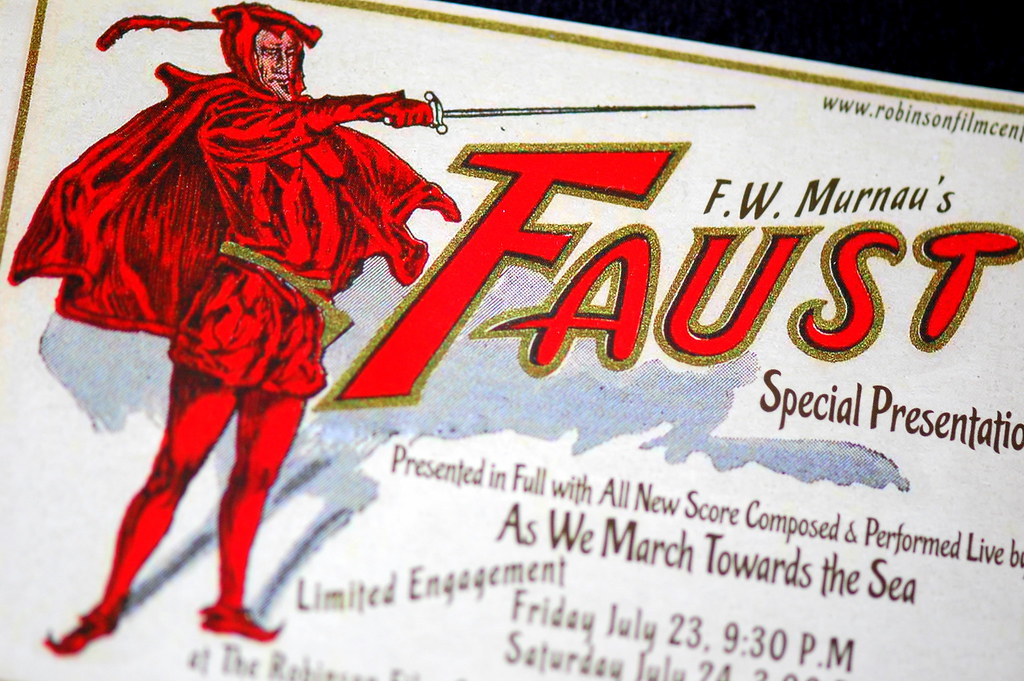
Murnau’s Faust, released in 1926, opens with something that resists description precisely because so much of its power lives in the negative space between shots. The figure of Mephisto does not simply appear — he accumulates, assembles himself from shadow and implication across a sequence of edits that give you pieces no single frame ever completes. What the audience constructs in that mental space between one image and the next is, neurologically speaking, their own image, generated by their own associative machinery. Goffman’s framework helps name what is happening: the cinematic frame has been deliberately stripped of enough information that the viewer’s frame-completing cognition activates without permission, producing an experience of authorship that is also an experience of entrapment. You built the monster. The screen merely handed you the materials.
This complicity has a specific texture that distinguishes it from simple suspense. Hitchcock, for instance, famously placed the bomb under the table and let the audience know it was there — the tension is informational, the viewer suffers from surplus knowledge. What Murnau engineers is the opposite: a tension born from deficit, from the mind’s refusal to tolerate incompletion. Cognitive psychologist Jerome Bruner, in his work on narrative expectation from the 1980s and 1990s, documented how human minds treat incomplete patterns as a form of pain — not metaphorically, but as a genuine discomfort that demands resolution. Murnau turned that neurological imperative into an aesthetic instrument, withholding resolution long enough that the viewer’s discomfort produced its own imagery, and then supplied a concrete image that arrived not as a revelation but as a confirmation of what the audience had already, privately, generated.
The disturbing consequence of this is that no two viewers of Faust constructed precisely the same film. The horror that settled into one person’s imagination in that threshold between cuts was biographical, assembled from their own archive of fears, their own history of darkness. The screen was the occasion; the viewer was the medium. This is what makes certain films impossible to fully discuss — not because they are ambiguous in some artistic sense, but because the most powerful material in them was never in them at all. It existed, briefly and indelibly, in the gap between what was shown and what the viewer’s mind could not stop itself from supplying.
What Goffman called the vulnerability of frame — the moment when organizing structures crack and raw experience floods through — is not an accident in Murnau’s work. It is the precise location where he chose to aim.
Exile, Sexuality, and the Politics of Concealment
You are standing at a party in Berlin in 1923, and the man across the room is watching you with a precision that feels less like attraction and more like documentation — cataloguing the angle of your jaw, the way your hand moves when you reach for a glass, storing it all somewhere behind his eyes where it will never be retrievable by anyone else. Friedrich Wilhelm Murnau looked at the world this way. Everyone who knew him said so. What they rarely said, at least not in print, was why a man might train himself so rigorously in the art of seeing without being seen seeing.
Paragraph 175 of the German Imperial Penal Code, in force since 1871 and not fully repealed until 1994, criminalized sexual acts between men with penalties that ranged from imprisonment to social annihilation. It was not a distant threat. Magnus Hirschfeld had been documenting its human wreckage since 1897, through the Scientific-Humanitarian Committee and its meticulous surveys of destroyed careers and suicides, and by the early 1920s Berlin’s queer subculture was both strikingly visible and strikingly precarious — a greenhouse built on a fault line. Murnau moved inside that world, carefully, with the practiced indirection of someone who understood that visibility itself was a form of exposure, and exposure was a form of danger. What appears in his films as an aesthetic philosophy — the meaningful shadow, the gesture that carries more weight than speech, the narrative truth buried beneath the surface of what the camera directly shows — had a biographical substrate harder and more urgent than any theory of cinema.
The camera, for Murnau, was never merely a recording device. It was a technology of displacement, capable of lodging forbidden content inside permissible form. When a film made in 1922 lingers on the way one man’s face changes in the presence of another — not the face of desire exactly, but the face of recognition, of being known — it is doing something that no legal document could touch, because the image refuses to name itself. Expressionism gave him the formal permission to make emotion architectural, to treat psychology as light source, which meant that interiority could be rendered with devastating precision while remaining officially unclassifiable.
His departure for Hollywood in 1926 was framed publicly as professional ambition, an invitation from Fox Film Corporation, the promise of resources that German studios could not offer. And it was all of those things. It was also a man putting an ocean between himself and a legal code with his name written invisibly in its margins. Hollywood in the late 1920s was not a liberated space — its own informal governance through the emerging structures that would harden into the Production Code of 1930 made certain desires cinematically unspeakable — but the geography of danger had changed, and sometimes that is enough to breathe differently. Sunrise, made in 1927, won him three Academy Awards at the first ceremony in history, which is a fact that sits strangely alongside the knowledge that its maker was navigating a social existence that required him to be perpetually, strategically, almost artistically incomplete in his self-presentation.
He died in March 1931, eleven days after a car accident on the Pacific Coast Highway north of Santa Barbara, and the circumstances carried their own charged ambiguities that contemporary accounts handled with the same studious vagueness that his films had perfected. He was forty-two. The passenger who survived and who had been driving was his young Tahitian companion, a detail that newspapers managed to report while simultaneously declining to interpret. Murnau had gone to Tahiti months earlier, in part to make a documentary, in part — one suspects — to find a place where the coordinates of his illegibility might finally shift. What he had spent a career encoding into shadow and threshold and the grammar of the almost-said was the interior life of a man for whom full visibility was never a neutral condition but always, structurally, a threat.
The Screen as Mirror of the Unspeakable
You already know the feeling — sitting in a room where everyone has agreed, without speaking, that a certain thing is true. No one voted for it. No one announced it. The agreement formed the way ice forms: silently, from the outside in, until the surface holds weight and no one tests whether the water beneath is still moving.
Siegfried Kracauer, writing in New York in 1947 with the particular urgency of a man who had escaped something enormous, argued in From Caligari to Hitler that Weimar cinema was a kind of collective dream, and that the distortions visible in its shadows and its staged tyrannies were symptoms of a German psyche already tilting toward submission. His thesis was seductive precisely because it gave horror a genealogy — it made catastrophe legible, traceable, something that could be read backward through the frame. But the argument, in its very elegance, committed the error it claimed to diagnose. It turned the illegible into a caption.
What Murnau’s images actually do is something Kracauer’s framework cannot absorb, because the framework requires that images mean something fixed, that the distorted staircase points toward the distorted state. Murnau’s cinema does not point. It withholds. The shadow on the wall in Nosferatu — the one that climbs the stairs before any body does — is not a metaphor for fascism waiting in the wings. It is a portrait of perception itself: the human tendency to register the shape of a threat before registering its substance, and then, crucially, to prefer the shape.
This preference is not weakness. It is architecture. The psychologist Leon Festinger, whose 1957 work on cognitive dissonance mapped the distances people travel to avoid contradictory information, discovered that the avoidance is not passive — it is active, energetic, sometimes ferociously defended. People do not simply fail to see the illegible truth. They organize their attention to prevent the encounter. Murnau stages this organization as visual fact: the characters in his films do not look away from what is terrible. They look directly at it and see something else.
There is a man in a small coastal town who has watched his neighbor board up his windows for three consecutive nights. He tells himself it is a renovation. The town has agreed, without speaking, that renovations are possible in all weather. By the time the shape at the door is undeniable, the agreement has been held so long that dismantling it would require dismantling the community that formed around it — and that cost is higher than any truth.
Kracauer saw German cinema as a mirror held up to a nation’s unconscious drives. But Murnau’s screen functions differently: not as a mirror that reflects what is already there, but as a surface that reveals what looking costs. The Expressionist distortions that Kracauer read as psychological symptoms are, in Murnau’s hands, perceptual experiments — tests of how much deformation a viewer can absorb before the category of “normal” collapses. And the answer, film after film, is: an enormous amount.
What makes this historically devastating is not that Weimar audiences were uniquely susceptible. The susceptibility Murnau diagrams is structural, not national. Hannah Arendt, whose 1951 analysis of totalitarianism’s origins located its preconditions in loneliness and the collapse of shared reality, was describing the same perceptual vacuum that Murnau’s frames render visible — the space where the legible lie becomes preferable not because it is comforting but because it is legible, because it offers the relief of a world that can be read. The screen does not show us monsters. It shows us the precise moment we choose the monster we can name over the truth we cannot hold, and in that choice, rendered in light and shadow with a silence that has never required translation, Murnau leaves us with no one else to blame.
🎞️ Shadows, Spirits and the Invisible Eye
F.W. Murnau transformed cinema into a language of the unseen, using light, shadow, and the moving image to make the invisible tangible. These articles explore the intellectual and artistic territories that surround his visionary work — from the supernatural traditions he drew upon to the aesthetic philosophies that shaped his haunting visual grammar.
Black and White Photography: Masters of Shadow and Light
Black and white photography and silent cinema share a primal kinship: both strip reality of its comforting surfaces to reveal the architecture of shadow and light beneath. Murnau understood this grammar instinctively, composing frames that feel less like recorded images and more like waking visions. The masters of monochrome photography illuminate the same aesthetic obsession that made Nosferatu and Faust immortal works of visual art.
GO TO THE SELECTION: Black and White Photography: Masters of Shadow and Light
The Aesthetics of the Sublime: When Beauty Is Frightening
Edmund Burke’s foundational theory of the sublime identifies terror as the root of the most powerful aesthetic experiences, a conviction that Murnau translated directly into cinematic form. The encounter with something vast, dark, and beyond rational comprehension is the engine driving his greatest films. Understanding Burke’s aesthetics opens a philosophical door into the emotional mechanics of Expressionist cinema.
GO TO THE SELECTION: The Aesthetics of the Sublime: When Beauty Is Frightening
The Vampire Myth: History and Symbolism
The vampire myth is one of the oldest and most resonant expressions of humanity’s fear of the invisible and the undead, and Murnau’s Nosferatu remains its most cinematically radical incarnation. This article traces the symbolic layers of the vampire across cultures and centuries, revealing how deeply the figure is rooted in collective psychological dread. Murnau’s genius was to strip the myth of romanticism and return it to its primal, shadow-dwelling origins.
GO TO THE SELECTION: The Vampire Myth: History and Symbolism
Caspar David Friedrich: The Painter Who Painted the Infinite
Caspar David Friedrich, the great painter of infinite horizons and solitary figures at the edge of the abyss, was a direct spiritual ancestor of Murnau’s cinematic sensibility. Both artists shared a Romantic conviction that landscape is not backdrop but soul — a mirror of interior states that cannot be spoken but only felt. To understand Friedrich’s canvases is to understand the visual theology that animates every frame of Murnau’s masterworks.
GO TO THE SELECTION: Caspar David Friedrich: The Painter Who Painted the Infinite
Discover the Cinema That Dares to Look Beyond
If these invisible territories fascinate you, Indiecinema is the streaming platform where independent and visionary cinema finds its true home. From Expressionist masterpieces to contemporary films that push the boundaries of the visible world, our catalog is a labyrinth worth getting lost in. Join us and let the screen become your window onto the unknown.
👉 EXPLORE THE CATALOG: Watch Indie Films in Streaming
A vision curated by a filmmaker, not an algorithm
In this video I explain our vision

