
A Man Playing at Ghosts
You sit down at your desk in the winter of 1764 and you write a lie. Not a small social lie, the kind that lubricates conversation and saves face — a structural, premeditated, architectural lie, the kind that requires you to build a scaffolding of fake history around it before anyone can even approach the thing itself. You invent a manuscript. You give it a translator, one “William Marshal, Gent.” You furnish it with an original Italian printer, Onuphrio Muralto, and you set its first printing in Naples, 1529, at a press that never turned a single page. You write a preface that smells of dust and scholarship, that hedges and qualifies with the precise anxiety of a man who has spent years in archives, and then you release it into London’s literary world as the recovered document of a vanished age. The extraordinary thing is not that you did it. The extraordinary thing is how completely you believed yourself while doing it.

Horace Walpole published The Castle of Otranto in December 1764 under this elaborate fiction, and the book sold so rapidly that a second edition was required within months. Only at that point did he confess his authorship — not out of guilt, but out of the confident vanity of a man who has proven his point. He had wanted to know whether a modern English reader would accept the supernatural if it arrived wearing medieval clothes, whether the apparatus of antiquity could lower the reader’s defenses enough to make them feel what they would otherwise intellectually refuse. The experiment worked so thoroughly that the confession itself became a kind of secondary triumph, the magician revealing his hands after the audience has already surrendered.
What Walpole was doing had a name, though it would not acquire one for another two centuries. The literary hoax had existed long before him — James Macpherson‘s Ossian poems, published between 1760 and 1763, had recently electrified Europe with their supposedly ancient Gaelic originals that turned out to be largely Macpherson’s own invention — but Walpole’s forgery was different in its intent. Macpherson wanted to give Scotland a Homer. Walpole wanted to give himself permission. The medieval frame was not nationalism or nostalgia; it was a mechanism for doing in fiction what polite Augustan literary culture would not allow: ghosts walking through castles at noon, helmets large enough to crush a man, portraits that sigh and abandon their frames. The rules of neoclassical decorum demanded probability, proportion, restraint. Walpole simply needed a world old enough to have different rules.
He had such a world already built. Strawberry Hill, his Gothic revival villa in Twickenham, had been under construction since 1749, its turrets and tracery assembled from a catalogue of medieval borrowings that architectural historians would later describe as more theatrical than structural — a house designed less to shelter a man than to stage one. Walpole understood instinctively that environment produces sensation, that if you surround yourself with pointed arches and stained glass, something changes in the quality of your daydreams. He was not a scholar of the Middle Ages so much as a man who had learned to use its atmosphere the way a composer uses a key signature, to set the emotional register before a single note has been played.
This is what makes the preface to Otranto so unsettling to read carefully, even now. It does not feel like dishonesty. It feels like someone who has spent so long inside an imagined world that the seams between invention and belief have simply dissolved. The scholarly hedging, the careful attribution, the performed uncertainty about the manuscript’s exact age — none of it reads as cynical performance. It reads as the work of a man who has genuinely crossed some interior threshold and is reporting back from the other side, convinced that what he found there is worth the deception required to share it.
Cathnafola - A Paranormal Investigation
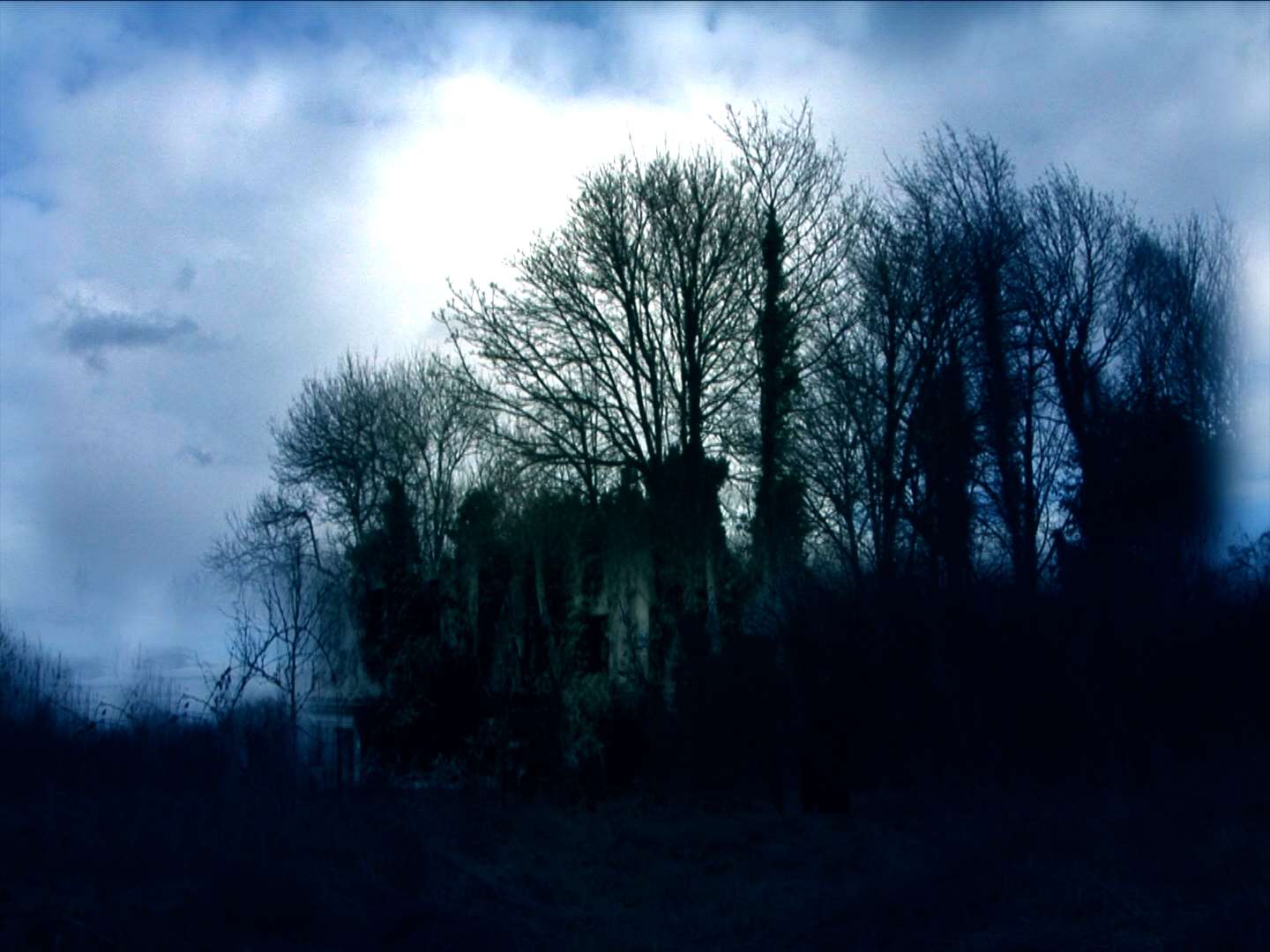
Documentary, horror, by Jason Figgis, USA, 2014.
In "Cathnafola", everything begins when renowned paranormal investigator Chris Halton of Haunted Earth UK receives footage filmed by three teenagers at the ruins of Cathnafola House in Ireland. Determined to unearth the truth behind the location’s bloody past, Halton embarks on a nighttime exploration of the infamous ruins—and soon uncovers terrifying and disturbing revelations.
LANGUAGE: English
SUBTITLES: Spanish, French, German, Portuguese
Strawberry Hill and the Architecture of Desire
You stand in a room that should not exist. The ceiling vaults upward in stone tracery borrowed from a medieval cathedral, but the stone is plaster, the cathedral is a fantasy, and the house itself sits on eighteen acres of suburban Thames-side land purchased in 1747 by a man who had never built anything before and had no architectural training whatsoever. The effect is not of religious awe but of something stranger — a private world legislated into existence by sheer insistence, where every arch and every battlement says, with perfect seriousness, this is who I am.
Walpole began transforming his modest Twickenham villa in 1749, a project that would consume nearly four decades of his life and an inheritance substantial enough to fund several actual careers. He called the process “a work of whim,” but the scale contradicts the modesty. He assembled a committee of taste — Richard Bentley and John Chute among them — to adjudicate each Gothic detail, consulting medieval tombs, old engravings, and his own restless imagination in roughly equal proportion. What emerged by the 1770s was a structure of approximately forty rooms containing armor, stained glass, painted glass, miniatures, curiosities, and relics of historical figures he admired, all organized under a single aesthetic proposition: that the Middle Ages were not dead but continuous, available for habitation. This was not historical scholarship. It was something closer to wish-fulfillment rendered in lath and plaster.
The psychological grammar of Strawberry Hill is difficult to overstate. Walpole was the fourth son of Robert Walpole, Britain’s first de facto Prime Minister, a man whose power was so comprehensive and so openly mercenary that his legacy left his descendants both comfortable and compromised. Horace spent much of his adult life insisting he cared nothing for politics while never quite leaving its orbit, maintaining correspondence with virtually every significant figure in Georgian public life, collecting gossip with the discipline of an archivist. Strawberry Hill was the one domain where he held complete sovereignty. He invented its genealogy rather than inheriting one, which made his authority over it absolute in a way no political appointment could have matched.
What makes this act of construction philosophically interesting is that it predates, by roughly fifteen years, the critical vocabulary that would eventually explain it. John Ruskin would not theorize the moral dimensions of Gothic architecture until The Stones of Venice in 1851-1853; Augustus Pugin would not publish his contrasts between Gothic virtue and classical decadence until 1836. Walpole was operating on pure intuition — or something that felt like intuition but was actually a coherent if unarticulated theory of selfhood: that identity could be manufactured through environment, that a man who surrounded himself with the artifacts of a chosen past could become continuous with it. The house was not a collection of things. It was an argument about who he was entitled to be.
This logic — that the built environment precedes and produces the interior self — is precisely what makes Strawberry Hill the true first draft of the novel he would write in 1764. The Castle of Otranto was not conceived in isolation. It was conceived by a man who had already spent fifteen years learning how to make stone corridors feel haunted, how to make a domestic space feel ancient, how to make the theatrical feel real through accumulated material conviction. The trap-door staircases, the armor, the hidden passages he genuinely installed in his own home — these were the raw grammar of Gothic fiction before Gothic fiction had a name. When he wrote the novel in eight weeks during November and December of 1764, describing it later as having come to him in a dream, he was narrating an architecture he had already built, translating three dimensions of deliberate illusion into two dimensions of prose.
The dream, in other words, had been under construction for a decade and a half before he claimed to have dreamed it.

The Counterfeit Middle Ages
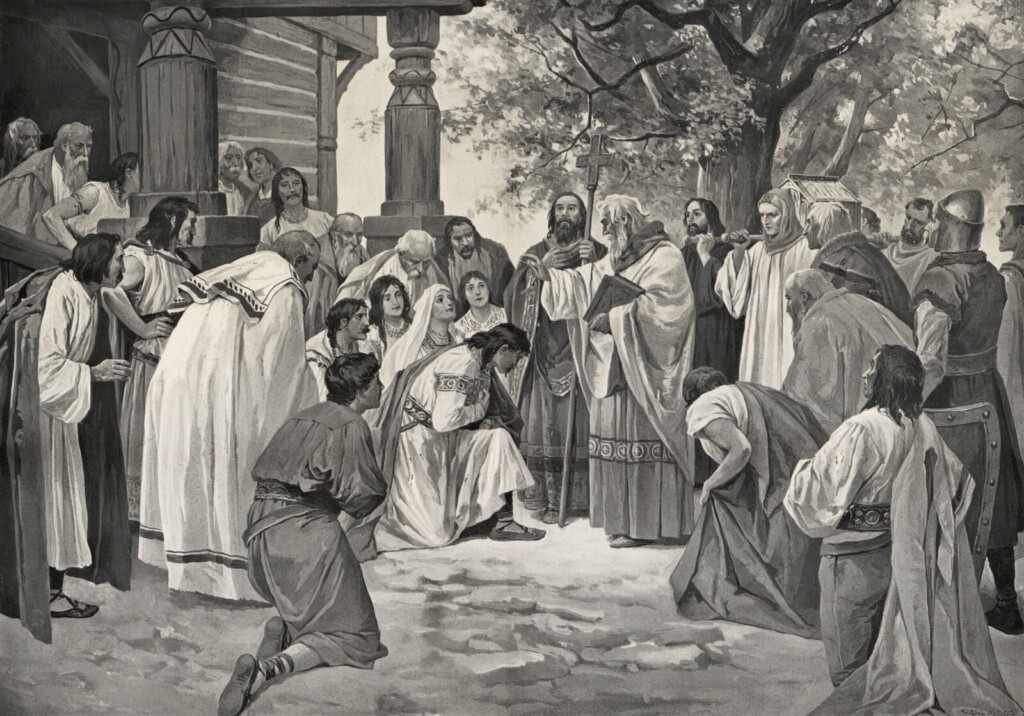
You buy a book in 1764 and the title page tells you it was translated from an Italian manuscript printed in Naples in 1529, recovered from an ancient Catholic family in the north of England. The translator introduces himself as William Marshal, Gent., a modest and dutiful figure who merely renders into English what some medieval Italian had witnessed and recorded. You feel the weight of centuries before you read a single word of the story itself.
There was no manuscript. There was no William Marshal. There was no Italian original. Horace Walpole, son of Britain’s most powerful prime minister, owner of Strawberry Hill — that extravagant Gothic fantasy he had built and decorated himself on the Thames at Twickenham — simply invented the entire apparatus of antiquity. When the first edition sold well enough to demand a second printing, he revealed his own name as author and offered an unapologetic preface explaining that he had wanted to combine the imaginative freedom of ancient romance with the psychological plausibility of the modern novel. The confession came easily because the fraud had already done its work.
What the fraud accomplished was more structurally significant than a simple literary hoax. The Enlightenment — that self-declared age of reason, empiricism, and regulated sentiment — had no respectable vocabulary for the pleasure of pure supernatural terror. Voltaire was publishing Candide in 1759, five years before Otranto appeared; David Hume had demolished the philosophical foundations of miracle and mystery; reason was the only legitimate currency. To admit that an educated English gentleman, a man of Parliament, a collector and wit and correspondent of half of Europe’s intellectuals, wanted to write about bleeding helmets and spectral giants and prophecies scratched into stone — this required institutional cover. The Middle Ages provided it, because the Middle Ages could be treated as a place where such appetites were historically appropriate, safely quarantined from the present.
The fabricated 1529 date is precise enough to do work. It locates the supposed original just after the height of the Italian Renaissance but before the full rationalizing force of Protestant modernity had settled over northern Europe — a cultural threshold moment when, in the Enlightenment imagination, credulous Catholic darkness might credibly persist. Denis Diderot was writing his Encyclopédie through the 1750s and 1760s to banish exactly this darkness. Walpole needed the darkness to persist somewhere, in some textual container, and he dressed it in scholarship to make it permissible.
What this reveals is not simple hypocrisy but something stranger: a society’s mechanism for consuming what it officially condemns. The attribution to a lost Catholic past allowed the 1764 reader to experience vicarious terror while maintaining a rational self-image, much the same way that medical quackery travels under the name of ancient wisdom to borrow the authority of age rather than admit it is simply desire wearing a laboratory coat. The reader of Otranto’s first edition was not deceived in the way a fraud victim is deceived — they were given permission to be deceived, offered an alibi for their own appetite.
Friedrich Schiller, writing in 1795 in On Naive and Sentimental Poetry, argued that the modern sensibility turns to antiquity not to recover something genuinely lost but to mourn a wholeness it suspects was never quite real. Walpole did not recover medieval romance; he manufactured a version of it that served exclusively contemporary needs — the need to feel, intensely, without accountability, without the embarrassment of admitting that the age of Newton and Locke still trembled before the dark at the bottom of a staircase.
The Gothic castle Walpole built in stone at Strawberry Hill and the Gothic castle he built in prose in Otranto were both, in the end, stage sets — not errors of historical judgment but deliberate constructions designed to produce a feeling that the present refused to authorize under its own name.
Terror as Aristocratic Privilege
You are reading the novel wrong if you think the ghost is the monster. Stand in the great hall of Otranto for a moment — not as a guest, not as a scholar, but as a servant girl who has just watched a helmet the size of a small house crush the heir to a principality, and ask yourself who in that room has the luxury of fainting. Not you. Fainting is for Isabella. Terror, in Walpole’s architecture, is not distributed democratically among those present; it is allocated according to rank, and the allocation is not accidental.
Manfred does not experience the supernatural the way the women around him do. When the portrait of his grandfather steps from its frame and sighs, he is shaken — briefly — but what dominates his response is calculation: how to suppress the omen, how to redirect it, how to convert metaphysical disturbance into dynastic strategy. He proposes remarriage to Isabella within hours of his son’s death, not because grief has unhinged him but because he understands, with the cold clarity of a man accustomed to treating women as instruments of lineage, that the supernatural clock is ticking and he has agendas to outrun. The ghost is a problem of succession. He administers his fear the way a lord administers an estate — by delegation.
Isabella and Matilda, by contrast, are not administrators of dread; they are its primary recipients and its moving vessels. They flee through underground corridors. They tremble in chapels. They absorb the atmospheric charge of every haunted room they enter, not because they are weaker but because the novel’s structure assigns them that function. Edmund Burke, writing in 1757 in his Philosophical Enquiry into the Origin of Our Ideas of the Sublime and Beautiful, located the experience of terror in the body as a form of physiological astonishment — a surrender of control that he associated, without entirely meaning to, with femininity and with the experience of being overpowered rather than overpowering. Walpole, who had read Burke and who was socially intimate with the aesthetic conversations of his moment, built his female characters to perform exactly this surrender. Their terror is proof of their sensitivity, their sensitivity is proof of their virtue, and their virtue is the quality that makes them marriageable and therefore useful to the men negotiating above them.
What this produces is a class technology disguised as atmosphere. The supernatural in Otranto does not threaten established hierarchy — it enforces it. The giant apparition of Alfonso the Good, assembled piece by enormous piece across the novel’s length until it finally erupts through the castle walls in the climax, is not the enemy of legitimate rule. It is the instrument of its restoration. The usurping line of Manfred must be displaced, and the displacement is accomplished not by rebellion, not by peasant uprising, not by any horizontal social force, but by vertical intervention from a sanctified dynastic past. The peasant Theodore turns out to be the rightful heir. The supernatural, having done its work, produces not liberation but a more correctly ordered aristocracy. The terror was always in service of the inheritance.
What Walpole could not have named, because the vocabulary did not yet exist in the form that Pierre Bourdieu would later give it in his 1979 Distinction, was that fear itself operates as cultural capital in this world — something possessed in the right quantities by the right bodies, conferring the right kinds of legibility. Too much fear marks you as low, as animal, as the servant who cannot be trusted with information. Too little marks you as Manfred — morally corrupt, supernaturally doomed. The women of Otranto feel fear in precisely the cultivated, exquisite register that announces their class membership even as it strips them of agency, their trembling a kind of involuntary credential that the novel never stops collecting on their behalf.
Edmund Burke's Sublime and the Politics of Overwhelm
You are sitting in a room that is too large for you. The ceiling is vaulted, the shadows pool in corners you cannot reach, and somewhere — not close, but not far enough — something moves. Your pulse adjusts before your mind does. That involuntary recalibration is not a malfunction. It is, as Edmund Burke argued in his Philosophical Enquiry into the Origin of Our Ideas of the Sublime and Beautiful in 1757, the signature of power operating on a body that has not yet decided whether to submit.
Burke was precise where his contemporaries were merely enthusiastic. He located the sublime not in grandeur as an aesthetic category but in terror as a physiological event — specifically, terror at a safe remove, pain experienced without its full consequence. Darkness, vastness, obscurity, the sense of power without legible limit: these were not metaphors for the sublime, they were its machinery. The beautiful, for Burke, solicited the viewer. The sublime crushed them, and the crushing was the point. What made this analysis quietly scandalous was its implication: that the aesthetic experience of overwhelm and the political experience of obedience run on identical circuitry. The subject who trembles before a vaulted ceiling and the subject who defers to a sovereign operate through the same trained reflex.
Walpole understood this before Burke had finished writing it. The Castle of Otranto, published in 1764, works as a kind of applied Burke, a laboratory in which the political mechanics of awe are stress-tested through fiction. Manfred’s ancestral castle does not simply house the action — it performs sovereignty. Its corridors resist navigation, its passages open onto further passages, its subterranean galleries swallow characters whole. The architecture is not a backdrop for power; it is power’s most legible argument. When Isabella flees through tunnels she cannot map, she rehearses something that medieval peasants rehearsed beneath actual fortifications: the body’s instinctive recognition that the structure was not built for them, that they exist inside a geometry of someone else’s dominion.
The political history embedded here runs deeper than metaphor. Burke’s Enquiry appeared at a moment when the British state was consolidating empire at an extraordinary pace — the Seven Years’ War would end in 1763 with Britain absorbing territories on three continents — and the question of how to manufacture consent in populations that had never been asked for it was not theoretical. Terror, administered aesthetically rather than literally, had long been a tool of dynastic legitimacy. Coronations, cathedrals, the deliberate scale of palace architecture: these were not incidental to governance but integral to it, ways of making the body feel the rightness of hierarchy before the mind could object. What Walpole accomplished was the privatization of that mechanism. He moved it from public ritual into the individual reading experience, where it could be rehearsed in solitude, at leisure, with the additional persuasion of pleasure.
This is what makes the novel’s famous machinery — the gigantic helmet, the portrait that steps from its frame, the statue that bleeds from the nose — something other than mere theatrical excess. Each apparition functions as a demonstration of force without legible source, which is precisely Burke’s definition of the sublime’s most potent register: power so total it cannot be assigned to a visible agent. The horror is never Manfred alone. It is the castle, the lineage, the prophecy, the weight of ancestral claim pressing down on every living character regardless of their guilt or innocence. That diffusion of agency is not a narrative weakness — it is the argument. When power cannot be located, it cannot be refused.
What the reader rehearses, turning these pages in the safe enclosure of a private room, is a posture the body already knows: vigilance without recourse, alertness without exit, the specific muscular tension of someone who understands that the structure around them was designed to make resistance feel absurd before it is even attempted.
A vision curated by a filmmaker, not an algorithm
In this video I explain our vision
The Second Preface and the Logic of Plausible Deniability

You have already been caught before the second edition arrives. Walpole knows this — he knows the game is over the moment the reviews begin to praise the wrong thing, to admire the manuscript’s authenticity with an earnestness that embarrasses him more than exposure ever could. So in 1765 he steps forward, signs his name, and does something far more consequential than confessing: he theorizes.
The second preface to The Castle of Otranto is not an apology. It is a capture operation. In fewer than a thousand words, Walpole reframes every element of the work not as a personal eccentricity or a private obsession but as the calculated execution of a literary principle — the blending of two narrative traditions, the ancient and the modern, the improbable and the psychologically specific. He coins his own genre from the inside, which means he simultaneously invents the crime and writes the law. Anyone who comes after him to describe what Gothic fiction does must use, in some form, the vocabulary he provided in that preface, because he built the critical scaffolding before the critics could assemble their own. This is not humility disguised as transparency. This is monopoly.
What Walpole performs in 1765 belongs to a pattern Pierre Bourdieu spent much of Distinction, published in 1979, trying to name precisely: the educated subject’s drive to convert cultural transgression into cultural capital before the market can assign an unflattering price. Bourdieu showed that taste is never innocent, that aesthetic choices encode social hierarchies with a fluency that makes them almost invisible to those who benefit from them. Walpole’s second preface is this mechanism made grotesquely legible — a man of enormous inherited privilege, MP for Castle Rising, collector of a fabricated medieval estate, choosing the moment of his exposure to lecture the reading public on the theory of imaginative literature. The confession and the manifesto arrive as a single document, inseparable, because the confession without the manifesto would leave him merely strange.
There is a particular cruelty in how completely this worked. Clara Reeve, writing The Progress of Romance in 1785, could not discuss the emergence of supernatural fiction without positioning herself in relation to Walpole’s stated intentions, agreeing here, correcting there, but always inside the frame he built. Horace Walpole had been dead in a theoretical sense since the first forgery was exposed — and yet the corpse had somehow arranged its own autopsy and published the findings first. Every subsequent novelist working in terror and ancestral guilt was, in some measure, operating on ground he had already claimed, not through the novel itself but through the apparatus of explanation he threw around it like a fence.
What makes this reflex modern rather than merely strategic is the particular relationship it assumes between the creator and the critical reader. Walpole does not simply defend the book. He instructs the reader in how to be sophisticated enough to receive it — implying, without ever stating outright, that those who were disturbed by the supernatural elements or found the plot’s mechanics implausible were simply reading from within the wrong tradition. This is the intellectual’s oldest defensive maneuver dressed in Enlightenment costume: the work is not at fault; your interpretive framework is insufficient. Criticism becomes evidence of the critic’s limitation rather than the text’s.
What lingers is not the audacity of the forgery but the speed with which transgression was converted into doctrine. The interval between the two prefaces is exactly one year, which is almost nothing — barely enough time for the cultural reaction to crystallize into something Walpole could read and reposition against. That he managed it at that velocity suggests the second preface was not improvised in response to exposure but was always latent in the first, waiting for the right moment to emerge and take control of what the book was allowed to mean.
What the Helmet Crushes
You are standing in the courtyard when the sky falls. Not metaphorically — something massive, inexplicable, and armored descends from nowhere and obliterates the young man who was supposed to inherit everything. Conrad, fifteen years old, crushed beneath a helmet of supernatural scale on the morning of his wedding, is the first casualty of The Castle of Otranto, and almost every reader treats this moment as mere spectacle, the opening shock of a new genre finding its feet. But the helmet is not decoration. It is the argument.
Walpole published the novel in 1764, presenting it as a translation of a medieval Italian manuscript, a lie so transparent it barely required unmasking — yet the disguise itself carries weight. He needed a layer of fiction between himself and what he was actually writing, because what he was actually writing was a meditation on the violence embedded in dynastic legitimacy. The helmet that kills Conrad is enormous because the inheritance it represents is enormous, because the structures of aristocratic succession that were supposed to shelter and perpetuate a bloodline are, at their root, crushing mechanisms. They do not protect heirs. They produce them for the purpose of being crushed by the very weight of what they are meant to carry.
Edmund Burke would argue, twenty-six years later in his Reflections on the Revolution in France, that inherited institutions accrue a kind of moral authority through duration, that the dead have a legitimate claim on the living through the contracts embedded in tradition. Walpole, who moved in the same political circles and shared many of Burke’s instincts, seems to have discovered something that Burke’s daylight reasoning refused to accommodate: that duration is not innocence, that the longer a structure persists, the more bodies it has already required, and the more it will demand. Manfred does not invent the violence in Otranto. He inherits it, along with the usurped title and the ill-gotten castle, and the machinery of that usurpation grinds forward with or without his conscious participation. He is less a villain than an engine component.
The psychoanalytic reading of Gothic fiction that emerged in the twentieth century — shaped significantly by Freud’s 1919 essay on das Unheimliche, the uncanny, the familiar turned threatening — would locate the horror of the helmet in the return of the repressed, the past erupting into the present. But this framing is too clean. It presupposes that the past was ever successfully buried, that the repression was ever complete. In Otranto, the past was never underground. It was always there in the stones of the castle, in the architecture of power, structuring every relationship and every room. The supernatural is not irruption. It is revelation.
What Walpole could not consciously say — could not say in a letter, could not say in his correspondence with Horace Mann or his architectural fantasies at Strawberry Hill — was that the English aristocracy to which he belonged was itself a system of legitimate violence wearing the costume of inheritance. The Magna Carta, signed in 1215, is often treated as the founding document of English liberty, but it was a negotiation between one class of powerful men and another about the terms of their mutual dominance. The liberties it protected were not general. They were positional. And the castle, as both literal structure and symbolic form, was always the architecture of that position: a place designed not only to defend its inhabitants but to make the cost of that defense fall on everyone outside its walls.
Conrad never speaks in the novel. He has no interiority, no dialogue, no desires that the text acknowledges. He exists only as the object of a succession plan, and he dies before the plan can be executed, crushed by the very symbol of the authority that was being prepared for him. Walpole may have intended this as Gothic machinery, but the novel’s logic exceeds his intentions: Conrad is not a character sacrificed for atmosphere but a structural argument about what dynastic systems do to the people they produce.
The Genre That Outlived Its Irony
You are standing in a corridor that has no exits you can find, and the candle is burning lower than you expected, and somewhere behind the wall something is moving that you cannot name — and the strangest part is that you have been here before, not in any house, but in every story you absorbed before you were old enough to know stories were constructed things. The corridor was built by a man who thought he was playing.
Horace Walpole published The Castle of Otranto in 1764 under a false Italian name, pretending to have merely translated a medieval manuscript, and the preface he attached to the second edition — once he admitted authorship — practically winks at the reader. He described his project as a marriage between the old romance and the new novel, between supernatural extravagance and careful psychological realism, and the formulation is elegant enough to read as sophisticated hedging: if the ghosts fail, blame the romance tradition; if the characters feel thin, blame the antiquarian conceit. The irony was structural, built into the bones of the enterprise, a gentleman’s insurance against the embarrassment of having felt too much in public.
Ann Radcliffe dismantled that insurance without acknowledging she was doing so. In The Mysteries of Udolpho, published in 1794, thirty years after Walpole’s experiment, she retained every gothic mechanism — the decaying castle, the tyrannical villain, the persecuted heroine sealed inside architectural enormity — but subjected each supernatural shiver to eventual rational explanation. The ghost resolves into a criminal in disguise; the apparition resolves into a wax figure; the sound behind the wall resolves into wind through a broken shutter. Critics have read this as timidity, but the move is more violent than it appears, because Radcliffe was not defusing the terror, she was relocating it entirely inside the human. The monster wearing aristocratic clothes turned out to be an actual aristocrat, and no ironic distance remained to soften that.
Matthew Lewis went the other direction with a force that scandalized even Radcliffe. The Monk, published in 1796 when Lewis was nineteen years old and a Member of Parliament, refused rational explanation entirely. The supernatural in Lewis is not a metaphor and not a mechanism of suspense — it is literal, carnal, and catastrophic, and the novel’s Madrid is soaked in a violence that the church itself generates rather than contains. Samuel Taylor Coleridge, reviewing it in The Critical Review in 1797, acknowledged the book’s undeniable power while calling it a work that a man of genius had produced without a man of principle — which tells you more about what Lewis had successfully destroyed than about any moral failure. Walpole’s irony was not merely abandoned here; it had become impossible to sustain, because the subject matter had been revealed as too real for protective distance.
By the time Mary Shelley wrote Frankenstein in 1818, the gothic form had absorbed enough sincerity to turn the machinery against its own origins. The creature assembled from charnel-house materials and abandoned by his creator is not a medieval baron’s ghost — he reads Plutarch’s Lives and Goethe’s The Sorrows of Young Werther and Paradise Lost, he argues philosophically for his own dignity, he is more educated than most of the people reading about him. The aristocratic fear that drove Walpole — the fear of obliterated bloodlines and usurped inheritance — had been inverted into a working-class rage at being made and discarded by someone who considered creation a private experiment. The genre had traveled from a gentleman’s toy to a political accusation in fifty-four years, and the journey required no single decisive rupture, only the accumulated sincerity of writers who took the architecture seriously and discovered what it had always been capable of housing.
What Walpole released into the world when he invented a haunted castle as an ironic gesture was not a form but a permission — permission to treat irrational fear as a subject worthy of serious literary attention, and once that permission existed, the irony that licensed it became the first thing the form consumed.
🏰 Gothic Shadows: Terror, Mystery and the Haunted Imagination
Horace Walpole’s The Castle of Otranto did not merely invent a genre — it opened a secret door into the architecture of fear, the supernatural, and the tyranny of the past over the living. These related articles explore the literary, psychological, and aesthetic territories that Gothic fiction made possible, from crumbling ancestral mansions to the uncanny horrors lurking in everyday spaces.
Edgar Allan Poe and the Cursed House: Architecture of Terror
Edgar Allan Poe elevated the haunted house into a metaphor for the decaying mind, transforming Gothic architecture into pure psychological landscape. In works like The Fall of the House of Usher, walls crack in sympathy with their inhabitants, and the building itself becomes a living extension of terror and hereditary doom. Poe’s cursed houses are direct descendants of Walpole’s Otranto, carrying forward the Gothic obsession with spaces that remember and punish.
GO TO THE SELECTION: Edgar Allan Poe and the Cursed House: Architecture of Terror
Contemporary Gothic: When Horror Becomes Psychology
Contemporary Gothic has evolved far beyond candlelit corridors and rattling armour, becoming a sophisticated lens through which modern psychology examines trauma, repression, and identity. Where Walpole used supernatural machinery to articulate anxieties about power and legitimacy, today’s Gothic writers and filmmakers use horror as a mirror for interior states of grief, guilt, and dissociation. The genre’s enduring power lies precisely in this double vision — the monster is always also the self.
GO TO THE SELECTION: Contemporary Gothic: When Horror Becomes Psychology
The Aesthetics of the Sublime: When Beauty Is Frightening
The aesthetics of the sublime — that overwhelming combination of beauty and terror first theorised by Edmund Burke and Kant — are inseparable from the Gothic literary tradition that Walpole inaugurated. The sublime transforms landscape, architecture, and darkness into forces that dwarf human reason and awaken a pleasurable dread, the same dread that readers feel when Otranto’s giant helmet crashes into the castle courtyard. Understanding the sublime is essential to understanding why Gothic fiction continues to exert such a visceral emotional grip.
GO TO THE SELECTION: The Aesthetics of the Sublime: When Beauty Is Frightening
Sheridan Le Fanu: Irish Gothic and Domestic Horror
Sheridan Le Fanu, writing a century after Walpole, refined the Gothic tradition by relocating its terrors from medieval Italian castles to the domestic interiors of Victorian Ireland, where horror lurks behind locked bedroom doors and in the habits of seemingly respectable households. His mastery of psychological dread and ghostly atmosphere made him one of the key architects of what we now call domestic Gothic, a mode in which the home itself becomes a site of imprisonment and dread. Le Fanu’s work demonstrates how Walpole’s foundational impulse — to make the past violently haunt the present — can be endlessly reinvented across different cultural and historical contexts.
GO TO THE SELECTION: Sheridan Le Fanu: Irish Gothic and Domestic Horror
Discover Gothic and Dark Cinema on Indiecinema
If these shadows and labyrinths have stirred something in you, Indiecinema is the streaming home for the films that dare to go further — independent, auteur, and genre-defying works that carry the Gothic spirit into moving images. Explore our curated catalogue and let the darkness in.
👉 EXPLORE THE CATALOG: Watch Indie Films in Streaming
A vision curated by a filmmaker, not an algorithm
In this video I explain our vision

