
The Inheritance No One Declared
You are standing in the kitchen doorway, watching your child struggle with something small — a jar lid, a homework problem, a shoelace that won’t cooperate — and before the thought has fully formed, before you have decided anything, you hear your father’s voice come out of your mouth. Not his words exactly. His tone. That particular compression of air that communicates, without stating, that patience has a ceiling and the child is approaching it. You did not choose this. You did not reach into a drawer of available responses and select it. It arrived the way breathing arrives — autonomic, prior to decision, rooted somewhere the will cannot easily access.

This is not metaphor. The mechanisms are biological and social simultaneously, which is what makes them so difficult to see and nearly impossible to contest. The developmental psychologist John Bowlby, working through the 1960s and 1970s on attachment theory, demonstrated that the relational patterns formed in early childhood become what he called internal working models — cognitive and emotional templates that shape every subsequent relationship, including the relationship a person will eventually have with their own children. By the time Bowlby published the third volume of his Attachment trilogy in 1980, the evidence was already suggesting something deeply uncomfortable: that the way a parent responds to distress is not primarily a matter of values or intentions but of neurological habit, carved by repetition into pathways that fire before reflection can intervene.
What makes this harder to accept is that modern parenthood has been saturated with the ideology of conscious choice. The twentieth century produced an enormous cultural apparatus — parenting manuals, psychological guidance, pedagogical philosophy — all premised on the assumption that knowing better automatically produces doing better. But the transmission of behavior across generations operates largely beneath the threshold where knowledge lives. A parent can read every word Winnicott wrote about the good-enough mother, understand it completely, believe it sincerely, and still grip their child’s arm too hard in a moment of public embarrassment, replicating the exact gesture they swore, at seventeen, they would never use.
The sociologist Pierre Bourdieu named this gap between conscious belief and embodied practice with the concept of habitus — the system of durable, transposable dispositions that structure perception and action without passing through deliberate calculation. In his 1980 work Le Sens pratique, Bourdieu argued that the social world is reproduced not primarily through ideology, which is visible and therefore arguable, but through the body itself, through posture, rhythm, gesture, and tone, all of which are absorbed in childhood and carried forward as a kind of second nature so natural it feels like no nature at all. This is the inheritance that appears on no document, that clears no customs, that no lawyer is ever called to administer.
What a family transmits is rarely what it believes it is transmitting. Parents who are convinced they are passing on resilience are sometimes passing on the dissociation that made their own survival possible. Parents who believe they are modeling ambition are sometimes modeling the specific anxiety that ambition was always a defense against. The content of transmission is not the stated value but the emotional structure in which that value was always embedded — and children receive the structure first, the explanation decades later if at all.
There is a kind of vertigo available to anyone willing to look at their own behavior with genuine honesty, the sudden recognition that the most intimate gestures of their daily life are not original, that the self they experience as sovereign and interior is in many of its most consequential moments a relay station for patterns that began before they were born, running through them toward children who will one day stand in their own kitchen doorways.
Days Blows by in a Moment
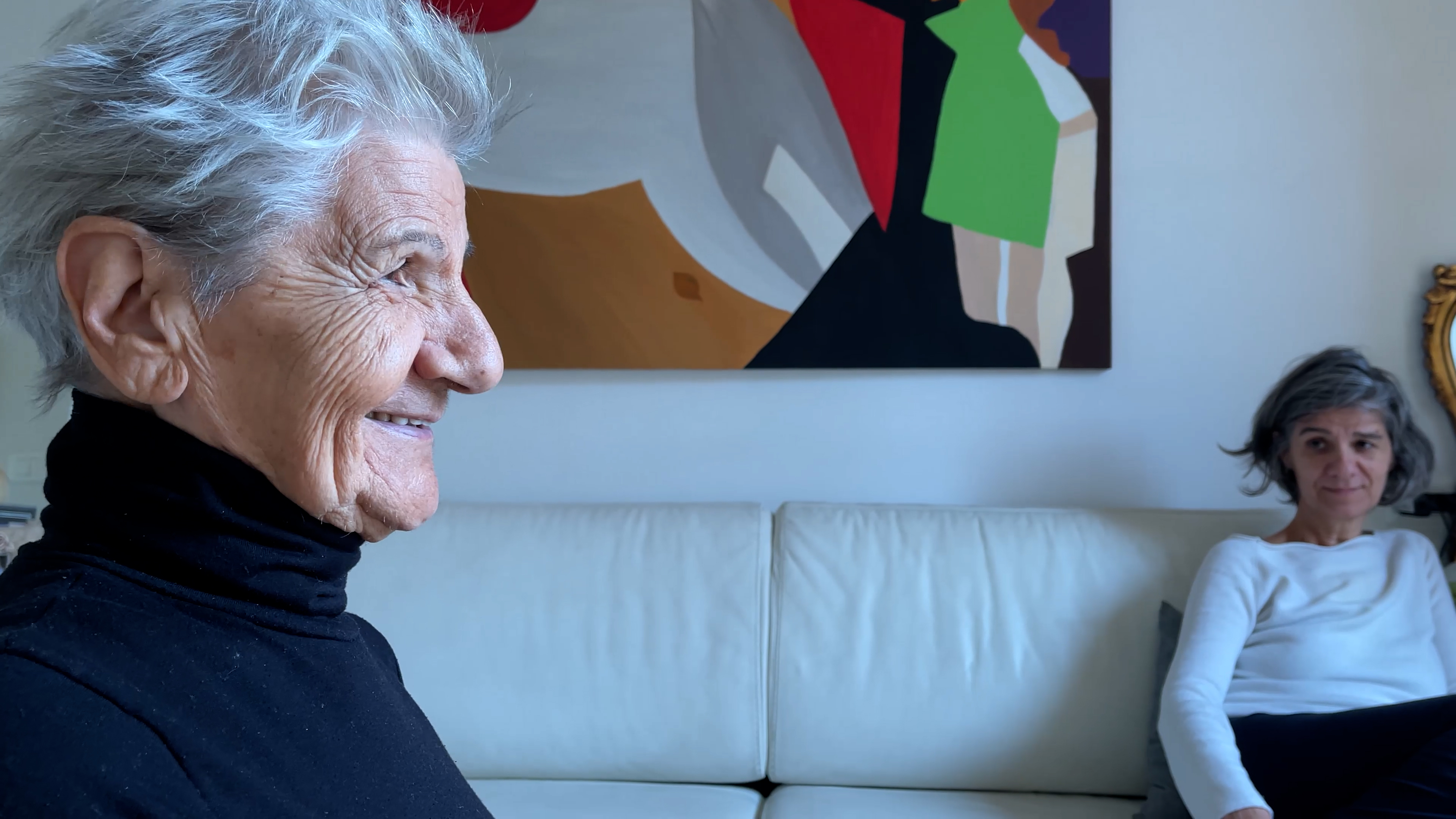
Documentary, by Cristiana Donghi, Italy, 2022.
Ancilla is 86 years old. Two years ago, she moved in with her daughter Emanuela at the pandemic's beginning. Ancilla is slowly losing her memory. He does not remember what she had for lunch, she only remembers events from the past, perhaps only because she has been repeating them for years. Emanuela takes care of her, day after day she wakes her up, prepares her food, washes her, dresses her, and accompanies her a couple of days a week to the hospice and does physiotherapy. This is one of the few contacts with the rest of the world she has left. Ancilla has another child, Mauro, who has been living in London since he left looking for a job. She hasn’t seen him for two years. Daily routines always repeat themselves and change only with the changing seasons. The mother's memories slowly introduce us to Ancilla, her past, the life she lived and that transported her here. Melancholy moments alternate with funny ones and those where patience reaches its limits. Ancilla's sympathy brings a light, fresh breeze into the lives of those around her and allows them to see everything in a way where even the most ominous clouds are blown away momentarily by a breath of wind.
LANGUAGE: Italian
SUBTITLES: English, Spanish, French, German, Portuguese
What Epigenetics and Psychoanalysis Agree On
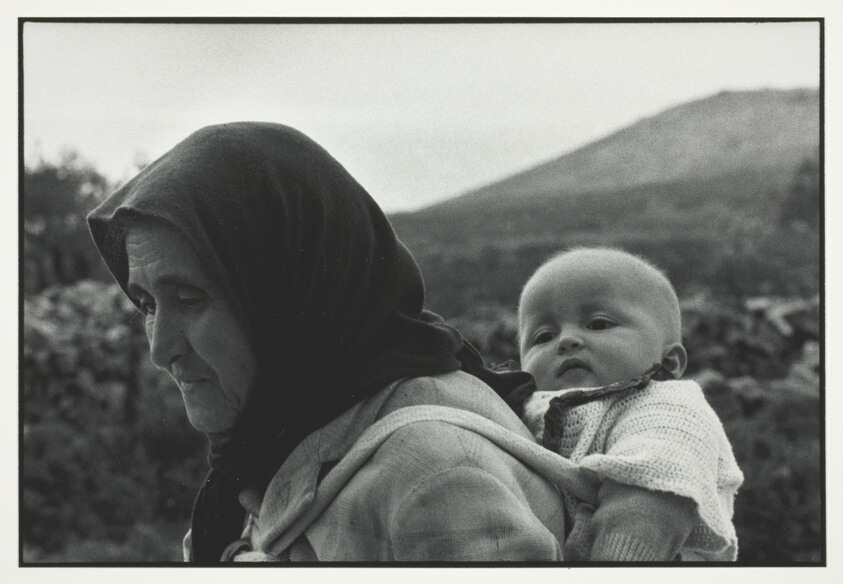
You did not inherit your grandmother’s silence. You became it.
There is a particular kind of knowledge that lives below language — not forgotten, not repressed in the classical sense, but simply never articulated, never handed a word, never given a frame. Christopher Bollas, the British psychoanalyst, called this the “unthought known”: the vast territory of experience that shapes a person before they have the cognitive architecture to think it. It is not unconscious in the way a traumatic memory is unconscious, buried under anxiety and defense. It is pre-symbolic, carved into the body’s way of moving through space, into the particular threshold at which a person startles, into the almost imperceptible hesitation before they allow themselves to need something from another human being. Bollas developed this concept across several works, most rigorously in “The Shadow of the Object” published in 1987, and what he was pointing at was this: the most consequential things transmitted between parent and child are precisely the things that were never spoken, because they could not be spoken, because the parent themselves had no words for them.
Rachel Yehuda’s research forced biology to admit the same thing. Working with the children of Holocaust survivors at the Icahn School of Medicine at Mount Sinai, Yehuda and her team published findings in 2016 in “Biological Psychiatry” demonstrating measurable epigenetic changes — specifically in the FKBP5 gene, which regulates the stress-response system — in the descendants of survivors compared to Jewish families who were not in Europe during the war. The children had not experienced the camps. They had not lived through the selections, the starvation, the specific terror of a world that had decided they did not deserve to exist. And yet their cortisol regulation, their baseline physiological relationship to threat, bore the stamp of it. The body had received a transmission the mind never consciously sent.
What is devastating about the convergence of these two frameworks is not the fact of transmission itself — cultures have always known that catastrophe echoes across generations, even if they explained it through gods or curses rather than methylation patterns. What is devastating is the precision of it. Yehuda’s epigenetic findings suggest that trauma does not merely alter behavior, which then models behavior in children, which then shapes nervous systems over time. It alters the molecular annotation of the genome itself, changing how genes are expressed without changing the underlying sequence, in a modification that can be passed directly through gametes. The grief does not trickle down. It is delivered.
This means a child can be born already calibrated to a danger that ended before they existed — already tuned to frequencies of threat that their parents could not consciously describe, because the parents themselves had inherited it from people who could not bear to speak about what had happened. Three generations of a family can share a physiological emergency response to a historical event that only one of them survived, while the other two were told, if they were told anything at all, that the past was the past, that things were better now, that there was no reason to be afraid. The gap between what was said and what was transmitted is not a gap of dishonesty. It is a gap of the unspeakable — the place where language failed and the body took over.
What epigenetics and psychoanalysis agree on, finally, is that the child is never a blank slate. The child is an archive. They carry documents they cannot read, written in a script no one taught them, recording events that ended decades before their first breath.

The Social Machinery of Reproduction
You sit across from your child at the dinner table and you are teaching them something you cannot name. Not the words you are saying. The way you hold your fork. The particular register of irony you deploy when discussing the neighbors. The almost imperceptible pause before you engage with someone you consider beneath your intellectual level. Your child is absorbing a full grammar of the world, and neither of you will ever speak of it directly, because the most powerful lessons are the ones that bypass language entirely.
Pierre Bourdieu spent the better part of the 1960s watching French schoolchildren fail in ways that looked personal but were structurally predetermined. In 1970, writing with Jean-Claude Passeron, he named what he saw: a system that presents inherited cultural competence as natural intelligence, that mistakes the child who already knows how to talk about Cézanne for the child who is simply smarter. The concept of habitus is not, as it is often casually reduced, merely about habits. It is about the entire sedimented history of a class position made flesh — made into posture, diction, aesthetic reflex, and the unconscious calibration of what counts as possible for a person like you. Cultural capital moves through families the way real estate does, except it is invisible in the will, untaxable, and denied entirely as inheritance by the very people who benefit most from receiving it.
What makes this machinery so resistant to exposure is precisely its fluency. The child raised in a household where books are furniture, where dinner conversation rehearses argument structure, where museum visits are unremarkable Saturday errands, arrives at school already performing competence in the institution’s native language. The teacher, who is also a product of this system, reads the performance as aptitude. No conspiracy is required. The bias is built into the very criteria of evaluation — what counts as a good answer, a sophisticated question, an impressive essay. By the time standardized testing arrived in mid-twentieth-century Europe and America as the supposedly neutral arbiter of merit, it was measuring, with remarkable precision, the quality of one’s parents’ bookshelves.
The cruelty of this mechanism is not that it punishes the poor. It is that it convinces them their poverty is cognitive. The working-class adolescent who drops out does not, in most cases, experience herself as a victim of structural exclusion. She experiences herself as someone who simply was not good enough, not curious enough, not made for that world. The social verdict is internalized so completely that it presents itself as self-knowledge. This is what Bourdieu meant when he described symbolic violence — not the violence of blows but the violence of categories, of legitimate culture, of the unspoken agreement between the dominated and the dominant about who naturally belongs where. The genius of it is that it requires no enforcer. The system reproduces itself through the sincere beliefs of everyone inside it.
Language is where the transmission becomes most intimate and most traceable. Basil Bernstein, whose research ran parallel to Bourdieu’s through the 1970s, demonstrated that working-class children tended toward what he called restricted codes — context-dependent, communally grounded speech — while middle-class children operated in elaborated codes capable of abstraction and institutional navigation. Schools reward one and pathologize the other. The child who says “you know what I mean” to a teacher is not less intelligent than the child who constructs a subordinate clause. They are speaking different social dialects, and the school does not function as a translator. It functions as a border.
What we cannot see, because we are inside it, is that taste itself — what you find beautiful, funny, worth your time — is a form of social positioning masquerading as personality.
Ancestral
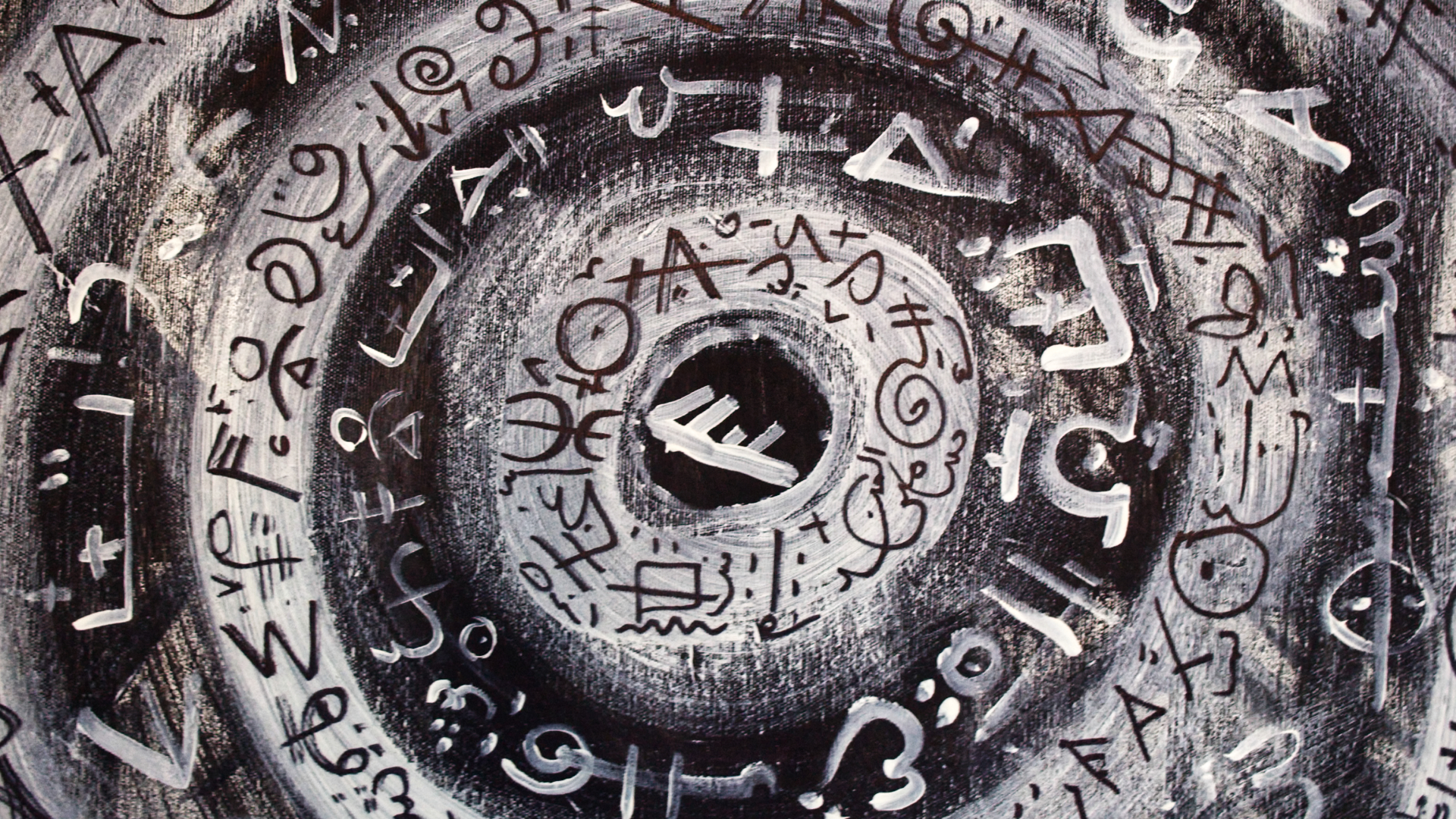
Documentary, by Lumar Brothers, Italy, 2023.
“Ancestral: Life and Art of Massinissa Askeur” is a documentary that explores the life and art of Algerian painter Massinissa Askeur. The film follows Askeur on his creative journey, showing his artistic process and his commitment to the preservation of Berber culture and tradition. Through interviews with Askeur, his family, friends and testimonies from people who knew him on a personal, professional and artistic level, the documentary tells the story of his past and his deep connection to his Berber roots. Askeur displays his art, from canvases to sculptures, which are inspired by the shapes and symbols of Berber culture, representing his search for a connection between the past and the present.
The documentary also explores the challenges Askeur faced throughout his life, including racial discrimination, poverty and the difficulty of making his art known outside of Algeria. However, despite these difficulties, Askeur continues to create and promote his art as a form of cultural resistance and celebration of his ancestral heritage. A vision far from art as a commercial product and very close, instead, to the exploration of the depths of one's own soul and the soul of the world. Massinissa's mission is to leave a testimony of his time to future generations.
LANGUAGE: Italian
SUBTITLES: English, Spanish, French, German, Portuguese
The Mythology of the Clean Break

You leave the town at eighteen with one suitcase and the absolute certainty that distance is the same thing as freedom. The accent softens over years, the references shift, the wardrobe changes, the dinner-party conversation moves fluently across registers your parents never had access to. You become, by every visible measure, someone else. And yet at three in the morning, when the architecture of your defenses has gone quiet, you find yourself thinking in the old syntax, wanting the old things, fearing the old fears — slightly relocated, impeccably disguised, but structurally identical to what you inherited.
The Western cult of self-reinvention rests on a foundational confusion between form and structure. It mistakes the renovation of surfaces for the transformation of load-bearing walls. Since at least Ralph Waldo Emerson‘s “Self-Reliance” in 1841, the Anglophone tradition has enshrined the individual’s capacity to author themselves from scratch as not merely possible but morally obligatory — as though the failure to escape one’s origins were a personal failing rather than evidence of how deeply origins operate below the threshold of conscious choice. This has produced a civilization fluent in the language of rupture and almost entirely illiterate in the grammar of transmission.
Didier Eribon returned to Reims in 2009 after his father’s death and found something that destabilized the entire architecture of his intellectual life. He had spent decades building a self in Paris — academic, gay, cosmopolitan, leftist — that seemed to him a genuine break from the working-class homophobic milieu he had fled. What the return revealed was that the break had been real at the level of identity but fictitious at the level of affect. The shame had not been dismantled. It had been inverted into pride, transferred from class to sexuality, repackaged into a new social performance that still organized itself around the same core wound: the terror of being seen as insufficient by a world that holds the criteria for sufficiency just out of reach. The escape had been genuine. The structure of the escape was inherited.
What makes this pattern so difficult to identify is that displacement is emotionally indistinguishable from transformation from the inside. The person who grew up in a household organized around financial anxiety and now performs elaborate indifference to money — refusing to discuss salaries, cultivating aesthetic disdain for commercial success — is not free of that anxiety. They have built an identity in opposition to it, which means the anxiety remains the fixed point around which everything orbits. Opposition is not independence. It is a different form of determination, one that requires the original wound to remain active in order to sustain its own coherence.
Sociologists call this the phenomenon of habitus conversion, borrowing from Pierre Bourdieu‘s concept of the durable dispositions that class origins inscribe into the body, the taste, the reflexes — not the opinions, which can be changed, but the pre-cognitive orientations that govern how a person moves through space, hesitates before speaking, reads a room. What Bourdieu demonstrated in Distinction in 1979 was that class does not primarily operate through ideas but through the body’s learned intuitions about where it belongs. Conversion — genuine structural conversion — would require not changing your ideas about class but unlearning the neuromuscular memory of subordination, and there is no ideology sophisticated enough to accomplish that.
The rhetoric of “breaking the cycle” carries inside it an unexamined assumption: that cycles are broken by the generation that names them. But naming is not the same as interrupting. It may in fact be the most elegant way of preserving a pattern — giving it a story, a vocabulary, an emotional significance that anchors it more deeply into identity than silence ever could.
What Cannot Be Neutralized
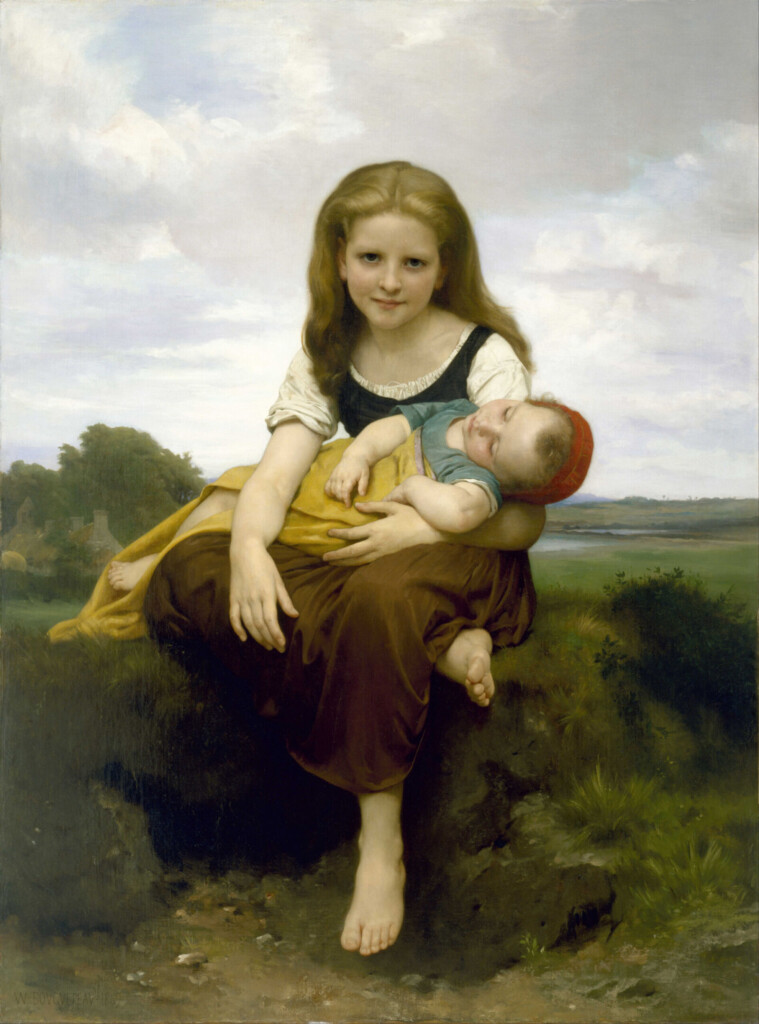
You are standing in a room you have never entered, speaking words you did not choose, feeling a grief that has no origin story you can point to. The sensation is not metaphorical. It arrives as a specific weight in the chest, a flinch before certain conversations, a sudden inability to breathe when someone asks about your grandfather’s war, or your grandmother’s silence at the dinner table every November. You assume this is yours. You have been living inside it long enough that it has taken the shape of your personality.
Nicolas Abraham and Maria Torok, working together through the 1970s and publishing their central collection “The Shell and the Kernel” in 1978, gave clinical language to something that psychoanalytic tradition had largely refused to acknowledge: that what is most devastating in a family is not what gets said and repressed, but what is never said at all. The phantom, in their formulation, is not a metaphor borrowed from ghost stories. It is a precise psychic structure — a foreign body installed in a descendant’s unconscious not through their own experience but through the gaps in someone else’s. The secret that a parent could not speak, the shame that required absolute silence to survive, does not disappear. It migrates. It takes up residence in the next generation as a symptom whose source is inaccessible because it was never the child’s to begin with.
This is why the therapeutic injunction to “work through your past” can feel so disorienting to people who carry inherited wounds. They are being asked to excavate an archaeology that predates them. The symptom is real — the panic, the compulsive behavior, the inexplicable shame around sexuality or money or professional ambition — but the originating event belongs to someone who may already be dead, someone who swallowed an unspeakable thing whole and handed the indigestion forward. Research in epigenetics has begun to locate this transmission in the body itself: studies following survivors of the 1944 Dutch Hunger Winter showed measurable methylation changes in the children and grandchildren of those who starved, physiological signatures of a famine those descendants never lived through. The silence becomes molecular. The body becomes an archive.
What makes this territory so resistant to conscious intervention is precisely the absence of narrative. Trauma that has been spoken, even incompletely, leaves a thread the next generation can follow backward. But the unspeakable secret — the father who collaborated, the mother who lost a child before you were born and never mentioned it, the violence that was absorbed into the family myth as mere “hardship” — generates symptoms without coordinates. The descendant experiences themselves as irrational, broken, inexplicably drawn to situations that replicate a catastrophe they have no name for. They do not know they are enacting a loyalty to a silence. They believe, with complete sincerity, that this is simply who they are.
There is something almost theological in the way unresolved historical violence refuses to stay in its historical container. The grandchildren of perpetrators carry different symptoms than the grandchildren of victims, but carry them nonetheless — a specific difficulty with moral clarity, an inherited numbness that passes for pragmatism, a family culture of looking away that gets coded as resilience or discretion. The German psychoanalyst and Holocaust researcher Dan Bar-On documented this in “Legacy of Silence” in 1989, interviewing the adult children of Nazi perpetrators and finding in them a recurring structure: the felt presence of something enormous and forbidden at the center of the family, organized around and never named.
What cannot be neutralized is the secret that achieved its goal — the one that was kept successfully enough that the keeper died believing it was buried, not knowing that silence is not burial but a different kind of speech, delivered on a delay, received by people who were never meant to hear it and have no idea they already have.
A vision curated by a filmmaker, not an algorithm
In this video I explain our vision
🧬 The Invisible Threads Binding Generations Together
What we pass on to our children is rarely chosen deliberately — it lives in silences, habits, wounds, and unspoken expectations. The emotional and psychological inheritance between generations shapes identity in ways that unfold over decades. These articles explore the hidden architectures of family transmission and the long shadows parents cast on the lives of their children.
The Emotional Legacy of Parents: How the Past Shapes Us
The emotional legacy left by parents operates like a silent script written before we are old enough to read it. This article explores how childhood experiences become internalized patterns that govern adult behavior, relationships, and self-perception. Understanding this inheritance is the first step toward consciously choosing what to pass forward — and what to finally let go.
GO TO THE SELECTION: The Emotional Legacy of Parents: How the Past Shapes Us
The Absent Father: Wounds That Remain
An absent father does not simply leave an empty chair at the table — he leaves a void that the child spends a lifetime trying to fill or explain. This article examines how paternal absence generates lasting psychological wounds that echo across identity formation, attachment styles, and emotional resilience. The absence itself becomes a paradoxical presence, shaping the child as powerfully as any sustained relationship might.
GO TO THE SELECTION: The Absent Father: Wounds That Remain
Unresolved Conflicts: When Resentment Becomes a Prison
Unresolved conflicts passed between generations can calcify into resentment so deeply embedded it feels like personality rather than pain. This article investigates how unexpressed grievances within family systems become inherited emotional furniture, occupying space in the psyche of children who were never even party to the original wound. Breaking the cycle requires first recognizing the prison’s walls for what they truly are.
GO TO THE SELECTION: Unresolved Conflicts: When Resentment Becomes a Prison
The Father-Son Relationship
The father-son relationship is one of the most mythologized and emotionally complex bonds in human culture, loaded with expectation, admiration, rivalry, and longing. This article traces how this fundamental dynamic shapes masculinity, ambition, and the capacity for intimacy across a man’s entire life. What a father teaches — and what he fails to teach — echoes in his son’s choices long after both have gone their separate ways.
GO TO THE SELECTION: The Father-Son Relationship
Discover the Cinema That Dares to Tell These Stories
The deepest films about family, inheritance, and emotional legacy are rarely found in mainstream multiplexes — they live in the world of independent cinema, where directors have the courage to sit with uncomfortable truths. On Indiecinema streaming, you will find a carefully curated selection of films that explore what we carry from those who came before us. Join us and let cinema open the conversations that families too often leave unspoken.
👉 EXPLORE THE CATALOG: Watch Indie Films in Streaming
A vision curated by a filmmaker, not an algorithm
In this video I explain our vision

