
The Man in the Makeup Chair
You sit down in the chair before the sun comes up. The room smells of rubber cement and cold cream, and the fluorescent light above you has the particular cruelty of a light that refuses shadows, that flattens everything it touches into something clinical and exposed. A man leans over you with tools that are not quite medical and not quite theatrical — small brushes, adhesive applicators, latex sheets that have been soaking overnight in a solution that burns slightly at the edges of the skin. You feel your face being erased in pieces. A ridge is built above your brow. Your jaw is widened by a quarter inch of synthetic material. Your hands, wrapped later, will stop feeling like your hands within the hour. You look into the mirror that the crew has positioned in front of you and watch yourself disappear with a patience that is either professional or broken, and you cannot always tell the difference at five in the morning.

This was not metaphor for Lon Chaney Jr. The makeup chair was a physical ordeal that consumed entire days before a single frame was shot. For the 1941 Universal production of The Wolf Man, Jack Pierce, the studio’s chief makeup artist, required between five and seven hours to apply the yak hair, the foam rubber nose appliance, the blackened contact lenses, and the layered greasepaint that built the character from the actor’s skin outward. Chaney sat through this repeatedly across four sequels and a crossover film, submitting his body to a process that left chemical burns along his hairline and damaged the skin around his eyes over years of repeated adhesive removal. The transformation that audiences watched compress into a two-minute montage was the residue of a working day that had already cost the man inside it something irreplaceable before the cameras began rolling.
What the culture does not easily accommodate is the idea that monstrosity, when it is performed rather than enacted, still extracts a genuine toll. There is a comfort in the clean separation between performer and role, a kind of social contract that says the actor goes home intact, that the latex comes off and the man underneath is unmarked. Erving Goffman, writing in The Presentation of Self in Everyday Life in 1959, described the performance of identity as a management of impressions, a surface negotiation between self and audience. But Goffman’s framework assumes that the performer retains access to a backstage where the performance is suspended. The makeup chair, for Chaney, was not backstage. It was a second stage, one with no audience and no applause, where the labor was entirely invisible and the cost entirely personal.
Chaney was the son of a man who had made silence into an art form. His father, the original Lon Chaney, had transformed his own body across more than 150 films between 1913 and 1930, famously dislocating his shoulders for The Hunchback of Notre Dame in 1923, wearing a harness that constricted circulation to reshape himself into Quasimodo. The son inherited an understanding of the body as raw material, as something that could be given over entirely to the requirements of a character. But he also inherited the weight of a name that was never quite his own, a legacy that preceded him into every room he entered and that the industry used as both invitation and measurement. He was always already compared, always already falling short of a ghost who had perfected the art of physical suffering as creative expression.
The monster on screen absorbed all of this without acknowledgment. The audience in 1941 saw Lawrence Talbot, the tragic werewolf, a man cursed against his will. What they did not see was the actor’s face under the appliances, already exhausted before noon, already carrying the particular loneliness of a man whose most celebrated quality was his willingness to vanish.
Spider Baby
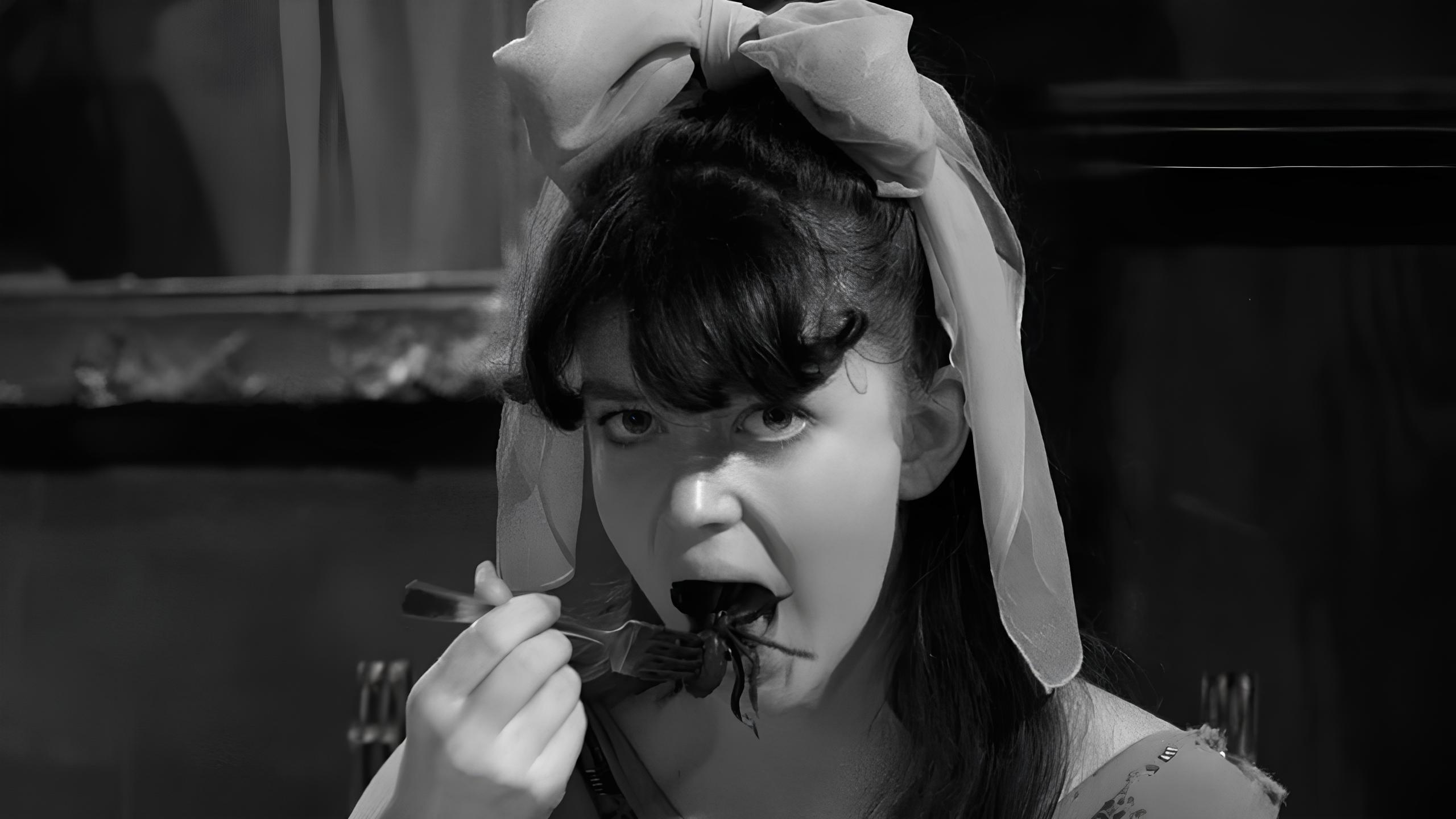
Horror, comedy, by Jack Hill, United States, 1967.
Spider Baby is a grotesque cult horror film that tells the story of the Merrye family, affected by a genetic disease that causes mental regression and feral behavior as they grow older. In an isolated house live Baby, her sisters, and the affectionate caretaker Bruno (Lon Chaney Jr.), who tries to contain their madness when unsuspecting guests arrive. The film mixes a gothic atmosphere, dark humor, and surreal tones, creating a disturbing yet almost fairy-tale world, a bizarre blend between classic horror and morbid comedy. Chaney delivers a surprisingly touching performance, and the direction manages to turn a tiny budget into a unique experience.
Spider Baby is an important cornerstone of American independent cinema: ironic, macabre, melancholic, and unconventional. Spider Baby is an experience that does not rely solely on fear, but plays with the theme of the “monstrous family” to talk about isolation, diversity, and decay, becoming over time a beloved cult title for those who seek a different kind of horror — deformed, grotesque, and unsettling at the same time.
LANGUAGE: English
SUBTITLES: Spanish, French, German, Portuguese
Son of the Icon, Heir to the Silence
You are ten years old and your father’s face is everywhere — on the sides of buildings, in the lobbies of theaters, in the eyes of strangers who look at you and see someone else entirely. Not you. Him. Already him.
Lon Chaney Sr. learned silence before he learned language. His parents were both deaf-mute, and the household he grew up in during Colorado Springs at the end of the nineteenth century was a place where meaning had to travel through the body or not at all. Before he ever stepped onto a stage, he already knew that the face is not decoration — it is the entire sentence. That education, involuntary and total, produced one of the most technically precise physical performers in the history of American cinema. His 1923 portrayal of Quasimodo in The Hunchback of Notre Dame required him to wear a harness weighing over forty pounds and to move through it as though the weight were a second skeleton, as though suffering were simply the architecture of his being. The audience paid to see him hurt. He obliged, and they loved him for it, and the machine that converted his endurance into their entertainment was called art and called commerce simultaneously, with no one especially troubled by the overlap.
What gets passed down in a family is never what the parents intend to transmit. The sociologist Pierre Bourdieu spent much of his career — particularly in The Logic of Practice, published in 1980 — demonstrating that the most powerful inheritances are the ones that never announce themselves, that arrive not as instruction but as atmosphere, as the specific gravity of a room. Creighton Chaney, who would rename himself Lon Chaney Jr. at the studio’s insistence in 1932, did not inherit his father’s genius for pantomime. He inherited the cultural expectation that a man named Chaney was supposed to disappear into suffering and make it watchable. These are not the same thing. One is a skill. The other is a sentence.
The Hollywood studio system of the 1930s and 40s operated on a principle that had less to do with artistry than with brand management. When Universal Pictures cast Chaney Jr. as Larry Talbot in The Wolf Man in 1941, they were not discovering an actor — they were activating a name. The film grossed an estimated four million dollars against a production cost of approximately two hundred thousand. Larry Talbot, the reluctant werewolf who weeps at what he becomes each full moon, was a character built precisely around the idea of a man trapped inside a monstrosity he did not choose. The executives understood that the Chaney brand carried a specific promise to the public: that the creature onscreen would be played by someone who understood, at some cellular level, what it felt like to be looked at rather than seen.
What the executives could not have articulated, because it served their purposes not to, is that this promise was parasitic. It fed on something real in Chaney Jr. — his displacement, his grief at being perpetually secondary to a ghost, his alcoholism that was already visible and already being managed around, not addressed — and it presented that real thing to an audience as spectacle. The German philosopher Walter Benjamin argued in 1935 in his essay The Work of Art in the Age of Mechanical Reproduction that mass reproduction strips an artwork of its aura, its singular presence in time and place. What Benjamin did not extend his analysis to cover is what happens to the human being who is themselves the reproduced object, who is copied not in celluloid but in expectation, in the audience’s insistence that you be what your father was, that you perform a lineage rather than a self.
The monster that Chaney Jr. played most convincingly was never the Wolf Man.

Universal's Assembly Line of Dread
You have already been handed a role before you knew what was being handed to you. That is how it works inside institutions built to produce at scale: the individual arrives believing they are being recognized, and what actually happens is that something latent in their physical presence — a heaviness, a melancholy, a particular quality of defeat readable even in stillness — gets identified as useful raw material, then systematically processed.
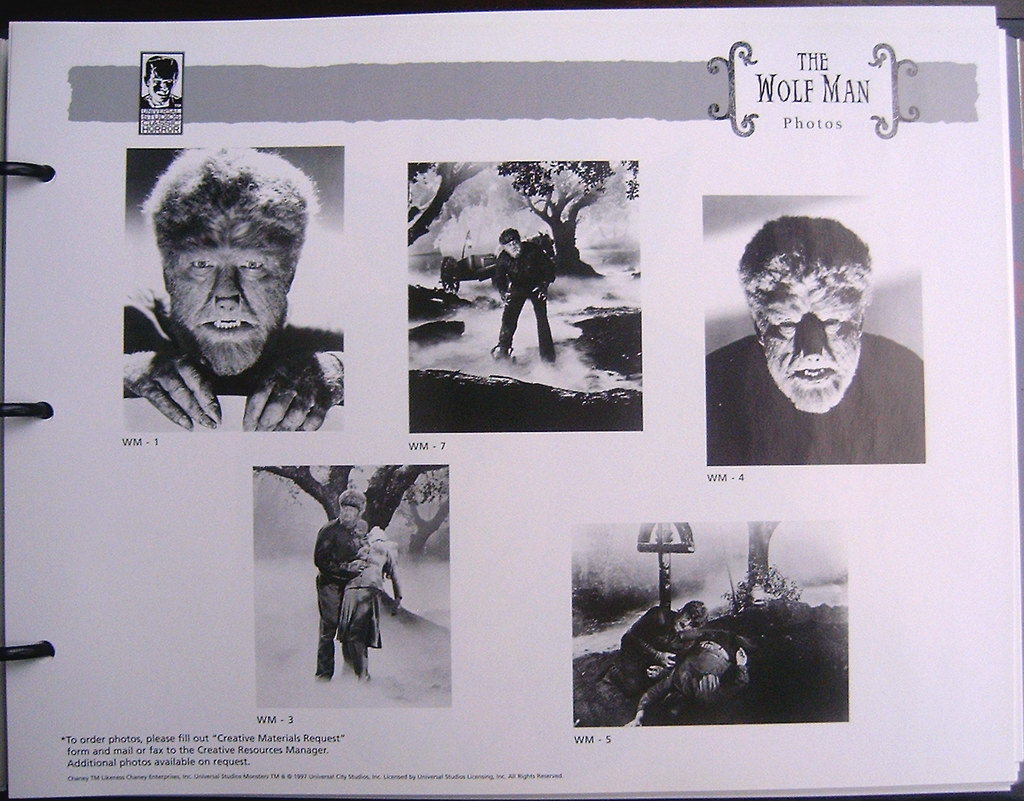
Between 1941 and 1951, Universal Pictures did something to Lon Chaney Jr. that has no precise parallel in Hollywood history. They cast him as the Wolf Man, then the Mummy, then Dracula, then Frankenstein’s monster, then the Invisible Man — not sequentially as a deliberate artistic program, but interchangeably, as though his body were a chassis onto which different costumes of horror could be bolted depending on what the production calendar required. He became the only performer ever to play all four of Universal’s principal monsters, a distinction that sounds like an achievement and functions more like a diagnosis. The studio had discovered that his particular emotional register — that compound of grief and hulking self-doubt — could be loaded into any monster shape and still generate the specific sensation audiences paid admission to feel.
The studio system operating in this period was not fundamentally different from what Max Weber described in 1922 when he mapped bureaucratic rationalization in Wirtschaft und Gesellschaft: the conversion of human difference into standardized, interchangeable units, motivated by efficiency rather than cruelty, which makes the process harder to name and therefore harder to resist. Universal had inherited a genre infrastructure from the 1930s and needed bodies to run through it. Chaney Jr. was available, contractually bound, and possessed of a face that photographed as suffering without requiring direction. From an institutional perspective, this was not exploitation in any dramatic sense — it was optimization.
What makes the mechanism visible is precisely the speed. In 1941 alone he appeared as Larry Talbot for the first time in The Wolf Man, and within two years he had been wrapped in bandages as Kharis the Mummy across a franchise that would eventually produce four entries, each one narratively thinner than the last, each one requiring him to lumber forward with arms extended while the human interiority that had made his debut performance genuinely moving was progressively stripped away by scripts that had no interest in it. The institution does not destroy what it extracts identity from all at once. It reduces incrementally, each reduction justified by the previous one’s commercial success.
A man sits in a makeup chair at four in the morning while technicians spend hours building something onto his face that is not his face. When he stands up, what walks onto the set is a product. The actor inside is present but structurally irrelevant — his actual nervous system, his memories, his specific quality of attention, none of it is visible through the latex. What registers on camera is the shape the studio decided audiences wanted. Erving Goffman’s 1959 analysis of social performance in The Presentation of Self in Everyday Life draws a distinction between performances we author and performances authored for us that we then inhabit; Chaney Jr.’s situation in this decade was the latter carried to its logical extreme, a performance so thoroughly authored by external demand that the performer’s interiority became a technical obstacle rather than a resource.
The cruelest detail is that he was genuinely capable of more. His work in Of Mice and Men in 1939 under Lewis Milestone demonstrated a range of emotional precision that had almost nothing to do with the lumbering archetypes Universal subsequently welded to him. What the studio system encountered in that performance was not a horror actor waiting to be discovered — it was something more complicated and therefore less immediately useful, a man whose grief was too specific to be efficiently packaged.
The Wolfman as Diagnostic Document
You already know the man before the credits end. He is harmless, clearly harmless, the kind of man who apologizes before he has done anything wrong, who flinches at his own shadow, who stands in a doorway too long before entering a room. Larry Talbot does not arrive as a monster. He arrives as someone who has spent his entire life trying to convince the people around him that he is manageable, legible, safe — and failing not because he is dangerous but because something in him has already been classified, pre-sorted, filed under suspicion before a single act of violence occurs.
Erving Goffman, writing in Stigma: Notes on the Management of Spoiled Identity in 1963, described the stigmatized person not as someone who carries a mark but as someone who is forced to manage the gap between what they know themselves to be and what their social world has already decided they are. The effort is constant, exhausting, and structurally impossible to win, because the management itself — the overexplaining, the compensating, the preemptive softening — reads as confirmation of the very suspicion the person is trying to neutralize. Talbot’s tragedy is not the wolf. The wolf is almost a relief. His tragedy is the human hours, the daylight hours, in which he performs normalcy for an audience that already senses the seam.
What makes this portrait clinically precise is its insistence on guilt without crime. Talbot is guilty before transformation. He carries it in his posture, in the way he accepts blame, in the ease with which he confesses to things that haven’t happened yet. This is the phenomenology of internalized stigma: the point at which the external judgment has been so thoroughly absorbed that the individual begins to police themselves with greater ferocity than any institution could manage from the outside. The werewolf mythology, stripped of its supernatural scaffolding, is simply a metaphor for the person who has been told, early and repeatedly, that something inside them is dangerous, uncontrollable, a threat to others — and who has come to believe it so completely that the belief itself begins to function as the disease.
Chaney’s performance never reaches for sympathy. That is the precision of it. A performance that reaches for sympathy is already doing the social management Goffman described — reassuring the audience, smoothing the threat, making the stigmatized body comfortable to watch. What Chaney does instead is remain inside the discomfort. His Talbot does not ask to be understood. He simply cannot stop confessing, cannot stop carrying the weight of a transformation he did not choose and cannot remember, cannot stop existing at the intersection of what he knows about himself and what his world has decided to do with that knowledge.
There is something in the structure of the 1941 film that most readings treat as mere plot — Talbot’s inability to die, his repeated survival across subsequent sequels, his literal immortality as a sufferer — that deserves to be read as social diagnosis rather than narrative convenience. The person who cannot escape their stigma is not simply burdened. They are made structurally undying. The condition regenerates with each new social encounter, each new community that must be warned, each new face that shifts from welcome to wariness once the information is transmitted. Talbot cannot die because stigma cannot die. It follows the carrier across geography, across time, across every fresh start that promised to be different.
What Goffman could not have predicted in 1963, though his framework absorbed it entirely, is that the stigmatized person often becomes their own most efficient persecutor — not out of self-destruction but out of a kind of terrible rationality. If you accept the world’s verdict completely enough, you spare yourself the violence of having it delivered again. Talbot locks himself in cellars not because the wolf is unstoppable but because he has already agreed that the wolf is what he is.
Alcohol, Repetition, and the Trap of Typecasting
You are sitting across from someone who has played the same man for twenty years — not the same character, but the same man, the same grief, the same body offered up to the camera’s hunger — and you wonder, watching his hands, whether the glass he reaches for is an escape or simply the most honest thing left in the room.
Lon Chaney Jr. was not a man who collapsed under pressure. He was a man who held up under pressure so consistently, so completely, and with such mechanical reliability that the holding-up itself became the catastrophe. By the early 1950s, Universal had extracted from him four distinct monster franchises, dozens of B-pictures, and a physical transformation so total in the role of Larry Talbot that critics stopped asking whether he was acting and started asking whether he was well. The question was never answered honestly by anyone in a position to answer it.
Barbara Ehrenreich argued in Bright-Sided, published in 2009, that American institutional culture does not merely prefer optimism — it mandates it, and punishes those who cannot perform it as a form of professional incompetence. The logic is precise and brutal: if you cannot project wellness, you are not ill, you are difficult. Studios in the classical Hollywood era operated on exactly this axis. An actor who drank was not an actor with a problem — he was a liability, a temperament, a negotiating risk. The drinking itself became the official explanation for every career contraction, which conveniently displaced any institutional responsibility for having built a career on the systematic elimination of creative agency.
Chaney Jr. had no authorship over the creatures he inhabited. He did not choose their return. Larry Talbot came back not because the character demanded it but because the box office required it, and each successive appearance drained the performance of whatever existential weight the original had carried. When a man is asked to perform his own disintegration repeatedly, in different costumes, for different producers, the repetition is not artistic — it is contractual. Erving Goffman’s work on the presentation of self in everyday life makes a distinction between performances that emerge from a felt identity and performances that are simply demanded by the institutional role. Chaney Jr. existed almost entirely in the second category, and had done so for long enough that the boundary between the performed self and the felt one had become genuinely difficult to locate.
Alcoholism in Hollywood was not, in the 1940s and 1950s, a condition that attracted treatment — it attracted management. Studios had doctors whose function was not to help actors recover but to keep them functional enough to complete a shoot. The language of care was present; the architecture of care was not. Chaney Jr. moved through this system the way many working-class performers did: with no union protection robust enough to cover psychological harm, no contractual language that acknowledged the cumulative cost of typecasting, and no critical framework that would have recognized what was happening to him as anything other than personal failure. The industry’s accounting of his decline stopped precisely at the level of his behavior, never one layer deeper at the conditions that produced it.
What gets called weakness in a performer is often just the refusal, conscious or not, to keep absorbing the gap between what is promised and what is delivered. Chaney Jr. had been promised, implicitly, that following his father’s discipline — the physical preparation, the total commitment, the willingness to disappear into a role — would produce something like artistic legitimacy. What it produced instead was a kind of indentured visibility: always recognizable, always available, never quite seen. The alcohol did not create that condition. It arrived after the condition had already been fully installed, and it named something the industry had no interest in naming for itself.
A vision curated by a filmmaker, not an algorithm
In this video I explain our vision
Tenderness as Subversion

You are watching a man the size of a doorframe crouch over a small animal that has gone still in the grass, and his shoulders are shaking. He is not performing grief in any theatrical sense — he is not lifting his face to let you see the tears, not timing the emotion to the swell of a score. He simply folds inward, the way very large people sometimes do when they are trying to make themselves smaller than their pain, and the camera holds on him without mercy. The creature he is mourning is not important. What is important is that you feel suddenly that you have walked in on something private, something not meant for an audience, and the discomfort you feel is not the discomfort of horror. It is the discomfort of recognition.
Lon Chaney Jr. understood something about tenderness that the studio system was entirely unprepared to monetize. The monster genre, particularly in its Universal iteration of the 1940s, operated on a very clean emotional contract: the audience pays to be frightened, the monster delivers the fright, and when the torch-bearing villagers arrive at the end, everyone goes home reassured that the boundary between human and inhuman has been policed back into place. What Chaney did, almost compulsively across his performances, was refuse that reassignment. He played creatures who reached toward people rather than away from them, whose violence was almost always preceded by a moment of such naked longing that the violence itself became a kind of tragic error, a failure of translation between an interior that was entirely human and an exterior that the world had already condemned.
This is not a small distinction. The philosopher Stanley Cavell, writing in The World Viewed in 1971, argued that cinema’s deepest subject is the human face in the act of being seen — and the specific terror it produces when that seeing is withheld or distorted. What Chaney’s performances introduced into that framework was a face that asked to be seen and was perpetually misread, not by characters within the films alone but by the critics and audiences outside them. The tendency to describe his work as crude or unsubtle, a charge that followed him throughout the 1940s and into the declining years of the decade, was in fact a response to something more threatening than bad acting. It was a response to acting that refused to provide the emotional distance the genre promised.
Boris Karloff‘s monster in the 1931 Frankenstein production, to name the obvious comparison Chaney could never escape, was rendered poignant through visual abstraction — the flat head, the bolts, the stiffened walk. The humanity was encoded into the grotesque aesthetic, safely contained within a design. Chaney offered no such container. His monsters wore their yearning directly on faces that were recognizably, uncomfortably close to ordinary human faces, and the pathos was not a function of makeup or movement vocabulary but of something happening behind the eyes that audiences had no ready category for. When critics wrote that he lacked subtlety, they were, with almost perfect inversion of the truth, describing an actor who was producing effects too subtle for the context surrounding him.
There is a particular kind of cultural anxiety reserved for softness that arrives in the wrong body. The gentleness of a large, stigmatized, physically imposing man is not read as gentleness by a society whose nervous system has been trained to read that body as threat. It is read as manipulation, as incorrectness, as a performance that has somehow gone wrong. Chaney’s off-screen life was saturated with exactly this misreading — the drinking that his peers euphemized, the rages that his tenderness seemed inexplicably to alternate with, the sense that he could not be held in any single emotional register long enough for anyone to feel safe deciding what he was.
What the Audience Needed Him to Be
You are sitting in a darkened theater in 1941, and the man on the screen is transforming against his will. You did not come to see him triumph. You came, without knowing it, to see him fail.
René Girard argued in his 1986 work that human communities have always required a sacrificial figure — not because the victim is guilty, but precisely because the community needs to discharge its own accumulated violence somewhere outside itself. The scapegoat works not through justice but through unanimous agreement that this particular body will absorb what the group cannot hold. What Girard understood, and what the film industry practiced without ever reading a word of his theory, is that the ritual only functions if the audience believes in the victim’s suffering. A symbol is insufficient. The flesh must be real.
Lon Chaney Jr. was unusually real. Where his father had armored himself in disguise and craft, constructing elaborate technical barriers between his person and his audience, the son had almost no such armor. He wore his damage openly — the alcoholism, the insecurity, the desperate professional hunger — and this nakedness, which he may have experienced as vulnerability, was precisely what made him useful. An audience cannot project its anxiety onto an actor who seems invulnerable. The scapegoat mechanism, as Girard traced it from ancient sacrifice through modern social persecution, depends on a creature who is both like the community and visibly marked as different. Chaney Jr. was both. He was recognizably human — thick-waisted, expressive, ordinary in his grief — and he was branded, from his very first appearance as Lawrence Talbot, with the mark of someone who cannot save himself.
This is not metaphor. The mark was structural. Universal Pictures built its entire Wolf Man franchise around the premise that Talbot’s suffering was permanent and unresolvable. He could not grow, could not heal, could not escape. The audience was invited back repeatedly not to watch a story progress but to watch the same wound reopen. By the time Chaney Jr. was playing Talbot alongside Abbott and Costello in 1948, the ritual degradation was almost clinical — the monster reduced to a punchline, the suffering figure literally made comic, the scapegoat now also the fool. The community’s anxiety had been discharged so many times that only mockery remained.
What the audience needed from him operated well below conscious intention. Postwar American culture was saturated with bodies that had returned changed — men who had seen things that did not fit inside peacetime language, who felt the beast in themselves and had no sanctioned way to name it. Lawrence Talbot, the decent man destroyed by something he did not choose and cannot control, gave that fear a shape that could be watched from a safe distance. The boundary between the audience and the monster on screen was the boundary they were paying to maintain. Every time Talbot transformed, every time he woke in horror at what he had done, every time he begged for death and was denied it, the people in the seats felt momentarily cleaner. The violence was his. The monstrousness was his. They walked out into the ordinary night confirmed in their separation from it.
The human cost of this function was that Chaney Jr. was never permitted to step outside it. Actors who play villains occasionally get to play heroes; actors whose darkness is structural to the audience’s psychological need do not get that escape. His attempts at dramatic range — the tender Lennie in Of Mice and Men in 1939, which came before the Wolf Man sealed his fate — were genuine enough to suggest what a different career might have looked like. But the audience had already decided what they needed him to be, and the industry, always efficient in its cruelties, simply agreed.
The Body That Paid the Bill
You are watching a man dissolve in increments across decades of celluloid, and the remarkable fact is that nobody called it labor.
Lon Chaney Jr. died on July 26, 1973, of heart failure compounded by throat cancer — the throat, specifically, the instrument that was entirely his own. His father had been a silent-screen artist, a sculptor of bodies and faces who never needed sound. The son had built himself around his voice, that low, broken-gravel register that could carry grief without a single special effect, and the disease took that first, leaving him to spend his final months communicating in whispers and written notes. There is something in this chronology that feels less like coincidence than like a bill presented at closing time, the body itemizing everything it was asked to carry and finally refusing.
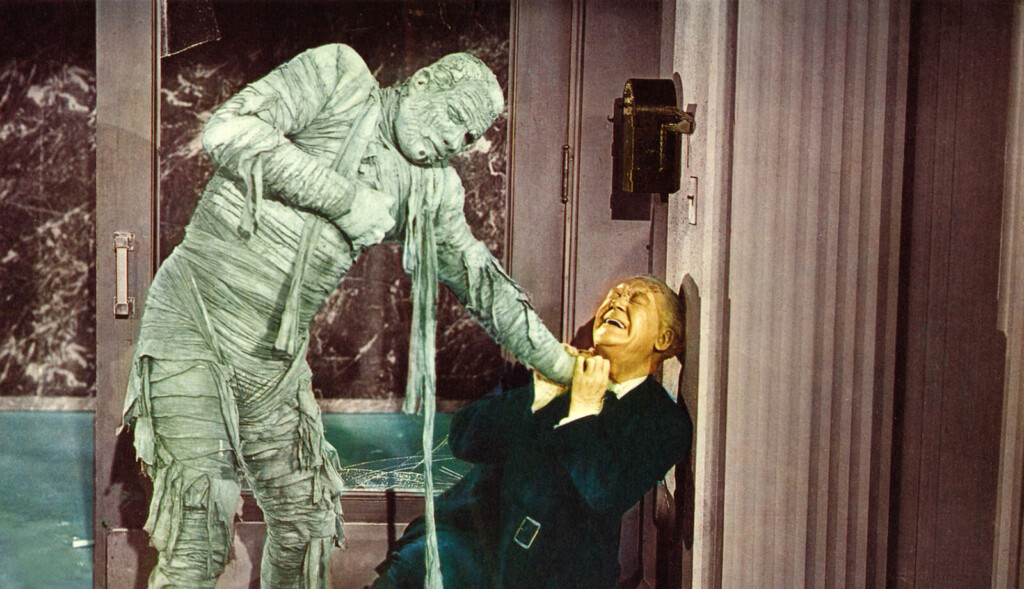
The cultural logic of the monster has always depended on a kind of contractual invisibility. When the Universal horror cycle was at its commercial peak in the 1940s, the studio system operated on loan-out agreements, binding contracts, and suspension clauses that treated actors as interchangeable productive units. Chaney Jr. was borrowed, reassigned, and doubled across franchises with a frequency that would be recognized in any other industry as overwork. He played the Wolf Man in five separate productions between 1941 and 1948, each one requiring physical transformation sequences, full-body makeup applications lasting hours, and sustained emotional performances that the promotional material reduced to a single image: the face mid-change, the man invisible inside the effect.
What Marx identified in the Grundrisse as the mystification of labor — the way a finished commodity erases the human time and suffering compressed inside it — operates with unusual clarity in horror cinema, because the commodity being sold is the suffering itself. The audience purchases fear, receives it in the form of a man’s genuine physical distress, and the transaction is laundered through genre so that nobody has to account for the source material. Chaney Jr. was not acting anguish in any trivially technical sense; he was translating anguish from his private reserves into a public product, and the studio collected the margin.
His drinking, which became severe enough by the mid-1950s to affect his reliability on set, is almost always narrated in biographical accounts as a personal failing, a character defect, a weakness inherited alongside his father’s name. The historian David Thomson, writing in A Biographical Dictionary of Film, describes Chaney Jr.’s career with a sympathy that still cannot quite locate the systemic cause of the wreckage. What the personal-failing narrative accomplishes is the privatization of a structural problem: it moves the damage from the industry’s ledger onto the individual’s, and the individual, being dead and having been a large frightening man who played werewolves, cannot contest the transfer.
There is a particular cruelty in the way cultures assign monstrousness to the bodies they have used and then mythologize the damage as essence. The Wolf Man’s tragedy — that he cannot control his transformations, that he is a decent man destroyed by a force inside him he did not choose — was not an allegory that Chaney Jr. inhabited from a safe artistic distance. It was a description of his professional life rendered in the only language the industry would fund.
By the time he made his final screen appearances in the late 1960s and early 1970s, he was visibly diminished, turning up in low-budget productions that treated his name as a marketing remnant, a piece of brand equity extracted from a body that had already given the essential thing. The voice, when it was still there, carried the whole history: not the performance of suffering but suffering organized into performance, which is a different thing, a thing that leaves a different kind of residue in the chest of anyone paying close enough attention to realize they are watching a man and not a monster, and that the distinction was never as stable as the ticket price required them to believe.
🎭 Monsters, Doubles, and the Horror of Being Human
Lon Chaney Jr. spent his career embodying creatures caught between two worlds — neither fully human nor entirely beast. These articles explore the deep cultural and psychological currents that made his monsters so hauntingly resonant, from the literature of the double to the archetypes of transformation and tragic identity.
The Double in Literature: From Dostoevsky to Stevenson
The figure of the double — the shadow self that mirrors and menaces the protagonist — runs through Western literature from Dostoevsky to Stevenson, and reaches its cinematic peak in the horror genre Chaney Jr. inhabited. This article traces how writers began externalizing the interior conflict between civilized mask and savage impulse, giving birth to characters who, like the Wolf Man, cannot escape what they are. Understanding the double is essential to understanding why Chaney’s monsters moved audiences to pity as much as terror.
GO TO THE SELECTION: The Double in Literature: From Dostoevsky to Stevenson
The Strange Case of Dr Jekyll and Mr Hyde: Analysis
Stevenson’s novella about a respectable doctor who unleashes his monstrous alter ego is one of the foundational texts of the horror tradition that would define Lon Chaney Jr.’s screen legacy. This analysis unpacks the symbolic architecture of transformation — the potion, the mirror, the loss of control — that would be recycled endlessly in Universal monster films. Hyde’s tragedy is Hyde’s humanity: a resonance Chaney understood better than almost any actor of his era.
GO TO THE SELECTION: The Strange Case of Dr Jekyll and Mr Hyde: Analysis
Arthur Machen: Life and The Great God Pan
Arthur Machen‘s cosmic horror fiction, particularly The Great God Pan, introduced early twentieth-century audiences to the idea that monstrosity lurks just beneath the surface of ordinary life — a threshold Lon Chaney Jr. crossed repeatedly on screen. Machen’s grotesque visions of half-human creatures torn between worlds directly influenced the atmosphere of dread that Universal Horror would bottle and sell to mass audiences. This article examines how Machen’s literary monsters paved the way for cinema’s most sympathetic freaks.
GO TO THE SELECTION: Arthur Machen: Life and The Great God Pan
Luigi Pirandello: Life and Works
Pirandello’s relentless interrogation of identity — the gap between how we see ourselves, how others see us, and who we truly are — offers a philosophical framework for understanding Chaney Jr.’s most anguished performances. Like Pirandello’s shattered protagonists, the Wolf Man and Larry Talbot are men destroyed not by evil but by the impossibility of being one coherent self. This article on Pirandello’s life and works illuminates how modern drama and monster cinema share the same existential wound.
GO TO THE SELECTION: Luigi Pirandello: Life and Works
Discover Cinema That Goes Beyond the Mask
If stories like Lon Chaney Jr.’s remind you that the most powerful films are always about what it means to be human, Indiecinema is your destination. Stream a curated selection of independent and cult cinema that dares to look beneath the surface — join us and find the films that stay with you long after the credits roll.
👉 EXPLORE THE CATALOG: Watch Indie Films in Streaming
A vision curated by a filmmaker, not an algorithm
In this video I explain our vision

