
The Drawer’s Hand and the Father’s Silence
The notebook is open on the table between them, and the pen keeps moving even when the voice stops. Vladek Spiegelman talks the way a man walks through a room he no longer trusts — cautiously, doubling back, testing the floor with each step. His son sits across from him and writes, and the act of writing is already a kind of betrayal, because what gets transcribed is not what was said but what can be held by a sentence. Between those two things — what a man says and what survives transcription — lies the entire problem of Maus.

This is not, despite every library shelf it has been placed on, a Holocaust memoir. It is something more structurally uncomfortable: a document of the failure of inheritance. Art Spiegelman published the first volume in 1986 after years of serialization in Raw magazine, and the second in 1991, and by the time he won the Pulitzer Prize in 1992 — a special citation, because no existing category fit the work — it had already exceeded every genre it was assigned to. But the prize and the category problem are almost beside the point. What matters is the scene that recurs throughout the book with the persistence of a symptom: a son with a recorder or a notebook, and a father whose testimony keeps revising itself mid-sentence, not because the memory is failing but because the truth was never a single thing to begin with.
Vladek corrects himself constantly. He circles back. He says one thing and then qualifies it into near-disappearance. Critics who have read this as the natural confusion of an aging man have missed the essential point that Georges Didi-Huberman makes when he writes about the images of the Sonderkommando — that testimony from the extreme is never seamless, never linear, because the experience it attempts to convey was itself a shattering of linear time. Vladek does not remember badly. He remembers the way someone remembers who survived by being present in several registers simultaneously, where past and present collapsed into a single act of attention. That kind of memory does not straighten into narrative. It folds.
And Art knows this, which is why the most honest structural decision in Maus is the one that most readers absorb without fully registering: the book contains both the conversation and the drawing, the recording and the frame around the recording, the story Vladek tells and the story of Art trying to receive it. The hand that draws is always visible. The drawer never disappears behind his subject. This is not a stylistic choice in the decorative sense — it is an epistemological one. Art Spiegelman is not representing the Holocaust. He is representing the act of a second-generation person attempting to approach something that refuses approach.
There is a passage where Art, seated at his drawing table, is surrounded by the bodies of dead mice — victims he is trying to depict — while above him the faces of journalists and critics hover, asking him to explain what Maus means, what statement it makes about evil, what lessons it offers. He sits in the middle of that swarm and says nothing useful. He cannot. Because the question assumes that representation is a kind of mastery, that to draw something is to have understood it, and the entire formal architecture of Maus exists to refuse that assumption.
What Vladek’s silences communicate — the pauses, the evasions, the sudden changes of subject when the story approaches Auschwitz’s interior — is not absence of information. It is information of a different order. It is the shape of something that did not fit into surviving without being changed by what you did to survive. Art’s pen moves across the notebook, and what it catches is not the truth of Auschwitz. It is the truth of sitting in a room with someone who was there, and feeling the distance between you measure itself in inches.
Slow Life
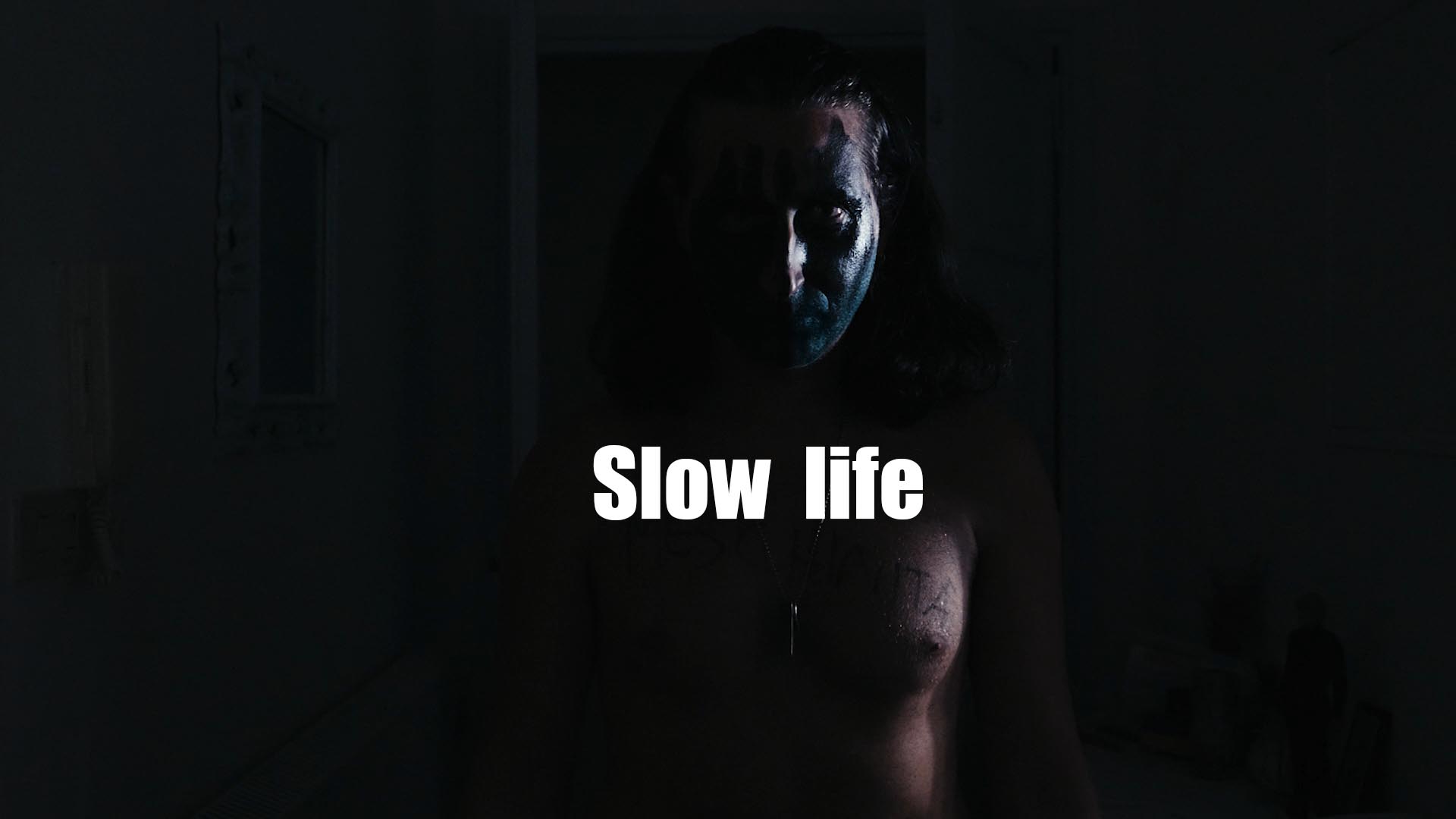
Drama, comedy, thriller, by Fabio Del Greco, Italy, 2021.
Lino Stella takes a period of vacation from his alienating job to devote himself to relaxation and his passion: drawing comics. But he did not foresee certain disturbing elements: the intrusive administrator of the building where he lives, the postman who delivers crazy fines and tax bills, an overbearing security guard, a very enterprising real estate agent, the old lady downstairs who raises the feline colony of the condominium. These characters will make his vacation hell.
Food for thought
The larger a social group is, the more rules and bureaucracy are needed, which often do not respect the individual. You have to learn to live with annoying people, but sometimes the social pressure and arrogance can become intolerable. The only laws that always come to our aid are the laws of Nature.
LANGUAGE: Italian
SUBTITLES: English, Spanish, French, German, Portuguese
Mice, Cats, Pigs: The Grammar of Dehumanization Turned Inside Out
You open the book and within seconds you are reading about extermination, and the characters doing the dying have whiskers and tails. The discomfort arrives before any conscious thought can intercept it — something faintly wrong, faintly absurd, and then almost immediately something worse than absurd: something you recognize. That recognition is the trap Spiegelman has laid, and you are already inside it before you understand what it is.
The animals are not metaphors in the way a literature course would teach you to use that word. They are not symbols standing in for human qualities — the cunning mouse, the predatory cat, the stubborn pig. They are the literal vocabulary that Nazi propaganda had already inscribed into European consciousness across two decades of Der Stürmer caricatures, Goebbels-commissioned films, and the visual logic of an entire regime that needed to make murder feel like pest control. When the SS officer looks at a crowded cattle car and sees vermin being transported, he is not being poetic. He is operating inside a system of representation that worked precisely because it was believed, or made to be believed, or made to feel natural enough that belief became unnecessary. Spiegelman takes this vocabulary and does something that no counter-argument could accomplish: he uses it, completely, without irony quotation marks around it, without a winking authorial distance. The Jews in Maus are mice. Fully, consistently, without exception. And that totality is the point.
Susan Sontag argued in her 2003 work that photographs of atrocity produce a kind of anaesthesia in the viewer — that the sheer accumulation of images of suffering eventually neutralizes their capacity to disturb. The problem is not exposure but the frame. How suffering is presented determines what the viewer is permitted to feel about it. Spiegelman understood this problem viscerally, not academically. By drawing his characters as animals, he removes the viewer from the comfortable position of compassionate witness. You are not looking at photographs of human beings you can pity from a safe moral distance. You are reading a cartoon, a form you associate with childhood, with entertainment, with the lightness of Saturday mornings — and inside that form there are gas chambers. The cognitive dissonance is not accidental. It is the mechanism.
What semiotics helps us see here is that caricature was never neutral. The caricaturist’s reduction of a human being to exaggerated feature or animal form always carried ideological weight — always said something about who counts as fully human and who can be reduced to type. The Nazi caricature of the Jewish face, the bent nose, the clutching hands, was not simply ugliness for aesthetic effect. It was a claim about the nature of a group of people, repeated until the claim felt like description rather than assertion. Spiegelman’s reversal is to take the animal form that was applied as dehumanization and inhabit it from the inside, to make the reader follow the interiority of the mouse, to feel Vladek’s anxiety and love and petty irritations and survival cunning as things that belong to a full person — a person you happen to be reading as a mouse.
This forces something uncomfortable: you have been reading the dehumanizing gaze, you have been inside it, and it has not worked on you the way it was supposed to work. You have not felt contempt or distance. You have felt recognition. Which means the form that was designed to strip humanity reveals, when turned inside out, that the stripping was always a lie requiring enormous machinery to sustain. The cat does not hunt the mouse because of nature. The cat hunts the mouse because a state decided that this was the story, and then built the trains and the camps and the uniforms to make the story stick.

What the Comic Strip Knows That Prose Cannot Say
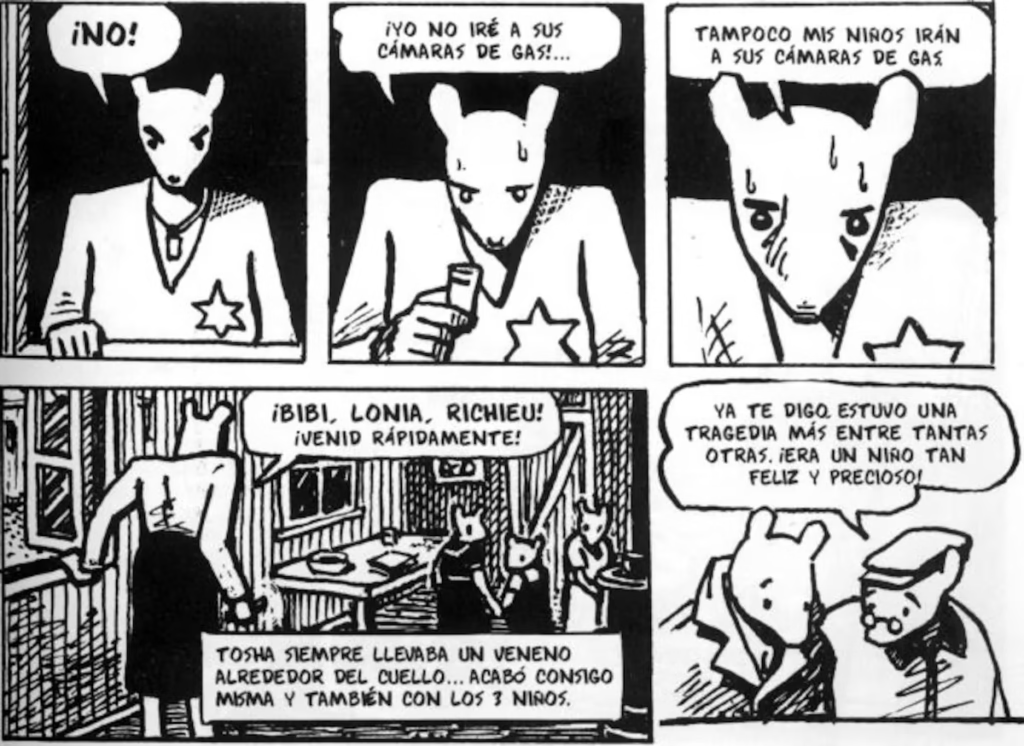
There is a white space between every two panels in a comic strip, a sliver of nothing that the eye crosses in less than a heartbeat. You do not notice it. That invisibility is the whole argument.
Scott McCloud, in his 1993 dissection of the grammar of sequential art, gave that white space a name: the gutter. His insight was not merely technical. He argued that the gutter is where the reader’s imagination performs the act that the artist refuses to draw. Two panels show a raised axe and then a screaming face. The gutter between them contains the blow. You supply it. Your mind closes the sequence, fills the violence, completes the murder — and in doing so, becomes not a witness but a participant in the image’s meaning. McCloud called this closure, and he understood it as the defining cognitive act of reading comics, the thing that separates the medium from film, from photography, from prose. The reader of a comic strip is not passive. They are the hidden co-author of every transition.
Spiegelman understood this before McCloud named it. The mice and cats of Maus are not a simplification of the Holocaust. They are a formal strategy for managing what cannot be looked at directly. When a panel ends and the white gutter opens before the next image begins, the space between is precisely where the gas chambers live, where the selections happen, where the bodies are, where everything the drawn line cannot hold is held instead by the reader’s own completing imagination. The horror does not reside in the panels. It resides in what you are asked to construct between them.
Walter Benjamin, writing in 1936 in his essay on the work of art in the age of mechanical reproduction, introduced the concept of the optical unconscious — the idea that the camera reveals dimensions of visual reality that the unaided eye cannot consciously perceive. Slow motion, the extreme close-up, the frozen frame: these technologies make visible what ordinary seeing suppresses. Benjamin’s argument was about photography and film, but its logic extends further than he took it. The fragmented sequential image of the comic strip performs something analogous at the level of cognition rather than optics. The gutter is not what the camera slows down to reveal. It is what the medium structurally refuses to show, forcing the unconscious to supply what consciousness would prefer to leave unformed.
Trauma works this way. It does not present itself as continuous narrative. It arrives in flashes, in non-contiguous images, in a sequence where the connective tissue has been burned away. Cathy Caruth, whose 1996 work on trauma and narrative made this observation with clinical precision, argued that traumatic memory is characterized by its resistance to integration — it remains as fragment, as intrusion, as image without context. The comic strip, structurally, is already a traumatic form. It has already performed the dissociation before the content arrives.
This is why prose cannot do what Maus does, not because prose lacks power, but because prose moves in time continuously. A sentence connects to the next sentence with the invisible mortar of syntax and grammar. Even when a prose narrative attempts fragmentation, the white space between sections is decorative, not constitutive. The reader does not build the atrocity. They receive it. In Maus, the gutter demands that you assemble what happened from the pieces the artist leaves deliberately incomplete, and in that assembly, you cannot remain outside the event. The medium has already made you complicit in the telling.
That is not a metaphor for how trauma is transmitted across generations. It is the structural enactment of it, happening to you on the page, in the half-second your eye crosses the white space and your mind, unbidden, fills it with what it knows must be there.
Vladek’s Accounting of Himself
He counts sugar packets at the diner. Not out of hunger, not even consciously — his hand moves across the table, gathering the small paper envelopes into a neat pile beside his coffee cup, and when the waitress looks at him he does not stop. This is not poverty. Vladek Spiegelman has enough money. This is something that poverty, once extreme enough and long enough, burns permanently into the nervous system: the reflex of acquisition that no subsequent abundance can switch off, because the body remembers what the mind has been persuaded to forget.
Art Spiegelman draws his father with unflinching precision on exactly this point, and it is an act of love that is also an act of refusal — a refusal to sanctify the man simply because the man survived something unsanctifiable. Vladek hoards wire, saves broken hinges, returns half-used goods to stores with elaborate justifications. He makes his second wife Mala miserable with a financial vigilance that functions less like thrift than like a kind of emotional withholding in economic costume. He says things about Black people that his son cannot let pass without comment. He is, in the specific texture of his daily life, difficult. Sometimes unkind. Sometimes, in the casual grammar of his prejudices, something worse.
Bruno Bettelheim spent years after his own release from Buchenwald and Dachau developing a psychology of extreme situations, and his conclusions were so uncomfortable that they generated fierce and largely deserved controversy. His 1960 work “The Informed Heart” argued that prolonged dehumanization could erode the autonomous self in ways that outlasted the conditions that produced the erosion — that survival itself, under certain conditions, required a form of internal accommodation that left residue. The survivors’ rights community, correctly, pushed back against the victim-blaming inflection in some of his formulations. But beneath the contested framework lay an observation that Maus embeds structurally: that what a person becomes in order to survive is not necessarily what they would have chosen to become, and that the two cannot always be cleanly separated afterward.
Primo Levi named this problem more precisely and with less liability for misreading. The gray zone, as he laid it out in “The Drowned and the Saved” in 1986, is the space of moral complexity that total systems create when they force the dominated to participate in structures of their own domination — the Sonderkommando, the Kapo, the prisoner who receives a marginally better ration for informing. Levi was explicit that this analysis does not distribute guilt evenly. The architects of the system bear their guilt in full. But the gray zone resists the satisfying architecture of pure victimhood, and it asks something genuinely difficult of the reader: to hold moral complexity without using it as exculpation, to see the compromised human without exonerating the machinery that compromised them.
Vladek never occupied anything like the Sonderkommando’s position. But the habits of the gray zone — the instrumentalization of other people, the zero-sum calculus applied to relationships, the emotional rationing — these did not disappear when the camp gates opened. They migrated. They settled into peacetime in the form of the sugar packets, the returned goods, the resentments directed at people who had nothing to do with anything. Art sits across from his father and draws what he sees, and what he draws is a man who survived by becoming something, and who cannot now stop being it.
This is the biographical core of Maus that makes it unbearable in a way that straightforward testimony cannot quite achieve. The horror is not only in Auschwitz. It is in the diner, in the argument about the broken wire, in the silence between a father and a son who loves him and cannot reach him and knows why and cannot fix it because history is not a wound that closes when the bleeding stops.
The Second Generation’s Inheritance
There is a photograph on the wall of Art Spiegelman‘s workspace that he did not choose to put there. His parents placed it, sometime before Vladek ever sat down to tell his son anything of consequence. It is a portrait of Richieu, the first son, the one who died before Art was born — poisoned by an aunt who chose death for her own children rather than the camps, taking Richieu with her. Art grew up under the gaze of a dead brother who was never anything but perfect, because the dead have no opportunity to disappoint. Richieu never threw tantrums. Richieu never argued with Vladek about money. Richieu never turned his father’s survival into a graphic novel that made Vladek look petty and difficult and real. Art says this, almost as confession, in the pages of the book itself — that he and Richieu are competing for a ghost trophy, and he is not sure he is winning.
This is what Marianne Hirsch, writing in Family Frames in 1997, called postmemory: the condition of those who grow up so saturated by the stories, images, and silences of a preceding generation’s trauma that those experiences come to feel like memory, carrying all the weight of memory, without ever having been lived. It is not transmission in any clean or pedagogical sense. It is closer to haunting — an inheritance of affect that arrives before language, before comprehension, before the child has any architecture capable of containing it. The photographs, the numbers, the names spoken at the dinner table with a particular silence around them: these are not information. They are weather. The second generation grows up inside that weather, develops a whole interior climate shaped by events that ended before they drew breath.
Art Spiegelman is not simply writing about this condition. He is enacting it, and the enactment is visibly uncomfortable for him. He appears in his own book as a character who is small, anxious, artistically ambitious in ways that embarrass him, and constitutionally unable to decide whether he is a witness or an opportunist. He puts that question on the page explicitly — at one point he imagines himself sitting atop a mountain of corpses, surrounded by journalists asking whether Maus is responsible for a new wave of Holocaust kitsch. It is one of the few moments in the book where the satire turns entirely inward, and the effect is brutal precisely because it refuses to resolve itself into either self-flagellation or self-defense. He knows what he is doing. He does not know whether that knowledge makes it better.
The guilt operates on multiple frequencies simultaneously. There is the guilt of having survived a trauma secondhand — of inheriting suffering without having earned the credential of actually suffering. There is the guilt of having aestheticized that inherited suffering, turned his father’s humiliation and endurance into a form that wins awards. And underneath both of those, running deeper and quieter, there is the guilt of feeling competitive with a brother who died in 1943 as a child and has been on the wall ever since, unchanging, unreproachable, always already the better son because the better son is always the one you can no longer argue with.
Hirsch’s framework insists that postmemory is not pathology but condition — a structural feature of how catastrophe travels across generations rather than a dysfunction in the individual inheriting it. But reading Spiegelman from inside the pages he drew, the distinction between condition and pathology feels academic in the most uncomfortable way. The weather does not care whether you call it climate or illness. Art Spiegelman did not survive the Holocaust. He survived growing up as its second generation, which is an entirely different sentence, and he seems never entirely sure which one is harder to live inside.
A vision curated by a filmmaker, not an algorithm
In this video I explain our vision
MetaMaus and the Problem of Bearing Witness to Bearing Witness

There is a page where a young man in a tight black prison suit sits in the corner of a room while the walls close in around him, striped like a concentration camp uniform, while the faces of the dead press out from the wallpaper. He has just found his mother in the bathtub. The drawing style shifts completely — scratchy, expressionist, almost unreadable in its density of grief — and for a moment you forget entirely that you have been reading about mice and cats. This is “Prisoner on the Hell Planet,” a comic strip Spiegelman made in 1972, years before Maus existed as a project, inserted into the narrative as an object Vladek finds in a box. The son reads a document about himself grieving his mother. The reader watches the son watch the father watch the son’s grief. The recursion is not a device. It is the actual condition of inherited trauma — the impossibility of knowing where one person’s wound ends and another’s begins.
This folding of the text back onto itself reaches its most explicit and most uncomfortable form in the second volume, where Spiegelman draws himself as a cartoonist sitting at a drawing table, wearing a mouse mask rather than a mouse face, perched on a literal pile of mouse corpses while journalists and cameras crowd around him. The caption reads something close to: “I feel so inadequate trying to reconstruct a reality that was worse than my darkest dreams.” He is not the survivor. He is the person who turned the survivor into a character. The mask makes that distinction visible and refuses to let it be forgiven.
Theodor Adorno’s famous sentence from 1949 — that to write poetry after Auschwitz is barbaric — is almost always quoted without its 1966 revision, in which he walked the claim partway back, acknowledging that the suffering of those who survived demands expression precisely because it cannot be resolved by silence. The tension between those two positions is not a philosophical disagreement Adorno resolved; it is the unresolved condition that Maus inhabits on every page. The question is not whether to represent, since Spiegelman has already done it, the book already exists, the Pulitzer has already been awarded. The question is what the act of representation costs, and who pays.
Lawrence Langer, in his 1991 study of video testimonies from Holocaust survivors, drew a distinction that cuts directly into the marrow of Maus: he separated what he called “common memory,” which integrates the past into a livable present narrative, from “deep memory,” which cannot be integrated, which the survivor carries as a permanently unassimilated rupture. Vladek’s testimony in the book operates mostly at the level of deep memory even when it appears to be common memory — the chronological story he tells, the dates and places and names, is continuously punctured by details that refuse narrative domestication, the way he mentions the smell, the weight of a body, the specific sound of something, and then moves on as if he has not just handed the reader something that cannot be put down. Spiegelman’s drawings catch this. The clean animal faces hold an emotion that the human face, rendered realistically, might overdramatize or sentimentalize. The abstraction creates a strange precision.
But the pile of corpses beneath the cartoonist’s chair does not let that precision feel like an achievement. It names the cost directly: these are the dead people who became your material. The mask on his face is not modesty. It is an admission that he is performing something — that the act of bearing witness to his father’s bearing witness is already a transformation, already a mediation, already a distance from the thing itself that can never be fully closed, no matter how many pages he draws.
History as a Thing You Inherit Without Consent
There is a man counting sugar packets at a breakfast table. He counts them twice, then pockets the extras, not because he needs them, not even because he wants them, but because the body that lived through 1944 has never received the memo that the war ended. The hands remember what the mind has been told to forget. This is not metaphor. This is physiology.
Bessel van der Kolk spent decades documenting what he called the body’s refusal to obey historical time. In “The Body Keeps the Score,” published in 2014, he argued that traumatic experience does not encode itself as narrative memory — as something that happened, past tense, over there — but as sensory and procedural memory, wired into the nervous system’s automatic responses. The survivor does not remember the camp the way you remember a film. The survivor’s body enacts it continuously, in the hoarding of bread, in the flinching at a raised voice, in the precise and anxious inventory of every resource available. Vladek Spiegelman counting sugar packets is not a character quirk. He is a physiological document. His stinginess is testimony in a form that predates language.
What makes Spiegelman’s portrait so structurally honest is that it refuses to elevate this into pathos. Vladek’s behavior is frequently maddening, petty, exhausting. Art is annoyed by it. So is the reader. And that annoyance is exactly the point — because we are experiencing, in real time, what it feels like to be on the receiving end of transmitted trauma without understanding its origin. The irritation is the inheritance. You feel the friction before you understand the history behind it.
Hannah Arendt, analyzing the machinery of totalitarianism in her 1951 work, identified one of its most durable features: its systematic effort to make the past unspeakable. Not simply by silencing witnesses, but by constructing conditions in which the experience itself becomes incoherent, resistant to ordinary narrative form. The camps were designed, among other things, to produce events that could not be reported because no existing grammar was adequate to them. Survivors returned carrying something the surrounding world had no category for. The silence that followed was not cowardice or repression in any simple psychological sense. It was the gap between what had happened and what language could hold.
This is why Vladek speaks in fragments, in detours, in obsessive practical detail. He does not withhold the story out of reticence. He can only approach it through the texture of how things worked, how much a piece of bread cost, how many people fit in a hiding space, what the guards’ schedule was on Tuesdays. The abstraction of historical meaning is unavailable to him. What remains is procedural knowledge, survival knowledge, the kind that kept him alive and that the body has never agreed to decommission.
Art inherits something he cannot name and did not choose. His anxiety, his guilt, his complicated relationship to a suffering he did not experience but that shaped every room he grew up in — this is what scholars of intergenerational trauma sometimes call the second generation’s burden: not the wound itself, but the wound’s weather. The emotional climate of a household where history pressed against the walls without ever being fully spoken. You grow up inside a consequence without being given access to its cause.
There is a particular violence in this kind of inheritance. Not the violence of the event, which at least has a date, a geography, a perpetrator. But the violence of receiving something formless, unnamed, that arrives not through education or archive but through the way a man holds his wallet, through the specific frequency of his worry, through what he cannot throw away and what he cannot explain. History, in this transmission, has no address you can return it to.
What Survives the Survivor
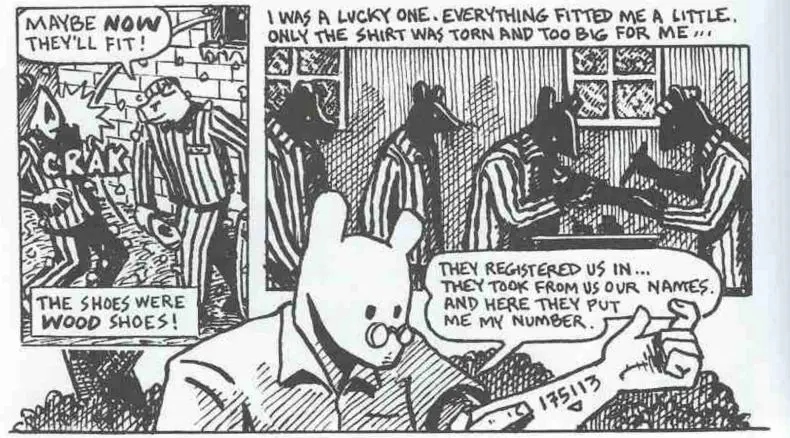
Vladek remembers with extraordinary precision the things that saved his life — the boots he traded for, the precise route through a particular ghetto, the name of a guard who could be bribed on a Tuesday but not a Wednesday. What he cannot narrate, or will not, surfaces in the drawings. His face, rendered in the panels, carries expressions he never describes in his own words. There is a moment where he speaks calmly about hiding his family and the drawn mouse-face shows something that can only be called a controlled collapse, the muscles of the jaw held too tight, the eyes fixed on nothing the reader can locate. The text says one thing. The image refuses to confirm it.
This gap is not accidental and it is not a failure of craft. It is the structural argument of the book. Paul Ricœur, in his 2004 work on memory, history, and forgetting, drew a distinction that becomes almost unbearably precise when applied to Maus: lived memory is always wider than narrated memory. The experience contains more than language can hold, and narration — the act of shaping events into sequence and cause — inevitably imposes a retrospective coherence that the experience itself never possessed. Vladek did not live his survival as a story. He lived it as a series of unbearable presents, each one with no guaranteed continuation. The story arrived later, imposed over those presents like a transparency that fits almost perfectly but not quite, leaving edges visible at the margins.
What Spiegelman draws is precisely those edges. He draws the silences between Vladek’s sentences. He draws the body language that contradicts the confident recall. He draws Vladek’s posture when the names of the dead are spoken — slightly forward, the way a person leans toward something they cannot reach — and nowhere does Vladek comment on his own posture. He does not know the reader is seeing him. Or perhaps he knows and has decided it is the one disclosure he can afford to make without making it.
Ricœur also wrote about the work of mourning as a condition for historical knowledge — the idea that a wound must be acknowledged before it can be understood, and that the refusal to mourn produces what he called a pathological memory, one that circles without landing. Vladek circles. He tells his son about Anja’s diaries and then, in the same breath, reveals that he burned them. He burned them after her death. He did not read them first, or if he did he says he didn’t, or perhaps the sequence matters less than the finality of the act. What remains is the absence of her voice inside a book that is partly about her, a structural wound the drawings cannot repair because no drawing can render what no longer exists.
The animal masks complicate this further. The mice and pigs and cats are not metaphors for dehumanization in any simple sense — they are Spiegelman’s admission that he cannot draw a human face and have it carry this weight without collapsing into sentimentality or monument. The masks keep the distance honest. They say: this is a representation of a representation, and you, the reader, are at least two removes from the event itself. Ricœur’s point about the distance between experience and transmission is here made visible rather than merely argued. The page itself enacts the epistemological condition it describes.
What survives the survivor is not the truth of what happened but the shape memory made of it under pressure, across decades, in conversation with a son who was also trying to survive something, and the gap between that shape and the event it describes is exactly where Spiegelman works, in that narrow and uncloseable space, making a book that is most honest precisely when it shows that honesty, at this distance, is all that can still be attempted.
🖼️ Memory, Trauma, and the Art of Testimony
Art Spiegelman‘s Maus stands at a unique crossroads of visual storytelling, historical trauma, and collective memory. The articles below explore the broader intellectual landscape surrounding its themes — from memory theory to autobiography, from the politics of representation to the power of popular forms as vehicles of truth.
Jan Assmann and Cultural Memory
Jan Assmann‘s theory of cultural memory explores how communities preserve and transmit their traumatic pasts through texts, rituals, and symbols. Maus engages deeply with this framework, using the comics medium to transform the Shoah into a durable cultural artifact. Understanding Assmann helps readers grasp why Spiegelman’s work functions not merely as biography but as an act of collective remembrance.
GO TO THE SELECTION: Jan Assmann and Cultural Memory
Pierre Nora and the Sites of Memory
Pierre Nora‘s concept of ‘sites of memory’ illuminates how certain objects, stories, and forms become repositories of collective identity when living memory begins to fade. Maus can be read as one such site — a graphic novel that crystallizes a generation’s testimony in permanent visual form. Nora’s framework reveals the historical stakes embedded in Spiegelman’s seemingly personal narrative.
GO TO THE SELECTION: Pierre Nora and the Sites of Memory
Paul Ricœur: Life and Philosophy of Memory
Paul Ricœur‘s philosophy of memory investigates the complex relationship between personal recollection, narrative, and historical truth. His work on ‘narrative identity’ is directly relevant to Maus, where Vladek’s fragmented storytelling shapes and distorts the son’s attempt to reconstruct the past. Ricœur helps us understand the ethical tensions at the heart of bearing witness through another’s memory.
GO TO THE SELECTION: Paul Ricœur: Life and Philosophy of Memory
Art Brut: History and Meaning
Art Brut, championed by Jean Dubuffet, celebrated raw, unmediated artistic expression outside the boundaries of official culture — a spirit that resonates with Spiegelman’s decision to treat the Holocaust through the ‘low’ medium of comics. Like Art Brut, Maus challenges assumptions about what materials and forms are worthy of serious subjects. Exploring this movement enriches our appreciation of Spiegelman’s radical formal choices.
GO TO THE SELECTION: Art Brut: History and Meaning
Cinema That Dares to Remember
If Maus moves you with its courage to face history through unconventional forms, Indiecinema is your next destination. Discover independent films and documentaries on our streaming platform that share the same commitment to memory, truth, and artistic daring — stories that mainstream cinema rarely tells.
👉 EXPLORE THE CATALOG: Watch Indie Films in Streaming
A vision curated by a filmmaker, not an algorithm
In this video I explain our vision

