
The Rodent in the Room
You are staring at the cereal box. It is seven in the morning, the kitchen is cold, and the cartoon mouse on the cardboard is grinning at you with that particular species of innocence that only mass-produced imagery can manufacture — round eyes, soft ears, a body that suggests comfort the way a stuffed toy does, the way a brand logo is engineered to make you feel safe enough to keep buying. The mouse means nothing. It has always meant nothing. It is a vehicle for sweetness, for the palatability of ordinary mornings, for the agreement between you and the world that certain symbols belong to childhood and nowhere else.

Somewhere else, at a drawing table, a man is using that same animal to draw Auschwitz.
Art Spiegelman did not arrive in the history of art as a career. He arrived as a problem that the culture had not given itself the tools to solve. Born in Stockholm in 1948 to two survivors of the Nazi camps — his father Vladek, his mother Anja, who would later take her own life — Spiegelman grew up in Rego Park, Queens, carrying a weight that had no name in the vocabulary of postwar American suburbia. The 1950s did not have a language for what his parents had seen. America was busy constructing a mythology of itself: abundance, safety, the clean geometry of shopping malls and television screens. Into that mythology, the cartoon had been folded as a natural element, as if images of talking animals and slapstick violence were simply part of the atmosphere, harmless as weather.
What Spiegelman understood, and what took him decades to find the form to say, is that the cartoon was never harmless. It was always a technology of perception — a system for telling you what to see and what to look away from, what to fear and what to find funny, what registers as human and what does not. The Nazis had understood this before he did. Der Stürmer ran caricatures of Jewish figures as rats and vermin throughout the 1930s and into the war years, not as decoration but as argument — as a sustained visual campaign to train the eye to dehumanize before the body could be compelled to destroy. The cartoon mouse, that soft and grinning thing on your cereal box, has a genealogy that passes through some of the darkest deliberate image-making in recorded history.
Spiegelman did not expose this by writing a treatise. He folded it back into the form itself. By assigning mice to the Jews and cats to the Germans in what would eventually become Maus — published in its complete form in two volumes in 1986 and 1991 — he performed an act of almost unbearable formal intelligence: he used the visual grammar of dehumanization to tell the story of dehumanization, forcing the reader to inhabit the very perceptual trap that made genocide possible. You cannot read those pages without becoming briefly, uncomfortably aware that you are looking at drawings of rodents and feeling grief. That awareness is not incidental. It is the entire point.
This is what makes Spiegelman a rupture rather than an achievement. Achievements can be catalogued, contextualized, celebrated, and then set back on the shelf. A rupture stays open. He did not add something to the tradition of comics or the tradition of Holocaust literature — he cracked both traditions against each other until something new and genuinely difficult came out of the collision. The familiar became monstrous: those soft ears, those round eyes now belonging to figures being loaded into cattle cars. The monstrous became familiar: genocide rendered in the visual language of Saturday morning, of breakfast tables, of the innocent hours before the world asks anything of you at all.
The cereal box mouse is still grinning. You just cannot look at it the same way anymore.
Slow Life
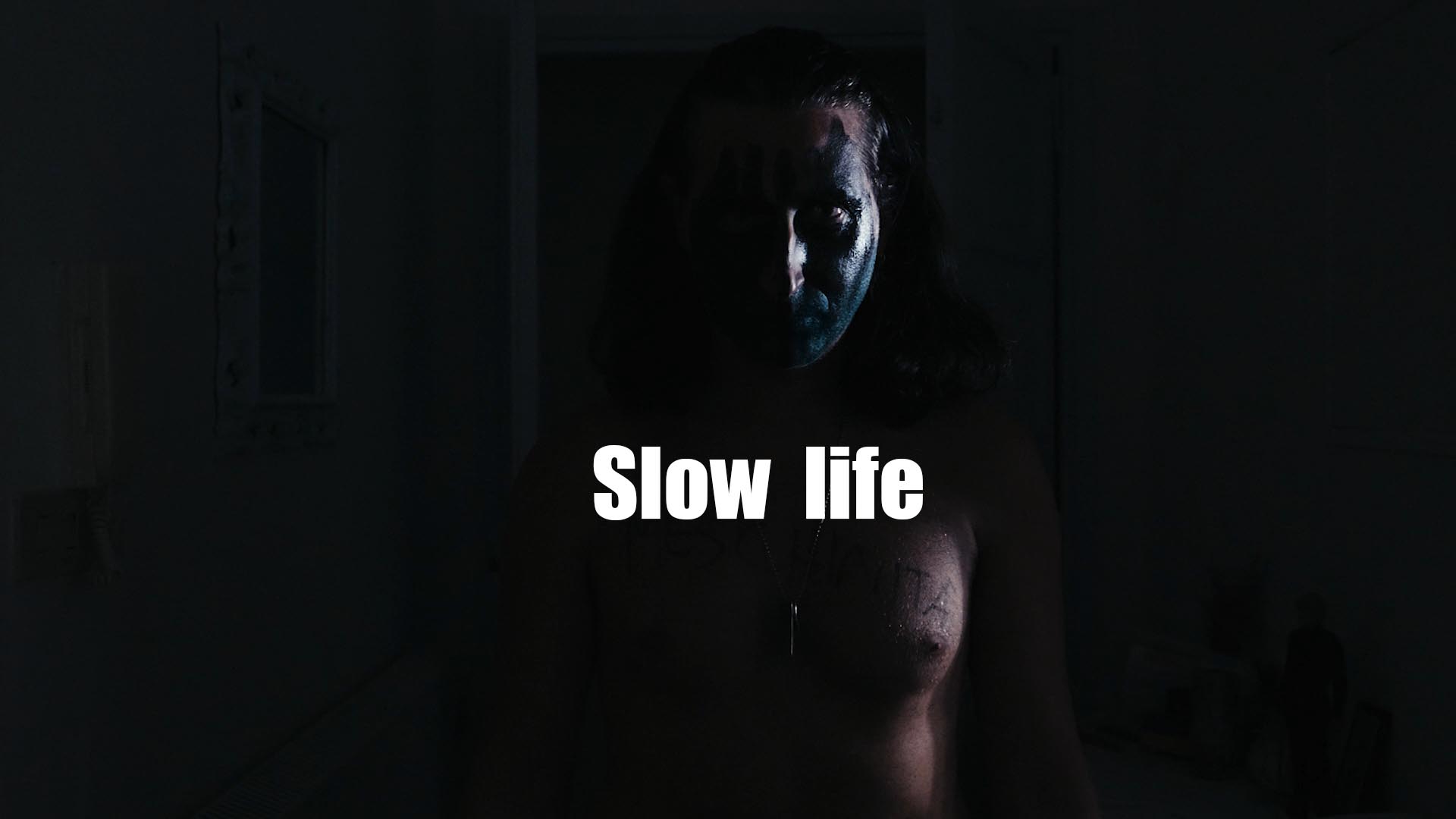
Drama, comedy, thriller, by Fabio Del Greco, Italy, 2021.
Lino Stella takes a period of vacation from his alienating job to devote himself to relaxation and his passion: drawing comics. But he did not foresee certain disturbing elements: the intrusive administrator of the building where he lives, the postman who delivers crazy fines and tax bills, an overbearing security guard, a very enterprising real estate agent, the old lady downstairs who raises the feline colony of the condominium. These characters will make his vacation hell.
Food for thought
The larger a social group is, the more rules and bureaucracy are needed, which often do not respect the individual. You have to learn to live with annoying people, but sometimes the social pressure and arrogance can become intolerable. The only laws that always come to our aid are the laws of Nature.
LANGUAGE: Italian
SUBTITLES: English, Spanish, French, German, Portuguese
Queens, Comics, and the Weight of Survival
The refrigerator hums in the kitchen on 108th Street. Dinner is finished. Your father sits in the armchair with the newspaper folded across his lap but he is not reading it. Your mother is somewhere else even when she is in the room. This is the weather of the house. It has always been this weather.
Art Spiegelman was born in Stockholm in 1948, three years after the camps, to parents who had survived Auschwitz by a combination of cunning, luck, and the kind of moral improvisation that peacetime citizens are never asked to perform. The family arrived in New York when he was three, settling in Rego Park, Queens, in a neighborhood dense with displaced European Jews who had reconstructed the forms of ordinary life over foundations that would never fully harden. The apartment, the routines, the careful management of resources — Vladek Spiegelman was famously thrifty to the point of anguish, a man who could not throw away a piece of wire — all of it had the quality of performance, of normalcy being enacted rather than lived.
The psychologist Dina Wardi, in her 1992 study of second-generation Holocaust survivors, introduced the concept of memorial candles to describe the children who are unconsciously assigned the task of bearing witness for parents who cannot bear to speak. These children do not receive an explicit instruction. The assignment is atmospheric, transmitted through silences at the dinner table, through the way certain questions are deflected, through the photographs that are not displayed, through the names of relatives who existed only as absences in conversation. They become vessels for a grief that was never metabolized, carrying emotions that belong technically to another generation but lodge in the body as their own. Spiegelman drew compulsively as a child, filling sketchbooks with figures and sequences, working in a medium that is itself a form of contained explosion — the panel as a cage for what cannot be said in one breath.
The comics he consumed and imitated were not, in the cultural atmosphere of 1950s America, considered serious. They were disposable, printed on paper that yellowed fast, sold at newsstands alongside candy. But for a child trying to give shape to something shapeless, the sequential image had a particular utility: it imposed order on time, it made cause and effect visible, it allowed a face to carry an emotion that words alone could not hold. William Eisner had already demonstrated in the 1940s that the gutter between panels — that blank white space — was where meaning actually lived, in the gap between one moment and the next. A child with unprocessed inherited trauma understands this intuitively. The gap is the whole story.
Then 1968. Anja Spiegelman takes her own life. Art is twenty years old. What this creates is not simply grief but a specific kind of wound that has no standard name: the loss of someone who was already, in some sense, elsewhere; the death of a witness who took her testimony with her; the violence of a silence that now becomes permanent. He would later describe the act itself as a kind of abandonment, and that word carries its full charge — not accusation, but the recognition that the dead make choices that the living must then inhabit for the rest of their lives.
He drew a three-page strip about it the following year, direct and savage, titled with her name. She does not appear in it with tenderness. She appears as someone who deprived him of his grief, who made mourning impossible by leaving no proper body of words behind. The work is not therapy. It is prosecution. And beneath the prosecution, barely visible, the shape of something that will take him another two decades to fully construct — a book about survival that is also, underneath everything, a book about what survival costs the people who were never asked if they wanted to pay.

Underground Ink and the Art of Controlled Chaos

The Garbage Pail Kids stared back at you from the corner store display in 1985, grotesque and gleeful, their surfaces smeared with everything polite culture preferred to suppress. Spiegelman had been designing for Topps since the early 1970s, contributing to their Wacky Packages series — those sticker parodies of consumer products that turned cheerful brand logos into tiny monuments of disgust. The work was commercial, anonymous, deliberately low. It was also a kind of laboratory. You could do almost anything inside a two-inch joke if nobody respectable was watching.
The underground comix scene that Spiegelman had entered in the late 1960s operated precisely on this logic. Robert Crumb, S. Clay Wilson, and the constellation of artists publishing through Rip Off Press and Last Gasp had discovered something structurally important: that the margins of a culture carry fewer guards. The obscenity trials that had shadowed earlier comics — the Senate hearings of 1954, Fredric Wertham‘s Seduction of the Innocent and its catastrophic influence on the Comics Code Authority — had already established that the form was dangerous enough to regulate. What the underground artists recognized was that this danger was the medium’s actual power, not its embarrassment. Spiegelman absorbed this, but he was never comfortable with transgression as an end in itself. The chaos had to be controlled, or it was simply noise.
This is where his obsession with the grid becomes legible as something more than formal preference. When McLuhan argued in 1964 that the medium itself was the message, he was gesturing at something that comics had been enacting for decades without theoretical permission: the page is not a neutral container. The sequence of panels, the gutters between them, the decision to fracture or sustain time — these are not decorative choices. They are epistemological ones. Spiegelman understood this at the level of the hand before he could articulate it intellectually. The panel was a cage, yes, but also a proposition about how consciousness parcels experience into something survivable.
Susan Sontag published her Notes on Camp in 1964, the same year McLuhan’s book appeared, and her essay opened a door toward taking seriously the aesthetics of the artificial, the excessive, the pop. But Sontag’s framework, generous as it was, still treated the low forms with a kind of anthropological affection — they were interesting because of what they revealed about taste, not because they were capable of bearing the full weight of human meaning. Spiegelman was mounting a different argument. Not that comics deserved to be welcomed into high culture, but that the distinction itself was a bureaucratic fiction protecting people from discomfort.
RAW magazine, which he co-founded with Françoise Mouly in 1980, was the most sustained institutional expression of this argument. Oversized, expensive-looking, printed with a seriousness that dared you to dismiss it, RAW published European artists alongside Americans, treated the page as graphic design and narrative space simultaneously, and refused the false choice between the literary and the visual. It ran until 1991, eleven issues in its large format before a smaller digest version. Spiegelman’s own work appeared in it serially — Maus began appearing there in installments, each section small enough to seem provisional, collectively accumulating into something that would become unavoidable.
The controlled chaos was never a style. It was an argument about where meaning actually lives — not in the smooth transmission of a message from sender to receiver, but in the friction between image and word, between what the panel shows and what the gutter suppresses, between what a father says and what a son cannot stop hearing. The grid held that friction in place. Without the structure, the feeling would have dissipated. And Spiegelman had learned, in those years of commercial anonymity and underground permission, that feeling without structure is just sensation.
Maus and the Grammar of Atrocity
The pages arrive in installments, each one a small emergency. Between 1980 and 1991, readers of RAW magazine received Maus in fragments, the way trauma itself arrives — not as a complete narrative but as intrusions, pieces that won’t cohere, panels that seem to come from different registers of reality. By the time Pantheon collected the work into two volumes, Maus: A Survivor’s Tale had already changed what comics were allowed to do, not by expanding the medium’s ambitions but by forcing it to confront something the medium had no right to survive.
Theodor Adorno’s most misquoted sentence hangs over this project like a sentence of execution. To write poetry after Auschwitz is barbaric — he wrote it in 1949, in Prisms, and spent the next two decades being misread, accused of prohibiting art, when what he was actually doing was identifying the obscenity of aestheticization, the way beauty can launder horror into something bearable and therefore forgotten. Spiegelman knew this. The whole formal architecture of Maus is built against comfort, against the seduction of the well-told story. The lines are deliberately scratchy, the panels unresolved, the frame sometimes collapsing into Spiegelman’s own drawing hand visible on the page, reminding you that someone is constructing this, someone who is also breaking down inside the construction.
Georges Didi-Huberman argued the opposite position with equal force. In Images in Spite of All, published in 2004 but drawing on decades of thought, he insisted that images — even partial, even inadequate, even monstrous in their inadequacy — are the only weapons we have against erasure. The Sonderkommando photographs smuggled out of Auschwitz in 1944 are blurred, incomplete, barely legible, and they are therefore more honest than any polished documentation. Spiegelman occupies the exact tension between these two positions. He does not resolve it. He lives inside it.
The animal device appears to offer a way out of that tension. You see a mouse, you relax slightly, the abstraction creates distance. This is the trap. The mouse-as-Jew and the cat-as-Nazi arrive looking like metaphor, like fable, like Aesop with catastrophe. But something happens after the first few pages that cannot be undone. Once you have accepted the visual shorthand — once you have agreed, by continuing to read, that this mouse is a human being whose humanity you will track and mourn — you have already performed the sorting. You have demonstrated, to yourself and without coercion, that the mind categorizes. That species logic is not foreign to you. That you did it willingly, the moment someone handed you a picture and asked you to follow along.
This is not Spiegelman accusing the reader. It is something more disturbing: he is showing the reader the mechanism from the inside. The philosopher Zygmunt Bauman argued in Modernity and the Holocaust, published in 1989, that the Holocaust was not an aberration of civilization but a product of it, that bureaucratic rationality, taxonomic thinking, and the ordinary human tendency to place others at a moral distance were all preconditions, not exceptions. Spiegelman arrives at the same conclusion through visual grammar rather than sociological argument. The animal mask doesn’t represent dehumanization. It enacts the cognitive operation that makes dehumanization possible, and it does it in you, while you read, before you realize what you’ve consented to.
Vladek Spiegelman is also not a hero. He is difficult, obsessive, racist toward Black Americans, exhausting to his son, a survivor whose survival required compromises the narrative refuses to resolve into dignity. Spiegelman gives you no permission to elevate him, because elevation is another form of distance, another way of placing the Holocaust at a remove that protects your understanding of yourself. What remains instead is a man and his mice and the unbearable grammar of what happened, laid out in panels that know they are not enough and keep going anyway.
The Pulitzer and the Problem of Recognition
The certificate arrived in a category that did not exist before the committee invented it. A special award, they called it, which is another way of saying: we do not know where to put this, but we cannot ignore it either. The 1992 Pulitzer Prize for Maus was not a door opening. It was a door being built in a wall that had no door, specifically so that this one thing could pass through it and the wall could remain intact on either side.
Lawrence Weschler understood immediately what that construction meant. He observed that the prize honored the work while simultaneously quarantining it — placing Maus in a category so singular that it could not contaminate the existing taxonomy. Not fiction. Not journalism. Not, God forbid, comics. Something. The award was less a recognition than a containment strategy dressed in the clothing of celebration.
This is how Western cultural institutions metabolize work that disturbs them. They do not reject it outright — rejection would concede that the threat is real. Instead they elevate it into a kind of sovereign exception, a work so extraordinary that it requires its own rules, which conveniently means that the existing rules remain unchanged for everything else. The Pulitzer committee did not expand its understanding of what literature could be. It granted Spiegelman a visa to a country while keeping the border closed behind him.
The paradox at the center of this is almost too neat to be accidental: the legitimacy that arrived was also a form of exile. By being special, Maus was made untransferable. Its lessons could not migrate. A cartoonist reading the news of the prize in 1992 could not take it as evidence that the medium had been recognized. They could take it as evidence that one extraordinary exception had been granted, which is the institutional equivalent of being told your case is unique precisely so your case cannot become precedent.
There is something in Hegel’s dialectic of recognition that applies here — the idea, traced through Alexandre Kojève’s influential 1930s lectures on the Phenomenology of Spirit, that recognition granted by a master to a slave does not constitute genuine mutual recognition because the power relation that frames it renders the gesture structurally incomplete. The Pulitzer committee was not Spiegelman’s equal in the transaction. The institution that does not know what comics are cannot genuinely recognize what Maus accomplished within and through that form. What it could recognize was the Holocaust content, the seriousness of the subject, the literary ambition — in other words, everything about Maus that resembled what institutions already knew how to value. The mice and the cats, the gutters between panels, the accumulated grammar of sequential art that made the book’s emotional architecture possible: those elements were thanked and then quietly set aside.
Trauma, in particular, gets metabolized this way with a kind of institutional efficiency that looks like reverence from the outside. The work is raised onto a plinth. It becomes sacred. And what becomes sacred becomes untouchable in two directions: you cannot dismiss it, but you also cannot truly use it, cannot let it reorganize your categories, cannot allow it to make you uncomfortable about what you failed to recognize before it arrived. The Holocaust in Maus was legible to the Pulitzer committee in a way the comics form was not, and so the prize celebrated the former as a vehicle for the latter while leaving the latter structurally unvalidated.
Spiegelman himself was not naive about any of this. He had spent his career in the underground press, in Raw, in the deliberate margins, and he understood that the center’s embrace comes with a cost that is never itemized in advance. Recognition arrived, and it arrived real, and it arrived as a kind of gilded quarantine — which is perhaps the most honest thing an institution can offer a work it does not fully understand and cannot afford to dismiss.
A vision curated by a filmmaker, not an algorithm
In this video I explain our vision
September 11 and the Collapse of Irony

The morning of September 11, 2001, Art Spiegelman was walking his daughter Nadja to school when the sky broke open. He was close enough to see the second plane hit, close enough to watch the south tower’s skeleton glow orange before it folded into itself. That image — the burning outline holding its shape for a fraction of a second before disappearing — became the obsessive center of everything he would make for the next three years, a visual splinter he could not extract.
What emerged in 2004 was a book unlike anything in his previous work, and deliberately so. The oversized broadsheet format of In the Shadow of No Towers mimicked the Sunday supplements of the early twentieth century — Winsor McCay’s Little Nemo, Lyonel Feininger’s Kin-der-Kids — not out of nostalgia but out of a precise and almost clinical logic. Those early comics were born in an era of mass catastrophe, of industrialized violence and the first intimations of a world that could destroy itself at scale. Borrowing their visual grammar was an act of historical honesty: this was not a new kind of terror, only a newly proximate one. The form carried grief that contemporary visual language, saturated by ironic distance, could no longer hold.
Paul Virilio argued in his writings on accident and technology that every invention carries within it the inevitability of its own catastrophe — the ship invents the shipwreck, the plane invents the crash. But he also understood that certain events constitute what he called the integral accident, the accident that does not merely damage a system but exposes the epistemological ground beneath it. September 11 was that kind of rupture. It did not simply destroy two buildings; it destroyed the particular mode of knowing that had allowed educated, culturally literate Westerners to process horror at a comfortable ironic remove. Spiegelman, who had built much of his artistic identity on that very mode — on the reflexive, self-aware layering that made Maus simultaneously a memoir and a meditation on the impossibility of memoir — found the ground gone from under him.
The book registers this vertigo structurally. The pages are unstable, crowded, sometimes nearly illegible with competing visual registers. One plate shows a tiny Spiegelman figure in the foreground while the towers fall endlessly in the background, the same image repeated across panels with minute variations, as though repetition itself might eventually produce meaning. It does not. That is the point. The towers keep falling because the mind cannot metabolize the image, only replay it.
But the personal trauma doubled almost immediately into civic fury, and this is what makes the book something beyond a grief document. Spiegelman watched the Bush administration weaponize the catastrophe with what he described as a speed that felt almost prepared. The flags, the slogans, the conversion of a specific and local horror into a generalized mandate for war — he experienced this as a second violation, cruder than the first because it was chosen. Maus had taught him what it looked like when trauma was instrumentalized by power; his parents’ survival had been folded into Israeli state mythology, into American Jewish communal identity, into a hundred narratives that served purposes other than truth. He recognized the mechanism.
The result is a book in permanent internal conflict, grief and rage refusing to resolve into each other. Some pages read as direct emotional testimony, almost raw. Others are savage political satire, George W. Bush depicted as a figure more dangerous than the hijackers because he was still standing and still deciding. Critics who expected a unified elegiac response found it dissonant. That dissonance was the argument. A man who had spent his career insisting that form and content were inseparable was not about to produce a harmonious book about an experience that had left nothing harmonious in its wake.
MetaMaus and the Refusal to Become Monument
There is a photograph in the archive that Spiegelman chose to reproduce — his father Vladek, young, unrecognizable, standing with a posture of careful dignity in clothes that do not quite fit. It is not a famous photograph. It does not illustrate anything cleanly. It sits in the record as evidence of a person who existed before the story needed him to be anything, before the mouse mask, before the survivor’s guilt, before the son’s guilt about the survivor’s guilt. Spiegelman published it anyway, along with the failed panel sketches, the taped interviews where his father contradicts himself, the drafts where the animal metaphor nearly collapsed under its own weight. He published all of it in 2011, thirty years after the first Raw installment, in a book that methodically unskinned the most celebrated graphic novel in the English language.
Most artists, when they have made something that has entered the culture permanently, develop a protective relationship to it. They give interviews that clarify without exposing. They authorize biographies that honor the mystery. They understand, instinctively, that the monument’s power depends on its opacity. Spiegelman did the opposite. MetaMaus is an act of deliberate structural self-cannibalism — a sustained attempt to eat the work from the inside, to show every seam, every doubt, every place where he chose one thing over another and could have chosen differently. The ethical compromises are named. The moments where he simplified his father for narrative efficiency, where he used the Holocaust as a kind of inherited dramatic engine, where his own ambivalence toward Vladek became indistinguishable from the text’s ambivalence — all of it surfaces, undefended.
Walter Benjamin argued, in his unfinished Arcades Project, that genuine historical thinking does not produce continuity but interruption. The dialectical image, for Benjamin, is the moment when two temporally distant things collide and produce meaning not through synthesis but through the shock of their juxtaposition. The flash of recognition is not comfort — it is a rupture in the seamless narrative that ideology prefers. What Spiegelman does in MetaMaus is precisely this: he forces the finished work and its own making into collision, so that neither can rest undisturbed. The polished panels cannot remain authoritative when you can see, on the facing page, the version that was almost printed instead. The archive is not a monument’s pedestal. It is its tremor.
This matters because the culture around Maus had already begun the process that kills difficult work — the process of making it safe by making it essential. Required reading. Holocaust curriculum. Award-winner. Once a book becomes a lesson, it stops being an encounter. Spiegelman had watched this happen and responded not with gratitude but with suspicion about his own role in it. The question MetaMaus keeps returning to is not how Maus succeeded but whether success of this particular kind was the right outcome. Whether the legibility, the accessibility, the animal allegory that made the Holocaust graspable to a generation of teenagers who would otherwise have turned the page — whether all of that was a necessary translation or a dangerous simplification. He does not resolve this. He sits in it.
There is a moment in the recorded conversations that form the book’s backbone where he describes realizing, mid-drawing, that he had made his father into a character. Not represented him. Made him. The distinction horrified him and he kept working anyway, because stopping would have been its own kind of betrayal. That sentence — the one about keeping working anyway — is the most honest thing in the archive. It is not the sentence of someone who found his way through. It is the sentence of someone who found no way through and went forward regardless, leaving the evidence of the impossibility behind him like a trail that leads nowhere and everywhere at once.
Drawing at the Edge of Language
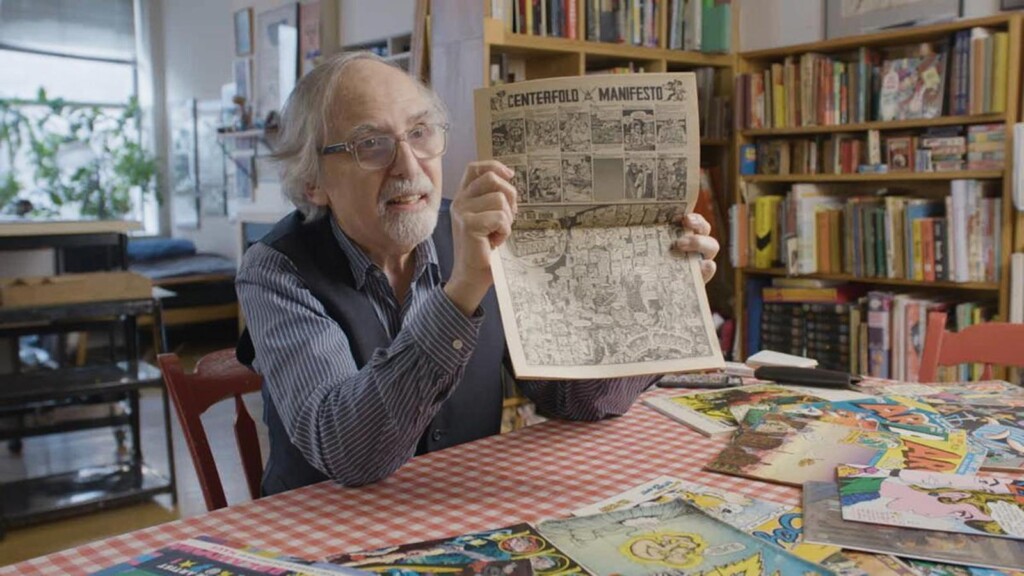
There is a moment where a man sits at a drawing table, his father’s voice still in his ears, the tape recorder running, the pencil hovering. He is not illustrating. He is deciding whether the act of making a mark is itself an act of betrayal — whether to render something is already to domesticate it, to place a frame around what refused every frame while it was happening.
This is the problem Spiegelman never solves, and never pretends to solve. His entire body of work circles it with the obsessive patience of someone who knows the center cannot be reached but cannot stop moving toward it. The broken grids in Maus are not a stylistic choice in any decorative sense. They are a position. When a panel bleeds into another, when time folds back on itself mid-page, when the artist appears inside his own reconstruction doubting the reconstruction, these are not experiments in form for form’s sake. They are the formal acknowledgment that coherence itself is a kind of lie when applied to experiences that shattered coherence as their primary act.
Jean-François Lyotard, writing in 1983 in Le Différend, named the condition precisely: the differend is the wrong suffered by someone who cannot make their harm legible within the idiom of the system that caused it. To speak the wrong in the language available is already to distort it. The victim who must prove their victimhood in the terms set by the perpetrator — or by history, or by genre — loses something essential in the translation. Lyotard was thinking in part about testimony from the camps, about the epistemological violence of demanding that survivors produce evidence in forms the dominant discourse would recognize as valid. Spiegelman understood this not as philosophy but as inheritance. His father Vladek was legible to American postwar culture only as a certain kind of survivor — grateful, resilient, ultimately redeemed. The actual Vladek, petty and damaged and brilliant and difficult, kept escaping that frame. Maus is, at its core, the record of that escape.
What words do when they are complicit is not simply fail to describe — they actively reshape. They smooth the fracture. They introduce causality where there was only rupture. They imply that because a narrative can be followed, the events within it can be understood. Spiegelman’s layered temporalities — Auschwitz and Rego Park and the drawing table existing simultaneously on the same page — refuse that implication at the level of structure. The reader cannot settle into the comfort of linear comprehension because the page itself denies linearity its usual authority.
And then there is the figure of the artist drawing himself drawing, which is not narcissism and not metafiction deployed as a clever device. It is the ethical insistence that no account arrives from nowhere, that every mark carries the weight of the hand that made it, the decade it was made in, the guilt and love and inadequacy the artist brought to the table. When Spiegelman draws himself as a figure crushed under the weight of Maus’s own success — the masks, the media, the commodification of atrocity into award-winning literature — he is not complaining. He is demonstrating that the differend does not end with publication. The wrong migrates. It finds new forms of distortion in the very apparatus of recognition.
To draw at the edge of language is not to find a way around language’s failures. It is to make those failures visible, to hold them open rather than suture them with the satisfactions of form. The page that looks broken is not broken by accident. It is broken on purpose, as an act of fidelity to what cannot be made whole, and the hand that drew it knew exactly what it was refusing when it put down the pen and looked at what remained.
🎨 Art, Memory, and the Power of Visual Storytelling
Art Spiegelman’s work exists at the crossroads of visual art, traumatic memory, and cultural criticism. His graphic novels redefine how images and words collaborate to bear witness to history, placing him in dialogue with thinkers and artists who explored similar tensions between form and meaning, remembrance and representation.
Art Brut: History and Meaning
Art Brut, the raw and untamed artistic expression championed by Jean Dubuffet, shares with Spiegelman’s work a fierce rejection of polished, mainstream aesthetics. Both traditions treat the act of mark-making as an act of survival and truth-telling, privileging authenticity over convention. Spiegelman’s underground comix roots draw deeply from the same anti-establishment spirit that defines Art Brut.
GO TO THE SELECTION: Art Brut: History and Meaning
Jan Assmann and Cultural Memory
Jan Assmann‘s theory of cultural memory explores how communities encode collective trauma and identity into durable symbolic forms, a preoccupation central to Spiegelman’s Maus. The graphic novel functions precisely as what Assmann calls a ‘figure of memory,’ transforming personal testimony into a shared cultural archive. Understanding Assmann illuminates why Spiegelman chose the comic strip as a vehicle for Holocaust remembrance.
GO TO THE SELECTION: Jan Assmann and Cultural Memory
Keith Haring: Life and Works
Keith Haring, like Spiegelman, emerged from the fertile underground art scene of New York and fought to have visual art taken seriously as a language of social and political urgency. Both artists used bold, instantly recognizable imagery to communicate ideas that transcended traditional gallery boundaries. Their parallel careers reveal how the 1980s avant-garde transformed popular visual culture from the margins inward.
GO TO THE SELECTION: Keith Haring: Life and Works
Banal Evil and Radical Evil: Kant and Arendt
Hannah Arendt‘s concept of the ‘banality of evil‘ resonates powerfully with the moral universe Spiegelman constructs in Maus, where perpetrators are depicted as ordinary beings within a catastrophic system. Arendt’s philosophical framework helps readers understand how Spiegelman refuses to reduce the Holocaust to simple monsters and victims. Both thinkers demand that we confront the uncomfortable ordinariness at the heart of historical atrocity.
GO TO THE SELECTION: Banal Evil and Radical Evil: Kant and Arendt
Discover Independent Cinema on Indiecinema
If Art Spiegelman’s exploration of memory, trauma, and visual storytelling has moved you, Indiecinema is the streaming destination where these themes come alive on screen. From avant-garde documentaries to bold independent features, our curated catalog brings you the films that dare to ask the hardest questions. Join us and keep exploring the edges of art and human experience.
👉 EXPLORE THE CATALOG: Watch Indie Films in Streaming
A vision curated by a filmmaker, not an algorithm
In this video I explain our vision

