
The Clock on the Wall
You are still awake at 1 a.m., and you are not thinking about anything pleasant. You are thinking about the email you did not send, the report that needs one more revision, the meeting you have to prepare for before Thursday, and underneath all of that, like a low current you cannot switch off, the feeling that today was not quite enough. Not a disaster. Not even a failure. Just not quite enough. You ran through the afternoon, you moved things forward, you completed the visible things — and still the mind refuses to go dark. It keeps running its inventory, checking what was done against some internal ledger whose final column never quite balances.

At some point, around two in the morning, you negotiate. You tell yourself that sleeping is not laziness, that rest is necessary for performance, that tomorrow you will be sharper if you allow yourself to stop now. And you notice, if you are honest, that you could not simply say: I deserve to sleep because I am tired. You had to earn it differently. You had to reclassify sleep as a form of productivity, a recovery investment, before your mind would accept it. The rest had to justify itself. The stopping had to serve the continuing.
This is not an anomaly. This is not a symptom of overwork in the clinical sense, not something that a wellness app or a better morning routine will dissolve. It is something structural, something that has been building in the walls of Western consciousness for roughly four hundred years, accumulating so quietly and so thoroughly that we now mistake it for human nature. The anxiety you felt at two in the morning was not yours alone. It was borrowed, inherited, pressed into the architecture of the self before you had any say in the matter.
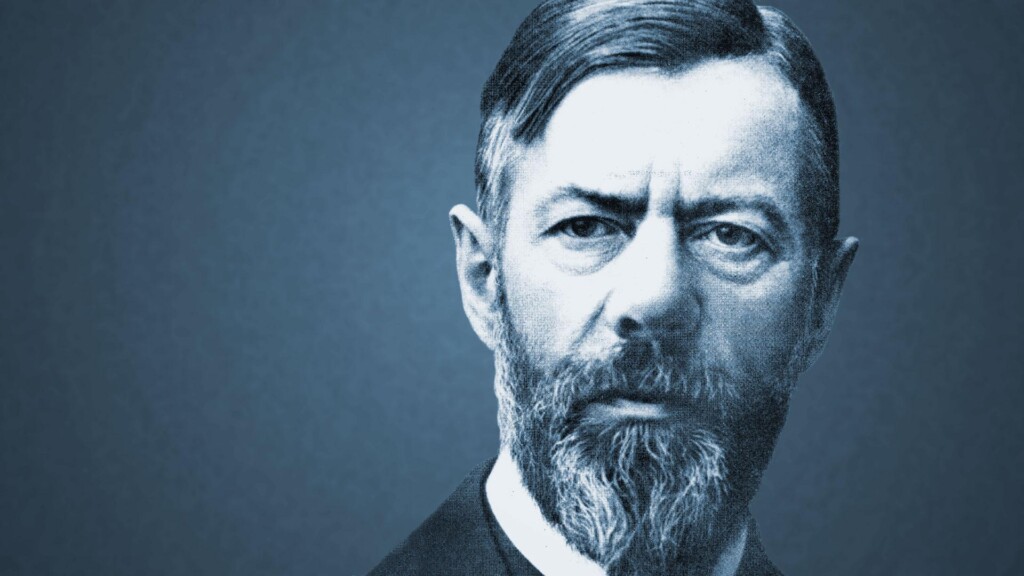
Max Weber saw it. Writing in 1904 and 1905, in a two-part essay that would become one of the most debated texts in modern social science, he identified something that most people around him were too close to see: that the relentless, rationalized, morally charged pursuit of work in the modern Western world was not simply a consequence of capitalism’s material incentives. It was the residue of a theological transformation. The spirit that drives you to lie awake rehearsing your failures was not born in the boardroom or the factory floor. It was born, Weber argued, in the confessional anxieties of sixteenth and seventeenth-century Protestantism, specifically in the Calvinist doctrine of predestination, which told believers they could not earn salvation but left them desperate to find signs that it had already been granted.
The Protestant Ethic and the Spirit of Capitalism did not claim to explain everything about modern economic life. Weber was too careful and too intellectually honest for that kind of totalizing ambition. He was explicit that he was tracing one thread — the cultural and psychological thread — not the whole fabric. But what he found in that thread was something with extraordinary staying power: a way of relating to work that had been spiritually charged, then secularized, and then so fully absorbed into everyday life that it no longer needed a church to sustain it. It became self-enforcing. It became the voice at two in the morning.
The clock on the wall of your bedroom, if you still have one, does not tick neutrally. Every instrument of time measurement carries within it a moral weight that was forged in a specific historical moment, in specific theological debates, about sin and grace and the unbearable uncertainty of not knowing whether you were saved. You have inherited that weight. You carry it in the way you feel guilty on a slow afternoon, in the way vacation requires justification, in the way you described your weekend not by how it felt but by what you managed to get done.
Slow Life

Drama, comedy, thriller, by Fabio Del Greco, Italy, 2021.
Lino Stella takes a period of vacation from his alienating job to devote himself to relaxation and his passion: drawing comics. But he did not foresee certain disturbing elements: the intrusive administrator of the building where he lives, the postman who delivers crazy fines and tax bills, an overbearing security guard, a very enterprising real estate agent, the old lady downstairs who raises the feline colony of the condominium. These characters will make his vacation hell.
Food for thought
The larger a social group is, the more rules and bureaucracy are needed, which often do not respect the individual. You have to learn to live with annoying people, but sometimes the social pressure and arrogance can become intolerable. The only laws that always come to our aid are the laws of Nature.
LANGUAGE: Italian
SUBTITLES: English, Spanish, French, German, Portuguese
What Weber Actually Wrote, and Why Most People Have Only Half-Read It
Pick up the book. Not the summary, not the Wikipedia entry, not the paragraph someone quoted in a business school lecture — the actual text, the one Weber published in two parts in the Archiv für Sozialwissenschaft und Sozialpolitik in 1904 and 1905. Feel how quickly the argument becomes something other than what you expected. There is no triumphant declaration that Protestantism created capitalism. There is instead something far more unsettling: a careful, almost forensic attempt to trace how a particular way of feeling anxious about one’s soul accidentally produced a particular way of organizing worldly life.
The distortion is so widespread that correcting it feels almost futile, but here it is: Weber never argued that Calvinist theology caused capitalism in any direct, mechanical sense. His claim was subtler and stranger. He was tracking what he called a Wahlverwandtschaft — an elective affinity — between the psychological disposition generated by Calvinist predestination doctrine and the behavioral patterns that early modern capitalism required in order to consolidate itself. These two things did not produce each other. They recognized each other, the way two frequencies resonate without either one generating the other. The famous formulation appears in the text itself: Weber is not writing a history of capitalism’s origins but an interpretation of one of the elements of its spirit.
That word, spirit, is doing enormous work, and most readers slide past it. Weber borrows it deliberately from a tradition that treats economic behavior as inseparable from the values, anxieties, and self-understandings of the people who engage in it. When he quotes Benjamin Franklin — “time is money,” “credit is money,” the whole catechism of industrious virtue from Poor Richard’s Almanack — he is not celebrating Franklin. He is diagnosing him. He is showing that Franklin’s advice reads less like practical wisdom and more like an ethical code, one in which the accumulation of money has become an end in itself stripped of any hedonistic or even utilitarian justification. The man who earns and does not enjoy, who profits and does not rest, who treats his own productivity as a moral obligation — this is the character Weber is trying to explain. Not the robber baron. Not the merchant adventurer. The man who genuinely believes that wasting time is a sin.
And here is where the Calvinist theology enters, not as cause but as training ground for a particular kind of inner life. The doctrine of predestination — the belief that God has already determined who is saved and who is damned, and that no human action can alter this — created, Weber argues, a form of existential terror with no liturgical exit. In Catholicism, the confessional offered relief. In Lutheranism, a direct emotional relationship with God provided comfort. Calvinism offered neither. The elect could not know with certainty that they were elect. What they could do was search for signs. And the theological advisors of the seventeenth century, tracking this anxiety with some pastoral precision, began suggesting that disciplined, methodical, successful work in one’s worldly calling might function as a symptom of grace rather than its cause. Not earning salvation, but perhaps glimpsing it.
This is the hinge. Weber is not saying that Calvinists became capitalists because their religion told them to make money. He is saying that the psychological infrastructure built by this particular form of religious anxiety — the compulsive self-monitoring, the rejection of spontaneous pleasure, the elevation of disciplined method over passionate impulse — turned out to be precisely the interior architecture that early capitalist enterprise needed from its practitioners. The theology produced a human type. The economic system selected for that type. These two processes did not plan to meet. They simply fit.
What makes this argument genuinely dangerous is not its claim about the past. It is the implication it leaves sitting in the present, unresolved, like a question someone asked in the room and then quietly left.

The Anxiety That Predates the Balance Sheet
There is a man who has not missed a single day of logging his productivity metrics in four years. Not illness, not grief, not the birth of his child interrupted the ritual. Every evening he opens the spreadsheet and enters numbers that will tell him, in aggregate, whether he deserves to feel acceptable about himself. He does not find this strange. Neither do his colleagues, who do roughly the same thing with different applications.
Calvin did not invent this man. But he built the theological structure that made him spiritually inevitable.
The doctrine of predestination, as Calvin formulated it in the Institutes of the Christian Religion published in 1536, contained a particular cruelty that even its author seemed to recognize as uncomfortable. God had already decided, before any action, before any merit, before birth itself, who would be saved and who damned. Nothing you did could alter that verdict. The elect were elect before they drew breath; the reprobate were lost before they sinned. This was not injustice in Calvin’s framing — it was sovereignty. God owed no explanation, and human reason was too corrupted by the fall to demand one.
Weber saw precisely what this produced in the believer’s psyche: an unbearable uncertainty with nowhere to discharge itself. Unlike the Catholic who could confess, perform penance, receive absolution, and return to a state of grace through institutional ritual, the Calvinist had no such mechanism. The priest could not help. The sacraments did not alter the divine arithmetic. You were either saved or you were not, and you could not know which. Weber described this as an “unprecedented inner loneliness” — a phrase that should be read clinically, not poetically. It was a structural condition, not a mood.
What emerged from this loneliness was not passivity but a ferocious need for signs. If election was real and if the saved were genuinely transformed by grace, then surely that transformation would manifest in conduct. Success in one’s calling — diligent, methodical, unrelenting work — began to function not as the cause of salvation but as its evidence. You could not earn your way into grace. But you could watch yourself carefully for proof that grace had already found you. The distinction sounds theological and remote. Its psychological consequence was immediate and violent: the need to produce visible results never stops, because the verdict it is meant to confirm never arrives with finality.
This is the mechanism Weber identified as the root of modern capitalism’s spirit, and it is worth being precise about what he was and was not claiming. He was not arguing that Protestantism caused capitalism in any simple material sense. He was tracing an elective affinity — a phrase borrowed from Goethe — between a specific form of inner anxiety and the behaviors that market economies would later require and reward. The rational, continuous, methodical accumulation of profit as a vocation rather than a means: this disposition needed a cultural substrate to grow in. Calvinist soteriology provided one.
The sixteenth-century believer scanning his conscience for signs of election and the contemporary professional refreshing his performance dashboard are not identical. But the underlying grammar is recognizable. In both cases, the anxiety precedes the activity. The work does not produce the reassurance — it merely defers the moment when its absence becomes undeniable. Erik Erikson, writing about identity formation in a different register entirely, observed that the need for external confirmation intensifies precisely when internal certainty has been structurally denied. He was describing adolescence. He could have been describing Zurich in 1550, or any open-plan office in the decades that followed his writing.
The spreadsheet gets filled every night because the verdict never comes. That is not a metaphor. That is the inheritance, still running.
When the Scaffolding Outlasted the Cathedral
There is a particular kind of exhaustion that has no name in most languages — the feeling of working hard not because you believe in anything the work produces, but because stopping would feel like a moral failure. You push through Sunday afternoon with a to-do list. You feel vaguely guilty reading fiction. You describe yourself as “bad at relaxing” the way someone might confess a character flaw, and the people around you nod in recognition rather than concern. Nothing theological is happening in that moment. No covenant is being honored, no God is watching the hours accumulate. And yet the structure of the behavior — the compulsion, the guilt, the self-surveillance — is identical to what Weber observed in the Calvinist merchant checking his ledger at midnight three centuries ago.
Weber called it the iron cage. The German he actually wrote was stahlhartes Gehäuse — a shell as hard as steel — and the translation softened something important. A cage implies imprisonment from outside. A shell implies that the structure has become your own skin. What Weber was diagnosing, in the closing pages of The Protestant Ethic and the Spirit of Capitalism published in 1905, was not oppression but something more unsettling: a system of meaning that had hollowed itself out while leaving its behavioral residue intact. The religious scaffolding that originally held the whole construction together — the terror of damnation, the hunger for signs of grace, the genuine metaphysical stakes — had crumbled. The cathedral it was built to support had been quietly dismantled. But the scaffolding remained, and people kept climbing it.
This is what Weber meant when he wrote, in one of the most haunting passages in modern social thought, that the pursuit of wealth had shed its transcendent meaning and now appeared as “pure competition” driven by “mechanized petrification.” The spirit had left the body but the body continued walking. And crucially, it walked faster, because without theological content to slow it down with questions of ultimate meaning, the behavioral imperative became self-justifying. You work because work is good. Why is work good? Because not working is bad. The circularity is total, and it functions precisely because no one examines it.
What secularization did, against all intuition, was not weaken this structure but render it invisible by rebaptizing it in secular vocabulary. The concept of a calling — Beruf, in Luther’s original translation, the word that fused vocation with profession into a single sacred duty — did not disappear when churches emptied. It migrated into the language of self-actualization, personal branding, the relentless injunction to find your passion and monetize it. The sociologist Richard Sennett, writing nearly a century after Weber, observed how the new capitalism demands not merely your time but your authentic self, your identity, your continuous reinvention — which is exactly what a calling always demanded, only now the deity demanding it is the market and the congregation is your LinkedIn network.
Personal responsibility functions the same way. Once a theological concept — the soul answerable to God for its stewardship of time and talent — it became, in the twentieth century’s self-help culture and then in neoliberal political discourse, an entirely secular moral absolute. When Margaret Thatcher dismantled social safety nets in the early 1980s, the ideological scaffolding she used was not religious in any explicit sense. It was the Protestant ethic translated into policy: poverty as failure, wealth as evidence of virtue, dependence as sin. The content had changed completely. The grammar had not moved an inch.
Weber himself suspected this was the endpoint. Not the dramatic clash of belief and unbelief that the nineteenth century had expected, but something quieter and more total — a world in which the ethic survived the theology like a parasite that had killed its original host and learned to live without it, feeding now on the body it had always secretly been building.
The Body That Learned to Feel Guilty for Sleeping
You wake before the alarm. Not because you are rested, but because something in you — some low-frequency hum installed long before you had words for it — registers the horizontal position of your own body as a form of debt. You are not ill. You have nowhere urgent to be. And yet lying there, you feel the particular discomfort of a person who has stopped moving without permission.
This is not insomnia. It is older than insomnia. It is the body that learned, across several centuries of doctrinal pressure and social enforcement, to experience rest as a kind of moral failure — a softness to be overcome, an indulgence requiring retroactive justification. You did not choose this. It was deposited in you the way sediment is deposited in stone: under pressure, over time, invisibly.
Weber’s argument about the Protestant ethic was never only about economics or theology. It was always, at its most precise, about the remaking of interiority — the production of a subject who polices himself from the inside. When the Calvinist doctrine of predestination removed the possibility of earning salvation through works or confession, it created what Weber described as an unprecedented psychological pressure: the believer could not know whether he was among the elect, and so he was condemned to read his own life obsessively for signs of divine favor. Worldly success became the only available symptom. Hard work, thrift, self-denial — these were not paths to salvation but symptoms to be monitored, evidence to be gathered about a verdict already rendered in eternity. The anxiety this produced was not occasional. It was structural. It became, over generations, the baseline emotional register of entire cultures.
Foucault, writing nearly four centuries after Calvin, would describe a different mechanism producing a similar body: the disciplinary apparatus that does not command from outside but installs itself as conscience, as the watcher one carries internally. What Foucault anatomized in Discipline and Punish — that shift in modern power from spectacle to surveillance, from the public execution to the internalized gaze — had its theological rehearsal precisely in the Protestant examination of conscience, the nightly audit of whether one had used the day well. The watched body and the guilty body are not the same body, but they share a posture: slightly braced, never fully at ease, always slightly behind.
Nietzsche saw something rawer underneath this. In the second essay of On the Genealogy of Morality, he traced guilt not to theology but to the creditor-debtor relationship, to the primordial logic of owing something that cannot be repaid. What the Protestant reformation accomplished, in Nietzsche’s terms without his language, was to universalize that debt — to make every human being a debtor to God, to time, to the community of the saved, to their own unlived potential. Rest, in this framework, is not recuperation. It is time stolen from repayment. The sleeping body is a defaulting body.
A man sits at his desk on a Sunday afternoon, the window open, a book beside him that he is not reading. He has finished what needed to be done. There is nothing wrong. And yet he cannot settle — he rearranges the papers, checks his phone, considers whether he should have done more. This is not neurosis in any clinical sense. It is the correct functioning of a system designed to produce exactly this: a person who experiences his own stillness as suspicious.
The remarkable thing is how completely this was achieved without ongoing enforcement. You do not need a pastor standing over you. The architecture was built so durably that it now runs without supervision, which is precisely what made Weber’s observation so unsettling when he first wrote it in 1905 — not that people were forced to work, but that they had learned to want nothing else, and to feel vaguely criminal when they stopped.
A vision curated by a filmmaker, not an algorithm
In this video I explain our vision
The Geography of the Ethic: Who It Included and Who It Was Always Going to Exclude

There is a map that does not show its own borders. It presents the territory as the world, the center as the obvious starting point, and everything beyond the frame as either irrelevant or not yet arrived at the correct moment in history. Weber’s Protestant ethic operates on precisely this cartographic assumption: that the discipline it describes, the restless accumulation, the moralization of work, the anxiety transmuted into method, is not one historical formation among many but the very shape of rationality itself. To read it sympathetically is to absorb that assumption without noticing you have done so. To read it critically is to ask who drew the map and whose land was declared empty in the process.
R. H. Tawney, writing in 1926 as a direct interlocutor with Weber’s thesis, identified something Weber had left architecturally obscured: the Protestant ethic was not merely a spiritual climate that happened to coincide with capitalism, but a moral vocabulary that capitalism actively required in order to present exploitation as virtue. In “Religion and the Rise of Capitalism,” Tawney traced how the individualism Weber admired in the Calvinist conscience was also the mechanism by which collective obligations were dissolved, by which the poor could be moralized rather than fed, by which the failure to accumulate became evidence of a personal deficiency rather than a structural condition. The ethic did not simply encourage work. It reorganized the meaning of poverty so thoroughly that to be poor was to be spiritually suspect, and to be wealthy was to carry visible proof of invisible grace.
That reorganization required a geography, and the geography required bodies. W. E. B. Du Bois, whose “The Souls of Black Folk” appeared in 1903, the same year Weber began publishing his essays, was already describing from inside the structure what Weber observed from outside it: a world in which the industriousness of Black Americans was systematically rendered invisible, reframed as servitude rather than labor, as nature rather than discipline, as an absence of the very Protestant virtue that their forced work was actually producing for others. The plantation economy was not a failure of rationalization. It was rationalization applied to human beings classified outside the moral ledger. The ethic needed that classification to survive. A system that attributes wealth to inner grace cannot afford to explain the wealth of slaveholders through the labor of the enslaved. So the enslaved were assigned to a different category entirely, one that Weber’s framework simply does not possess the conceptual tools to name.
Postcolonial readings push this further, noting that the spread of what Weber calls the spirit of capitalism across the globe during the colonial period was not an organic diffusion of rationality but a violent reorganization of existing economic systems into forms that could be extracted from. Scholars working in the tradition of Frantz Fanon observed that colonized peoples were not described as indolent because they refused to work, but because the work they performed did not take the form recognized by the ethic, it was not individualized, not anxiety-driven, not directed toward accumulation as a sign of election. The indolence attributed to entire populations was a moral alibi for dispossession. You could not rationalize taking someone’s land if you acknowledged their labor on it. So the labor had to be reclassified as something other than labor, and the ethic provided exactly the vocabulary for that reclassification.
Weber was not unaware of racial capitalism or colonial extraction. He simply did not ask what his central category looked like from inside what it excluded. The Protestant ethic as he described it is a Protestant ethic of a very specific longitude and latitude, of specific bodies permitted to carry its anxiety, specific souls eligible for its grace, specific labor legible as discipline rather than servitude. The universality was always a particular wearing a costume.
The Secular Descendants: Productivity Culture, Self-Optimization, and the Algorithmic Conscience
Your phone tells you that you slept six hours and forty-three minutes last night, that your heart rate variability was below average, and that your recovery score is sixty-one out of a hundred. You have not yet gotten out of bed. The verdict has already been delivered.
Weber never used the word algorithm, but he understood the structure perfectly. The Calvinist who woke each morning into uncertainty about his own salvation and searched his daily conduct for signs of grace was not so different from the person lying under the covers reading a numerical score that grades how well they rested. The theological vocabulary has been retired. The guilt mechanism is intact. What changed is only the source of the verdict — it migrated from God to the dashboard.
Hustle culture made this explicit in ways that the Puritans, with their instinct for concealment, never would have. The open celebration of sleep deprivation as proof of commitment, the sixteen-hour workday worn as a badge, the LinkedIn post that turns a canceled vacation into evidence of passion — these are not distortions of the Protestant ethic but its logical continuation once the productivity theology becomes self-aware and starts to perform itself. The inner-worldly ascetic, as Weber described him in 1905, did not consume the fruits of his labor but reinvested them. His contemporary descendant does not consume leisure but photographs it, quantifies it, optimizes it, and posts the metrics.
The quantified self movement, which began acquiring institutional form around 2007 with conferences, communities, and dedicated applications, is perhaps the purest expression of this inheritance. The premise is that the self can be improved through measurement, and that any dimension of human experience — mood, productivity, sleep depth, caloric intake, social interaction frequency — becomes legible and therefore governable once rendered as data. Georg Simmel, writing in 1900 in The Philosophy of Money, had already identified the tendency of modern life to translate qualitative experience into quantitative equivalence. He saw it as a consequence of money’s logic spreading beyond the market into perception itself. The quantified self is what happens when that logic colonizes interiority.
Wellness arrived as the compassionate face of this colonization. It speaks the language of care, rest, and balance, but its structure is disciplinary in exactly the Weberian sense. The woman who wakes at five in the morning to meditate, journal, exercise, and prepare a nutritionally optimized breakfast before her first meeting is not rebelling against productivity culture. She is practicing its most advanced form. Her recovery is strategic. Her stillness is scheduled. The app that guides her ten-minute mindfulness session will also track whether she completed it, and if she did not, a notification will arrive to remind her of the gap between who she is and who she could become.
Foucault called this the technology of the self — the set of practices through which individuals act on their own bodies, souls, and conduct in order to transform themselves toward some normative ideal. What he could not have anticipated fully is the degree to which that technology would be externalized into devices, platforms, and algorithmic scoring systems, so that the panopticon no longer needs a central tower because the prisoner carries the tower in his pocket.
The guilt that Weber traced to predestination anxiety now circulates through a secular infrastructure with extraordinary efficiency. You do not need to believe in hell to feel the particular dread of opening a productivity app at the end of a day and finding the tasks undone. The categories have changed. Salvation has become optimization. Sin has become inefficiency. Grace has become peak performance. But the relation between the soul and its judge — that structure, the one Weber put his finger on in Heidelberg more than a century ago — that has not moved at all.
The Question Weber Left Open
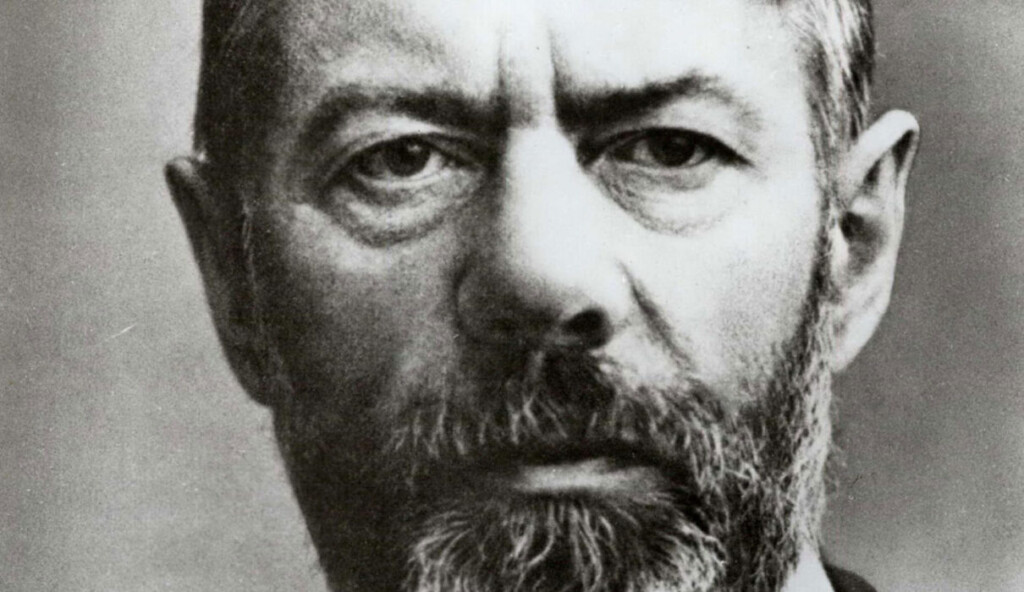
The last pages of The Protestant Ethic and the Spirit of Capitalism are not a conclusion. They are a man standing at a window, watching something he cannot name, unwilling to lie about what he sees. Weber had spent two hundred pages tracing the inner logic of how a theology of grace became a machinery of accumulation, how the anxious soul seeking signs of election transformed, over generations, into the efficient worker who no longer remembers what he was anxious about. And then, at the end, he stops. He does not declare victory for the rationalist project. He does not mourn the death of the spirit. He writes, instead, of the iron cage — Stahlhartes Gehäuse, literally a steel-hard casing — and leaves the reader inside it without a key.
What makes that image so persistent, almost a century and a quarter after it was written, is precisely its refusal of direction. The cage is not a punishment. It is not a mistake that could be corrected. It is the product of a process that was, at every individual step, reasonable. The Calvinist merchant who kept meticulous accounts was being rational. The entrepreneur who reinvested rather than consumed was being rational. The industrial system that optimized labor was being rational. Each link in the chain makes sense. Only the chain itself, seen whole, produces something that Weber could only describe by reaching for an image of enclosure, of breath running out.
He borrowed the phrase from Baxter, the Puritan divine who had warned his congregation that worldly goods should sit on their shoulders like a light cloak, ready to be cast off at any moment. Weber notes, with the precision of a diagnostician who has found the lesion, that the cloak has become an iron cage. The inversion is total and, crucially, unintended. No one chose this. No conspiracy made it. The transformation happened inside the logic of choice itself, at the level where individual rationality and collective outcome diverge so completely that they seem to belong to different worlds.
What Weber refused to do — and this refusal is itself the most philosophically serious thing in the book — was to tell us whether that divergence is a tragedy or simply a fact. He had read Nietzsche carefully enough to distrust the language of decline. He had studied Marx carefully enough to distrust the language of progress. He stood, as the sociologist Hans Henrik Bruun has argued in his work on Weber’s methodology, at the exact point where both grand narratives collapse into each other, and he stayed there. He did not flinch toward consolation.
The specialists without spirit, the sensualists without heart — the Fachmenschen ohne Geist, Genussmenschen ohne Herz — who populate his final paragraph are not villains. They are the outcome of a process that selected for exactly their qualities: reliability, efficiency, the capacity to perform without needing to believe. Weber calls this nullity imagining it has attained a level of civilization never before achieved, and the sentence lands not as satire but as autopsy.
There is a kind of intellectual courage in ending a major work with an open wound rather than a suture. Weber knew that the question of what the iron cage means — whether it represents the final maturation of human organization or its quiet suffocation — was not his to answer. It belonged to whatever came next, to the century his readers were about to inhabit, to the institutions they would build and the wars they would fight and the bureaucracies they would feed with their labor and their silence. He handed the question forward, unresolved, because resolving it would have been a form of bad faith, a comfort purchased at the cost of honesty. The cage stands. The question of what to call it remains exactly as open as he left it.
⚙️ The Protestant Ethic: Work, Society, and the Spirit of Modernity
Max Weber‘s The Protestant Ethic and the Spirit of Capitalism stands as one of the most influential sociological texts of the modern era, weaving together religion, economics, and cultural history into a single compelling argument. To fully understand its implications, it helps to explore the broader intellectual landscape it inhabits — from alienation and class to community and social disintegration. These related articles deepen the conversation Weber began.
Karl Marx and Alienation: Economic and Philosophical Manuscripts
Karl Marx’s concept of alienation, developed in his Economic and Philosophical Manuscripts, offers a powerful counterpoint to Weber’s analysis of the Protestant work ethic. While Weber traced the spiritual origins of capitalist discipline, Marx exposed the human cost of labor transformed into a commodity. Together, these two thinkers illuminate opposite faces of the same historical transformation.
GO TO THE SELECTION: Karl Marx and Alienation: Economic and Philosophical Manuscripts
Veblen’s The Theory of the Leisure Class: Analysis
Thorstein Veblen‘s The Theory of the Leisure Class examines how wealth and consumption became markers of social status in modern capitalist societies, an insight that resonates deeply with Weber’s thesis. Where Weber focused on the ascetic accumulation of capital driven by Protestant anxiety, Veblen revealed how that same wealth was eventually squandered in conspicuous display. The tension between the two frameworks reveals the contradictions at the heart of bourgeois culture.
GO TO THE SELECTION: Veblen’s The Theory of the Leisure Class: Analysis
Tönnies’s Community and Society: Analysis
Ferdinand Tönnies‘s foundational distinction between Gemeinschaft and Gesellschaft — community and society — runs parallel to Weber’s account of modernization and the rationalization of social life. Both thinkers were preoccupied with the erosion of organic bonds under the pressure of capitalist and bureaucratic forces. Reading Tönnies alongside Weber provides a richer sociological portrait of the transition to modernity.
GO TO THE SELECTION: Tönnies’s Community and Society: Analysis
Bourdieu’s Distinction: Taste and Social Class
Pierre Bourdieu‘s Distinction extends the Weberian tradition by showing how class position is reproduced not only through economic capital but through cultural taste and symbolic power. Bourdieu’s analysis of the habitus and social fields builds implicitly on Weber’s concept of status groups and life-conduct, updating it for the realities of twentieth-century consumer society. This article traces how Bourdieu transformed Weberian sociology into a rigorous empirical discipline.
GO TO THE SELECTION: Bourdieu’s Distinction: Taste and Social Class
Discover Independent Cinema on Indiecinema
The ideas explored here — labor, faith, power, and modernity — come alive not only in books but on screen, in the independent films that dare to question the foundations of our social world. On Indiecinema, you will find a curated streaming selection of films that engage with exactly these themes, from sociological dramas to philosophical essays in moving image. Join us and explore cinema as a form of critical thinking.
👉 EXPLORE THE CATALOG: Watch Indie Films in Streaming
A vision curated by a filmmaker, not an algorithm
In this video I explain our vision

