
The Film That Broke Copyright and Survived Anyway
You are watching something that should not exist. The film unspools before you in shades of grey and amber, a creature moves across a screen with that lurching, impossible gait, and somewhere in the back of your mind a fact settles like cold water: a German court ordered every copy of this film burned in 1925, three years after its release, and yet here it is, undestroyed, breathing, looking back at you across a century.

Friedrich Wilhelm Murnau completed Nosferatu, Eine Symphonie des Grauens in 1921 and released it through the production company Prana-Film on March 4, 1922. The film was, by any reasonable legal standard, stolen property. Bram Stoker had died in 1912, leaving a widow, Florence Stoker, who held the copyright to Dracula with the particular ferocity of someone who had watched her family’s financial security erode in the years following her husband’s death. Prana-Film had never requested rights. They had simply taken the novel, changed the names — Count Dracula became Count Orlok, Jonathan Harker became Thomas Hutter, Mina became Ellen — and proceeded to make one of the most unsettling films in the history of the medium. Florence Stoker discovered what had happened, contacted the British Incorporated Society of Authors, and pursued the case with a persistence that courts eventually rewarded. In 1925, a German court sided with her estate. The ruling was unambiguous: all existing prints and the original negative were to be destroyed.
What the court could not account for was the geography of cinema in the early 1920s. Prints of Nosferatu had already scattered across Europe and into the United States with the casual indifference of water finding cracks. The legal machinery of intellectual property in that era had no effective international enforcement mechanism capable of tracking every physical canister of film that had left German territory. One print had reached the United States as early as 1922. Others had moved through private hands, through film clubs, through the emerging networks of cinephiles who treated early cinema with the kind of devotion that libraries reserve for rare manuscripts. The destruction order was complied with, partially, in Germany. Elsewhere, it simply wasn’t.
This is where the paradox sharpens into something genuinely strange. The film’s survival was not an act of defiance by any single heroic archivist. It was the product of structural incompetence — the gap between what law declares and what physical reality permits — combined with the specific material conditions of early film distribution, which no one had designed with copyright enforcement in mind. Walter Benjamin, writing in 1935 in his essay “The Work of Art in the Age of Mechanical Reproduction,” was working through a related problem: what happens to an original when perfect copies exist? Nosferatu inverts the question entirely. Here, the copies are the original. The negative was destroyed. What survived were duplicates of duplicates, each generation of reproduction carrying new damage, new grain, new flickering imperfections that have since become inseparable from the film’s identity. The creature you watch today is partly the creature Murnau made, and partly the creature that entropy and accident made over a hundred years of survival.
Florence Stoker died in 1937 having never received the damages the court awarded her, because Prana-Film had declared bankruptcy almost immediately after the ruling, dissolving itself with the efficiency of a company that had nothing left to lose. The irony is architectural: the legal victory was total and practically meaningless, while the aesthetic object it sought to erase continued accumulating cultural mass in exactly the way that forbidden things tend to do. Censorship and destruction orders have a peculiar relationship with cultural survival — they frequently guarantee it, by signaling to posterity that something powerful enough to threaten existing arrangements once passed through this world and had to be stopped.
Nosferatu
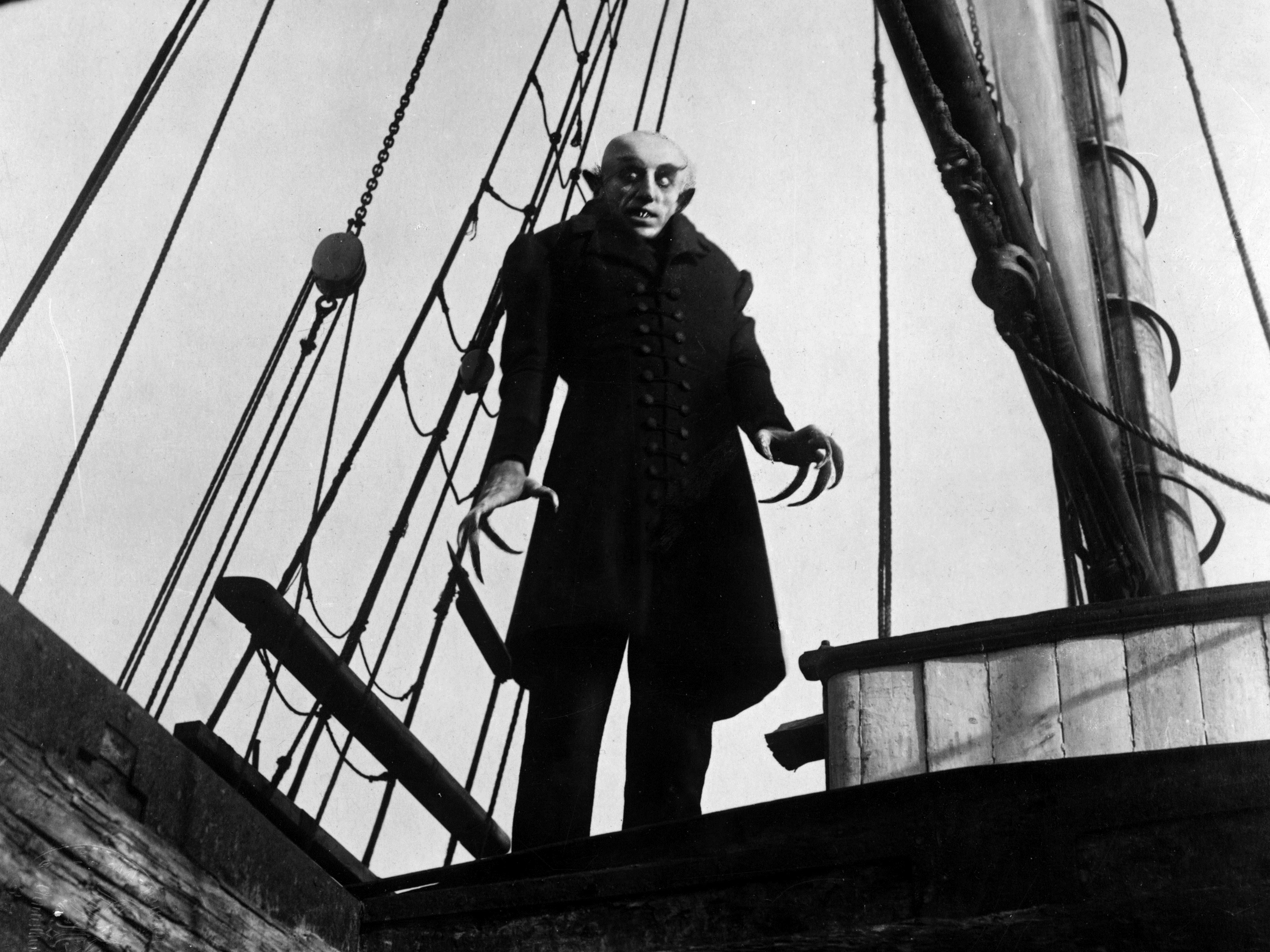
When a young real estate agent, Thomas Hutter, goes to the castle to close a deal, Orlok is attracted by his blood and decides to follow him to his hometown. The arrival of the count causes a series of mysterious deaths and spreads panic among the inhabitants.
Murnau, through evocative images and disturbing atmospheres, creates a work that goes far beyond the simple adaptation of Stoker's novel. The film explores universal themes such as the fear of death, isolation and the loss of humanity. The production of Nosferatu was characterized by some legal difficulties due to the copyright of Bram Stoker's novel. Despite this, Murnau and his crew managed to make a film of great visual impact. The choice of Max Schreck to play Count Orlok was ingenious. His cadaverous appearance and his unnatural movements have made the character of Orlok one of the iconic monsters in the history of cinema. Over the years, Nosferatu has become a cult film, influencing generations of filmmakers and becoming a reference point for the horror genre. The image of Count Orlok, with his elongated nails and sunken eyes, has become an icon of horror cinema.
When Theft Becomes the Authentic Version
You are standing in a courtroom in 1925, watching a judge order every print of a film destroyed, and you understand, with the particular clarity that comes only from witnessing something irreversible, that the people trying to erase this work have already lost. The film has been seen. The image of Count Orlok ascending a ship’s gangplank, his elongated silhouette bending against the sky like a question the daylight refuses to answer, has already entered the nervous system of anyone who watched it. You cannot uninvent a way of seeing.
Friedrich Wilhelm Murnau took Bram Stoker‘s 1897 novel without permission, renamed the characters, shifted the geography from England to Germany, and produced something that the courts correctly identified as derivation and that history has incorrectly treated as mere theft. What happened between the source text and the finished film was not the substitution of one proper name for another. It was a fundamental ontological reclassification of what the vampire figure could be. Stoker’s Dracula is aristocratic, seductive, socially mobile — he travels to London precisely because he wants to assimilate into modernity, to pass. He is dangerous the way a financial predator is dangerous: through charm, through the manipulation of trust, through his ability to look like one of us. Murnau’s Orlok, with his bald skull and rat-like fingers and movement that suggests a body organized around principles other than the skeletal ones, cannot pass. He is visible wrongness. He does not seduce — he infects. The distinction is not cosmetic.
Walter Benjamin, writing in 1935 in “The Work of Art in the Age of Mechanical Reproduction,” argued that the copy destroys the aura of the original — its presence in time and space, its singular historical testimony. But the Nosferatu case inverts this entirely. The copy did not drain the original; it exposed what the original had suppressed. Stoker’s novel, grounded as it is in Victorian anxieties about reverse colonization and foreign contamination, keeps its monster legible within a social framework — Dracula can be hunted because he can be tracked, because he moves through institutions and leaves traces. Orlok moves through nothing. He precedes institutions. He is the pestilence that arrives before the city exists to name it. The 1922 film did not illustrate the novel. It reached under the novel and found what the novel had been too decorous to say.
This raises a question that intellectual property law has never seriously entertained: whether the “original” work owns the territory that only the unauthorized version made visible. Florence Stoker pursued her copyright claim with ferocious determination, and she was legally correct to do so — Prana Film had not sought permission, had not paid, had changed details in a transparently insufficient attempt at disguise. But the moral geometry of the situation is stranger than the legal geometry. What Murnau revealed through his act of transformation was not Stoker’s property; it was a latency within the vampire myth itself that Stoker’s version had organized around without fully articulating. The court could order the prints burned. It could not order the visibility revoked.
There is a structural irony in the survival of Nosferatu that goes beyond the romantic narrative of forbidden art outlasting its suppression. Several prints had already crossed borders before the destruction order could reach them. The film survived through exactly the kind of uncontrollable dispersal that Orlok himself represents — not hidden in a vault, not preserved by an institution, but replicated quietly, moving through informal networks, arriving in places it was never officially permitted to enter. The monster and the film shared the same immune system. And the Stoker estate, having won its case entirely, found itself in possession of a legal victory over something that no longer needed permission to exist.

The Widow, the Courts, and the Copies That Kept Multiplying
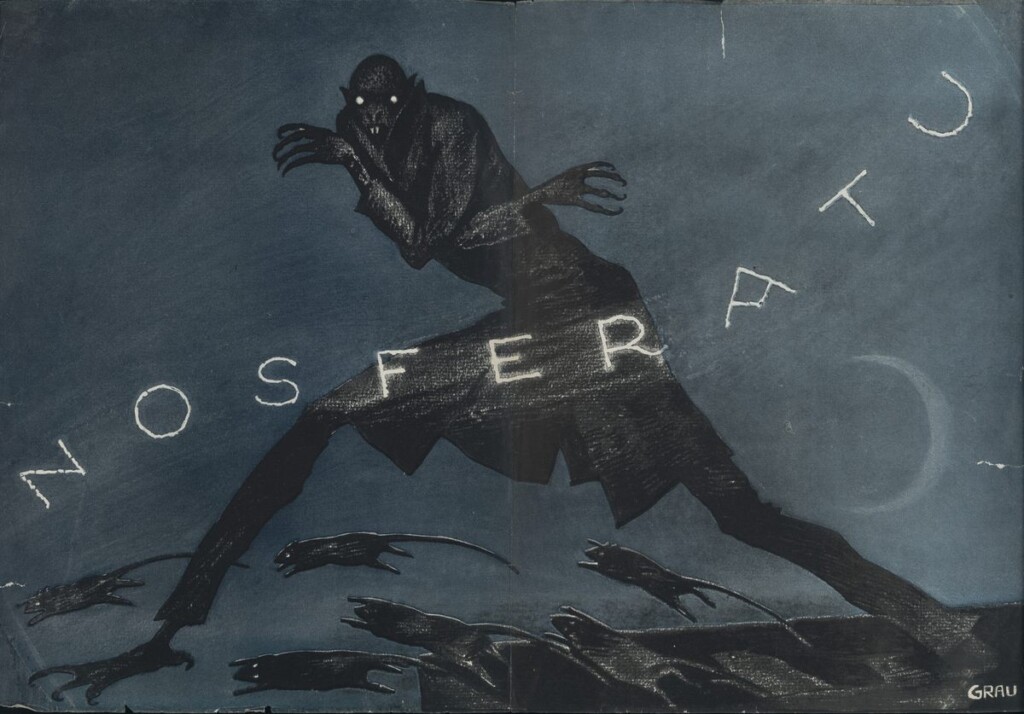
Florence Stoker learned about the film the way most people learn they have been robbed — after the fact, from someone else, in a tone that assumed she already knew. Her husband had been dead for ten years when Prana Film released its unauthorized adaptation in 1922, and the company had not bothered to contact her, seek her permission, or offer her a single German mark. She was not wealthy. Bram Stoker had died leaving debts and a widow who survived largely on a civil list pension and the diminishing royalties of a novel that had never quite conquered the mainstream during his lifetime. The theft was not abstract. It was financial, specific, and conducted by people who believed that a widow in London could not reach them in Berlin.
She could, and she did, though not immediately. The Society of Authors took up her case, and the legal machinery that followed was slow in the way that early international copyright disputes tend to be slow — because the law itself had not yet fully imagined the problem it was being asked to solve. The Berne Convention of 1886 had established the principle of cross-border literary protection, but film sat in an ambiguous category, neither pure performance nor fixed text, and the German courts had to determine whether an unauthorized adaptation of a novel constituted infringement under frameworks that had been written before cinema existed. In 1925, they decided it did. The court ordered all prints of the film destroyed and the production company dissolved. Prana Film was already bankrupt by then, having collapsed after the film’s commercial failure, so the dissolution was largely ceremonial. But the destruction order was meant to be real.
What the court did not account for was geography, which is always what courts fail to account for when they try to unmake a physical object that has already traveled. Prints had been struck in Germany, but they had also been shipped — to distributors in Sweden, to exhibitors in the United States, to private collectors who understood that a film under legal threat becomes immediately more interesting than a film that is simply mediocre. The logic of prohibition has never successfully erased the thing it prohibits; it tends instead to transform the object into a relic, charged with the additional meaning of its own suppression. By the time Florence Stoker won her case, the film had already passed through a cultural membrane that no injunction could penetrate.
There is something almost structurally inevitable about this. A 35mm print in 1922 weighed roughly two kilograms per reel, was highly flammable, and was worth real money to anyone who could project it. It was not a file to be deleted or a URL to be deindexed. It was a physical artifact that required physical retrieval, and the reach of a German court order stopped at the German border with complete precision. Foreign archives operated under foreign laws. American distributors held American property. Private collectors held nothing at all in any legal sense, which meant they also could not be compelled to surrender anything. The order to burn all copies was, in practice, an order addressed to an empty room.
What survived did so through accident, institutional inertia, and the specific human quality of not quite getting around to destroying something. A print held by a film archive in Czechoslovakia was simply never destroyed because no one with authority over that archive received instructions to destroy it, or received them and did nothing, or received them and quietly disagreed. The Cinémathèque française, founded formally in 1936 by Henri Langlois, would later become famous for exactly this kind of principled non-compliance with demands that valuable films be surrendered or erased. Langlois reportedly hid reels in his bathtub during the German occupation rather than allow them to be confiscated — and the cultural logic behind that instinct was already operating, informally and without name, in the years when Florence Stoker was winning a legal battle against something that had already outrun the law.
Horror as a Mirror That Predates Psychology
You are standing in a hallway you have walked a thousand times, and something is different. Not the walls, not the light, not the geometry — and yet your body knows before your mind does, that animal knowledge rising through the sternum like cold water. The object has not changed. You have not changed. The wrongness lives precisely in that gap, in the failure of the familiar to remain familiar, in the sudden revelation that comfort was always a kind of forgetting.
Count Orlok does not seduce. He does not flatter, does not wear the civilized mask that most nineteenth-century vampire mythology had carefully constructed. He arrives as something that has crawled out from beneath the logic of the human form — bald, elongated, moving with that particular wrongness that the body registers before the eye can name it. The fingers are too long. The posture is too still. The shadow falls at angles that do not correspond to any light source the rational mind can locate. Friedrich Wilhelm Murnau built a creature that violated the basic covenant between the living and the world they inhabit, and in doing so, he exposed something that language had not yet learned to carry cleanly.
Sigmund Freud published Das Unheimliche in 1919, three years before the film’s release, and the concept he assembled there — the uncanny as the return of something repressed, the familiar made monstrous through proximity rather than distance — was already insufficient to the thing it was trying to describe. Freud traced the sensation back to the German word heimlich, meaning both homely and concealed, and noticed that its opposite, unheimlich, did not mean simply alien but rather something that was once intimate and has been estranged from itself. The terror is not of the unknown. It is of the known that has gone wrong in a way you cannot locate or repair. What Freud’s taxonomy could not fully absorb was the specifically corporeal dimension of that dread — not the idea of the wrong body, but the sight of it, moving.
The body that moves but should not carries a particular charge in the human nervous system that predates every theoretical framework by several hundred thousand years. There is evidence from paleontological records and comparative primate behavior that the threat-detection systems wired into the mammalian brain respond with specific intensity to movement that is almost-but-not-quite biological — the jerking of something that resembles a limb without being one, the stillness broken in rhythms that don’t match breathing or heartbeat. Orlok’s movement across the screen in 1922 was not simply an acting choice or a directorial flourish. It was the deliberate activation of an alarm system older than civilization, older than language, older than the very concept of the monster.
What horror reveals, in its most uncompromising forms, is that the psyche does not run on concepts. It runs on pattern recognition operating below the threshold of conscious thought, and those patterns were calibrated in environments where the misshapen, the decomposing, and the wrongly-moving signaled contamination, disease, and death with reliable accuracy. The gaunt frame, the rat-like features, the pestilential aura that Orlok drags through every scene he occupies — these are not arbitrary aesthetic choices assembled from folklore. They map directly onto a cluster of biological signals that the human visual system associates with pathogenic threat. In 1922, Europe had just finished burying the dead of the Spanish flu, a pandemic that had killed somewhere between fifty and one hundred million people between 1918 and 1920. The audiences who watched Orlok move through the walls of the infected city were not interpreting a metaphor. They were recognizing something their bodies had spent two years learning to fear in the actual world.
What no theoretical apparatus built after the fact can quite account for is why the mirror works even when you know it is a mirror.
Plague, Rats, and the Semiotics of the Outsider
You have watched something cross a threshold without being invited in, and the wrongness of it settled somewhere below your sternum before your mind could name it. Not the creature itself — the ship. An empty vessel drifting into harbor with a dead crew and boxes of earth in the hold, and something alive below the waterline that should not be. The horror arrives not as a monster but as a manifest, a cargo declaration, a problem of import and quarantine.
Friedrich Wilhelm Murnau completed his film in 1922, which means he made it inside one of the most catastrophic economic and psychological implosions a modern society had ever survived. Germany in that period was not merely suffering poverty — it was suffering a specific kind of unreality, the kind where a wheelbarrow of banknotes could not purchase a loaf of bread, where the social contract had been voided so completely that the very idea of stable value, of predictable consequence, had become absurd. Hyperinflation does something particular to a population’s relationship with causality: it makes the world feel haunted, governed by forces that arrive from outside and cannot be reasoned with or earned against. The creature who sails from Eastern Europe with soil beneath his fingernails is not a metaphor in the literary sense — he is a symptom rendered visible, the externalization of an economic terror that had no face.
The rats matter in a way that film criticism has consistently underread. In 1347, when the first ships carrying Black Death reached Messina in Sicily, the harbor officials ordered them back to sea because the sailors were either dead or covered in black boils that wept blood and pus. They were too late. The rats had already disembarked. What the film encodes in this image is not medieval superstition but something far more precise: the epidemiological logic of a society that had watched influenza kill between fifty and one hundred million people between 1918 and 1920 — more than the entire war — and had done so through vectors that were invisible, democratic, and completely indifferent to borders or moral standing. Disease does not punish the guilty. That was the unbearable part.
The foreign aristocrat who carries plague within him draws directly on a semiotic tradition that Susan Sontag mapped with clinical precision in Illness as Metaphor, published in 1978, where she demonstrated that tuberculosis and cancer were never merely diseases in the cultural imagination but judgments, projections of social anxiety onto bodies that could be othered and quarantined. The vampire in this reading is not supernatural at all — he is the figure onto whom a devastated population displaced its understanding that catastrophe has no origin story clean enough to mourn. He arrives from Transylvania, from the East, from somewhere that is coded as ancient and corrupt and aristocratic in the worst sense, meaning extractive, meaning feudal, meaning a system where the many are drained for the sustenance of the few.
Walter Benjamin, writing in the same decade, was already developing the idea that the face of the oppressor gets supernatural features in the imagination of the oppressed — not because the oppressed are irrational, but because supernatural attribution is the only available language for power that presents itself as natural, inevitable, unchallengeable. The defeated German soldier returning from a war that had never been officially lost, according to the stab-in-the-back mythology already circulating in beer halls by 1919, was a man who needed an explanation for a catastrophe that rationality could not absorb. The creature from outside, carrying his foreign soil, immune to everything except the most extreme measures, draining the vital force from a community that cannot even name what is happening to it — this is not allegory. This is a population doing the only cognitive work available to it when the institutions that promised to make the world legible had already collapsed into worthless paper.
A vision curated by a filmmaker, not an algorithm
In this video I explain our vision
What Stoker's Dracula Refused to Say Out Loud

You are sitting across from something that wants to eat you, and it is wearing a very good suit.
That is the implicit contract Bram Stoker signed with his readers in 1897, and it is worth pausing on how extraordinary that contract was. Dracula arrives in London with property deeds, a solicitor, a letter of introduction. He is tall, commanding, magnetically repellent in the way that powerful men are repellent — you notice them before you understand why, and by the time you understand why, you have already extended your hand. Stoker gave the predator an aristocratic frame because the aristocratic frame was the one his Victorian readers already knew how to desire and distrust simultaneously, which meant they could enjoy the threat from a position of comfortable ambivalence. The horror was aestheticized precisely so it could be consumed without full confrontation.
What Friedrich Wilhelm Murnau did in 1922, working from a screenplay he could not legally call an adaptation, was strip that frame entirely. Count Orlok has no suit. He has claws that curve like the tools of an animal, a skull face, a body that does not move like a seducer but like something that has forgotten the performance of seduction is even necessary. He does not glide through drawing rooms. He stalks. He scuttles. He emerges from a ship’s hold surrounded by plague rats, and the port city of Wisborg erupts in death behind him — not metaphorical death, not the languid swooning of women at a window, but bodies stacked in the street while officials count and recount and cannot explain the numbers. The ugliness was not an artistic accident. It was the argument.
The psychoanalytic tradition, particularly the line of thinking Melanie Klein developed through her work on early object relations in the 1930s and 1940s, identified something she called the paranoid-schizoid position — the infant’s foundational terror that the thing it depends on for survival might also be the thing that destroys it. Klein’s insight was that this terror never fully resolves; it migrates into adult life wearing different disguises, finding new objects to attach itself to. The disguise Stoker provided was almost too convenient: a foreign nobleman, ancient and aristocratic, arriving through official channels. The displacement was total. The monster came from outside, spoke with an accent, and could be repelled with garlic and crosses — all the rituals of a threatened border. Orlok offered no such displacement. There was no accent sophisticated enough, no property deed legitimate enough, to make him look like something you had chosen.
What the ugliness forced onto audiences was the collapse of the invitation narrative. Dracula’s entire mythology, as Stoker constructed it, depends on the idea of the willing threshold — the vampire must be invited in, and the seduction is the mechanism of that invitation. Lucy Westenra opens her window. Mina is drawn forward in sleep. The victim participates, which means the victim shares something close to responsibility, which means the reader is insulated from the full weight of what is being depicted: that predatory structures do not always seduce before they extract. Sometimes they simply arrive, and the question of whether you invited them is a luxury the body in the street cannot afford to answer.
In 1921, the year before Nosferatu reached German cinemas, the economist Nikolai Kondratiev was completing early research on what he would later describe as long economic waves — cyclical periods of growth and contraction that moved through industrial societies with a regularity that suggested not conspiracy but systemic necessity. Famine, inflation, war, epidemic: these things did not ask permission. They did not make themselves beautiful first. The Weimar audiences watching Orlok carry plague into a prosperous harbor town were not watching fantasy. They were watching the recent past with the serial numbers filed off, and the creature’s face told them what Stoker’s velvet-lined coffin had not — that the thing draining the life out of a city does not owe you the courtesy of being beautiful.
Destruction as the Engine of Canonical Status
You already know the ending before it happens. A judge signs a document in 1925, the ink dries on an order that should have erased everything, and somewhere in a projection booth a reel catches fire on purpose — and yet here we are, a century later, watching the same shadows move across the same walls. The destruction failed. But the failure was not accidental, and it was not innocent, and understanding why it succeeded as failure requires looking directly at something that most cultural histories prefer to leave peripheral.
Walter Benjamin, writing in 1935 in his essay “The Work of Art in the Age of Mechanical Reproduction,” argued that what gives an original artwork its authority — its weight, its almost religious demand on the viewer — is what he called the aura: the sense of singular presence, of this object in this place at this time, irreplaceable and unrepeatable. He was diagnosing modernity’s erosion of that quality. Mass reproduction, he argued, strips the aura away. The lithograph, the photograph, the film print distributed to a thousand theaters simultaneously — all of these democratize the image while quietly killing something he thought was essential to genuine aesthetic experience. He was not entirely wrong. But Nosferatu became the living proof of his argument’s blind spot: a film that acquired aura precisely because it was mechanically reproduced in secret, against a legal order designed to annihilate it.
The court ruling obtained by Bram Stoker‘s estate in 1925 ordered all prints destroyed. Florence Stoker had pursued the case for three years with the tenacity of someone who understood that intellectual property was not merely legal territory but economic survival — she was a widow in reduced circumstances, and the unauthorized adaptation represented money she had never received. She won. And the enforcement was real: prints were burned, negatives were confiscated, the film was legally extinguished. What the ruling could not account for was the geography of early cinema distribution, the porousness of borders between Germany and the rest of Europe, and the sheer human tendency to keep what one finds extraordinary. Copies had already traveled. Some had been sold. Some had been archived by institutions that either did not receive the order or chose not to honor it.
Here the irony becomes structurally precise rather than merely anecdotal. Had the film been permitted to exist normally — screened, distributed, re-released in the standard commercial cycle of the 1920s — it would have been consumed and contextualized like any other film of its era. It would have aged into the archive the way thousands of Weimar-era productions did: respected by specialists, invisible to everyone else. The destruction order transformed it into contraband. Contraband travels differently than commerce. It moves through networks of the devoted, the obsessive, the aesthetically militant. Each illegal copy carried with it the metabolic heat of transgression, and transgression is perhaps the most reliable engine of cultural canonization ever identified.
This is what Benjamin’s framework could not fully anticipate: that mechanical reproduction, when it occurs under conditions of legal prohibition, does not merely preserve the object — it manufactures the aura that institutional survival would have dissolved. Every surviving print of Nosferatu exists because someone chose illegality over compliance, and that choice is now inseparable from the film’s meaning. The scratches in the image, the missing frames, the variations between prints that scholars still debate — these are not defects. They are the material evidence of clandestine circulation, and they function exactly as Benjamin said the original’s physical uniqueness functions: they anchor the viewer to a specific, unrepeatable encounter with an object that should not exist.
There is a certain violence in recognizing that canonical status in Western art frequently requires a near-death experience. Not metaphorically — literally. The Parthenon survived because it was converted into a mosque. Kafka’s manuscripts survived because Max Brod refused the instruction to burn them. And Nosferatu survived because the people who received destruction orders either ignored them or had already passed the copies further down a chain that the court could not trace.
The Vampire That Could Not Be Killed by Law
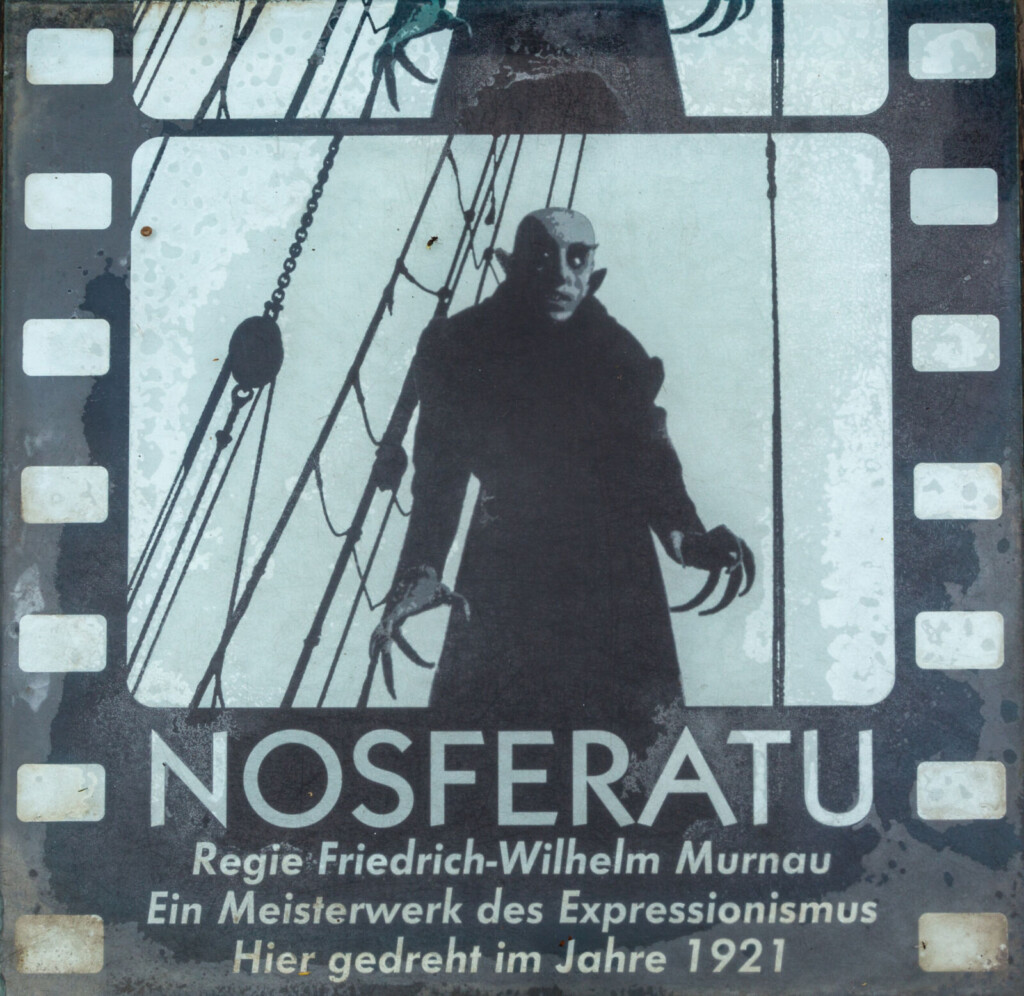
You are sitting in a courtroom in 1925, watching lawyers argue over whether a film can be murdered. The Bram Stoker estate has already won on paper — the German courts have ordered all copies of Friedrich Wilhelm Murnau‘s unauthorized adaptation destroyed, and the ruling is categorical, the language of property and theft applied with the full weight of civil law. What the lawyers cannot account for is that the film has already escaped the room.
There is a particular kind of institutional blindness that believes destruction and erasure are the same operation. Destroying an object removes it from circulation; erasing it removes it from memory. The law is extraordinarily capable of the first and almost constitutionally incapable of the second. When the Weimar courts ordered the prints burned, they were operating under the assumption that culture behaves like property — that you can reclaim it, lock it down, reduce it to zero copies and therefore zero existence. But Murnau’s film had already been screened across Germany, across some corners of Europe, had already lodged itself in the retinas and nervous systems of everyone who had watched Max Schreck‘s elongated shadow climb a staircase. You cannot serve a court order on a memory.
What the legal campaign against the film revealed, almost involuntarily, was that the institutions doing the destroying understood precisely what they were destroying. Censorship of this order — not rating restrictions or content warnings but annihilation orders — is a form of confession. It tells you what a society recognizes as dangerous before it can explain why. The Catholic Church placed books on the Index Librorum Prohibitorum not because they were obscure but because they were legible, because ordinary people could read them and be moved by them without the mediation of doctrine. The Nazis burned Magnus Hirschfeld’s Institut für Sexualwissenschaft library in 1933 within days of coming to power, targeting 20,000 volumes of research on gender and sexuality not because the science was wrong but because it had already begun to normalize what the regime needed to render monstrous. Destruction at that scale and speed is always a measure of threat recognized and not yet fully contained.
Nosferatu survived because of human carelessness, institutional failure, the ordinary entropy of archives and private collections — a print in Czechoslovakia, another in the United States, the kind of survival that has nothing heroic about it and everything accidental. By the time the copyright expired in the mid-twentieth century and the film entered the public domain, it had already become unkillable by legal means. What followed was not a resurrection but a disclosure: the film had never actually died, only waited in basements and archive drawers for the machinery of suppression to exhaust itself.
The deeper logic here is one that copyright law and censorship doctrine have never been able to integrate without contradiction: the things a society most urgently moves to destroy are the ones that have already succeeded. A failed film, a powerless image, a forgettable story — these require no court order. The ferocity of the attempt to eradicate Nosferatu was itself the proof that it had touched something the law could name as property but could not reach as experience. Stoker’s estate sued over rights and received a judgment, but the judgment could not undo the fact that Murnau had found, inside the novel’s architecture, a creature more disturbing than the one Stoker had written — something that looked less like Gothic fantasy and more like a disease vector, a system failure, the body’s own defenses turning against themselves.
A century later, the film circulates freely, scored by different composers for different audiences, colorized, remixed, screened in opera houses and art cinemas and uploaded in dozens of versions to platforms that did not exist when the last person with a legal claim to destroy it was still alive, and the count’s shadow still climbs the wall.
🧛 Blood, Shadows & the Undead Imagination
Nosferatu is more than a film about a vampire — it is a meditation on obsession, transgression, and the dark forces that haunt the edges of civilization. To understand its enduring power, we must look at the literary and mythological roots from which it springs. These articles trace the deep veins of horror, the Gothic tradition, and the vampire as cultural mirror.
The Vampire Myth: History and Symbolism
The vampire myth is one of the most persistent and psychologically charged symbols in Western culture, drawing from folklore, fear of death, and the terror of the Other. From Eastern European superstition to nineteenth-century literature, the undead figure embodies anxieties about desire, contagion, and the boundaries of the human. Understanding this myth is essential to grasping why Nosferatu felt so viscerally real to its first audiences.
GO TO THE SELECTION: The Vampire Myth: History and Symbolism
The Vampire in Literature: From Polidori to Stoker
The literary vampire did not emerge from nothing — it was carefully constructed across generations of writers who transformed peasant superstition into psychological horror. From John Polidori’s aristocratic Lord Ruthven to Bram Stoker‘s Dracula, each incarnation reflected the fears and fascinations of its era. Nosferatu inherits this entire tradition while pushing it into something far more grotesque and primal.
GO TO THE SELECTION: The Vampire in Literature: From Polidori to Stoker
Bram Stoker and Dracula: Terror as a Mirror of Victorian Society
Bram Stoker‘s Dracula is the direct literary ancestor of Nosferatu, and Murnau’s unauthorized adaptation triggered one of cinema’s most famous legal battles. Stoker’s novel encoded the anxieties of Victorian society — fear of sexuality, foreign invasion, and the collapse of rational order — into the figure of the vampire. Reading Dracula alongside Nosferatu reveals how much Murnau both borrowed and transformed in his haunting vision.
GO TO THE SELECTION: Bram Stoker and Dracula: Terror as a Mirror of Victorian Society
Contemporary Gothic: When Horror Becomes Psychology
Contemporary Gothic literature and film have rediscovered what Murnau intuited in 1922: that horror is most powerful when it becomes a language for inner states, trauma, and existential dread. The shift from supernatural spectacle to psychological depth defines the best of the Gothic tradition, from Poe to today’s art-house horror. Nosferatu stands at the very origin of this transformation, making the monster a mirror for the human soul.
GO TO THE SELECTION: Contemporary Gothic: When Horror Becomes Psychology
Discover the Cinema That Dares to Go Further
If Nosferatu and its shadowy legacy have awakened your appetite for bold, uncompromising storytelling, Indiecinema is your destination. Our streaming platform is dedicated to independent and auteur cinema — films that, like Murnau’s forbidden masterpiece, refuse to ask permission to exist. Explore our catalog and let the margins of cinema surprise you.
👉 EXPLORE THE CATALOG: Watch Indie Films in Streaming
A vision curated by a filmmaker, not an algorithm
In this video I explain our vision

