
The Mechanics of Immediate Recognition
You are standing in a crowd, or maybe you are alone in a room with a screen, and someone is speaking. The voice is not addressing you the way a teacher addresses a student, or a doctor addresses a patient — with the particular condescension of expertise, the slight distance of someone who knows something you do not. This voice is doing something different. It is naming the exact pressure you feel behind your sternum when you think about your rent, your job, your neighborhood changing in ways no one asked you about, the nagging sensation that the rules apply differently depending on who you know. The speaker has not met you. The speaker could not pick you out of a crowd. And yet you feel, with a certainty that surprises you, that this person understands you better than most people who have spent years in your company.

That sensation is not accidental, and it is not a gift.
What you are experiencing has a precise architecture. Gustave Le Bon mapped its foundations in 1895 in “The Crowd: A Study of the Popular Mind,” where he observed that a crowd does not think — it feels, and what it feels is amplified by the act of being witnessed collectively. The individual submerged in a group loses the internal friction of private reasoning and gains instead a terrifying fluency of emotion. Le Bon was writing about physical crowds in the age of industrialization, but the mechanism he identified does not require bodies pressed together in a square. It requires only the perception of shared recognition — the sense that one’s private grievance has been elevated into a public truth. A skilled political voice does not create this sensation; it locates the pre-existing wound and simply announces that it has always seen it.
The wound, in almost every documented case, precedes the voice by years or decades. Economic historians tracking the rise of charismatic nationalist movements across Weimar Germany, interwar Hungary, and Depression-era Louisiana note a consistent pattern: the conditions of material precarity, institutional erosion, and social disorientation are already fully formed before the demagogue arrives. Historians like Robert Paxton, in “The Anatomy of Fascism” published in 2004, documented with uncomfortable precision how these movements did not invent the resentments they exploited — they simply became the first entities to speak those resentments without apology, without the hedging language of policy, without the delay of parliamentary procedure. The ordinary citizen, unaccustomed to hearing their frustration treated as legitimate data rather than an embarrassing symptom, receives this directness as intimacy.
There is something almost neurological about the response. When a message confirms what you already believe at the level of felt experience rather than argued position, the brain does not engage critical evaluation the same way. Psychologist Drew Westen, researching motivated reasoning, published his findings in “The Political Brain” in 2007, demonstrated through neuroimaging studies that partisan subjects processing information confirming their worldview showed activation in emotional and reward centers rather than in prefrontal regions associated with rational deliberation. The point is not that people are stupid — the point is that recognition bypasses the usual inspection. You do not audit a mirror. You look at it, and if the reflection is close enough, you take it as confirmation that you exist the way you thought you did.
A woman who has spent eleven years working in a regional hospital, watching administrative decisions made by people who have never held a bedpan, hears someone say into a microphone that the experts have failed and the real knowledge lives with ordinary people. She does not need to evaluate the claim epistemologically. The claim is not a claim. It is a name for something she has already lived. The speaker has simply arrived late to a conversation she has been having with herself for over a decade, and announced themselves as if they started it.
Demagogy as an Ancient Engineering Problem
You are standing in the Pnyx, the open-air assembly hill west of the Acropolis, somewhere around 427 BCE. The man speaking is not the most intelligent person present. He is not the most informed. He is, however, the loudest, and he has understood something about the crowd that the crowd has not yet understood about itself: that it does not want to be reasoned with. It wants to be recognized.
Cleon of Athens was, by every account that survived him, a tanner’s son who rose to political dominance not through military genius or philosophical depth but through a precise calibration of collective resentment. Thucydides, who despised him, nonetheless gave him the most damning kind of immortality — detailed documentation. In the Mytilenean Debate of 427 BCE, Cleon stood before the Athenian assembly and argued for the massacre of an entire allied city that had revolted, and he did not argue for it on strategic grounds alone. He argued for it by accusing the assembly itself of being dangerously soft, too clever, too susceptible to good rhetoric. He told the demos that their love of sophisticated argument was a weakness enemies would exploit. He was, in other words, using anti-intellectualism as a weapon in an intellectual forum, and it worked with terrifying efficiency.
What Thucydides understood, writing his History of the Peloponnesian War between roughly 431 and 404 BCE, was that this was not an aberration in Athenian democracy but a structural vulnerability baked into its architecture. The assembly operated by speech. Whoever controlled speech controlled the outcome. The system had no antibody against a man who was willing to degrade the quality of the discourse in order to win within it. Thucydides watched Athens vote itself into catastrophic military decisions — the Sicilian Expedition of 415 BCE chief among them — not because the citizens were stupid but because the deliberative mechanism could be gamed by anyone willing to trade accuracy for emotional intensity.
Alcibiades did it differently, which is almost more disturbing. He was brilliant, beautiful, aristocratic, and he knew how to perform all of those qualities as a kind of seduction. He promised the assembly glory, expansion, destiny — the Sicilian campaign as an act of world-historical ambition rather than the logistical nightmare it actually was. Where Cleon weaponized resentment, Alcibiades weaponized desire. Two different levers, the same mechanism: bypass judgment by engaging appetite.
Plato saw the architecture of this problem with clinical precision, and he named it in the Gorgias, written sometime in the early fourth century BCE. The dialogue draws a hard line between techne — genuine craft or skill — and kolakeia, which translates roughly as flattery or pandering. Rhetoric, in Plato’s framing, is not knowledge. It is the simulacrum of knowledge. The doctor knows what is good for the body; the pastry chef knows what the body wants right now. The statesman who reasons from principle is doing something categorically different from the demagogue who mirrors the crowd’s existing hungers back at them in amplified form. Plato’s real target in the Gorgias was not bad rhetoric but the possibility that the demos could be made to prefer the pastry chef over the doctor — not through trickery but through the honest expression of what pleasure feels like compared to what medicine feels like.
The unsettling implication, which Plato does not fully confront, is that the crowd choosing the flatterer is not making an error in reasoning. It is making a completely rational preference given the information available to appetite. If you have never been taught to distinguish between the feeling of being understood and the feeling of being flattered, they are experientially identical. The demagogue does not counterfeit an inferior product. He delivers exactly what is being demanded.

The People as a Rhetorical Construct
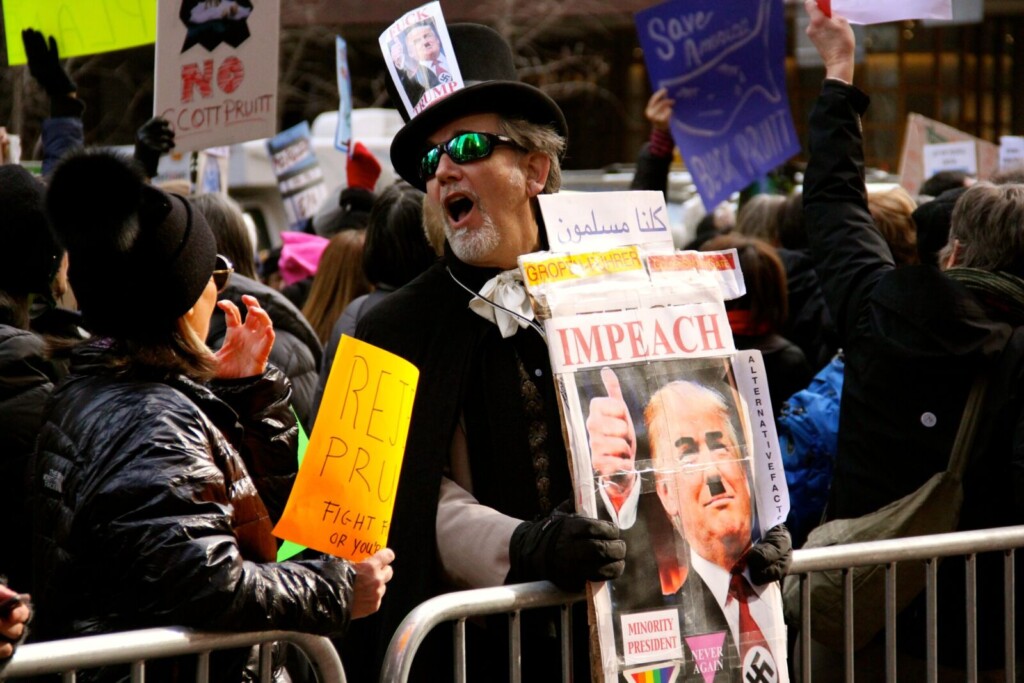
You are standing in a crowd and you feel, for the first time in years, that you belong to something larger than yourself. The speaker on the platform does not need to name you precisely — your occupation, your neighborhood, your specific grievance — because the word he keeps using seems to contain all of those things simultaneously. He says “the people,” and you hear yourself.
That word does no descriptive work whatsoever. It performs something far more consequential: it manufactures a body that did not exist before the speech began. Ernesto Laclau spent the better part of his intellectual career dismantling the assumption that political collectives precede their representation, and his 2005 work On Populist Reason is the most rigorous demolition of that myth available. What Laclau demonstrated is that “the people” is never a sociological fact waiting to be acknowledged — it is a rhetorical achievement, constructed through what he called an equivalential chain. A farmer furious about grain prices, a factory worker whose plant has been shuttered, a schoolteacher who cannot afford rent, a small business owner strangled by bureaucratic regulation: none of these people share a common condition in any structural sense. Their grievances are genuinely heterogeneous. But a sufficiently skilled political language can stitch these discrete frustrations into a single imaginary body by positioning them all against the same adversary. The enemy is what produces the unity, not any prior solidarity.
This mechanism has a precise historical anatomy. In Argentina during the first Peronist mobilization of 1945, Juan Perón did not organize a class in the Marxist sense — he aggregated what sociologists would later call the descamisados, the shirtless ones, from wildly different sectoral backgrounds, holding them together not through programmatic coherence but through a shared antagonism toward the oligarchy and foreign capital. The word oligarchy did the same work that any efficient enemy-term does: it was vague enough to absorb multiple real fears and specific enough to provide a target. By 1946, a category that had no political existence twelve months earlier had become the sovereign legitimating force of an entire government. The people had been spoken into being.
What makes this construction so durable is precisely its internal emptiness. Laclau borrowed the concept of the empty signifier — a term so evacuated of fixed meaning that it can serve as the nodal point around which different demands crystallize without any of those demands having to be reconciled with the others. The word “freedom” in the mouths of Weimar-era German nationalists carried no stable referent; it gestured at national humiliation, economic ruin, cultural anxiety, and ethnic resentment all at once, without ever specifying which of these it intended to resolve. That ambiguity was not a flaw in the rhetoric — it was the rhetoric’s primary instrument of cohesion.
There is a distinction that most political commentary refuses to make rigorously, and its absence costs enormously: the difference between a political movement that represents a pre-existing social group and one that constitutes its constituency through the very act of address. Liberal democratic theory since John Stuart Mill has operated on the assumption that citizens hold interests prior to politics and that representation is the mechanism by which those interests find institutional voice. But the populist formation inverts this sequence entirely. The leader does not discover the people — he produces them, and the people, once produced, experience their manufactured unity as something they always already possessed. This retroactive naturalizing of a discursive creation is arguably the most powerful psychological operation in modern politics, because it makes the constructed feel primordial and the contingent feel inevitable.
By the time the crowd disperses, the grievances that were genuinely different have been welded into a single narrative of victimhood and righteousness that no individual member of that crowd could have articulated alone before they arrived.
Resentment as Political Fuel
You are standing in a crowd that is not celebrating anything. The signs are angry, the chants are percussive, the faces carry something that looks like joy but functions like release — and what is being released is not frustration about a specific policy failure but something older, something that has been sitting in the body like an unacknowledged debt. Nobody in that crowd is primarily there because they have calculated the optimal legislative outcome. They are there because finally, for once, someone important is being told that they are the problem.
Nietzsche identified this current long before it had a modern political vocabulary. In the genealogical work he published in 1887, he described ressentiment not as ordinary anger but as a particular transformation that occurs when the capacity for direct action is blocked: the frustrated energy turns inward, curdles, and then re-emerges as a moral judgment against the powerful. It is revenge that cannot announce itself as revenge, so it announces itself as justice. The crucial distinction is that it does not begin with a positive vision of what one wants — it begins with a negative fixation on what someone else has, someone else represents, someone else is allowed to be without consequence. The identity formed through this process is entirely relational and entirely retrospective: I know who I am because I know who wronged me.
Max Scheler, in his 1915 philosophical treatise, took this structure and mapped it onto the social body with clinical precision. He argued that ressentiment flourishes specifically in societies that formally proclaim equality while materially delivering hierarchy — contexts where the gap between what people are told they deserve and what they actually receive is not merely an injustice but a daily, humiliating reminder of their position. The democratic promise, in other words, does not eliminate this psychology; it actively cultivates it by raising expectations to a level that existing structures cannot honor. Every election cycle that changes nothing deepens the deposit.
What populist movements understand intuitively — and what technocratic politics perpetually fails to grasp — is that this accumulated grievance is experienced as more epistemically reliable than any policy document. A white paper on fiscal reform is abstract, deferrable, produced by people who have demonstrated their capacity to be wrong before. But the feeling of having been dismissed, overlooked, spoken to as though you were a problem to be managed rather than a citizen to be addressed — that feeling is immediate, it is verified by memory, it carries the full weight of lived experience. The demagogue who names it is not manufacturing the emotion; the emotion was already there. The demagogue is simply the first person in a position of visibility who has treated it as legitimate rather than embarrassing.
This is why policy-based rebuttals collapse against populist momentum with such regularity. The sociologist Arlie Hochschild spent five years embedded in Louisiana communities and captured this dynamic in her 2016 field study: the people she documented were not ignorant of the material contradictions in their political choices. They knew, on some level, that certain policies would not serve their economic interests. But they were not primarily making an economic calculation. They were making an identity claim — asserting that their suffering had been real, that their displacement had been real, that the liberal narrative which cast them as obstacles to progress had been a form of violence. Voting against that narrative, even at personal cost, was a way of refusing to accept its terms.
The remarkable sociological fact is that this fuel does not diminish with political victory. Winning an election does not discharge the ressentiment because the ressentiment was never actually about winning — it was about being recognized as having had the right to be angry in the first place, which is a need that no electoral outcome can fully satisfy, and so the movement must continuously reproduce its sense of siege to maintain the energy that brought it to power.
The Statistical Anatomy of a Crowd in Crisis
You are standing in a queue that has not moved in forty minutes. The man behind you mutters something about the people at the front. You do not know those people. You have never seen their faces. But something in you, without asking permission, already agrees with him.
That reflex is not stupidity. It is what the cognitive scientist Daniel Kahneman spent decades mapping in his 2011 work “Thinking, Fast and Slow” — the mind’s systematic preference, under conditions of stress and scarcity, for the heuristic over the analysis. When resources feel threatened, the brain does not suddenly become irrational. It becomes efficient in a way that is catastrophically exploitable. The simplified narrative is not chosen because people are credulous. It is chosen because complexity carries a cognitive cost that exhausted people cannot afford to pay.
By 1932, thirty percent of Germany’s working population was unemployed. Not uncomfortable. Not anxious. Unemployed — without income, without routine, without the daily structure that organizes identity. The Weimar Republic had, in the space of roughly a decade, subjected its population to hyperinflation that made a wheelbarrow of banknotes insufficient to buy bread, then to the relative stability of the mid-twenties, then to the catastrophic implosion of the global economy following 1929. What this sequence produced was not simply poverty. It produced a population that had watched every institutional promise fail in succession, every expert reassurance dissolve, every framework for understanding the future collapse before it could be tested. The historian Richard Evans, across his three-volume anatomy of the Third Reich, documents how the NSDAP’s electoral support did not rise linearly with unemployment but spiked precisely during the periods of maximum uncertainty — when the numbers were bad but also when no one could agree on what the numbers meant or where they were going. It was the interpretive vacuum, not the deprivation alone, that became the political opening.
Italy had lived its own version of this arithmetic earlier. The lira’s purchasing power eroded through the early 1920s under pressures the liberal government of Giovanni Giolitti could neither control nor coherently explain to a population already exhausted by the human cost of the First World War — a war Italy had entered late, fought at enormous sacrifice, and then been diplomatically humiliated at Versailles in ways the nationalist press described, accurately enough for the wound to stick, as a mutilated victory. Mussolini did not invent the grievance. He simply arrived at the moment when the grievance had outgrown the institutional vocabulary available to process it, and he offered a lexicon of enemies and destinies that required no financial literacy, no knowledge of international trade balances, no tolerance for the condescension of credentialed economists.
The Brexit Leave vote of June 2016 carried a demographic signature that resisted the class-war reading many immediately applied to it. Analysis of the polling data showed that the strongest predictor of a Leave vote was not income level but educational attainment combined with geography — specifically, residence in post-industrial towns where the service economy had arrived as a kind of replacement promise that never quite replaced anything. These were not the poorest communities in Britain by absolute measure. They were communities that had been told, across several decades of successive governments, that retraining, flexibility, and integration into a European market would produce prosperity, and had watched instead the closure of the industries that had organized their social life, the arrival of low-wage service work with no union structure, and an expert class that seemed congenitally unable to understand why the replacement promise had felt like an insult. The political scientist Matthew Goodwin, in his 2018 work with Roger Eatwell, documented how these communities had not suddenly become xenophobic. They had become, over a long accumulation of broken institutional contracts, profoundly indifferent to the warnings of institutions.
Economic precarity does not manufacture the demagogue. It manufactures the audience — specifically, an audience whose prior experience of complexity has been a sequence of betrayals, and for whom the simplified account carries the additional weight of feeling, finally, like honesty.
A vision curated by a filmmaker, not an algorithm
In this video I explain our vision
Charisma as a Social Hallucination

You are standing in a square that has just emptied. The man who was speaking is still at the podium, but the amplification has cut and his mouth is moving without consequence. His gestures, which thirty seconds ago organized the attention of forty thousand people into a single directed tremor, now look like a man arguing with himself at a bus stop. Nothing about him has changed. His jaw is still set, his shoulders still broad, his eyes still carry that specific quality of focused rage that made the crowd feel, collectively, that someone finally understood what they were owed. And yet the authority has simply vanished, the way a shadow vanishes not because the object changed but because the light shifted. What you are watching is not the end of a performance. You are watching charisma reveal what it actually is.
Max Weber, writing in Economy and Society — the vast unfinished work published posthumously in 1922 — identified charismatic authority as one of three pure types of legitimate domination, alongside traditional and rational-legal authority. What Weber noticed, and what his interpreters have consistently underweighted, is that charisma in his framework is never located in the individual. It is located in the recognition of the followers. The leader does not possess charisma the way someone possesses a strong jaw or a talent for oratory. The leader is declared charismatic by a group that requires, at a particular historical moment of crisis or disorientation, a figure who seems to embody an answer to an otherwise unbearable question. Weber called the charismatic leader someone who demonstrates his gifts through proof — through miracles, through victories, through the felt sense that the world reorganizes itself around his presence. But the proof is always ratified retroactively by those who need it to be true.
This means that what political psychology calls charisma is structurally a collective hallucination — not in the dismissive sense of delusion, but in the precise clinical sense of a perception generated internally and then projected outward onto a surface that merely receives it. Freud observed in Group Psychology and the Analysis of the Ego, published in 1921, that the binding mechanism of the crowd operates through libidinal ties — the individual members of a group place one and the same object in the position of their ego ideal and consequently identify with one another. The leader does not seduce the crowd from outside. The crowd constructs the leader from inside, elects him as the externalized container of what each member cannot tolerate holding individually — the rage, the shame, the longing for coherence in a world that has become illegible.
The historical record is relentless on this point. Mussolini’s political authority in Italy was not continuous — it was episodic, dependent on conjunctures of economic humiliation and institutional collapse that made the projection available. When those conditions deteriorated beyond a certain threshold in 1943, the Grand Council removed him in a single session lasting less than ten hours, and the crowds that had genuflected to his image ceased to do so almost immediately. The man remained. The charisma, which had never been his, was simply no longer deposited in him by a population whose need had shifted.
What this means for how we understand democratic crisis is more uncomfortable than most political analysis is willing to pursue. It means that the danger of charismatic leadership is not primarily located in the leader. The danger is located in the social conditions that make the projection necessary — in the specific quality of collective suffering that requires an external figure to organize it into something that feels like agency. The question of how a demagogue rises is, underneath its obvious answer, a question about what a population has been made to feel it cannot carry.
The Liberal Consensus and Its Blind Spots
You are sitting in a policy briefing sometime around 2010, watching a man in a good suit explain, with charts, why the austerity measures are not a political choice but a technical necessity. The numbers require this. The spreadsheet has spoken. There is no ideology in the room, only competence — and that is precisely the trap.
The claim that governance can be politically neutral is not a modern innovation, but the liberal center elevated it into something close to a theology after 1989. With the ideological contest of the Cold War apparently settled, mainstream parties across Western Europe and North America converged toward a managerial model: problems were framed as complex, solutions as expert-driven, and dissent as either uninformed or dangerous. Anthony Giddens formalized this instinct in The Third Way (1998), arguing that left-right distinctions had been superseded by the pragmatics of what works. What the framework could not account for was that deciding what counts as working — for whom, over what timeframe, at whose expense — is itself a political act dressed in the clothes of administration.
Chantal Mouffe spent the better part of two decades naming what that framework refused to see. In The Democratic Paradox, published in 2000, she argued that liberal democracy contains an irresolvable tension between the liberal logic of individual rights and the democratic logic of popular sovereignty, and that the attempt to dissolve this tension through consensus produces something more dangerous than open conflict. Her concept of the political — borrowed and sharpened from Carl Schmitt’s 1932 The Concept of the Political — insists that antagonism is constitutive of social life, not a malfunction to be managed. When institutional politics suppresses the friend-enemy distinction rather than channeling it into legitimate agonistic contest, the distinction does not disappear. It migrates. It finds other vessels.
What liberal centrism produced in practice was a political landscape where the major parties agreed on the fundamentals — free movement of capital, technocratic central banking, trade liberalization — while competing ferociously on the margins. The Overton window narrowed not because populations had genuinely converged but because elites had. Citizens who experienced the consequences of those fundamentals differently — workers in deindustrialized regions, communities hollowed out by capital mobility — found no legitimate political vocabulary to name their condition inside the mainstream. The anger existed. The vessel was simply waiting to be filled.
This is why the populist surge of the 2010s was not, despite how it was almost universally reported, a sudden irruption of irrationality. The Brexit vote of 2016, the election of figures like Viktor Orbán, the yellow-vest movement that paralyzed France in 2018 and 2019 — these were not category errors made by populations who had failed to understand their own interests. They were the return of suppressed antagonism in the only form still available to it: anti-institutional, affective, and attracted to anyone willing to name an enemy out loud. The form was often ugly. But the ugliness was partly a symptom of how long the underlying conflict had been denied legitimate expression.
What makes this dynamic so structurally durable is that the liberal response to each populist eruption tends to reproduce the original error. The diagnosis consistently centers on misinformation, manipulation, or authoritarian charisma — all of which are real factors — while systematically refusing to examine what the consensus itself foreclosed. To acknowledge that the technocratic settlement carried winners and losers, that its neutrality was a rhetorical achievement rather than a political fact, would require reopening questions that the consensus was specifically designed to close. Every centrist strategy built around restoring credibility, rebuilding trust in institutions, and defending norms against populist attack is, in this sense, an attempt to repair a container without asking what pressure inside it caused it to fracture.
Consensus Without Truth, Truth Without Audience

You are sitting across from someone you trust — a friend, a colleague, a person whose judgment you have relied on for years — and they say something demonstrably false. Not mistaken. Not confused. False in a way that is verifiable within thirty seconds on any neutral source. And yet they hold the claim with a serenity that no amount of counter-evidence disturbs, because the claim is not functioning as information. It is functioning as identity. To correct it would not be to inform them — it would be to evict them from themselves.
Hannah Arendt, writing in 1967 in her essay “Truth and Politics,” drew a distinction that most political theory had refused to make explicit: the difference between rational truth, which belongs to philosophy and logic, and factual truth, which belongs to history and public record. Rational truth can be argued over. Two times two equals four is not a political position. But factual truth — that a war began on a specific date, that a leader signed a specific document, that an event occurred or did not — is perpetually vulnerable to organized denial, because it depends on witnesses, and witnesses can be discredited, silenced, or simply outnumbered. Arendt’s deeper alarm was not that people would dispute the facts. It was that they would lose interest in the distinction between disputing and knowing.
What accelerated in the early twenty-first century was not the production of lies — every era has had those — but the collapse of the shared epistemological ground on which a lie could be called a lie in public without being dismissed as a partisan attack. By 2016, researchers at MIT’s Media Lab tracking information diffusion on social platforms found that false news traveled faster, farther, and deeper into networks than accurate reporting, not because of bots or algorithms alone, but because novelty and emotional charge drove human sharing behavior at the root level. The architecture did not create the appetite. It industrialized it.
What populist demagoguery understood — intuitively, tactically, often without theoretical articulation — is that affective coherence is more durable than factual accuracy as a binding agent for collective identity. A story that explains who you are, who threatens you, and why your resentment is righteous does not need to be true in the journalistic sense. It needs to be felt as true in the tribal sense, which is a completely different cognitive operation. The philosopher Miranda Fricker, in her 2007 work “Epistemic Injustice,” mapped how testimony is accepted or rejected not only on its merits but on the perceived credibility of the speaker — and credibility is socially assigned, which means it can be redistributed by those with the power to define who counts as a reliable witness to reality.
This is the mechanism by which experts become elites, scientists become lobbyists, and journalists become enemies of the people — not through argument but through reclassification. Once the source is delegitimized, the content becomes irrelevant. Truth without audience is not falsehood, but it is inert. It exists in the way an unpublished manuscript exists: complete, accurate, and functionally absent from the world.
What Arendt feared most was not the tyrant who suppresses truth, but the citizen who becomes genuinely indifferent to it — not deceived, not coerced, but structurally uninterested in the difference. Because that indifference cannot be corrected by better journalism, clearer data, or more rigorous fact-checking. It is not an information deficit. It is a preference, shaped over time by a political culture that rewarded emotional intensity over factual precision, and that taught its participants to experience the demand for evidence as an act of hostility rather than as the minimum condition for shared reality.
The most durable consensuses in history have not been built on what was true but on what people were prepared to believe together, and the distance between those two things is where every demagogue has ever lived.
🎭 The Crowd, the Demagogue, and the Art of Manufactured Consent
Populism and demagoguery have always fed on the same raw material: the desire for simple answers in a complex world. To understand how charismatic leaders seduce entire populations, we must trace the cultural, psychological, and political roots of mass manipulation. These articles map the terrain where rhetoric meets power and easy consensus becomes a tool of control.
The psychology of the scapegoat and mass hysteria
Mass hysteria and the psychology of the scapegoat are two of the most powerful engines behind populist movements throughout history. When a community feels threatened, it tends to identify an enemy—real or imagined—onto whom all collective anxieties can be projected. This mechanism has fueled witch hunts, pogroms, and modern political demagoguery alike, revealing how little distance separates fear from persecution.
GO TO THE SELECTION: The psychology of the scapegoat and mass hysteria
How power elites manufacture the public enemy
Power elites have always required an enemy to consolidate their authority, and the manufacturing of a public enemy is one of the oldest tools of political manipulation. By identifying a group as dangerous or subversive, those in power deflect attention from structural injustices and channel popular discontent into controllable rage. This article dissects the rhetorical and sociological machinery behind one of history’s most enduring deceptions.
GO TO THE SELECTION: How power elites manufacture the public enemy
Bernays’s Propaganda: Analysis
Edward Bernays‘s landmark text on propaganda remains one of the most unsettling documents in the history of mass communication, revealing how public opinion can be systematically shaped through emotional rather than rational appeals. Bernays understood that the crowd does not think—it feels—and he built an entire science of persuasion around this insight. Reading his work today is essential to understanding the mechanics that underpin modern populist communication strategies.
GO TO THE SELECTION: Bernays’s Propaganda: Analysis
Lippmann’s Public Opinion: Analysis
Walter Lippmann‘s Public Opinion introduced the concept of ‘stereotypes’ as cognitive shortcuts through which citizens filter reality, making them vulnerable to manipulation by those who control the flow of information. Lippmann argued that the gap between the world as it is and the picture of it in our heads is precisely where propaganda and demagoguery take root. His analysis remains a foundational text for anyone seeking to understand how easy consensus is manufactured in democratic societies.
GO TO THE SELECTION: Lippmann’s Public Opinion: Analysis
Explore the Cinema That Asks the Hard Questions
If these ideas have stirred something in you, independent cinema is where they come alive on screen. On Indiecinema you will find films that challenge power, expose manipulation, and dare to portray the world in all its uncomfortable complexity—stories that no algorithm would recommend and no mainstream platform would greenlight. Come and discover them.
👉 EXPLORE THE CATALOG: Watch Indie Films in Streaming
A vision curated by a filmmaker, not an algorithm
In this video I explain our vision

