
The Hands That Write and the Hands That Sign
You are reading aloud in a room where the light has gone soft, and the words coming out of your mouth feel borrowed from some deeper part of yourself you did not know existed. “I want to do with you what spring does with the cherry trees.” You did not write that line. But it lands in your chest as if you had. This is the first and most seductive trick of great lyric poetry — it steals your interiority and gives it back to you improved, and you are so grateful you forget to ask who wrote it, or what else those same hands were capable of.

Those hands belonged to Ricardo Eliécer Neftalí Reyes Basoalto, born July 12, 1904, in Parral, Chile, a small agricultural town in the Maule region where his mother died of tuberculosis less than two months after his birth. He would later adopt the name Pablo Neruda — drawn partly from the Czech poet Jan Neruda — and under that name he would become one of the most widely read poets in any language, the recipient of the 1971 Nobel Prize in Literature, a man whose Veinte poemas de amor y una canción desesperada, published in 1924 when he was barely nineteen years old, has sold more than a million copies and continues to sell. Those hands wrote lines of such intimate precision that generations of lovers have used them as a common language, a shared grammar for desire. And those same hands signed letters of loyalty to Joseph Stalin. They wrote odes to a regime that, by the most conservative historical estimates, was responsible for the deaths of millions of human beings through purges, forced collectivization, and the systematic architecture of the Gulag.
This is not a small biographical footnote. It is the structural problem of the man.
Hannah Arendt, in her 1951 work The Origins of Totalitarianism, identified something that helps us here without resolving anything: the capacity of intelligent, sensitive people to sustain ideological commitments that their own faculties of perception should have demolished. She was not talking about stupidity. She was talking about the peculiar human ability to compartmentalize moral vision, to see clearly in one domain while remaining willfully blind in another. Neruda was not ignorant of what Stalinism had done. The Moscow Trials were public. The testimonies were available. Arthur Koestler, who had been a Communist and seen the machinery from inside, published Darkness at Noon in 1940. Neruda read. Neruda knew. And Neruda continued.
In 1953, the year Stalin died, Neruda published an ode in his honor. He called him a good man. The same year, Aleksandr Solzhenitsyn was somewhere in the frozen northeast of Kazakhstan, a prisoner in a labor camp, writing in secret on scraps of soap that he would later melt down to erase the evidence. These two realities existed simultaneously. They always do. History does not grant us the luxury of clean separations.
What makes Neruda’s case so uncomfortable — and so instructive — is precisely that the poetry is genuinely extraordinary. This is not a situation where you can simply dismiss the work as mediocre and walk away intact. The verses in Canto General, published in 1950, contain passages of such geological grandeur, such deep identification with the indigenous and colonial history of Latin America, that to read them is to feel the continent shift beneath your feet. The tenderness in his Odas Elementales is real. The erotic charge of his early poems is not manufactured. The gift was authentic. And the moral failure was also authentic. Both things are true at the same time, sitting in the same body, moving through the same nervous system, and written by the same hands that you, moments ago, were using to give shape to your own longing.
The Lost Poet
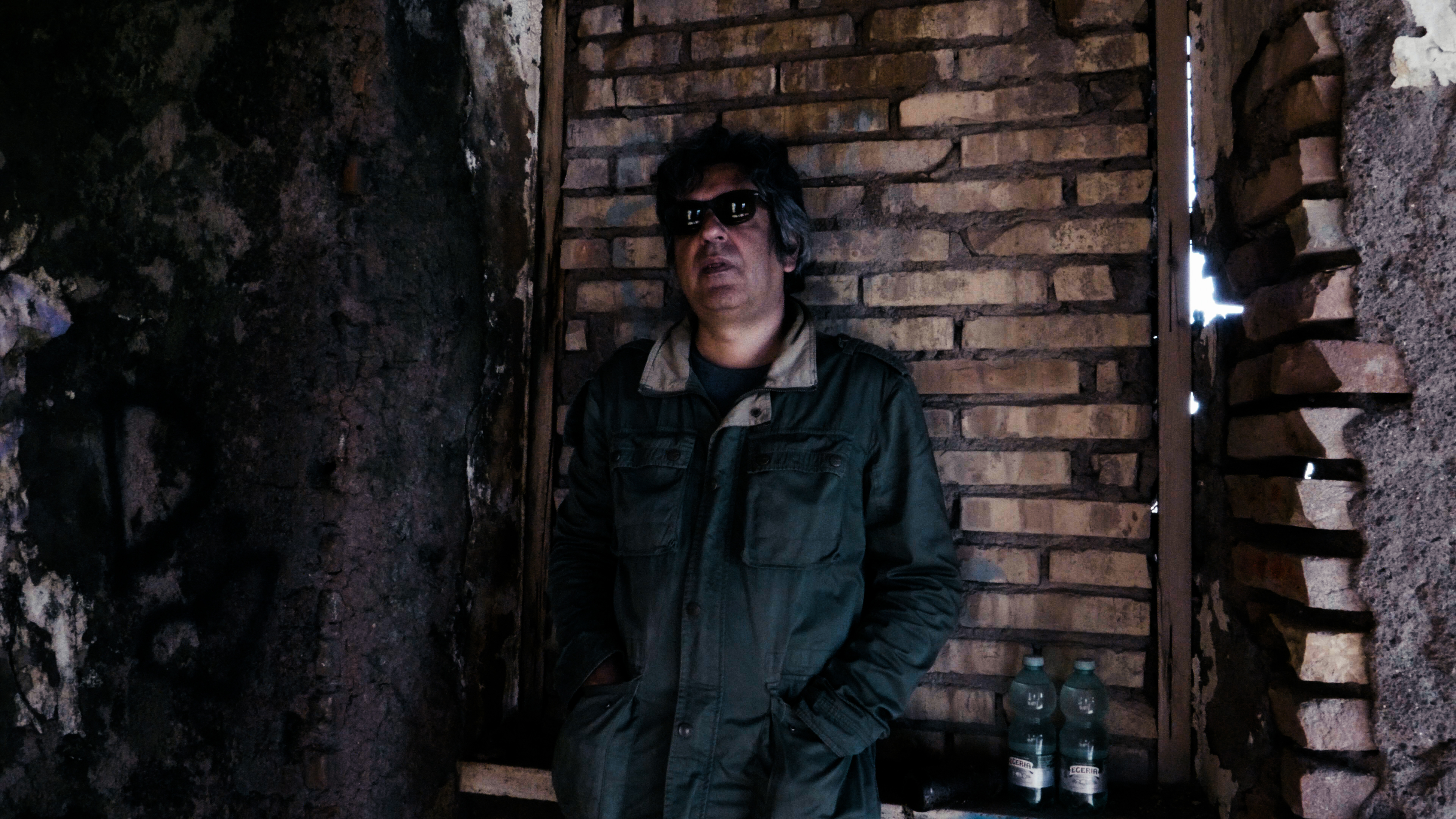
Drama, by Fabio Del Greco, Italy, 2024.
Dante Mezzadri wants to see an old friend, nicknamed the Iguana, whom he has lost sight of for many years, and who has managed to turn their shared youthful passion for poetry into a job, becoming a famous writer and poet. The man escapes from his bourgeois life and his wife to live homeless on the Roman coast, printing and trying to sell his poetry collections. At night he sleeps in a park of old carnival floats, inside a papier-mâché tank, and waits for the opportunity to meet his old friend, who however never shows up for appointments in the places they frequented when they were young, now in ruins. Dante's poetry books do not interest anyone and to support himself he is forced to "change product": he starts selling the infamous "cannibal pill" on behalf of young drug dealers, a new drug that sells like hot cakes and causes sensory and consumerist ecstasy. However, he realizes that this powerful drug is very dangerous for those who take it, he comes into conflict with his ethical conscience and throws all the pills into the sea. However, the dealers want to collect their money.
Shot over a period of 2 years, the film is a reflection on the cultural and artistic rubble of the society in which the protagonist lives, in an increasingly mechanized, consumerist and arid world. Dante Mezzadri is yet another human being who has renounced his inspiration and his creativity, but unlike many he is not willing to give his life to a system that distances him from his true identity. The physical world around him, however, seems constructed in such a way that it seems impossible to escape from this "invisible cage". The enthusiasm of the people he meets is ignited only by sensory gratification, by unreal visions of personal affirmation and success, by "metaverses" that offer an escape into an illusory and destructive reality. The poet's house on the coast, where he met with his friends as a young man, is just a pile of abandoned rubble. What happened to all those who wanted to become poets and ended up becoming something else? Are there internal forces with which that house can be "rebuilt"?
LANGUAGE: Italian
SUBTITLES: English, Spanish, French, German, Portuguese
A Body Born from Rain and Coal
He was born in a place that seemed designed to teach a person that beauty arrives without warning and leaves without explanation. Parral, 1904, a small Chilean town where the earth smelled of wet stone and the sky was something you endured rather than admired. His mother, Rosa Neftalí Basoalto, died of tuberculosis before he could form a single memory of her face. He was not yet two months old. What he inherited from her was nothing he could touch — only her name, which he would later steal and wear like a second skin, signing his poems with it when his father forbade him to sign them with anything at all.
The father was José del Carmen Reyes Morales, a railroad worker who carried the particular contempt of a practical man for anything that could not be weighed or measured. He moved the family to Temuco when the boy was still small, and Temuco was exactly the kind of place that shapes you without asking permission. The Chilean south in those years was a frontier — logging companies cutting through ancient Araucanian forest, settlers arriving with mud on their boots and hunger in their eyes, rain falling with the persistence of an argument no one wins. The Nobel Prize lecture Neruda gave in Stockholm in 1971 returns to this rain obsessively, as if he were still standing in it, still trying to understand what it asked of him. He described it as “the rain of the south of Chile,” and the phrase carries more weight than any meteorological observation has a right to.
What the rain did, specifically, was isolate. Temuco in the early twentieth century was not a place where a sensitive child found easy company. The poet Gabriela Mistral was teaching school there when Neruda was a boy, and she gave him books — Tolstoy, Dostoyevsky, works that arrived in translation like letters from another civilization. She recognized something in him that his father refused to see. His father, upon discovering that his son was writing poems, reportedly said that poets died of hunger. He was not wrong as a sociological observation. He was wrong about nearly everything else.
There is a moment that returns in various forms across Neruda’s memoirs and interviews — the image of a hand passing through a hole in a fence, offering a small toy sheep made of wool. A neighboring child’s gesture, anonymous, unrepeatable. Neruda kept the sheep for years. He spoke of that exchange as the first transaction of his poetic life: something given without reason, received without understanding why it mattered so much. Erik Erikson, writing on the formative power of early relational experience in Childhood and Society in 1950, argued that the capacity for trust — or its absence — gets installed in precisely these wordless exchanges, before language has organized the world into categories of possible and impossible. Neruda’s exchange through the fence was the opposite of what his father offered. It was gratuitous. It was warm. It cost nothing and meant everything.
The wound that his aesthetics would never fully name is this: he grew up in a place of enormous, indifferent natural power, motherless, presided over by a man who associated tenderness with failure, in a landscape where beauty was not decorative but structural — it was inside the rain, inside the wood grain, inside the particular grey of a winter morning that smelled of coal smoke and damp earth. He had no permission to love any of it. So he loved all of it with a ferocity that would spend the rest of his life looking for a form large enough to hold it.
The Twenty Love Poems and a Song of Despair, published in 1924 when he was barely nineteen, is not a young man’s debut. It is a reckoning with a landscape that raised him without ever claiming him.

Twenty Poems and the Myth of Pure Desire
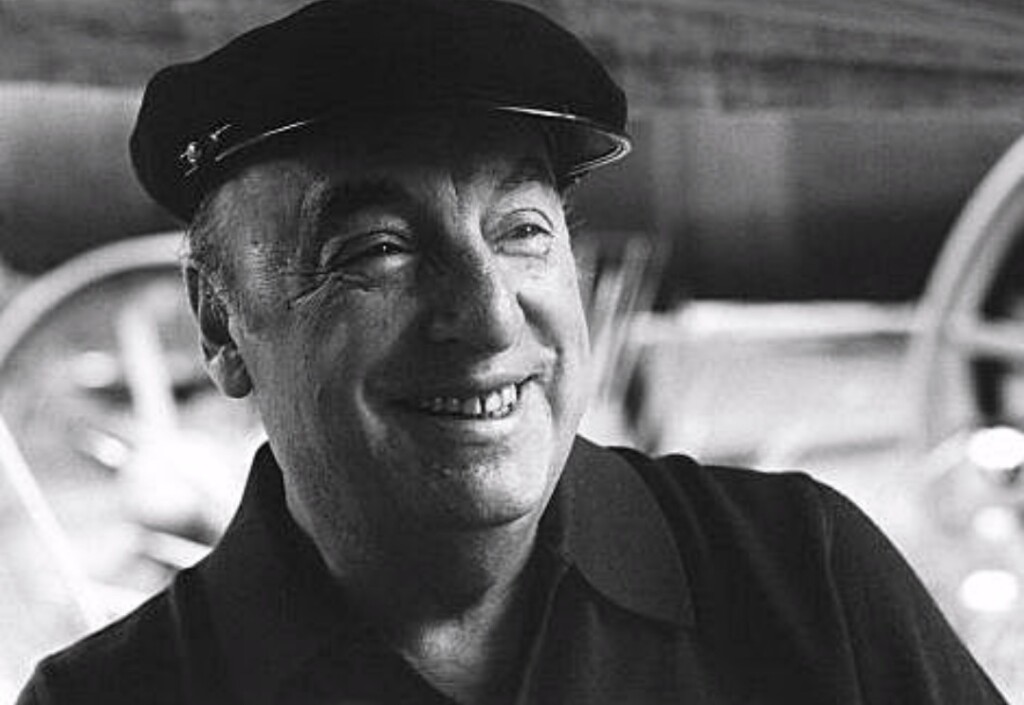
You have read those lines before you understood what desire was. Someone wrote them in the margin of a notebook, or whispered them across a table, or sent them in a message at two in the morning when the right words felt impossible and borrowed ones would have to do. “I want to do with you what spring does with the cherry trees.” You recognized the feeling before you could name it, which is exactly how a myth works — it arrives ahead of your understanding and installs itself as truth.
Neruda was nineteen years old when Veinte poemas de amor y una canción desesperada appeared in 1924, a fact that should give any reader pause. Not because youth disqualifies feeling, but because what he produced was not simply a record of desire — it was the architecture of desire, a grammar so internally coherent and so aesthetically overwhelming that three generations of readers absorbed it as instruction. The collection would sell over a million copies in his lifetime alone, a number almost unthinkable for poetry in any language, and it would go on to be translated into dozens of tongues, recited at weddings, tattooed on skin, pressed into the hands of people newly in love as a kind of manual. The numbers tell you something the critics often do not: this was not literature operating as literature. It was literature operating as ideology.
What the twenty poems construct is a grammar of pure desire — desire understood as absolute, consuming, essentially solitary, and directed not at a person but at the idea of a person. Roland Barthes, writing decades later in A Lover’s Discourse in 1977, would identify precisely this structure: the lover does not love the beloved, the lover loves the image of the beloved, and the beloved’s actual existence becomes an inconvenience to the perfection of that image. Neruda’s poems are Barthes’s thesis enacted at full lyric velocity. The women in the collection — and there are women, plural, however the romantic myth insists on reading them as one — are described with extraordinary sensory precision, but the precision is the trap. You can describe something only from a position of distance. The cataloguing of her body, her silences, her absence, her hair, her hands, is an act of ownership dressed in the language of adoration.
There is a moment in which a man watches a woman through a window from across a dark courtyard. She is doing something ordinary — moving through a room, unaware of being seen. He does not approach her. He watches. The watching is presented as love, and perhaps it is a kind of love, but it is also a kind of erasure: she exists in that scene as a surface for his feeling, not as a subject producing her own. That is the visual logic Neruda’s poems operate on. “You are like nobody since I love you,” he writes, which sounds like the highest compliment and is actually the most complete absorption of another person into the self. Her singularity exists only because of his love. Without him perceiving her, she ceases to be particular.
Simone de Beauvoir in The Second Sex, published in 1949, argued that romantic love as Western culture constructs it requires woman to become the absolute Other — the mirror in which man recognizes his own transcendence. The twenty poems are perhaps the purest lyric expression of this structure ever written, which is why they feel so complete, so satisfying, so true. They feel true because the culture that produced them trained you to find them true. The myth precedes the book. The book merely perfects the myth.
And yet you still feel something when you read them. That feeling is also real. The question worth sitting with is what exactly you are feeling — the other person, or the exquisite sensation of your own longing given form.
The Consul and the Refugee: Power Worn Like a Second Skin
There is something almost unbearable about watching a person do the right thing for reasons that are partly wrong. Neruda in the late 1930s is exactly this kind of figure — a man whose hands were genuinely saving lives while his mind was constructing justifications that would eventually cost him the very clarity he needed to see what he was doing.
He had spent years in consular posts that the Chilean government assigned to poets the way one assigns inconvenient relatives to distant provinces — Rangoon, Colombo, Batavia, Singapore, Madrid. These were not prestigious appointments. They were bureaucratic exile dressed in diplomatic clothing, and he lived them accordingly, with a mixture of isolation, sensory overwhelm, and the particular loneliness of someone too alive for the job he has been given. In the East, he witnessed colonial machinery at its most casual and indifferent — the systematic reduction of human beings to instruments of extraction, the British and Dutch administrations moving through occupied territories with the serene confidence of those who have never been asked to justify themselves. He absorbed it without yet having a political language adequate to what he was seeing.
Spain gave him that language, and it gave it to him through blood. The Civil War was not an abstraction for Neruda. It was Federico García Lorca shot in a ditch outside Granada in August 1936, a death that Neruda carried as a physical wound for the rest of his life. It was Madrid under bombardment, intellectuals choosing sides with a desperation that had nothing theoretical about it, the Republican cause collapsing not from lack of conviction but from the precise, calculated abandonment by the Western democracies that had decided non-intervention was a form of neutrality rather than what it actually was: complicity. He watched all of this and it radicalized him in the way that witnessing real atrocity radicalizes people — not gradually, through argument, but suddenly, through grief.
The Winnipeg in 1939 is one of those episodes in history that resists cynicism. Neruda, by then removed from his consular post and working through the Chilean government under Pedro Aguirre Cerda, organized the transport of approximately 2,200 Spanish Republican refugees from France — where they were deteriorating in internment camps after the fall of Catalonia — to Chile. He called it “the most beautiful thing I have ever done in my life.” The ship departed Pauillac in August 1939 and arrived in Valparaíso in September. These were real people with real names who would have otherwise faced internment, forced return, or death, and they did not face those things because one poet used his position with unusual moral seriousness. The record of what he did is unambiguous.
And yet. Hannah Arendt, in her 1951 examination of totalitarianism, identified what she called the peculiar susceptibility of intellectuals to ideological systems that offer total explanatory power — the way devotion to a historical narrative can coexist with, and eventually consume, the capacity for concrete moral judgment. She was not writing about Neruda, but she might as well have been. The same man who organized the Winnipeg was simultaneously writing with reverence about a Soviet system that was, at the very moment of the ship’s departure, operating the labor camps of the Gulag at full capacity. The same solidarity that made him capable of extraordinary action for Spanish republicans produced a selective blindness so complete it constitutes its own kind of moral catastrophe.
This is not hypocrisy in the ordinary sense. Hypocrisy implies awareness of the gap between what one professes and what one does. What Neruda demonstrated was something more structurally interesting and more troubling — the way that genuine moral achievement in one domain can function as psychological permission to avoid moral scrutiny in another, the way a person can wear the evidence of their own goodness like armor against the truth.
Canto General and the Seduction of Grand Narratives

There is a moment when a man sits down to write the history of a continent and genuinely believes he is setting it free. Not documenting it, not interpreting it — liberating it, as though language were a lever placed beneath the weight of centuries. This is the seduction that produces monuments. And monuments, as any honest archaeologist will tell you, are always built on buried things.
The work that emerged from Neruda’s years of exile and clandestinity — written partly underground, smuggled across borders, completed in 1950 — is a staggering object by any measure. Two hundred and thirty-one poems. Fifteen thousand lines. A continent that begins before Columbus and ends in the anticipated dawn of proletarian redemption. The ambition is geological, and that is precisely the problem. When a poem aspires to the condition of geology, it begins to operate by geology’s rules: it sediments, it compresses, it makes the contingent appear permanent and the constructed appear inevitable.
Roland Barthes, writing in Mythologies in 1957, described myth not as falsehood but as a particular operation performed on meaning — the transformation of history into nature, the erasure of the act of construction so that what has been made appears as what has always been. The myth does not lie. It simply forgets to mention that it chose. And what Neruda’s epic performs, across those fifteen thousand lines, is precisely this operation at continental scale. The indigenous past becomes a prophecy that was always pointing toward the communist future. The Spanish conquest becomes a wound that was always awaiting this particular remedy. The mountains, the rivers, the copper mines of Chuquicamata — they are recruited into a narrative that feels like discovery precisely because it presents itself with the authority of the elemental.
He believed it. That is the part that cannot be dismissed or flattened into cynicism. A man who had witnessed the slaughter of Spanish Republicans, who had seen workers crushed by the machinery of states and companies, who had crawled through the Andes to escape his own government’s persecution — such a man does not choose a grand narrative for convenience. He chooses it because the magnitude of the suffering he has witnessed demands a commensurate explanatory framework. The grand narrative is not vanity. It is grief organized into purpose.
But Barthes understood that the sincerity of the mythmaker is irrelevant to the function of the myth. A woman watches her village burn and a man arrives to tell her the fire is the birth pang of a new world. He may be entirely convinced. The fire still burns, and her grief is still being organized by someone else’s calendar. The intellectual who places their art in the service of a historical teleology does not stop being an artist. They become something more dangerous: an artist whose beauty makes the teleology feel inevitable.
There is a scene in which a man learns that people he has championed, people whose cause he has adorned with his most luminous language, have been erased — not metaphorically, but administratively, physically, permanently — by the very machinery he celebrated. He continues writing. The lines continue to arrive with their mineral certainty. This is not hypocrisy in any simple sense. It is the price the grand narrative extracts from the person who has fully inhabited it: the incapacity to read contradicting evidence as evidence, because the narrative has already determined what evidence means.
The epic poem is real as art. Its images of submerged stone gods and exhausted miners contain a truth about suffering that no ideological framework can fully colonize. But the frame insists on surrounding them, and the frame was constructed in Moscow’s cultural offices as surely as it was constructed in Neruda’s imagination. The question that the poem refuses to ask is the one that its own beauty most urgently raises: who decides when the prophecy has been fulfilled, and what happens to those who are inconvenient to the answer.
A vision curated by a filmmaker, not an algorithm
In this video I explain our vision
The Nobel, the Myth, and the Market of Suffering
In October 1971, the Swedish Academy handed Pablo Neruda the Nobel Prize in Literature, and something quietly died in the process. Not the man — he would live another two years, long enough to watch Salvador Allende‘s Chile begin its brief, doomed experiment in democratic socialism, long enough to see the world prepare the coffin it would dress him in after death. What died was the productive friction that his life had always generated. The prize smoothed everything. It took a man who had been a diplomat and a fugitive, a Stalinist apologist and a genuine revolutionary, a seducer who abandoned a disabled daughter and a poet who wrote some of the most viscerally human verses of the twentieth century, and it reduced him to an emblem. Poet of love. Voice of the oppressed. Safe for export.
Guy Debord, writing in 1967 in “The Society of the Spectacle,” described with surgical precision the mechanism by which living experience gets converted into its own representation — not falsified exactly, but hollowed out, turned into an image that circulates in place of the thing itself. The spectacle does not suppress radicalism. It does something more efficient: it digests it, extracts the flavor, and sells the residue as nutrition. Neruda’s Nobel was precisely this kind of digestion. By 1971, the Twenty Love Poems and a Song of Despair, first published in 1924 when he was nineteen years old, had already sold millions of copies across dozens of languages. The Canto General, that enormous seismic poem of continental history and political fury published in 1950, had been smuggled across borders, printed clandestinely, read in whispers. After Stockholm, it became a coffee table book.
There is a particular kind of fame that functions as erasure. You know it when you see it — the poster on the wall of someone who has never read a word of the work, the quote stripped of its context and printed on a mug, the name invoked as proof of cultural sensitivity without any engagement with what the name actually stood for or against. Neruda became, in the decades following the Nobel, one of the most efficiently marketed poets in history. His love poems, already incandescent, were now universally available in the kind of decorative editions that signal feeling without requiring it. The complicated Neruda — the one who wrote odes to Stalin, who dismissed the Hungarian uprising of 1956 with embarrassing ideological loyalty, who treated women across three marriages with a combination of obsessive devotion and casual cruelty — that Neruda was filed away in the footnotes where discomfort goes to be forgotten.
This is not an accident of popularity. It is the specific grammar of cultural canonization, which requires a simplified moral architecture. The philosopher Herbert Marcuse, in “One-Dimensional Man” published in 1964, argued that advanced industrial society absorbs its own opposition — that the system’s greatest trick is not repression but assimilation, the conversion of critique into commodity. A protest song on a corporate playlist. A revolutionary manifesto as museum exhibition. A poet who called for the overthrow of capitalist order, translated into the language of capitalist consumption, sold to the same middle class he spent his life alternately courting and denouncing.
What is left when you remove the contradiction from a contradictory man is not a cleaner version of the truth. It is a lie that wears the face of truth. The Neruda that fills bookshop windows, that gets quoted at weddings, that appears on Instagram captions between photographs of sunsets and carefully staged solitude, is a figure assembled from selected parts — the beauty kept, the ugliness discarded, the political anger domesticated into something that feels like passion without being dangerous. It is a portrait that serves its audience rather than disturbing them. And a portrait that serves its audience is not art.
The Death That Refuses to Stay Simple
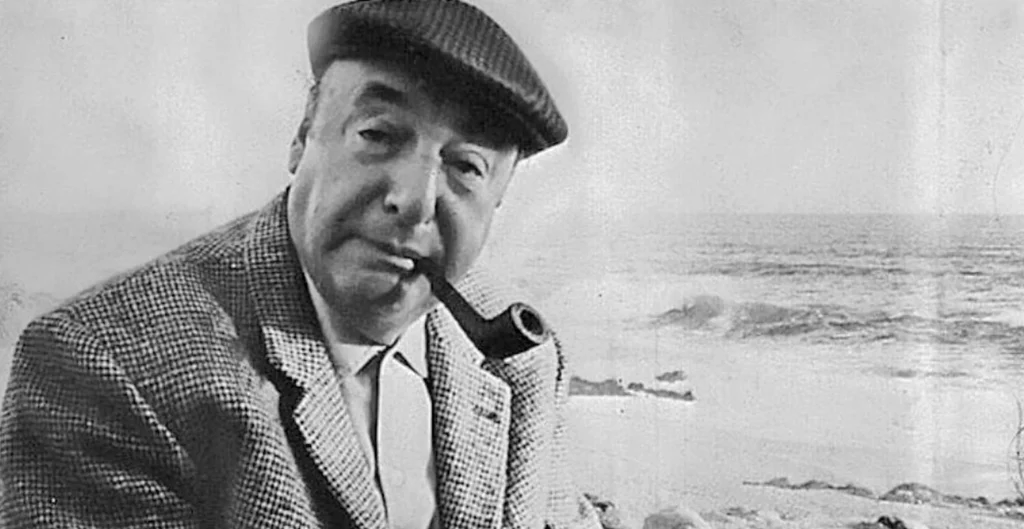
He died twelve days after the coup. That fact alone should stop you for a moment, the arithmetic of it, the terrible precision. September 11, 1973, Pinochet’s planes bomb La Moneda. September 23, the most celebrated poet in Chilean history is dead at sixty-nine, officially of prostate cancer, at the Santa María Clinic in Santiago. His personal secretary, José Miguel Insulza, would later describe a man who had been declining but was not, by any clinical measure, dying on the schedule that history then assigned him. And yet the death certificate was signed, the body was buried, and the machinery of the new state moved on to other business, of which there was a great deal.
The problem with official truths is not that they are always lies. The problem is that they are always selections. Michel Foucault, in The Archaeology of Knowledge published in 1969, made the argument with a precision that cuts directly into situations like this one: what any epistemic order calls knowledge is never the full record of what happened but rather the product of institutional rules that determine which statements are allowed to count as true. The archive is not a warehouse. It is a filter. And whoever controls the filter controls the past, which means they also control, in very practical ways, the present.
In 2011, nearly four decades after that signed death certificate, a Chilean judge ordered Neruda’s body exhumed. The investigation had been reopened on the basis of testimony from his former driver and close associate, Manuel Araya, who stated with uncomfortable specificity that a doctor had entered Neruda’s clinic room on the night of September 22 and administered an injection. Within hours, the poet was dead. The forensic examination that followed identified the presence of Clostridium botulinum bacteria in his remains, a pathogen not consistent with prostate cancer, not consistent with anything natural. The scientists from the international forensic team working the case were careful with their language, as scientists must be, saying the findings were “incompatible” with the official cause of death, stopping just short of the word everyone was thinking.
That word has still not been officially spoken. The investigation remained open, then stalled, then reopened, then inconclusive, accumulating the particular silence that institutions produce when they are protecting something more fragile than a reputation. Think of a man who spent his final days in that clinic, receiving visitors, dictating the memoir that would become Confesso che ho vissuto, still moving words around in his mind even as the country he had loved and argued with and sung into being was being unmade outside the window. He had received news of Allende’s death. He had received news of the coup. He had spoken of going into exile in Mexico, where he had already been promised refuge. He was, by multiple accounts, a man preparing to continue, not to die.
The political dimension of the unresolved forensic record is not incidental to it. It is the record. What Foucault called the “will to truth” is not the desire to discover facts but the social mechanism through which certain facts are made sayable and others are buried in the procedural sediment of investigation and counter-investigation, committee and counter-committee, until the question itself exhausts the people asking it. By 2023, the case had still not produced a definitive ruling. A half-century of juridical process producing not resolution but managed uncertainty, which is its own kind of answer.
There is a scene that stays with you, not from any document but from the quality of what was recorded around it. A poet’s books being burned in the streets of Santiago, soldiers feeding pages to the fire, and somewhere in a clinic bed, the man who wrote those pages still breathing, briefly, into the same smoke-colored air.
What We Borrow When We Quote Him
You have read the line so many times it has stopped being language and become something closer to a reflex. It surfaces in you the way a smell does — without permission, without context, before thought. Someone sends it to you at two in the morning and you do not ask where it comes from. You already know where it lives. It lives in you, in the specific hollow where certain words settle when they arrive at the right moment in the wrong year of your life.
This is what Neruda does. Not what he did — does, present tense, ongoing, because the poems are still being sent, still being tattooed into forearms and wrists and the soft skin below the collarbone, still being written by hand onto cards tucked into coat pockets. The biographical record of the man who wrote them is now fully available to anyone who looks. The allegations surrounding Josie Bliss, the admission in his own memoirs of an assault he framed with a casualness that makes the stomach drop, the political silences and convenient allegiances — none of it is hidden. It is there, in the same digital space where the poems circulate. A single search retrieves both the rapture and the reckoning in the same minute.
And yet the line is still in you. That is the uncomfortable fact you are sitting with.
There is a philosophical tradition that tries to settle this problem by separating the work from the maker. Roland Barthes declared the death of the author in 1967, arguing that once a text is released, the biography of the person who produced it becomes irrelevant to meaning — the reader becomes the true site where sense is made. It is an elegant theory and it has genuine intellectual weight. It also functions, if you are not careful, as a permission slip. A way of closing the file on discomfort before discomfort has finished speaking.
Because knowing changes the reading even when you refuse to let it. The poem about wanting to do with your body what fire does with silence carries a different electrical charge once you understand that the man who wrote it also recorded, with apparent equanimity, an act of domination framed as desire. The words have not changed. Your nervous system has. And you are not wrong to feel the difference, just as you are not dishonest for feeling the original pull beneath it.
What you borrow when you quote him is never simply language. You borrow a sensibility, a particular shape of longing, a way of making need sound like music rather than wound. That borrowing was always a transaction with more than one party, even when you thought it was private, even when the poem felt like something you had written yourself in a dream. The reader who carries the line across twenty years of their own life has made it genuinely theirs — has bled into it, grown around it, used it to survive things the poet never imagined. That is not a metaphor. That is what reading does to language when reading is serious.
But the origin does not disappear simply because the destination has transformed. Both things are true at once and the discomfort of holding them simultaneously is not a problem to be solved. It is the actual condition of inheriting anything made by human beings, who are always both more and less than the best thing they ever produced.
The poem on your forearm belongs to you. It was made by someone whose full life you now cannot unknow. These two facts do not cancel each other, and the life you have built around certain words is neither invalidated by the biography nor absolved by your love for what those words gave you — it is simply what it has always been: yours, impure, irreducible, and true.
🌊 Words That Flow Like Rivers: Poetry and Thought
Pablo Neruda’s life and works stand at the crossroads of passionate lyricism, political commitment, and a deep sensory engagement with the world. To fully understand his poetic universe, it helps to explore the broader traditions of poetry as knowledge, the literary currents that shaped his era, and the Latin American cultural landscape that nourished his voice.
Poetry as a Form of Knowledge: History and Theory
Poetry has never been merely an aesthetic exercise — it is a mode of knowing the world that rivals philosophy and science in depth. This article traces the long history of poetic epistemology, from ancient traditions to modern theory, revealing the intellectual frameworks that help us understand why a poet like Neruda could claim to speak truths that prose cannot reach. Understanding poetry as knowledge transforms how we read every verse Neruda ever wrote.
GO TO THE SELECTION: Poetry as a Form of Knowledge: History and Theory
Octavio Paz: Life and Thought
Octavio Paz, Neruda’s great contemporary and sometimes rival, offered one of the most penetrating literary and philosophical minds in twentieth-century Latin America. Exploring Paz’s thought illuminates the shared cultural and political tensions that shaped both poets, as well as the deep differences in their visions of identity, eroticism, and solitude. Reading Paz alongside Neruda opens a rich dialogue between two giants of the Spanish-language poetic tradition.
GO TO THE SELECTION: Octavio Paz: Life and Thought
Mexican Literature: History and Main Authors
Mexican literature provides an essential backdrop for understanding the broader Latin American literary world in which Neruda’s Chilean voice resonated and competed. This overview of Mexican literary history introduces the key authors, movements, and cultural debates that defined a continent-wide conversation about language, identity, and liberation. Neruda’s poetry cannot be fully appreciated without understanding the rich literary ecosystem that surrounded and challenged it.
GO TO THE SELECTION: Mexican Literature: History and Main Authors
Stream of Consciousness in Literature and Cinema
The stream of consciousness technique, developed in literature and later adopted by cinema, shares with Neruda’s most experimental poetry a commitment to capturing the fluid, associative movement of inner experience. This article explores how modernist writers and filmmakers sought new formal languages to render consciousness itself visible on the page and screen. Neruda’s surrealist-inflected collections like ‘Residencia en la Tierra’ breathe with the same restless interiority that defines this entire literary and cinematic tradition.
GO TO THE SELECTION: Stream of Consciousness in Literature and Cinema
Discover the Cinema That Speaks Like Poetry
If Neruda’s words remind you that art can shake the soul and rewrite reality, then independent cinema is your next destination. On Indiecinema streaming you will find films that carry the same lyrical courage — stories told with passion, vision, and an uncompromising love for the truth. Dive in and let the images speak where words leave off.
👉 EXPLORE THE CATALOG: Watch Indie Films in Streaming
A vision curated by a filmmaker, not an algorithm
In this video I explain our vision

