
The Drawer Full of Unfinished Systems
There is a drawer somewhere in almost every serious person’s life. Not a metaphorical drawer — an actual one, wooden or plastic, that sticks slightly when you pull it open because it is so full it has begun to warp the frame around it. Inside: sheets of paper covered in handwriting that grew increasingly urgent as the night wore on, diagrams where arrows chase each other in loops, index cards with single words circled and underlined and circled again, color-coded systems that made perfect sense at two in the morning and now resemble the private language of someone in crisis. You open this drawer and you feel something complicated. Not quite shame. Not quite pride. Something closer to recognition of a hunger that was never fully fed.

The hunger is specific. It is not the desire to know more facts. It is the desire to find the architecture beneath the facts — the hidden grid, the combinatory engine, the single rotating mechanism that, if you could only build it correctly, would generate every true statement about reality from a finite set of moving parts. The person who fills that drawer is not confused. They are, in their own way, pursuing the oldest and most dangerous intellectual dream in the Western tradition: the dream of a complete and unified system, a machine for truth.
This dream has a name, though most people who experience it have never heard of the man who built its most extraordinary early monument. What lives in that drawer is a version of what Ramon Llull attempted in the thirteenth century with a ferocity and systematic ambition that has never quite been matched before or since — not in the volume of work, not in the strangeness of the method, not in the absolute conviction that language, logic, geometry, and theology could be fused into a single rotating apparatus that would leave no question unanswerable.
But the drawer comes first, because the drawer is honest in a way that grand historical narratives rarely are. When you sit at a kitchen table at midnight with concentric circles drawn on three different sheets of paper and string connecting concepts across a corkboard, you are not doing something eccentric. You are doing something ancient. You are enacting a compulsion that runs through Leibniz’s dream of a universal characteristic, through Descartes’ method, through the neo-Platonic ladders of Pico della Mirandola, through the memory theaters of Giulio Camillo, all the way back to a Catalan mystic on a mountain who believed God’s attributes could be mapped onto rotating wheels and that the intersections produced by spinning those wheels would unlock every secret the universe was keeping.
The philosopher Charles Sanders Peirce, writing in the 1860s and 1870s, called this impulse the architectonic drive — the need not merely to accumulate knowledge but to systematize it, to find the formal structure that holds all knowledge in right relation to itself. What Peirce understood, and what the person staring into their warped wooden drawer understands without knowing the word for it, is that the architectonic drive is not separable from something almost erotic. There is desire in it. There is the feeling that completion is possible, that one more diagram, one more rotation of the wheel, one more cross-reference between the theological and the geometric will close the gap between what we know and what there is to know.
The gap never closes. This is not a tragedy. It is the condition that makes the systems worth building and worth examining — because what survives in those drawings, those rotating figures, those arrow-chased loops, is not the proof that was being sought but the mind that was doing the seeking. And the mind that built the most elaborately beautiful version of this system in the Western Middle Ages was doing something stranger and more alive than any of his commentators have yet been willing to admit.
The Man Who Wanted to Prove God with a Machine
There is a particular kind of person you have probably met at least once in your life. Not a fanatic in the obvious sense — not someone who shouts or threatens — but someone who has arrived at a certainty so complete, so architecturally satisfying to them, that they genuinely cannot understand why everyone else has not yet seen it. They build systems. They draw diagrams. They stay up late arranging their proofs in ever more elaborate configurations, certain that the right presentation, the right sequence of steps, will finally make the truth self-evident to anyone who looks. Their conviction is not aggressive but it is absolute, and there is something both admirable and slightly terrifying about watching them work.
Ramon Llull was this person. Born around 1232 in Palma de Mallorca, a prosperous minor nobleman who spent his early adulthood in the conventional pleasures of courtly life, he underwent a conversion experience in his early thirties that did not simply change his beliefs but reorganized his entire cognitive architecture. He became convinced not merely that Christianity was true but that it was demonstrably, logically, necessarily true — true in the way that a geometric proof is true, true in a way that would compel assent from any rational mind regardless of its cultural or religious starting point. What followed was not a life of quiet devotion but an extraordinary, obsessive, decades-long project to build the machine that would prove it.
The Ars Magna, completed in its definitive form around 1305 after multiple earlier versions going back to 1274, is the result of that project. At its core are a set of rotating concentric wheels — volvelles, they are sometimes called — inscribed with letters that stand for the fundamental attributes of God: Goodness, Greatness, Eternity, Power, Wisdom, Will, Virtue, Truth, Glory, arranged in combinations that generate, mechanically and exhaustively, every possible theological proposition. The wheels turn. The combinations emerge. The letters B through K cycle through their permutations, and in that cycling, Llull believed, the entire structure of divine reality would become visible and irrefutable. It was, in the most literal sense imaginable, an argument machine.
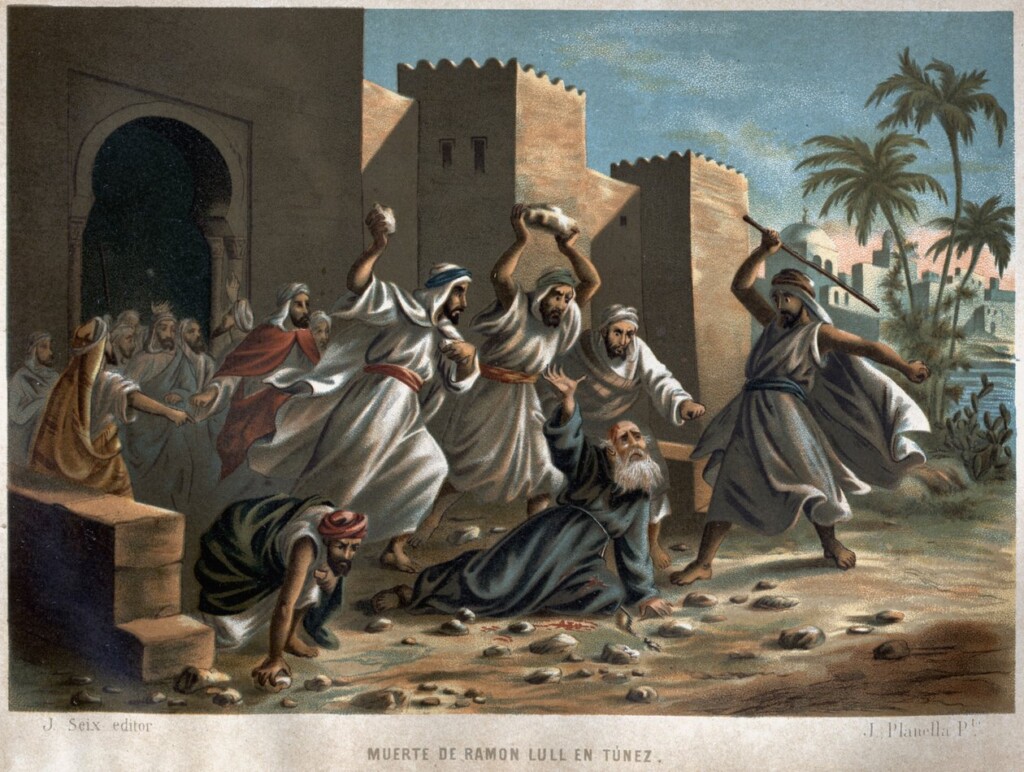
The ambition behind it deserves to be taken seriously before it is judged. Llull was not primarily trying to impress other Christians. He traveled to Tunis and to Bugia, risking his life — he was eventually stoned there in 1315 and died from the injuries — to demonstrate his Ars to Muslim scholars. He learned Arabic, one of the very few Latin Christian thinkers of his era to do so seriously, precisely because he wanted to engage rather than simply condemn. He petitioned the Council of Vienne in 1311 to establish university chairs in Arabic, Hebrew, and Aramaic, a proposal of striking intellectual openness for its historical moment. He was not trying to impose truth by force but to display it with such clarity that rejection would become rationally impossible.
This is where his project becomes genuinely strange, and genuinely revealing. The philosopher Charles Taylor, in his monumental Sources of the Self published in 1989, traces the long history of the Western tendency to conflate moral order with cosmic order — the assumption that what is good must also be what is ultimately real and therefore ultimately demonstrable. Llull inhabits this assumption so completely that he cannot conceive of a gap between the truth of God and the logical compulsion that truth should exert. If the divine attributes are real, they must be rationally accessible. If they are rationally accessible, then a sufficiently precise instrument must be able to display them. The machine is not a metaphor for faith. It is faith translated into gears.
What makes him recognizable across seven centuries is not his theology but his psychology: the person who has found the system that explains everything, and who cannot rest until the mechanism is perfected enough to make everyone else see it too.

When Mysticism Becomes an Algorithm
There is a particular kind of madness that looks, from the outside, exactly like discipline. You have seen it in someone you know — the person who fills notebooks with diagrams at three in the morning, who believes that if they can only arrange the variables correctly, the answer will emerge on its own, inevitable, like water finding its level. The hand moves across the page with the certainty of someone who is not inventing but discovering. The circles turn. The columns align. The combinations multiply. And somewhere in that multiplication, they are convinced, God is hiding.
This is precisely what Ramon Llull built, and what he believed he had found. The Ars Magna, in its mature form, operates through a system of concentric wheels — volvelles, the manuscript tradition calls them — each inscribed with letters representing divine attributes: Bonitas, Magnitudo, Eternitas, Potestas, Sapientia, Voluntas, Virtus, Veritas, Gloria. Nine principles, nine letters, arranged on rotating discs that could be combined in sequences to generate propositions about the nature of God, creation, and the soul. The mechanism is startling in its simplicity and vertiginous in its implications. By rotating the wheels, a practitioner could produce 1,680 distinct combinations from just three concentric layers — a number that, in the thirteenth century, represented something close to the totality of expressible truth. Llull was not writing theology. He was engineering it.
What makes this more than a historical curiosity is the interior logic driving the machine. Leibniz, writing in 1666 in his Dissertatio de Arte Combinatoria, acknowledged Llull directly and dreamed of extending the principle into a universal calculus of thought — a characteristica universalis capable of resolving all philosophical disputes by computation. He was twenty years old when he wrote it, and already understood that Llull had done something genuinely unprecedented: he had proposed that reasoning was not an art of intuition but an art of combination, that if you could enumerate the primitive concepts of a domain and specify their rules of interaction, truth would fall out mechanically, without the interference of the unreliable human mind. Three centuries separate Llull from Leibniz, and the idea arrived intact, slightly refined, no less audacious.
But the seduction concealed a trap, and Llull, characteristically, was the last person to see it. A man stands before a wall covered in handwritten charts, connecting names and dates and symbols with colored thread. He has been at this for months. He believes the pattern is almost complete, that the connections will soon speak for themselves, that meaning is not something imposed but something extracted. What he cannot see — what no one around him can say to him without destroying something essential — is that the act of combination is not neutral. The wheels do not turn in empty space. The attributes Llull inscribed on his discs were not discovered; they were chosen. The grammar of the machine was already a theology before the first rotation. Every combinatory system encodes the assumptions of its designer at the level of its primitive terms, and those assumptions are precisely what the machine cannot question.
This is what the philosopher Frances Yates, in her 1954 study of Llull’s influence on Renaissance memory and magic, identified as the central ambiguity of the entire project: the Lullian art presents itself as a logical instrument while functioning as a spiritual one. The appearance of mechanism confers an authority that intuition alone could never claim. The wheels turn, the combinations emerge, and the result carries the weight of inevitability — not because the logic is sound, but because the process looks like it cannot lie. In this sense, Llull did not anticipate the algorithm only in its structure. He anticipated it in its rhetoric, in the peculiar human willingness to trust a process more than a person, a system more than a judgment, a machine more than the trembling, interested mind that built it.
The Alchemical Parallel: Transmuting Lead into Logic
There is something almost tactile about the alchemist’s table — the arrangement of vessels, the precise sequence of heating and cooling, the belief that if you place the right substances in the right order and apply the right degree of transformation, something categorically new will emerge from what was merely ordinary. Not better ore. Not refined metal. Something that did not exist before the procedure, something that could not have been predicted from looking at the individual components. The lead does not become gold by accumulating more lead. It becomes gold by passing through a structural ordeal, a reconfiguration at the level of essence.
This is, with almost unsettling precision, exactly what Ramon Llull believed about thought.
The parallel is not metaphorical decoration. It runs structurally through both enterprises. The alchemist begins with a finite set of base elements — sulfur, mercury, salt in the Paracelsian elaboration, or the classical quartet of earth, water, fire, and air — and operates on the conviction that their correct combination, governed by laws that are real even when hidden, produces a substance of entirely different ontological status. Llull begins with his Dignities, his nine or sixteen fundamental attributes of divine reality, and operates on the identical conviction: that their correct combination, mechanically generated and exhaustively explored, produces truth. Not probable truth. Not interesting approximation. Truth in the scholastic sense, hard and necessary, as unrefutable as geometry.
Umberto Eco, in his 1993 study of the Western obsession with constructing or recovering a language adequate to reality, locates Llull precisely at the hinge between mystical illumination and combinatory mechanics. What Eco finds remarkable is not Llull’s piety but his radicalism: the Ars Magna is an attempt to make the discovery of truth a procedure rather than an event, to replace the unpredictable lightning bolt of insight with a machine that, if operated correctly, cannot fail to produce it. The wheels do not suggest. They demonstrate. This is the alchemy of logic — the transformation of contingent, fallible human reasoning into something with the inevitability of natural law.
And then history performed one of its characteristic acts of creative confusion. Beginning in the fourteenth century, a substantial body of alchemical literature began circulating under Llull’s name. The texts were detailed, technically sophisticated, and entirely consistent with the alchemical tradition of the period. They described transmutation procedures with the authority of someone who had mastered the art. The problem was categorical: Llull himself, the historical Llull who wrote in Catalan and Latin and traveled to North Africa and was almost certainly stoned to death in Tunis around 1316, had been explicitly and repeatedly hostile to alchemy. He considered it a false art, a deception that promised what nature did not permit. The pseudo-Lullian alchemical corpus — now attributed to one or several anonymous authors writing in his name — is a posthumous fabrication, a case of intellectual identity theft so successful that it persisted for centuries and confused even serious scholars.
What made Llull’s name available for this appropriation was precisely the structural resonance Eco identifies. If you believed that Llull had found a method for combining basic elements to produce necessary truth, it required almost no conceptual violence to imagine him also believing he had found a method for combining basic substances to produce necessary gold. The architecture of the two claims is identical. The same faith in the hidden combinatory laws of reality, the same confidence that the right arrangement unlocks something that mere accumulation cannot reach. The forgers did not simply steal a famous name for credibility. They recognized, perhaps instinctively, that the epistemological form of Llull’s project and the epistemological form of alchemical transmutation were close enough to be indistinguishable from a certain angle.
Which raises a question that neither the medieval forgers nor their victims could quite articulate: if the structures are identical, what exactly is the difference between them?
The Forgery That Became More Real Than the Man

There is a particular kind of institutional forgery that operates not through malice but through desire — the desire for a great mind to have said what you need it to have said. By the early fourteenth century, Ramon Llull was already a figure of sufficient magnitude that his name carried a gravitational weight, pulling lesser texts toward it the way a large body warps the space around it. He died around 1316, probably on a ship returning from North Africa, and almost immediately his intellectual estate was colonized. The Testamentum, one of the most widely circulated alchemical texts of the medieval period, bears his name on its face. He did not write it. Neither did he write the Codicillum, nor the Liber de secretis naturae, nor the vast archipelago of pseudo-Lullian treatises that accumulated across the fourteenth and fifteenth centuries like barnacles on a hull. These texts were produced after his death, sometimes decades after, by writers who understood that attribution was a technology of persuasion.
What is disturbing — genuinely disturbing, once you sit with it — is not that the forgeries existed. Forgery is as old as writing. What disturbs is that the false Llull was, by almost any historical measure, more influential than the real one. The actual Llull spent his life constructing a formal combinatory logic, the Ars Magna, as a tool for universal rational demonstration — a system that Leibniz would still be praising in the seventeenth century, that would echo faintly in the computational architectures of the twentieth. The real Llull was a logician of startling ambition. But the Europe that remembered him, that taught him, that argued over him through the Renaissance and into the early modern period, largely remembered a Llull who had discovered the philosopher’s stone.
This is not an accident of archiving. It is a structural feature of how cultural inheritance works. The historian Michela Pereira, whose work on the pseudo-Lullian alchemical corpus remains definitive, has documented with forensic precision how these texts circulated, how they were copied into major manuscript collections, how they were cited by figures like John of Rupescissa and later by practitioners who treated them as canonical sources. The forgeries entered the libraries; the forgeries shaped the curricula; the forgeries became the man. By the time the printing press arrived and fixed these attributions into something resembling permanence, the transformation was complete. To dispute the alchemical Llull was to dispute a tradition, not merely a text.
Walter Benjamin wrote in 1936 that every document of civilization is simultaneously a document of barbarism. He was thinking about the labor concealed inside cultural monuments. But the formulation applies with equal force to the authorship concealed inside canonical texts — the unnamed desires, the institutional needs, the strategic fictions that made certain attributions convenient and others invisible. The pseudo-Lullian corpus is not just a case of fraud. It is a case of a civilization deciding what it needed from a man and then producing the evidence retroactively.
There is a man in a room surrounded by papers he did not write, answering questions about ideas he never held, famous for a life he did not live. This is not metaphor. This is what happened to Ramon Llull, and it continues to happen to him in certain corners of the internet and certain shelves of esoteric bookshops where the Testamentum is still sold under his name, still read as his voice, still mined for the secret of transmutation he supposedly concealed in its pages. The real Llull believed transmutation was theologically suspect. The real Llull wanted to convert the infidels through logic, not impress them with gold. But the real Llull is, in a meaningful sense, the less real one now, the fainter signal beneath the noise of his own fabricated reputation.
A vision curated by a filmmaker, not an algorithm
In this video I explain our vision
Leibniz’s Dream and the Violence of Perfect Language
There is a particular kind of argument that never ends because neither party is actually arguing with the other. You have witnessed it, perhaps participated in it: two people at a table, each laying out their reasoning with increasing precision, each convinced that if they could only arrange the terms correctly, in the right order, with sufficient clarity, the other would have no choice but to capitulate. The argument does not escalate into anger. It becomes colder and more elaborate. Both sides believe they are operating from an irrefutable grid, a combinatory structure so airtight that disagreement can only be the product of ignorance or bad faith.
Gottfried Wilhelm Leibniz was twenty years old when he wrote the Dissertatio de Arte Combinatoria in 1666, and he named Llull directly, with reverence and with ambition. He wanted to take the Mallorcan mystic’s wheel of concepts and transform it into something harder and more universal: a characteristica universalis, a symbolic language in which all human knowledge could be encoded, and all disputes resolved not by persuasion but by calculation. His famous formulation was almost shockingly simple: when philosophers disagree, they should put down their pens and say, calculemus, let us calculate. The vision was intoxicating precisely because it promised an end to the exhaustion of interpretation, to the endless sliding of meaning, to the suspicion that every argument is partly a performance of power dressed in the costume of logic.
Michel Foucault, writing in The Order of Things in 1966, identified exactly this obsession as the defining pathology of the classical episteme: the conviction that the world’s disorder is a problem of insufficient classification, that if the table of knowledge were large enough and fine-grained enough, reality would finally submit to its categories. The project was not merely intellectual. It was, Foucault argued, a fantasy of domination wearing the mask of transparency. To name everything correctly, to arrange everything in the right combinatory grid, was to make reality obedient. Llull had begun with theology, with the hope that the right arrangement of divine attributes would compel the infidel into faith. Leibniz translated that hope into secular philosophy, but the deep structure remained identical: the belief that a perfect language would dissolve the other’s resistance by making their error visible to themselves.
There is a scene that belongs to this lineage, even if it took place in an ordinary room with no philosophical pretension whatsoever. A man is trying to explain to his father why he made the choices he made, and the father is listening with apparent patience, waiting for the moment when the explanation will collapse under the weight of its own faulty premises. Neither of them is listening to the other. Each is running the other’s words through a grid that was constructed long before this conversation began. The father’s grid was built from a specific set of values about sacrifice and duty that were themselves inherited without examination. The son’s grid was assembled in partial reaction to that inheritance, which means it is not independent but parasitic on the very structure it opposes. They are, in Leibniz’s terms, calculating. They are running their combinatory machines. The machines are not compatible. The machines were never designed to interface with one another.
What Leibniz could not see, and what Foucault helped name almost three centuries later, is that the desire for a perfect calculus is itself a symptom of a prior wound: the intolerable experience of being misunderstood, of watching the other person inhabit a world that is structured differently from your own. The characteristica universalis was not a solution to disagreement. It was a fantasy of preempting it entirely, of building a language so total and so exact that the other person’s different experience would become literally unspeakable. Not defeated in argument. Simply rendered inexpressible. And a person whose experience cannot be expressed is not a person who has been persuaded.
The Wheels Keep Spinning After the Hand Stops
There is a moment, familiar to anyone who has spent time online after midnight, when the screen begins to know you better than you intended. You click on something — a documentary about medieval trade routes, a recipe for a dish your grandmother made, a song you half-remember from a summer you cannot fully reconstruct — and within minutes the algorithm has assembled a portrait of you that feels simultaneously accurate and slightly wrong, like a mirror angled two degrees off true. You did not ask for this portrait. You did not consent to being combinatorially sorted. And yet there it is, waiting for you on the next scroll, the next refresh, the next session that the machine already knew you would begin.
This is not metaphor. This is the wheel, still turning.
The connection between Ramon Llull’s rotating concentric discs and the foundational logic of computation is not a romantic intellectual coincidence. Gottfried Wilhelm Leibniz, who in 1666 published his Dissertatio de Arte Combinatoria at the age of twenty, read Llull seriously and acknowledged him as a precursor to his own dream of a universal calculus of reasoning — a formal language in which all disputes could be resolved by calculation rather than argument. Leibniz wanted what Llull wanted: a machine that could exhaust the possible, that could turn theological and philosophical controversy into an arithmetic problem. The difference was that Leibniz was closer to the mathematics that would eventually make such a machine real. When Alan Turing, in his 1936 paper “On Computable Numbers,” described an abstract device capable of reading and writing symbols on an infinite tape according to a finite set of rules, he was formalizing something that had been gestured at across centuries — the dream that combination itself is a form of thinking, that the systematic exhaustion of possibilities constitutes, or at least simulates, understanding.
A man sits across from a woman at a dinner table. They met through an application that assessed their compatibility using hundreds of variables — musical preferences, sleep schedules, political leanings expressed through the language of their social media posts, response times to messages, the emotional valence of their emoji usage. The algorithm matched them with a confidence score it never showed them. What they feel as chemistry is, in part, the output of a combinatory process that would have been recognizable to Llull as a descendant of his own method, even if the theology has been replaced by behavioral data and the divine attributes replaced by preference clusters. The wheels turned. They ended up at this table.
Norbert Wiener, writing in Cybernetics in 1948, warned that the feedback loop — the self-correcting system that adjusts its outputs based on information about its own effects — would become the dominant organizational principle of modern life. He was right, and he was worried. A diagnostic flowchart in a hospital emergency room, branching across laminated paper or a tablet screen, asks a series of binary questions and arrives at a probable diagnosis through a process of systematic elimination that is structurally identical to Llull’s descent through the tree of knowledge. The physician follows the branches. The patient becomes a position within a combinatory space. The art of medicine, at least in its triage form, becomes the art of combination.
What Llull never resolved — and what no one since has resolved — is whether the output of a combinatory system constitutes knowledge or merely its simulation. Whether a wheel that has turned through all possible positions has thereby understood anything, or only processed it. George Boole, whose 1854 work “An Investigation of the Laws of Thought” translated logical operations into algebraic symbols, gave the modern world the binary foundation upon which all digital computation rests. He believed he was describing the actual operations of the human mind. That belief has never been confirmed and has never been abandoned.
The wheel does not know it is spinning. That has always been the question lodged at the center of the machine.
What the Machine Cannot Combine
There is a moment most people recognize without being able to name it: you are trying to explain something you know with absolute certainty, something felt in the body, and the words keep arriving wrong. Not insufficient words — wrong ones. The thing you are reaching for is not complex, exactly. It is just that language, in that instant, reveals itself as a grid laid over something that does not have corners.
Llull’s great dream was that the grid could be made fine enough. That if you multiplied the attributes, rotated the discs, combined the letters in sufficient permutations, you would eventually pass through every possible truth the way a key passes through a lock. Leibniz inherited this dream so completely that he spent decades designing what he called the characteristica universalis — a symbolic language in which all reasoning would become calculation, all dispute would collapse into arithmetic. By 1679 he was writing that two philosophers disagreeing need only sit down and compute. The quarrel would dissolve. The answer would emerge like a sum.
What neither man could quite bring himself to confront was the category of things that resist summation not because they are too complex, but because their meaning lives precisely in their resistance to resolution. Keats called it negative capability in 1817: the capacity to remain in uncertainty, in doubt, without any irritable reaching after fact and reason. He was describing a psychological stance, but he was also, without knowing it, diagnosing the structural limit of every combinatory system ever built. The machines can reach after. Reaching is what they do magnificently. But remaining — holding two contradictory truths simultaneously without collapsing them into a third term — that is something the rotating discs cannot perform.
The pseudo-Lullian alchemists sensed this, even as they betrayed Llull’s original purpose. When they mapped the four elements onto his wheels and began rotating matter against spirit, sulfur against mercury, they were not just extending a logical system. They were acknowledging, perhaps unconsciously, that the transmutation they sought was not a problem of correct combination but of threshold — a moment of transformation that could not be generated by procedure, only waited for. The alchemical vessel was, in this sense, a space held open for something that could not be scheduled. It was the opposite of Leibniz’s calculus. It was anti-computation dressed in the costume of computation.
What all of these systems exclude — what they must exclude to function — is the entity that is genuinely both things at once without synthesis. Not thesis plus antithesis yielding synthesis, which is still a machine with three positions. But the thing that Wittgenstein gestured toward in the Philosophical Investigations when he noted that a word’s meaning is its use, and that some uses cannot be systematized because they depend on a form of life, on a way of being in the world that no grammar can fully capture. The limit of Llull’s ars combinatoria is not computational. It is ontological. There are aspects of what it means to be a situated, mortal, contradictory human being that do not survive translation into attributes and permutations.
The neuroscientist Antonio Damasio documented, in Descartes’ Error, patients who had lost the capacity for emotional response but retained full logical function — and became catastrophically unable to make decisions. Not because they lacked information, but because value, the weight that makes one combination matter more than another, is not itself a combinable element. It is the ground on which combination rests, invisible and prior to every rotation of every wheel.
Which leaves the question open in a way Llull might have found intolerable: whether the human hunger for total systems — for the disc that, if only turned enough times, will eventually produce the name of God, the formula for gold, the algorithm for all truth — is not a path toward knowledge at all, but a very elaborate turning away from the one thing that no combination has ever been able to hold.
🔮 The Labyrinth of Hermetic Knowledge
Ramon Llull’s combinatory art stands at a fascinating crossroads of medieval logic, mystical theology, and proto-alchemical thought. His rotating wheels of letters and concepts echo through centuries of esoteric tradition, connecting to a vast network of thinkers who sought to unify all knowledge into a single transformative system. The articles below trace the hidden threads that link Llull’s visionary method to the broader landscape of Western alchemy and Hermetic philosophy.
Giordano Bruno and the Hermetic Tradition
Giordano Bruno absorbed Llull’s combinatory memory systems and transformed them into a vast Hermetic architecture of the universe. Like Llull, Bruno believed that the mind could mirror the divine order through structured permutations, making their two bodies of work inseparable in the history of esoteric thought. This article explores how the Hermetic tradition provided the philosophical soil in which both thinkers planted their most radical seeds.
GO TO THE SELECTION: Giordano Bruno and the Hermetic Tradition
Paracelsus: Life and Alchemical Thought
Paracelsus pushed alchemical thought beyond the laboratory and into the realm of cosmic correspondences, a move that resonates deeply with Llull’s ambition to systematize all knowledge under divine principles. His concept of the three primes — sulfur, mercury, and salt — reflects the same combinatory logic that animated Llull’s rotating diagrams. Understanding Paracelsus is essential to grasping how combinatory and alchemical ideas evolved into a unified esoteric science.
GO TO THE SELECTION: Paracelsus: Life and Alchemical Thought
The Corpus Hermeticum: Guide to Esoteric Reading
The Corpus Hermeticum forms the philosophical backbone of the tradition into which Llull’s work was absorbed and reinterpreted during the Renaissance. Its vision of a universe structured by divine intellect and hidden correspondences gave later readers a framework for understanding Llull’s Art as a mystical rather than merely logical system. This guide illuminates the esoteric reading strategies necessary to navigate both Hermetic and Lullian texts with depth and clarity.
GO TO THE SELECTION: The Corpus Hermeticum: Guide to Esoteric Reading
What Is Alchemy: History and Origins
To fully appreciate Llull’s place in intellectual history, one must first understand alchemy’s own tangled origins in Hellenistic Egypt, Arabic scholarship, and medieval European synthesis. This foundational article traces the roots of alchemical thinking and reveals how combinatory and transmutative ideas were always intertwined from the very beginning. It provides the essential historical context that makes Llull’s contributions to proto-alchemical thought fully legible.
GO TO THE SELECTION: What Is Alchemy: History and Origins
Discover the Cinema That Dares to Think
If these hidden histories of the mind captivate you, independent cinema holds even deeper mysteries waiting to be unlocked. On Indiecinema streaming you will find films that dare to explore mysticism, esoteric thought, and the boundaries of human consciousness with the same bold spirit as the thinkers above. Step into the labyrinth — your next transformative vision is only a play button away.
👉 EXPLORE THE CATALOG: Watch Indie Films in Streaming
A vision curated by a filmmaker, not an algorithm
In this video I explain our vision

