
The Body on the Beach
You are standing at the edge of something, though you do not yet know what it is. The water is gray, the beach is gray, the sky offers nothing. A body lies face-down in the mud at Idroscalo, a scrubland at the edge of Ostia, on the outskirts of Rome, in the early hours of November 2, 1975. The body belongs to a man who spent the last decade of his life telling Italy exactly what it was doing to itself, and Italy responded, as it so often does to inconvenient witnesses, by producing his destruction and then arguing about the details for the next fifty years.

Pier Paolo Pasolini was fifty-three years old when he was beaten to death, run over repeatedly with his own car, and left in the dirt outside the city he had spent a lifetime reading like a wound. The forensic photographs are not difficult to find, and they are not photographs of a man who died accidentally or in a simple altercation. The degree of violence was extraordinary, the kind of violence that communicates something beyond the immediate, that carries intention in its excess. His face was barely recognizable. His body had been driven over multiple times. A seventeen-year-old named Giuseppe Pelosi was arrested the same night, convicted, then partially recanted his confession decades later, then the Italian courts reopened the case and no one was ever definitively brought to justice. This is not a footnote. This is the essential structure of the story: the crime and its permanent, engineered unresolution sitting side by side, feeding each other.
What makes this particular body on this particular beach into something more than a murder statistic is not Pasolini’s celebrity, though he was one of the most prominent intellectual figures in postwar Italy, a poet, novelist, filmmaker, and essayist whose work crossed nearly every boundary Italian culture had drawn around itself. What makes it historically resonant is the timing. In September and October of 1975, in the weeks directly before his death, Pasolini had published a series of articles in the Corriere della Sera in which he stated, with a directness that still feels like a hand grabbing your collar, that he knew the names of those responsible for the political massacres and terrorist acts that had destabilized Italy through the late 1960s and early 1970s. He used the word “know” deliberately, without qualification. He wrote that the entire Italian political class, particularly within the Christian Democratic Party that had governed the country almost without interruption since 1948, was implicated in a network of violence, corruption, and manufactured disorder so total that it had become indistinguishable from the state itself. He was not speaking metaphorically.
Italy in 1975 was a country living inside a crisis that had been partially designed. The period known as the “Years of Lead,” the anni di piombo, had produced bombings, assassinations, the rise of both far-left and far-right paramilitary groups, and a series of atrocities whose actual authorship remained systematically obscured. The Piazza Fontana bombing in Milan in December 1969, which killed seventeen people and wounded eighty-eight, had been initially attributed to anarchists, then revealed, through decades of judicial investigation, to have connections to neo-fascist networks operating with the protection or active participation of elements within Italian intelligence services. This was not a conspiracy theory. It was, eventually, documented. What Pasolini understood, before most of the documentation existed, was that the confusion was the point — that a state which could not be held accountable for its own violence had effectively become ungovernable in any meaningful democratic sense.
He was writing all of this in a mainstream Italian newspaper. He was naming a system that depended on not being named. And then, six weeks later, he was dead in the mud outside the city, and the investigation into who killed him moved, from the very beginning, with a particular quality of institutional slowness that students of political violence would recognize immediately.
Crazy World
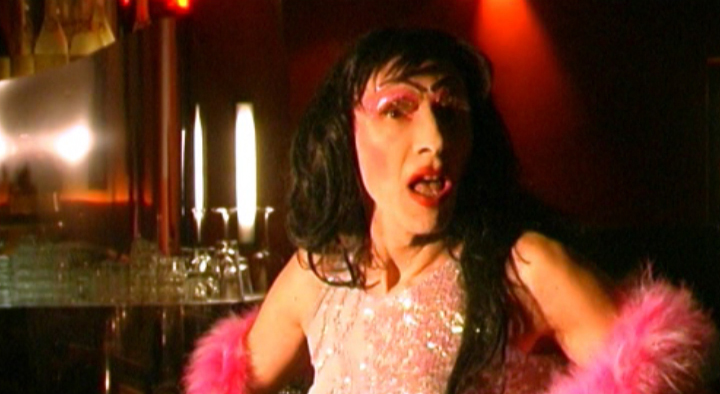
Drama, thriller, by Fabio Del Greco, Italy, 2010.
Luca is poor and works, precariously, as a waiter. He lives a problematic relationship with his girlfriend, and his life is full of doubts. One day Luca meets Chiara, a friend who had studied philosophy with him at university. She has realized her dream of opening a night and is now well-off. Luca leaves everything behind and starts a relationship with Chiara. He manages the nightclub with her and, thanks to the cocaine and call girls sold to politicians, he gets out of his hard economic situation. But Chiara does not manage to obtain the contract for an old furnace, so she blackmails Saverio, a member of the Parliament. Chiara owns a video in which Saverio has sexual intercourse with a transsexual.
LANGUAGE: Italian
SUBTITLES: English, French, Spanish, German, Dutch, Portuguese.
A Country That Lied to Itself
You are standing in a voting booth in the spring of 1948, and the choice in front of you is not really a choice. The posters outside told you that a vote for the left was a vote for Moscow, that priests would be defiled, that your children would be taken. The Vatican had issued a pastoral letter. The CIA had spent approximately sixty-five million dollars — the largest covert electoral operation in its history to that point — to ensure that the Christian Democracy won. It won with 48.5 percent of the vote. It would not lose national power for the next forty-six years.
What followed was not governance in any recognizable sense. It was the slow construction of a parallel state, one that wore the costume of parliamentary democracy while operating through an entirely different logic. The Christian Democracy, the Democrazia Cristiana, did not govern by persuading citizens. It governed by making itself indispensable — through the capillary distribution of favors, jobs, contracts, and protections that reached from the ministries of Rome down to the smallest municipal office in Calabria or Veneto. Sociologist Gianfranco Pasquino, writing in the 1980s, identified this not as corruption in the ordinary sense but as the systemic colonization of the state by a single party, a phenomenon he called partitocrazia — the rule not of citizens but of party machines. The distinction matters enormously, because colonization does not feel like theft. It feels like the normal texture of daily life.
The numbers make the architecture visible. Between 1948 and 1994, Italy held seventeen national elections and produced forty-nine governments, with an average duration of less than a year each. This instability was not chaos — it was a deliberate feature. Rapid cabinet turnover ensured that no individual politician accumulated enough institutional power to threaten the party’s vertical control, while the party itself remained constant, its secretariats and factional networks persisting beneath the surface churn. The sociologist Robert Putnam, in his 1993 study Making Democracy Work, demonstrated through decades of regional data that the south of Italy had developed civic cultures almost entirely organized around vertical dependency rather than horizontal trust — a pattern he traced not to individual moral failure but to centuries of extractive governance that the postwar republic had not interrupted but inherited and extended.
And underneath all of this ran the American guarantee. The United States had decided, without consulting Italians, that Italy could not be permitted to arrive at communism democratically. This decision, formalized through National Security Council directive NSC 1/2 in 1948, authorized ongoing covert support for anti-communist political forces that continued well into the 1970s. The practical consequence was that the Italian left — which by the early 1970s commanded roughly a third of the national electorate — was structurally excluded from governing. A democracy in which one-third of voters cannot access power is not a democracy with a flaw. It is a managed performance of democracy. The philosopher Cornelius Castoriadis argued in L’institution imaginaire de la société, published in 1975, that every society institutes itself through the meanings it refuses to examine — the foundational agreements that cannot be questioned because questioning them would dissolve the social order. Italy had instituted itself on precisely such an agreement: that the appearance of democratic competition was sufficient, that the form could substitute for the substance, that the ritual of elections could coexist with the permanent foreclosure of certain political outcomes.
What this produced, over decades, was a population trained in a specific and corrosive form of literacy. Italians learned to read the official language and simultaneously know that it meant something else. They learned that the state made promises it did not intend to keep, that laws existed alongside the real arrangements that superseded them, that power spoke one language in public and another in the room where decisions were actually made. This was not cynicism as a personality trait. It was a survival skill, transmitted across generations, normalized into something that no longer even felt like compromise.

The Intellectual as Diagnostic Instrument
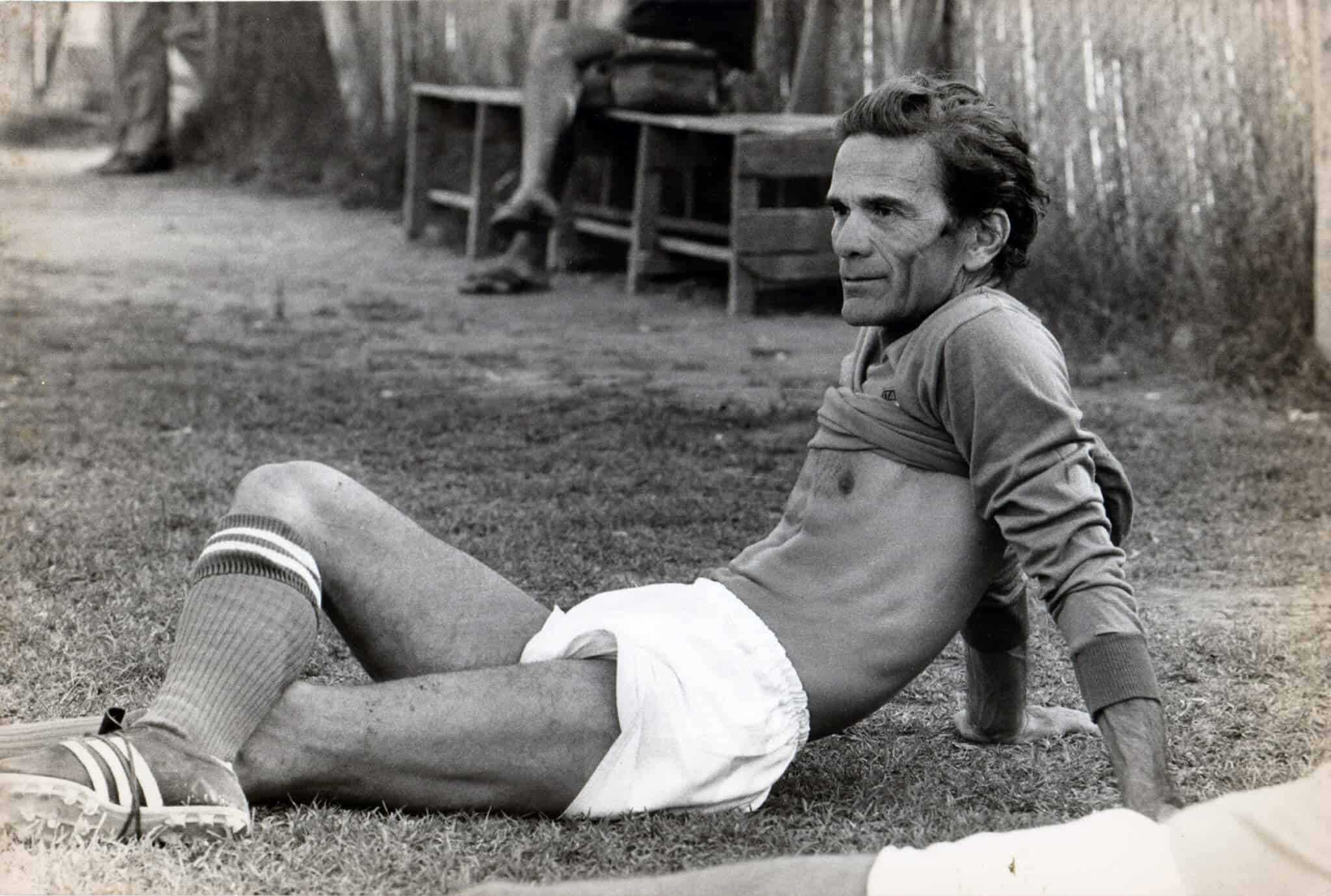
You read the newspaper at the breakfast table and feel vaguely informed. The words arrive in a language that has been pre-digested, pre-sorted, made compatible with the time you have available before work. What you do not notice — what you cannot notice, because the mechanism is inside the very act of reading — is that the language itself has already decided what can be thought. Pier Paolo Pasolini noticed. And the noticing was not a political opinion. It was a diagnostic act, the way a physician reads a body not by asking how the patient feels but by measuring what the patient can no longer do.
In 1974 and 1975, Pasolini published a series of essays in the Corriere della Sera that unsettled readers not because they were radical but because they were precise. Italian intellectuals were accustomed to ideological combat, to positions declared and defended. Pasolini was doing something different. He was performing epistemology in public — asking not what had happened to Italy but what kind of instrument you would need to even perceive what had happened. The essays were collected posthumously as Scritti corsari in 1975, and what runs beneath all of them is a single, disturbing proposition: that the transformation of Italian society under postwar consumer capitalism had been more thorough, more annihilating, than anything the fascist regime had accomplished across twenty years of deliberate cultural engineering. Mussolini had wanted to produce a new Italian. He had failed. The television set and the supermarket had succeeded where the blackshirt had not.
The concept Pasolini used to name this transformation was antropologia — not in the academic sense but in the sense of the total texture of a living body embedded in a specific place, speaking a specific dialect, carrying a specific set of gestures inherited from a particular social formation. He watched this texture dissolve. The regional dialects of Italy, which had survived centuries of invasion, unification, and war, were being homogenized by a national television culture that rewarded a single phonetic standard and punished deviation as backwardness. The bodily comportment of southern peasants, the micro-economies of knowledge embedded in how a Friulian farmer moved through a field or a Neapolitan street vendor negotiated a price — these were not folkloric curiosities to Pasolini. They were epistemological systems, ways of knowing the world that were being replaced, not by something richer, but by something emptier dressed in the costume of abundance.
The distinction he drew between sviluppo and progresso is where the argument becomes genuinely dangerous to comfortable thinking. Development — sviluppo — is measurable: GDP growth, car ownership rates, the spread of refrigerators into working-class homes, the percentage of households with access to credit. Italy’s economic miracle of the late 1950s and 1960s produced these numbers in spectacular quantities. Progress — progresso — would have required something else entirely: an expansion of the conditions under which a human being could think differently, live differently, refuse differently. What Pasolini observed was that sviluppo had been mistaken for progresso so completely, so structurally, that the mistake was no longer visible as a mistake. It had become the definition of improvement itself. To question it was not to raise a political objection. It was to speak a language that the culture had ceased to contain.
This is the move that separates Pasolini from the ordinary dissident. He was not arguing against the system from a position outside it. He was arguing that the system had consumed the outside — that the categories of critique available to an Italian in 1974 were themselves products of the transformation being critiqued. The corruption he would later name in his final, unfinished writings was not merely the corruption of politicians taking bribes. It was the corruption of the perceptual apparatus itself, the slow replacement of a capacity to see with a trained incapacity to look anywhere the light had not already been arranged.
Power Without a Face
You are standing in a courtroom where the judge, the prosecutor, and the defendant all belong to the same club, attended the same dinners, and will retire to the same country houses. No one needs to pass a note. No one needs to make a call. The verdict is already ambient, the way humidity is ambient — not decided, simply present in the air that everyone breathes.
This is not corruption in the conventional sense, meaning a deviation from a functioning standard. Hannah Arendt, writing in 1951 in The Origins of Totalitarianism, made a distinction that most political science has since buried: the difference between a system that fails its own principles and a system whose principles were always something other than what it advertised. The Italian postwar republic advertised democracy. What it constructed, under American strategic pressure and Vatican cultural dominance, was a managed containment — a structure whose primary engineering goal was not representation but the permanent disqualification of the left. The Democrazia Cristiana did not enter a clean machine and soil it. It was the machine, built precisely to run on what outsiders would call grime.
Michel Foucault, in his lectures at the Collège de France between 1975 and 1976, published later as Society Must Be Defended, formalized what he called the shift from sovereign power to biopower — the move away from the king’s visible, spectacular authority toward a diffuse governance of populations, of norms, of what counts as livable life. What made Italian Christian Democracy so architecturally sophisticated was that it operated in exactly this register before Foucault had named it. Power was not exercised through decrees or arrests, at least not primarily. It was exercised through employment, through the routing of a pension, through the decision about which neighborhood received running water and which did not, through the recommendation letter that existed only if the right parish had been attended. It was power operating below the threshold of spectacle, precisely where accountability cannot reach because no single act is visible enough to condemn.
The genius of absorption — and it was, structurally speaking, a genius — was that it did not need to eliminate its opponents. It needed only to employ them. A union leader offered a position in a state-adjacent agency becomes something more complex than a collaborator: he becomes someone with a mortgage, with colleagues, with obligations that did not exist before the offer. By 1975, Italy’s state-controlled sector employed approximately 1.7 million people through the labyrinthine system of enti pubblici and partecipazioni statali, a figure that does not include the informal dependencies created through public contracts, licensing systems, and municipal patronage. Opposition, inside this architecture, was not suppressed. It was metabolized. The left that remained outside faced not a wall but a slow gravitational pull — an economy of favors so total that refusing it meant accepting a kind of civil poverty.
What Pasolini understood, with the fury of someone watching from the outside and the grief of someone who had grown up inside the same Catholic culture that fed the machine, was that this system did not produce cynics. It produced believers. The functionary who routed a contract to his cousin was not, in his own self-understanding, corrupt. He was loyal. He was maintaining the social fabric. The vocabulary of corruption requires a prior vocabulary of neutrality — a belief that there exists a procedural space empty of allegiance. Italian Christian Democracy, inheriting centuries of Church governance in which every human exchange was also a spiritual one, simply never built that space. The neutral zone did not exist. Every act was already embedded in a web of obligation that made the word bribe almost grammatically incorrect — because a bribe implies you were owed something else first, something clean, something that the system had simply never promised to deliver.
The Petrolio Manuscript and the Unspeakable
You are reading a manuscript that was never meant to be finished — not in the way a writer abandons a project from exhaustion or distraction, but in the way a deposition gets interrupted by the sound of a door opening. Pier Paolo Pasolini left Petrolio in fragments when he was killed in November 1975, and the incompleteness of the text is not a literary condition. It is a forensic one.
The novel, if one can call it that, circles obsessively around the Italian energy sector in the postwar decades — specifically around ENI, the state-owned hydrocarbon company that had become, under Enrico Mattei, one of the most politically autonomous institutions in the republic. Mattei died in October 1962 when his private plane disintegrated over Bascapè, in Lombardy. The official version held mechanical failure. Decades of subsequent investigation established that the plane had been sabotaged. By whom and on whose orders remains, in any strict legal sense, unresolved — though the convergence of interests hostile to Mattei included the major Anglo-American oil companies he had openly defied, factions within Italian intelligence, and networks with documented connections to organized crime operating under political protection. Pasolini knew this, or knew enough of it to write a novel in which a fictional analog of Mattei’s death appears not as tragedy but as policy.
What Pasolini understood about ENI was structural, not conspiratorial in the tabloid sense. Mattei had built the company into a sovereign instrument, negotiating directly with postcolonial governments in North Africa and the Middle East, cutting deals that bypassed the cartel arrangements the so-called Seven Sisters had spent decades cementing. This made him not merely inconvenient but systemically dangerous to an international energy order whose profits depended on precisely the kind of price discipline and market capture he was dismantling. His death, within this logic, was not an aberration. It was the system correcting itself.
Petrolio handles this not through exposition but through a kind of doubled realism — a narrative voice that is simultaneously fictional and testimonial, characters who exist both as invention and as transparent transpositions of living figures in Italian industrial and political life. The manuscript contains what Pasolini himself described, in letters and interviews from the early 1970s, as a “scandalous document”: a section dealing directly with the criminal implication of specific individuals at the intersection of ENI, the Christian Democratic party, and the covert security apparatus. One section of the manuscript, titled Nota 21, was missing from the papers found after his murder. It has never surfaced. The absence is not neutral.
The philosopher Giorgio Agamben, writing on testimony and its limits, observed that the true witness to catastrophe is precisely the one who cannot speak — that the survivor’s account is always partial because the complete account would require occupying the position of the one who did not survive. Petrolio enacts this epistemologically. The text knows more than it can say in the form of a finished novel. Its fragmentary condition is not a stylistic choice but the material trace of a historical situation in which completion was genuinely dangerous. This is different from the romantic notion of the unfinished masterpiece. It is closer to what a lawyer means when she says a document has been spoliated.
The Italian state’s relationship to its own industrial infrastructure in the postwar period was never what it was publicly described as being. The language of national development, of sovereign energy policy, of democratic planning — this language coexisted with a parallel architecture of decision-making in which businessmen, intelligence officers, politicians, and criminal intermediaries met in spaces that had no official record. Pasolini was writing about those spaces. He was naming, in disguised but not unrecognizable form, the people who inhabited them. And the manuscript was still on his desk when someone drove him to a beach outside Ostia and left him there in the dark.
A vision curated by a filmmaker, not an algorithm
In this video I explain our vision
What the Borgate Knew

You walk into a courtyard in Torpignattara sometime around 1955 and you understand immediately that no one here is waiting to be saved. The laundry hangs between windows with the pragmatism of a flag — not decorating anything, just drying. The children invent games from rubble. The men who have work talk about it with a specific exhaustion that is not complaint but information. This is a world that has already computed the terms of its exclusion and organized its life around that computation with extraordinary precision.
Pasolini spent years in these courtyards. Not as a documentarian, not as a journalist, but as someone genuinely altered by what he found there. The borgata — those peripheral Roman settlements built hastily under Fascism to house the poor expelled from the historic center — were not slums in the sociological sense of failed urbanization. They were something more structurally interesting: zones that consumer capitalism had not yet managed to absorb and homogenize. The postwar Italian economic miracle, which between 1958 and 1963 doubled industrial production and tripled the number of private automobiles, had not yet reached these courtyards with its full grammar of desire, debt, and aspiration. The borgata existed in a temporal gap, and in that gap its inhabitants had developed a relationship to reality that was stripped of the consoling fictions available to those with more to lose.
Antonio Gramsci, writing in his prison notebooks through the 1930s, had tried to theorize what he called subalternity — not simply poverty, but the specific cognitive and political condition of those systematically excluded from the dominant culture’s self-representation. The subaltern, for Gramsci, did not simply lack power; they possessed a fragmented, provisional, and often unspoken knowledge of how power actually operated, precisely because they encountered it without the insulation that class privilege provides. They felt the machinery directly, without cushioning, and their understanding of it was therefore more tactile, more accurate, and less susceptible to the ideological laundering that the middle classes performed on their own experience. What Pasolini found in Torpignattara and Pietralata and the other borgata was this knowledge in living form.
The language itself was evidence. The Roman dialect spoken in these neighborhoods carried within its grammar a worldview that distinguished sharply between official speech and true speech, between what institutions said and what everyone knew those institutions were actually doing. There was a whole vocabulary for the various categories of pretense — for the gesture that performs generosity while extracting obedience, for the promise made in public that everyone present understood would not be kept, for the powerful man who arrives in the neighborhood before an election and whose real purpose is legible to every person over fourteen before he opens his mouth. This was not cynicism as a philosophical posture. It was literacy. These people read the State the way a sailor reads weather — not academically but for immediate survival.
The Christian Democrats, who governed Italy for nearly the entire postwar period through a system of patronage so elaborate that political scientists like Giorgio Galli spent entire careers mapping it, relied structurally on the poverty of these neighborhoods even while performing concern for it. The borgata resident who accepted a favor from the local party functionary was not naive about the transaction. He understood its logic with perfect clarity. He understood that the favor created a debt, that the debt would be called in at the ballot box, and that the ballot box would produce a government that would ensure he needed another favor next time. He accepted because the alternative was nothing, not because he believed the story being told about him.
What Pasolini saw — and what made him unbearable to the respectable left as much as to the right — was that this knowledge, so precise and so earned, had no channel into political consequence.
The Trial That Never Happened
You are sitting in a courtroom in Rome in 1976, watching a seventeen-year-old boy named Pino Pelosi receive a sentence of nine years and two months for the murder of a man whose name was already a cultural monument. The verdict arrives with an administrative tidiness that should have alarmed everyone in the room. One boy, one crime, one night, one body found in the mud at Ostia on November 2, 1975. The math was too clean for a death that violent, and the wounds on Pasolini’s body told a geometry that a single adolescent could not have drawn.
Forensic pathologists who reexamined the physical evidence decades later identified fracture patterns and contusion distributions inconsistent with a single attacker. The degree of force applied to the skull, the arrangement of tire marks across the torso, the spatial logic of the scene itself — these pointed toward coordinated action, multiple bodies moving in sequence. Pelosi himself, in 2005, thirty years after maintaining his lone-guilt story, changed his account and described men with southern accents, men he did not know, men who threatened his family into silence. He named no one. He could not, or would not. The threshold between those two possibilities is where the real history lives.
The Banda della Magliana, the Roman criminal organization whose operations wound through the city from the mid-1970s into the early 1990s, maintained documented connections to factions of Italian intelligence services, to elements of the neofascist underground, and to the Sicilian Mafia’s mainland operations. Investigators working the 1992 reopening of the Pasolini case found threads that ran directly into that network — not proof of a commissioned murder, but proximity so dense it collapsed the distinction between coincidence and design. The organization had already been implicated in the 1978 kidnapping and execution of Aldo Moro, in the 1982 murder of Roberto Calvi under Blackfriars Bridge in London, and in the theft of documents from the Vatican Bank. It was not a criminal enterprise operating outside the Italian state. It was, in the language of the parliamentary commission that later investigated it, a third level — below politics, below organized crime, below the intelligence apparatus, and threaded through all three simultaneously.
What Pasolini had diagnosed as a system — the merging of power, capital, and manufactured consent into a single unaccountable force — was not a metaphor. It had organizational form, bank accounts, couriers, and kill lists. The Corsera dei Fanciulli, the Eni scandal, the real estate developments consuming the Roman periphery he documented in his poetry: these were not symptoms of isolated corruption. They were outputs of a machine whose engineering became partially visible only when the Mani Pulite investigations broke open in Milan in February 1992, seventeen years after his death. By the time Antonio Di Pietro began issuing arrest warrants that would eventually reach seven thousand individuals, destroy five political parties, and remove the entire postwar ruling class from power, Pasolini had been dead long enough to be considered prophetic rather than dangerous. The safely dead are easier to honor than the inconveniently living.
The Tangentopoli revelations — tangente meaning kickback, poli meaning cities, the system of institutionalized bribery that had financed Italian political life since at least the 1950s — confirmed in court testimony what he had argued in newspaper columns, in films, in spoken depositions addressed to journalists and magistrates alike. The Christian Democratic Party, the Socialist Party, the industrial consortia, the state contracting system: the entire architecture of postwar Italian legitimacy was a transaction, continuous and self-renewing. He had named it without the wiretap transcripts, without the Swiss bank records, without the cooperative witnesses. He named it from observation, from the face of a politician he passed on television, from the body language of a country that had traded its poor for its prosperity and then pretended the trade had been voluntary.
The question that the 1992 investigations could not answer — and did not try to answer — was whether the man who had seen all of this most clearly had been killed for seeing it.
The Citizen Who Recognizes Nothing
You are standing in a voting booth, pencil in hand, and the names on the paper mean almost nothing to you — not because you are ignorant, but because the architecture of the choice itself has been designed to exhaust meaning before you arrive at it. The candidates exist within parties that exist within coalitions that exist within funding structures that exist within interests that no ballot ever names. You mark a box anyway. You fold the paper. You leave. And the sensation that follows is not quite guilt and not quite compliance — it is something closer to the recognition that the gesture was real and the stakes were not, or that the stakes were real and the gesture was not, and that you cannot tell which.
Italy did not invent this condition, but it refined it to a degree that functions almost as instruction. The years between 1992 and 1994, when the Mani Pulite investigations dismantled the First Republic and revealed that roughly 15,000 politicians and businesspeople had operated inside a systemic bribery network involving sums estimated at over 4 billion dollars, produced not a restructured political culture but a renamed one. The parties dissolved and reconstituted under new labels. The beneficiaries of the old system migrated into the new formations. The word “tangente” — kickback — remained in everyday speech as a kind of historical admission that changed nothing structurally, because the admission was collective and therefore anonymous, and anonymity at scale is the perfect solvent for accountability.
What this produces across generations is a particular species of citizen: one who is neither deceived nor engaged, but habituated. The sociologist Robert Putnam, in his 1993 study of Italian regional governments “Making Democracy Work,” documented the striking correlation between civic participation, institutional trust, and the historical depth of associative life in northern communes versus the feudal dependency structures of the south — a distinction that was never simply geographic but was the long shadow of who had been allowed to trust whom, and for what purposes, over centuries. Distrust, Putnam’s data suggested, is not a personality trait. It is a learned institutional inheritance, transmitted not through language but through experience repeated until it becomes expectation.
The expectation is this: that naming what is actually happening will cost you something. Not in the way it cost Pasolini, whose body was found on a beach in Ostia in November 1975 under circumstances that have never been fully clarified despite decades of reinvestigation. The cost now is quieter and more efficient. You are not prosecuted. You are not silenced. You are reclassified. The person who speaks with precision about structural corruption becomes a polemicist, a pessimist, a figure of entertainment or irritation — present in the conversation but somehow exempt from it, because the conversation has agreed in advance that clarity at that register is a form of excess. You are visible and irrelevant simultaneously, which is a more elegant management of dissent than any prosecution.
This is what makes the inheritance so difficult to name: it does not feel like inheritance. It feels like realism. The person who has absorbed a political culture built on untransparency does not experience themselves as defeated — they experience themselves as lucid. They know how things work. They have no illusions. And that absence of illusion is worn as a kind of dignity, when it is in fact the final product of a system that has successfully convinced its subjects that the distance between what is said and what is done is a law of nature rather than a political construction maintained by specific people for specific reasons at a specific and calculable cost to everyone else.
The question that remains is not whether you can see the system clearly. The question is what you are prepared to do with clarity in a world that has learned to make clarity socially uninhabitable — and whether that preparation itself is already being managed by the very structure you believe you are seeing through.
🔥 Power, Corruption, and the Poet as Witness
Pier Paolo Pasolini’s relentless confrontation with Italian political corruption was inseparable from his broader critique of bourgeois society, consumerism, and the betrayal of the Italian left. His work positioned the poet as a moral witness against the slow rot of institutions and the homologation of culture. These articles trace the intellectual landscape surrounding his uncompromising vision.
Pier Paolo Pasolini and the Roman Suburbs
Pasolini’s engagement with the Roman suburbs was never merely sociological but profoundly political, mapping the margins of a society corrupted by postwar capitalism and Christian Democratic power. His borgata novels and films exposed how the underclass was exploited and ultimately destroyed by the very modernity that promised liberation. To understand Pasolini’s accusations against Italian corruption, one must first understand the landscape of human wreckage he documented on Rome’s periphery.
GO TO THE SELECTION: Pier Paolo Pasolini and the Roman Suburbs
Pier Paolo Pasolini and Poetry: Language and Identity
Pasolini’s poetry in Friulian dialect was a deliberate political act, a refusal of the standardized national language he associated with the homogenizing power of Italy’s ruling classes. Language for him was never neutral — it carried the fingerprints of those who wielded institutional and economic power. His poetic identity was therefore the foundation upon which his later, more explicit denunciations of Italian corruption would rest.
GO TO THE SELECTION: Pier Paolo Pasolini and Poetry: Language and Identity
Antonio Gramsci: vita e pensiero politico
Antonio Gramsci‘s concept of cultural hegemony provided Pasolini with one of his most essential intellectual tools for diagnosing Italian political corruption as something deeper than mere illegality. Gramsci argued that ruling classes maintained power not only through force but through the subtle colonization of popular culture and common sense. Pasolini extended this insight into his furious indictment of Italy’s postwar political class and its complicity with media, industry, and the Church.
GO TO THE SELECTION: Antonio Gramsci: vita e pensiero politico
Balestrini’s We Want Everything: Analysis
Nanni Balestrini‘s novel We Want Everything captures the revolutionary fervor of the Italian factory workers’ movement that Pasolini observed with both sympathy and deep ambivalence. The Hot Autumn of 1969 and the broader cycle of workers’ struggles laid bare the structural violence of Italian capitalism that Pasolini had long denounced from his own cinematic and journalistic platform. Reading Balestrini alongside Pasolini reveals the full spectrum of voices raised against Italy’s entrenched political and industrial corruption in those explosive years.
GO TO THE SELECTION: Balestrini’s We Want Everything: Analysis
Cinema as Political Courage
Pasolini believed cinema could be a weapon of truth against power — and that tradition lives on. On Indiecinema you can discover independent and auteur films that carry the same uncompromising spirit, refusing to look away from the world as it really is. Explore our streaming catalog and find the films that make you think, resist, and feel.
👉 EXPLORE THE CATALOG: Watch Indie Films in Streaming
A vision curated by a filmmaker, not an algorithm
In this video I explain our vision

