
The Exhausted Center
You eat, and nothing happens. Not in the way hunger is satisfied — you consume the meal, you clear the plate, you even taste it, somewhere between the first and third bite, before the motion becomes automatic and the fork moves without you. And afterward there is that particular flatness, not fullness exactly, not emptiness either, something between the two that has no clean name. You sit at the table after and feel vaguely cheated, as though the food passed through without making contact, as though your body received the delivery but nobody was home to sign for it.

This is not a story about eating disorders or nutritional deficiency in any clinical sense. This is something older and stranger. It is the experience of a center that processes without transforming, that takes in without converting, that turns the wheel but generates no light. Millions of people move through this daily and have no language for it beyond fatigue, beyond brain fog, beyond the soft and culturally acceptable complaint of being tired all the time. They sleep and wake exhausted. They rest without restoring. They pour energy into their days and find the account perpetually overdrawn, not dramatically, not catastrophically, just chronically, quietly, in the specific way that wears a person down to something translucent.
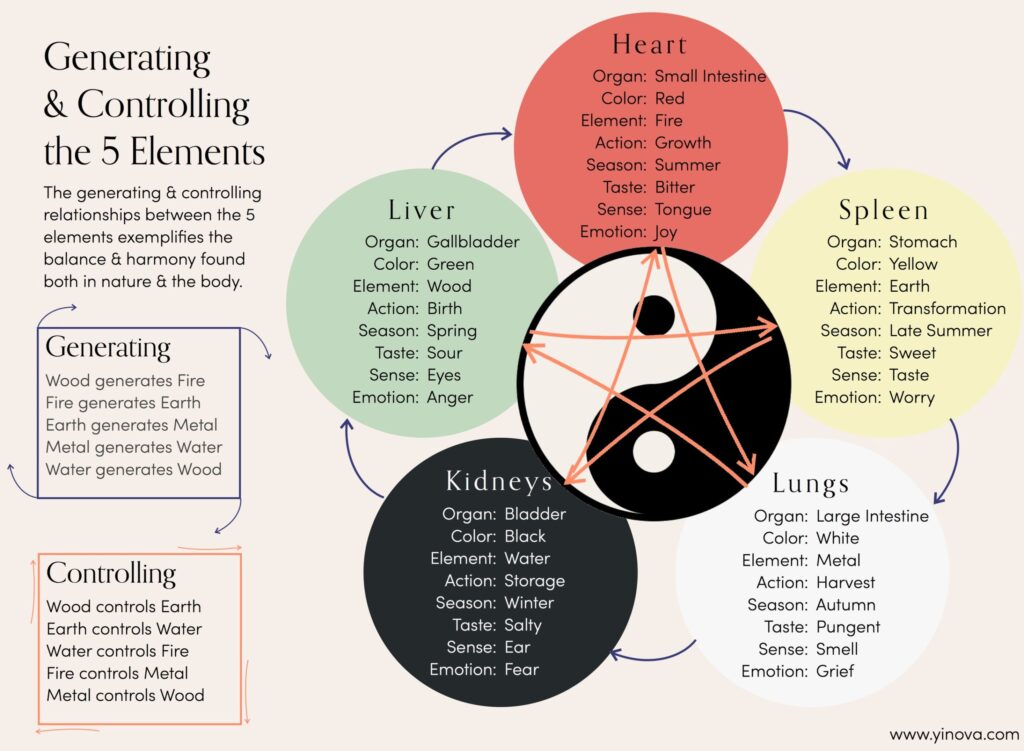
Chinese medicine has a name for the architecture of this experience, and the name is not a metaphor. The Spleen and Stomach in classical East Asian medicine constitute what is called the Central Earth, the pivot of the middle, the axis around which the generation of blood and vital energy organizes itself. Li Dongyuan, the twelfth-century physician whose 1249 treatise Pí Wèi Lùn — the Treatise on the Spleen and Stomach — remains one of the foundational documents of internal medicine, argued that the majority of chronic illness originates not in external invasion but in the collapse of this center. He was writing in a period of catastrophic social disruption, the Mongol conquest of northern China, watching populations starve, grieve, labor beyond their limits, and he noticed that what broke first was not the heart, not the lungs, not the kidneys. It was the middle. The capacity to transform.
The Stomach receives. The Spleen transforms and transports. Together they are responsible for what classical texts call the generation of post-heaven essence — the vital substance extracted from food and breath that fuels every subsequent function in the body, the production of blood, the maintenance of the organs, the clarity of thought, the stability of mood. When this axis weakens, everything downstream weakens with it. Blood becomes insufficient. Energy fails to rise. The mind clouds. The limbs grow heavy. The person continues to function in a technical sense, continues to show up and perform, but something has quietly gone out of the center, the way a fire burns without producing heat, the way a lamp glows without illuminating anything.
What Li Dongyuan understood, and what Western biomedicine is only beginning to articulate through research into the gut-brain axis and mitochondrial function, is that the digestive center is not merely a mechanical processing unit. It is the site where the outside world becomes the self. Where the foreign is made familiar. Where matter is converted into meaning, biochemically speaking. When that conversion fails, when the transformation is incomplete, you get the specific modern condition that has no satisfying diagnosis: adequate input, insufficient output, a person who consumes everything the culture prescribes — the food, the sleep, the productivity, the wellness — and remains, somehow, perpetually unfed.
Earth as Origin, Not Metaphor
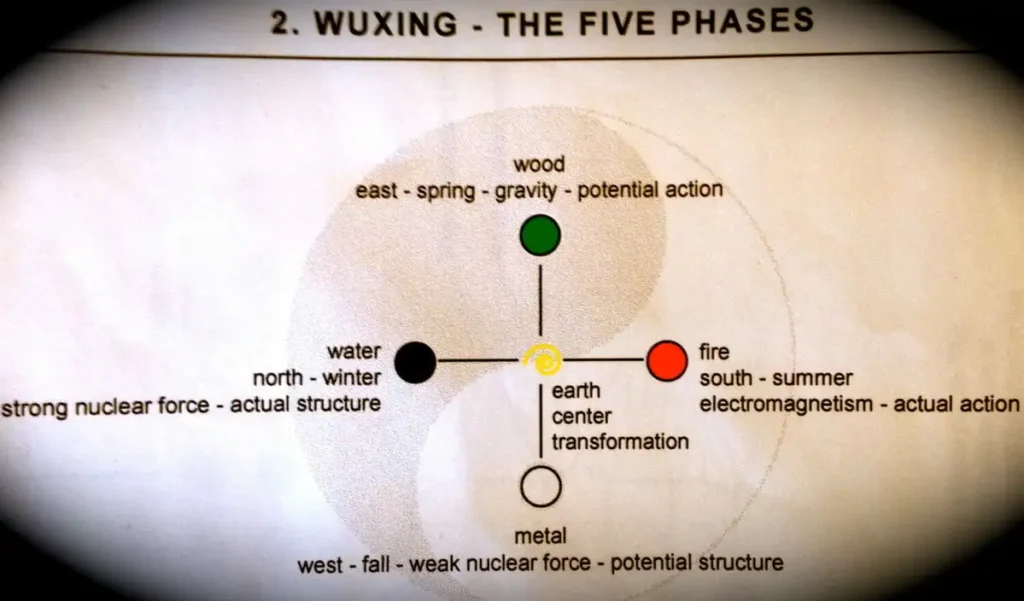
There is a word in classical Chinese that does not translate cleanly into any European language: wei, the position of the center that is also the condition of balance. Not balance as equilibrium between two opposing forces, but balance as the ground from which all forces become possible. In Five Element theory, Earth does not sit at the end of a sequence. It sits in the middle of everything, and that positional fact is not decorative. It is the entire argument.
The other four phases — Wood, Fire, Metal, Water — move through time in recognizable cycles of generation and control. Earth alone occupies the axis. In some classical texts it governs the transitional period between each season, the eighteen days before the next phase begins, the pause in which transformation itself is prepared. The Spleen and Stomach are its organs, and their function is described with a word that Western medicine has no equivalent for: yunhua, which means simultaneously to transport and to transform. Not to receive and pass along, like a pipe. To receive and change the nature of what has been received, to convert raw material into something the body can recognize as its own. This is not digestion in the biochemical sense. It is ontological work.
Simone Weil, writing in the early 1940s as France collapsed under the weight of its own moral vacancy, described rootedness as the most important and least recognized need of the human soul. She was not speaking metaphorically about trees. She was speaking about the specific conditions under which a human being can draw nourishment from what surrounds them — from land, from work, from community, from continuity with the past. When those conditions are severed, she argued, the person does not simply become unhappy. They become incapable of a particular kind of aliveness. The Need for Roots was published in 1949, the year after her death, and in it she identified what she called uprootedness as the most dangerous malady of modern society, one that propagates itself by contagion, just as certain diseases do. The Spleen in classical Chinese medicine is vulnerable to precisely this contagion. It weakens under dampness, under overthinking, under the exhaustion of a life that demands constant processing without ever providing real ground.
Ivan Illich, thirty years later and from a different direction entirely, arrived at the same site. His critique of what he called counterproductive institutions — hospitals that produce iatrogenic illness, schools that produce certified ignorance, transportation systems that consume more time than they save — extended naturally to food systems that produce malnutrition through abundance. He saw industrial nourishment not as a failure to feed people but as a structural replacement of feeding with something that mimics it. The form of eating remains. The act of being nourished disappears. What the body receives no longer carries the information that food, in its traditional form, always carried: where it came from, who tended it, what season required it, what body of knowledge shaped its preparation.
A man sits at a table somewhere in the middle of a fluorescent afternoon, opening a container of something that is warm and present and utterly without origin. He eats it efficiently. He is not hungry afterward, not in the way that would mean satisfaction. He is simply no longer acutely aware of the absence. There is a difference between those two states, and the difference is exactly what the classical texts mean when they distinguish between the Stomach receiving and the Spleen transforming. The food arrived. The transformation did not happen. The center held nothing.
This is what it means for Earth to fail — not dramatically, not all at once, but in the slow accumulation of meals that fed the body and starved the axis.

Blood Is Not a Metaphor Either
There is a woman sitting in a waiting room, third chair from the window, hands folded in her lap with the careful stillness of someone who has learned to spend energy only when absolutely necessary. Her face is not sad. It is simply absent of color in the way that certain winter afternoons are absent of light — not dramatic, not suffering, just drained of whatever pigment once signaled presence. She will tell the doctor she is tired. The doctor will tell her her blood work is “within normal range.” She will go home and wonder, quietly, whether she is simply weak of character.
This is where Georges Canguilhem becomes indispensable. In his 1943 work “The Normal and the Pathological,” he argued that norms are not discovered in nature but constructed by the systems that have a vested interest in defining what counts as functional. What contemporary medicine calls “normal range” for hemoglobin or ferritin is a statistical average drawn from populations already compromised by industrial diets, chronic stress, and disrupted sleep. The woman in the waiting room is not well. She is merely average. These are not the same thing.
Classical Chinese medicine had been thinking about this distinction for roughly two thousand years before Canguilhem named it. The Spleen, in its classical understanding, is the organ responsible for what the tradition calls transformation and transportation — the conversion of food and drink into the refined substances the body actually uses. Gu Qi, the energy extracted from food, rises to meet Kong Qi, the breath drawn from air, and together, mediated by the Heart, they become Blood. Not metaphorically. The process is physiological, sequential, and entirely dependent on the functional vigor of Spleen Qi as the initiating force. When that force weakens, Blood production falters. The person does not simply feel tired. They become, at the cellular level, less.
Paul Pitchford spent decades mapping this territory where Eastern energetic medicine and Western nutritional biochemistry converge. His monumental work “Healing with Whole Foods,” which grew through multiple editions from 1993 onward, documents how the foods the Chinese tradition classifies as tonifying to Spleen and Stomach — congee made from whole grains, root vegetables, legumes prepared with warming spices — correspond precisely to the nutrient profiles contemporary research identifies as necessary for sustained hematopoiesis. Iron, folate, B12, zinc — the cofactors of blood-building — arrive in the body not as isolated supplements but embedded in a matrix of fiber, enzymes, and secondary compounds that determine their bioavailability. A diet of processed food does not merely lack nutrients. It actively disrupts the absorptive capacity of the digestive lining, which is to say it damages the very mechanism the Spleen governs. The center stops generating not because nothing is consumed but because nothing is converted.
What this produces in a living person is not simply fatigue. It is the scattered quality of someone whose mind cannot hold a thought to its conclusion, whose anxiety has no object, whose sleep does not restore. Wei Qi — the defensive energy the tradition says is produced by the Spleen and distributed across the body’s surface — diminishes, and with it the immune coherence that keeps external pathogens from finding easy entrance. The pallor, the loose stool, the tendency to bruise easily, the sense of floating slightly outside one’s own life — these are not personality traits. They are a center that has stopped generating what the periphery requires to remain whole.
The woman in the waiting room is not weak. Her Spleen is not transforming. That is a physiological statement, and it demands a physiological response — not reassurance, not antidepressants prescribed to fill the silence where a proper diagnosis should have been.
The Social Architecture of Depletion
There is a particular kind of exhaustion that has no single cause. You wake up already tired. You eat, but something in the eating feels mechanical, joyless, like refueling a machine you are no longer sure you believe in. The food is technically present — calories, macronutrients, the whole arithmetic of modern nutrition — and yet the body receives it the way a flooded field receives rain: nowhere left to absorb, nowhere left to go.
This is not a personal failure. It is an architecture.
Byung-Chul Han, writing in 2010, identified something that practitioners of Chinese medicine had been observing in their clinics for decades without having quite this vocabulary for it. The achievement-subject, Han argues, is not oppressed by an external force. He oppresses himself. The transition from a disciplinary society to a performance society means that the whip has been internalized, invisible, wrapped around the will like a second nervous system. You cannot rebel against a command that comes from inside your own ambition. You can only exhaust yourself against it, and then, in the exhaustion, find fresh reasons to feel inadequate. The Spleen, in classical terms, is the organ of sustained, gentle, purposeful transformation. It does not sprint. It ripens. And a culture that has abolished the category of ripening — that has replaced it with optimization, scaling, perpetual growth — is a culture that is, at a structural level, injuring the Central Earth in every body that participates in it.
The processed food industry is perhaps the most literal expression of this injury. What arrives in those packages is designed not to nourish transformation but to bypass it — hyperpalatable, nutritionally hollow, engineered to hit dopamine receptors without requiring the Spleen to do any real work. The result, clinically, is dampness: a kind of metabolic residue that accumulates when the digestive fire cannot complete its work, when the raw material given to it is too refined, too chemically altered, too far from what the organ evolved to handle. By 2022, ultra-processed foods accounted for more than fifty percent of daily caloric intake in several high-income countries. The Spleen is asked to make silk from plastic.
Then there is the question of sleep, which is not simply a biological function but has become, in liquid modernity — Zygmunt Bauman‘s term for the condition in which all stable structures dissolve, all identities become provisional, all ground shifts beneath the feet — a site of economic violence. To sleep is to be unproductive. The achievement-subject who sleeps eight hours is quietly suspected of insufficient hunger. The result is a population chronically operating in a state that Chinese medicine recognizes as Spleen Qi deficiency complicated by Liver overinvasion: the Wood element, associated with planning and striving and controlled tension, perpetually encroaching on the Earth it was never meant to dominate.
A man sits in a fluorescent office long after everyone else has left. He is not working anymore, not really. He is performing the posture of work, compulsively refreshing screens, unable to stop because stopping would require him to feel the full weight of what he is doing to himself. This is worry as metabolic event. Chinese medicine has always understood what neuroscience is only now quantifying: that chronic rumination, circular thinking, the loop that cannot close — these are not psychological states that incidentally affect the body. They are the body. The Spleen is the organ most sensitive to this loop. It generates thought and is destroyed by thought’s excess. In Bauman’s liquid world, where no decision is ever final, no identity ever secure, no future ever legible, the mind has nothing solid to rest its weight upon. And so it circles. And circling, it depletes the very organ that might otherwise generate the clarity to stop.
The monetization of worry is perhaps the most elegant cruelty of the system. Anxiety sells supplements, apps, retreats, diagnostic tests, self-optimization courses. The industry that profits from your depletion also profits from your attempt to recover from it. The Spleen, exhausted by the original injury, is then asked to metabolize the cure.
Nourishing the Center as a Political Act
There is something quietly radical about eating a warm meal at the same time every day. Not because of what the meal contains, but because of what the act refuses. It refuses the acceleration. It refuses the idea that nourishment is a problem to be optimized, a variable to be compressed, a inconvenience to be outsourced to a protein bar consumed standing over a sink at eleven in the morning. The body, in that moment of sitting down, of waiting, of chewing slowly, is making a claim that the system around it would prefer it not make.
Michael Pollan traced with considerable precision how this happened — how, across the twentieth century, the industrialization of food was not merely a logistical shift but an ideological one. The processed food industry did not simply change what people ate; it changed what people believed eating was for. It severed the act from its context, from seasonality, from preparation, from the social body gathered around a table. What had been a daily practice of transformation — raw material becoming nourishment, labor becoming sustenance — became instead a transaction. Calories in, energy out. Efficiency above all. And somewhere in that conversion, something that classical Chinese medicine had always considered the absolute center of physiological life was quietly dismantled.
Claude Lévi-Strauss understood that cooking was never merely technical. In his structural analysis of the culinary triangle, he argued that the movement from raw to cooked was one of the founding gestures of human culture — that transformation itself, the application of heat and time and intention to raw matter, was how a society expressed its relationship to nature and to itself. To cook was to think. To cook was to occupy a position between the natural and the cultural, to exercise a specifically human form of mediation. What happens, then, to a culture that has largely stopped cooking? What does it believe about transformation? What does it believe about time?
The Spleen and Stomach, in the classical framework, are precisely that — organs of transformation and transportation, the Earth axis around which all metabolic meaning rotates. They do not simply digest food. They generate Qi and Blood from what is received, they hold things in their proper place, they provide the energetic foundation from which thought, memory, and intention become possible. When they weaken — through cold food, irregular hours, chronic worry, relentless mental labor without physical rest — the center collapses. And when the center collapses, everything drifts. The limbs grow heavy, the mind fogs, the blood thins, the will loses its ground.
This is not metaphor. Or rather, it is metaphor that has refused to remain merely metaphorical, because it describes something people recognize in their bodies before they have any language for it. The exhaustion that sleep does not repair. The hunger that food does not satisfy. The sense of being somehow unmoored from oneself, functional but not quite present, producing but not quite alive.
To tonify the Spleen and Stomach — through warm, cooked food eaten at regular hours, through simplicity, through stillness after eating, through the radical act of not working through meals — is to rebuild something the extractive logic of modern productivity requires to remain broken. A person with a strong center is harder to exhaust, harder to anxietize, harder to sell things to. They have enough. They feel it in their gut. And that sufficiency, that groundedness, is quietly threatening to an economy architected around the perpetual sensation of lack.
Whether we can truly rebuild that center — not as a wellness practice purchased on weekends but as an actual reorganization of daily life against the current — remains the question that sits, unanswered, somewhere just below the sternum.
A vision curated by a filmmaker, not an algorithm
In this video I explain our vision
🌿 Nourishing the Body’s Inner Landscape
The Spleen and Stomach, known in Chinese medicine as the Central Earth, form the vital axis through which food transforms into blood and vital energy. Understanding this system opens a deeper conversation about how ancient traditions map the body’s invisible architecture and rhythmic intelligence. These related articles explore the energetic, meridian, and philosophical dimensions that surround and illuminate the Central Earth’s role in health.
The Organ Clock: Why Every Organ Has Its Time of Peak and Low Energy
Just as the Spleen and Stomach operate within a precise energetic window, traditional Chinese medicine teaches that every organ pulses with peak power at a specific hour of the day. The Organ Clock reveals this hidden temporal map, showing how timing meals, rest, and activity can harmonize with the body’s natural cycles. Understanding these rhythms is essential to supporting the digestive fire at the heart of Central Earth theory.
GO TO THE SELECTION: The Organ Clock: Why Every Organ Has Its Time of Peak and Low Energy
The 12 Energetic Channels: The Secret Map of Meridians in Body
The Spleen and Stomach do not work in isolation — they are embedded within a vast network of energetic channels that carry Qi throughout the entire body. The 12 Meridians form the secret map through which nourishment, transformed by the Central Earth, is distributed to every tissue and organ. Exploring this meridian system reveals why a healthy digestive center is the foundation of whole-body vitality.
GO TO THE SELECTION: The 12 Energetic Channels: The Secret Map of Meridians in Body
Vital Breath: if Your Qi is Blocked, Weak, or Scattered
When the Spleen and Stomach function optimally, Qi flows freely and abundantly, sustaining life with quiet strength. But when this central axis is weakened, Qi may become blocked, scattered, or depleted, manifesting as fatigue, poor digestion, and emotional imbalance. This article on Vital Breath examines the nature of Qi and how its disruption affects every layer of human experience.
GO TO THE SELECTION: Vital Breath: if Your Qi is Blocked, Weak, or Scattered
The Dance of Yin and Yang: Harmony Between Opposing Forces
Central Earth medicine is ultimately a practice of balance — between nourishment and depletion, activity and rest, Yin and Yang. The interplay of these opposing yet complementary forces governs how the Spleen and Stomach generate blood and energy from the raw material of food. Delving into the Dance of Yin and Yang enriches our understanding of why harmony within the digestive center is inseparable from harmony throughout the whole person.
GO TO THE SELECTION: The Dance of Yin and Yang: Harmony Between Opposing Forces
Discover the Inner Worlds of Independent Cinema
If these explorations of ancient wisdom and the body’s hidden energies resonate with you, Indiecinema streaming offers a curated universe of independent films that dive just as deeply into the mysteries of existence, consciousness, and the human condition. From meditative documentaries to visionary narratives, Indiecinema is your portal to cinema that nourishes the soul the way the Central Earth nourishes the body. Come explore films that dare to ask the questions that matter most.
👉 EXPLORE THE CATALOG: Watch Indie Films in Streaming
A vision curated by a filmmaker, not an algorithm
In this video I explain our vision

