The Crack in the Wall You Cannot Stop Looking At
You are standing in a room where something has broken, and you cannot look away. It does not matter whether it is a fresco on a church wall in Umbria, its pigment lifting in tiny curls like the skin of something long dead, or a ceramic bowl your grandmother carried from one country to another and that now sits on your kitchen shelf with a hairline crack running from rim to base like a fault line in a continent. The damage is there. It has a kind of gravity. And you feel, in your chest more than in your mind, two simultaneous and contradictory pulls: the impulse to fix it, to restore it to what it was before time got its hands on it, and something else, something harder to name, a reluctance to erase what the damage itself has become. Because the crack is also a record. It is also true.

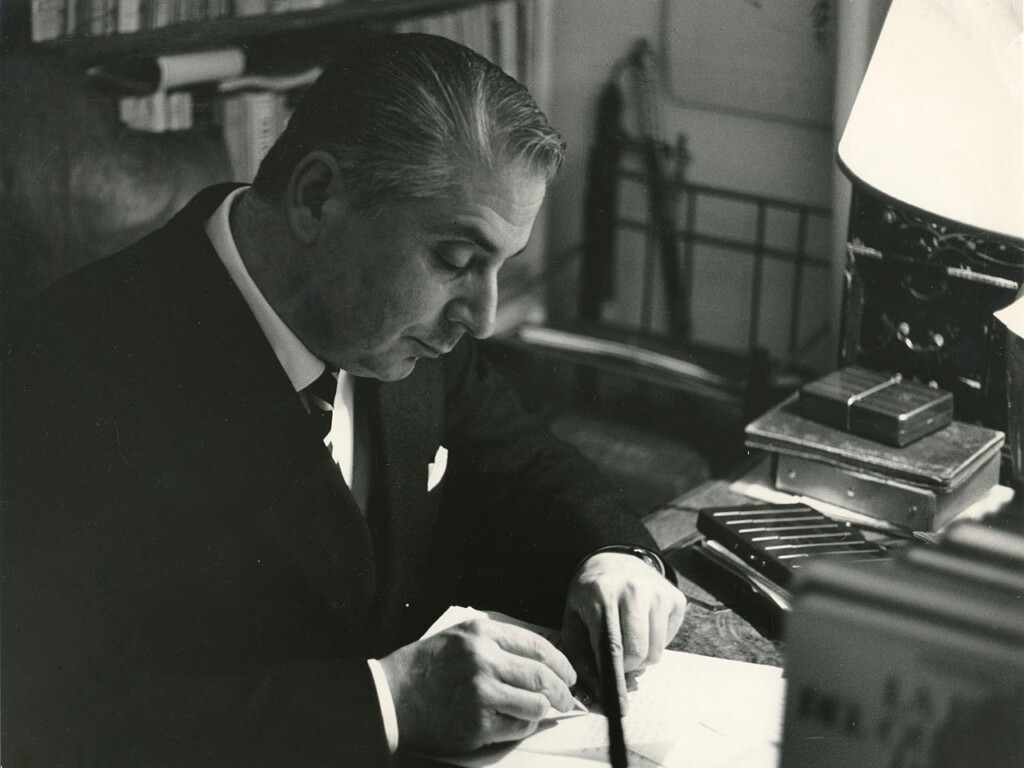
This is not a sentimental observation. It is the entry point into one of the most rigorous and quietly radical intellectual projects of the twentieth century, one that most people outside the specialized world of conservation have never encountered and that those inside it have sometimes buried under bureaucratic procedure until it lost its philosophical nerve. In 1963, the Italian art historian and critic Cesare Brandi published Teoria del Restauro, a text that emerged not from the comfort of abstract theory but from decades of direct confrontation with damaged things. Brandi had founded the Istituto Centrale del Restauro in Rome in 1939 and spent years watching restorers make decisions — irreversible decisions — about objects whose wounds had become, over time, inseparable from their identity. What he wrote was not a manual. It was something closer to a philosophical confession about the nature of time, matter, and the hubris of human intervention.
The central problem Brandi identified was one that sounds simple until you sit with it long enough to feel its weight: restoration is always an act performed in the present upon an object that belongs, in some essential way, to the past. And the present cannot pretend to be the past without lying. A restorer who fills in the missing face of a fourteenth-century Madonna with pigments that perfectly match the surrounding surface has not restored the painting. He has forged a continuity that never existed, and in doing so he has not saved the work but replaced part of it with himself, with his era, with his assumptions about what the original must have looked like. The damage, Brandi insisted, is not an interruption of the artwork’s history. It is part of that history. To erase it without acknowledgment is to commit a kind of violence dressed up as care.
There is a woman who sits in a half-lit archive in a scene that stays with you long after you have forgotten the circumstances around it. She is examining a manuscript, and her hands hover above the page without touching it. She knows what the missing section contained — she has the documentation, the cross-references, the scholarly consensus — and she could reconstruct it. But she does not. She lets her hands fall back into her lap. What she understands, in that suspended moment, is that her knowledge of what was there is not the same as what was there. The gap is real. The gap is information. To fill it would be to mistake her certainty for the object’s truth.
Brandi called this the “instance of time.” He argued that every artwork exists simultaneously in historical time — the moment and circumstances of its creation — and in the present moment of encounter, and that restoration must honor both without collapsing one into the other. This is not a technical instruction. It is a moral position. It says that the thing in front of you has already lived a life you were not present for, and that your job is not to undo that life but to understand what your relationship to it actually is.
The crack in the wall is not a problem waiting to be solved. It is a question waiting to be read.
What Restoration Actually Means When You Strip the Piety Away
You have spent hours putting things back where they were. The lamp in the corner, the books arranged by color because that is how she kept them, the chair angled exactly thirty degrees from the window. You know it is not the same. You know this the way you know your own heartbeat — without having to check. And yet your hands keep moving, adjusting, correcting, as if precision at the level of centimeters could close the gap between what was and what is now only an arrangement of objects that once meant something together.
There is a scene that lives in the memory like a bruise: a man returning to a room that has been methodically dismantled, every object removed or broken, and spending what feels like the entire duration of a life placing things back. He works with the concentration of a surgeon and the grief of a child. He is not restoring the room. He is restoring himself, using the room as the instrument. The objects cooperate but do not respond. They hold no memory of their former positions. The memory is entirely his, and he is pouring it into matter that cannot receive it.
This is precisely the trap that Cesare Brandi identified and methodically refused. In his Teoria del restauro, published in 1963, Brandi drew what remains the most underestimated distinction in the entire history of conservation: the difference between the physical material of a work — the pigment, the marble, the canvas — and what he called the artistic image, the form that emerges from that matter and constitutes the work’s actual existence as a work. Restoration, he argued, is never an operation on matter alone. It is an operation on the image. And the image, unlike marble, cannot be touched. This is not mysticism. It is a phenomenological precision that most restorations still refuse to honor.
The consolatory narrative of restoration — the idea that skill and patience can return something to what it was — collapses the moment you press on it. Walter Benjamin, in his 1935 essay The Work of Art in the Age of Mechanical Reproduction, named what is lost with a word that has since been domesticated into comfortable uselessness: aura. For Benjamin, aura was not beauty or prestige. It was the mark of singular presence in a particular place and time, the accumulation of everything that happened to an object in its specific existence. When he wrote that even the most perfect reproduction lacks one thing — the here and now of the work of art, its unique existence in the place where it happens to be — he was not making an aesthetic complaint. He was describing an irreversibility that the restoration industry, then and now, prefers not to advertise.
What the man in the reassembled room discovers, whether he admits it or not, is that reconstruction is a form of notation, not recovery. He has written down, in three dimensions, what he remembers. And memory is always edited, always inflected by loss, always shaped by who you are at the moment of remembering rather than who you were when the thing first existed. Brandi was clinical about this: every intervention on a work of art takes place in the present, not in the past. The present is the only tense available to the restorer’s hands. To pretend otherwise is not humility toward the original — it is a disguise for the self that is doing the restoring.
This is what the piety strips away. The language of restoration promises return, original states, authentic conditions. It speaks of the work as if it were a destination that can be reached again by the right route. But the route was destroyed with everything else. What survives is the restorer’s interpretation of the route, shaped by everything they have seen, everything they believe about what the original should have been, every cultural assumption they carry so naturally they have never thought to name it. The room is reassembled. It looks, from a certain angle, like what it was. The person standing in it is not the same person who once lived there. Neither is the room.

The Lie of the Original and Who Benefits From It
There is a woman bent over a portrait, her brush loaded with ochre, and she is deciding. Not restoring. Deciding. The difference is everything, and the institution that hired her knows better than to say it out loud.
The fantasy of the original state is one of the most durable lies Western culture has managed to sustain. It carries the grammar of science — precision instruments, spectral analysis, infrared reflectography — but it serves the purposes of power with a reliability that no amount of technical sophistication can obscure. When we speak of returning an object to its original condition, we are not describing a historical fact. We are asserting a political preference and dressing it in the clothing of inevitability.
Nelson Goodman understood this with unusual clarity. In Languages of Art, published in 1968, he argued that there is no perception without interpretation, no looking without a conceptual framework already in place. The eye does not receive the world neutrally. It reads it. And reading is always a selective act, shaped by the categories we bring to the encounter. What this means for restoration is brutal in its simplicity: the restorer who claims to be uncovering the original is actually constructing a version of it, guided by assumptions about what the original ought to look like, assumptions drawn from a particular historical moment, a particular aesthetic education, a particular set of institutional pressures. There is no view from nowhere. There never was.
Umberto Eco pressed the same wound from a different angle. His theory of interpretation insists that a text — and by extension any cultural artifact — is not a container of fixed meaning waiting to be unlocked by the sufficiently trained reader. It is a machine for generating interpretations, and those interpretations are always co-produced by the reader who encounters the work under specific conditions. The work is not prior to its readings. It exists in them, through them, in the friction between what the object offers and what the interpreter brings. To restore a painting to its supposed original state is to declare one interpretation sovereign over all others, to close the machine by fiat, to say: this reading ends here.
Back to the woman with the brush. She has been given documents. Pigment analyses, X-ray photographs, a scholarly monograph published in 1987 by a German art historian whose methodology was impeccable and whose conclusions were shaped, like all conclusions, by the questions he thought to ask. She leans closer. The ochre is wrong — too warm, she can feel it. She adjusts the mixture. This micro-decision, this almost involuntary correction born from a lifetime of looking at other paintings in other museums funded by other patrons, will become invisible the moment the varnish is applied. The next restorer, a generation from now, will read what she has done as evidence of the original. The lie accretes. It compounds.
Who benefits from maintaining the illusion that originals exist and can be reached? The answer is not cynical so much as structural. Museums benefit, because their authority rests on custody of the authentic. Nation-states benefit, because cultural patrimony requires stable objects with clean genealogies. The art market benefits most nakedly of all, because authenticity is the mechanism by which price is justified and speculation is laundered into connoisseurship. The fiction of the original state is not an innocent scholarly error. It is load-bearing infrastructure for a system of cultural ownership that depends on the suppression of exactly the kind of interpretive complexity that Goodman and Eco spent their careers describing.
Cesare Brandi knew this territory intimately, which is why the ambiguities in his Teoria del restauro are not weaknesses. They are the honest residue of a thinker who refused to resolve a real contradiction into a false clarity. The original, for Brandi, is not a historical fact to be recovered. It is an instance — a moment of creation with philosophical weight — and what we owe it is not imitation but recognition. The distinction sounds fine until you watch the brush moving across the face in the portrait, deciding what that face once was, and understand that recognition and invention have never been fully separable.
Time as Material: The Heresy Brandi Actually Committed
There is an old man sitting in a hospital corridor, his forearm open from a fall three days prior. The nurse insists. The doctor insists. He refuses stitches with a calm that unsettles everyone around him because it does not look like stubbornness — it looks like knowledge. The wound has already begun its own work, he says. The edges have already started their conversation with each other. To stitch it now would be to lie about when this moment is.
Cesare Brandi would have understood him immediately.
The claim Brandi makes in the Teoria del Restauro, published in 1963, is so quietly stated that its violence is easy to miss. He argues that the patina — the accumulated surface of time on a work, the oxidation, the darkening, the wear — is not damage. It is not the enemy of the original. It is itself part of the work’s material reality, a stratum of authentic history that the object has genuinely lived through. To remove it in the name of recovering the original is not restoration. It is erasure of a different kind. It is amputating the scar because you preferred the skin before it fell.
This is heresy of the clearest variety, because every institution built around the preservation of the past — the museum, the archive, the library, the restoration laboratory itself — rests on a founding fiction: that there is a stable original to recover, that time is an interruption rather than a participant, that what something was is more real than what it has become. Brandi’s patina argument pulls the floor out from under all of them.
Henri Bergson, in his work on duration developed across texts from 1889 onward through Creative Evolution in 1907, argued against the scientific habit of freezing time into measurable units and treating the frozen frame as more real than the flow. Duration, for Bergson, is the actual fabric of lived experience — continuous, irreversible, impossible to cut without falsifying. You cannot slice a melody into individual notes and claim you have preserved the melody. The notes exist only in their relation to what came before and what is about to come. Brandi’s patina is a Bergsonian argument applied to objects. The fresco does not exist in 1305. It exists in every year it has passed through, and those years are visible on its surface, and that visibility is not pollution — it is duration made material.
Paul Ricoeur, in Memory, History, Forgetting published in 2000, goes even further into the epistemological wound. He identifies what he calls the problem of the faithful image: the desire to make memory correspond exactly to the past event creates a form of violence, because the past event no longer exists in the form we want to recover. What we have is always already a trace, a remainder, something that has survived precisely by being transformed. The pretense of recovering the original is, for Ricoeur, a form of forgetting disguised as remembrance. It forgets that time passed. It forgets that the transformation is itself a form of testimony.
This is where the old man in the hospital corridor becomes unbearable to the doctors around him, because medicine, like restoration, is built on the premise that the original state of the body is the correct state — that health means return, that intervention means recovery of what was before. His refusal to stitch does not fit the model. He is saying that the wound, in its three days of work, has already become part of his body’s history, and that history is not reversible without consequence, and that the consequence of reversing it would be a lie told in collagen.
Museums hang their legitimacy on exactly that lie. Every gallery that removes centuries of varnish in order to show you what the painter intended is performing a temporal amputation and calling it clarity. Every archive that deacidifies its paper is making a decision about which time counts and which time is merely corrosive. These are not neutral technical choices. They are philosophical positions about whether the past can be owned, controlled, returned to — and Brandi, more than almost anyone in the twentieth century, had the precision and the nerve to say they cannot.
The Restorer’s Hand and the Violence It Cannot Avoid
There is a moment when the brush lifts from the surface and the conservator understands, with a certainty that arrives too late, that what she has just done cannot be undone. She does not cry immediately. She sits very still, the light angled low across the panel, and looks at what her hand has made. Then something in her face collapses, quietly, without drama, the way a wall gives way not at the moment of impact but in the silence afterward. Whatever she removed — a layer of varnish, a retouching from a previous century, something she had judged extraneous — is gone now, and gone means a different thing in this room than it does anywhere else in the world.
Cesare Brandi understood this. He understood it so thoroughly that his entire theoretical architecture can be read as an attempt to legislate against the irreversible, to build a system of constraints around the restorer’s hand so intricate and philosophically demanding that the hand might hesitate long enough to think. His principle of reversibility — that every intervention must be technically reversible by a future operator — is not an aesthetic preference. It is an acknowledgment of terror. It admits, at its root, that the restorer acts under conditions of radical epistemic limitation, that what appears correct today will appear criminal tomorrow, that the history of restoration is littered with the wreckage of certainty.
Giorgio Agamben, writing on potentiality in Potenza del pensiero and drawing from Aristotle’s distinction between energeia and dynamis, argues that genuine potentiality is not merely the capacity to act but equally the capacity to not-act — what he calls the potenza di non. The truly sovereign gesture, for Agamben, is the one that holds both possibilities open simultaneously. The restorer who cannot refrain, who cannot suspend the hand above the surface and inhabit that suspension as a form of knowledge, has already lost something essential before the brush descends. Brandi’s theory, read through this lens, is a prolonged philosophical training in exactly that capacity: the art of not intervening as a discipline prior to and higher than the art of intervening.
But the hand is never purely philosophical. In May 1972, a geologist entered St. Peter’s Basilica in Rome and struck Michelangelo’s Pietà fifteen times with a hammer, shattering the Madonna’s left arm, her nose, her eyelid, a portion of her veil. The subsequent restoration, undertaken by Vatican workshops, was technically accomplished and historically catastrophic in a different register: it fixed, it closed, it decided. It made choices about what the Pietà was that no individual or institution had the right to make definitively. The object that emerged was not the object that had been damaged. It was a new proposition about what the object should be.
The Sistine Chapel cleaning, completed in 1994 after fourteen years of work, generated a controversy that never fully resolved itself. Critics argued that what had been removed was not merely grime but the final glazes Michelangelo himself had applied — the shadows and pentimenti that constituted the work’s depth. Defenders cited chemical analysis, reversibility protocols, institutional authority. Both were speaking the truth. That is precisely the point. The restoration produced not a recovered object but a conflict about what the object ever was, and that conflict is now permanent, built into the ceiling itself, invisible but structurally present like a crack that has been filled.
Brandi wrote in the Teoria del restauro that the work of art exists in a double moment: its material instance and its aesthetic image, the thing and its transmission across time. The restorer’s paradox is that in touching the first, you inevitably alter the second — and the second is, in some ways, the only thing that ever actually existed for the people who stood before it and felt something shift in their understanding of being alive. The hand that reaches toward the surface is reaching toward that. It cannot be innocent. It was never going to be.
A vision curated by a filmmaker, not an algorithm
In this video I explain our vision
What We Cannot Restore and Why We Keep Trying
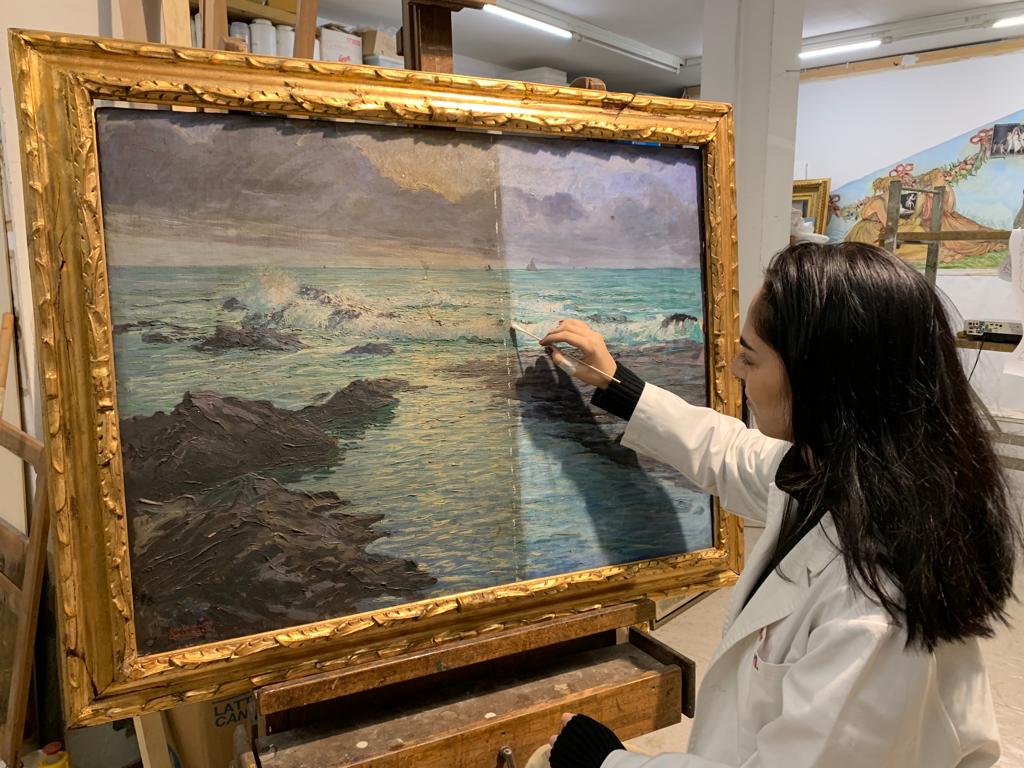
There is a moment in the life of certain ruins when they stop being damaged and begin being themselves. You have seen this without knowing how to name it: a wall where the plaster has fallen away to reveal three centuries of pigment in uneven strata, a mosaic floor with a missing corner that somehow focuses your attention more sharply than any complete surface could. The absence is not a wound. It is a disclosure. Something is being said precisely through what is no longer there, and the scholar who approaches with a trowel full of fresh mortar is not restoring the work but silencing it.
This is the deepest implication buried inside Cesare Brandi‘s theory, the one that most of his interpreters prefer to soften: that some losses are constitutive, that they belong to the identity of the work as irrevocably as any original brushstroke, and that to recover them would be an act not of preservation but of erasure. The lacuna, in Brandi’s framework, is not merely a problem awaiting a solution. It is testimony. It holds inside its emptiness the entire record of everything that has happened since the work left the artist’s hand, and to fill it is to destroy that record while pretending to honor the work that produced it.
Freud understood this logic from a completely different angle, and arrived at something remarkably adjacent to it. In 1930, in Civilization and Its Discontents, he offered Rome as an analogy for the structure of the psyche, imagining a city where every phase of construction still coexisted with every other, simultaneously, in the same space: the original Latin settlement, the Republican temples, the Imperial forums, the medieval accretions, all present at once, none of them dissolved by what came after. He knew this was spatially impossible. That was precisely the point. The mind does not demolish what it builds over. It layers, compresses, folds earlier structures into later ones, and the past persists inside the present not as memory but as architecture. What Freud was describing, without using the vocabulary of conservation, was the traumatic weight of what cannot be restored: the fact that certain experiences do not heal because healing would mean their disappearance, and their disappearance would mean the loss of something that, however painful, constitutes the self.
The city that rebuilds itself too quickly over its own ruins knows this erasure in a different register. You have walked through such a place: streets where new construction rises seamlessly over bomb sites, where the urban surface offers no trace of what stood before, where the trauma of destruction has been so efficiently metabolized into function that the loss becomes literally invisible. And you have felt, walking there, a strange unease that is hard to articulate, a sense that something is being asked of you that you cannot perform, which is to grieve what you are not permitted to see. The built-over ruin does not disappear. It migrates inward. The city carries it the way the psyche carries what it has been forced to forget, and the smoothness of the surface becomes its own kind of wound, more difficult to read than the original fracture ever was.
Brandi’s theory holds both possibilities inside the same tension without resolving them, and this is where its honesty lives. He does not tell you to leave everything broken. He does not tell you to restore everything. He asks you to discriminate, and discrimination of this kind requires you to accept that the criteria are not universal, not transferable, not derivable from a formula, because what is at stake is always specific: this work, this loss, this moment in time, this particular silence that the damage has introduced into the image.
The question that refuses to close is not whether restoration is legitimate. It is what we are confessing about ourselves when we cannot bear to let things remain incomplete, when the lacuna becomes intolerable not because the work demands filling but because we do.
🏛️ Art, Time, and the Memory of Form
Brandi’s Theory of Restoration raises profound questions about time, authenticity, and the ethics of intervening in works of art. These themes resonate deeply across the history of art and aesthetics, touching on how human civilizations have always negotiated the relationship between creation, decay, and preservation. The articles below explore adjacent territories of meaning and form.
Medieval Art: History and Meaning
Medieval Art: History and Meaning offers an essential grounding in the visual and symbolic universe that restoration theory so often confronts. Understanding the original intentions behind medieval works—their spiritual iconography and material choices—is fundamental to any critical approach to restoration. Brandi’s concept of the ‘aesthetic instance’ finds some of its most challenging applications precisely in this historical period.
GO TO THE SELECTION: Medieval Art: History and Meaning
Medieval Sculpture: History and Iconography
Medieval Sculpture: History and Iconography explores the formal and symbolic dimensions of one of art history’s most physically vulnerable categories of objects. Sculpture’s three-dimensional presence makes it especially susceptible to the ravages of time, weathering, and human intervention, all of which Brandi’s theory was designed to address. Reading this article alongside Brandi’s framework illuminates the tension between historical integrity and aesthetic legibility.
GO TO THE SELECTION: Medieval Sculpture: History and Iconography
Romanesque Architecture: History and Main Examples
Romanesque Architecture: History and Main Examples presents a built heritage that has been subject to centuries of restoration debate, from nineteenth-century Viollet-le-Duc controversies to modern conservation ethics. The massive stone structures of the Romanesque period raise questions about structural authenticity that parallel Brandi’s theoretical distinctions between restoration and reconstruction. This context enriches any serious reading of his foundational text.
GO TO THE SELECTION: Romanesque Architecture: History and Main Examples
Titian: Life and Works
Titian: Life and Works brings the discussion of restoration into the domain of painting at its most luminous and technically complex. Titian’s layered glazing techniques and his use of color as a structural element make his canvases emblematic of the challenges Brandi theorized when addressing the ‘material instance’ of a work. The delicate balance between preserving original matter and ensuring visual coherence is nowhere more dramatically illustrated than in the conservation of his masterpieces.
GO TO THE SELECTION: Titian: Life and Works
Discover Cinema as a Form of Living Thought
If these reflections on art, time, and meaning have stirred something in you, Indiecinema streaming is where that conversation continues through the language of independent film. Explore a curated selection of works that take aesthetics, memory, and transformation seriously—films that think as deeply as the theories that inspire them. Join Indiecinema and let cinema become your own ongoing act of restoration.
👉 EXPLORE THE CATALOG: Watch Indie Films in Streaming
A vision curated by a filmmaker, not an algorithm
In this video I explain our vision