
The Man Who Disappeared Twice
There is a moment, familiar to anyone who has spent time in archives, when a name simply stops appearing. Not crossed out, not annotated with a marginal note of disapproval — just gone, as if the administrative record had quietly exhaled and the person had never existed. A researcher working through the membership rolls and conference proceedings of the Anthroposophical Society in the Netherlands encounters exactly this. Valentin Tomberg is present, then contributing, then central, then absent. The erasure is not violent. It is bureaucratic, which is somehow worse. Bureaucratic erasure carries the message that the disappeared person was not even worth the drama of condemnation.

Tomberg was born in Saint Petersburg in 1900, into a world that would spend the next five decades dismantling itself with extraordinary thoroughness. He came to Rudolf Steiner‘s Anthroposophy as a young man with the particular intensity of someone who has found not a philosophy but a home — and found it, crucially, at a moment when Steiner himself was still alive, still generating, still capable of being encountered rather than merely studied. Steiner died in 1925, and the timing matters enormously. Tomberg had absorbed enough to be formed by the living body of the work, but not enough to have calcified inside it. He was twenty-five years old with a cosmology in his hands and no one left to tell him where the boundaries were.
Through the 1930s he became a serious and respected voice in Dutch Anthroposophical circles, delivering lectures, writing meditative studies on the Gospel of John, exploring the Christological dimensions of Steiner’s spiritual science with a rigour that read, at first, as deep fidelity. He was not a peripheral figure or an eccentric footnote. He was, by any reasonable measure, one of the movement’s most promising younger intellects. Then something shifted — or rather, something in Tomberg continued shifting while everything around him stopped.
The rupture came because Tomberg kept going. Where Steiner’s inheritors had begun the long institutional work of consolidating, preserving and defending a body of doctrine, Tomberg was performing something closer to what the philosopher Hans-Georg Gadamer would later describe as genuine interpretation: not the reproduction of meaning but its living extension, the kind of engagement that risks the original by taking it seriously. His Christological emphasis grew more intense, more specifically theological, more willing to draw on streams of tradition — Catholic mysticism, the heritage of the Rosicrucian impulse, the deep grammar of sacramental life — that the Society’s leadership regarded as incompatible with Steiner’s project. The accusations of heresy came. Then the erasure.
What is rarely examined with sufficient seriousness is what it costs to be excommunicated from a spiritual community you joined not for social belonging but for truth. Sigmund Freud, writing about the psychology of group life in 1921, identified how the bond between members of a movement is structurally dependent on their shared relation to the leader — and how, when that leader is gone, the group frequently substitutes doctrinal rigidity for living contact. The aggression that can no longer be directed upward gets redirected sideways, toward those who deviate. Tomberg did not deviate in the sense of abandoning the questions. He deviated by refusing to stop asking them.
He left the Netherlands. He entered a kind of interior exile, the kind that leaves no forwarding address. And the man who had been erased from the records began, quietly and without announcement, the process of erasing himself — not from history, but from the self he had been, the self that had believed a single tradition could contain what he was looking for.
What Steiner Opened and Could Not Close
There is a particular kind of reading that happens only late at night, when the house has gone quiet and the lamp makes a small island of light against everything that surrounds it. You pick up a book expecting to read it, and somewhere around the third or fourth page you realize with a strange, slightly vertiginous feeling that it is reading you instead. Not flattering you, not confirming what you already suspected about yourself, but identifying something you had no language for until this precise moment. The book does not explain you. It simply names what was already there, unnamed, and in the naming changes its nature entirely.
This is the phenomenology of esoteric encounter, and it is not mystical in the vague, dismissive sense that word usually carries. It is cognitive and visceral simultaneously. Rudolf Steiner understood this mechanism with almost clinical precision. His 1904 Theosophy did not present itself as speculation. It presented the spiritual world as a domain as structured and navigable as geography, with its own laws, its own inhabitants, its own causal logics. The etheric body, the astral body, the ego-organization — these were not metaphors. They were meant as descriptions. To read Steiner seriously was to be asked whether you were willing to treat the invisible as literal, and the disorientation that followed from saying yes was not confusion but a kind of epistemological vertigo that many found permanently reorienting.
Valentin Tomberg said yes completely. He absorbed the lecture cycles on the Gospels, the christological meditations, the vast architecture of spiritual evolution that Steiner had assembled across hundreds of volumes and thousands of lectures before his death in 1925. Tomberg did not approach this as scholarship. He entered it as a practitioner enters a discipline, with the specific quality of attention that changes the one attending. Between 1933 and 1938, he produced eleven studies on the New Testament from within the Anthroposophical framework, and this is where the institutional machinery began to malfunction. Not because the studies were heterodox. Because they were too insistently, too exclusively, too urgently Christ-centered. In a community that had grown comfortable with Christ as one important node in a cosmic hierarchy that included Lucifer, Ahriman, the Sun Spirit, and entire hierarchies of supersensible beings, Tomberg kept returning to the singular. He kept insisting on a centrality that made his colleagues uneasy in the particular way that excess of seriousness always makes institutions uneasy.
Harold Bloom, writing about American esoteric religion in the early 1990s, observed that movements built around the pursuit of gnosis — direct, experiential knowledge of spiritual reality — inevitably produce their own heretics, and that these heretics are almost always the ones who took the founding impulse most seriously rather than least seriously. The institution forms precisely to manage and transmit what the founder discovered. In managing it, it domesticates it. Anyone who refuses the domestication becomes, by structural necessity, a problem. Ernst Troeltsch, whose 1912 analysis of Christian social forms remains one of the most rigorous sociological accounts of religious organization, described mystical religion as inherently resistant to institutionalization — not because mystics are antisocial, but because the logic of direct encounter cannot be administered. It can only be undergone.
Tomberg’s isolation from the Anthroposophical Society after 1938 was therefore not a scandal or an accident. It was the predictable outcome of what Troeltsch would have recognized as a structural incompatibility. The institution had developed, as all institutions do, an immune response to the thing that threatened its equilibrium. What threatened it was not error. It was someone who had followed the original question further than the institution had agreed to go.

The Conversion That Was Not a Betrayal
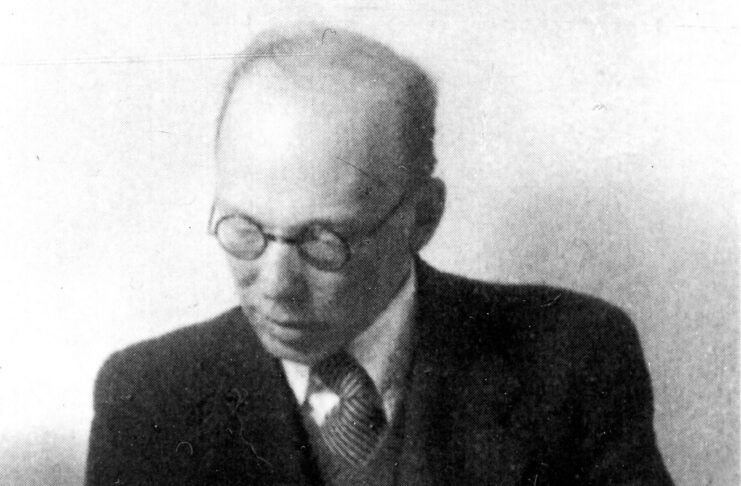
There is a moment some people know and almost no one can describe accurately to someone who has not lived it — the moment you step across a threshold that looks, from the outside, like capitulation. You have been standing there for a long time, longer than anyone around you realizes, and the step you finally take feels less like a decision than like the acknowledgment of something that has already happened inside you without your permission. The people who love you see a man going into a building. You know you are not entering but arriving.
Tomberg was received into the Roman Catholic Church in 1944. The year alone is enough to make the suspicious mind work quickly. Europe was occupied, the progressive spiritual movements of the early century had either collapsed or been co-opted, the Anthroposophical community he had moved through was itself fractured and, in the territories under National Socialist control, endangered. It is easy, almost too easy, to read a frightened man in those coordinates. A thinker who had spent decades in the visionary currents of spiritual Europe, suddenly finding shelter in the oldest and most institutional of Western religious structures. The psychological explanation writes itself and, like most psychological explanations that write themselves, it is almost entirely wrong.
William James, in his 1902 lectures that became The Varieties of Religious Experience, proposed something that still disturbs the secular reader who encounters it: that conversion is not the replacement of one self by another, not the erasure of complexity in favor of comfort, but the integration of previously warring elements of the psyche into a new and more coherent center of gravity. James called it the unification of a divided self, and he was careful to insist that the unity achieved was not simplification but resolution — the way a key does not simplify a lock but corresponds to it completely. The person who converts out of fear is recognizable by what they abandon. The person who converts out of integration is recognizable by what they carry with them.
Tomberg carried everything. The sacraments, for him, were not consoling rituals addressed to social beings in need of ceremony. They were objective spiritual operations, interventions in the subtle architecture of the world that functioned whether or not the priest performing them was personally illuminated, whether or not the congregation understood what was happening at the level at which it was actually happening. This was not a retreat from esoteric vision into institutional compliance. It was the recognition that the Church, understood at its deepest structural level, was itself an esoteric body — a cosmic organism performing functions that the purely interior, individualist spiritual path could not replicate because it lacked the dimension of time, of accumulated transmission, of something given and not merely achieved.
Wouter Hanegraaff, whose work on the history of Western esotericism has done more than almost anyone else’s to map the terrain Tomberg was navigating, has documented with uncomfortable precision how thoroughly Western modernity has marginalized esoteric knowledge — not only in secular culture, which one might expect, but within ecclesiastical culture as well, which policed its own depths with particular vigilance. To move toward the Church in 1944 was not to move toward safety in any recognizable sense. The institution Tomberg was entering was itself embattled, its intellectual traditions under pressure from both secular rationalism and the brutal simplifications of political theology. What he found there, or what he recognized there, was tradition as living transmission rather than dead archive — the difference between a river and a museum of water.
The assumption that genuine spiritual depth and institutional religion are mutually exclusive is itself a historical product, a specifically modern prejudice that would have been incomprehensible to the great mystics who built the Church’s interior life from within its structures. Meister Eckhart did not experience the Dominican Order as a cage. John of the Cross did not find Carmelite rule opposed to the dark nights he was mapping. The institution, at its most serious, has always known that it contains more than it can officially say.
Meditations on the Tarot: A Book Without an Author

Someone gives you a book. No explanation accompanies it — only the weight of it in your hands, the slightly rough texture of the cover, the faint smell of paper that has already been somewhere before reaching you. You open it once, read three pages, and close it again. Not because it fails you, but because something in it asks for more silence than you currently possess. It sits on your shelf for months. You return to it during an illness, during a crisis, during a Tuesday afternoon when nothing in particular is happening except that the light through the window falls at an angle that makes ordinary objects look briefly significant. You read it in fragments over years and realize at some point that you have never been able to answer the simplest question anyone asks about it: what kind of book is it?
This is not a failure of description. It is the book’s first philosophical claim, made before a single argument is stated. Completed around 1967 and published posthumously in French in 1980, then in English translation in 1985, the work appeared without an author’s name on its cover, by its author’s explicit request. Tomberg did not withhold his name out of false modesty or strategic calculation. He withheld it because the anonymity was structural — because a book that asks the reader to dissolve the boundary between their own interiority and the symbolic material it presents cannot simultaneously perform the authority of a named ego standing behind it like a guarantor. The signature, in other words, would have contradicted the epistemology.
What the book actually does is something Hans-Georg Gadamer, writing in Truth and Method in 1960, might have recognized as the fullest possible enactment of what he called the fusion of horizons — the moment in genuine understanding when the horizon of the text and the horizon of the reader do not simply collide but reshape each other into something neither possessed before. Gadamer argued that interpretation is never neutral retrieval but always a transformative event, a dialogue across time in which both parties are changed. Tomberg’s twenty-two letters, each addressed to an “Unknown Friend” and structured around one of the Major Arcana of the Tarot, perform precisely this: they fuse Hermetic symbolism, Kabbalistic structural logic, and Catholic mysticism without dissolving any of them into a synthesis that erases their differences. The Magician is not a symbol stripped of its occult history and repackaged as Christian allegory. The Kabbalistic Tree of Life is not decorative scaffolding. Each tradition retains its own internal gravity, and the fusion occurs in the reader’s consciousness rather than on the page — which is why the book cannot be summarized and why every reader who has genuinely encountered it carries a slightly different version of it.
The book’s reception tells its own strange story. Hans Urs von Balthasar, among the most architecturally ambitious Catholic theologians of the twentieth century, wrote an introduction endorsing it with a seriousness that could not be dismissed as ecumenical courtesy. Figures in private proximity to the Vatican read it. And yet academic religious studies ignored it entirely — not refuted it, not critiqued it, but passed around it in perfect silence, the way water moves around something it cannot categorize. This is its own kind of data point. The institutional guardians of religious knowledge require an author to interrogate, a position to locate, a name to place in footnotes. Anonymous transmission short-circuits that apparatus. It refuses to enter the archive on the archive’s terms.
There is something almost violent in that refusal — or rather, something that exposes the violence already present in the demand for attribution, the assumption that knowledge must be owned before it can be received.
The Tradition That Has No Institution
There is a room somewhere — there have always been rooms like this — where a small group of people sits in the particular silence that precedes something serious. The host has arranged chairs in a rough circle. There are no credentials on the walls. Someone has brought tea. The person who will speak knows, in some part of themselves they have learned not to ignore, that what passes between them tonight will not survive in this form. The notes will scatter. The faces will age. The specific quality of attention in this room, at this hour, cannot be archived. And yet they begin. Not despite this knowledge but somehow because of it.
Pierre Hadot spent decades arguing that we have systematically misread the entire tradition of ancient philosophy, and that the misreading has cost us something we can barely name because we lost it so thoroughly. His landmark reframing, developed across the essays collected in 1981, was devastatingly simple: ancient philosophy was not primarily a body of doctrines to be learned and transmitted. It was a set of spiritual exercises — practices of attention, examination, and transformation that existed to change the person performing them, not to inform them. The knowledge and the knower were not separate operations. You did not study Stoicism and then decide whether to apply it. The study was the application. The understanding arrived as a different way of being, or it did not arrive at all. What passed for philosophy after the medieval institutionalization of learning, Hadot suggested, was something else entirely — rigorous, often brilliant, but structurally severed from the transformative function that gave it its original reason for existing.
This is precisely what Tomberg was attempting to recover, and what makes him so difficult to classify. The Meditations on the Tarot is not a theology, not an occult system, not a catechism. It is a spiritual exercise in Hadot’s exact sense — a practice of sustained contemplative attention designed to work on the reader from inside, to alter the quality of interiority itself. The anonymous authorship was not modesty or evasion. It was a structural condition of what the book required. Once it belongs to someone, it becomes information about that person. Once it becomes information, it stops being transformation.
What is rarely remarked upon, because it fits no expected narrative, is that Tomberg spent his final years in England working as a legal scholar at the University of London. Not as a visiting mystic, not as a spiritual director with a growing following, but as a technical researcher in comparative law, producing work on Soviet legal structures, publishing in the dry vocabularies of jurisprudence. The esoteric readers who discover this tend to find it jarring. The academics who encounter his esoteric work find it inexplicable. Both reactions are themselves revealing. Tomberg apparently found neither register insufficient. The spiritual life, as he understood and practiced it, did not require a protected enclosure. It required full incarnation in the weight and friction of the actual world. The living room circles and the legal texts were not in tension. They were the same refusal — the refusal to let the inner life become a specialist domain, to let contemplation become a profession, to let transformation become a curriculum.
The community that has gathered around his work is small, international, and deliberately without center. There is no Tomberg Institute, no authorized teaching lineage, no certification. Readers find each other slowly, often by accident, often across significant cultural distances. Whether this is failure or fidelity is a question that resists being answered cleanly, because it depends entirely on what you believe transmission is for.
If knowledge must be institutionalized to survive, then what Tomberg left behind is already dissolving. If it can only be received personally — in the specific silence of a specific room, between people who are genuinely present to something — then perhaps the absence of institution is not the problem. Perhaps it was always the condition.
A vision curated by a filmmaker, not an algorithm
In this video I explain our vision
🌀 Esoteric Paths Between Worlds and Doctrines
Valentin Tomberg’s extraordinary journey from Anthroposophy to Esoteric Catholicism reflects a broader current in Western spiritual history: the restless search for a living synthesis between mystical tradition and personal transformation. His work invites us to trace the roots and branches of the esoteric tree, from Steiner’s visionary legacy to the great theosophical movements that shaped the modern spiritual imagination.
Rudolf Steiner and Anthroposophy: A Guide to Modern Esoteric Thought
Rudolf Steiner and Anthroposophy form the essential starting point for understanding Tomberg’s spiritual biography, as Tomberg began his path as one of Steiner’s most devoted students. This article maps the foundations of Anthroposophy — its vision of the human being as a spiritual entity evolving through cosmic stages — and illuminates why it attracted so many seekers in the twentieth century. Understanding Steiner is indispensable for grasping the depth of Tomberg’s later transformation.
GO TO THE SELECTION: Rudolf Steiner and Anthroposophy: A Guide to Modern Esoteric Thought
Ita Wegman: the Doctor Who Healed the Soul Beyond the Body
Ita Wegman was one of Rudolf Steiner‘s closest collaborators, and her life embodies the intersection of spiritual insight and practical healing that defined the Anthroposophical movement. Her story reveals the inner tensions and profound loyalties that shaped the community Tomberg eventually left behind. Exploring her legacy helps us understand the human and doctrinal stakes involved in any departure from the Anthroposophical circle.
GO TO THE SELECTION: Ita Wegman: the Doctor Who Healed the Soul Beyond the Body
Helena Blavatsky and Theosophy: the Woman Who Revolutionized Esoteric Thought
Helena Blavatsky and Theosophy represent the great esoteric wellspring from which both Anthroposophy and Tomberg’s later interests drew their symbolic vocabulary. Her revolutionary synthesis of Eastern and Western mysticism created the conceptual landscape in which figures like Tomberg could later navigate and ultimately transcend. This article provides the broader historical backdrop against which Tomberg’s spiritual odyssey takes on its full meaning.
GO TO THE SELECTION: Helena Blavatsky and Theosophy: the Woman Who Revolutionized Esoteric Thought
Universal Consciousness
The concept of Universal Consciousness lies at the heart of the esoteric traditions that Tomberg navigated throughout his life, from Steiner’s cosmic evolutionism to the Sophianic mysticism of his mature Catholic writings. This article explores how different spiritual currents have approached the idea of a unified divine mind underlying all existence. It offers a philosophical bridge between Anthroposophy, Theosophy, and the Christian mysticism that Tomberg ultimately embraced.
GO TO THE SELECTION: Universal Consciousness
Discover the Spirit on Indiecinema
If these spiritual journeys between doctrines and inner worlds have stirred your curiosity, Indiecinema streaming is the place to deepen the exploration. Our catalog of independent and art-house films brings to the screen the same visionary search for meaning, transformation, and transcendence that defines the lives of esoteric pioneers like Valentin Tomberg. Come and discover films that dare to ask the questions that matter most.
👉 EXPLORE THE CATALOG: Watch Indie Films in Streaming
A vision curated by a filmmaker, not an algorithm
In this video I explain our vision

