
The Composer in the Room
You are sitting across from him at a small table, and something is wrong. Not wrong in the way that a conversation goes badly or a face betrays discomfort — wrong in the way that a room can be perfectly still and yet feel like it is tilting. He speaks with precision. He makes arguments that close like traps. When he laughs, you laugh, and then a half-second later you do not know why. You have the sensation, familiar from dreams, of having agreed to something before you understood its terms.

The man across from you is not monstrous. That is exactly the problem. He is brilliant in a way that has a smell to it, a temperature. When he describes what he is working on — the piece, the system, the structure he has found — you can hear that he means it absolutely, that there is no corner of him hedging or doubting or standing slightly to one side of his own certainty. And this is what unsettles you most deeply, because you have spent your entire life treating doubt as evidence of intelligence, treating hesitation as a sign that someone is still thinking. He has stopped hesitating. He has arrived somewhere. And the place he has arrived at is sealed from the inside.
Thomas Mann spent eleven years writing Doctor Faustus, completing it in 1947, and the novel is saturated with this particular dread — not the dread of evil in its crude, recognizable forms, but the dread of a mind that has purchased its own greatness by surrendering the one faculty that makes greatness worth anything: the capacity to be wrong, to recoil, to refuse. Adrian Leverkühn, the novel’s composer-protagonist, does not sell his soul in the operatic sense. He contracts syphilis, deliberately, from a woman he has been warned about — and Mann makes the infection inseparable from the creative explosion that follows. The disease and the genius advance together. By the time Leverkühn is producing work of staggering originality, he is also unreachable by ordinary human appeal.
Mann was writing inside a catastrophe that had just ended, or had just apparently ended, and he knew that the catastrophe had not arrived from outside civilization but from within its highest cultural pretensions. Germany had not fallen into barbarism despite its philosophers and composers and theologians — it had fallen partly through them, or at least alongside them, with their vocabulary and their structures of feeling providing cover and texture and even beauty to what was happening. This was the wound Mann could not leave alone. The question was not how a nation of brutes had done monstrous things. The question was how a nation that had produced Johann Sebastian Bach and Arthur Schopenhauer had done them.
What Doctor Faustus proposes — and this is the move that still costs something to follow — is that the aesthetic and the ethical are not natural allies. The beautiful and the good do not trend toward each other. A piece of music can be a masterpiece and a moral catastrophe simultaneously, not as a contradiction but as a single unified phenomenon. Leverkühn’s twelve-tone compositions, built on a method Mann borrowed directly from Arnold Schoenberg’s real theoretical work, achieve their formal perfection through a kind of coercion — every note predetermined by the series, freedom abolished at the structural level, the system totalizing itself. Mann saw in this method not an insult to Schoenberg but an image: the image of a mind that has traded its contingency for its power.
And sitting across from that mind, you feel it the way you feel a change in air pressure before a storm. There is nothing to point at. There is only the tilt of the room, and the laugh you cannot account for, and the slow understanding that the person before you has already gone somewhere you cannot follow.
Altin in the City

Drama, thriller, by Fabio Del Greco, Italy 2017.
Altin, aspiring Albanian writer arrived in Italy aboard a large ferry in the 90‘s, works in a butcher shop when he’s selected to audition for a reality of writers and finally sees a chance to be successful with his book “the journey of Ismail.” Unfortunately, this is the begin of the adventures which will lead him to learn about revenge, loneliness and extreme poverty, to the dark side of wealth and success.
The theme of Altin in the City should not lead to the assumption that it is merely the story of a young immigrant trying to integrate. In reality, it is a tale where greed, thirst for power and success, cynicism, and ambition intertwine, creating a sort of modern-day Faust and a new "pact with the devil" belonging to the 22nd century, which we could summarize as: show business. The reality show becomes the Mecca, the keystone, and the springboard for those who wish to achieve success without effort. Del Greco presents this world with subtle irony, characterized by kitsch nuances and parodic tones. However, success without effort comes at a price: Altin has sold his soul to the devil and, from being an easy prey of television showbiz, will soon become a victim of himself.
LANGUAGE: Italian
SUBTITLES: English, French, Spanish, German.
Mann’s Exile and the Weight of 1943
You are sitting in a house above the Pacific in 1943, and Europe is burning. Not metaphorically — literally, city by city, archive by archive, the civilization that formed you is being fed into its own furnace. Thomas Mann had been in California since 1941, having fled first to Switzerland in 1933, then to Princeton, then westward again, as if the continent itself kept tilting under the weight of what was happening on the other side of the world. He began dictating Doctor Faustus in May of that year, the same months the Wehrmacht was collapsing at Stalingrad, the same months the deportations from the Warsaw ghetto were reaching their operational peak. The novel did not react to these events. It was written inside them, which is an entirely different thing.
What exile does to a writer is not simply that it makes them sad or nostalgic or politically urgent. It restructures the relationship between witness and event in a way that has no clean literary precedent. The witness cannot intervene. The witness cannot even fully corroborate what they see, because they are not quite there — they receive the news, the photographs, the reports, the survivor testimonies, but always through the membrane of distance. Mann solved this structural problem not by ignoring it but by building it into the novel’s skeleton. He invented Serenus Zeitblom, the humanist schoolteacher who narrates the life of the composer Adrian Leverkühn, and crucially, Zeitblom writes his account between 1943 and 1945, in real time, watching Germany collapse from within it while the reader understands that Mann himself is watching from without. The narration doubles the exile: there is the exile of the author, and there is the exile of the narrator from any stable moral ground, any position from which he can explain what he is witnessing without being implicated in it. Zeitblom loves Germany. Zeitblom is appalled by Germany. He cannot reconcile these two facts, and Mann refuses to reconcile them for him.
This is not a technique in the ornamental sense. It is an epistemological commitment. Mann had been reading Theodor Adorno’s work on the sociology of music — Adorno would formally collaborate on the novel’s musical philosophy — and what Adorno understood, drawing from his own forced displacement after 1933, was that modernity had produced a specific kind of knowledge: the knowledge of someone watching a catastrophe they helped build. The Frankfurt School’s entire project, which Adorno would consolidate with Max Horkheimer in Dialectic of Enlightenment, published in 1944 while Mann was mid-manuscript, was premised on the idea that Enlightenment rationality had not failed to prevent barbarism. It had produced it. The exile position was therefore not incidental to this analysis but central to it: to see clearly, you had to be displaced, and displacement was itself a form of punishment for that clarity.
Mann’s diaries from the period reveal something almost unbearable. He writes about the novel’s progress alongside entries about broadcast news, about the lists of destroyed cities, about the faces of his German émigré circle in Los Angeles — Bertolt Brecht, Lion Feuchtwanger, Arnold Schoenberg, people who had all lost entire worlds and were now constructing replacements from language and music in rented houses near the sea. Schoenberg in particular haunts the novel’s background, his twelve-tone method becoming the formal model for Leverkühn’s fictional compositional breakthrough, though Mann and Schoenberg’s relationship over this appropriation would eventually curdle into mutual bitterness. The community of exiles was not a community of solidarity. It was a community of people who had each individually failed to stop the same thing, and who lived now in the strange grammar of the past imperfect — what was being destroyed, what had been destroyed, what would soon be beyond recovery.
The novel begins not with Leverkühn but with Zeitblom picking up his pen in a specific month, in a specific year of the war, making sure the reader knows precisely when the narration starts.

Adrian Leverkühn as Diagnostic Instrument
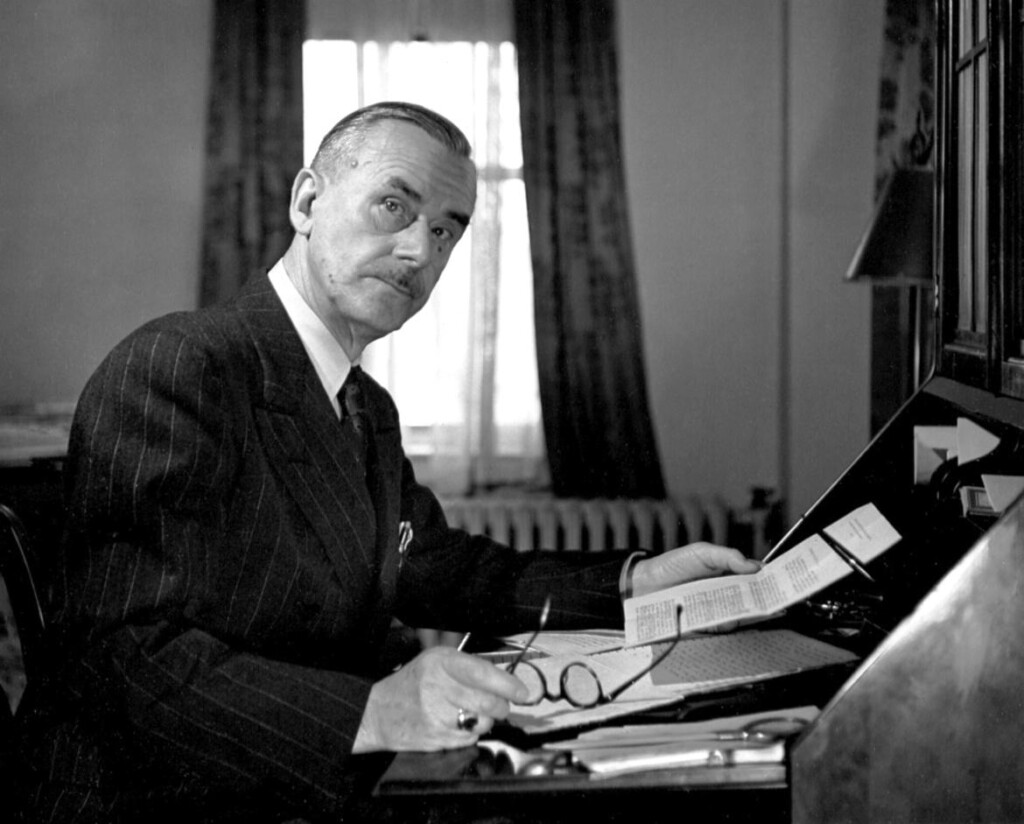
You are sitting with a score you cannot finish. The notes are there, the architecture is immaculate, the harmonic logic is airtight — and yet the piece refuses to close because closing it would mean accepting a limit, and you have not accepted limits since you were twenty-two. The fever comes and goes. The headaches move behind the left eye. You keep working.
Adrian Leverkühn is not a character in any sense that the nineteenth-century novel trained us to recognize. He has no interiority that the reader is invited to inhabit sympathetically, no growth arc, no moment of authentic self-discovery. Mann constructed him as a diagnostic instrument — a probe inserted into the body of German culture to measure what had already gone wrong before anyone used the word fascism in a political context. The novel was written between 1943 and 1947, and Mann was explicit in his journals and in the retrospective account he published as The Story of a Novel in 1949: Leverkühn was not a portrait of a man but a portrait of a civilization’s relationship to its own genius.
The biographical scaffolding Mann borrowed was not invented. Friedrich Nietzsche‘s mental collapse in Turin in January 1889, the progressive paralysis, the letters signed “Dionysus” and “the Crucified,” the decade of silence before death in 1900 — these were the raw materials Mann recomposed into Leverkühn’s trajectory. And behind Nietzsche stood a mythological apparatus that German culture had been constructing for over a century: the idea that syphilis, contracted in a moment of transgression, could unlock creative powers that bourgeois hygiene kept sealed. This was not a fringe belief. It circulated through medical literature, through biographical legend, through the Romantic cult of the artist as someone who pays in flesh for what he perceives in spirit. Mann took that mythology seriously enough to systematize it, which is a different and more dangerous thing than dismissing it.
What the pact with the devil literalizes is not the supernatural but the internal logic of aesthetic absolutism — the position that art’s only obligation is to itself, that the artist who accepts social, ethical, or human constraints has already betrayed the work. Leverkühn does not sell his soul in a moment of weakness. He sells it in a moment of total coherence, because the logic of his entire formation leads precisely there. Twenty-four years of heightened productivity, the prohibition on love, the creative temperature that burns everything biographical away — this is not a fairy tale. It is the endpoint of a cultural value system that elevated aesthetic intensity above every other human claim, and that found in Germany its most disciplined and most catastrophic institutional home.
The question Mann was actually asking, the one that makes the novel still feel like a live wire, is whether German high culture — Bach, Beethoven, Schopenhauer, Wagner, the whole apparatus of Bildung and aesthetic seriousness — constituted a form of resistance to National Socialism or its secret preparation. The comfortable answer, the one that German cultural institutions rebuilt themselves on after 1945, was resistance: the real Germany was Goethe, not Goebbels. Mann refused that comfort with surgical precision. Leverkühn’s music does not oppose the logic of totalitarian will — it perfects it. The twelve-tone system as Mann imagined it is control absolute, a structure that eliminates the accidental, the spontaneous, the human remainder. It is beautiful the way a closed system is beautiful, which is to say it is beautiful in a way that has abolished everything beauty was supposed to protect.
The infection is the method. The devil does not arrive from outside; he is the concentrated form of what Leverkühn already was — the coldness, the irony, the refusal of warmth as a form of artistic integrity. German culture did not fail to resist fascism because it was weak. It failed because its highest values, pursued without remainder, arrived at the same destination by a different road.
The Devil Who Speaks in Intervals
You are sitting across from someone who speaks your language better than you do. Not a foreign accent, not an alien grammar — your own technical vocabulary, your professional shorthand, the precise terms you use when you want to sound serious about the thing you love most. He discusses voice leading with the authority of someone who has spent decades inside the problem. He knows the difference between a tritone as tension and a tritone as arrival. He knows what Webern was doing in the Variations for Piano, Op. 27, and he knows why it matters. You find yourself nodding, leaning forward, feeling for the first time in years that you are being truly understood — and it is only later, much later, that you realize you were being measured.
Thomas Mann places his devil in Chapter XXV of Doctor Faustus not in fire and sulfur but in a cold Palestrina room, dressed first as a pimp, then shifting, mid-conversation, into a figure who looks something like a music critic — small glasses, an intelligent forehead, the slightly irritable manner of someone who has read everything and found most of it insufficient. He speaks in the grammar of the modernist avant-garde. He diagnoses tonality as a historical corpse. He understands seriality not as a technique but as a fate. What Mann understood, with a precision that still cuts, is that the most effective seduction does not arrive dressed as temptation. It arrives dressed as clarity.
The conceptual architecture of that dialogue did not emerge from Mann’s ear alone. Between 1943 and 1947, while the novel was being written in Pacific Palisades, Theodor Adorno functioned as something close to an intellectual prosthesis for Mann’s composer-protagonist. Adorno provided technical analyses, draft passages on Beethoven’s late style, detailed descriptions of twelve-tone composition that Mann adapted almost verbatim into the novel’s interior musical world. The collaboration is documented in Mann’s own diary entries and in the correspondence between the two men, as well as in Adorno’s wry acknowledgment in the 1949 postscript to his Philosophy of New Music that the relationship with Doctor Faustus had bent his thinking in directions he had not anticipated. This was not ghostwriting. It was something stranger — a philosopher lending his analytical nervous system to a novelist who needed to make musical ideas feel like flesh.
Adorno’s central argument in Philosophy of New Music, published in 1949 though largely written during the same wartime years, is not that twelve-tone composition is fascist or that Schoenberg was wrong. The argument is more unsettling than that. Adorno identifies in the serial method — in its total organization, its systematic negation of every harmonic convention that had ever allowed a listener to feel at home — a structural homology with the administered society it was supposed to resist. The row governs every note. Nothing is left to the contingency of feeling. The system achieves its liberation from bourgeois sentimentality by becoming, itself, a kind of compulsion. Radical freedom, pursued to its logical end, produces a new unfreedom that is harder to name because it wears the face of rigor.
What this means for the novel’s devil is that he is not offering Adrian Leverkühn a corrupt bargain on behalf of chaos. He is offering him a system. Twenty-four years of unimpeded genius, yes — but genius that will operate inside a formal structure so total that inspiration and calculation become indistinguishable. The gift is not the release from rules. The gift is a rule so absolute it feels like destiny. And this is precisely where the pact reveals what ordinary readings of the Faust myth tend to miss: the soul is not stolen through weakness. It is surrendered through the experience of being completely, finally, technically right about something that turns out to be a cage.
Serenus Zeitblom and the Complicity of the Witness
You are reading a book, and you realize somewhere around the third chapter that the person telling you the story is not trustworthy — not because he lies, but because he watches. He watches with such meticulous care, such trembling devotion, such exquisite sensitivity to every moral nuance of the catastrophe unfolding before him, that his watching becomes itself a form of abandonment. Serenus Zeitblom, the mild Catholic humanist who narrates Adrian Leverkühn’s life and damnation in Doctor Faustus, is one of the most devastating characters in twentieth-century literature precisely because he never does anything wrong. He is appalled. He is grieved. He notes, with scholarly precision, every symptom of the disease. And he does nothing.
Mann constructed this narrator in 1943, writing in Pacific Palisades while Europe burned, and the temporal architecture of the novel is itself a confession: Zeitblom is composing his biography of Leverkühn between 1943 and 1945, as the Allied bombs fall on German cities, as the Reich collapses around him. His prose flinches at every air raid siren and then returns, with almost indecent fastidiousness, to the details of Leverkühn’s musical development. The juxtaposition is not ironic decoration. It is the argument. The civilized man continues his cultural labor while history commits its crimes, and the continuity of that labor is not innocence — it is the very texture of complicity.
Hannah Arendt, reporting on the Eichmann trial for The New Yorker in 1963 and collecting those dispatches into Eichmann in Jerusalem, identified something that scandalized her readers: that the bureaucratic machinery of atrocity depends not on monsters but on functionaries, on people who process information, file reports, and describe events with professional detachment. The horror was not in the exceptional but in the procedural. Zeitblom is this mechanism transferred into the realm of friendship and aesthetics. He documents Leverkühn’s pact, his syphilitic genius, his cold inhumanity toward the people who love him, with the same careful neutrality a clerk might bring to a transport manifest. The warmth of his prose — and it is genuinely warm, genuinely grieving — does not cancel this. It makes it worse, because it gives the witnessing the appearance of moral seriousness without the substance of moral action.
What Zeitblom never asks himself is the question that would destroy his self-image: at what point does the decision to bear witness become the decision not to intervene? He frames his proximity to Leverkühn as loyalty, as love, as the humanist’s sacred duty to preserve and transmit. But loyalty to a man who has sold himself to destruction, who has willingly courted nihilism and dragged others into his orbit, is not a neutral act. The French philosopher Emmanuel Levinas argued in Totality and Infinity, published in 1961, that the ethical relation is fundamentally constituted by the face of the other — by the demand the other makes on you before you have chosen whether to respond. Zeitblom sees Leverkühn’s face for decades. He sees the faces of those destroyed around him. And he writes it all down.
There is something the reader feels before they can name it: that Zeitblom’s humanist vocabulary — his invocations of Goethe, of classical learning, of European cultural tradition — functions as insulation. Every time he reaches for the language of civilization, he creates a small distance between himself and the obligation to act. This is not hypocrisy in the ordinary sense. He believes every word. That is precisely the mechanism. The belief in civilization becomes the alibi for civilization’s failure, because the man who is certain he represents the best values of a culture is the last person who will admit that those values have become a costume worn over complicity.
Mann knew this from the inside. He had been that figure — the celebrated German artist who initially resisted political engagement, who in 1914 wrote Reflections of a Nonpolitical Man defending German culture against Western democratic values, and who spent the following decades dismantling that position piece by piece. Zeitblom is not a foil or a contrast. He is a self-portrait wearing the mask of innocence.
A vision curated by a filmmaker, not an algorithm
In this video I explain our vision
Germany as the Artist’s Body

You are sitting with a fever you cannot name, one that arrived so gradually you mistook its warmth for vitality. That is how Adrian Leverkühn lives for years inside his infection — not suffering, but accelerating, producing at a pace that frightens even those who love him, his mind burning with a clarity that only the terminally ill seem to possess. The disease does not feel like destruction from the inside. It feels like election.
Thomas Mann spent nearly a decade writing Doctor Faustus between 1943 and 1947, and the temporal coincidence is not incidental: he was composing the novel while Germany was losing a war it had entered with the certainty of a culture that had mistaken its own fever for superiority. The syphilitic infection that a demonic encounter transmits to Leverkühn is not a symbol Mann reaches for because it is dramatic. It is a clinical proposition. The same neurological deterioration that eventually strips Leverkühn of language and leaves him collapsed at a piano — mid-sentence, mid-note — is structurally identical to what Mann believed had happened to German cultural life over the preceding century and a half. Both processes begin with a gift so intense it cannot be distinguished from damage.
Friedrich Nietzsche, who Mann drew on with almost predatory precision, had already understood that the will to greatness contains a self-consuming logic. In The Birth of Tragedy from 1872, Nietzsche located the highest art in the tension between Dionysian excess and Apollonian form — and warned implicitly that a culture too drunk on the absolute would eventually lose its capacity for the provisional, the human, the merely sufficient. What Mann did was take this philosophical intuition and press it into flesh. Leverkühn does not choose excess over measure in some abstract aesthetic debate. He signs the contract because he is constitutionally unable to tolerate the ordinary scale of achievement available to uncursed talent. The good is the enemy of the absolute, and the absolute kills.
This is where Mann’s diagnosis becomes genuinely difficult to receive, because it refuses to separate the beautiful from the catastrophic in German cultural history. The same civilizational impulse that produced Beethoven’s late quartets — that refusal to accept musical resolution as anything less than total — produced, in Mann’s reading, a political culture that could not govern itself through compromise. Democracy requires a tolerance for the incomplete. It asks its citizens to accept that no final form is achievable, that the polity is always approximate, always negotiated. A culture that has trained itself on the metaphysics of totality — in music, in philosophy, in Romantic nationalism — finds this tolerance nearly impossible. The Weimar Republic did not collapse because Germans were uniquely cruel. It collapsed because a significant portion of the educated class experienced parliamentary compromise as a kind of aesthetic humiliation.
Leverkühn’s genius operates by the same refusal. His late compositions — as Mann describes them through the narrator Serenus Zeitblom’s anguished testimony — are works that take back the affirmation of the Ninth Symphony, that unmake the consolation of classical form, that insist on an honesty so brutal it has no audience in the moment it is produced. They are correct the way a diagnosis is correct. They offer no warmth. And the mind that produced them is simultaneously being consumed by the organism it invited inside when it chose intensity over protection. The parasite and the host are by this point indistinguishable. The syphilitic spirochete does not corrupt what was healthy. It accelerates what was already the organizing principle of the self.
What Mann refuses to grant Germany is the comfort of external seduction — the idea that something foreign arrived and perverted an otherwise sound culture. The infection was invited. It was cultivated. It was, at some level, desired, because the alternative was mediocrity, and mediocrity had always been the one thing this particular civilization could not forgive itself for tolerating.
The Pact’s Real Terms
You are already inside the terms before you understand them. That is the first trick, and Mann understood it with the precision of someone who had watched his own country sign the document without reading it. Adrian Leverkühn does not sell his soul for pleasure — that is the medieval misreading, the cartoon version that lets modern people feel safely distant from the transaction. What he surrenders, in the negotiation Zeitblom can barely transcribe, is the right to uncertainty. The devil’s actual offer is this: you will never again wonder whether what you are making means anything. The paralysis will end. The cold, constitutional awareness that significance might be something we paste onto silence — that will be taken from you, and in its place you will have the terrible momentum of a man who knows.
This is a far more seductive bargain than damnation for pleasure because most serious artists already live without reliable pleasure. What destroys them is the gap between effort and meaning, the morning when the work feels arbitrary, when the notes or the sentences sit there like furniture someone else chose. Leverkühn’s disease — the syphilitic infection he courts almost deliberately — functions in Mann’s architecture not as punishment but as neurological guarantee. The inflammation clarifies. It burns away the hesitation that is also the conscience. After Esmeralda, his compositions arrive with the force of dictation, and dictation, by definition, comes from somewhere else. That somewhere else is precisely what the pact names.
Ernest Becker, writing in 1973 in The Denial of Death, identified what he called the “immortality project” — the structure by which human beings transform their terror of annihilation into systems of meaning large enough to feel cosmic. Nations, religions, artistic legacies, revolutionary movements: Becker’s argument was that these are not expressions of genuine transcendence but of managed panic, elaborate performances staged to convince the performer that his existence has weight beyond the biological. The horror buried inside this argument is that it makes heroism and denial the same gesture. Every cultural monument is also a document of fear. Every declaration that something matters is simultaneously a refusal to sit with the possibility that it does not.
What Mann constructs in Doctor Faustus, published in 1947 after twelve years of composition and exile, is a narrative in which Germany’s cultural apparatus — its music, its philosophy, its sense of providential historical mission — turns out to have been exactly such a pact. The nation did not descend into barbarism despite its civilizational achievements. It descended because of the logic those achievements required: a logic that traded doubt for certainty, ambiguity for force, the discomfort of meaning’s contingency for the momentum of meaning’s annihilation. Fascism, in this reading, is not the failure of culture but its pathological fulfillment, the moment when the immortality project runs its program to the end and reveals what it was always protecting against.
Leverkühn’s final work, the Lamentation of Doctor Faustus, is structurally a negation — it takes back Beethoven’s Ninth, unwriting the great affirmation of Western humanist culture, returning joy to grief. This is not nihilism as teenagers understand it. It is a rigorous accounting. If the certainty was purchased, then everything built on that certainty is architecture over a void, and the honest artist’s last act is to draw the blueprint of the foundation rather than continue to furnish the rooms above. The piece cannot be performed. It exists as score, as document, as confession. This is the clause no one reads at the bottom of the bargain: that what the devil gives you in the form of power, he collects in the form of audience. The work that arrives with divine inevitability arrives into silence, because the people who might have heard it were the ones the certainty was used to destroy.
What the Music Cannot Say
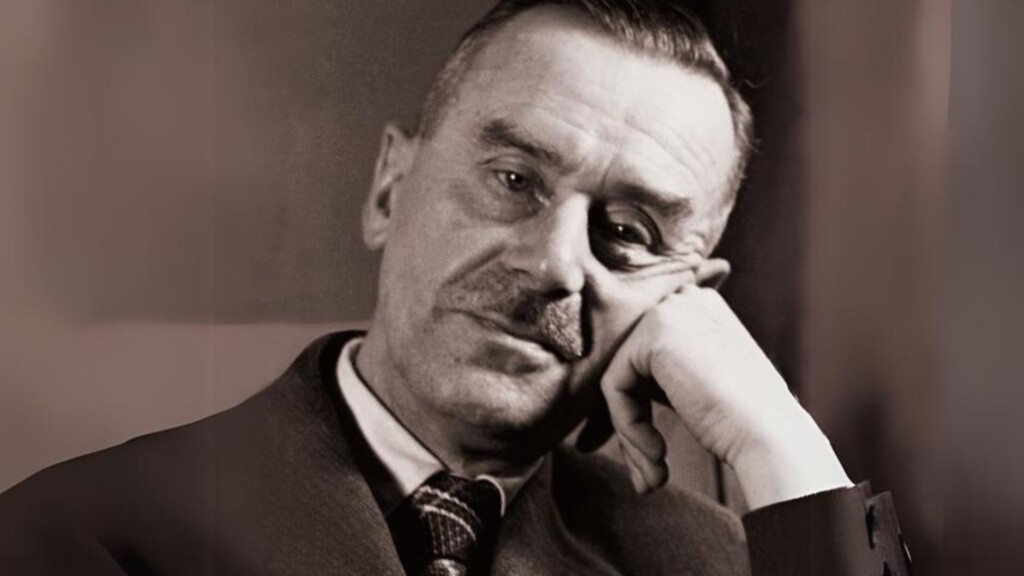
You sit with the final pages of the novel and realize that the music you have been reading about for hundreds of pages will never arrive. The Lamentation of Doctor Faustus, Leverkühn’s terminal masterwork, exists in the novel as description, as testimony, as the breathless account of a witness who heard it performed once before the composer lost his mind entirely. You receive the report of devastation without the devastation itself. Mann understood precisely what he was doing, and the cruelty of it is architectural, not accidental.
There is a philosophical problem embedded in this formal choice that goes beyond literary technique. Theodor Adorno, who worked alongside Mann during the novel’s composition and whose 1949 Philosophy of New Music shadows the entire project, argued that authentic modern art necessarily makes itself incomprehensible to the culture that produced the conditions requiring it. The work that genuinely responds to historical catastrophe cannot be domesticated by the entertainment apparatus, cannot be consumed by the same sensibility that sleepwalked through the catastrophe. If that is true, then any art which successfully communicates its rupture to a mass audience has already, in that success, betrayed the rupture. The transmission is the compromise. The legibility is the lie.
Mann understood this not abstractly but materially, in the grammar of the novel’s structure. To write the Lamentation in full, to render it in prose with enough narrative detail that the reader could reconstruct it emotionally, would be to make it receivable. And a receivable Lamentation is not the Lamentation that cost Leverkühn everything. The pact with the devil, whatever else it means, means paying a price that cannot be shared, a wound that cannot be exhibited without being transformed into entertainment. So the novel describes the work the way a survivor might describe a city that no longer exists: accurately, movingly, and with the irreducible knowledge that the description and the thing are separated by an abyss that language cannot close.
This is where the novel’s deepest discomfort lives. We are always on the wrong side of the abyss. We read about the work; we do not receive the work. And yet we feel something, which means either that Mann found a way to transmit the intransmissible, or that what we feel is not the same thing Leverkühn’s single audience felt, but rather our own projection of grief and magnitude onto a described object. The question of whether those two experiences can be distinguished — from the inside, by the person feeling them — is not a question the novel answers. It simply leaves you holding it.
What makes this unbearable in the specific way Mann intended is that Leverkühn’s final composition ends not in silence but in a single cello note that the novel describes as a light in the darkness, something that is heard dying away. It is the most deliberate ambiguity in a book built from deliberate ambiguities. The note could be the last filament of hope that the Nietzschean darkness has not won absolutely. It could be the sound of hope itself being extinguished, drawn out into a long, visible, undeniable ending. Both readings are grammatically available. Both are emotionally available. Mann refused to collapse them, which means the novel ends in a suspension that is not comfort and not despair but something closer to the condition of being genuinely alive inside a historical moment whose meaning has not yet resolved.
Germany 1947, the year of the novel’s completion, was not a moment whose meaning had resolved. It remains, arguably, a wound whose full accounting has never been made. The Lamentation cannot be heard because it describes a debt that has not been paid, and art that describes an unpaid debt cannot be received as settled, cannot be framed and hung, cannot become the kind of cultural object that a society consumes in order to feel it has processed what it preferred not to face.
The note holds. Whether it is dying or surviving is a question the silence after it refuses to answer.
🔥 Pacts with Darkness: Literature and the Soul’s Bargain
Thomas Mann's Doctor Faustus plunges into the abyss where artistic genius, diabolical temptation, and the collapse of civilization converge. To fully grasp its labyrinthine depths, these thematically kindred works illuminate the same shadowy corridors of the human spirit.
Goethe’s Faust: Meaning and Analysis
Goethe's Faust is the unavoidable precursor to Mann’s reimagining of the Faustian myth, transforming the medieval legend of the devil’s bargain into a philosophical epic of limitless human striving. Mann himself wrote Doctor Faustus in direct dialogue with Goethe, inverting the redemptive arc into a tragedy of damnation. Understanding the original Faust is essential to grasping the bitter irony Mann weaves into every chapter.
GO TO THE SELECTION: Goethe’s Faust: Meaning and Analysis
Hesse’s Steppenwolf: Analysis
Hesse’s Steppenwolf, like Doctor Faustus, explores the tormented interior of a German intellectual torn between bourgeois existence and the dangerous extremes of artistic and spiritual transgression. Both novels situate personal crisis within the broader collapse of German culture in the first half of the twentieth century. The parallel between Harry Haller’s self-division and Adrian Leverkühn’s pact with chaos makes this an indispensable companion text.
GO TO THE SELECTION: Hesse’s Steppenwolf: Analysis
Kafka and Bureaucracy: The Trial and The Castle
Kafka’s vision of bureaucratic labyrinths in The Trial and The Castle shares with Doctor Faustus a profound sense of invisible, inscrutable forces governing human destiny. Both Mann and Kafka construct worlds in which the individual is ensnared by systems — divine, diabolical, or institutional — that exceed rational comprehension. This thematic resonance makes Kafka’s work a crucial lens through which to read Mann’s allegory of Germany’s surrender to dark powers.
GO TO THE SELECTION: Kafka and Bureaucracy: The Trial and The Castle
Alchemy in Literature: From Dante to Goethe
Alchemy in literature, from Dante to Goethe, provides the esoteric and symbolic substratum upon which the Faustian tradition is built — the dream of transgressing natural limits through secret knowledge. Mann draws deeply on this tradition, casting Leverkühn’s musical genius as a form of alchemical transmutation achieved at the cost of his soul. This article maps the literary and symbolic genealogy that flows directly into the heart of Doctor Faustus.
GO TO THE SELECTION: Alchemy in Literature: From Dante to Goethe
Discover Independent Cinema on Indiecinema
The themes of forbidden knowledge, artistic obsession, and the soul’s darkest bargains do not live only in literature — they pulse through some of the most extraordinary works of independent cinema. On Indiecinema streaming you will find films that dare to explore these same abysses with the same uncompromising depth. Step beyond the mainstream and let independent cinema take you further into the labyrinth.
👉 EXPLORE THE CATALOG: Watch Indie Films in Streaming
A vision curated by a filmmaker, not an algorithm
In this video I explain our vision

