
The Physics of Darkness as Moral Architecture
You are sitting in the dark, and there is a single candle burning on the left side of the frame. You do not know why your body tightens. The rest of the image is not empty — it is occupied by an absence so deliberate it feels authored, as though someone decided, with full intention, that what you cannot see matters more than what you can. The face emerging from that shadow is not being revealed to you. It is being rationed. And somewhere beneath your conscious attention, you understand that you are being told something about the moral weight of this person, about whether they deserve the light at all.

This is not an accident of filmmaking craft. It is the residue of a theological argument that Europe spent two centuries trying to resolve in paint before cinema inherited it wholesale. When Leonardo da Vinci began systematically studying what he called sfumato — the gradation of tone through imperceptible degrees — he was not solving an aesthetic problem. He was making a claim about divine order. Light, in the cosmology that underwrote Renaissance painting, was not neutral. It carried ontological rank. The illuminated thing was the thing that God had permitted to be known. Shadow was not the absence of light but the presence of something resistant to revelation, and that resistance was morally charged.
Caravaggio pushed this claim to its breaking point. In works like The Calling of Saint Matthew, completed around 1600, the light source enters the canvas like a prosecutorial finger — it does not illuminate a scene, it singles out a sinner. The darkness surrounding the figures is not atmospheric. It is judicial. Caravaggio understood, perhaps more brutally than any painter before him, that shadow is where human beings actually live: in the zones of ambiguity that official theology, official portraiture, and official morality refused to acknowledge. His figures emerge from black backgrounds not because he lacked technical means but because he was insisting that the visible world is mostly darkness, and that light is the exception which requires justification.
What the history of art tends to flatten into a stylistic evolution — from chiaroscuro to tenebrism to the northern European painters who refined contrast into psychological instrument — was in fact a prolonged argument about visibility as a form of power. Rembrandt van Rijn, working in Amsterdam in the mid-seventeenth century, turned this argument inward. His late self-portraits, painted between roughly 1655 and 1669, refuse the hierarchy entirely: his own aging face is half-consumed by shadow, and the illuminated portion offers no redemption, no authority, no theological promise. The light in those paintings is exhausted. It falls on a human face not to crown it but to observe it dying, and the shadow that takes back most of the canvas is not menacing — it is patient.
By the time German Expressionist painters and then filmmakers began working with extreme tonal contrast in the early twentieth century, this theological architecture had been largely forgotten as a conscious framework. But it had not disappeared. It had become instinct. The directors who emerged from and around the UFA studios in Weimar Germany — working on films that appeared between roughly 1919 and 1933 — deployed shadow not because they had studied Caravaggio but because the culture that produced them had absorbed his logic through three hundred years of visual repetition. Shadow as moral indeterminacy. Shadow as the space where the psyche does its unsanctioned work. Shadow as the only honest representation of interiority, because the inside of a human being does not resolve neatly into the lit and the dark but exists almost entirely in the gradations between.
What those filmmakers recognized, and what cinema has never fully stopped knowing, is that the viewer’s nervous system reads tonal contrast before the conscious mind reads narrative.
Nosferatu
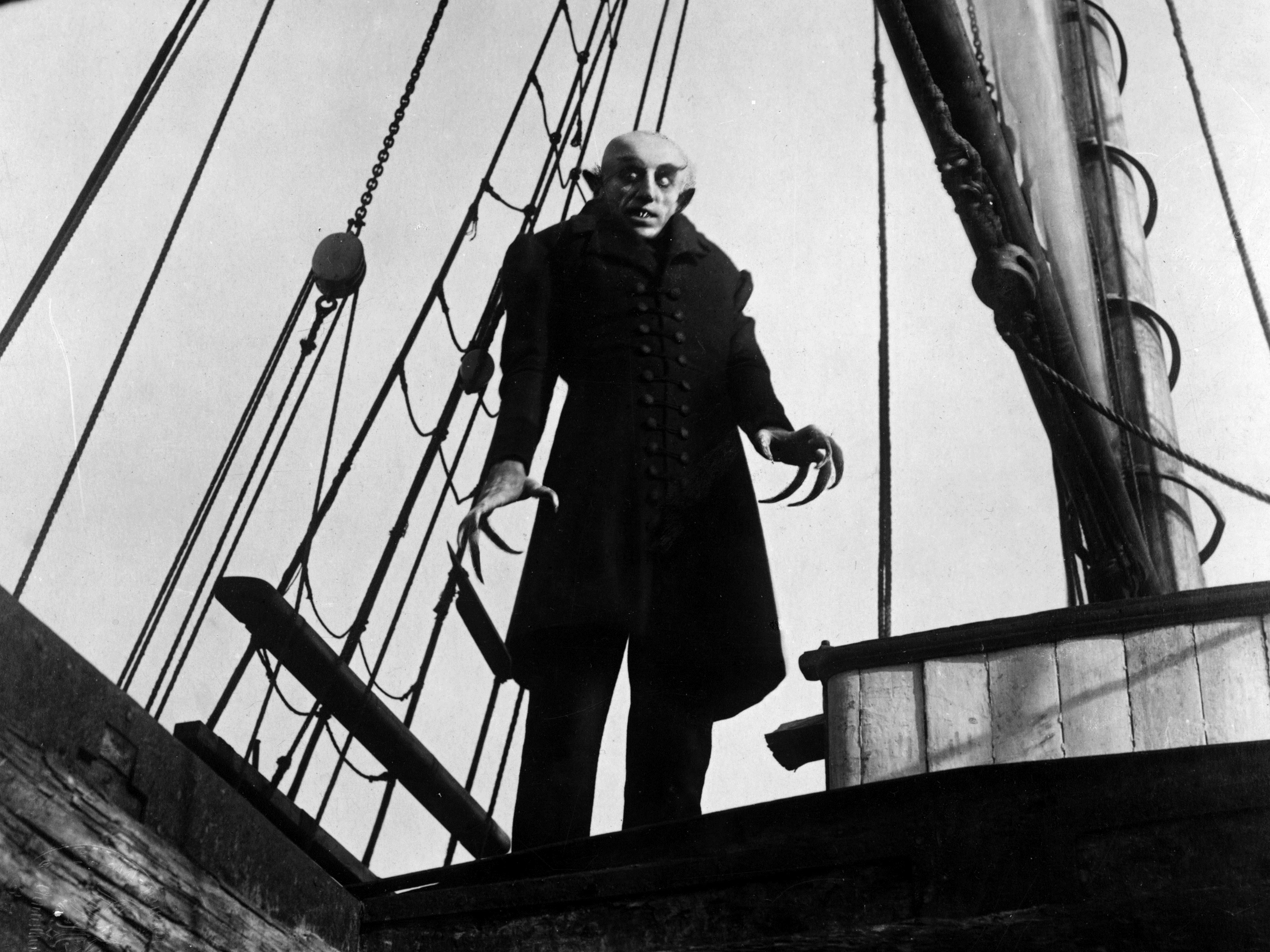
When a young real estate agent, Thomas Hutter, goes to the castle to close a deal, Orlok is attracted by his blood and decides to follow him to his hometown. The arrival of the count causes a series of mysterious deaths and spreads panic among the inhabitants.
Murnau, through evocative images and disturbing atmospheres, creates a work that goes far beyond the simple adaptation of Stoker's novel. The film explores universal themes such as the fear of death, isolation and the loss of humanity. The production of Nosferatu was characterized by some legal difficulties due to the copyright of Bram Stoker's novel. Despite this, Murnau and his crew managed to make a film of great visual impact. The choice of Max Schreck to play Count Orlok was ingenious. His cadaverous appearance and his unnatural movements have made the character of Orlok one of the iconic monsters in the history of cinema. Over the years, Nosferatu has become a cult film, influencing generations of filmmakers and becoming a reference point for the horror genre. The image of Count Orlok, with his elongated nails and sunken eyes, has become an icon of horror cinema.
Caravaggio's Heresy and the Birth of Cinematic Guilt
You are sitting in a darkened room when the beam finds you — not the projector’s beam, not yet, but the one Caravaggio invented somewhere around 1600, the one that has been hunting human faces ever since. It does not illuminate. It accuses.
Michelangelo Merisi da Caravaggio understood something about light that the entire Renaissance tradition had politely refused to admit: that visibility is not a gift. Before him, painters flooded their sacred scenes with luminosity as a form of divine endorsement, as if God’s presence required brightness the way a stage requires footlights. Caravaggio dismantled that contract. In the Calling of Saint Matthew, painted for the Contarelli Chapel in Rome between 1599 and 1600, the light does not descend from the heavens — it enters laterally, almost horizontally, like an interrogation lamp. Matthew does not look illuminated. He looks caught.
This is the theological heresy that art historians have circled for centuries without fully naming: tenebrism is not a technique for dramatizing faith. It is a technique for dramatizing guilt. The darkness Caravaggio preserves around his figures is not the darkness before revelation — it is the darkness that revelation destroys whether you want it to or not. His saints do not glow with grace. They flinch. They look away. They cover their eyes with the posture of people who would prefer not to be seen at this particular moment, in this particular condition, by whatever is generating that light.
Robert Zwijnenberg, in his 2008 essay on Caravaggio’s corporeality and sacred violence, noted that the painter’s figures carry what he called “the burden of being seen” — a phrase that sounds psychological but is in fact deeply theological. The Catholic Church of the Counter-Reformation, which commissioned much of his work, was in the middle of a massive campaign to make guilt visible, tactile, present in the body rather than abstract in the soul. Caravaggio gave them the visual machinery for it, then turned that machinery against everyone, including the Church’s own saints, including Christ himself, who in The Flagellation of Christ appears not transcendent but exhausted, lit from above like someone under a hospital lamp.
When silent cinema arrived three centuries later, it reached instinctively for this same grammar without understanding where it had come from. The directors working in Germany between 1919 and 1927 — in studios where the budget was too low for elaborate sets and the electricity too expensive to waste — discovered that shadow was cheaper than construction and more emotionally efficient than dialogue. What they were rediscovering, without the historical vocabulary to name it, was Caravaggio’s central proposition: that the human face, caught in a narrow beam against total darkness, reads immediately as a face with something to hide. The shadow is not decorative. It is diagnostic.
This inheritance was never acknowledged because the filmmakers themselves did not know they were inheriting anything. They thought they were solving practical problems of production. But the bodies of their performers, twisted away from light sources, hands raised against brightness, eyes wide in the half-dark, were re-enacting a visual logic that had already spent three hundred years training Western eyes to read exposure as condemnation. The audience did not need to be told that the man standing in the light was guilty. They already knew. They had been learning it in churches since childhood.
What makes this particularly unsettling is the directionality of the effect. Caravaggio’s light has no warmth. It grants no comfort, offers no safety. It simply finds you where you are, in whatever compromised posture you happen to be occupying, and holds you there for the viewer to assess. The cinema that inherited this structure did not soften it.

The German Studio System and the Industrialization of Dread
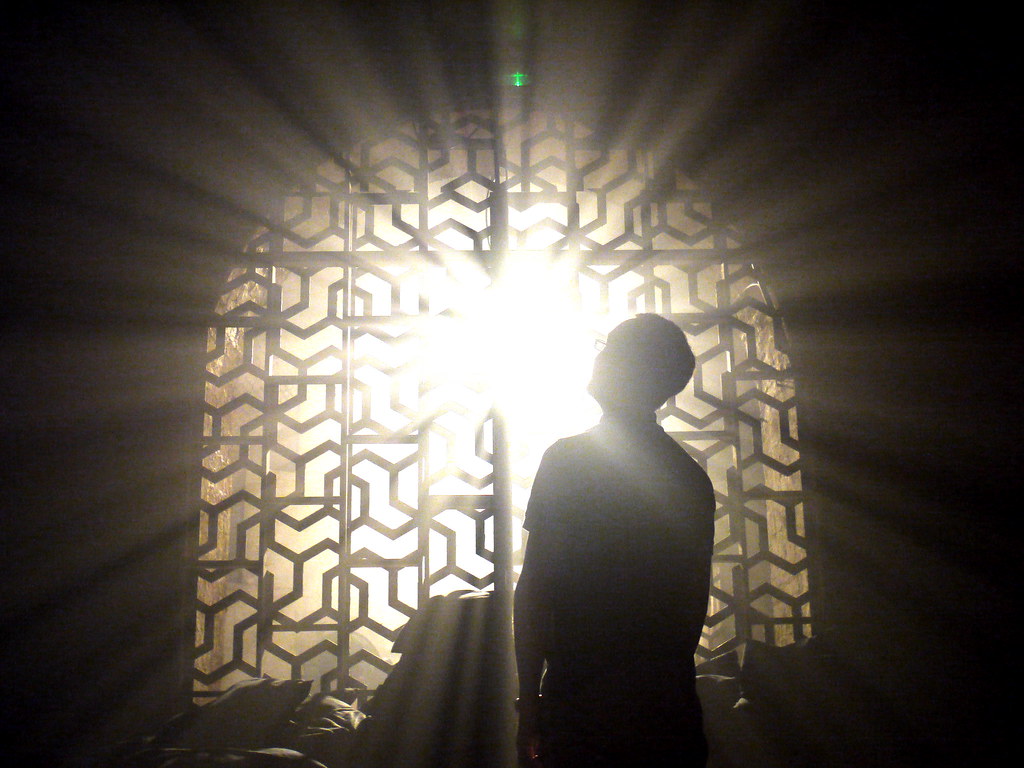
You are working late in a building you know well, and then the lights cut and the corridors you have walked a hundred times become something else entirely — the geometry unchanged, the threat unspecified, the darkness doing work that no visible monster ever could.
That is precisely the situation the German film industry found itself in after 1919, except the darkness was not accidental. It was budgetary. The hyperinflation that gutted the Weimar Republic’s middle class made elaborate sets, location shooting, and expensive pyrotechnics functionally impossible for most productions. What the studios of Babelsberg and the smaller Berlin houses could still afford was paint, lumber, and lighting rigs. So they painted shadows directly onto walls. They built staircases that leaned at angles structurally impossible in any real architecture. They angled their lamps to cast what reality never would. Scarcity became methodology, and methodology became vision.
The key figure who codified this not as compromise but as doctrine was Karl Freund, whose cinematography on films throughout the early 1920s demonstrated that a single light source placed below a human face does not merely illuminate differently — it rewrites the moral grammar of the face entirely. Freund understood something that most of his contemporaries were still treating as a technical accident: the camera does not record reality, it produces a second reality whose emotional rules are entirely separable from the first. When Fritz Lang’s production designers at UFA built environments where the shadows fell at impossible angles relative to the light sources visible in frame, they were not making errors. They were asserting that psychological truth overrides optical truth, and that an audience’s nervous system would follow the former while barely noticing the contradiction.
What this produced, structurally, was the industrialization of dread as a repeatable process. By 1922 there were informal but functional conventions circulating between cinematographers, directors, and set designers in the German studio system: low-key lighting ratios far more extreme than anything then standard in Hollywood, foreground objects left in heavy shadow to compress the apparent depth of a space, actors lit from positions that made their eye sockets vanish into dark pools. Rudolf Kurtz, writing in his 1926 critical study Expressionismus und Film, identified this as a deliberate inversion of Enlightenment spatial logic — the German studios were manufacturing interiors where the expected relationship between visibility and safety had been surgically reversed.
The sociological dimension of this cannot be treated as incidental. A population that had lost its savings to inflation by 1923, watched political stability erode through successive crises, and lived under the daily experience of institutional unreliability was being handed, at the cinema, an aesthetic language that externalized exactly that feeling — the feeling that the space you occupy may not behave according to the rules you were given. The historian Siegfried Kracauer argued in his 1947 work From Caligari to Hitler that these films were unconsciously processing what ordinary German social life could not say aloud. Whether or not one accepts the full determinism of Kracauer’s thesis, the phenomenological observation underneath it is harder to dismiss: these films felt true to their audiences in a way that had nothing to do with narrative.
What the German studio system proved, almost despite itself, was that fear is not produced by the content of what is shown. It is produced by the manipulation of the frame’s relationship to legibility. A figure half-consumed by shadow is more frightening than a clearly visible threat because the brain’s threat-assessment machinery is activated by ambiguity, not by information. The shadow does not represent danger — it constitutes it, in the same way that silence in a room you expected to contain sound constitutes something wrong before you can name what is missing.
Shadow as Social Diagnosis in Expressionist Cinema
You are standing in a corridor that tilts. The floor slopes at an angle no architect would permit, the walls lean inward like a tribunal closing its ranks, and the single light source hangs from a point that cannot be determined — casting a shadow of a man twice his height, stretched and blackened against plaster that seems to breathe. Nothing in this space is accidental. Every degree of distortion was calculated on a Berlin studio floor sometime between 1919 and 1927 by painters who had migrated from canvas to celluloid and brought with them a fury of geometric unease. They were not decorating. They were diagnosing.
German Expressionist cinema arrived in the aftermath of a war that had industrialized death, rationalized slaughter through command structures, and returned millions of men to civilian life with the knowledge that institutions could mobilize an entire civilization toward its own destruction. What the films encoded in their fractured angles and impossible shadows was not metaphor for that experience — it was a documentary impulse. The distortion on screen was the accurate shape of how power actually felt from beneath it. Siegfried Kracauer, writing in 1947 in From Caligari to Hitler, made this argument with sociological precision: the tyrannical figures of Expressionist cinema, the somnambulist led by an authoritarian doctor, the serial killer who cannot resist his own compulsion, were not villains in the narrative sense but structural revelations. They showed the audience the logic of surrender — the way ordinary people, exhausted by economic catastrophe and institutional betrayal, were already inclined to hand their will to whoever arrived with the posture of certainty.
What makes this reading more than retrospective cleverness is the cities that produced it. Weimar Berlin in 1921 had an unemployment rate fluctuating with terrifying unpredictability, a hyperinflation that would by 1923 render a loaf of bread literally a billionaire’s purchase, and a street life so densely anonymous that sociologist Georg Simmel had already, in his 1903 essay “The Metropolis and Mental Life,” described the metropolitan individual as someone who develops a blasé attitude not from sophistication but from sheer neurological self-defense against overstimulation. The elongated shadow in Expressionist cinema is the visual form of that blasé attitude turned inside out — the moment when the numbed interior erupts as a monstrous exterior, when the anonymity the city demands becomes the anonymity that kills.
The fractured light was also doing something specific to the architecture of identity. In a studio built on forced perspective, where a staircase narrows impossibly toward a vanishing point and a window casts a rhombus of white across a floor of black, the human figure cannot maintain the bourgeois fiction of stable selfhood. The body becomes an element of composition rather than a sovereign subject. This was not a failure of technique but its achievement. Max Reinhardt‘s theatrical training had already taught an entire generation of German stage directors that the body in light is always already a social body — positioned, framed, dominated or released by the architecture surrounding it. When those directors moved into film and recruited designers like Hermann Warm, who reportedly said that film images must become graphic art, they imported a conviction that visual structure is never neutral, that the angle of a shadow tells you exactly where power lives.
Urban anonymity was not background scenery in these films — it was the operating system. The faceless crowds that populate the street sequences, barely individuated, moving in mechanized rhythm, prefigured what Hannah Arendt would later call the banality of ordinary participation in extraordinary systems. The camera did not need to name this. It only needed to show a man walking into a pool of darkness between two streetlamps, swallowed completely for three seconds, and then emerging slightly altered — as though the dark between lights was not empty space but an institution with its own appetite.
The Migration of Darkness: From Berlin to Hollywood, 1933–1945
You are watching a man walk down a wet street at two in the morning, the pavement catching a single lamppost’s reflection like a wound that won’t close, and you understand without being told that this city has already swallowed something it cannot name. The man’s hat brim throws a shadow across his eyes. He is not a detective or a criminal yet — he is, at this precise moment before the plot assigns him a function, simply someone who has survived something the frame refuses to disclose.
What entered Hollywood between 1933 and 1941 was not a stylistic preference. It was a body of knowledge carried inside the nervous systems of people who had watched their countries transform overnight into machines of elimination. Fritz Lang crossed the border into France the day after Goebbels personally offered him control of the Nazi film apparatus in 1933. Billy Wilder left Berlin with forty dollars and a typewriter. Robert Siodmak, Edgar Ulmer, Otto Preminger, Curt Siodmak — the list reads like a casualty roster written in the wrong tense, the tense of those who survived rather than those who did not. They brought with them not nostalgia for Weimar aesthetics but a physiological understanding of what light does when it abandons a space, what architecture becomes when it is designed to threaten the person standing inside it.
The American studios received these men with the particular generosity of institutions that believe they are doing the absorbing. Columbia, Universal, Paramount handed them genre assignments — crime pictures, melodramas, B-pictures with tight budgets and tighter schedules — without recognizing that the people behind the camera were encoding into every shadow an experience that American cultural production had no legitimate vocabulary to process. The trauma was not metaphorical. Germany’s Enabling Act of March 1933 had been signed while some of these directors were still in pre-production on films that would never be completed. The darkness they placed on screen was not borrowed from Expressionist theory; it was the residue of a specific historical rupture pressed into celluloid because there was nowhere else to put it.
What film noir accomplished — and what no one called film noir until the French critics Nino Frank and Jean-Pierre Chartier named it in 1946, watching from a distance that allowed them to see the pattern — was the displacement of political terror into the grammar of individual moral failure. The corrupt city, the femme fatale as figure of uncontrollable chaos, the protagonist trapped in systems he cannot master: these were not invented as metaphors for fascism. They were the emotional architecture of people who had lived inside a society that turned, who had felt the specific vertigo of a world where institutions ceased to protect and began to hunt. Siegfried Kracauer had argued in From Caligari to Hitler, published in 1947, that Weimar cinema had prefigured the psychological conditions of totalitarianism — but the argument can be extended and reversed. The directors who escaped carried the post-totalitarian psyche into a country that had not yet confronted what totality of power actually felt like from the inside, and they expressed it in the only register available to commercial cinema: crime, desire, betrayal, the city at night.
The cinematographer John Alton, born in Austria-Hungary, published a manual in 1949 called Painting with Light, which described low-key lighting not as a technique but as a philosophy of vision — the deliberate choice to let darkness claim what it is owed, to refuse the democratic brightness that American cinema had treated as a moral default. What Alton was codifying had already been practiced for a decade on sets across Los Angeles by men who understood, in a way that no studio executive could, that sometimes the most honest thing a frame can do is show you how little of the room you are actually permitted to see.
A vision curated by a filmmaker, not an algorithm
In this video I explain our vision
What the Audience Refuses to See in the Dark

You are already doing it before the projector beam has steadied — filling the dark corner of the frame with something worse than whatever the director placed there, animating the stillness at the edge of vision with a threat your conscious mind would immediately dismiss if it were simply named. The shadow in the doorway becomes specific to you, calibrated by your own archive of fear, and this is not metaphor. It is neuroscience.
The process has a clinical name: perceptual filling-in, the brain’s compulsive habit of completing incomplete sensory data using prior expectation. It is the same mechanism that makes the blind spot in your visual field invisible to you — your cortex interpolates, invents, papering over the gap with plausible texture. What Semir Zeki documented across decades of visual neuroscience research, particularly in his work on the constructive nature of visual perception published through the 1990s into the 2000s, is that the brain is never passively receiving an image. It is always actively generating one, submitting guesses and revising them at speeds the conscious observer cannot track. Cinema’s strategic use of shadow therefore does not withhold information from a passive recipient — it triggers a creative act in a participant who believes themselves to be an audience member.
This is where the trap closes. Sigmund Freud‘s 1919 essay “Das Unheimliche” — translated as “The Uncanny” — identified something that visual theory would take decades to absorb: the most potent form of dread is not produced by the alien and incomprehensible but by the familiar rendered strange, the domestic returned as threatening. The uncanny, for Freud, was etymologically buried inside the German word itself — heimlich meaning both homely and concealed, its opposite unheimlich meaning what has been kept hidden and has now surfaced. What makes this relevant to the darkened frame is that shadow performs exactly this semantic inversion spatially. It transforms the known geometry of a room, a face, a corridor into something simultaneously recognizable and wrong, and the viewer’s filling-in instinct reaches for the familiar category only to find it contaminated.
The spectator, in short, is not a victim of the image. They are its author in the crucial final stage of production, which no director can fully control and which varies from nervous system to nervous system. A filmmaker can place a lamp at forty-five degrees and let the rest dissolve, but what floods that dissolution is imported — dragged in from the viewer’s personal sediment of unresolved fears, half-remembered losses, images seen and supposedly forgotten. The medium exploits what cognitive scientists now call predictive processing, the brain’s continuous generation of a model of the world against which incoming sensory data is checked for deviation. Shadow maximizes deviation while minimizing data, which forces the predictive model to work harder, to produce a richer, more anxious hallucination.
What makes this genuinely uncomfortable to acknowledge is the question of consent it raises. The viewer who leaves a screening shaken, who carries an image into sleep and finds it there waiting, was not passive before a stimulus. They assembled the thing. They lent it their own darkest materials. The terror that felt externally imposed was partly self-generated, which means the experience of being frightened by shadow on a screen is always, at some structural level, a confrontation with what the viewer already carries — not introduced from outside but excavated from within and projected back at them with the borrowed authority of the cinematic frame.
This is what the industry never quite puts in the promotional copy: that the darkness on screen is also a mirror, and what populates it says nothing definitive about the director’s imagination and something uncomfortably precise about the person sitting in the seat, leaning slightly forward, certain they are watching when in fact they are creating.
Color, Light Metering, and the Whiteness of the Default Gaze
You are watching a photograph develop in a darkroom, the image rising slowly through the chemical bath, and you notice that the faces emerge first — pale skin catching the light, pulling itself out of the gray before everything else. It seems natural. It seems like physics. It is neither.
Kodak’s earliest color film stocks, particularly Kodachrome introduced in 1935 and the family of emulsions that dominated professional cinematography through the postwar decades, were calibrated using a reference standard known internally as the “Shirley card” — a printed image of a light-skinned brunette woman used to set exposure and color balance for laboratory processing. Technicians in film labs across the United States adjusted their chemical baths, their timing, their printing lights against this single face. The consequences were not cosmetic. It was structural. Any skin tone that deviated significantly from that reference point was rendered either washed out or swallowed by shadow, not because the physics of light demanded it, but because the entire processing chain had been tuned to a specific human being treated as the universal default.
The philosopher Charles Mills argued in “The Racial Contract” (1997) that white supremacy functions not through explicit exclusion alone but through the normalization of whiteness as the unmarked, transparent, unquestioned standard from which all deviation must be explained. What happened inside Kodak’s research and development labs is precisely this mechanism expressed in silver halide and dye couplers. The technical was never neutral. It carried an assumption about whose face was the face, whose skin was the skin that light was supposed to reveal. Every cinematographer who learned exposure by reading a meter against a neutral gray card, then translating that reading to Caucasian flesh tones, was absorbing a racial epistemology presented as optical science.
This matters for how the entire aesthetic vocabulary of cinematic lighting was constructed, word by word, across decades of practice. The term “motivated light” implies that the source of illumination justifies itself through narrative logic — a window, a lamp, a fire. But motivation is always motivation for someone. When the dominant question in studio lighting design was how to make a star’s face luminous, sculpted, and present, and that star was almost invariably white, the grammar of motivation was quietly racially indexed. Low-key lighting read as “dramatic” on pale skin and simply as “underexposed” on darker complexions. What was aestheticized as shadow in one context was misread as technical failure in another.
Richard Dyer‘s 1997 study “White” traced precisely this problem through the history of photography and cinema, arguing that the technology of light reproduction was developed in intimate parallel with a cultural project of making whiteness visible, radiant, and self-evidently beautiful. He pointed to the lighting manuals of Hollywood’s golden age, which routinely described the ideal face as one that “held” light — meaning reflected it evenly without absorbing too much. Darker skin, which absorbs more light across the visible spectrum, was by this definition literally resistant to the aesthetic ideal baked into the medium.
The rupture came slowly and imperfectly. In the 1970s, Kodak was reportedly pressured by furniture and chocolate manufacturers — industries struggling to reproduce accurate color for their darker products — to recalibrate their emulsions before there was significant pressure from cinematographers or directors working with predominantly Black casts. The market corrected the racial bias not in the name of human representation but because wood grain and cocoa packaging demanded it. The technology became marginally more inclusive as a side effect of commercial necessity, which tells you something precise about the hierarchy of concerns embedded in industrial image-making.
Cinematographers like Bradford Young, working in the digital era on films shot in the 2010s, have spoken openly in interviews about having to actively fight the default assumptions built into camera sensors and lighting equipment — assumptions that still tilt, however subtly, toward rendering pale skin as the baseline of correct exposure. The ghost of the Shirley card has not been fully exorcised.
Digital Light and the Illusion of Democratic Visibility
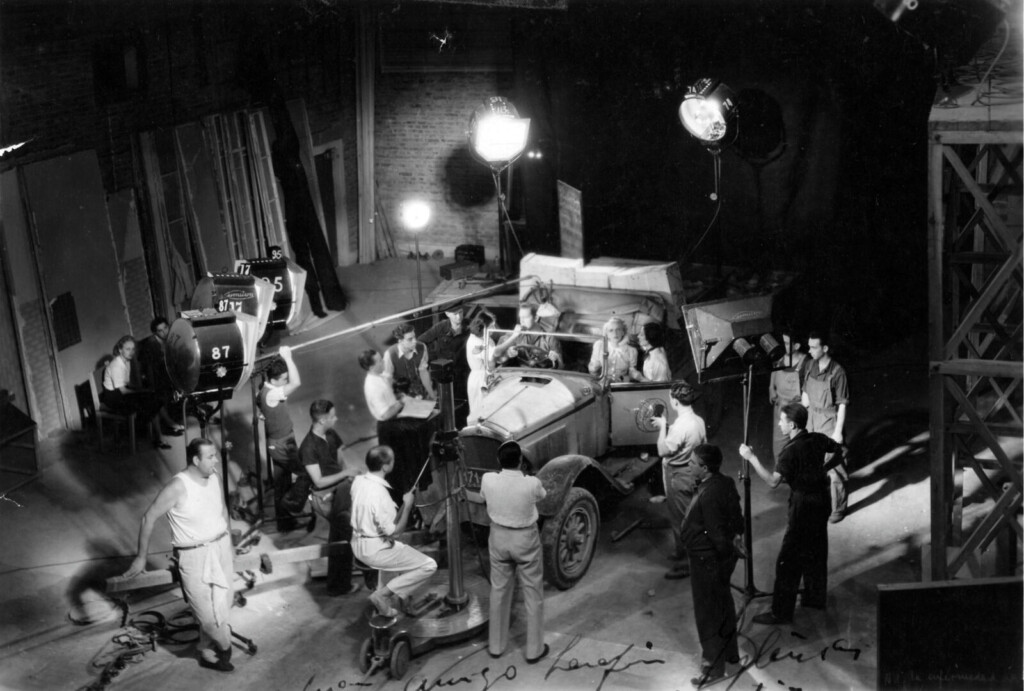
You are watching a film shot entirely in daylight, every shadow lifted, every corner illuminated by sensors that can distinguish forty stops of dynamic range, and yet somehow the villain still occupies the frame differently than the hero — not darker, exactly, but compositionally displaced, geometrically subordinate, caught in negative space that no amount of luminous data can quite dissolve.
The promise embedded in digital cinematography’s technical revolution was essentially democratic: if the camera can now render what the human eye sees in a moonlit field or a sun-blasted desert with equal clarity and fidelity, then the old hierarchies of the visible — who gets to be seen, who gets swallowed — must necessarily collapse. This was never an innocent claim. It borrowed its rhetorical force from a longer tradition of confusing the expansion of a medium’s capacity with the transformation of its underlying intentions, the same category error that greeted the introduction of synchronized sound in 1927, when critics argued that cinema had finally become universal, only to watch the industry immediately use the technology to enforce new accents, new social markers, new codes of belonging and exclusion.
Walter Benjamin, writing in 1935 in “The Work of Art in the Age of Mechanical Reproduction,” identified a different kind of trap: the moment a technology achieves total reproducibility, it does not destroy the aura of power — it redistributes it invisibly into structure, into the grammar of selection and framing that determines which reproductions circulate and which do not. HDR rendering and digital grading have done precisely this. The full spectrum of light is theoretically available, but the decisions about where to direct the viewer’s eye — which zones of the frame to treat as morally central, which to treat as peripheral — are now made in post-production color suites where the inherited geometry of chiaroscuro operates through metadata rather than through light ratios on a physical set. The shadow has not been abolished; it has been bureaucratized.
There is also a sociological dimension that quantitative data makes impossible to ignore. A 2019 study published by the University of Southern California’s Annenberg Inclusion Initiative found that across the top 1,200 films produced between 2007 and 2018, characters from marginalized racial and ethnic groups were not only underrepresented in narrative terms but consistently placed in compositional positions — shallower focal planes, higher key-light ratios that flatten rather than sculpt, wider framings that reduce psychological intimacy — that the grammar of classical cinematography had always reserved for figures of lesser moral weight. The cameras were more powerful than anything Fritz Lang or Karl Freund had ever touched. The grammar they were executing was structurally continuous with the one those men had inherited from nineteenth-century theatrical lighting and from the chiaroscuro logic of Caravaggio’s 1600 paintings, where divine illumination fell on figures whose claim to grace was already decided before the brush moved.
What digital technology genuinely changed was the plausibility of denial. When shadows were carved physically into film emulsion, their ideological function was at least legible — you could point to the underexposed face, the crushed blacks in a particular scene, and name what you were seeing. Now the same effect is achieved through a grading decision made by a colorist working on a timeline at two in the morning, adjusting a luminance curve by three percent in a secondary mask, and the result on screen is indistinguishable from a neutral technical correction. The moral geometry is still there, still organizing the viewer’s sympathies, still deciding who radiates and who recedes — but its production has been rendered invisible even to many of the people producing it, dissolved into workflow, into software defaults, into the aesthetic intuitions that feel like craft and are in fact the accumulated sediment of a very long history of deciding, with light, who counts as fully human.
🎞️ Light, Shadow, and the Art of Cinematic Vision
The interplay of light and shadow has shaped some of cinema’s most powerful aesthetic movements, from the stark contrasts of German Expressionism to the brooding atmospheres of film noir. Understanding these visual languages requires exploring their roots in painting, philosophy, and the psychology of perception. The articles below illuminate the deeper cultural and artistic forces that made chiaroscuro a cornerstone of the moving image.
Light in Painting: History and Symbolism
Light in painting is not merely a technical device but a philosophical statement about reality, divinity, and human perception. From Caravaggio’s violent contrasts to Vermeer’s quiet luminosity, painters developed a visual grammar that filmmakers would later inherit and transform. This article traces that rich history, revealing how cinematic lighting was born long before the invention of the camera.
GO TO THE SELECTION: Light in Painting: History and Symbolism
Caravaggio: Life and Works
Caravaggio revolutionized Western art by wielding darkness as dramatically as any brushstroke of color, pioneering the chiaroscuro technique that would echo through centuries of visual storytelling. His figures emerge from absolute blackness with an almost theatrical intensity, anticipating the expressionist aesthetics of early cinema by three hundred years. Understanding Caravaggio is essential to understanding why shadows in film feel so emotionally charged.
GO TO THE SELECTION: Caravaggio: Life and Works
The Relationship Between Painting and Cinema: History and Theory
The dialogue between painting and cinema is one of the most fertile and underexplored conversations in art history, with directors consciously borrowing compositional strategies, color theories, and lighting philosophies from the canvas. This article examines how filmmakers from Eisenstein to Kubrick studied painters with the same devotion a musician studies composers. The result is a compelling argument that cinema is, at its core, a moving painting.
GO TO THE SELECTION: The Relationship Between Painting and Cinema: History and Theory
Black and White Photography: Masters of Shadow and Light
Black and white photography created the foundational visual language that early cinema adopted wholesale, establishing conventions of contrast, texture, and tonal drama that still define shadow-heavy filmmaking today. The masters of monochrome photography understood instinctively that removing color forces the eye to confront form, light, and darkness in their purest emotional states. This article celebrates the artists who turned the absence of color into one of art’s most expressive tools.
GO TO THE SELECTION: Black and White Photography: Masters of Shadow and Light
Discover the Cinema of Light and Shadow on Indiecinema
If these visual and philosophical depths have stirred your curiosity, Indiecinema’s streaming platform offers a handpicked selection of independent films that carry on the tradition of chiaroscuro and expressionist vision. From European art cinema to bold contemporary voices, you will find works where light and shadow are never accidental but always meaningful. Explore the catalog and let the darkness speak.
👉 EXPLORE THE CATALOG: Watch Indie Films in Streaming
A vision curated by a filmmaker, not an algorithm
In this video I explain our vision

