
The Woman Who Arrives in the Snow
You are moving through snow that has stopped being weather and become something else entirely — a substance, a pressure, a whiteness so total it erases the boundary between ground and sky and leaves you suspended in a featureless void where direction loses meaning. Your legs have been numb for an hour. The cold has moved past sensation into a kind of clarity, a narrowing of the mind to a single bright point of survival instinct, and it is precisely in this state — stripped of social performance, of the small armors you wear in rooms with other people — that you see her.

She is standing where nothing should be standing. The snow does not touch her the way it touches everything else; it parts around her, or perhaps she simply does not accumulate it, does not receive it the way surfaces receive things. She is white in a way that is not pallor — not the white of illness or cold but the white of something that has never needed warmth to begin with. Her hair is the only darkness in the landscape, and it falls with a stillness that the wind does not disturb. She is looking at you with an expression that you will spend the rest of your life trying to decode, because it contains neither malice nor compassion — it contains something older and more unsettling than either, something that sees you completely and is not moved by what it sees.
What happens in the next few seconds depends entirely on who you are, what you have done, what you carry. This is not a metaphor. In the oldest recorded tellings of the Yuki-onna — the snow woman of Japanese folklore, documented with sustained literary attention at least since the Muromachi period, between 1336 and 1573, and preserved across regional variants spanning from Aomori to Kyushu — her behavior toward the traveler she encounters is not predetermined by her nature but calibrated to something in him. She kills some. She spares others. She takes certain men as husbands and lives with them for years, bearing children who are notably pale and cold to the touch, before vanishing back into winter. The criteria for these different outcomes are never explained in the source material, which is itself a kind of explanation.
Lafcadio Hearn, the Greek-Irish writer who became a Japanese citizen under the name Koizumi Yakumo, recorded the most internationally known version of the Yuki-onna story in his 1904 collection Kwaidan: Stories and Studies of Strange Things. His account introduces a woodcutter named Mosaku who dies in the snow and a younger man named Minokichi who survives because the Yuki-onna, standing over him with her breath like arctic wind, finds something in his face worth preserving. She spares him on condition of silence — he must never speak of what he has seen — and then she is gone. Years later he marries a woman of unusual beauty and unusual coldness, and you already know where this is going, and the fact that you know does not diminish the horror of the moment when she reveals herself, because Hearn understood that the uncanny does not operate through surprise. It operates through recognition.
That recognition is the central wound of the Yuki-onna myth, the thing that makes her different from a simple predatory spirit. She is not hiding. She has been there the whole time, in the bed, at the hearth, nursing children, performing the exact gestures of domestic womanhood with a precision so flawless it passed for the real thing — and the question the story refuses to answer is whether the performance was also, somehow, genuine. Whether something that cannot feel warmth can nonetheless generate it for others. Whether a creature who is categorically not human can inhabit human love so completely that the distinction stops mattering, right up until the moment it matters absolutely.
Ugetsu
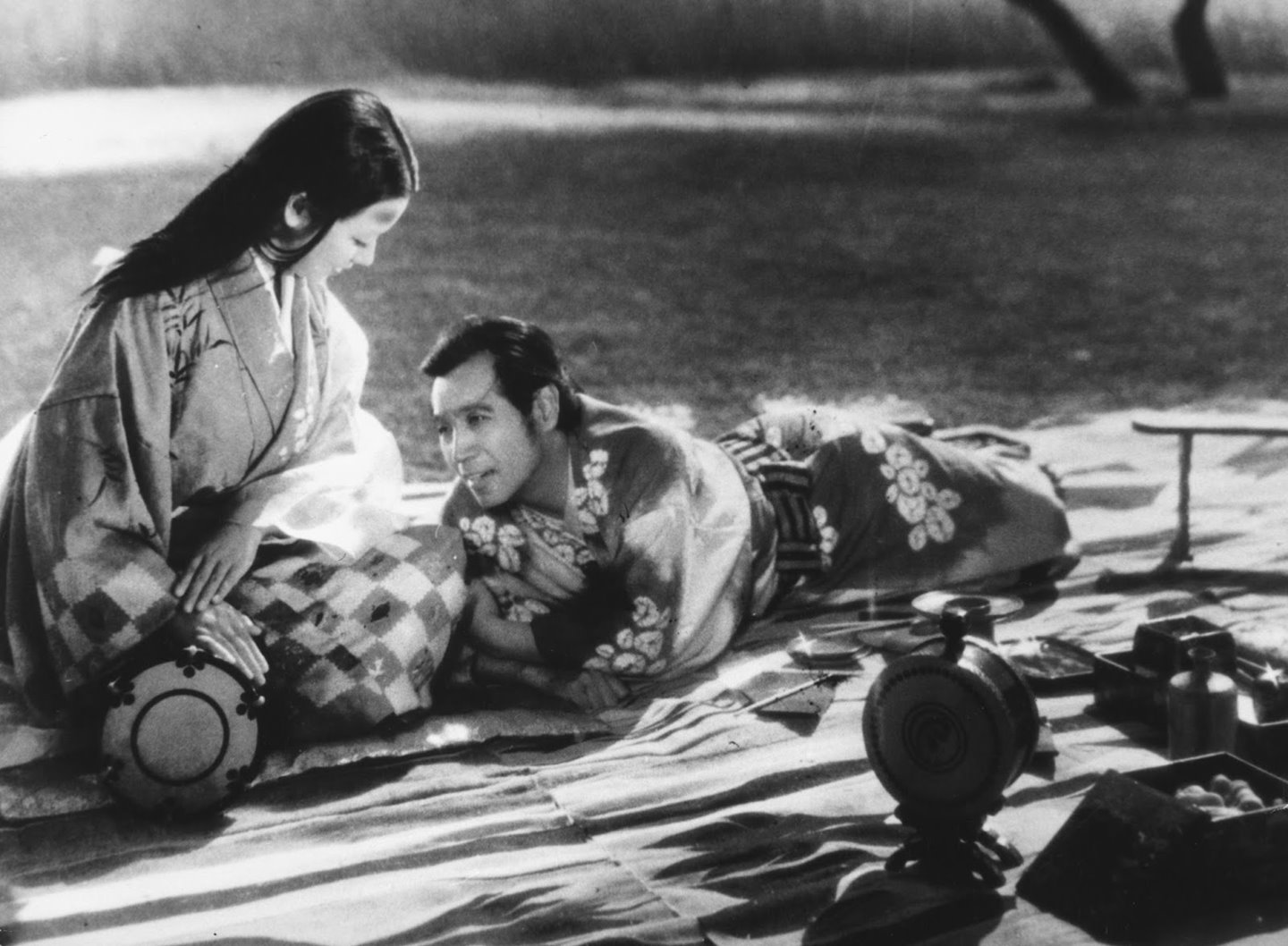
Drama, fantasy, by Kenji Mizoguchi, Japan, 1953.
Japan, late 16th century: the potter Genjurō and his brother Tobei live with their wives Miyagi and Ohama in a village in the Omi region; Genjurō, convinced that he can earn a lot of money by selling his goods in the nearby city, goes to the county of Omizo with Tobei, who joins him with the sole purpose of being able to become a samurai. Back home with a good income, the two work hard to make even more money; Tobei, increasingly obsessed with the ambition of becoming a samurai, needs the money to buy an armor and a spear while Genjurō, overcome by greed, tries to cook a batch of crockery with his brother in just one night. Legend and innovation of cinematic language, a wonderful world next to a brutal and cruel world. Mystery film that opens a discourse with the invisible planes of existence, ghosts and forays into the fantastic, made by Kenji Mizoguchi in a Japan still frozen by the two atomic bombs dropped on Hiroshima and Nagasaki. Fundamental work by Mizoguchi, recognized as one of the greatest expressions of the Seventh Art. A lofty lesson in directing that creates wonder with a dramatic tale of greed and lust for possession. A woman who is a tempting demon and a wife abandoned to a fate of war and misery, Mizoguchi uses the camera to enter "another world".
Food for thought
According to ancient Eastern traditions there are other non-physical planes beyond the physical plane. The etheric plane envelops the physical body, gives it vital energy and acts as an intermediary with the higher levels. Beyond the etheric plane there is the astral plane where entities may exist that have not been able to resign themselves to the loss of their body and wander in search of sensations. They are what are commonly referred to as "ghosts". These entities are looking for bodies that have unbalanced etheric planes to "hook up" to in order to experience sense satisfaction through them.
LANGUAGE: Japanese
SUBTITLES: English, Spanish, French, German, Portuguese
A Mythology Built from Male Dread
You are walking alone on a mountain pass in February, the kind of cold that does not announce itself but simply enters you, and somewhere between the last village and the next you realize that the snow has erased every landmark you trusted. That is not a metaphor. That is the biographical condition of the men who first gave Yuki-onna her shape — woodcutters, hunters, travelers moving through the Japanese alps before there were roads or rescue parties, men for whom a wrong turn in a blizzard was not an adventure but a quiet and final disappearance.
Lafcadio Hearn published his version of her in 1904 in Kwaidan: Stories and Studies of Strange Things, and the text has since become the primary lens through which Western readers encounter her. But Hearn was a collector, not an inventor, and what he gathered already carried centuries of sediment. The Edo-period encyclopedist Toriyama Sekien had catalogued supernatural beings in his Gazu Hyakki Yagyō series between 1776 and 1784, and Yuki-onna appears there with unsettling casualness, as though she required no introduction, as though her audience already knew exactly what she was because they had already felt her. That familiarity is the first thing worth examining — not as evidence of a real supernatural entity, but as evidence of a real psychological consensus, a shared hallucination that communities had agreed to house inside a female body.
The construction follows a logic that anthropologists of religion have traced across dozens of cultures. When a force is lethal, unpredictable, and beyond human control, the mind reaches for personhood. Claude Lévi-Strauss, in The Raw and the Cooked, argued that mythological thinking does not describe the world — it resolves contradictions the world refuses to resolve on its own terms. The cold kills without malice, which is perhaps the most unbearable fact about it: there is no negotiation possible, no moral framework to invoke, no anger to appease. Give the cold a woman’s face, and suddenly there is a story. Suddenly there is a reason. Suddenly the man who did not come home made a mistake with a woman rather than a mistake with the weather.
That substitution is not innocent. The specific choice of a female body to contain this annihilating force reveals what the men building this mythology feared alongside frostbite. Desire and death are fused in Yuki-onna from her earliest appearances — she is beautiful before she is dangerous, and her beauty is not incidental but causal. She kills through seduction or through the mere exhalation of her breath, and in Hearn’s retelling she spares a young woodcutter specifically because she finds him physically beautiful, which means his survival depends entirely on her caprice rather than his virtue. The male subject in these stories is structurally helpless in the same way he is structurally helpless before attraction itself — overwhelmed, irrational, robbed of agency by something that entered through the eyes.
Sigmund Freud in Beyond the Pleasure Principle, published in 1920, theorized the death drive as something that operates below conscious volition, a pull toward dissolution that the organism both fears and obscurely wants. Yuki-onna dramatizes exactly this ambivalence — men do not simply flee her in the old tales, they pause, they look, they follow. The folklore does not read as a warning against a predator so much as an explanation for why men walked into blizzards and did not turn back. The figure of the snow woman gave communities a narrative for self-destruction that preserved the dignity of the dead by making their annihilation a seduction rather than a lapse of judgment.
What gets buried inside that dignity is the fact that the cold never chose them.

Beauty as Weapon, Stillness as Threat
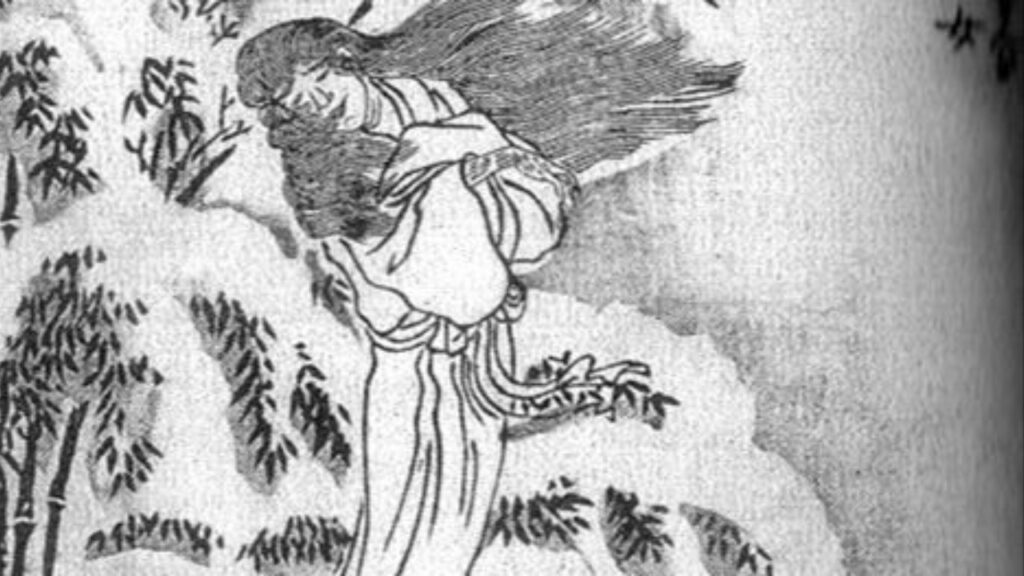
You are standing at the edge of a forest in winter, and something is watching you from between the trees. You cannot tell if it is moving. That uncertainty — not the cold, not the dark — is what stops your breath.
Yuki-onna does not threaten. She does not pursue or demand or raise her voice. She stands in the snow and she is perfectly still, and that stillness is the thing men in the old stories cannot survive. Her skin is the color of the ground she rises from, her hair the only contrast, her lips sometimes described as faintly blue — not the blue of cold, but the blue of something that has never needed warmth in the first place. She is not waiting for anything. That is the part that destroys you.
Simone de Beauvoir, writing in 1949, identified a pattern so old it had become invisible: in the symbolic economies men construct to make the world legible, woman is not a subject but a mirror. She reflects back the desires, fears, and self-images of the one looking. When she fails to reflect — when she remains opaque, self-contained, when her interior life simply does not respond to male projection — she becomes monstrous by default. Not because she has done anything. Because she has refused the function assigned to her. De Beauvoir called this refusal, even when it was not conscious, a kind of scandal. The folklore of Yuki-onna is the cultural record of exactly that scandal, preserved in snow.
What makes this structurally violent is that her beauty is genuine, overwhelming, and entirely beside the point. She is not beautiful as a trap she has laid; she is beautiful the way a glacier is beautiful — indifferently, categorically, on terms that do not include you. The men in the stories who see her and feel desire are experiencing something the stories themselves diagnose as fatal: the projection of legibility onto a being that has none to offer. They do not want her. They want the version of her that would want them back, and no such version exists. The gap between those two things is where they die.
Silence in women has historically been legislated as virtue, which means that when Yuki-onna is silent, she is performing what has always been demanded of her — and still it reads as menace. The Confucian framework that shaped Japanese domestic ideology for centuries placed a woman’s worth in her quietness, her stillness, her subordination of personal will to social role. Yuki-onna is all of those things. She is maximally quiet, maximally still, maximally removed from the expression of need. She has taken the ideal and followed it to its logical extreme, and the result is terrifying. The folklore does not miss this irony so much as it encodes it: perfect compliance, once it no longer needs you to witness it, becomes its own kind of sovereignty.
Consider what the stories do when they try to domesticate her. In several variants she marries, she enters a house, she lives among humans for years. She is a good wife in every external sense — quiet, beautiful, attentive. Then one day her husband tells the secret he was never supposed to tell, and she leaves. She does not punish extravagantly. She does not collapse into rage. She simply withdraws, back into the cold, as if the human life were a garment she had been wearing and has now set down. The horror for the storytelling tradition is not the departure itself but the composure with which it is executed. She was never, the reader suddenly understands, actually there. Something had been living in that house that was always already elsewhere, and the house was never its home.
The category of the uncanny, as Freud mapped it in his 1919 essay, depends on the return of something that should have remained hidden — but Yuki-onna inverts the structure entirely. Nothing returns. Nothing was ever fully present to begin with.
The Ghost Who Was Once a Wife
You watch her from across the room — she is folding laundry, and the movements are correct, precise, unhurried. She makes tea without being asked. She remembers the name of your colleague you mentioned once, months ago. And yet something underneath all of it refuses to arrive. Her eyes, when she does not know you are looking, go somewhere else entirely, somewhere without walls or warmth, a place that has no furniture in it.
This is the domestic uncanny that regional variants of the Yuki-onna legend have been encoding for centuries, not as horror exactly, but as recognition. In the Tōno region of Iwate Prefecture, made famous by Kunio Yanagita’s 1910 collection Tōno Monogatari, the snow woman does not haunt mountain passes as a solitary predator. She becomes a wife. She moves into a house. She cooks. She bears children. The cold does not leave her — it simply learns to wear an apron.
Yanagita’s project was ethnographic, but what his informants gave him was something stranger than folklore. The Tōno stories describe a woman who performs domesticity with flawless accuracy while remaining, at some unlocatable depth, elsewhere. Her husband knows and does not know simultaneously. This double knowledge — the intimate stranger at the center of family life — is not the invention of peasant superstition. It is a structural feature of how premodern Japanese society organized marriage itself, which was less a union of interiority than a contract of functional proximity. The woman was expected to be present in body, competent in labor, and emotionally legible only within extremely narrow registers. The legend simply names what that arrangement produced.
What makes the wife variant particularly destabilizing is that the cold she carries is not destructive in the obvious sense. She does not kill her husband. In most tellings, she leaves — only when the agreement that sustained the marriage is broken, only when he speaks what he was never supposed to speak aloud. The violence, when it comes, is a departure rather than an attack. And this reversal is where the legend becomes genuinely uncomfortable: the monster is not what she does, but what she endures before she goes.
Sociologist Chizuko Ueno, in Patriarchy and Capitalism in Japan published in 1990, documented how the postwar restructuring of Japanese labor placed women in a position that had no equivalent social language — expected to sustain emotional and domestic labor invisible to economic accounting while men’s productivity was measured, valorized, and publicly recognized. The Yuki-onna wife precedes this analysis by several hundred years and says the same thing without academic scaffolding. She is cold because coldness is what survives when warmth is extracted without reciprocity for long enough.
The maternal variant adds another layer that cannot be reduced to the marital one. In certain Niigata and Akita tellings, the snow woman is encountered carrying a child — sometimes her own, sometimes one she has taken, sometimes one she simply holds with the gravity of someone who has lost. The child motif pulls the figure away from pure danger and into something more ambiguous, a grief that has crystallized into form. Folklorist Noriko Reider, writing in 2003 in the Japanese Journal of Religious Studies, notes that female supernatural figures in Japanese tradition frequently embody unresolved maternal attachment — spirits who cannot complete death because an obligation to a child remains severed rather than fulfilled. The cold, in this reading, is not absence of love but its perfect, terrible preservation.
What these regional elaborations collectively refuse is the clean separation between the monstrous and the familiar. The Yuki-onna is not a creature who impersonates a wife or a mother. She is one. The ice was always there, beneath the ordinary warmth, which means the ordinary warmth was never quite what it appeared to be either, and neither was the house, and neither was the life being lived inside it.
What the Cold Actually Means
You are standing at the edge of a rice field in February, somewhere in the interior of Tohoku, and the temperature has dropped below minus fifteen Celsius. There is no wind, which makes it worse — the silence has weight, a physical pressure against the ears, and the snow is not falling so much as existing, omnipresent, suspended between sky and ground like a second atmosphere. The nearest village is four kilometers away. You have been cutting wood. Your hands stopped hurting an hour ago.
This is not atmosphere. This is the demographic and material condition from which the figure of the snow woman emerged. The northeastern prefectures of Japan — Aomori, Akita, Iwate, Yamagata — along with the island of Hokkaido experienced winter mortality rates that modern populations cannot easily metabolize as historical fact. In the Edo period, between 1603 and 1868, rural communities in these regions regularly lost between ten and thirty percent of livestock to winter exposure, and human deaths from cold-related illness and starvation during extended snowfall periods were common enough to have their own administrative terminology. The snow did not merely inconvenience people. It killed them with statistical regularity, and the communities it killed were small enough that every death was a face.
Anthropologist Noriko Reider, whose scholarship on Japanese demon lore and supernatural femininity has mapped the ideological architecture of these figures with unusual precision, argues that the oni and related apparitions in Japanese folk tradition functioned not as projections of irrational fear but as cognitive instruments for processing violence the community had actually witnessed. Her work traces how the supernatural female, across multiple regional variants, almost always appears at the site of historical trauma — at the ford where the body was found, at the mountain pass where the travelers disappeared, at the edge of the field last cultivated before the famine year. The figure does not invent death. She marks it.
What this means materially is that the landscape itself was already lethal before it was mythologized, and that the mythology was always secondary — a second skin grown over the wound. The cold was not a metaphor for loneliness or sexual danger or the treachery of beautiful women, interpretations that have been layered onto the legend by literary scholars working from warm libraries. The cold was the primary fact, and everything else was its translation. When a body was found frozen in the snow, the question the community asked — consciously or not — was not only “what killed him” but “what kind of thing does this killing.” The answer the legend provided was not random. It was female, and it was deliberate, and it was without remorse.
That absence of remorse is the element that does not survive polite retelling. In the sanitized versions, the snow woman is tragic, conflicted, even maternal — she spares the young boy, she weeps, she disappears out of mercy or grief. But the older stratum of the legend, preserved in the regional collections that predate Lafcadio Hearn’s 1904 rendering in Kwaidan, which shaped most Western and much modern Japanese engagement with the figure, contains a creature who kills without ambivalence and without explanation. She does not mourn her victims. She is not punishing them for a specific transgression. She kills because she is winter, and winter does not explain itself.
The transformation of mass death into female agency performed a specific cultural function that had nothing to do with misogyny as a starting point. When the cause of death is impersonal — cold, starvation, the indifferent arithmetic of January — grief has nowhere to direct itself. The legend gave grief an address. It made the killing intentional, which made it legible, which made it survivable as a story even when it was not survivable as an event. The woman in the snow looked at the man who was dying and chose not to stop it, and that choice, however terrible, was a mind — and a mind can be understood, bargained with, eventually narrated into something the living can carry forward into spring.
A vision curated by a filmmaker, not an algorithm
In this video I explain our vision
The Silence Clause and Its Violations

You are sitting across from someone you love, and you realize, with a cold precision that has nothing to do with anger, that the version of them you are allowed to keep requires their silence about something essential. The arrangement feels like mercy. It is not.
The Yuki-onna’s most consistent narrative gesture across regional variants — documented extensively in Lafcadio Hearn’s 1904 collection Kwaidan, which drew from oral traditions spanning Tōhoku and the Kanto plain — is not violence but the conditional suspension of it. She encounters a man, witnesses his helplessness, and retreats from the kill with a single clause attached: speak of this to no one, or I will return and finish what I started. The man agrees. Years pass. He marries, has children, grows ordinary. Then one night he tells his wife. The wife reveals herself to have been the snow woman all along. The story has been circling its own trap from the beginning.
What looks like a ghost story is actually a theory of naming. Judith Butler argued in Gender Trouble, published in 1990, that gender is not an interior truth expressed outward but a performance constituted through repetition — and that what gets recognized as legitimate existence depends entirely on whether the dominant symbolic order has a category prepared to receive it. The Yuki-onna exists in a space before that category is formed. She is cold, she is lethal, she is beautiful in the particular way that the Japanese aesthetic concept of mono no aware allows for beauty saturated with impermanence and threat. She is too much. The silence clause is not protection for her. It is the condition under which she can exist at all within human proximity — unnamed, unverified, officially unreal.
The problem with silence as a survival strategy is that it is not neutral. It performs a function for the structure that enforces it. When the Yuki-onna demands that the man say nothing, she is not protecting her sovereignty — she is accepting the terms by which she will be permitted to move through the world. She becomes a kind of open secret, the thing that the community’s symbolic order cannot integrate but also cannot acknowledge it has failed to integrate. The anthropologist Mary Douglas wrote in Purity and Danger in 1966 that what a culture labels as dangerous is almost always what exists at the border of its categories — not evil, but structurally disruptive. The snow woman does not threaten men because she is cruel. She threatens the architecture of legibility itself.
Consider what happens at the moment of naming. The husband, in the oldest recorded Tōno variant, does not accuse or betray. He tells a story he experienced as beautiful, to someone he trusts, in the dark of their shared home. The act is intimate. And it destroys everything. This is the mechanism that Butler’s framework makes visible: recognition is always also a form of capture. To speak of someone is to submit them to the order of the sayable, to fix them within a framework that was not built to hold them. The Yuki-onna, once named aloud in the domestic space, can no longer sustain the productive ambiguity that made coexistence possible. She is called into a symbolic register that either domesticates or eliminates. There is no third option.
When She Kills and When She Does Not
You find a man alone on a mountain road in deep winter, and the woman appears from the snow the way cold itself appears — not arriving, simply present. Whether he lives or dies depends on nothing you can identify in him. He is not braver or more virtuous than the man in the next village’s version of the same story, the one who froze solid before dawn. The outcomes do not distribute according to any logic the text is willing to defend.
This inconsistency has bothered scholars who prefer their folklore tidy. Some have tried to resolve it by categorizing regional variants, proposing that killing versions cluster in northern Honshū while the more ambivalent tales concentrate elsewhere, as if geography were fate. Others have reached for the protective taboo — she spares you if you promise silence, and kills only when the promise breaks. Lafcadio Hearn’s 1904 rendering in Kwaidan leans on exactly this structure, giving the violence a contractual logic that almost makes her feel like a legal entity rather than a spirit. But the taboo explanation only covers a fraction of the tales, and even within those tales the terms of the contract shift in ways that suggest the rule was invented after the story to explain an outcome that preceded any rule.
What is actually being revealed in that inconsistency is the mechanism of projection. Vladimir Propp’s 1928 morphology of the folktale established that characters in oral narrative are not psychologies but functions — they exist to perform a role within a structure, not to embody a coherent inner life. Yuki-onna is never given interiority in any primary source. She does not deliberate. She does not hesitate on the page. The narrator knows immediately whether she kills or does not, because the narrator already decided before the story opened what kind of night this was going to be, what kind of fear needed metabolizing, what kind of woman the man in the story had encountered — or feared encountering — in waking life.
Male narration in pre-Meiji Japan was not a neutral act of transmission. It occurred within a social architecture in which women’s power was simultaneously acknowledged and systematically suppressed, in which the dangerous woman was a cultural obsession precisely because actual women had been legislated into dependency. The scholar Noriko Reider, writing on Japanese supernatural females, traces how the onryō and the yōkai female cluster around historical moments of intensified patriarchal consolidation — they proliferate when real women’s autonomy contracts, as if the psychic energy of what has been denied needs somewhere to go. When she kills in the story, she is doing what could not be permitted in the village. When she does not kill, she is performing a different need — the reassurance that the dangerous feminine can be domesticated, made domestic, made to cook and weep and finally dissolve when exposed.
Her dissolving matters more than it has been allowed to. In multiple variants, she does not die or flee but simply ceases — she returns to weather, to the air, to the condition she was before the story required her to be a woman. This is not mercy granted to the male protagonist. It is erasure of the figure once her narrative function has been completed. She is never allowed to persist beyond her usefulness to the scene, which means she was never quite a character at all — she was a temporary coherence imposed on something much older and less human, something that the story needed to make female in order to make it speakable.
The question of why she kills in one version and loves in another is therefore less interesting than the question of who was in the room when each version was told, and what that room needed to believe about snow, about women, about surviving the winter with one’s sense of control intact.
She Has Always Been About the Living
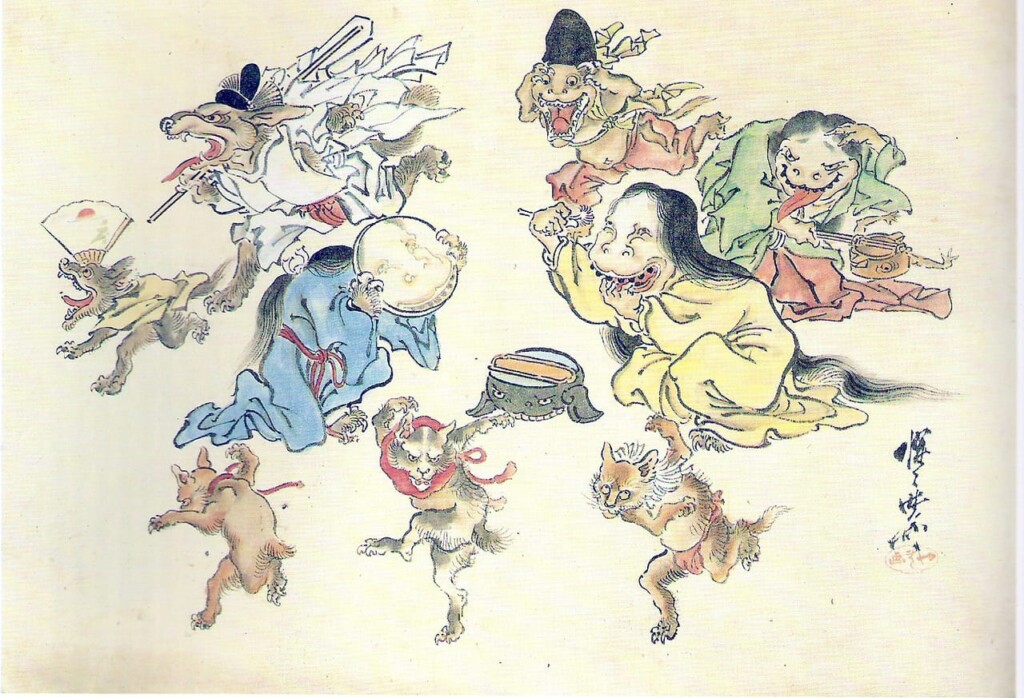
You have probably never asked yourself why she has no past. She appears at the edge of a snowfield, luminous and absolute, and the story begins with her already fully formed — no childhood, no wound, no name that anyone bothers to keep. That absence is not an oversight. It is the architecture.
Marina Warner, in From the Beast to the Blonde published in 1994, identified something that runs through the entire tradition of female mythological figures in world folklore: the systematic erasure of origin. Warner called it a kind of structural amnesia, the way stories about women — particularly women coded as dangerous or supernatural — arrive without backstory, without grievance, without the causal logic that would make their power legible as a response to something done to them. The forgetting is not accidental. A figure with a history has standing. A figure without one can be shaped to serve whatever the present moment requires of her.
Yuki-onna is shaped, over and over. She kills men who are weak or unworthy. She rewards men who are pure of heart. She vanishes when her secret is spoken aloud, returning to a nature that apparently had been waiting to reclaim her all along. Each of these narrative functions places her outside human moral grammar — she is a force, not a subject, and the distinction matters enormously. A subject can be wronged. A force simply acts. This is how cultures archive feminine power without having to account for it: by relocating it into the non-human, into weather, into ice, into something that was never a person in the first place and therefore cannot issue a complaint.
What makes this particularly precise in the Japanese case is the way the figure absorbs and neutralizes the very specific anxiety of masculine encounter with feminine incomprehensibility. The ethnologist Kunio Yanagita, whose 1910 collection of regional legends helped canonize Yuki-onna across prefectures and dialects, was working in a moment of enormous cultural pressure — a Meiji-era Japan actively negotiating which of its folk traditions would survive modernization and in what form. The Yuki-onna that emerged from that process was tidied, made symbolic, drained of whatever local specificity she might have carried. She became interchangeable. A universal cold woman. And universality, for female mythological figures, almost always means the stripping away of particularity — which is to say, the stripping away of selfhood.
The figure who frightens is never allowed to become the figure who explains herself, because explanation would require the story to ask what happened to her before she became what she is. Did she die there, in that pass, in that storm? Was she abandoned? Was she a woman who loved someone who did not return? None of these questions get asked, or if they are gestured toward, they resolve too quickly into the supernatural frame, dissolving the human wound before it can demand a reckoning. The cold is the explanation. The cold is enough.
What endures, then, is not a ghost story. What endures is a technology for containing a particular cultural discomfort — the discomfort of feminine power that has no obvious source in masculine permission, no legible origin in male action or inaction. She does not haunt because she is dead. She haunts because she was never allowed to be fully alive within the story’s own terms, never granted the interiority that would make her frightening for the right reasons. And cultures keep returning to her, retelling her across centuries and media and idioms, not because they want to understand her, but because the act of retelling her in the same frozen, nameless, originary form reassures them that the archiving worked — that whatever she once was, or might have been, has been successfully kept at the temperature where nothing changes and nothing escapes.
👻 Spirits, Myths, and the Uncanny Feminine
The Yuki-onna inhabits a world where nature, death, and feminine power converge into haunting myth. These related articles explore the deeper currents of folklore, the supernatural, and the literary imagination that give such figures their enduring resonance.
Venetian Legends and Ghosts of the Lagoon
Venice has long been a city of spirits and whispered legends, where the boundary between the living and the dead grows thin in the fog-laden canals. This article explores the ghostly folklore of the Venetian lagoon, uncovering tales of restless souls and supernatural presences that have haunted the city’s imagination for centuries. Like the Yuki-onna, these legends speak to a deep human need to personify the mystery and danger lurking within beautiful, liminal landscapes.
GO TO THE SELECTION: Venetian Legends and Ghosts of the Lagoon
The Literary Fantastic: Todorov and the Theory of the Fantastic
Tzvetan Todorov‘s theory of the fantastic provides one of the most rigorous frameworks for understanding narratives that hover between the natural and the supernatural. His concept of hesitation — the reader’s uncertainty about whether uncanny events have a rational explanation — maps perfectly onto figures like the Yuki-onna, whose nature is never fully resolved. This article offers an essential theoretical lens for anyone wishing to situate Japanese ghost folklore within the broader tradition of world literature.
GO TO THE SELECTION: The Literary Fantastic: Todorov and the Theory of the Fantastic
Arthur Machen: Life and The Great God Pan
Arthur Machen‘s work stands as a landmark in Western literature’s exploration of ancient, terrifying forces embodied in female or nature-linked forms. His novella The Great God Pan presents a supernatural feminine figure whose beauty conceals devastating, inhuman power — a striking parallel to the snow woman of Japanese legend. This article traces Machen’s life and his contribution to a tradition of gothic horror rooted in the uncanny and the mythological.
GO TO THE SELECTION: Arthur Machen: Life and The Great God Pan
H.P. Lovecraft: Life and Works
H.P. Lovecraft drew extensively on world mythologies and folklore to construct his universe of cosmic dread, where beautiful surfaces conceal annihilating truths. His approach to the supernatural shares with Yuki-onna mythology a fascination with beings that exist beyond human moral categories, embodying nature’s indifference rather than evil in any simple sense. This article examines Lovecraft’s life and works, placing his vision within the global history of the uncanny and the monstrous.
GO TO THE SELECTION: H.P. Lovecraft: Life and Works
Discover the Cinema of the Invisible on Indiecinema
If these spectral figures and mythological depths have stirred something in you, Indiecinema’s streaming platform offers a carefully curated selection of independent films that explore folklore, the supernatural, and the hidden dimensions of human experience. Step beyond the mainstream and let independent cinema take you to places where the uncanny feels achingly real.
👉 EXPLORE THE CATALOG: Watch Indie Films in Streaming
A vision curated by a filmmaker, not an algorithm
In this video I explain our vision

