
The Man Who Dreamed of Boiling Himself Alive
There is a moment, familiar to almost anyone who has stood long enough at a stove or a workbench, when something crosses a threshold and cannot come back. You watch sugar darken past amber into something bitter and irreversible, or you see a solid edge soften and lose its boundary, and for a fraction of a second you feel it — not the chemistry, not the physics, but something older and harder to name. A small vertigo. The sense that the world is less stable than you agreed it was. Most people shake it off immediately. They lower the flame, they step back, they return to whatever they were doing before the matter started misbehaving. But some people, across the whole length of human history, have leaned in instead.

Zosimos of Panopolis leaned in so far that he fell into the question entirely and never quite came back out.
He lived and wrote in Alexandria around 300 CE, a Greek-Egyptian mystic operating in one of the most intellectually saturated cities the ancient world had ever produced. Alexandria in that period was not a single civilization but a collision of several — Hellenistic philosophy, Egyptian priestly tradition, Babylonian cosmology, emergent Christianity, Gnostic theology, Jewish mysticism — all of them pressing against each other in the same libraries, the same workshops, the same narrow streets. Zosimos absorbed all of it. He wrote in Greek, thought in the categories of Neoplatonic philosophy, worked with Egyptian ritual inheritance, and produced a body of texts so strange and dense that scholars are still arguing about what exactly he was doing nearly seventeen centuries later. He is often cited, carefully and somewhat reluctantly, as the earliest alchemist whose work survives in anything approaching completeness. The title sits uneasily on him, because what he actually wrote resists every clean category we might try to impose on it.
Among his surviving texts — preserved largely through Byzantine manuscript traditions and later Arabic transmission — there are technical instructions for apparatus, discussions of sulfur and mercury, observations about the transformation of metals. These are the passages that historians of chemistry tend to quote. But there are also visionary accounts of such raw psychological intensity that they feel less like laboratory notes than like transcripts of fever. In one of the most striking sequences, Zosimos describes a recurring dream. He finds himself at an altar shaped like a bowl, a phiale, and at that altar there is a priest who announces that he must be transformed. The transformation is not gentle. The priest — and here the text becomes genuinely disturbing in its physicality — tears apart his own flesh, strips his own eyes from their sockets, grinds his teeth and bones, boils himself alive in the vessel, and as he boils he speaks, explaining that this destruction is the beginning of something else.
It would be easy, and in some ways comfortable, to treat this as allegory — to say that Zosimos was describing the purification of metals in symbolic terms, dressing chemistry in dream-clothes because that was the rhetorical fashion of his time. Scholars have done exactly that, and they are not entirely wrong. But they are also missing something. The phenomenological weight of that dream sequence is not the weight of metaphor. It is the weight of something actually experienced, or at least something encountered in the imagination with the full force of the real. Carl Gustav Jung spent considerable attention on Zosimos in his 1944 work Psychologie und Alchemie, arguing that the visions represented genuine psychological material — the unconscious working through the logic of transformation in images that the conscious mind had not organized or softened. Jung was right about the intensity even when his interpretive framework strains under the specificity of the material.
What Zosimos was doing was not proto-science dressed in mystical clothing, waiting for the Enlightenment to come along and remove the costume. He was doing something at once stranger and more honest: he was trying to understand what it meant to change a thing fundamentally, and he suspected — he more than suspected, he was convinced — that you could not answer that question by staying outside the process.
Alexandria as the World’s Last Synapse
There is a particular kind of mind that only emerges when too many worlds press against each other at once, when no single tradition can claim the ground beneath your feet as exclusively its own. Alexandria in the final decades of the third century CE was exactly that kind of pressure. It was not the Alexandria of popular imagination — the library, the lighthouse, the clean geometry of Hellenistic ambition — but something stranger and more turbulent: a city where Egyptian temple priests still practiced rites that predated Alexander by two millennia, where Neoplatonic philosophers argued about the nature of the One in the same neighborhoods where Jewish mystics were elaborating the earliest layers of what would become Kabbalistic thought, where Gnostic Christian communities read texts that blended the Gospel of John with the cosmologies of Babylonian astrology. There was no synthesis. That is the crucial thing to understand. These traditions did not merge into a harmonious whole. They collided, borrowed from each other without acknowledgment, accused each other of theft and heresy, and in doing so generated something that none of them had intended: an entirely new way of thinking about matter, transformation, and the hidden architecture of the world.
This was the city where Zosimos of Panopolis wrote. He had likely come from Panopolis, modern Akhmim, a city in Upper Egypt that was already ancient when Rome was young, a center of Egyptian religious tradition and, significantly, of textile production — a city where the manipulation of materials, of dyes and pigments and metallic threads, was part of the cultural fabric in the most literal sense. He wrote in Greek, the intellectual lingua franca of the eastern Mediterranean, and he wrote extensively. His great encyclopedic work, known as the Cheirokmeta — roughly translatable as Things Made by Hand — ran to approximately twenty-eight books, a vast systematic attempt to gather everything known about the transformation of substances, the preparation of medicines, the working of metals, and the mystical principles that, in his understanding, governed all of it. Almost nothing of this survives in its original form. What we have are fragments, excerpts, summaries — transmitted first through Byzantine compilations, then through Arabic translations and commentaries that traveled across centuries and continents before landing in the manuscripts that scholars began to study seriously only in the nineteenth century.
The transmission chain itself is philosophically significant. Synesius of Cyrene, writing in the early fifth century, cites Zosimos as a foundational authority, already treating him as someone whose voice carries weight precisely because it synthesizes traditions that lesser minds kept separate. Later, when Arabic-language alchemy emerged in the eighth and ninth centuries — when figures like Jabir ibn Hayyan were constructing their own vast systems — Zosimos appears again and again as the reference point, the name invoked to ground a claim in genuine antiquity. He was already, within a few generations of his death, not just a practitioner but an origin. The Arabic alchemists who called him the authority were doing something more than paying scholarly respect. They were acknowledging that something essential had been thought through in Alexandria that could not simply be replicated, only inherited and extended.
Peter Kingsley, in his rigorous and often unsettling work on the pre-Socratic philosophers — particularly his reading of Parmenides and Empedocles as figures operating within living esoteric traditions rather than as proto-rationalists — has argued that the conventional story separating rational inquiry from mystical experience is itself a historical fabrication, imposed retrospectively by a modernity desperate to legitimize its own methods by projecting them backward. The division between logos and mythos, between empirical observation and symbolic vision, was not felt as a division by the people who inhabited these traditions. Kingsley shows that what looks to us like contradiction — a philosopher who both argues logically and descends into incubation rituals, who both measures and prays — was experienced from the inside as a single coherent practice. Zosimos stands exactly in this space. His laboratory procedures are precise, his observations of color change and vapor production are careful and repeatable. And they are inseparable, in his own understanding, from the dream visions he records with equal seriousness.

The Visions and What They Actually Said
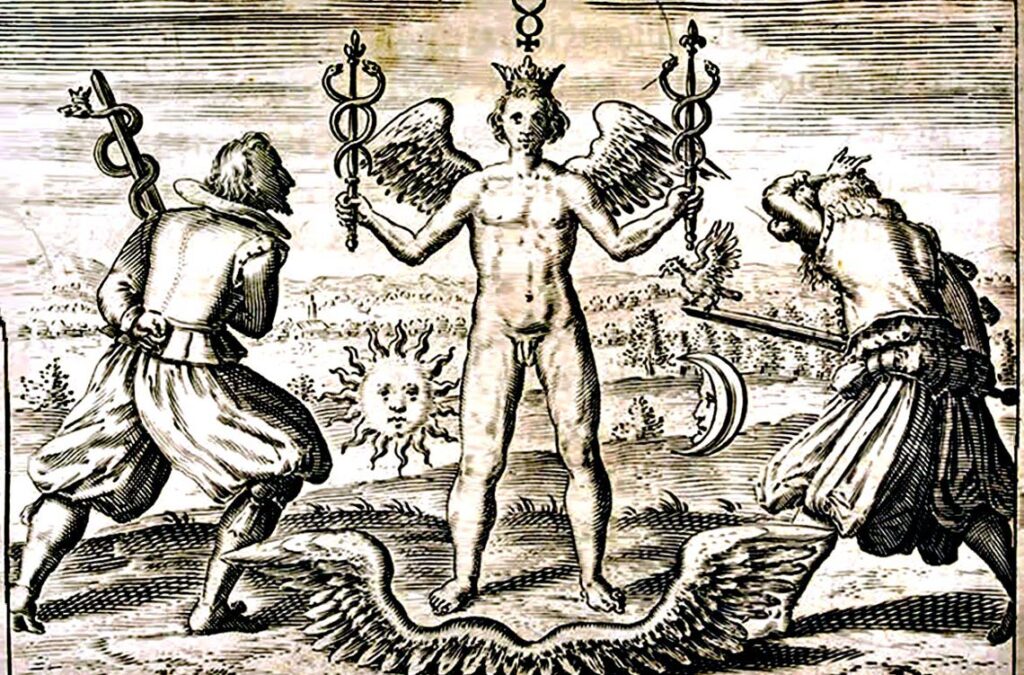
There is a moment in which a man watches himself dissolve. He is standing at the edge of something — a basin, a threshold, a memory — and what he sees reflected back is not quite a face anymore. The features are there, but the coherence between them has loosened. He watches, and the watching is the dissolution. He cannot say whether what is coming apart is the water or the man in it, the image or the thing the image was supposed to hold together.
This is not a metaphor Zosimos of Panopolis uses. It is what he reports.
The Visions are among the strangest documents to survive from late antiquity, and their strangeness has consistently been domesticated by those who handle them. Scholars call them allegory, symbol, dream-sequence, and move on to safer ground. But Zosimos presents them as phenomenological reports — accounts of what happened, to whom, and in what sequence. A priest named Ion stands before a bowl-shaped altar, a phiale, built like a staircase descending into itself. He has invited Zosimos to look. What Zosimos sees is Ion being dismembered: the flesh peeled from the bone, the eyes gouged from their sockets, the body boiled in its own transformation until something that is still recognizably Ion emerges on the other side — not restored to what it was, but completed by having passed through its own destruction. Ion tells him, with the peculiar calm of someone who has already lived the worst of it, that this is the operation. That the operation is the only path.
Ioan Couliano, whose 1992 work The Tree of Gnosis remains one of the most precise maps of Gnostic dualism ever written, argued that the Gnostic body was never merely a body — it was a theater in which the cosmic drama of matter and spirit played out its oldest war. The human form, in this framework, is not incidental to the problem of existence; it is the problem, expressed in flesh. What Zosimos is watching in Ion is something Couliano would have recognized immediately: the body as the site where the conflict between the pneumatic and the hylic — the spiritual and the material — becomes visible and, potentially, resolvable. Not by choosing one over the other, but by passing both through the flame simultaneously.
This is where Bruno Latour becomes unexpectedly useful. In We Have Never Been Modern, published in 1991, Latour draws a distinction between two operations that modernity pretends are the only options available: purification, which separates categories cleanly — nature from culture, matter from meaning, object from subject — and translation, which creates hybrids, which refuses the separation and works instead in the space between. Modernity, Latour argues, built its entire self-image on purification while secretly depending on translation to get anything done. Zosimos, writing in the third century, never had access to this particular self-deception. He was doing translation from the beginning — not as a compromise between two better options, but as the fundamental method. The sulfur and mercury in the vessel were not illustrations of spiritual states. They were spiritual states, expressed in a register that happened to be wet and hot and metallic. The laboratory operation and the inner transformation were not parallel processes. They were the same process, legible from two angles simultaneously.
This is what makes the dismemberment of Ion so difficult to read if you insist on allegory. Allegory allows you to say: this represents something else, and the something else is what matters. Zosimos gives you no such escape. Ion is being boiled. Ion is also being completed. The bowl-altar is a container for matter, and it is a container for whatever Ion is when he is no longer holding himself together by an act of will. The dissolution is the work. The work is the dissolution. And Zosimos is watching, unable — or unwilling — to say which side of the glass he is standing on, which of them is the observer and which is the thing being observed, slowly losing its edges in the heat.
The Trap of Calling Him the First
There is something almost automatic in the way we reach for the word “first.” It arrives before thought does, before research does, before honesty does. Someone mentions Zosimos of Panopolis and within moments the gravitational pull begins, the need to locate him, to pin him to a coordinate, to say: here, this is where it started, this is the man, this is the origin. The compulsion is not intellectual. It is closer to something architectural — the human insistence on foundations, on the clean line between before and after, on the founder standing at the threshold with the door still swinging behind him.
The problem is that “first” is almost never a discovery. It is almost always a decision.
Lawrence Principe, in his meticulous 2013 study of alchemy’s actual history, traces with considerable precision how the historiography of this field was shaped not by evidence but by the ideological needs of those doing the shaping. What he reveals is a double mutilation, two separate amputations performed by two separate eras, each convinced it was merely recognizing the truth. The Enlightenment thinkers who were constructing chemistry as a rational discipline needed alchemy to be its irrational ancestor, the embarrassing primitive from which science had finally escaped. They read the texts selectively, emphasized the mystical language, ignored the laboratory observations, and produced a Zosimos who was essentially a confused proto-chemist dreaming in symbols he couldn’t decode. Then came the Romantic occultists of the nineteenth century, who needed exactly the opposite: they required alchemy to be purely spiritual, a secret initiatory wisdom dressed in material clothing, and so they read the visions and dismissed the apparatus, producing a Zosimos who was essentially a mystic forced by convention to mention copper and sulfur. Both readings were confident. Both were wrong in the same fundamental way — not wrong about the details, but wrong about the method, which was to make the evidence serve the conclusion rather than produce it.
What Principe demonstrates, painstakingly, is that alchemy was always both: simultaneously a physical practice involving real materials and real heat and real transformations, and a tradition saturated with cosmological meaning that the practitioners themselves did not experience as separate from the physical work. There was no split to resolve. The split was imposed by readers who needed one.
A man sits in a room and listens to someone tell the story of his own life. The person speaking knows certain facts — dates, decisions, relationships, failures — and arranges them with care and evident sincerity. The man listens. He nods, sometimes, because the facts are accurate. The dates are correct. The decisions happened. But with each sentence he feels himself receding from the account being given, not because the story is false but because it is being organized around a meaning he does not recognize as his own, a trajectory that suits the teller’s need for the life to be about something specific, to demonstrate something, to arrive somewhere the teller has already decided it must arrive. By the end of the account he is sitting very still, feeling the particular violence of being correctly described and completely erased.
This is what has been done to Zosimos for approximately seventeen centuries. The facts are cited. The texts are quoted. The name is installed at the origin point. And the figure that emerges serves, always, the needs of whoever is doing the installing. The Enlightenment needed a primitive to overcome. The Romantics needed a mystic to recover. The contemporary popular imagination needs a “first” to anchor its timeline, to satisfy the narrative hunger for founders and thresholds. None of these needs are Zosimos’s needs. None of these readings ask what his texts actually do, what problems they were working inside of, what tradition he was in genuine conversation with, what he himself understood himself to be doing in those rooms with those vessels and those fires.
Calling him the first alchemist is not an error exactly. It is a category that lands on him from the outside, from our direction, carrying everything we need him to mean.
Sulfur, Mercury, and the Self That Won’t Stay Fixed
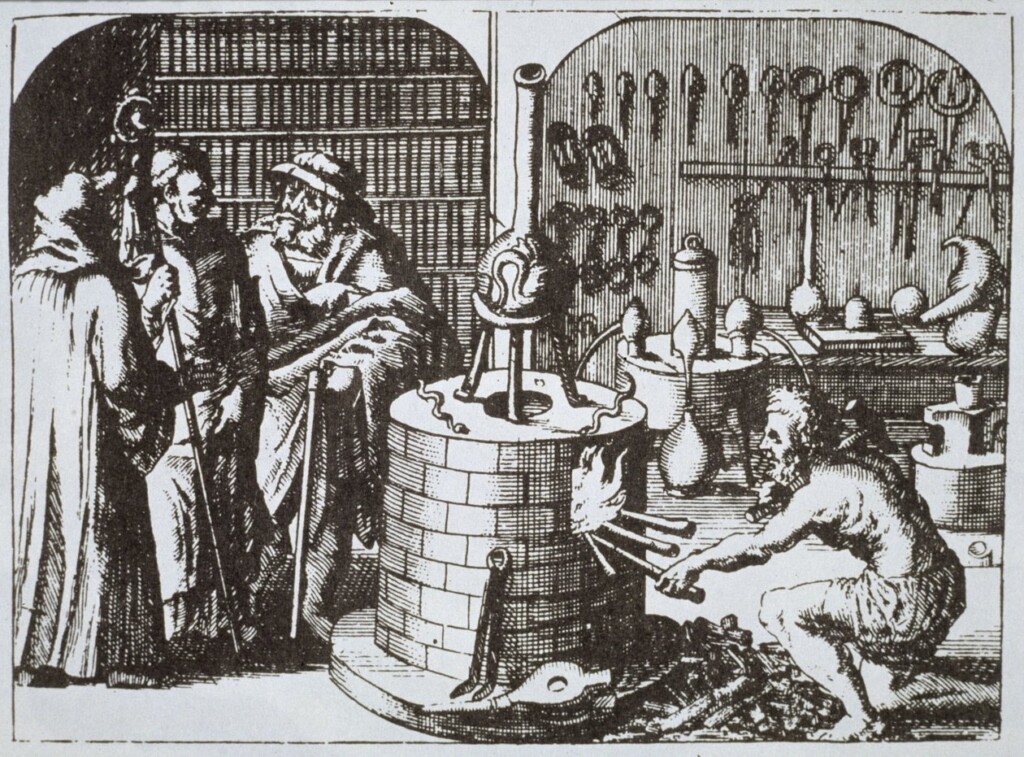
There is a particular hour, somewhere past midnight, when the hands stop being instruments of intention and become something else entirely. A craftsman bending over a workbench, soldering iron or chisel or brush held in fingers that have long since stopped receiving conscious commands, enters a state that has no clean name in modern psychology. The work is happening. The person is somewhere inside the work, not above it, not directing it. The boundary between the maker and the made has gone soft, permeable, almost liquid. Anyone who has ever worked this way knows the feeling — knows also the faint terror of it, the sense that the self which began the evening’s labor is not quite the self that will finish it.
Zosimos knew this. More than that, he theorized it.
His technical language operates on two registers simultaneously, and the genius of it is that neither register is metaphorical. When he describes sulfur and mercury as the two fundamental principles of all metallic transformation, he is speaking with the precision of a working craftsman who has spent years in proximity to furnaces and retorts, observing what actually happens when substances are subjected to heat, dissolution, recombination. Sulfur, for Zosimos, carries the principle of combustibility, of active penetrating force, of the volatile soul that escapes if you do not contain it properly. Mercury carries the principle of fluidity, receptivity, the capacity to take on form without fixing permanently into any single form. Together they are not a philosophy but an observation — metals do behave this way, do contain volatile and fixed components that separate under heat and recombine under different conditions. The theory is wrong by modern chemistry’s accounting, but it is wrong the way a close and honest description of something genuinely observed can be wrong: not arbitrarily, not carelessly, but through the application of a conceptual grid that captures something real while missing something else.
Mircea Eliade, writing in 1956 in what remains one of the more searching attempts to understand alchemy from the outside, argued that the metallurgist’s labor has always been charged with sacred significance precisely because it imitates and accelerates the hidden work of nature. The ore in the earth is already, in archaic understanding, a living thing in the process of becoming something else. The smith merely hurries what time would accomplish anyway. Eliade’s romanticism is genuine and occasionally seductive, but it softens what in Zosimos is genuinely hard. Because Zosimos was also simply a craftsman writing for craftsmen, and his texts contain the kind of practical detail that no mystical program generates on its own.
The kerotakis he describes is a real apparatus, a reflux device in which volatile substances condense on a plate held above a heated material and drip back down repeatedly, cycling the transformation through multiple passes. The tribikos is a three-armed still, and Zosimos gives instructions for its construction in a voice that expects to be understood by someone who will actually build one, who will need to know the right proportions and the correct materials for the joints. This is not allegory reaching for concrete imagery to clothe itself. This is technical writing that has grown a second nervous system, in which every procedure names itself twice — once as physical operation and once as ordeal of the self.
The calcination that breaks a substance down to its ash is the same word, the same concept, that describes the destruction of a fixed identity. The dissolution that follows carries the same logic whether you are reading it as chemistry or as the experience of a self that has lost its organizing structure and does not yet know what it will become next. The conjunction that Zosimos describes, the moment when dissolved components reunite in a new configuration, holds the same weight in both registers. He is not using chemistry to illustrate a spiritual truth, nor using spiritual language to dignify a craft. He has found — or perhaps simply inhabited — a place where these are not two things at all, where the sulfurous volatile that escapes the flask and the part of the self that refuses to be fixed are genuinely, structurally, the same problem.
A vision curated by a filmmaker, not an algorithm
In this video I explain our vision
What He Left That We Cannot Classify
There are fragments of Zosimos that scholars pass over quickly, not because they are unimportant but because no one knows where to put them. They are not recipes. They are not prayers. They are not philosophical arguments in any form Plato or Aristotle would have recognized. They exist in a register that contemporary knowledge has no drawer for — passages where the boundary between instruction and vision dissolves entirely, where a man describes the transformation of metals and the transformation of the self in the same breath, using the same verb, refusing to let the reader separate them into manageable categories.
James Hillman spent much of his career circling this problem from the psychological direction. In Re-Visioning Psychology, published in 1975, he argued that depth psychology had unconsciously replicated the structure of alchemy without ever acknowledging its debt — that the entire enterprise of making the invisible visible, of working with images as if they were substances that could be refined, of treating the psyche as a laboratory in which something was genuinely being transformed, was alchemical in its bones. Hillman was not speaking metaphorically. He meant that when Jung mapped the stages of individuation onto the operations of the alchemists, he was not borrowing a convenient symbol system. He was recognizing something that had been doing its work for seventeen centuries before psychology gave it a clinical address. The alchemists, Hillman insisted, had a psychology — they simply refused to isolate it from cosmology, chemistry, and theology, and that refusal was not their limitation. It was their precision.
What Hillman could not quite say, because his own discipline required him to stop somewhere, was what we are supposed to do with knowledge that will not submit to domestication. There is a particular kind of encounter — anyone who has worked deeply with something for long enough has had it — where you stand in front of what you have made or found and understand, without being able to explain it, that it does not belong to you. A man sits in a room looking at something he has spent years constructing, and the recognition that crosses his face is not pride and not satisfaction. It is closer to strangeness. The thing exists. It has weight, presence, consequence. It has already begun changing the people who encounter it. And yet he cannot account for it fully, cannot place it within any framework he consciously deployed, cannot claim it as a product of his intention alone. It has exceeded him. This is not a failure. It is the moment when work becomes real.
Zosimos knew this moment. The fragments he left — scattered across Byzantine manuscripts, preserved in Arabic translations, quoted by writers who sometimes understood them and sometimes clearly did not — have that quality of exceeding their container. The Cheirokmeta survives in pieces. The visions exist in versions that differ from each other in ways that cannot be resolved by textual criticism alone, because the differences may be original, may be the point, may be Zosimos himself refusing to fix the meaning into a single authorized reading. He wrote in a city, Alexandria at the turn of the fourth century, that was already trembling with the forces that would eventually consume its libraries, fracture its intellectual culture, and scatter its inhabitants across a Mediterranean that was becoming something unrecognizable. He could not have been unaware of what was coming. The burning would not arrive in his lifetime but the heat was already present, the arguments already violent, the world he had inherited already beginning its long demolition.
And yet he kept writing. Adding fragments to a work that would never be finished, that would survive only in pieces, that would reach the future in exactly the condition of incompleteness that the alchemical process itself described — matter that has been worked, changed, partially refined, still in transformation. As if he understood, bending over his oil lamp while Alexandria held its breath, that a text which arrived whole and resolved would be a text that had already died, and that the only way to remain alive across centuries was to leave something permanently open, permanently unfinished, permanently in need of the reader who had not yet been born.
🜁 The Ancient Roots of Alchemical Wisdom
Zosimos of Panopolis did not emerge from a void — he stood at the crossroads of Egyptian mysticism, Greek philosophy, and Hermetic tradition. The threads he wove into his visions and treatises continue to run through centuries of esoteric thought, from medieval laboratories to Jungian psychology. These related articles trace the living lineage of ideas that Zosimos helped set in motion.
What Is Alchemy: History and Origins
Before Zosimos can be fully understood, one must grasp the broader historical and philosophical soil from which alchemy itself grew. This article traces the discipline’s origins across Egyptian, Greek, and Arabian cultures, revealing how proto-chemical practices merged with spiritual cosmology. It provides the essential foundation for appreciating why Zosimos remains such a pivotal and luminous figure at alchemy’s very dawn.
GO TO THE SELECTION: What Is Alchemy: History and Origins
Tabula Smaragdina: Text Meaning and Interpretation
The Tabula Smaragdina, or Emerald Tablet, is one of the most concentrated expressions of the Hermetic worldview that Zosimos inhabited and transmitted. Its cryptic axioms — above all the famous ‘as above, so below’ — encode a vision of cosmic correspondence that runs through all alchemical writing. This article unpacks the text’s layers of meaning and shows how it served as a compass for generations of alchemists who followed in Zosimos’s footsteps.
GO TO THE SELECTION: Tabula Smaragdina: Text Meaning and Interpretation
The Corpus Hermeticum: Guide to Esoteric Reading
The Corpus Hermeticum represents the literary and philosophical universe in which Zosimos’s thought is most deeply rooted, drawing on the same Alexandrian synthesis of Greek reason and Egyptian gnosis. Reading these texts alongside Zosimos’s own visions reveals a shared language of transformation, divine matter, and the soul’s ascent through the planetary spheres. This guide offers an indispensable entry point into the Hermetic world that gave the first alchemist his conceptual vocabulary.
GO TO THE SELECTION: The Corpus Hermeticum: Guide to Esoteric Reading
Jungian Alchemy: Jung and Alchemical Psychology
Carl Gustav Jung famously saw in alchemical symbolism a precise map of the unconscious psyche, and the visions of Zosimos — with their dismembered priests and furnaces of transformation — were among his most cherished case studies. Jung argued that Zosimos was not merely describing chemical processes but enacting an inner drama of psychological individuation centuries before modern psychology existed. This article explores how Jungian thought breathed new interpretive life into the oldest alchemical writings known to history.
GO TO THE SELECTION: Jungian Alchemy: Jung and Alchemical Psychology
Discover the Cinema of Inner Transformation on Indiecinema
The search for the philosopher’s stone is ultimately a search for meaning — and independent cinema has always been one of humanity’s most honest laboratories for that quest. On Indiecinema streaming you will find a carefully curated selection of films that explore consciousness, esoteric tradition, and the depths of the human spirit with the same courage that Zosimos brought to his visions. Join us and let the screen become your alchemical vessel.
👉 EXPLORE THE CATALOG: Watch Indie Films in Streaming
A vision curated by a filmmaker, not an algorithm
In this video I explain our vision

