
The Man Who Would Not Die
You are standing in a hospital corridor at two in the morning, and the fluorescent light above you is doing that thing where it flickers just slightly, just enough to remind you that everything artificial eventually fails. Someone you love is behind a closed door. The smell is that particular mixture of antiseptic and something underneath it that the antiseptic is trying to erase. And for a moment, not a metaphorical moment but an actual, physical, stomach-dropping moment, you understand with absolute animal clarity that this is what it comes down to. All of it. Every ambition, every argument, every carefully constructed identity collapses into this corridor, this flicker, this smell. The body knows before the mind admits: we are temporary, and we cannot stand it.

This terror is not modern. It is not a product of existential philosophy or post-industrial alienation. It is the oldest human thing there is, older than language, older than god. Ernest Becker argued in 1973, in his Pulitzer Prize-winning work The Denial of Death, that virtually all human civilization is an elaborate, unconscious project of mortality denial, a system of symbolic immortality built specifically to outrun the knowledge that we will die. Every cathedral, every dynasty, every philosophical system, every name carved into stone is a finger pressed against the wound. We build because we cannot accept that we will not be here to see what we built.
Nicolas Flamel was a finger pressed against that wound, and he pressed so hard that nearly seven centuries later the wound still bears his mark.
The historical Flamel was, by most credible accounts, unremarkable in the way that most lives are unremarkable when stripped of the stories we tell about them afterward. He was born around 1330 in Pontoise, a modest town north of Paris. He worked as a scrivener, a copyist, a man whose livelihood depended on the patience to reproduce other people’s words with careful fidelity. He was good at his trade. He married a widow named Perenelle, who brought property and some financial stability to what became a quiet, prosperous bourgeois life. He donated to churches. He commissioned building works. He left a documented paper trail of contracts, wills, and property transactions that historians have been able to trace with reasonable confidence. He died, the records suggest, around 1418. He was buried. There is a gravestone.
And yet. The legend that accumulated around this entirely plausible notary insists otherwise. It insists that Flamel had, sometime in the 1380s, decoded an ancient alchemical manuscript, that he had discovered the philosopher’s stone, that he had transmuted base metals into gold, and most urgently, most desperately, that he and Perenelle had drunk from the elixir of life and had not died at all. That they had staged their deaths, abandoned their tombs, and slipped sideways out of history into something that history has no category for. Reports circulated centuries later placing him in India, in Constantinople, at a Paris opera house in 1761, buying vegetables at a market, unchanged, ageless, faintly smiling.
The question is not whether any of this is true. The question is why we needed it to be.
There is something being confessed in the Flamel legend that cannot be confessed any other way. A medieval scribe with no exceptional military victories, no political throne, no theological authority becomes the symbolic vessel for the most fundamental human longing there is, and he becomes it precisely because he was ordinary. Because if he could do it, then the terror in that hospital corridor is not the final word. If a copyist from Pontoise found the door, then the door exists. The legend does not require you to be a king or a saint. It only requires you to want badly enough. And we all want badly enough. That is the one thing the flickering fluorescent light makes perfectly, horribly clear.
The Real Flamel: Ink, Parchment, and Modest Wealth
There is a particular kind of man who becomes invisible precisely because he is too useful. He sits at a table near the entrance of a market, or just outside a church, and people come to him with their crumpled problems — a contract that needs witnessing, a letter that needs composing, a will that needs language clear enough to survive a legal challenge. He charges a modest fee. He does this every day for decades. He accumulates, slowly and without drama, the kind of wealth that looks suspicious only because no one watched it arrive.
Nicolas Flamel was this man. Born around 1330, probably in Pontoise, he established himself in Paris as a manuscript dealer and public scribe, working from a shop on the rue de Marivaux and later near the charnel houses of the Saints-Innocents cemetery. His trade was entirely legitimate and, in the Paris of the late fourteenth century, genuinely lucrative. Books were not yet printed. Every document, every illuminated text, every notarial record required hands and ink and time. Flamel provided all three. His marriage to Perenelle Lethas, a widow older than him and already possessed of property from two previous marriages, was not a romantic convenience but a sound economic consolidation of the kind that historians of medieval bourgeois life have documented exhaustively. Together they were not wealthy in any aristocratic sense, but they were comfortable, careful, and shrewd.
The archival record is more coherent than the legend would prefer. Tax rolls from 1371 show Flamel listed among Parisian property owners of middling standing. By 1382 — the very year the alchemical legend insists he completed his first transmutation of base metal into gold — the accounts reveal a man who had simply continued to prosper through careful investment in real estate and the steady income of his trade. The coincidence of dates is not accidental; the legend needed a founding moment, and 1382 was retrofitted with meaning it did not originally carry. What Flamel actually did in the years around that date was fund the construction of an arch and charnel chapel at the church of Saint-Jacques-la-Boucherie, one of at least fourteen charitable donations he made to Parisian churches and hospices over the course of his life. He paid for the building of shelters for the poor. He endowed masses for the dead. He inscribed his name and Perenelle’s onto stone in the way that prosperous medieval Parisians regularly did — as a form of spiritual insurance, not concealment.
The church of Saint-Jacques-la-Boucherie still speaks in the historical record even now that the building itself is mostly gone, its tower surviving as the isolated Tour Saint-Jacques that stands incongruously in the fourth arrondissement. Flamel’s name appears in the accounts of that church with the mundane precision of someone who paid for things and expected them acknowledged. This is not the behavior of a man hiding a miraculous secret. It is the behavior of a successful tradesman who understood that public piety was both genuinely felt and socially strategic — a calculation that Natalie Zemon Davis, in her work on gift culture in early modern France, traced as a defining feature of the prosperous urban middle class. You gave visibly because visibility confirmed your standing. The gift was real, but so was its function.
What the legend colonized, then, was not a mystery but a perfectly legible life. The mechanism of that colonization follows a pattern that the sociologist Max Weber identified when he wrote about the disenchantment of the modern world and the hunger that disenchantment produces — not in modernity alone, but in every era that feels its explanations are insufficient. A man grows wealthy through patience and ink. That is not a story. But a man who discovered the philosopher’s stone and lived for centuries, dying perhaps not at all — that is a story that fills something. The question worth sitting with is not whether Flamel was an alchemist. The question is what it reveals about us that a diligent scribe was so intolerable in his ordinariness that five centuries of imagination worked without rest to make him otherwise.

The Book of Abraham: How a Legend Is Manufactured
There is a particular kind of silence that falls over a person when they find exactly what they were looking for. Not the silence of surprise, but the silence of confirmation — heavier, more dangerous, the silence of someone who has just decided to stop asking questions. A man sits in a library, or a dusty antique shop, or the corner of an estate sale, and he lifts a document from a pile, and something in his chest locks into place. The dates align. The symbols match. The handwriting looks old enough. He does not think: this is too convenient. He thinks: I knew it.
This is not a weakness of intellect. It is, as the cognitive psychologist Daniel Kahneman demonstrated across decades of research, a structural feature of how minds work — what he called the availability heuristic and its sibling, confirmation bias. We do not evaluate evidence neutrally. We weigh it against what we already hope is true, and we call that weighing discernment.
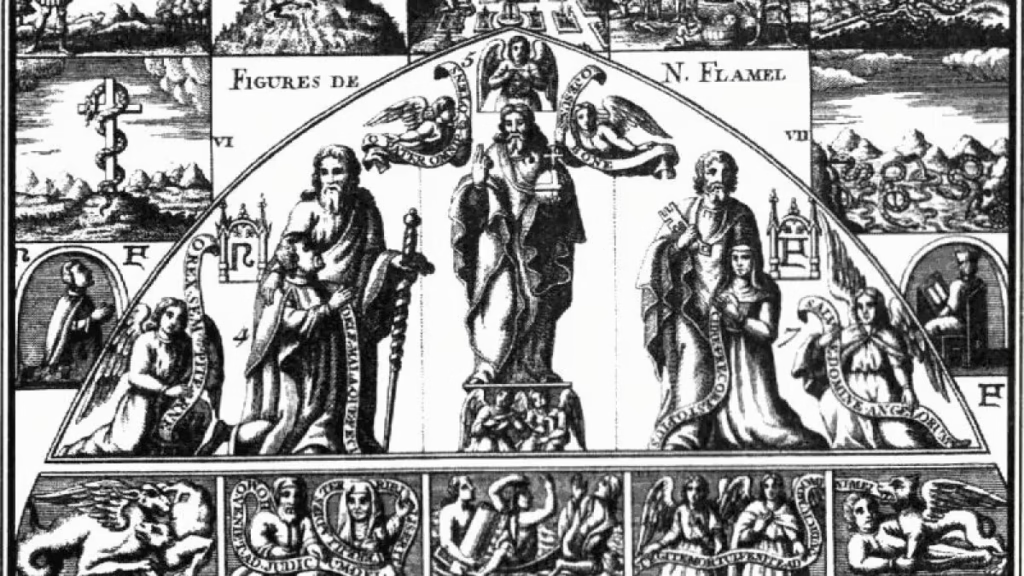
The Livre des figures hiéroglyphiques — published in Paris in 1612, attributed to Nicolas Flamel — is a document that understood this before Kahneman had words for it. The book appeared nearly two hundred years after Flamel’s death in 1418. It claimed to be his own account of how, in 1357, he purchased a mysterious manuscript from a stranger: twenty-one leaves of unusual material, covered in symbols, allegedly the work of Abraham the Jew, a legendary figure situated somewhere between rabbi, magician, and pre-Christian sage. The book described Flamel’s long struggle to decode the text, his pilgrimage to Spain to find a scholar who could assist him, and ultimately his mastery of the Great Work — the transmutation of mercury into silver and gold, performed first in 1382 and again three weeks later.
It is an extraordinary story. It is almost certainly not his.
Scholars of early modern French publishing history have established that no manuscript of this text predates the seventeenth century. The 1612 edition was likely composed — or at minimum radically elaborated — by an anonymous hand working in a period when alchemical interest had reached something close to a cultural fever. Between 1550 and 1650, Europe produced more alchemical texts than in any comparable span before it, many of them pseudepigraphical, authored by the dead or by fictional ancients, because authority in that world was measured by antiquity. To say something new, you gave it an old name. To make your ideas credible, you made them inherited.
Umberto Eco, in his essays on forgery and cultural fabrication, made an observation that cuts directly to this: forgeries do not succeed by deceiving people who do not want to be deceived. They succeed by satisfying people who need them to be true. The mechanism is not fraud in the criminal sense — it is something more like collaborative fiction between text and reader, in which the reader provides half the credulity the document requires. A forgery, Eco argued, is the purest expression of a cultural desire: it shows you exactly what a society wanted to find. The content of any successful fabrication is always a map of the anxiety it relieves.
What the Livre des figures hiéroglyphiques relieves is the anxiety of meaninglessness. Here is a man, unremarkable by birth, a copyist and a minor functionary of Parisian commercial life, who stumbled into a secret that preceded Christianity itself, survived in hidden manuscripts, and could be unlocked by patience and spiritual readiness. The message is not subtle: the knowledge exists, it is accessible to the prepared mind, and its proof is material — houses built, chapels endowed, charities founded, the lead turned to gold. Flamel’s charitable legacy, which was real and documented, becomes in the book the receipt confirming the transaction. The money had to come from somewhere. The alchemy explains the money.
This is the logic of the conspiracy text that Eco dissected in Foucault’s Pendulum, the novel he wrote in 1988 as a direct interrogation of how humans manufacture meaning from pattern. Everything connects. And everything connecting is not evidence of a hidden order — it is evidence of a mind that cannot tolerate the absence of one.
Alchemy as the Language of Refusal
There is a particular kind of person who cannot leave a thing alone. You have seen them, perhaps you have been them: the one who returns at midnight to the desk where something unfinished waits, who turns a problem over in their hands the way a stone gets turned in a river, wearing smooth not from indifference but from obsessive contact. The notebooks fill and the candles burn and the question does not resolve, and still they return. Not because they are foolish. Because they have understood, at some level below articulation, that the work is not really about the thing they are ostensibly working on. It is about something else entirely. It is about whether they can become the person capable of finishing it.
This is what alchemy actually was. Not proto-chemistry, not the superstitious groping of minds not yet illuminated by the scientific method. That reading is lazy and historically dishonest, a way of domesticating a tradition that remains genuinely unsettling if you look at it without condescension. Alchemy was a symbolic system of extraordinary sophistication, a language invented to narrate the one process human beings have always found most terrifying and most necessary: the transformation of the self, and the conquest of what undoes it. Carl Gustav Jung spent years inside this material before publishing Psychology and Alchemy in 1944, and what he found there was not the embarrassing prehistory of chemistry but an elaborate, culturally sustained projection of unconscious processes onto physical matter. The alchemist, Jung argued, was externalizing interior work onto the substances of the laboratory, watching in lead and mercury and sulfur the drama his own psyche was enacting but could not yet name directly. The opus alchemicum, the great work, was simultaneously a metallurgical procedure and an individuation process, and the two were never truly separable in the mind of the practitioner. The gold being sought was real gold and also something that gold could only gesture toward.
Medieval Europe understood impermanence with a violence that the modern world has largely anesthetized itself against. Plague moved through cities like a wind that chose arbitrarily. A man could be alive and prosperous in the morning and gone before compline. The church offered one grammar for navigating this terror, and alchemy offered another, not opposed to the theological but running alongside it through the same cultural body, sometimes intertwined with it in ways that made the boundary impossible to locate. Where theology said submit and trust, alchemy said understand and transform. It was the language of refusal. Refusal to accept that the base condition is final, that what is corrupt cannot be purified, that the body is simply subject to time without recourse.
Consider what happens to a person who has spent years inside a single unfinished problem. There is a point where the problem ceases to be external. It has moved in. It has reorganized the furniture of the mind. Someone returns again to a room strewn with pages and diagrams, the attempt accumulated like geological strata, each layer representing a version of themselves that got closer and then failed. They do not experience this as defeat. They experience it as incompletion, which is a different thing entirely, because incompletion implies that the next attempt exists, that the transmutation is still possible, that the substance has not yet been heated to the correct temperature or held at that temperature for precisely long enough. The refusal encoded in alchemy is not the refusal of reality. It is the refusal of finality. And that distinction contains everything.
Jung called the philosopher’s stone the symbol of the Self in its most integrated form, the psyche having metabolized its own contradictions into something stable and luminous. The alchemists called it the lapis, the stone, and they described it in paradoxes that drove rational commentators to frustration: it is everywhere and nowhere, it is cheaply available and never found, it is made of what you already possess. The laboratory was never really about lead. It was about the practitioner’s refusal to remain what they entered as.
Immortality as Cultural Symptom

Someone you know — perhaps you yourself — photographs their meal before eating it, captions a sunset they barely looked at, archives the minor turbulences of a Tuesday as though Tuesday were evidence of something. The feed accumulates. The stories stack. There is a logic beneath this that has nothing to do with vanity, or not only vanity. There is something older working through the screen, something that precedes the algorithm by several millennia. The compulsion is not to share. The compulsion is to persist. To leave a mark legible enough that the world cannot close over you without a trace. Ernest Becker understood this with a clarity that made his 1973 book almost unbearable to read: civilization, he argued, is not a system for organizing society. It is a system for managing the terror of death. Every cultural monument, every religious structure, every ideological project is at its root what Becker called an immortality project — a collective fiction that allows the individual to feel they are participating in something that will outlast the body’s inevitable failure. The pharaohs built in stone. The medievals built in theology. We build in data.
This is why the Flamel legend does not die. It cannot die, because it is not really about Nicolas Flamel. It is about the need that Flamel’s story satisfies, and that need intensifies precisely when the cultural structures that usually contain death-terror begin to crack.
The first major modern appropriation came in the eighteenth century, when Rosicrucian movements — themselves a symptom of Enlightenment anxiety, of a world where God was becoming optional and science had not yet promised enough — seized on Flamel as a prototype. He was retrofitted into their symbolic architecture: the humble manuscript dealer who had cracked the code of nature, who had found the hinge between the material and the eternal. The attraction was not occult nostalgia. It was the need for a proof of concept. If one man had done it, then the project was real. The Rosicrucian appropriation of Flamel was less mysticism than it was panic wearing mysticism’s clothes.
The pattern repeated. Each time a civilization’s standard immortality projects lost their purchase — when institutional religion loosened its grip, when political utopias collapsed into atrocity, when the future stopped feeling like a promise — Flamel returned. Not because anyone rediscovered new evidence. Because the hunger rediscovered him.
The most recent eruption is the most revealing. The mass cultural resurrection of the Flamel legend in the early 2000s, ignited by a single enormously successful series of novels that placed the Philosopher’s Stone at the center of a children’s mythology about death, sacrifice, and the refusal to accept mortality as final, arrived at a particular historical hinge. The turn of the millennium had not delivered transformation. September 2001 had fractured the Western sense of protected progress. The years that followed were saturated with what sociologists of religion like Robert Bellah would recognize as a crisis of civil religion — the shared secular faith in progress, safety, and national permanence had been visibly wounded. Into that wound, the old alchemical dream flooded back, domesticated into narrative form safe enough for children but structured around an anxiety that was entirely adult.
Becker’s framework holds here with uncomfortable precision. The Philosopher’s Stone is not a magical object in these cultural revivals. It is a displacement object — something onto which a society projects its unresolved terror of finitude. The stone promises what the social contract had quietly stopped promising: that death is a problem with a solution, not a condition with no exit.
A vision curated by a filmmaker, not an algorithm
In this video I explain our vision
What We Turn Ordinary Men Into, and Why
There is a house on the Rue de Montmorency in Paris, number 51, built in 1407, that is still standing. You can touch it. The stone is cold in a way that feels deliberate, as though it has been preserving something. A tourist stops there on a gray Tuesday afternoon, running a hand along the facade where carved inscriptions ask passersby to pray for the souls of the dead — not an alchemical cipher, not a coded map to hidden gold, just a man asking for prayers the way men of his century asked for prayers, because they believed it helped, because they were afraid, because they were human. The tourist photographs the inscription. Then photographs it again. Then stands back and feels something unsettling that she cannot immediately name: the building is more solid than the legend, and the legend has somehow made the building feel less real.
This is the mechanics Georges Didi-Huberman describes in his work on images — particularly in Ce que nous voyons, ce qui nous regarde, published in 1992 — when he argues that the image is never simply what it shows. The visible surface of a thing becomes a screen, not in the metaphorical sense but in the almost physical sense of something that intercepts a projection. A face, a gravestone, a name carved into stone does not simply transmit information about the person who left it behind. It receives what we cannot bear to carry forward ourselves. The grief, the longing, the refusal to accept that matter dissolves into matter and nothing more. Didi-Huberman’s thinking moves through the long tradition of mortuary images, of effigies and cenotaphs, and arrives at the same uncomfortable conclusion the tourist arrives at on the Rue de Montmorency: what we see when we look at the traces of the dead is not them. It is the shape of our own need, pressed into whatever surface remains.
The real Nicolas Flamel was a scribe and manuscript dealer. He was a landlord who owned properties across Paris and managed them with documented care. He funded the construction of charnel houses, paid for the maintenance of churches, commissioned works for the poor, and left behind a paper trail so meticulous that historians can trace the arc of his financial life across decades with reasonable confidence. He died in 1418, having outlived his wife Pernelle by eight years, and was buried — actually buried, verifiably, in the ground — beneath a slab that eventually made its way to the Musée de Cluny, where it can still be seen today. His will was preserved. His accounts survived. He is, by the standards of medieval documentary evidence, unusually knowable.
And yet we could not leave him there. The alchemical mythology began within two centuries of his death and never fully stopped accumulating. The 17th-century book that claimed to be his — the Livre des figures hiéroglyphiques, which appeared in 1612 under his name — was almost certainly a forgery, but it launched a tradition. By the time the novels, the films, the esoteric encyclopedias, and finally the children’s fantasy franchises had finished with him, the actual man had been so thoroughly buried under invented meaning that the stone house on the Rue de Montmorency, the oldest in Paris, feels to some visitors like a reconstruction, a themed attraction built around someone else’s story.
What we do to figures like Flamel is not simply mythologize them. It is something closer to what Didi-Huberman calls the work of the image against death — the refusal to let the void be a void, the insistence on filling the darkness behind a name with something luminous and inexhaustible. Flamel was a careful man who gave money to churches and wrote out manuscripts in a steady hand and worried, probably, about the same things men of his station worried about. That life — unglamorous, documented, finite — is in every meaningful sense enough. It is a complete human life. And still we look at it and reach, instinctively, for the gold we were told must be hidden somewhere inside it.
🔮 Alchemists, Mystics & Seekers of Hidden Truth
Nicolas Flamel’s legend sits at the crossroads of alchemy, mysticism, and the eternal human hunger for hidden knowledge. The figures and traditions that surround his story share this same obsessive quest — transmuting the self, the spirit, and reality itself. Explore these connected paths through history’s most daring esoteric minds.
Aleister Crowley: the Great Beast and the Religion of Will
Like Flamel, Aleister Crowley devoted his entire existence to the pursuit of hidden forces that lie beneath the surface of ordinary reality. His system of Thelema reimagined Western magic as a discipline of iron will, turning the occult into a personal religion. Understanding Crowley means confronting the same forbidden territories that Flamel’s legend opens up.
GO TO THE SELECTION: Aleister Crowley: the Great Beast and the Religion of Will
Helena Blavatsky and Theosophy: the Woman Who Revolutionized Esoteric Thought
Helena Blavatsky, much like Flamel, became a mythological figure whose teachings reshaped how the West understood the esoteric tradition. Her Theosophy synthesized ancient wisdom, Eastern philosophy, and occult knowledge into a revolutionary framework for spiritual seekers. To study Blavatsky is to trace one of the deepest roots of the modern occult revival in which Flamel’s legend thrives.
GO TO THE SELECTION: Helena Blavatsky and Theosophy: the Woman Who Revolutionized Esoteric Thought
Neville Goddard: the Mystic Who Turned Imagination into the Law of the Universe
Neville Goddard, like Nicolas Flamel, believed that an invisible inner reality held the true power to transform the outer world. His teachings on imagination as the supreme creative force echo the alchemical conviction that consciousness itself is the philosopher’s stone. This article explores how Goddard turned ancient mystical intuitions into a bold and practical metaphysical system.
GO TO THE SELECTION: Neville Goddard: the Mystic Who Turned Imagination into the Law of the Universe
Esoteric Movies to Watch
The world of esoteric cinema is the natural visual companion to figures like Flamel, whose story blurs the line between historical fact and mythological dream. These films venture into realms of hidden knowledge, initiation, and the transformation of the self that alchemy has always promised. Watching them is, in its own way, a practice of the same inner transmutation Flamel pursued.
GO TO THE SELECTION: Esoteric Movies to Watch
Discover the Cinema That Dares to Go Beyond
If these hidden histories and mystical traditions have sparked your curiosity, Indiecinema streaming is your next portal. Explore a curated universe of independent and esoteric films that mainstream platforms would never dare to recommend — stream them now on Indiecinema.
👉 EXPLORE THE CATALOG: Watch Indie Films in Streaming
A vision curated by a filmmaker, not an algorithm
In this video I explain our vision

