
The Bargain You Already Made
You remember the exact moment. Not the days of deliberation before it, not the rationalizations that came after, but the moment itself — sitting at a desk or standing in a kitchen or lying awake at three in the morning when the decision crystallized into something irreversible. You chose the salary over the vocation. You stayed in the city that was killing your spirit because the city also paid your rent. You ended the relationship that made you feel most alive because it made you feel too alive, too exposed, too far from the person everyone expected you to become. And in that moment, something was exchanged. You felt it. Not metaphorically — physically, somewhere below the sternum, a small permanent subtraction.

You did not know you were signing anything. That is the first thing to understand about the bargain. It does not come with a contract. It does not arrive wearing a name. It arrives as pragmatism, as maturity, as the reasonable adult decision that your parents would finally approve of. It arrives as relief. And that relief is the most insidious part of it, because relief is not supposed to be the feeling you have when you lose something essential.
Johann Wolfgang von Goethe spent sixty years writing a single work. He began Faust in fragments sometime in the 1770s, published the first complete part in 1808, and finished the second part only months before his death in 1832, at the age of eighty-two. Sixty years of returning to the same question, which means the question could not be resolved — only deepened, turned over, examined from the next decade’s vantage point with new scar tissue and new light. The work that emerged is not a cautionary tale. It is not a morality play dressed in Romantic clothing. It is a diagnosis. And the patient is not a fictional medieval scholar who summons a devil. The patient is you, reading this now, in whatever particular form your bargain took.
The philosopher Georg Wilhelm Friedrich Hegel, writing in the early nineteenth century at almost exact historical parallel to Goethe’s labor, described the dialectical movement of consciousness as a process of alienation and return — the self externalizing itself into the world, losing itself in that externalization, and struggling to recover something it cannot quite name. What Hegel mapped in the architecture of logic, Goethe mapped in the architecture of a soul. Faust is not a man who makes one bad deal. He is consciousness itself, perpetually dissatisfied, perpetually reaching, perpetually trading what it has for what it believes it lacks.
And you have been doing this your entire adult life.
The cultural historian Marshall Berman, in his 1982 work All That Is Solid Melts Into Air, argued that Faust is the foundational myth of modernity not because it depicts evil, but because it depicts development — the intoxicating, devastating logic of becoming, of transformation at any cost, of the belief that the next thing will be the real thing, the true thing, the thing that finally satisfies. Berman traces this Faustian impulse through centuries of urban planning, economic expansion, and political revolution. The bargain is not private. It is structural. It is built into the way modern societies organize desire.
But before it is structural, it is yours. Before it belongs to history, it belongs to that kitchen, that desk, that three in the morning. The specific weight of what you handed over in exchange for something safer, more legible, more approved. And the strange persistence of what you handed over — how it keeps appearing at the edges of your life like a creditor who does not need to raise his voice because he knows, and you know, that the debt has never actually been settled.
Goethe knew this. He spent sixty years knowing it.
Eve of the Irises
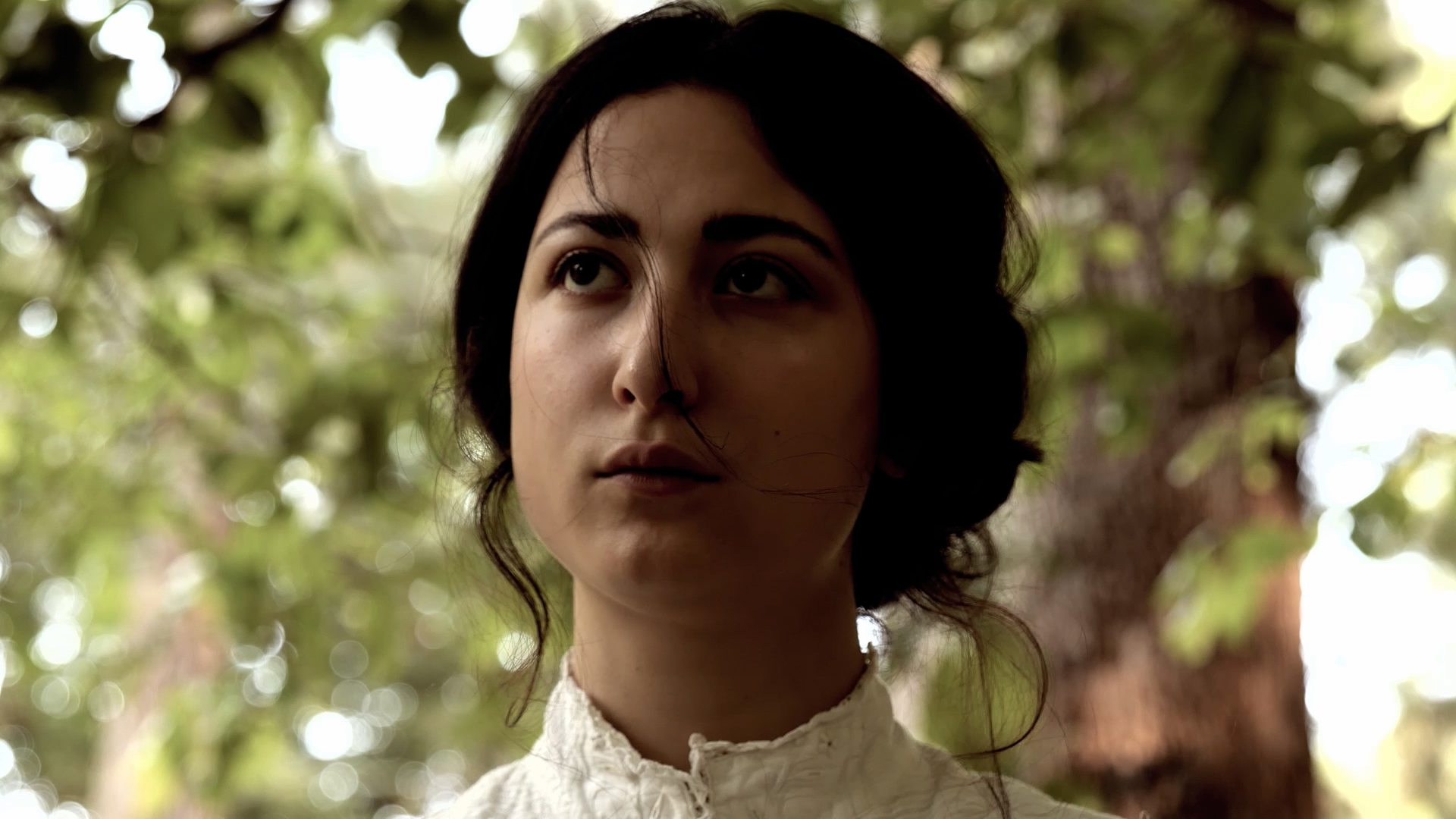
Documentary, by Isabel Russinova, Rodolfo Martinelli Carraresi, Italy, 2026
Eva of the Irises is a historical biographical docu-film about the scientist Eva Mameli Calvino, a botanist and pioneer of environmentalism in Italy, mother of the writer Italo, born in Sassari in 1886. The film, based on a multidisciplinary approach that combines several genres—such as theatre, documentary, cinema, and research—moves between memories, reflections on life, as well as the goals and missions the scholar still wished to achieve.
The multifaceted artistic sensibility of Isabel Russinova is expressed across many fields, from writing to acting, from directing to civic engagement, and finds one of its highest expressions in the docu-film Eva of the Irises, created with Rodolfo Martinelli Carraresi. The film blends scientific rigor and poetic refinement to portray the extraordinary figure of the botanist Eva Mameli Calvino, mother of Italo Calvino but above all an independent protagonist of 20th-century scientific culture. It is told through a combination of archival materials, interviews, and evocative staging capable of elegantly and profoundly conveying her intense human and professional story.
LANGUAGE: Italian
SUBTITLES: English, Spanish, French, Portuguese
A Man Dissatisfied by Everything He Knows
You have read every book on the shelf. Not skimmed them, not borrowed their arguments for dinner conversation — read them, absorbed them, turned them over in the dark until their logic became your own. And now you stand in the room where all that knowledge lives, and something is wrong. The room is full and you are empty. The certificates are real, the mastery is genuine, and none of it tells you what you actually needed to know.
This is where Goethe places his Faust at the opening of the poem, and it is not a dramatic exaggeration for theatrical effect. It is a psychological portrait so precise that it still lands like a diagnosis. Faust has studied theology, law, medicine, and philosophy — the four faculties of the medieval German university, the entire institutional architecture of legitimate human knowledge — and he announces, in lines that carry no self-pity but only a cold devastation, that he knows no more than before he began. The German word he uses is leider, which means unfortunately, regrettably, with a sigh. Not with rage. With the exhausted honesty of someone who followed the rules exactly and arrived at a place they did not expect.
The character is recognizable not because we have all read scholastic theology but because most of us have, at some point, completed the prescribed sequence. You did what was asked. You learned what was teachable. And somewhere in the middle of having achieved it, you noticed a silence that the achievement did nothing to fill.
Goethe began writing Faust in the early 1770s, when he was in his early twenties, and the earliest surviving fragment dates to around 1772 or 1773. He would not publish the completed first part until 1808, and the second part appeared only posthumously in 1832, the year of his death at eighty-two. The work spans sixty years of a single life, which already tells you something about what kind of question it is asking. These are not questions that resolve. They accompany.
The historical moment matters here in a way that goes beyond background. The late eighteenth century in German-speaking Europe was precisely the moment when the Enlightenment’s promise was beginning to crack under the weight of its own ambitions. The project of reason — the systematic conquest of ignorance through method, observation, and logic — had produced genuine wonders. It had reorganized medicine, reformed jurisprudence, challenged theological authority. But it had also, in the process, quietly evacuated the interior. Reason could explain how the blood circulates. It had considerably more difficulty explaining why getting up in the morning should feel like it matters.
Goethe lived this contradiction personally and professionally. He had trained in law at Leipzig and Strasbourg, studied alchemy and natural science, written poetry and novels, administered a duchy, conducted geological surveys, and developed a theory of color that put him in direct, combative opposition to Newton. He was, by any measurement, one of the most comprehensively educated Europeans of his era, and he understood with unusual clarity that comprehensive education and inner coherence are not the same project. His friendship with Schiller, his correspondence with Herder, his complicated engagement with Kant — these were not academic exercises. They were attempts to think through what remained after all the systems had been applied and the silence returned.
Friedrich Schiller, in his 1795 essay On the Aesthetic Education of Man, diagnosed the same wound from a slightly different angle, arguing that the division of labor — not just economic but intellectual — had fragmented the human being into specialized functions, leaving no one whole. The expert, Schiller suggested, is a person who knows everything about one dimension of existence and has sacrificed the others to get there. Faust is the limiting case: the person who became expert in all the dimensions simultaneously and found that the totality still fell short of something he cannot name.

Mephistopheles Is Not the Devil You Were Promised
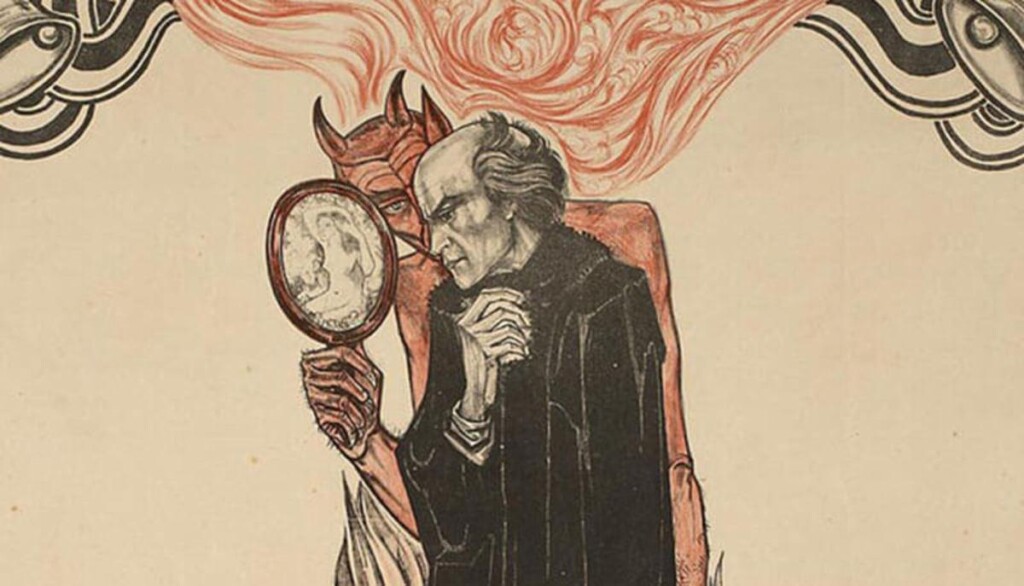
There is a moment when someone you trust — a colleague, a friend, a mentor figure — sits across from you and says, with a smile so calm it borders on cruelty, exactly what is true about you. Not what is wrong with you. What is true. And you realize that what you needed most was never the encouragement, never the hand on the shoulder, never the voice that said you were on the right track. What you needed was this: the precise and merciless naming of the thing you had been refusing to see.
Mephistopheles is that figure. Except we have spent centuries misunderstanding him because we arrived at Goethe’s text already holding the wrong map. We expected a tempter. We expected sulphur and seduction, the ancient machinery of sin. What we found instead — if we actually read the words — is something far more unsettling: a philosopher. A logician. An entity who introduces himself with devastating precision as part of that power which always wills evil and always creates good. Read that again slowly. He does not say he accidentally produces good despite his evil intentions. He is describing something structural, something ontological. He is describing himself as the necessary engine of negation inside reality itself.
Hegel, writing his Phenomenology of Spirit in 1807, less than two decades after Goethe began publishing Faust, would have recognized this immediately. For Hegel, the dialectic is not a debate technique or a logical game. It is the actual mechanism by which consciousness, history, and reality advance. The negative is not an obstacle to truth — it is what produces truth. Without the antithesis, the thesis remains frozen, self-satisfied, incapable of becoming anything more than what it already is. Mephistopheles, in Goethe’s architecture, functions as precisely this force: the negation that refuses to let any achieved form calcify into permanence. He is not evil in any folk-theological sense. He is the philosophical adversary in the original meaning of the word — the one who stands against, and whose standing against is the condition of movement.
Watch how he operates. He does not offer Faust pleasure, not really. He offers him dissolution. He strips away the library, the robes, the accumulated prestige of decades spent building a self-image of someone engaged in the pursuit of knowledge. He does not seduce Faust into vice. He seduces him into honesty — into admitting that the whole edifice was a beautiful, suffocating lie. There is a scene that lives in the mind like a wound: a man of considerable social standing, elegant, precise in his speech, sits with someone half his age who is on the verge of a significant decision. The older man does not warn, does not advise. He simply reflects back what the younger man has been performing, and the performance suddenly looks unbearable under that quiet, ironic gaze. That is the Mephistophelean gesture. Not corruption. Clarification.
This is why he is more dangerous than any conventional devil. A tempter flatters you toward damnation. Mephistopheles shows you where you already are. He tells Faust that his celebrated learning has brought him to the exact same place as the most ignorant man on the street — and he says it without contempt, almost with tenderness. The cruelty is in the accuracy.
The theologian Paul Tillich, in The Courage to Be published in 1952, argued that genuine courage is not the absence of anxiety but the willingness to affirm existence in the face of nonbeing. Mephistopheles is the embodiment of that nonbeing pressing against the self. He does not destroy. He reveals what was already hollow. And what is hollow cannot be defended — it can only be surrendered, which is the beginning, not the end, of whatever comes next.
The Wager and What It Actually Costs
You have been there. Not in the library, not in the study — but in the moment immediately after getting what you wanted. The promotion, the relationship, the finished work, the crossed finish line. And instead of fullness, something like an embarrassing silence opening up inside you, a cavity you were certain the achieved thing would fill and which the achieved thing has somehow made more visible, not less.
This is the exact terrain on which Faust and Mephistopheles lay their wager. The terms are precise and worth sitting with: Faust bets his soul that the devil cannot produce a moment of experience so perfect, so consummately satisfying, that Faust will ask it to stay. Not that he will be happy — happiness is too mild, too bourgeois a category. He bets that no moment can be so total that he would surrender forward motion for it, that he would let himself say: linger now, you are so fair. The soul belongs to Mephistopheles the instant Faust reaches contentment. Faust, in other words, bets his immortality on his own incapacity for satisfaction.
What makes this terrifying is not that it sounds like hubris. It sounds like a confession.
Schopenhauer understood the mechanism with a clarity that is almost clinical. Writing in The World as Will and Representation in 1818, he described human desire not as a trajectory toward fulfillment but as a wheel that cannot stop turning. The will — his word for the blind, insatiable force that drives all living things — produces desire, desire produces striving, striving occasionally produces satisfaction, and satisfaction produces, almost immediately, boredom. Boredom then produces new desire, and the wheel turns again. There is no exit ramp on this road. Faust’s wager is not eccentric. It is, in Schopenhauer’s reading of human nature, simply honest. He is the first man in Western literature to make the terms of ordinary consciousness into a legal contract.
Freud added a darker layer still. In Beyond the Pleasure Principle, written in 1920, he proposed that beneath the drive toward satisfaction runs a counter-current, something he called the death drive — Todestrieb — a compulsion to return to the inorganic stillness before excitation began. The restlessness Faust experiences is not merely a failure to find the right object of desire. It is the structure of desire itself, which requires tension to exist, which metabolizes satisfaction like fuel and keeps burning. The perfect moment, in Freud’s topology, would mean the end of wanting. Which means the end of the self as Faust knows it. He is not, then, wagering that Mephistopheles will fail. He is wagering that he cannot die while still alive.
There is a scene — not in a theater, not in a myth, but in the life of a man at the apex of everything he constructed — where he sits across a dinner table from people who adore him, in a house that cost precisely what it was supposed to cost, wearing the face he spent decades building. And the face is correct. And the table is correct. And none of it reaches him. He moves through the room with the mild horror of someone who has arrived somewhere they no longer remember wanting to go. The achievement has not betrayed him. It has simply revealed that it was never the achievement he wanted — it was the wanting itself that kept him upright, kept the architecture of his days from collapsing inward. He had bet, without knowing it, exactly what Faust bet.
The wager costs Faust his soul only if he loses, which is to say only if he rests. But what Goethe sees, and refuses to sentimentalize, is that the inability to rest is not a virtue. It is a wound that has learned to call itself ambition.
Gretchen: The One Who Pays for Someone Else’s Enlightenment
She is sixteen years old. She spins thread, goes to church, keeps her mother’s house, and has never once thought of herself as anything other than ordinary. That is precisely why she is chosen. Not despite her simplicity, but because of it — because a man consumed by the hunger for absolute experience needs something pure to consume.
Faust does not love Gretchen. He desires the sensation of loving her. There is a difference so vast it constitutes an abyss, and she falls through it. She falls through his need to feel deeply, his need to prove to himself that he is still capable of something real after all the books and all the disillusionment. She becomes the instrument of his self-investigation, and she pays with her mind, her child, and finally her life. He moves on, toward Helen of Troy, toward the eternal feminine as abstraction. She remains in her cell, singing to herself, her hair undone, a child’s corpse somewhere beneath the earth she will never walk again.
This is not a story about evil. That is the most unsettling part. Nobody in this machinery considers themselves monstrous. Faust believes he loves her, or at least that what he feels is close enough. Mephistopheles is merely facilitating desire, which is after all what desire demands. The neighbors who condemn Gretchen are following the moral architecture they were given. What destroys her is not malice — it is the aggregate weight of people acting inside their assigned roles with perfect, devastating consistency.
Hannah Arendt spent years thinking about exactly this structure. Her work on the banality of evil, developed most sharply through her 1963 reporting on the Eichmann trial, identified a particular kind of horror: the harm that flows not from exceptional depravity but from ordinary thoughtlessness, from the suspension of judgment in favor of function. Eichmann did not hate his victims. He simply did not think about them as the kind of beings whose suffering could constitute a moral claim on his attention. Faust does not hate Gretchen either. He simply does not think about her as a being whose interiority has the same weight as his own.
There is a woman sitting across from a man at dinner, and she is telling him about a fear she has carried for years, something specific and tender, and she watches his eyes go slightly distant — not cruel, not dismissive, simply turned inward, already translating her vulnerability into something he can feel, into a mirror of his own depth. He will later tell a friend that she is remarkable, that she moves him. He will mean it. He will not understand why she never calls again. This is the structure. Not violence. Solipsism dressed as intensity.
Gretchen’s tragedy in Faust is also a social document. She has no institution to protect her, no language to name what has been done, no narrative that places her at the center of her own story. The moral framework available to her — the one offered by church, by community, by every structure she was raised inside — condemns her for the consequences of her seduction while the seducer ascends toward transcendence. Part One ends in 1808 with her voice crying out for divine judgment, and it is the most honest moment in the entire poem, because she sees clearly what everyone around her has agreed not to see.
Goethe understood something about the architecture of innocence and exploitation that his culture had no vocabulary to process cleanly. Gretchen does not die because she sinned. She dies because she was necessary to someone else’s journey and then she was not. The journey continues. The one who made it possible is already somewhere else, already becoming something new, already moving toward the next experience that will confirm the depth he is so certain he possesses.
A vision curated by a filmmaker, not an algorithm
In this video I explain our vision
Part Two and the Architecture of Ambition
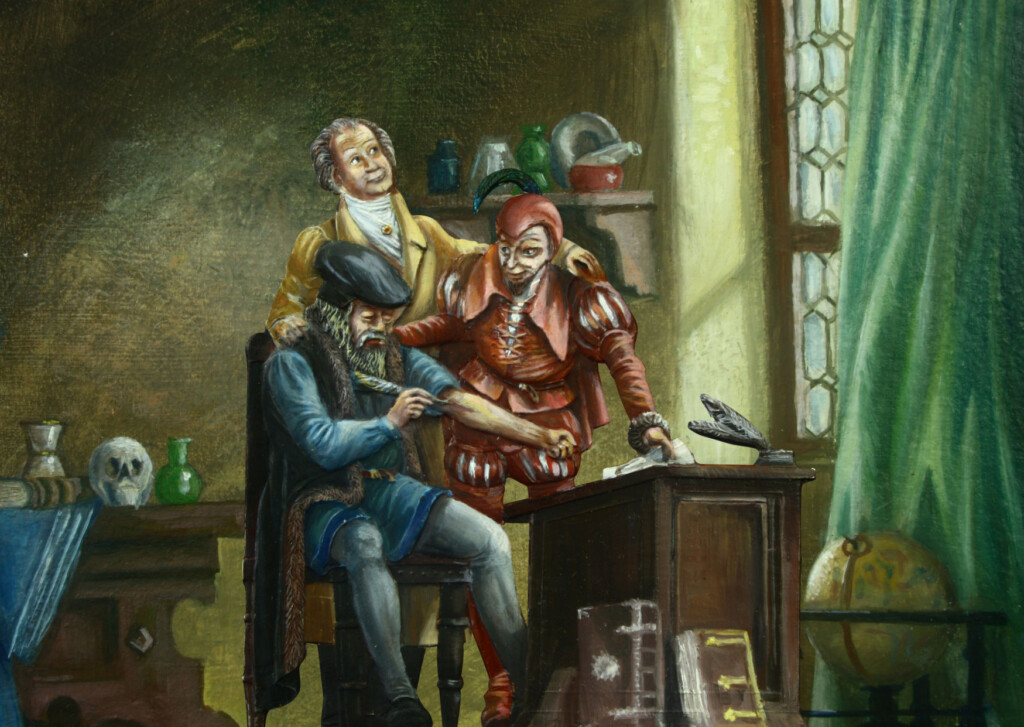
There is a moment when ambition stops being personal and becomes architectural. When the desire is no longer for a woman, or for knowledge, or even for sensation, but for land itself — for the reshaping of the physical world according to a single will. Faust, in the second part of his story, has become something else entirely. He is no longer the scholar in the narrow room. He is a force of civilization, and civilization, as it turns out, has a specific relationship with the people who were already living where it intends to build.
Goethe completed this second movement in 1831, sealed the manuscript, and left instructions that it not be opened until after his death. He died the following year. There is something deliberate in that gesture — a man finishing the largest work of his life and choosing not to witness the world’s reaction to it. As if he knew that what he had written would require time to become true, that the world would have to catch up to the allegory before it could recognize itself inside it.
What Faust builds in these final acts is a reclaimed coastline. He drains marshes, redirects water, engineers an entirely new territory from nothing — or rather, from what was previously unconquerable by human will. It is the dream of mastery made literal: the earth itself submitted to rational planning, to the vision of a single man backed by the machinery of power. And standing in the way of that vision, on a small plot of land at the edge of the new empire, are two elderly people. Philemon and Baucis. They have a cottage, a garden, a chapel with a small bell. They were there before the project began. They will not sell, will not move, will not consent to progress. Faust does not kill them himself. He simply expresses his impatience, his frustration with the obstruction, and others understand what must be done. The old couple dies. The cottage burns. The bell goes silent.
Max Weber, writing in 1919 in “Politics as a Vocation,” described the modern state as the entity that holds a monopoly on the legitimate use of physical force. The word “legitimate” is doing all the work in that sentence. It is the hinge on which civilization swings between justice and atrocity. Faust’s project is not illegal. It is sanctioned, organized, efficient. The violence against Philemon and Baucis is not a crime within the logic of the world Faust has built — it is, at most, a regrettable inefficiency. Weber understood that the rationalization of violence does not make it less violent. It makes it invisible, procedural, almost natural.
You watch a dam rise in the jungle, built by ten thousand hands that will never appear in any official account of the project. The forest behind it will flood within the year. The villages downstream were relocated, which is a bureaucratic word for displacement, which is a gentle word for erasure. The man at the top of the enterprise does not see himself as cruel. He sees the electricity that will power the cities, the progress that will lift the nation, the legacy that will carry his name. Faust, standing at the edge of his reclaimed land in the final pages, blind and aging, hears the sound of shovels and believes they are digging the future. They are digging his grave.
This is what the second part of the story maps: the inner logic of a civilization that builds on top of what it cannot absorb. Political power requires aesthetic justification — hence the summoning of Helen of Troy, hence the court of the Emperor, hence the endless spectacle of beauty placed in service of dominion. Technological mastery requires a philosophy of the future so totalizing that the present, and everyone living in it, becomes acceptable collateral.
Salvation Without Redemption: The Final Scene’s Uncomfortable Truth
There is a moment you have probably witnessed, in a courtroom or a hospital room or simply at a deathbed, when someone who spent decades consuming others is suddenly surrounded by forgiveness. The room fills with it. People who were broken by this person stand at the edges, quiet, and the one who caused the wreckage dies in something resembling peace. You watch this and feel a strange vertigo, because the official story being written in that room does not match the story you lived through.
This is precisely what Goethe stages at the end of his poem, and he knows it. Faust dies still striving, still projecting his will onto a future that does not belong to him, ordering the draining of marshlands in a vision of productivity so grandiose it has blinded him to the sound of actual people being displaced and killed around him. Mephistopheles, for once, tells the truth: the old man is building his monument on a foundation of corpses. And then angels descend. They scatter roses. They carry Faust’s immortal part upward while Gretchen, transfigured, intercedes for him from on high. The woman he seduced, abandoned, whose brother he killed, whose mother he poisoned, whose child drowned, who was executed by the state while he wandered in pursuit of new experiences — she speaks on his behalf. And heaven accepts the argument.
Nietzsche, writing in On the Genealogy of Morality in 1887, diagnosed precisely this mechanism as one of the most sophisticated forms of power the Christian tradition ever invented: the erasure of the creditor-debtor relationship through an act of divine substitution. The god who absorbs all guilt, who pays the debt on behalf of the one who incurred it, does not abolish the structure of guilt. It abolishes accountability while preserving the grandeur of the system. The one who strove, who consumed, who broke everything in his path, is redeemed not because he repaired anything but because striving itself is reclassified as sacred. The wreckage is not undone. It is aestheticized.
Walter Benjamin, staring at Paul Klee’s Angelus Novus in 1940 and writing what would become his ninth thesis on the philosophy of history, saw the angel of history being blown backward into the future by the storm we call progress. The angel’s face is turned toward the past, toward the accumulating pile of debris, the catastrophe upon catastrophe. He would like to stay, to wake the dead, to repair what has been broken. But the storm drives him forward and the pile grows. This is not an abstract image. It is the exact spatial logic of Faust’s salvation: the future is promised to the striver, while the dead stay dead, the debris stays debris, and Gretchen stays in the position of the one who forgives.
There is a man at the center of a story you know, perhaps from a film, perhaps from a life. He has made monstrous choices. He has let people fall because his ambition was more vivid to him than their suffering. Near the end, he is granted an absolution that the narrative frames as earned, or at least as cosmically appropriate. The camera — or the room, or the eulogy — lingers on his final expression, which is peaceful. What you do not see is what happened to the ones who gave him that peace. They have already exited the frame. Their suffering was the price of his journey, and the story has decided that journey was worth it.
Goethe does not hide this. He puts it in full ceremonial light, with celestial choirs and ascending souls. The question he leaves burning is whether he intends it as triumph or as indictment, and whether the two can even be separated once the machinery of divine mercy has been set in motion.
The Striving That Never Arrives

You know the feeling. You crossed the threshold you had been moving toward for years — the promotion, the relationship, the city, the version of yourself you had assembled so carefully — and stood inside it for a moment, waiting for the arrival to announce itself properly. It did not. Something in you had already turned its eyes toward the next horizon before you had even unpacked.
This is not a character flaw. Goethe spent the better part of sixty years writing a poem about exactly this, and he did not write it as a cautionary tale. He wrote it as a diagnosis. Faust is not a story about a man who wanted too much. It is a story about a man who could not stop wanting, which is an entirely different thing, and the distinction costs everything.
The German word at the center of the text is Streben, and it resists translation the way a living organism resists being pinned to a board. It is not ambition, which implies a target. It is not desire, which implies an object. It is closer to a constitutional orientation of the self toward what is not yet, a forward lean built into the very posture of consciousness. Goethe understood something that most motivational frameworks still refuse to admit: that this leaning is not a problem to be solved but the fundamental condition of the kind of creature that asks questions about its own existence.
There is a man who spends decades building a kingdom of ice, ordering every detail of a vast construction project from a wheelchair, his eyesight nearly gone, still commanding, still revising, still reaching. He is almost blind when he imagines the finished land, the free people working it, the sound of it. He dies before any of it is real, and in the seconds before his death he hears the sound of spades — what he believes is the sound of his vision becoming actual. It is not. It is the sound of his grave being dug. And yet the moment is not tragic in the way we expect tragedy to feel. There is something luminous in it. The striving continued past the boundary of what was possible to perceive accurately, and that continuation was itself the life.
Friedrich Schiller, writing to Goethe in 1794, recognized immediately that what his friend was constructing was not a moral allegory but a phenomenological portrait of human interiority. The soul that strives, he observed, is always also the soul that suffers its own striving, because the gap between the reaching and the arrival is never closed, only relocated. Hegel would later formalize this into his notion of negation as the engine of consciousness — the idea that the self becomes itself precisely by never being able to rest in what it already is. But Goethe had already lived this before Hegel had named it, and Faust had dramatized it before philosophy had found its vocabulary.
What Goethe encoded in the poem is the possibility that Streben is not the trap and not the solution but the very texture of a conscious life honestly lived. The angels who carry Faust upward at the end do not reward him for his achievements. They reward him, if that is even the right word, for the quality of his reaching. For refusing the moment of perfect satisfaction that would have cost him his soul. For remaining, to the last, someone who had not yet arrived.
And so you stand again at the edge of the thing you have been moving toward, feeling the familiar tilt forward begin before the moment has even resolved, and you have to ask yourself whether this restlessness is the wound in you that never healed, or whether it is the most alive thing you contain.
🔥 The Abyss of the Human Soul: Faust and His Kin
Goethe’s Faust is not merely a literary masterpiece — it is a map of the human condition, tracing the restless hunger for knowledge, the pact with darkness, and the possibility of redemption. The articles gathered here explore the same labyrinthine territory: alchemy, existential philosophy, and the literature of transformation. Let these readings deepen your encounter with Faust’s immortal questions.
Alchemy in Literature: From Dante to Goethe
Alchemy and literature have been intertwined since the medieval imagination first cast the poet as a kind of spiritual metallurgist. This article traces the rich thread connecting hermetic philosophy to literary creation, from Dante’s infernal transmutations all the way to Goethe’s Mephistopheles and the alchemical symbolism embedded in the Faust legend. Understanding this connection reveals how much of Western literary genius was secretly written in the language of lead and gold.
GO TO THE SELECTION: Alchemy in Literature: From Dante to Goethe
The Philosopher’s Stone: Esoteric Meaning
The Philosopher’s Stone is the central obsession of alchemical tradition and one of the hidden metaphors pulsing beneath Goethe’s Faust. This article examines its esoteric meaning — not as a literal mineral but as a symbol of the perfected self, achieved through suffering, dissolution, and inner fire. Faust’s unceasing striving mirrors precisely this alchemical quest for the impossible transmutation of the mortal into the eternal.
GO TO THE SELECTION: The Philosopher’s Stone: Esoteric Meaning
Schopenhauer: Life and Philosophical Thought
Schopenhauer’s vision of the world as blind, insatiable Will finds a powerful literary echo in Faust’s relentless desire and dissatisfaction. This article explores how Schopenhauer built a philosophy around the suffering born of endless striving — the same existential restlessness that drives Faust to his demonic bargain. Reading Schopenhauer alongside Goethe illuminates why Faust remains the archetypal figure of modernity’s spiritual crisis.
GO TO THE SELECTION: Schopenhauer: Life and Philosophical Thought
Albert Camus: Life and Philosophical Thought
Albert Camus confronted the absurd with lucidity and defiance, positioning the human being as a creature condemned to seek meaning in a universe that offers none — a predicament Faust would recognize instantly. This article traces Camus’s philosophical journey through revolt, freedom, and the refusal of easy salvation. Together, Camus and Goethe form a dialogue across centuries about what it means to live fully in the shadow of the infinite.
GO TO THE SELECTION: Albert Camus: Life and Philosophical Thought
Cinema That Dares to Ask the Same Questions
If Faust’s journey into the depths of the human soul has stirred something in you, Indiecinema is the streaming platform where that conversation continues on screen. Discover independent and art-house films that explore transformation, existential daring, and the mystery of what it means to be human — stories that, like Goethe’s masterpiece, refuse easy answers and illuminate the darkness with uncommon beauty.
👉 EXPLORE THE CATALOG: Watch Indie Films in Streaming
A vision curated by a filmmaker, not an algorithm
In this video I explain our vision

