
The Gold That Was Never Decoration
You stand in front of it and feel almost nothing. That is the honest admission you will not make aloud, not in a museum, not surrounded by people who nod slowly and tilt their heads with cultivated reverence. The altarpiece rises before you — gold ground, rigid figures, hands arranged in gestures that seem neither natural nor entirely symbolic, faces that do not quite meet your eyes but do not look away either. The scale is wrong for the room. The proportions are wrong for the body. The gold does not reflect the light the way gold should. It absorbs it, redistributes it, turns the air around the panel into something thick and directionless, as though the source of illumination were inside the object rather than falling upon it. You feel vaguely inadequate. Then, because the feeling is uncomfortable, you move on.

This moment — so ordinary it barely registers — contains everything we have gotten wrong about medieval visual culture for roughly three centuries.
The discomfort you feel is real and it deserves examination, not dismissal. It is not a failure of sensitivity or education. It is the perfectly logical response of a consciousness trained by centuries of post-Enlightenment aesthetics to encounter an object that was built on entirely different premises, for entirely different perceptual equipment, addressing a kind of attention that modernity has systematically dismantled. You are not failing to understand medieval art. Medieval art is accurately diagnosing you.
Hans Belting spent decades working toward an argument that shook art history when he finally assembled it fully in his 1990 work Bild und Kult — translated into English as Likeness and Presence — proposing that before the Renaissance, images were not art at all in any sense the modern world would recognize. They were presences. They were not representations of sacred figures; they were the sites where sacred figures were actually encountered. The distinction is not theological hair-splitting. It is the difference between a photograph of your mother and your mother. The medieval worshipper standing before an icon or an altarpiece was not appreciating formal qualities. They were in a relationship. The object had agency. It looked back.
This is why the gold was never decoration. The gold ground that flattens the spatial depth of so many medieval panels, the feature that strikes the contemporary eye as primitive or simply pre-perspectival, was a precise theological statement about the nature of divine light. Ordinary light falls from somewhere. Divine light emanates from everywhere and nowhere simultaneously. To eliminate the illusion of a light source was not a technical limitation but a metaphysical insistence. The painter was not failing to render space. The painter was refusing to lie about the nature of eternity by making it look like an afternoon in a Florentine garden.
Georges Didi-Huberman, building in part on Belting’s foundations and in part on his own phenomenological reading of Fra Angelico, argued that what we call the anachronism of medieval images — their apparent refusal to belong to a single historical moment — is in fact their most sophisticated feature. The image does not depict the Annunciation as a past event. It holds the event open. It insists on the present tense of the sacred. The figure does not stand in a room. The figure stands in the only available approximation of a place outside of time.
You were never supposed to look at it from a distance. The museum has already falsified the encounter before you took a single step toward the panel. The neutralizing white wall, the climate-controlled silence, the explanatory placard with its dates and attributions — all of this is an elaborate machinery for converting a living address into a historical artifact, for making something that once demanded a response into something that merely invites an opinion.
The altarpiece is still making its demand. You just cannot hear it anymore.
St. Mary of Vezzolano. The Restoration of the Jubé
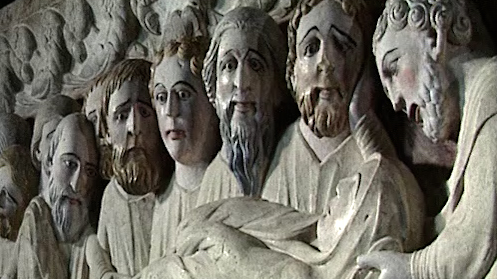
Documentary, by Fedele Aula, Italy, 1998.
In the heart of Monferrato, among silent hills and winding roads, stands the Canonica of Santa Maria di Vezzolano: a place where history, art, and spirituality have intertwined for nearly a thousand years. At the center of the narrative emerges the jubé, an extraordinary medieval rood screen that miraculously survived the dictates of the Counter-Reformation that had ordered its destruction. This rare structure, suspended between liturgical function and visual storytelling, becomes the guiding thread of the documentary: a “stone book” recounting the genealogy of Christ and the Dormitio Virginis, still preserving traces of its original colors.
Through the work of restorers, institutions, and volunteers, the film explores the delicate balance between conservation and enhancement, bringing new life to a work unique in the European landscape. The restoration of the jubé thus becomes not only a technical intervention, but a journey through memory, giving voice once more to a monument that has endured centuries, resisting time and human actions. Through testimonies, evocative imagery, and artistic details, the documentary invites viewers to rediscover Vezzolano as a “magical” place, where every stone tells a story and the past continues to dialogue with the present.
LANGUAGE: Italian
SUBTITLES: English, Spanish, French, German, Portuguese
A World Without Perspective, And Proud Of It
You walk into a room and immediately understand who the most important person in it is. Not because of where they stand, but because of how much space they take up, how the room seems organized around their presence, how everyone else’s posture tilts slightly toward them. You already know this grammar. You read it before you were taught to read anything. Now imagine someone telling you that this instinct is not natural but learned, not universal but historically specific, and that there was once an entire civilization that understood visual importance through entirely different rules — and understood it completely, fluently, without confusion.
A man kneels before a figure twice his size. Behind them, a city the height of a child’s fist. The gold background swallows all distance. There is no horizon. There is no shadow. There is no suggestion that any of these things exist within the same physical space, because the point was never physical space. The point was hierarchy so self-evident it required no argument, only demonstration. The large figure is large because it is important. The city is small because cities are, in the order of things, less significant than the divine body before which a mortal bends. You are not looking at a technical failure. You are looking at a different definition of what a picture is for.
Hans Belting, in his 1990 study on the sacred image in the Christian West, made an argument so disorienting in its simplicity that it took decades to fully absorb: the medieval image was not a representation of reality. It was a presence. It did not depict the holy; it was understood, functionally and theologically, to contain it. This distinction collapses everything you thought you knew about what makes a painting succeed or fail. If the object on the panel is not a window onto something beyond itself but rather a site where the sacred becomes accessible, then spatial coherence, atmospheric depth, anatomical accuracy — these are not only irrelevant, they are actively beside the point. A window needs to be transparent. A presence needs to be felt.
The training you received — whether in a classroom or simply through years of exposure to post-Renaissance Western imagery — has conditioned you to read linear perspective as a neutral given, the natural endpoint of visual representation. But perspective is a convention codified in fifteenth-century Florence, systematized by Brunelleschi around 1420 and theorized by Alberti in 1435. It is approximately six hundred years old. Byzantine art is over a thousand. Romanesque fresco cycles, Coptic icons, illuminated manuscripts from the Carolingian period — all of these represent not primitive stagings on the way to perspective but complete visual languages with their own internal logic, their own demands, their own theory of what the eye is for.
The medieval artist who made a saint’s hand disproportionately large was not failing to measure correctly. That hand had performed miracles. It had touched the sick and the dead. It carried theological weight that could not be confined to biological scale. Size in that visual world was not a function of proximity to a vanishing point. It was an argument. It was a sentence in a language that the entire community of viewers read without instruction, because it expressed what everyone already believed about the order of creation.
What is destabilizing is not that this language existed. What is destabilizing is the realization that you have been reading the history of art as a story of progress — from flat to deep, from symbolic to realistic, from ignorant to enlightened — when what actually happened was simply a change in convention. One grammar replaced another. The replacement was political and economic and theological all at once, not optical. Not inevitable. Not an improvement. And the grammar you inherited as natural, as obvious, as simply correct — that grammar has a birth date.

The Craftsman Who Was Never an Artist
You have spent weeks building something — a piece of furniture, a stone wall, a garden structure — and somewhere in the middle of it, you felt the strange urge to sign it. Not from vanity, exactly. From something older: the need to leave proof that you were here, that your hands moved across this surface, that the work and the self are the same thing. That instinct feels so natural it seems almost biological. It is not. It is historically specific, culturally constructed, and surprisingly recent.
Between roughly 500 and 1400 CE, across the entirety of what we call medieval Europe, the overwhelming majority of objects made with extraordinary skill — altarpieces, illuminated manuscripts, carved choir stalls, mosaic floors, embroidered vestments, entire cathedrals — carry no name. Not because the makers forgot. Not because the records were lost. Because the question of who made it was, in the deepest sense, not the relevant question.
Georges Duby, in his 1976 study of the cathedral-building era, argued that this anonymity was not a social condition imposed on craftsmen but an expression of a fundamentally different ontology of making. The medieval maker did not experience the work as an extension of selfhood. The work was not the self projected outward. It was something more like a participation in an order that existed prior to and beyond any individual — divine, communal, liturgical. To sign it would have been not modest but confused, like signing the rain.
Think of a man working for thirty years on the same stone portal. He arrives before dawn. He strikes the same chisel in the same way he was taught, and he teaches it to the young men beside him. He watches figures emerge from rock — angels, apostles, the Last Judgment rendered in limestone — with a precision that still destabilizes anyone who studies it closely. He will die before the portal is finished. His son may finish it. His grandson may add the final tympanum. There is a continuity here that runs not through individual genius but through something more like custody. He is not the author. He is the custodian of a form that passes through him.
This is almost impossible to imagine from inside modernity’s assumptions, where the self is the basic unit of culture and authorship is how that self becomes legible. Walter Benjamin noticed, in his 1936 essay “The Work of Art in the Age of Mechanical Reproduction,” that the modern obsession with authenticity — with the original, the singular, the signed — is tied to a particular historical configuration of the self and the market. Before that configuration, objects had authority not because of who made them but because of what they participated in. A reliquary did not need a signature. Its power came from the relic inside it and the liturgical context surrounding it. The maker’s identity was irrelevant to that circuit of meaning.
What this reveals, uncomfortably, is that our own need to sign our work — to be credited, cited, recognized — is not a universal human drive but a particular cultural formation that arrived with Renaissance individualism and calcified into law, commerce, and identity over the following centuries. The sociologist Richard Sennett, in “The Craftsman” published in 2008, traces how the separation between the person who conceives and the person who executes — between artist and artisan, designer and worker — produced a kind of psychological wound that medieval guild practice did not recognize because it had not yet been inflicted. The anonymous carver did not feel the wound because the category that would have created it — the singular, credited, autonomous creator — had not yet colonized the language of making.
What was lost when it arrived is not sentimental. It is structural. A way of understanding work as something you serve rather than something you own.
What the Icons Were Actually Doing
You have stood before one of those faces and felt, without wanting to, that it was looking back. Not at you in the general sense that portraits sometimes seem to follow movement, that optical trick of well-placed pupils, but at you specifically, with a patience that preceded your arrival and would outlast your leaving. The gold behind the figure was not a background. It was not decorating empty space the way a painter fills a canvas corner. It was the abolition of space itself, the refusal of depth, of atmosphere, of the recession that tells the eye it is looking into a world. The gold said: there is no world here. There is only presence.
This is what John of Damascus understood in approximately 730 CE when he wrote his three Treatises on the Holy Images in response to the iconoclast controversy tearing the Byzantine church apart. His argument was not aesthetic. He was not defending beautiful objects. He was defending a theory of contact, insisting that the image participates in the reality of what it depicts through a logic that the Greek theological tradition called methexis, a kind of ontological sharing. The icon did not represent the saint. It made the saint available. The flat gold surface, the elongated impossible proportions, the frontal gaze that refuses the three-quarter turn of naturalism, these were not failures of technique. They were technical solutions to a theological problem: how do you construct a surface that functions as a membrane rather than a wall.
She comes every morning, an older woman in a coat that has seen many winters, and she lights a single candle before an image she could not explain to anyone who asked her to explain it. She does not try. The gesture is older than her understanding of it, passed through her hands from her mother’s hands, and what she feels standing there, the slight shift in the quality of the air, the sensation of being received, she refuses to give it a name because naming it would require her to either defend it or abandon it, and she wants to do neither. What she is doing, without knowing the vocabulary for it, is operating a cognitive technology that took centuries to engineer.
The anthropologist David Freedberg, in his 1989 study The Power of Images, documented across cultures and centuries the persistent human experience of images as alive, responsive, dangerous, or healing, and concluded that this experience is not primitive error but something structural in the way human perception processes certain visual forms. The response precedes the explanation. You feel it before you theorize it. The Byzantine tradition did not stumble onto this. It built it deliberately, using the frontal gaze because peripheral vision processes faces looking directly at us differently than faces in profile, using gold because gold does not reflect light the way pigment does but seems to emit it, using the suppression of shadow because shadow implies a fixed light source, a specific moment, and the icon must exist outside specific moments.
A man walks into a church during a war he did not choose, carrying a fear he has no words for. He sits in a corner. There is an image on the wall and it is looking at him. He does not believe in what the image represents. He has not believed in years. But something in him responds to being looked at without judgment, without the social calculation that attends every human gaze. The experience of the icon as contact point does not require theological assent. It may require nothing more than the nervous system that evolution gave you, encountering a form specifically engineered to trigger a response that was old before the theology arrived to explain it.
What we call superstition is often a practice that has outlived the theoretical framework that made it legible.
Cathedrals as Compressed Time
You walk through a heavy wooden door and the world behind you — the street noise, the cold, your own name, the particular weight of whatever you were carrying before — disappears. Not gradually. Immediately. The nave opens ahead of you like a held breath that has been waiting eight centuries for you to step inside it, and your body understands something your mind has not yet formulated: you are not in a building. You are inside an argument.
That argument was never meant to be comfortable. The architects of Chartres, whose rebuilt nave rose from the rubble of a 1194 fire to become the most coherent surviving expression of Gothic logic, were not building shelter. They were building a machine for the dissolution of the ordinary self. Every vertical line was calculated to pull the eye — and through the eye, the whole nervous system — upward along a trajectory that has no visible termination point. The vaulting recedes into shadow before it finds a ceiling you can hold in your gaze. The effect is not grandeur exactly. It is more like vertigo without the fear: the sensation of your ordinary coordinates quietly failing.
Erwin Panofsky, in his 1951 study Gothic Architecture and Scholasticism, made an argument that still cuts sharper than most: the structure of a Gothic cathedral and the structure of a scholastic summa — Thomas Aquinas‘s Summa Theologica, completed in 1274, being the monumental example — obey the same organizing intelligence. Both are systems that make their own skeleton visible. Both operate through a logic of manifestatio, the explicit display of how the parts relate to the whole. The flying buttress is not hidden behind a wall; it is exposed, announced, made part of the aesthetic experience. The chapter divisions of a summa are not administrative conveniences; they are load-bearing elements, visible to the reader as the buttresses are visible to the pedestrian. In both cases, the form is the argument.
Notre-Dame de Paris, begun in 1163 and not substantially completed until well into the thirteenth century, makes this visible at a scale that is almost aggressive. Standing inside the choir, you register how the light is not simply entering the building — it is being organized, filtered through the rose windows into something that behaves less like illumination than like theology made sensory. The color does not decorate the space; it alters the quality of perception within it. Medieval optical theory, drawing on thinkers like Robert Grosseteste who by 1230 had developed elaborate theories of light as the first principle of physical reality, understood this perfectly. Lux was not merely what you saw by. It was what the divine had used to create the visible world, and filling a space with colored, structured light was a doctrinal statement about the nature of matter itself.
The Sainte-Chapelle, consecrated in 1248 and built for Louis IX to house the Crown of Thorns, takes this logic to an almost hallucinatory conclusion: the walls essentially disappear, replaced by fifteen windows comprising over a thousand individual scenes, so that in certain afternoon light the stone structure seems to be merely the pretext for an uninterrupted field of narrative radiance. You are not meant to read the windows sequentially. You are meant to be overwhelmed before you can read anything at all.
This is the calculation that has been systematically misread by every subsequent century that approached these buildings as monuments to power or as aesthetic achievements divorced from their experiential function. They were built to break something open in the person who entered them. Not to instruct. Not to impress. To briefly — for exactly as long as the light holds, for exactly as long as the proportions keep working on your body — make you forget the particular and continuous burden of being only yourself.
A vision curated by a filmmaker, not an algorithm
In this video I explain our vision
The Violence Inside the Beauty
You have probably stood in front of one of these panels and called it beautiful. The gold leaf catching light in a dim museum room, the precise rendering of drapery, the delicate arch of a halo — and somewhere in the center of that same composition, a man’s skin is being peeled from his body in neat vertical strips while his face holds an expression of almost serene acceptance. You registered the beauty first. You may never have fully registered the other thing.
This is not an accident of perception. It is a trained response, and it took centuries to build.
Medieval visual culture did not flinch from the body in extremity. It organized entire programs of imagery around it. The flayed saint, the wheel embedded with blades, the gridiron, the boiling oil, the arrows bristling from a torso like a grotesque crown — these were not marginal curiosities tucked into corners. They were the central content. Altarpieces commissioned for cathedrals, frescoes covering the walls of civic buildings, manuscript illuminations carried in the hands of the devout: all of them dense with torn flesh, broken bones, the specific mechanics of suffering rendered with an artisan’s precision and a theologian’s intent. The Last Judgment compositions that stretched across entire west walls of Romanesque and Gothic churches depicted the damned in states of anatomical violation that no clinical description quite captures. Demons with animal mouths swallowing human bodies whole. Souls crushed under stone, drowned in rivers of fire, contorted into shapes the living body cannot achieve. It was the first thing you saw when you entered. It was the last thing you saw when you left.
Philippe Ariès, in his monumental study published in 1981 after years of research into Western attitudes toward death across a millennium, argued that medieval culture practiced what he called a “tame death” — not in the sense of a death made mild, but in the sense of a death fully admitted into the space of the living. The dying man knew he was dying, summoned his community, arranged his affairs, and performed his departure as a public act. Death was not sequestered in institutions, not managed by professionals, not euphemized into passage or transition. It stood in the room with everyone. Ariès traced how this changed across centuries, how death became progressively hidden, medicalized, aestheticized — how the 20th century inherited a culture so terrified of mortality that it could no longer look at it directly. What he did not fully pursue, though his evidence points toward it, is how completely that terror restructured our relationship to the images that preceded it.
When you call a martyrdom scene beautiful, you are performing an act of neutralization. You are taking an image designed to do violence to the viewer’s complacency — to force them into the body of the sufferer, to make the question of what they would endure for what they believed suddenly urgent and personal — and you are filing it under aesthetics, where it can be appreciated at a safe remove. The museum has helped. The white wall, the measured distance, the small explanatory card with its art-historical terminology — all of it works to ensure that what you encounter is an artifact of a distant civilization rather than a direct address.
But the direct address was the entire point. These images were made for people who watched public executions, who processed through streets with relics that were actual pieces of human remains, who understood that the body of the saint and the body of the criminal and their own body existed on a single continuum of vulnerability. The terror in those Last Judgment walls was not meant to be survived by aesthetic appreciation. It was meant to land.
What you feel standing before them now, if you allow yourself to feel it honestly, is not beauty first. It is beauty as a way of surviving something that is still, underneath all the gold, aimed directly at you.
Marginalia, Or the Subversion Hidden in Plain Sight
You are turning the pages of a facsimile edition of a thirteenth-century Book of Hours when you stop. There, in the lower margin of a page dense with devotional Latin and the serene face of the Virgin, a knight in full armor is fleeing in terror from a snail. The snail is winning. You laugh before you understand why, and then the laughter sits strangely in your chest, because you realize you are laughing at something made by a monk, in a scriptorium, during hours devoted to sacred work, on a page meant to bring the reader closer to God.
The margins of medieval illuminated manuscripts are full of this. Rabbits conducting a human funeral with mock solemnity. A priest with the head of a donkey delivering a sermon to a congregation of geese. Naked figures doing things that would scandalize a modern human resources department. Hybrid bodies assembled from incompatible anatomies — the torso of a man, the tail of a fish, the wings of a rooster — creatures that exist nowhere in theology, nowhere in bestiaries, nowhere in any sanctioned imagination. They exist only here, at the edge of the sacred page, pressed against the Word of God like a crowd of uninvited guests who somehow got in through a window.
The instinct is to read them as accidents, as bored scribes doodling, as the medieval equivalent of drawing in the margins of a textbook. This is almost certainly wrong. Mikhail Bakhtin, writing in Rabelais and His World in 1965, described the carnivalesque not as a breakdown of order but as its necessary shadow. Carnival — with its inversion of hierarchies, its grotesque bodies, its obscenity and laughter — was not the opposite of medieval religious culture. It was the pressure valve that allowed that culture to function. The world turned upside down for a designated interval so that the world could remain right-side up for the rest of the year. The grotesque, Bakhtin argued, is always social. It does not mock to destroy. It mocks to release, and in releasing, to confirm.
The knight fleeing the snail is not an accident of a wandering pen. It is a precise symbolic operation. The snail, in medieval iconography, carried associations with cowardice, with slowness, with the failure of masculine virtue. The armored knight — the supreme figure of secular power and martial honor — reduced to a man running from a garden creature. The image works because it knows exactly what it is deflating. You cannot parody what you do not understand with precision, and whoever drew this understood the chivalric code well enough to find the single image that would make it look absurd. The laughter is not random. It is surgical.
What unsettles you, after the laughter passes, is the realization of how much that laughter was controlled. It was permitted here, in the margin, at this scale, in this form. Not on the altar, not in the sermon, not in the public square. The carnival has a calendar and a geography. Bakhtin knew this, and it is the part of his argument that his most enthusiastic readers sometimes prefer not to dwell on: the carnivalesque does not threaten power, it negotiates with it. The margin is not a crack in the wall. It is a door that was built into the wall on purpose.
And yet something leaks. The monk who spent three days painting a bare-bottomed figure blowing a trumpet from an anatomically impossible position was doing something with his hands that his vows did not account for. Whatever theology said about the body, his hands remembered differently. The image exists now, eight hundred years later, and you are laughing at it in a room far from any scriptorium, which means it traveled. It crossed every border it was never supposed to cross.
Who Owned the Meaning
Stand before the great tympanum at Vézelay sometime in the 1130s, if you can. You are a peasant, your hands carrying the particular roughness of someone who has worked soil since childhood, and above the central portal of the abbey church there unfolds a universe of carved stone so dense with meaning that it would take a trained theologian years to exhaust its references. Christ enthroned at the center, rays of divine energy streaming from his outstretched hands into the bodies of the apostles, the nations of the earth arrayed around the outer arc in their exotic particularity — dog-headed men, pygmies mounting horses with ladders, peoples whose ears are large enough to sleep inside. You see the drama. You feel its weight and its terror. But the grammar of it, the precise doctrinal argument being made in stone, the specific iconographic choices that distinguish this Pentecost from a Last Judgment, the theological stakes of every gesture — that knowledge belongs to someone else, and that someone else is standing just inside the door.
Michel Foucault spent much of his intellectual life demonstrating that knowledge is never neutral, that it does not float freely above social arrangements but is instead produced within them and used to reproduce them. In Discipline and Punish, published in 1975, he traced how the organization of visibility — who sees whom, who can be seen, who controls the frame — functions as one of the primary mechanisms through which power operates. The medieval church did not need to read Foucault to understand this intuitively. The entire visual program of the Romanesque and Gothic cathedral is a system of controlled visibility, a landscape of meaning in which the image is given to everyone and the interpretation is reserved for the initiated.
This is not a conspiracy. It is something more ordinary and therefore more durable than conspiracy. The clergy who commissioned and explained these programs genuinely believed they were offering salvation to people who could not access it through texts. The mosaics of Ravenna, the portal sculptures of Chartres, the painted cycles of Sant’Angelo in Formis — all of it was understood, by those who made it possible, as an act of generosity toward the unlettered. Gregory the Great had said as much in the sixth century, in letters that became foundational to the entire medieval theory of sacred imagery: pictures are the books of the illiterate. The phrase sounds compassionate. It is also a precise description of a hierarchy, because a book you cannot read yourself is a book that requires a reader, and the reader holds a power over you that the text alone never could.
There is a scene that stays with you — a man sitting for years in a room where a painted paradise covers every wall, its beauty slowly becoming the architecture of his interior life, the images so deep in him now that he cannot separate what he believes from what he was shown. The question of where devotion ends and conditioning begins is not a comfortable one, and the medieval visual tradition does not resolve it. It holds both possibilities simultaneously, with a confidence that perhaps only a culture of genuine collective faith could sustain.
The beauty was real. The control was real. These two facts do not cancel each other, and perhaps that is the most honest thing that can be said about the entire enterprise. Erwin Panofsky, whose work on Gothic architecture and scholastic thought in 1951 remains one of the most precise attempts to map the relationship between visual form and institutional mind, understood that the cathedral was simultaneously a philosophical argument and a social technology. To stand inside it was to be educated and to be managed, to be elevated and to be positioned, and the stone did not distinguish between these operations because, for the people who built it, they were the same.
🏰 Art, Faith, and Form Through the Ages
Medieval art did not exist in isolation — it grew from ancient traditions, absorbed spiritual symbolism, and transformed across centuries into new visual languages. The articles below trace the most important threads connecting medieval artistic culture to the broader history of Western art and thought.
Romanesque Art: History and Characteristics
Romanesque art represents the direct visual ancestor of the Gothic style that flourished in the High Middle Ages, sharing with it a deep religious function and a symbolic rather than naturalistic approach to form. This article explores how Romanesque architecture, sculpture, and painting expressed the theology and worldview of medieval Christendom. Understanding Romanesque art is essential for anyone seeking to grasp the visual logic that underlies the medieval artistic tradition.
GO TO THE SELECTION: Romanesque Art: History and Characteristics
Titian: Life and Works
Titian stands at the turning point between the medieval symbolic tradition and the fully realized humanism of the Renaissance, making his work a crucial reference for understanding how European art evolved after the Middle Ages. His mastery of color and light transformed the way painters represented the sacred and the human figure. Studying Titian illuminates the long arc of Western art history that begins in the medieval workshop and ends in the grandeur of the Venetian school.
GO TO THE SELECTION: Titian: Life and Works
Memento Mori: History and Meaning
The Memento Mori tradition — the artistic and philosophical meditation on death and human mortality — has deep roots in medieval culture, where images of skulls, decaying bodies, and the Dance of Death were ubiquitous in churches and manuscripts. This article traces the history and meaning of this powerful symbolic practice from antiquity through the Renaissance and beyond. For anyone studying medieval art, the Memento Mori offers a window into the spiritual anxieties and theological convictions that shaped every brushstroke of the era.
GO TO THE SELECTION: Memento Mori: History and Meaning
Vanitas in Art: Symbolism and Meaning
The Vanitas genre in art shares its spiritual DNA with medieval iconography, using symbolic objects to remind viewers of the transience of earthly life and the primacy of the soul. This article examines how painters across centuries encoded moral and religious meaning into still-life compositions filled with candles, hourglasses, and wilting flowers. The continuity between medieval symbolism and the Vanitas tradition reveals how deeply the Middle Ages shaped the visual and philosophical vocabulary of later European art.
GO TO THE SELECTION: Vanitas in Art: Symbolism and Meaning
Discover Art and Cinema on Indiecinema
If these journeys through art history have sparked your curiosity, Indiecinema streaming is the place to continue the exploration. Our platform curates independent and arthouse films that illuminate culture, beauty, and human meaning — the very themes that medieval art sought to capture in stone and gold. Join us and discover a cinema that dares to ask the deepest questions.
👉 EXPLORE THE CATALOG: Watch Indie Films in Streaming
A vision curated by a filmmaker, not an algorithm
In this video I explain our vision

