
The Stone That Outlasted the Prayer
You step inside and the temperature drops by four degrees. Not metaphorically. Your skin registers it before your mind does, that particular cold that old stone holds the way a body holds grief — not aggressively, but persistently, in the bones of the place, radiating outward from walls that are sometimes three feet thick and have been doing this for nine centuries. The light falls at an angle that has nothing to do with you. It fell that way before you arrived and will continue falling that way long after you leave, slicing through narrow windows that were never designed to show you the landscape but to orient a life toward the divine at specific hours of the day. You look up. The vault rises in a geometry so precise it feels like an argument, each rib and keystone locked into a logic that doesn’t require your comprehension to function. The building was not waiting for you. That is the first thing to understand.

Most people who enter an ancient abbey do so with the benign confusion of the tourist, which is to say they carry a kind of telescoped awe — vague, photographic, self-referential. They feel something, genuinely, but they file it immediately under “atmosphere” or “history” and move toward the gift shop carrying the feeling like a souvenir already half-forgotten. The stone permits this. It has permitted far worse. It has watched entire theological orders dissolve, watched kings seize its property, watched reformers strip its altars and soldiers stable horses in its nave, watched centuries of rain work quietly at its mortar. Your camera phone is not particularly threatening to it.
But the question the stone actually poses, if you stand still long enough to hear it, is more unsettling than anything you brought with you. Who builds something intended to outlast their own civilization? What kind of mind, what kind of collective terror or faith or social organization, decides that permanence is not just desirable but necessary, not just for God but for the institution, for the rule, for the perpetuation of a particular way of organizing human time and human bodies inside a bounded space? Because that is what a monastery is, before it is anything aesthetic. It is a machine for the production of a certain kind of person, built in stone because stone communicates a message that wood cannot: we intend to be here after you are dead, and after the people who come after you are dead.
The French philosopher Paul Connerton, writing in 1989 in How Societies Remember, argued that social memory is not primarily stored in texts or archives but in habitual bodily performances and in the built environment that shapes those performances. The abbey does not merely commemorate the past. It enforces it. Every corridor designed to make you walk at a particular pace, every ceiling height calibrated to make you feel your own smallness, every threshold between spaces of different sonic quality — all of it is working on your body before your consciousness gets a word in. Connerton’s insight was that forgetting is not passive; it is something that structures work to prevent. Stone is the most conservative memory technology we have ever invented.
And yet here you are, a tourist, which means you have arrived in this machine designed to produce monks and found it repurposed as a destination. The beds are gone. The choir stalls are roped off. The herb garden has an interpretive plaque. The building has survived by becoming something it was never designed to be, which raises the possibility that survival and integrity are not the same thing, and that what you are standing inside is not the past preserved but the past taxidermied — its shape intact, its animating principle quietly extracted. The cold is still real. The geometry still rises. But what it once demanded of the people inside it, you are under no obligation to supply.
St. Mary of Vezzolano. The Restoration of the Jubé
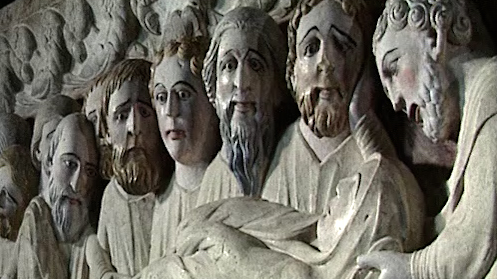
Documentary, by Fedele Aula, Italy, 1998.
In the heart of Monferrato, among silent hills and winding roads, stands the Canonica of Santa Maria di Vezzolano: a place where history, art, and spirituality have intertwined for nearly a thousand years. At the center of the narrative emerges the jubé, an extraordinary medieval rood screen that miraculously survived the dictates of the Counter-Reformation that had ordered its destruction. This rare structure, suspended between liturgical function and visual storytelling, becomes the guiding thread of the documentary: a “stone book” recounting the genealogy of Christ and the Dormitio Virginis, still preserving traces of its original colors.
Through the work of restorers, institutions, and volunteers, the film explores the delicate balance between conservation and enhancement, bringing new life to a work unique in the European landscape. The restoration of the jubé thus becomes not only a technical intervention, but a journey through memory, giving voice once more to a monument that has endured centuries, resisting time and human actions. Through testimonies, evocative imagery, and artistic details, the documentary invites viewers to rediscover Vezzolano as a “magical” place, where every stone tells a story and the past continues to dialogue with the present.
LANGUAGE: Italian
SUBTITLES: English, Spanish, French, German, Portuguese
Order as Architecture, Architecture as Order
You have stood in a cloister and felt something you could not name. Not peace, exactly. Something more like the sensation of being watched by a geometry. The four walls enclosing the garden, the covered walkway repeating its arches at measured intervals, the silence that is not merely the absence of sound but the presence of a deliberate design — all of it pressing on you in a way that feels almost bodily, almost like restraint.
This was not accidental. It was the entire point.
When Benedict of Nursia codified his Rule around 529 AD, he was not writing a spiritual guide in any modern therapeutic sense. He was engineering a human being through the manipulation of space and time. The Benedictine monastery was, before anything else, a machine for producing a specific kind of subjectivity: obedient, rhythmically attentive, incapable of private ownership of even a moment. Michel Foucault, in Discipline and Punish published in 1975, observed that modern institutions — prisons, hospitals, schools, barracks — all share a common grammar of enclosure, partition, and visibility. He traced this grammar to its earlier theological roots and found exactly what any honest visitor to Monte Cassino or Fontenay finds: that the arrangement of bodies in space is never innocent, never merely practical, always an argument about who has power over whom and in whose name that power is exercised.
The cloister was not a garden for contemplation. It was a surveillance apparatus wearing the clothing of beauty. The monk could always be seen from multiple angles. The dormitory required communal sleeping without curtains or private enclosures precisely so that no moment of darkness could become a moment of autonomy. The refectory silenced individual conversation and replaced it with the voice of a single reader, elevated on a pulpit, so that even the act of eating — the most animal and private of necessities — was colonized by collective spiritual purpose. Every transition between spaces was regulated by bells, the horologium of the monastic day dividing existence into segments so fine that the self had nowhere to retreat into itself.
The Cistercians, reforming what they perceived as Benedictine luxury in the twelfth century, believed they were stripping away distraction to approach God more purely. Bernard of Clairvaux‘s famous denunciation of Cluniac excess — his letter to Abbot William around 1125, cataloguing the grotesque animals and hybrid monsters carved into Cluniac capitals as pornography for distracted monks — reads today as one man’s aesthetic argument but was in truth a power struggle disguised as theology. The Cistercian abbey of Fontenay, founded in 1118 and still standing in Burgundy with a completeness that is almost oppressive, shows what Bernard’s theology looked like when built in stone: walls deliberately bare, windows emitting only cool northern light, no color, no figure, no narrative carved into the capitals. The absence of decoration was not humility. It was a more complete form of domination. Without the grotesque monster on the column to pull the eye and liberate a private thought, the monk had nothing to look at except the architecture of his own obedience.
The Cluniac model, centered on the great abbey of Cluny whose third church completed around 1130 was for nearly four centuries the largest building in Christendom, operated through opposite means toward identical ends. Magnificence as instrument. The monk dwarfed by scale, overwhelmed by richness, reduced by beauty to something appropriately small and grateful. Two different aesthetic strategies, one structural logic: the human being as material to be shaped by the built environment surrounding it.
Foucault called this the production of docile bodies. The abbots of the tenth through thirteenth centuries would have called it the work of God. The difference in terminology conceals a disturbing similarity in method, and standing inside that cloister, inside that measured repetition of arches, you feel both descriptions simultaneously as true.

The Twelfth-Century Building Fever and What It Was Really About
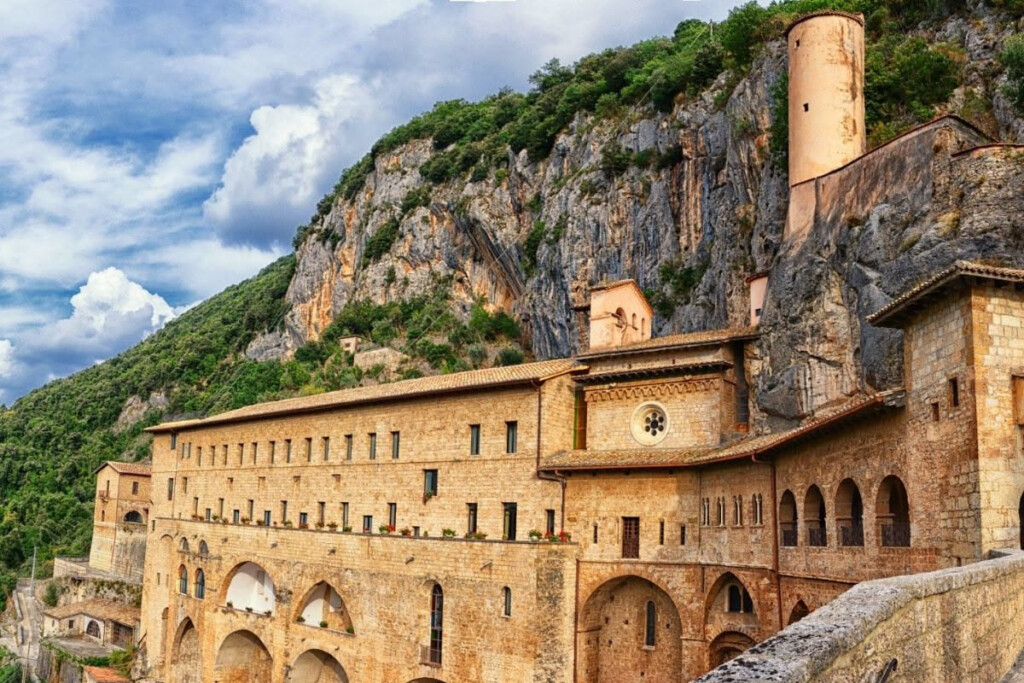
Something shifts in Europe around the middle of the eleventh century that no single explanation fully captures. Stone begins to rise faster than theology can justify it. Between 1050 and 1200, the continent witnesses a construction fever so intense that historians have struggled ever since to decide whether it was primarily a spiritual movement or an economic one, as though the two were ever truly separable in the medieval mind.
The numbers are not metaphorical. By the time Bernard of Clairvaux died in 1153, the Cistercian order alone had established more than 500 houses across Europe, a network that had barely existed when Bernard entered Cîteaux in 1112 as one of thirty companions. He arrived with the declared intention of embracing radical poverty, renouncing the ornamental excess of Cluniac culture, stripping the church of gilded capitals and figured tympana that he denounced, in his Apologia ad Guillelmum of around 1125, as distractions that seduced the eye and corrupted the soul. What followed this declaration of austerity was one of the most aggressive institutional expansions in medieval history.
This is not hypocrisy in the simple sense. It is something more structurally interesting: the way ascetic ideology can function as the most effective possible instrument of territorial consolidation. The Cistercians chose their sites deliberately — marginal lands, valley floors, edges of forests considered agriculturally worthless — and then transformed them through hydraulic engineering, land clearance, and the systematic labor of lay brothers, the conversi, who were not monks in the full canonical sense but workers bound to the community under a simplified rule. By the late twelfth century, houses like Rievaulx in Yorkshire or Clairvaux itself had become centers of wool production, iron smelting, and grain cultivation that rivaled the economic output of secular lordships. The rhetoric of fleeing the world had produced, in practice, an extraordinarily efficient mechanism for reorganizing it.
Georges Duby, in his foundational work on the rural economy of medieval France, was among the first to articulate with precision what the chronicles preferred to obscure: that monastic expansion in this period cannot be understood without understanding the gift economy, the system by which aristocratic families donated lands to religious houses not purely out of piety but as a form of spiritual insurance, social legitimacy, and dynastic memory. An abbey bearing your name, housing prayers for your dead, preserving your family’s cartulary, was a form of power that outlasted any castle. The stone of the cloister was also the stone of inheritance.
A man walks through a half-built nave somewhere in the Burgundian countryside in the 1140s. He is not thinking about posterity as an abstraction. He is watching the walls rise and calculating, in the back of his mind, what this structure will mean for his sons, his creditors, his standing among the other lords who have also been giving land to abbeys and expecting something in return. The theology is real to him. So is everything else. The two do not cancel each other out. They inhabit the same body, the same transaction, the same stone.
This is what gets lost when monastic architecture is framed purely as spiritual expression. The buildings were also legal documents, territorial claims, financial instruments. The Romanesque arch carried weight in more than the structural sense. And the sheer pace of construction between 1050 and 1200 — a pace that left Europe, by some estimates, with more major ecclesiastical buildings per capita than at any point before the industrial age — suggests that something beyond faith was generating the energy. Faith provided the language. Something older, more competitive, and considerably less celestial was providing the mortar.
Light as Theology, Stone as Argument
There is a particular quality of darkness inside a Romanesque nave that you do not forget. Not the darkness of absence, but something denser — a darkness that has weight, that presses against the skin like warm water. The walls are three and four feet thick. The windows are small not from ignorance but from conviction. The stone is not merely holding the roof up. It is making a claim about what it means to stand before God: you are small, matter is heavy, the divine does not arrive easily here.
This was not primitive architecture awaiting correction. It was a fully developed theology rendered in load-bearing walls.
Then sometime in the twelfth century, something breaks open. Not metaphorically. Literally. A man named Suger, abbot of Saint-Denis just north of Paris, begins rebuilding his church and writes about what he is doing with a precision that still feels urgent. He wants light. Not light as decoration or comfort, but light as a philosophical substance. He calls it lux nova — new light — and he means it in the most serious possible sense: that when light pours through colored glass and fills a space, it is not representing the divine but actually participating in it. He draws on the Neoplatonic tradition running from Plotinus through the mystical theology of Pseudo-Dionysius, for whom light was the primary metaphor of emanation, the way the One overflows into the Many. For Suger, the Gothic window is not a hole in a wall. It is an argument about the nature of reality.
The structural consequences of this argument were enormous. To let in light, you must thin the walls. To thin the walls, you must redirect weight. The flying buttress, that strange external skeleton reaching out from Gothic cathedrals like arms bracing against the wind, exists because someone decided that God was best approached through radiance rather than through enclosure. Theology generated engineering.
But there were those who found this deeply dangerous. Bernard of Clairvaux, writing in the 1120s, looked at the ornamental excess of Cluniac monasteries — the carved capitals with their monsters and warriors and hybrid creatures — and asked a question that still cuts: what are these ridiculous monsters doing in the cloisters, where monks are supposed to be reading? His Apologia, addressed to William of Saint-Thierry around 1125, is one of the most precise critiques of aesthetic seduction ever written. Beauty, Bernard argues, does not lead the soul upward. It traps it. It gives the eye something to consume so that the spirit stops moving.
The Cistercian abbeys built under his influence — Fontenay in Burgundy being the most intact surviving example, consecrated in 1147 — are the physical embodiment of this position. Walking into Fontenay is walking into a different theory of the sacred entirely. The nave is plain limestone, unadorned. The windows are clear glass or simple geometric patterns. Nothing competes with silence. The architecture does not perform. It withholds. And in that withholding it makes its own argument: that God is reached not through the senses but through their disciplined suppression.
What is extraordinary is that Suger and Bernard were contemporaries, knew each other, disagreed profoundly, and built their disagreement in stone within decades of each other. One said: flood the body with light and the body will follow the light upward. The other said: starve the body of sensation and the soul, freed from distraction, will find its own way. Both were working on the same problem — how does a material creature approach an immaterial God — and they arrived at architecturally opposite answers.
The thickness of a Romanesque wall and the height of a Gothic vault are not points on an evolutionary timeline. They are competing answers to a question that has not stopped being asked.
The Men Who Disappeared Inside the Walls
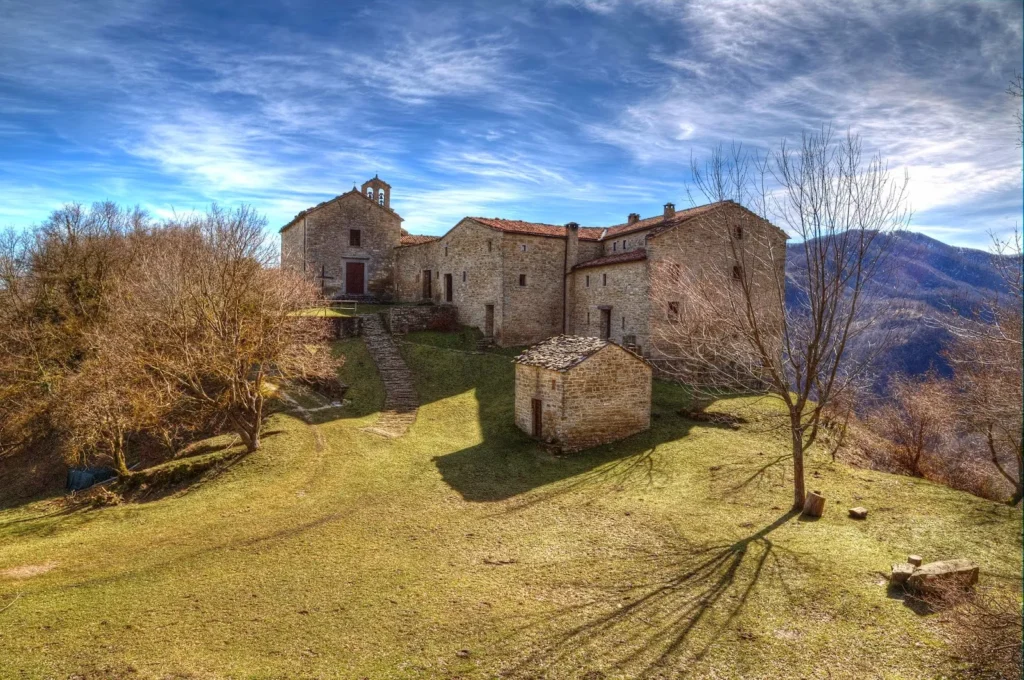
There is a moment — you can see it in the face of any man who has lived long enough inside stone walls — when the boundary between surrender and erasure becomes impossible to locate. Not a dramatic moment. Not a crisis. Just an ordinary afternoon in a courtyard, the same courtyard he has crossed ten thousand times, the light falling at the same angle it fell yesterday and the year before, and something in his expression tells you that he no longer experiences this as repetition. He has moved beyond repetition into something else entirely, something for which the secular world has no adequate word.
This is what enclosure actually produced, over decades, in the bodies and minds of men who entered monasteries young and died inside them old. Not enlightenment in any cinematic sense. Not the beatific serenity that tourist brochures paste over cloister photographs. Something far stranger and more unsettling: the systematic dissolution of the self as a project, undertaken willingly, sustained through architectural pressure, liturgical rhythm, and the slow erasure of any life that might have been otherwise.
Simone Weil called this decreation. She meant it as a mystical ideal — the annihilation of the created ego so that God might act through the vacancy left behind. In her notebooks, collected and published posthumously as “Gravity and Grace” in 1947, she wrote that the self must be destroyed, not mortified or disciplined but genuinely unmade, so that divine reality could occupy the space. She was not describing monasticism specifically, but she was describing exactly what the Rule of Saint Benedict had been engineering since the sixth century: an architecture of self-removal, stone by stone, hour by hour, year by year.
What troubles you when you sit with this long enough is how close Weil’s mystical vocabulary sits to the clinical language of dissociation. The psychologist William James, in “The Varieties of Religious Experience” published in 1902, documented case after case of contemplative practitioners who described their achieved states in terms that a contemporary clinician would flag immediately — depersonalization, the dissolution of the boundary between self and environment, the loss of what he called the “hot place” at the center of experience. James was fascinated rather than alarmed, but he was honest about the ambiguity. He refused to separate the pathological from the sacred as cleanly as the theologians wished.
An old monk moves through a corridor at dawn. He has been walking this corridor for forty years. His hands no longer grip things the way they once did — not from weakness but from a kind of learned release, as if holding has become philosophically untenable. He pauses at a window that looks onto the same garden it has always looked onto. The pause is not contemplative in any demonstrative sense. It is simply what he does now. Whether this is freedom or its opposite is a question the walls do not answer.
The sociologist Erving Goffman, in “Asylums” published in 1961, identified monasteries explicitly alongside prisons and psychiatric institutions as what he termed “total institutions” — environments that systematically strip the individual of prior identity markers, impose uniform time structures, and replace the self’s previous organizing narrative with an institutional one. Goffman was not being provocative for its own sake. He was observing that the mechanisms were structurally identical regardless of whether the person entered voluntarily or under compulsion. The architecture worked the same way on the human animal whether it was called cloister or confinement.
And yet the men who stayed — not those who fled, not those who suffered obvious breakdowns, but the ones who remained and grew old inside — often produced something. Scholarship, illumination, music, theology. As if the decreated self, hollowed of its ordinary ambitions, became oddly productive in the space where ambition used to live. Whether that productivity was the point, or merely the residue of an operation aimed at something else entirely, is the question that the stone courtyards continue to hold without answering.
A vision curated by a filmmaker, not an algorithm
In this video I explain our vision
The Abbey as Economic Empire
You have heard the phrase “vow of poverty” your entire life, and somewhere in the architecture of your assumptions it lodged itself as fact — the monk who owns nothing, wants nothing, has turned his back on the very mechanisms by which the world organizes itself. It is one of the most durable myths Western civilization has ever produced, and it survived precisely because it was so useful to everyone involved.
By the eleventh century, Cluny controlled a network of over a thousand dependent priories stretching from England to Poland. Its abbot commanded more political leverage than most crowned heads of minor kingdoms, received ambassadors, negotiated with popes, and supervised an agricultural estate whose yield in grain, timber, and livestock required an administrative apparatus of considerable sophistication. The vow of poverty applied to individual monks in the sense that no brother could hold personal property. The institution, however, was under no such constraint. Cluny did not renounce the world. It absorbed it.
The economic logic was elegant in its indirection. Because a monk could own nothing personally, everything he touched belonged to the abbey. Every acre ploughed, every fleece sheared, every manuscript copied and sold — the surplus flowed not to any individual but to the corporate body, which faced no theological ceiling on accumulation. The sociologist Max Weber, writing in the early twentieth century, identified this structural feature as one of the preconditions for a certain rationalized approach to economic life in the West, the idea that disciplined, methodical labor oriented toward an institutional good could generate wealth without the sin of personal greed attaching to it. The monastery was, in this reading, an early rehearsal for the logic of the corporation.
Fountains Abbey in Yorkshire illustrates the point with almost uncomfortable clarity. Founded in 1132 by a group of Cistercian reformers who had walked out of a Benedictine house specifically to live in austerity, it became within two centuries one of the largest wool producers in England, supplying Italian merchant houses in Florence and Pisa through advance contracts that functioned, in everything but name, as commodity futures. Cistercian granges — the outlying farms managed by lay brothers called conversi — operated as efficient productive units across thousands of acres, running sheep on the Yorkshire moors in numbers that reshaped the landscape permanently. By the thirteenth century, English Cistercian abbeys collectively supplied roughly a quarter of the country’s wool export, the dominant commodity in European trade.
The manuscript economy was no less material. Scriptoria produced not only liturgical texts for internal use but legal documents, chronicles commissioned by noble patrons, illuminated books sold at prices that could equal the annual wage of a skilled craftsman. Some houses ran what can only be described as banking operations, holding deposits, issuing credit, managing the estates of nobles who died on crusade and left their financial affairs in monastic hands. The historian Lester Little, in his 1978 work Religious Poverty and the Profit Economy in Medieval Europe, traced how the language of spiritual virtue and the language of economic transaction became so thoroughly entangled in this period that separating them is almost analytically impossible.
There is a scene that lodges in memory — a man walking through a vast kitchen, its fireplaces wide enough to roast an ox whole, its vaulted ceiling blackened by centuries of smoke, the scale of it designed not for a handful of contemplatives but for feeding hundreds of laborers, guests, petitioners, and dependents daily. This is not the kitchen of people who have left the world. This is the kitchen of people who are feeding it, managing it, and drawing it into their orbit. The question the architecture asks, if you stand there long enough, is whether renunciation and administration were ever really opposites, or whether one was always the respectable face of the other.
Dissolution, Ruin, and the Aesthetics of Convenient Forgetting
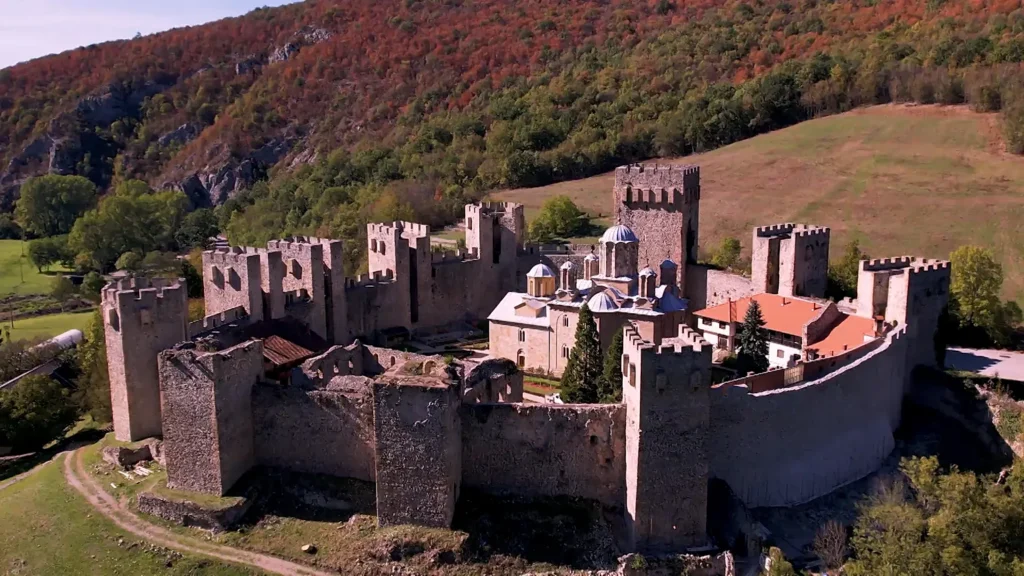
You have stood before a ruined abbey and felt something you might call beauty. The roofless nave open to the sky, the tracery windows holding nothing but light, the stones softened by centuries of moss — and somewhere in you, a pleasurable ache. That feeling has a history, and it is not innocent.
Between 1536 and 1541, Henry VIII’s commissioners moved through England with inventories and writs, and more than eight hundred religious houses ceased to exist as functioning institutions. The Crown seized land worth an estimated £200,000 annually — a figure that represented something close to a third of all English landed wealth outside the nobility. The lead was stripped from roofs first, because lead was immediately convertible to currency. Timber followed. Stone was sold to local landowners as building material, which is why the bones of so many medieval abbeys are scattered across the manor houses and farm walls of the English countryside. What remained standing did so largely because it was too expensive to demolish, not because anyone wished to preserve it.
This was not reformation. It was liquidation. Thomas Cromwell, who administered the process with bureaucratic efficiency that historians have compared to a hostile corporate takeover, distributed the proceeds partly to the Crown and partly to a new class of Protestant gentry whose loyalty was thereby purchased in mortared stone. The sociologist Max Weber, writing in “The Protestant Ethic and the Spirit of Capitalism” in 1905, traced the deep structural relationship between Reformed theology and the accumulation logic of early capitalism. The Dissolution was that logic made violently literal — sacred commons converted overnight into private property, contemplative communities expelled, their libraries burned or dispersed, their centuries of manuscript culture reduced to what John Leland, the King’s antiquary, desperately tried to salvage before the bonfires consumed it.
Then, roughly two centuries later, the ruins became picturesque. William Gilpin published his observations on picturesque beauty in 1782, offering a vocabulary for experiencing broken architecture as aesthetically superior to whole architecture, precisely because incompleteness invited the imagination to complete it. The Romantics followed with ardor. Wordsworth visited Tintern Abbey in 1798 and wrote not about dispossession but about the sublime consolations of time. Constable painted. Turner painted. A ruin that had been produced by an act of state violence became, within two hundred years, a site of private spiritual refreshment for the educated classes.
There is a man examining the broken transept of a dissolved priory, sketching it carefully in a leather notebook, murmuring something about the medieval masons’ genius. He has driven two hours to be there. He feels, genuinely, a connection to the past. And what he is experiencing is real — but it is also the product of a remarkably successful cultural operation in which the evidence of seizure was transformed into the occasion for reverie. The violence was not hidden. It was aestheticized, which is more effective than hiding it, because the aestheticization feels like depth rather than concealment.
The philosopher Walter Benjamin argued in his theses on the philosophy of history, written in 1940, that every document of civilization is simultaneously a document of barbarism. He was not being rhetorical. He meant that the conditions of production of cultural monuments are always entangled with coercion, and that the act of admiring the monument without reading those conditions is a form of complicity, however unconscious. The picturesque ruin is perhaps the most elegant demonstration of his point that Western culture has produced.
What was dissolved was not only a set of buildings but an entire social infrastructure — hospitals, schools, grain stores, pilgrimage networks, systems of poor relief that, however imperfect, had organized rural life for centuries. The people expelled from those institutions largely disappeared from the historical record, which is itself a kind of architectural fact: the record, like the lead, was stripped and sold.
What the Silence Is Actually Saying
You are standing in the nave again, or perhaps you never left. The tour has ended, the guide has moved on, and the other visitors have dispersed toward the gift shop or the car park, and you remain here in the middle of a space that will not release you with the easy courtesy of a museum. The silence has changed texture since you entered. You noticed it as ambient, perhaps even pleasant, something to photograph alongside the vaulted arches. Now it presses differently. It is not the absence of sound. It is the presence of something that does not need to speak.
What you are standing inside is not primarily architecture. It is an argument about the nature of time and attention, built in stone by people who believed that the two great enemies of the human soul were noise and speed. The Benedictine formula of ora et labora — pray and work — was never a schedule. It was a theory of consciousness, a conviction that the self disperses without rhythm, that silence is not empty but structured, that the body placed daily in the same posture before the same altar undergoes a transformation that cannot be willed, only submitted to. And here you are, submitting to nothing, standing in the echo of a submission you cannot quite reconstruct.
There is a kind of person who enters enclosed ancient spaces searching for an experience they cannot name in advance, only recognize in its arrival or its failure to arrive. A man walks through cloistered corridors at a pace that keeps slowing, his footsteps becoming quieter as though he is trying not to disturb something still in residence. He is not religious. He does not know what he came for. He touches the worn stone of a doorframe with one palm, flat, as though taking a pulse, and his face in that moment carries the expression of someone who has just remembered something they were never told. The space has given him nothing except his own reflection, clarified, stripped of the daily noise by which he usually fails to notice himself.
Michel de Certeau, writing in The Mystic Fable in 1982, argued that mysticism arose historically as a response to the fragmentation of a unified Christian world — that it was not escape from history but an attempt to locate within the body and its disciplines what the institutions could no longer guarantee. The monastery, in this reading, is not a retreat from the world but a laboratory for a different relationship with interiority. What de Certeau identified in the sixteenth-century mystics applies with uncomfortable precision to the secular pilgrim of today, who arrives in these spaces not with a theology but with a hunger whose object they prefer to leave undefined.
The hunger is not vague. It is specific and it is old. You want to know what it would feel like to live without the acceleration. You want to know whether the self you carry into every room would survive without the noise that normally confirms it. The monks who built these walls and then lived inside them for decades, sometimes for entire lifetimes, were not performing renunciation. They were testing a hypothesis: that there is something in the human being which ordinary life systematically buries, and that only an architecture of repetition, enclosure, and silence could unearth it. The hypothesis remains untested for most of us because we visit for an hour and leave before the silence finishes its sentence.
A woman sits alone in a side chapel so small it was meant for private confession. No one has come to confess anything for perhaps a century. She is not praying. She is simply sitting still in a space designed for honesty, and the design is working on her whether she consents to it or not, because the stones do not require your belief to do what they were built to do.
🏰 Stone, Faith, and Sacred Architecture
Medieval abbeys and monasteries were not merely places of worship — they were living monuments of art, philosophy, and cultural memory. To fully understand their significance, it helps to explore the broader artistic and architectural currents that shaped the Middle Ages. These related articles offer essential context for anyone fascinated by sacred medieval heritage.
Romanesque Architecture: History and Main Examples
Romanesque architecture forms the visual backbone of many of Europe’s most celebrated abbeys and monastic complexes. This article traces the development of the style, from its heavy stone vaults to its distinctive semicircular arches, exploring iconic examples across the continent. Understanding Romanesque architecture is essential for reading the spatial and spiritual logic embedded in medieval religious buildings.
GO TO THE SELECTION: Romanesque Architecture: History and Main Examples
Romanesque Art: History and Characteristics
Romanesque art emerged alongside the great monastic movements of the early medieval period, becoming deeply intertwined with the spiritual mission of abbeys and convents. This article examines its visual language — symbolic imagery, stylized figures, and devotional iconography — that adorned cloisters, chapels, and illuminated manuscripts. It is a foundational companion to any study of medieval sacred spaces.
GO TO THE SELECTION: Romanesque Art: History and Characteristics
Medieval Art: History and Meaning
Medieval art cannot be separated from the monastic world that produced and preserved it across centuries of European history. This article explores the full sweep of medieval artistic production, from Byzantine influences to Gothic innovations, offering a rich interpretive framework. It illuminates how monks and abbots served as patrons, creators, and custodians of one of history’s most spiritually charged visual traditions.
GO TO THE SELECTION: Medieval Art: History and Meaning
Albertus Magnus: Alchemy and Natural Philosophy
Albertus Magnus was one of the most celebrated scholar-monks of the medieval period, embodying the deep connection between monastic life, natural philosophy, and intellectual inquiry. This article explores his synthesis of Aristotelian thought with Christian theology, a project carried out largely within the walls of Dominican convents and university halls. His work reveals how monasteries functioned not only as houses of prayer but as vital centers of scientific and philosophical culture.
GO TO THE SELECTION: Albertus Magnus: Alchemy and Natural Philosophy
Discover the Spirit of Independent Cinema on Indiecinema
If the interplay of history, art, and sacred thought captivates you, Indiecinema streaming is the place to deepen your journey. Our curated collection of independent and auteur films explores spirituality, architecture, myth, and the hidden currents of human civilization — stories rarely told by mainstream cinema. Join us and let independent cinema open new doors to the past and the present.
👉 EXPLORE THE CATALOG: Watch Indie Films in Streaming
A vision curated by a filmmaker, not an algorithm
In this video I explain our vision

