The Gaze That Does Not Blink
You step into the half-dark and the gold hits you before your eyes have adjusted. Not a warm gold, not the gold of jewelry or of wealth displayed — something older and more unsettling, a gold that seems to generate its own light rather than borrow it from the candles below. And then the face finds you. It does not matter where you stand. It does not matter how you shift your weight or look away and look back. The eyes are already there, already waiting, with a fixity that no living person could sustain without it becoming a threat. You feel, in a way you cannot immediately rationalize, that you have been recognized. Not admired, not welcomed — recognized, in the way a judge recognizes the person standing before them.

This is not a comfortable experience, and it was never meant to be.
We have spent roughly five centuries learning to see Byzantine mosaics incorrectly. The story runs something like this: Greek rationalism produced a certain clarity of form, Rome inherited and amplified it, then something went wrong — the empire fragmented, the barbarians arrived, and the human figure, which had been so confidently rendered in marble and fresco, retreated into flatness and rigidity. The eyes grew too large. The bodies lost their weight. The gold backgrounds swallowed up any illusion of space. And then, mercifully, Giotto arrived in the late thirteenth century, and Masaccio a hundred years after him, and the long embarrassment of the medieval image began its correction toward the Renaissance. This is the standard narrative, and it is almost entirely a story that the Renaissance told about itself.
Ernst Gombrich noted in his 1950 “The Story of Art” that every period constructs its own idea of progress, and in doing so necessarily constructs a prehistory of failure. The Renaissance needed a dark age the way a biography needs a difficult childhood — as evidence that the arrival of genius was both inevitable and hard-won. Byzantine art became that difficult childhood, frozen and symbolic and hieratic, waiting to be liberated by perspective and anatomical correctness. What this framing could not accommodate was the possibility that Byzantine artists were not attempting what Renaissance artists achieved and falling short. They were attempting something else entirely.
The technical mastery alone should have troubled the narrative sooner. The great mosaic cycles of Ravenna, completed in the fifth and sixth centuries — Galla Placidia, Sant’Apollinare in Classe, San Vitale — demonstrate a control of tesserae, of light-angle and color gradation, that required years of specialized knowledge and a tradition of accumulated craft. The mosaicists who set those tiny cubes of glass and stone were not fumbling toward naturalism. They were doing something precise, deliberate, and theoretically grounded in a theology of vision that most modern observers have simply never been introduced to.
The large eyes that disturb you are not a failure of anatomy. They are a statement about what seeing means. In the Neoplatonic and early Christian thought that saturated Byzantine intellectual culture — the thought of Plotinus, of Pseudo-Dionysius the Areopagite, whose “Celestial Hierarchy” from around the late fifth century shaped Orthodox iconographic theory for a millennium — the eyes are the organ of the soul, the site where the divine and the human make contact. To enlarge them is not naivety. It is emphasis. It is the artist pointing at the only thing that matters in an encounter between a mortal and a sacred image.
What you feel standing in that half-dark, that sense of being seen rather than seeing, is not an accident of dim lighting or overactive imagination. It is the intended effect of an art form that understood, with complete sophistication, that the purpose of an image is not to represent reality but to produce a specific transformation in the person who stands before it.
The question is whether you are willing to be transformed, or whether you would simply prefer to call it primitive and walk on.
Gold as Theology, Not Luxury
You stand in front of it long enough and something shifts. Not an intellectual adjustment — something more like a pressure change in the room. The gold does not behave the way gold behaves on jewelry or on a gilded frame around a painting. It does not catch the light. It is the light. And that distinction, small as it sounds, contains an entire metaphysics that Western eyes have largely lost the equipment to read.
The assumption almost everyone carries into a Byzantine mosaic is that the gold is a sign of wealth, of imperial patronage, of the Church flexing its resources in compressed colored glass. It is ornamental excess made sacred by proximity to holy figures. This reading is not simply incomplete. It is precisely inverted. The gold was never background. There is no background in Byzantine mosaic theology. What the gold abolishes, with absolute intention, is the very concept of a world existing behind the sacred image — a world of depth, of atmosphere, of receding space. Roman painting had built that world carefully, obsessively even, in the first and second centuries: the villa frescoes at Pompeii with their illusionistic architecture, their columns opening onto imaginary gardens, the whole apparatus of trompe-l’oeil designed to extend the real room into a fictional one. That tradition understood painting as a window. Byzantine mosaic understood it as a wall — not a barrier but a presence, a surface that does not recede but advances.
The transition happened with remarkable speed once it was decided. By the late fourth century the naturalistic conventions were already dissolving, and by the time the long nave of a basilica in Ravenna was filled with its processions of saints around 500 CE, the transformation was complete. Those figures move across their gold field in a lateral register, each one slightly frontal, slightly flattened, their feet resting on a ground that is more symbolic than gravitational. They are not standing in a place. They are manifesting in a condition.
Pseudo-Dionysius the Areopagite, writing in the late fifth or early sixth century in texts that would shape Christian mystical theology for the next thousand years, articulated what the mosaicists were already doing with their hands. In the Celestial Hierarchy and in the Divine Names, he argues that light is not a metaphor for the divine — it is the closest material approximation of what the divine actually is. God does not illuminate things. God is the only true substance, and everything visible participates in being only insofar as it participates in that light. Darkness is not the absence of light in Pseudo-Dionysius; it is the absence of being. The gold tessera, catching and redistributing the flicker of oil lamps or candles, was doing something liturgically precise: it was rendering the theological claim that there is no neutral space, no empty air, no secular darkness in which the holy figures happen to appear. They appear from light, within light, as expressions of light.
This is why the eyes of Byzantine saints look at you the way they do — not inward as in later Western portraiture, not outward into some depicted world, but directly, flatly, without the psychological depth that Western representation would come to prize above almost everything else. There is no interiority to suggest because the interior and exterior have collapsed. The image is not showing you a person who exists somewhere else and has been captured. The image is the person’s mode of existing in the theological real.
To mistake this for artistic limitation, for a technique not yet sophisticated enough to render depth convincingly, is not merely a historical error. It is the specific error of a culture so committed to the logic of representation — of images as windows, of depth as sincerity, of naturalism as truth — that it cannot recognize a fully developed alternative logic when it stands directly in front of it, blazing.

Frontality as Power, Not Limitation
You know the feeling. You are standing somewhere ordinary — a train platform, a waiting room, the edge of a crowded square — and you become aware, before you can explain why, that someone is watching you. Not glancing. Watching. You turn, and there it is: a face aimed directly at yours, with no apology and no deflection. In that instant the geometry of the space rearranges itself entirely. You were the observer; now you are the observed. The ground beneath your epistemological feet shifts, and something uncomfortably close to accountability moves through you.
This is precisely what happens in front of a Byzantine mosaic, and it is not an accident.
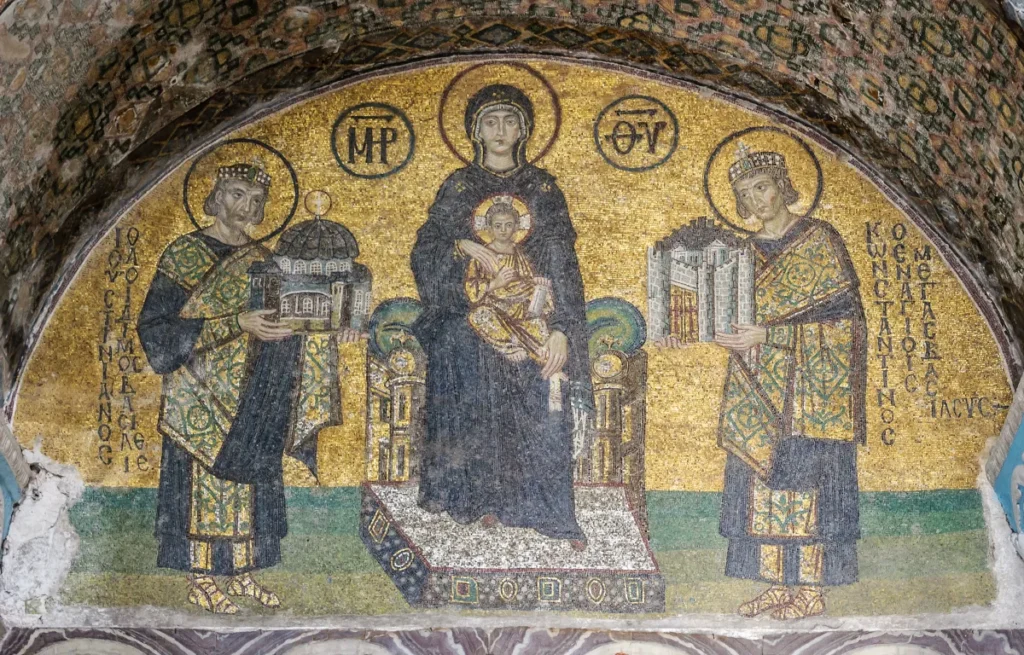
The Christ Pantocrator gazes out from the apse or the dome with eyes that do not track you as you move, because they do not need to. They were already on you before you arrived. The Theotokos holds her child and looks forward with a stillness that has nothing passive in it. These figures do not turn their heads, do not offer you a three-quarter profile that would soften the confrontation, do not recede into atmospheric depth. They are here, in your space, on your side of the wall. Western art criticism, for roughly five centuries, has called this flatness. Has called it stiffness, limitation, the charming but technically deficient product of craftsmen who had not yet learned what Giotto would eventually teach. This reading is not merely wrong. It is a projection of one civilization’s aesthetic theology onto another civilization’s entirely different set of intentions.
Ernst Kitzinger, whose work on early medieval and Byzantine art remains indispensable, was among the first art historians to articulate with scholarly precision what had been dismissed as primitive incapacity. In his analyses of late antique and Byzantine stylization, Kitzinger argued that the progressive dematerialization of the figure — the elongation, the suppression of bodily weight, the ironing out of naturalistic depth — was not regression but a deliberate hieratic language. The word is important: hieratic, meaning sacred, priestly, belonging to a register above ordinary communication. The Byzantine artist was not failing to achieve what Raphael would later achieve. The Byzantine artist was refusing it, because what Raphael’s space offers — a window into a world you observe from the outside, comfortably and safely — was theologically useless. Sacred art in the Byzantine understanding was not representation. It was presence.
Linear perspective, which the Renaissance codified through Brunelleschi’s demonstrations around 1420 and which Alberti theorized in De Pictura in 1435, constructs a space organized around a single human eye. You stand at the apex of a cone of vision; everything recedes toward a vanishing point that your eye controls. You are the sovereign of that pictorial space. The figure inside it exists for your contemplation. Byzantine iconography inverts this arrangement with absolute deliberateness. The vanishing point, if you want to use that language, is behind you. The figure is not receding into the picture; it is advancing out of it. Frontality is not the absence of spatial organization. It is a different spatial organization, one in which the image holds authority and the viewer is the object being assessed.
This is why standing beneath the Pantocrator in the dome of a Byzantine church is nothing like standing before a Renaissance altarpiece. In the altarpiece, you look. In the Byzantine space, you are looked at. The asymmetry is total and intentional. Kitzinger’s insight is that what looks like stylistic limitation is in fact a precision instrument, calibrated to produce exactly this vertigo of reversal. The elongated fingers, the enlarged eyes, the suppression of flesh and shadow — these are not failures of craft. They are the visual grammar of a gaze that claims jurisdiction over the person standing in its field.
That stranger on the platform never looked away either. And you felt it.
Iconoclasm: When the State Decides What God Looks Like
There is a moment, recorded with the precision of a wound in the chronicles of the period, when soldiers climb a ladder in Constantinople in 726 CE and destroy the image of Christ that hangs above the Chalke Gate, the great bronze entrance to the imperial palace. A crowd of women pulls the ladder down. The soldiers fall. Some die. The emperor Leo III has them replaced immediately, and the gate that once bore the face of the divine is left blank. What replaces the image is not nothing. It is a statement about who owns the right to represent God, and therefore the right to represent everything.
This is not a theological dispute. Judith Herrin, in her meticulous excavation of the period in “The Formation of Christendom,” is clear on this point: the iconoclast emperors were not men tormented by scripture. They were men tormented by power and its fragile geometry. Leo III had consolidated his throne against tremendous odds, having survived Arab sieges and internal rebellions, and he understood with the cold lucidity of the self-made ruler that the monastery networks, the bishops, the abbots who controlled the devotional images controlled something more precious than art. They controlled the visual imagination of millions of people. They controlled which faces appeared in the darkness when ordinary people prayed. An emperor who cannot determine what his subjects see when they close their eyes is an emperor on borrowed time.
Constantine V, Leo’s son and the more ferocious engine of what historians call the first period of iconoclasm, understood the arithmetic even more clearly. Between 754 and 775 CE he presided over the Council of Hieria, which declared image veneration heretical, and then systematically dismantled the visual infrastructure of Byzantine devotional life with the efficiency of a man who has understood that belief is not internal, it is environmental. You do not change what people believe by arguing with them. You change what surrounds them. You replace the faces of saints with geometric ornament, with crosses, with imperial imagery. You replace the intimate and particular with the abstract and hierarchical. And then you wait for the next generation, who will have grown up inside a different visual world, and you call that generation orthodox.
There is a scene that refuses to leave the mind once encountered: a man sits before a blank wall where an image once was, running his fingers over the smooth plaster as though reading a text that has been erased. He knows the shape of what was there. His hands remember it. But his children, standing behind him, see only wall. That gap between the man who remembers and the children who do not is precisely what the iconoclast state was manufacturing, deliberately, at scale, across a century.
The violence embedded in this project is rarely named as such, because it does not involve the conventional instruments of violence. But Roland Barthes, writing more than a millennium later in “Mythologies,” identified with uncomfortable precision what happens when a culture decides which images are natural and which are aberrant: the decision itself vanishes, becoming invisible, becoming simply the way things are. The iconoclast emperors were not destroying images. They were establishing a new naturalness, a new default condition of the visual field, and erasing the memory of any alternative. This is among the most sophisticated exercises of power available to any state: not the prohibition of thought, but the prohibition of the images through which thought becomes possible.
The restoration of image veneration in 843 CE, which Byzantines called the Triumph of Orthodoxy, is usually narrated as a theological victory. It was also a territorial one. The monasteries, the women’s communities, the popular devotional networks that had hidden icons under floors and behind walls for generations had held a particular kind of territory: the inner landscape of the imagination. And the state had failed, for once, to take it.
The Mosaic as Accumulated Time
There is something that happens when you watch someone work with their hands for long enough. Not the first few minutes, when you are still observing as a tourist of their effort, cataloguing the movements with the detached curiosity of someone who will leave soon. But after twenty minutes, thirty, when the rhythm has absorbed you and you have stopped counting, you begin to feel something close to grief. Not for yourself. For them. For the fact that what they are making will outlast any memory of the making itself.
The tesserae of a Byzantine mosaic were not pressed into place carelessly. Each small cube of glass, stone, or gold-backed smalti was set at a deliberate, calculated angle — fractionally tilted, sometimes by no more than a few degrees — so that light arriving from a particular window at a particular hour would strike it and return differently than it would an hour later. This was not decoration. It was engineering applied to the sacred, a calibration of matter to time, the slow accumulation of thousands of individual decisions that would eventually disappear entirely into a surface that looks, to the uninitiated eye, effortless. Unified. As if it arrived whole, as if God pressed his thumb into the wall and left an image.
No one who made the great mosaics of Hagia Sophia signed their name. Not one. We know the emperors who commissioned them, the theologians who determined their iconographic programs, the historical moments they were designed to anchor into permanence. We know almost nothing of the hands. Richard Sennett, in his 2008 study of skilled labor and its cultural meaning, argued that the separation between the concept and the execution of a work — the moment when the thinker and the maker become different people — is not a natural development but a historical wound, one that the Western tradition inflicted on itself with particular violence beginning in the Renaissance. The Byzantine workshop would not have understood the question of individual authorship because the question itself would have seemed a kind of spiritual category error, like asking which prayer belongs to which throat.
A workshop producing a major mosaic cycle in the ninth or tenth century operated across years, sometimes across the lifetimes of its members. A craftsman might spend the entirety of his working life setting tesserae into a single apse. He would die before the scaffolding came down. His son might finish what he began, not as inheritance but as continuation, the self dissolving into the collective project with a completeness that modern culture can barely imagine without reaching for words like sacrifice or tragedy. But those words belong to a framework built around the individual as the irreducible unit of meaning, and that framework is precisely what the Byzantine workshop refused, not consciously, not as philosophy, but as practice, as the daily grammar of how work was done.
Sennett’s deeper argument is that the ethics of craft — attention, repetition, the willingness to serve a standard outside the self — carry a kind of knowledge that cannot be fully translated into language or attribution. The gold tesserae set at their angles know something about light that no document records. The mosaic holds the accumulated time of its making in a form that is simultaneously invisible and absolute. You cannot see the hours. You cannot find the hands. What you see is a surface that appears to have no history, only presence.
And that is the cruelest trick of the beautiful thing. It erases its own becoming. It stands before you complete and silent and offers no account of what it cost, who bent over it in the lamplight, whose knees ached, whose eyes failed. It asks you to believe in the eternal precisely by making the temporal disappear, and you do believe it, because the alternative is to stand in the nave of Hagia Sophia and mourn every soul whose name the gold swallowed whole.
A vision curated by a filmmaker, not an algorithm
In this video I explain our vision
Iconography as a Grammar No One Taught You
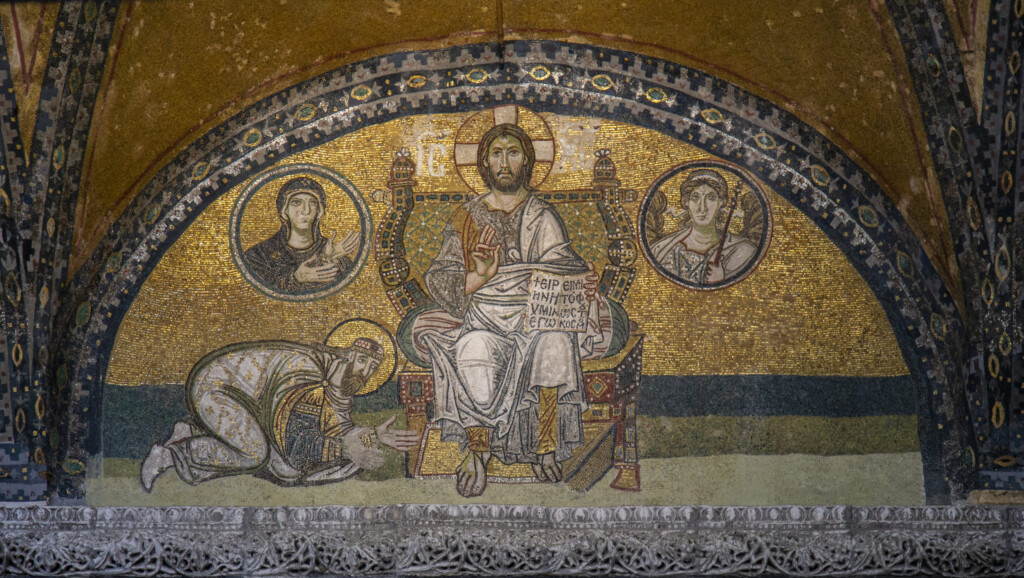
You have been reading this image your entire life without knowing how to read. The figure at the center of the dome — hands raised, gaze fixed slightly past your left shoulder, drapery falling in those precise geometric folds — you have processed it, filed it, moved on. You assumed understanding. You assumed the image was simply there, the way a photograph is simply there, recording something that happened. But nothing in that image is accidental, and nothing is illustrative. Every element is a statement in a language whose grammar was codified over centuries, debated in councils, and defended — sometimes at the cost of mutilation or exile — as the difference between truth and its counterfeit.
The red inner garment beneath the blue mantle is not a color choice. Red, in this visual grammar, carries the weight of divinity made flesh — the body, blood, the material entry into human time. The blue draped over it signals the divine nature that precedes and exceeds the incarnation. The two together are a theological argument worn on a body, a claim about the double nature of Christ that the Council of Chalcedon formalized in 451 AD and that painters were then obliged to render visible, consistently, across centuries and continents. A deviation from this arrangement was not an artistic decision. It was a heresy.
The gold of the background is not decorative. Gold, in Byzantine visual theology, is the color of uncreated light — the light that precedes the sun, that belongs to no earthly optics. When Kurt Weitzmann, in his foundational scholarship on the transmission of iconographic types, traced the survival of specific compositional formulas from late antiquity through Byzantine workshops and into medieval Western production, he was documenting something that functioned less like artistic influence and more like a syntactic chain. The same gesture of the blessing hand — thumb touching the ring finger to form the Greek letters IC XC, the abbreviated name of Christ — appears with such consistency across geographic and temporal distance that its transmission resembles not inspiration but dictation. The elongated fingers, the asymmetric eyes, the slight torsion of the neck: these are not stylizations in the modern sense, not the imposition of a personal aesthetic. They are the deliberate refusal of naturalism, the insistence that what you are looking at is not a man who resembles Christ but a presence that participates in him.
Charles Peirce, in his tripartite semiotic structure, distinguished between the icon, which resembles what it represents; the index, which points to its referent like smoke points to fire; and the symbol, which relates to its meaning purely by convention. Byzantine image theory — articulated most sharply in the writings of Theodore of Studion and John of Damascus — refused all three categories as sufficient. The icon was understood as something stranger: not a likeness, not a pointer, not a convention, but a participation in the prototype. To venerate the image was to venerate what it made present. The image did not illustrate a story. It was an event.
This is where the unsettlement begins to have a sharper edge than art history can contain. Because if a visual language this precise can operate for centuries on millions of viewers who never received formal instruction in its grammar, absorbing its claims about divine nature, human hierarchy, and the structure of sacred space without ever choosing to learn it — then the question that opens beneath you is not really about Byzantium. You have been read by images your entire life. The advertisements that shaped your sense of desirability in adolescence had their own red-and-blue logic, their own gold-ground conventions, their own precise syntax for which bodies occupy the center of the frame and which are cropped to its edges. You did not choose to learn that grammar either. You simply became fluent in it, the way children become fluent in shame.
Ravenna, Constantinople, Palermo: The Geography of the Absolute
There is a particular quality of light inside San Vitale in Ravenna that has nothing to do with the sun. The windows are narrow, the walls thick, and yet the interior seems to generate its own luminescence, as though the gold tessera embedded in the vault above you are not reflecting anything but producing it from within. You stand there, in the middle of a city in northern Italy that most tourists pass through in an afternoon, and what surrounds you is not Western art. It is something older, stranger, and far more certain of itself than anything the Latin tradition would produce for the next seven centuries.
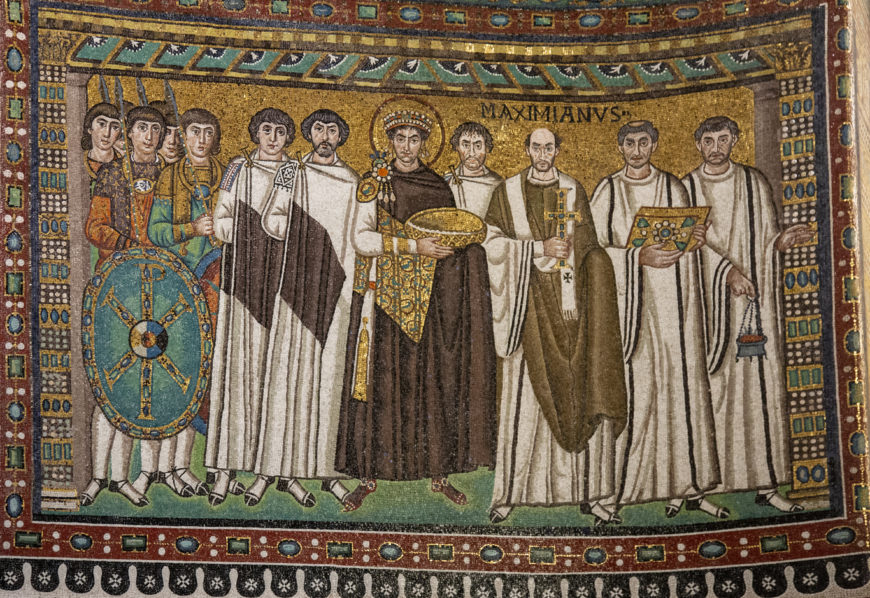
Ravenna became what it became by accident. When the Western imperial court relocated there in 402 CE, seeking the protection of its marshlands, it became simultaneously a provincial backwater and a conduit for the most sophisticated visual culture in the Mediterranean world. The mosaics executed under Theodoric’s Ostrogothic patronage and then under the direct commission of Justinian’s imperial representatives in the 540s are not decorations. They are constitutional documents. The famous apse panel showing Justinian and his court — the emperor positioned exactly at the center, haloed, holding the eucharistic paten, flanked by soldiers on his left and clergy on his right — is a diagram of a theological and political order so fused that to separate the sacred from the imperial becomes a category error. Justinian does not attend the liturgy. He is part of it. His authority does not derive from God as an external source; it is continuous with divine order, made visible through the same visual grammar that renders Christ pantocratic on the vault above.
This is the grammar that crossed water and survived time. When Justinian commissioned the reconstruction of Hagia Sophia after the Nika riots destroyed its predecessor in 532, he created not merely a building but a cosmological argument made of brick and light and gold. The dome that rises above the nave appears to float, suspended by the ring of windows at its base, and the effect — described by Procopius of Caesarea in his treatise De Aedificiis as a dome suspended from heaven by a golden chain — was not metaphor but phenomenological fact. You stood beneath it and felt the ground and the sky lose their fixed relationship. Gravity became uncertain. The mosaics that were added, modified, and partially destroyed across the following centuries were not supplementary to this experience; they completed it. The figures that remained after the iconoclast interventions, after the Latin occupation of 1204, after the Ottoman conversion of 1453, are fragments of a total environment designed to dissolve the boundary between the visible and the invisible. What survives is partial. What it implies is total.
The Norman kings of Sicily understood this implication better than anyone who claimed direct Roman lineage. When Roger II commissioned the Cappella Palatina in Palermo in the 1140s, he was not borrowing a foreign style as decoration. He was deploying Byzantine visual authority to make a political claim legible across multiple cultural languages simultaneously. The chapel’s mosaics speak Greek and Latin and Arabic in the same breath — the Christ Pantocrator in the apse follows iconographic protocols established in Constantinople, while the muqarnas ceiling above the nave speaks to the Islamic craftsmen who built it, and the Latin inscriptions anchor the entire ensemble to Roman ecclesiastical legitimacy. Roger appears in the mosaics receiving his crown directly from Christ, bypassing papal intermediary, mimicking exactly the logic Justinian had made visible in Ravenna six centuries earlier.
What Europe calls its sacred visual tradition is, in its most formative expressions, a translation from Greek. The gold ground, the frontal gaze, the hierarchical scaling of figures, the deliberate suppression of shadow and depth — none of this is Western invention. It arrived from the East, was absorbed without acknowledgment, and was subsequently claimed as native. The Byzantine visual language did not influence European sacred art. It constituted it, and then watched from the margins while its authorship was quietly reassigned.
What We Call Primitive Is What We Cannot Control
There they are again — those eyes. Flat, frontal, unblinking, ringed in gold so dense it seems to generate its own light rather than reflect anyone else’s. You have been standing in front of them for longer than you intended, and something uncomfortable has settled in your chest, the specific discomfort of being looked at by something that does not need your approval to exist.
The standard art historical verdict on this experience is well known. Byzantine art, we are told, is hieratic, rigid, pre-Renaissance, a long waiting room before the real party begins somewhere around 1400 in Florence. The figures do not move naturally. The space is not convincing. The bodies lack anatomical interest. What is implied, always, beneath this taxonomy of deficiencies, is that the Byzantines simply did not yet know how to do what Masaccio would eventually do — that their flatness was a technical failure rather than a philosophical position. This verdict is so thoroughly absorbed into Western aesthetic education that it barely registers as an argument anymore. It presents itself as a fact, the way the most effective ideological positions always do.
But consider what Erwin Panofsky demonstrated, with uncomfortable precision, in his 1927 essay on perspective as symbolic form: that the Renaissance invention of linear perspective was not a discovery of how reality actually looks. It was the construction of a particular philosophical claim about who sits at the center of reality. The vanishing point is not a neutral geometric device. It is a declaration — that all lines of sight converge toward a single human eye, that the measurable, the visible, and the real are coextensive, that the universe organizes itself around the act of human perception. This was not progress. It was a coup. A slow, beautiful, devastating coup conducted in oil and fresco, and we have been living inside its assumptions ever since, so thoroughly that we mistake them for the laws of vision itself.
The Byzantine image works from an entirely opposite premise. Giorgio Agamben, in his thinking on the image as gesture, makes a distinction that cuts to the heart of this: there are images that represent and images that act, images that show you something and images that do something to you. The icon does not represent the divine. It does not illustrate a theological proposition for those who cannot read. It is a site of presence, a threshold, a claim made on the body of the person standing before it. The gold ground is not a decorative choice or a failure to render convincing atmospheric depth. It is the deliberate abolition of the spatial logic that would place you, the viewer, in command. There is no recession into distance, no vanishing point organizing the scene around your eye, no invitation to feel yourself as the stable center from which meaning radiates outward. The gaze comes toward you. It does not wait to be perceived. It perceives.
What we call primitive is almost always what we cannot control. The label arrives precisely when something refuses to organize itself around our comfort, our categories, our assumption that we are the ones doing the looking. The Western dismissal of Byzantine art as a phase to be outgrown is a defense mechanism, and not a particularly subtle one — it is the response of a tradition that built its entire self-image on the sovereignty of the human eye encountering a form that was never interested in that sovereignty, that predates it by centuries and has survived every attempt to render it quaint.
You are still standing in front of the mosaic. The gold is still generating its impossible light. Those eyes have not moved, have not softened, have not offered you the mercy of looking away first — and neither, you realize, have you.
✨ Sacred Art, Symbol, and the Medieval Spirit
Byzantine mosaics did not emerge in isolation — they were born from a vast world of medieval devotion, iconographic tradition, and sacred craftsmanship. These related articles trace the deeper currents of meaning that flowed through the art and architecture of the Middle Ages, revealing how image, stone, and symbol were woven together into a single spiritual language.
Medieval Art: History and Meaning
Medieval art is not merely a precursor to the Renaissance but a rich tradition in its own right, saturated with theological meaning and symbolic intent. Understanding its history and interpretive frameworks provides essential context for reading Byzantine mosaics, which shared the same visual vocabulary of divine hierarchy and sacred narrative. This article offers a foundational guide to the spiritual logic that governed image-making throughout the medieval world.
GO TO THE SELECTION: Medieval Art: History and Meaning
Medieval Sculpture: History and Iconography
Medieval sculpture, like Byzantine mosaic, was never purely decorative — every figure, gesture, and composition carried precise iconographic weight. This article explores how sculptors encoded theological ideas into stone, following conventions strikingly parallel to those that governed the mosaic workshops of Constantinople and Ravenna. Reading it alongside Byzantine iconography deepens our appreciation of the shared visual grammar of medieval Christian art.
GO TO THE SELECTION: Medieval Sculpture: History and Iconography
Gothic Cathedrals: History and Symbolism
Gothic cathedrals represent one of the most ambitious attempts to transform architecture itself into sacred scripture, where light, stone, and image collaborate to express the divine. Their symbolic programs — saints, narratives, and hierarchies rendered in glass and sculpture — echo the iconographic ambitions of Byzantine mosaic traditions. This article illuminates how medieval Christian culture consistently sought to make the invisible visible through monumental art.
GO TO THE SELECTION: Gothic Cathedrals: History and Symbolism
Romanesque Art: History and Characteristics
Romanesque art developed in the centuries that immediately preceded the Gothic and was deeply intertwined with the same theological and iconographic impulses that defined Byzantine visual culture. Its characteristic hieratic figures, symbolic compositions, and narrative cycles reveal a Europe-wide conversation about how sacred images should function in worship and instruction. This article charts the history and distinctive characteristics of a tradition that stood at the crossroads of Eastern and Western Christian art.
GO TO THE SELECTION: Romanesque Art: History and Characteristics
Discover the Art of Independent Vision on Indiecinema
Just as Byzantine mosaics invite us to slow down and look more deeply, independent cinema rewards those who seek meaning beyond the surface. On Indiecinema streaming you will find a carefully curated selection of films that explore history, spirituality, and the power of the image — join us and discover a world of stories that endure.
👉 EXPLORE THE CATALOG: Watch Indie Films in Streaming
A vision curated by a filmmaker, not an algorithm
In this video I explain our vision