
The Felt Room and the Expanded Definition
You walk into a room and the air is wrong. Not wrong in the way of a broken ventilator or a forgotten lunch — wrong in the way of a changed pressure, as if the space has been breathing without you and resents the interruption. The walls are lined with felt, thick industrial rolls of it, the kind used to insulate pipes against catastrophic cold. In the corner, a wedge of fat sits hardening in the crease where floor meets wall, yellow-grey and waxy, catching no light because felt absorbs light the way debt absorbs years. There is no label explaining what you are supposed to feel. There is no comfort object, no orientation point, no curated pathway guiding your gaze toward the intended meaning. You are simply inside something that was made without you in mind, and that fact — the fact that this was not assembled for your reassurance — is precisely what begins to work on you.

Joseph Beuys built these environments not to display objects but to alter the conditions under which a human being processes reality. The fat was not symbolic of fat. The felt was not a metaphor for warmth. Both materials had a biographical charge: Beuys had claimed, in the story he repeated with the deliberate rhythm of a man who knows a myth requires repetition, that Tartar tribesmen wrapped his crashed body in animal fat and felt after a 1944 plane wreck on the Crimean steppe, restoring his warmth and therefore his life. Whether the story is literally true is less interesting than what it reveals about his method — he understood that materials carry memory, that they arrive in a room already weighted with prior events, and that this weight is transferable to whoever enters. He was not decorating space. He was engineering an encounter between a living body and substances that had already survived something.
In 1973, working through the Free International University he had helped found in Düsseldorf, Beuys articulated the claim that would make him either visionary or insufferable depending on who was listening: every human being is an artist. The statement was not an invitation to pick up a paintbrush. It was a structural assertion, closer to a political theorem than a romantic encouragement. What he meant — and the distinction matters enormously — is that the capacity to shape, to give form, to impose intention on raw material is not the exclusive property of trained practitioners working in sanctioned institutions. It is a faculty distributed across the entire species, expressed in how a mother organizes the emotional life of a household, how a farmer reads weather, how a steelworker negotiates the resistance of metal. Creativity, in Beuys’s formulation, is not an aesthetic category. It is an anthropological one.
This is where he diverges from every prior attempt to democratize art. The Romantic tradition, from Schiller’s 1795 Letters on the Aesthetic Education of Man forward, had argued for art’s civilizing power — but always as something produced by exceptional individuals and received by the broader population. Even the Bauhaus, with its ambitions to dissolve the boundary between fine art and functional craft, still operated within the logic of the institution, the curriculum, the certificated competence. Beuys was proposing something more destabilizing: that the division between artist and non-artist was itself a political construction, a way of concentrating symbolic authority in a credentialed class while convincing everyone else that their own formative activities — the way they raise children, organize neighborhoods, resist or submit to power — were not acts of authorship but merely acts of living.
The felt room does not illustrate this argument. It performs it, by placing you inside a space where your discomfort is the medium and your response is the work.
Sculpture as Political Ontology
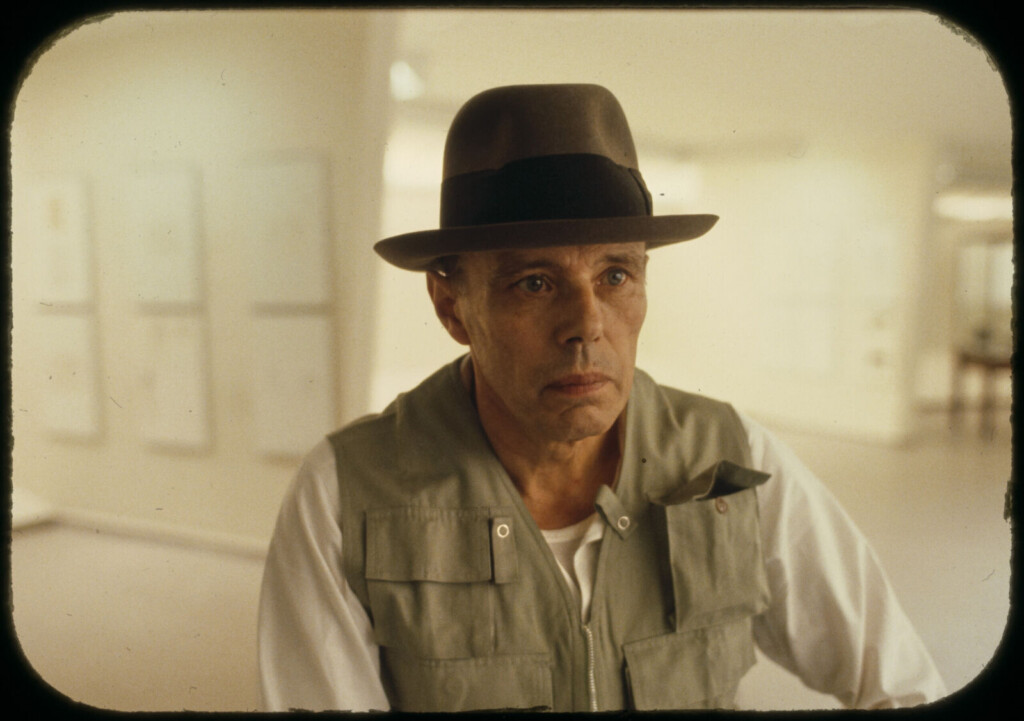
You are sitting in a room that has not yet decided what it is. The walls hold neither paintings nor slogans. The people around you are arguing about land reform, about grain prices, about who gets to speak at the next municipal meeting. This is not a gallery. This is not a parliament. Joseph Beuys would have told you it is both, and that your inability to separate those two facts is precisely the problem he spent his life diagnosing.
When Beuys co-founded the Free International University for Creativity and Interdisciplinary Research in 1974 alongside Heinrich Böll and others, he was not building an institution in any recognizable sense. He was enacting a claim: that the organization of human attention, the structuring of collective thought, the very architecture of how people deliberate together — these are sculptural acts. Soziale Plastik, Social Sculpture, was never a metaphor for politics. It was an ontological assertion that form-giving and world-making are the same gesture performed at different scales. The artist who shapes clay and the citizen who shapes a constitution are exercising an identical faculty, one that industrial modernity had systematically divided, professionalized, and then quietly abolished in most people.
Hannah Arendt arrived at a structurally identical wound by a different road. In The Human Condition, published in 1958, she distinguished between labor, work, and action — and located the catastrophe of modern political life in the slow colonization of the public realm by the logic of process, administration, and biological necessity. What she called “the space of appearance,” that fragile, luminous zone where human beings reveal themselves to one another through speech and deed, had been progressively enclosed by bureaucratic management, by what she named “rule by nobody,” a system so diffuse that no individual hand could be held responsible for its violences. The public realm, for Arendt, was not a place you went to exercise power. It was the only condition under which genuine human plurality — the irreducible distinctness of each person — could become visible and therefore real.
Beuys had never read Arendt systematically, or at least left no evidence that he had. The convergence is therefore more unsettling than an intellectual debt would be. Both were responding to the same historical trauma — the total mobilization of European societies in the first half of the twentieth century, the reduction of human beings to biological material, to labor units, to statistical populations — and both concluded that the repair could not happen through better policy alone. The form of collective life had to change before its content could mean anything. You cannot pass just laws inside an unjust architecture of attention.
What makes Beuys dangerous even now, decades after his death in 1986, is that he located this sculptural capacity not in specialists but in everyone. Every human being is an artist, he insisted — a statement almost always quoted in a way that domesticates it, turns it into an encouragement, a motivational slogan. Strip away the comfort and what remains is a radical redistribution of ontological responsibility. If every person is capable of giving form to social reality, then the passivity of democratic spectatorship — the act of watching politics happen to you while professionals manage the outcome — becomes not just a political failure but a kind of self-mutilation. You have amputated the very faculty that would make you real in the public sense Arendt described.
The Free International University never became what its founders imagined. It ran workshops, published documents, attracted thinkers from across disciplines, and then slowly dissolved into the friction of underfunding and ideological disagreement. But its failure to institutionalize is almost irrelevant to its argument, because Beuys was not trying to build something permanent.

The Myth of the Passive Citizen
You already know the layout of the room: white walls, polished concrete, a single object on a plinth, and the unspoken instruction — issued by no one and enforced by everyone — that you are here to receive. The silence is not natural. It was engineered over roughly two centuries, and the engineering was precise enough that most people who enter that room feel, somewhere beneath their sternum, a faint guilt at not understanding, as if the failure were theirs alone.
Immanuel Kant‘s 1790 Critique of Judgment introduced a distinction that would quietly become a social policy. Beauty, he argued, must be experienced with disinterest — detached from personal desire, utility, or consequence. The aesthetic response was to be pure, untouched by the contamination of wanting something from what you were looking at. The argument had genuine philosophical ambition, but its institutional translation was brutal: it sorted humanity into two camps, those capable of disinterested contemplation and those still too entangled in need and appetite to ascend to genuine aesthetic experience. The poor, by structural definition, could never fully qualify.
What followed was not an accident. The nineteenth century constructed the modern museum as a civic temple precisely when European industrial economies needed populations who could tolerate a very specific relationship to production — they made things, other people owned them, and the gap between making and owning was to be accepted, aestheticized, and eventually celebrated. The 1851 Great Exhibition at Crystal Palace did not simply display objects; it trained an emerging mass public to gaze at the fruits of their own collective labor as if those fruits belonged to a separate, elevated world. Looking became the permitted form of relationship with what one had made.
By the time the white cube gallery codified itself as the dominant exhibition format across the twentieth century — a term the critic Brian O’Doherty examined with surgical precision in his 1976 essays collected as Inside the White Cube — the separation between art and daily existence had achieved near-total institutional authority. The white cube was not neutral space. It was an argument made in architecture: that meaning flows in one direction only, from the sanctioned object outward toward the receptive viewer, who contributes nothing to what the work means and is not expected to. Viewers were trained, systematically and across generations, to distrust their own interpretive instinct. The phrase “I don’t know much about art but I know what I like” became a confession of inadequacy rather than what it actually is — a person accurately describing how aesthetic experience functions for every human being who has ever lived.
Pierre Bourdieu spent a considerable portion of his career documenting the social machinery underneath this trained inadequacy. In Distinction, published in 1979, he demonstrated through empirical survey data across French society that aesthetic taste correlates not with sensitivity or intelligence but with accumulated cultural capital — itself a function of class inheritance. The person who stands comfortably in the white cube, nodding with practiced recognition, is not more perceptive. They have simply been socialized into the performance of perceptiveness, and that performance serves a function: it marks a boundary, and the boundary protects something. What it protects is the authority to define what counts as meaningful, transformative, worthy of preservation and institutional support.
A population that believes meaning is produced by specialists and received by audiences will also, with notable consistency, believe that politics is produced by politicians and received by citizens, that economics is managed by experts and experienced by workers, that history is made by great figures and inhabited by everyone else. The partition runs through every room.
Capital as Invisible Sculpture

You are standing in Kassel in 1982, watching a man plant a tree next to a stone, and you cannot quite decide if you are witnessing an act of faith or an act of argument, and perhaps that is precisely the point, because the distinction Beuys refused to honor was the one that kept art safely decorative and politics safely ugly.
The operation he launched at Documenta 7 was disarmingly literal: 7,000 oak saplings, each paired with a basalt stele roughly the height of a human torso, to be planted across the city of Kassel over the following five years. The first stone came from a pyramid of 7,000 basalt columns that Beuys had piled in front of the Fridericianum museum like a deliberate affront to the clean lines of institutional space. Each pair — tree and stone — functioned as what he called a unit of social measurement, a way of making visible the metabolic relationship between a living system and an inert one, between growth that takes time and matter that simply endures. The project was not completed during his lifetime; he died in January 1986, and the final oak was planted by his son Wenzel later that year. Duration was built into the structure of the work, which meant that grieving and completion were not separable events.
What made 7,000 Oaks philosophically precise rather than merely poetic was its insistence on the material trace as an argument. Rudolf Steiner, whose anthroposophical thinking shaped much of Beuys’s cosmology, had proposed that thinking itself was a form of action in the world, not a private mental event but a force with consequences in matter. Beuys took this further by reversing the direction: if thought could shape matter, then matter could be arranged to shape thought. The basalt stone does not symbolize permanence — it enacts it. The oak does not represent ecological consciousness — it performs it at a timescale that outlasts any single viewer’s attention. The work demands that you return, which means it refuses the single consuming glance that the art market had trained people to offer.
And here is where the argument cuts deepest, because the same invisible sculpting that Beuys tried to make legible through trees and stones is operating continuously on every city that never planted anything, never paired growth with endurance, never asked what its organizing material logic was doing to the bodies moving through it. Capital shapes urban space the way an artist shapes clay — with intention, with aesthetic preferences, with a theory of what human beings are for — but it does this without ever submitting to the judgment that aesthetic acts invite. Glass towers that narrow natural light to the pedestrians below are sculpting attention and mood as surely as any installation, but because they are called development rather than art, they escape the accountability that comes with calling something a choice. Georges Perec noted in 1974, in Species of Spaces, that we do not know how to name what surrounds us precisely because it surrounds us completely — the frame is invisible when you are inside it.
The advertising hoarding that replaces a park bench, the food desert that a rezoning decision produces, the attention economy that fragments concentration into units too small for sustained thought — these are aesthetic decisions wearing the costume of economic necessity, and the costume works because we have agreed, collectively and without much examination, that beauty is what hangs in galleries while function is what happens everywhere else. Beuys understood that this agreement was itself a sculpture, and that someone had made it.
Creativity as Misappropriated Territory
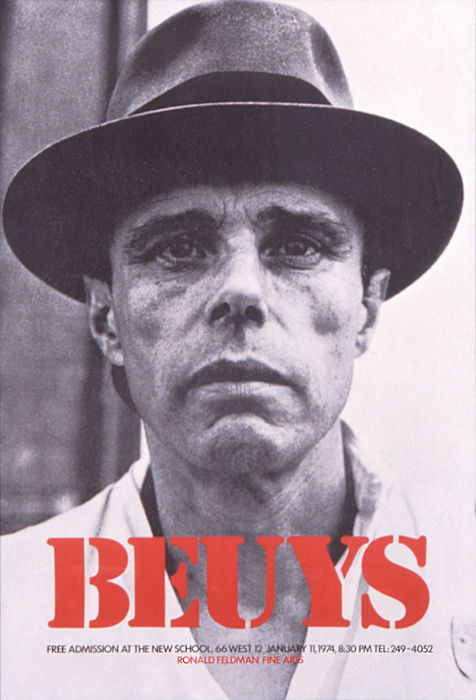
You have heard it so many times that it no longer registers as a claim: the idea that creativity is the defining human capacity, that it must be unleashed, that organizations must foster it, that cities must attract it, that economies must be built around it. The sentence sounds emancipatory. It is, in fact, a sorting mechanism.
When Richard Florida published The Rise of the Creative Class in 2002, he did something precise and consequential: he took the argument that every human being is inherently creative — an argument with deep roots in postwar artistic radicalism — and reattached it to a sociological category defined by exclusion. The creative class, in Florida’s taxonomy, comprises roughly 30 percent of the American workforce: scientists, engineers, architects, designers, educators, artists, entertainers. The remaining 70 percent — service workers, manufacturing laborers, the people who clean the buildings where creativity happens — are not members of this class. They exist to support its conditions. The democratic promise, the idea that creativity is not a gift distributed to a talented few but a fundamental dimension of being human, was absorbed into the new framework and then quietly revoked at the threshold of usefulness.
What made this absorption so effective was its sincerity. Florida was not cynical. He genuinely believed that cultivating creative environments would produce more just and vibrant cities. But the infrastructure his thesis helped construct — the creative districts, the innovation hubs, the artist-led gentrification cycles documented with painful clarity in Sharon Zukin’s Naked City from 2010 — consistently produced the same result: the displacement of economically precarious communities to make room for the creative economy’s preferred human type. The artist, who was supposed to embody a challenge to commodity logic, became the advance scout for rising real estate values. Galleries arrived. Rents followed. The original residents left.
There is something almost surgical about how institutions process radical propositions. The language survives; the force is neutralized. Museums began commissioning participatory works, collaborative projects, socially engaged practices — entire curatorial frameworks built around the vocabulary of dissolving the boundary between art and life. What they produced instead was a new genre: socially engaged art, legible, fundable, exhibitable, and contained within precisely the institutional walls it claimed to exceed. The Whitney Biennial, the Venice Biennale, Documenta itself — the same exhibition complex that once provided a platform for genuinely disruptive work — became the consecrating apparatus for a version of political art that required no political transformation from its audience, only their presence and their attention.
The deeper irony is structural. An idea powerful enough to challenge an institution will, if it survives long enough, become one. The process is not corruption in the moral sense; it is something more like gravitational pull. Any proposition that gains sufficient traction generates an economy of interpretation, a class of specialists, a set of gatekeeping functions, a canon. By the time a challenge to the art world becomes the subject of retrospectives, monographs, and university syllabi, it has already been metabolized into the system it opposed. The provocation does not disappear — it becomes a reference point, which is a different thing entirely: a coordinate inside the map rather than a pressure against the map’s edges.
What remains is not nothing. The original argument — that every human being participates in shaping the social world and bears responsibility for its form — retains its precision regardless of what has been done with it since. But it now exists in a condition of almost complete institutional capture, cited in corporate innovation workshops and curatorial statements with equal fluency, stripped of the specific political demand it once carried: not that creativity be recognized, but that the structures deciding whose creativity counts be fundamentally dismantled.
A vision curated by a filmmaker, not an algorithm
In this video I explain our vision
🌍 When Art Becomes a Force for Social Change
Joseph Beuys believed that every human being is an artist and that creativity itself is the foundation of a transformed society. His concept of Social Sculpture invites us to reconsider art not as an object but as a living process that shapes the world. These related articles explore the philosophical, sociological, and artistic territories that surround this radical vision.
Contemporary Sculpture: History and Protagonists
Contemporary sculpture has evolved far beyond stone and bronze, embracing installation, performance, and social engagement as legitimate artistic languages. The journey from Rodin to Koons, passing through Beuys himself, reveals how sculpture increasingly questions the boundaries between art, politics, and everyday life. Understanding this history is essential to grasping why Social Sculpture remains one of the most influential ideas in twentieth-century art.
GO TO THE SELECTION: Contemporary Sculpture: History and Protagonists
The Artistic Community: History and Sociology of Collective Creativity
The idea that art can be created collectively rather than by a solitary genius is central both to Beuys’s thinking and to the sociology of artistic communities. From Renaissance workshops to contemporary collectives, creative communities have always negotiated the tension between individual vision and shared purpose. This article examines how collective creativity functions as a cultural and sociological phenomenon with genuine transformative power.
GO TO THE SELECTION: The Artistic Community: History and Sociology of Collective Creativity
Healing Through Art: History and Theory
Healing through art is one of the most direct expressions of the conviction that creativity can change reality, not merely represent it. From art therapy to community muralism, the therapeutic and social dimensions of artistic practice echo Beuys’s belief that making art is an act of social responsibility. This article traces the history and theory behind art’s capacity to repair both individuals and communities.
GO TO THE SELECTION: Healing Through Art: History and Theory
Pierre Bourdieu and the Artistic Field
Pierre Bourdieu‘s analysis of the artistic field reveals how power, capital, and distinction operate invisibly within the world of art and culture. His sociological framework helps us understand the institutional resistance that visionaries like Beuys encountered when they proposed to dissolve the boundaries between art and life. Reading Bourdieu alongside Beuys offers a critical lens on the politics embedded in every artistic gesture.
GO TO THE SELECTION: Pierre Bourdieu and the Artistic Field
Discover the Cinema That Transforms the World on Indiecinema
If Beuys’s vision of art as a force capable of reshaping society resonates with you, Indiecinema is the streaming platform where that spirit lives on in moving images. Explore a curated selection of independent and avant-garde films that challenge, provoke, and inspire — because cinema, too, can be a form of Social Sculpture.
👉 EXPLORE THE CATALOG: Watch Indie Films in Streaming
A vision curated by a filmmaker, not an algorithm
In this video I explain our vision

