
The Morning You Stopped Believing in Progress
You wake up and everything works. The coffee machine runs its cycle with the quiet competence of something that has never once failed you, the news loads before you have finished the first sip, the city below the window is already in motion — buses on schedule, glass towers catching the early light at exactly the angle the architects intended. There is nothing wrong. That is precisely the problem. There is nothing wrong and yet you stand there in the kitchen with a feeling you cannot name, a sensation that sits just below language, something closer to a smell than a thought: the smell of lateness. Not tiredness. Not pessimism. Lateness. The specific quality of an hour that has already passed without anyone announcing it.

You have felt this before without knowing what to call it. At some large, well-organized gathering where the food is plentiful and the music well-chosen and yet when you arrive you sense immediately, instinctively, the way you sense a change in weather through the skin, that the real moment of that evening happened an hour ago in a smaller room with fewer people and you were not there for it. Everything that follows will be perfectly pleasant and absolutely secondary. The party has not ended. It has simply crested. And no one will say so.
Oswald Spengler spent the years between 1911 and 1917 writing a book that begins, essentially, with that feeling taken seriously as a philosophical category. The Decline of the West, published in its first volume in 1918 in Vienna, was not received as the meditation on cultural mortality it actually was. It was received as prophecy, as provocation, as the intellectual detonation of a civilization in the middle of detonating itself. The timing was not incidental. Spengler understood timing as a fundamental dimension of historical truth. Cultures, he argued, are not accumulations of achievements that can be indefinitely extended through better policy, more education, superior technology. They are organisms. They are born from a specific landscape, a specific metaphysical attitude toward existence, a specific sense of what the infinite means and what the human body means and what death means. They grow. They flourish. They become rigid. They produce what Spengler called Civilization — the final, brilliant, sterile phase, the phase of great cities and world-historical empires and technical mastery and the complete exhaustion of original creative possibility.
This is not a comfortable distinction to sit with, because it collapses the story you were told about where you live and what you are part of. The story is linear, ascending, cumulative: every generation inherits more than the previous one, refines what it receives, passes on something better. Progress. Spengler did not argue against this story by pointing to counterexamples or moral failures. He argued against its fundamental metaphysics. He borrowed from Goethe — not from Goethe the romantic poet but from Goethe the morphologist, the man who spent decades studying the transformations of plant forms and saw in them not mechanism but destiny — the idea that living forms follow an inner logic of development that cannot be reversed or prolonged by an act of will. You cannot make a plant flower twice in the same season by wanting it to. You cannot make a culture generate the kind of spiritual energy it generated four centuries earlier by passing legislation or funding institutions or writing manifestos.
What you can do is live in the Civilization phase with extraordinary technical competence and organizational sophistication, producing works of immense complexity and zero originating force. The coffee is excellent. The infrastructure holds. The apps load. And somewhere in the body, before the mind has had time to formulate a single coherent thought about history or culture or the direction of the age, something already knows.
The Lost Poet
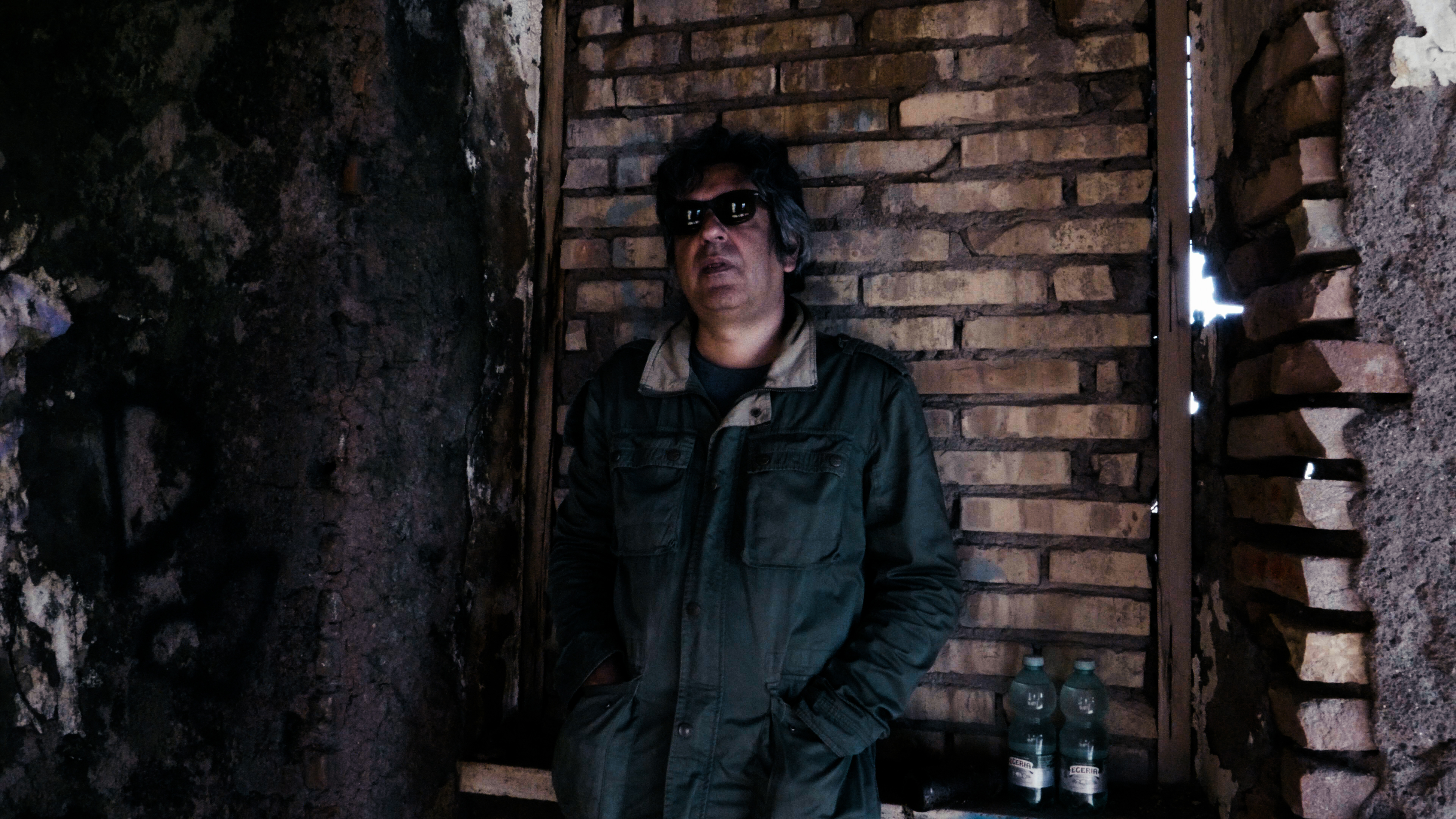
Drama, by Fabio Del Greco, Italy, 2024.
Dante Mezzadri wants to see an old friend, nicknamed the Iguana, whom he has lost sight of for many years, and who has managed to turn their shared youthful passion for poetry into a job, becoming a famous writer and poet. The man escapes from his bourgeois life and his wife to live homeless on the Roman coast, printing and trying to sell his poetry collections. At night he sleeps in a park of old carnival floats, inside a papier-mâché tank, and waits for the opportunity to meet his old friend, who however never shows up for appointments in the places they frequented when they were young, now in ruins. Dante's poetry books do not interest anyone and to support himself he is forced to "change product": he starts selling the infamous "cannibal pill" on behalf of young drug dealers, a new drug that sells like hot cakes and causes sensory and consumerist ecstasy. However, he realizes that this powerful drug is very dangerous for those who take it, he comes into conflict with his ethical conscience and throws all the pills into the sea. However, the dealers want to collect their money.
Shot over a period of 2 years, the film is a reflection on the cultural and artistic rubble of the society in which the protagonist lives, in an increasingly mechanized, consumerist and arid world. Dante Mezzadri is yet another human being who has renounced his inspiration and his creativity, but unlike many he is not willing to give his life to a system that distances him from his true identity. The physical world around him, however, seems constructed in such a way that it seems impossible to escape from this "invisible cage". The enthusiasm of the people he meets is ignited only by sensory gratification, by unreal visions of personal affirmation and success, by "metaverses" that offer an escape into an illusory and destructive reality. The poet's house on the coast, where he met with his friends as a young man, is just a pile of abandoned rubble. What happened to all those who wanted to become poets and ended up becoming something else? Are there internal forces with which that house can be "rebuilt"?
LANGUAGE: Italian
SUBTITLES: English, Spanish, French, German, Portuguese
The Man Who Read History Like a Pathologist Reads a Body
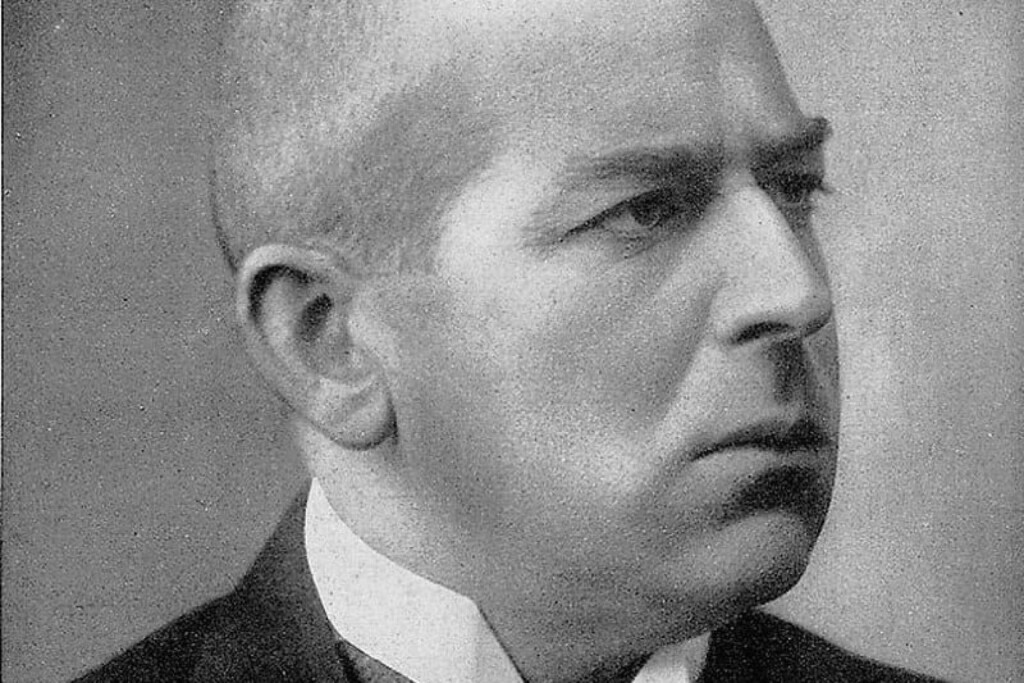
He was not a professor. He held no chair, belonged to no school, commanded no seminar. He lived in Munich on a small inheritance and the money his mother left him, writing in near-total solitude for years, reading voraciously across disciplines that academics considered incompatible — mathematics, art history, botany, comparative mythology — and he brought all of it to bear on a single question that he believed everyone else had been too frightened or too comfortable to ask honestly. Oswald Spengler was born in 1880 in Blankenburg, a small German town in the Harz mountains, and by the time he published the first volume of The Decline of the West in 1918, he had spent a decade dissecting something that was still alive. That is what made the academic establishment so uncomfortable. Not the conclusions — provocative as they were — but the method. He was not excavating ruins. He was cutting into a breathing body and naming the disease before the patient had fallen.
The book arrived into a Germany already shattered by war, and its title felt less like a thesis than a verdict already delivered. It sold in extraordinary numbers for a work of that ambition and density — tens of thousands of copies in the first years alone, eventually translated across Europe and beyond — and yet the professional historians largely refused to take it seriously. They called it speculative, unscientific, fatalistic. What they could not entirely dismiss was how precisely it seemed to describe what they were living through. Arnold Toynbee, who would spend much of his career constructing a rival theory of civilizational cycles, admitted that Spengler had reached many of the same conclusions before him and had done so with a ferocity Toynbee himself could not match. The rejection from institutions only deepened Spengler’s isolation and, one suspects, his certainty.
His central move was to treat world-cultures not as chapters in a single progressive story but as separate organisms, each with its own birth, flowering, and death. He identified eight great cultures — the Egyptian, the Babylonian, the Indian, the Chinese, the Classical Greco-Roman, the Arabian or Magian, the Mexican, and what he called the Faustian, meaning the culture of Western Europe. Each of these, in his reading, passed through recognizable phases: a spring of mythic and religious creativity, a summer of intellectual and artistic maturity, an autumn of critical refinement, and then — inevitably — a winter. That winter had a specific name. He called it Civilization.
This distinction is the hinge on which everything else in his system turns, and it is worth sitting with it carefully, because it cuts against almost everything we have been taught to celebrate. Culture, for Spengler, was the living form — the period in which a people creates, questions, reaches toward something it cannot fully articulate, generates genuine art and genuine philosophy and genuine spiritual hunger. Civilization was what came after. It was the hardened shell, the city-state grown into megalopolis, the philosopher replaced by the technician, the cathedral replaced by the railway terminal, the poet replaced by the journalist. Civilization was not progress. It was the moment when a culture stopped creating and began administering. It was order purchased at the cost of life.
The philosopher Ernst Cassirer, writing in An Essay on Man in 1944, argued that human beings are symbol-making animals, that culture is precisely the capacity to generate meaning through form. What Spengler saw — and what made his diagnosis so difficult to refute — was that the symbol-making capacity does not last forever. At a certain point, the forms remain but the generative force behind them has gone cold. The ritual continues. The institution persists. The vocabulary of greatness is still spoken fluently. But the man performing the autopsy knows that fluency and vitality are not the same thing, and he continues cutting.

Faustian Man and the Infinite Hunger
There is a moment, familiar to anyone who has pushed hard enough toward something they genuinely wanted, when the thing arrives and the room goes quiet in the wrong way. Not the silence of satisfaction. The silence of a machine that has lost its function. You hold what you chased. You turn it over. And what you feel is not gratitude or peace but a faint, vertiginous horror, because you understand now that the wanting was the architecture of your days, and without it the structure has no walls.
Spengler called this the signature of the Faustian soul. Not a personal failure of temperament, not ingratitude or neurosis, but the defining spiritual condition of Western civilization in its entirety. The West, he argued in the first volume of Der Untergang des Abendlandes, published in 1918, did not simply produce a culture among cultures. It produced a culture organized entirely around infinite striving, around the will to push through every horizon the moment it is reached, around the insatiable demand for more depth, more distance, more time, more cosmos. Every other high civilization, in his morphological taxonomy, had a symbol at its core: the Apollonian had the bounded, perfected body; the Magian had the cave, the grotto, the sacred enclosure. The Faustian had infinite space itself. The arrow that never lands. The cathedral nave that pulls the eye upward past any possible resting point toward a vault that suggests transcendence rather than containing it.
This is not metaphor. It is the actual experience of a man who spent fifteen years building a company, not because he wanted the company but because the building was the only state in which he felt real. When it succeeded beyond what he had imagined, he sat in a glass office above a city and felt, not triumph, but a slow draining, as though the pressure that had kept him upright had been released all at once. He was not depressed in any clinical sense. He was Faustian. He had reached the horizon and discovered that it was just another piece of ground.
Nietzsche diagnosed the same condition from a different angle. The will to power, in his formulation, is not the desire for domination over others but the drive toward self-overcoming, toward the perpetual surpassing of one’s own previous limit. It is a description of an engine that cannot idle. What Nietzsche celebrated as the mark of the higher type, Spengler mapped onto an entire civilization and asked: what happens when this engine runs out of genuine horizons? What happens when the will to overcome has overcome everything available to it?
Max Weber‘s answer, arriving through a different methodology but landing in the same place, was the iron cage. The extraordinary rationalization that Western civilization deployed to conquer nature, organize labor, calculate profit, systematize knowledge — all of that striving had built a structure so total, so efficient, so self-enclosed, that the original spiritual energy animating it had been quietly sealed inside. Weber saw this in 1905 in Die protestantische Ethik und der Geist des Kapitalismus. The hunger that once reached toward God had been metabolized into procedure. The transcendent had become administrative.
What Spengler added to Weber was the biological fatalism, the sense that this was not a correctable error but a developmental phase, a season in the life of a form. The same hunger that threw up Gothic cathedrals in the twelfth century, that launched ships into unmapped oceans, that split the atom and fired rockets past the edge of the solar system, is now turning on the structures it built. It has no new direction to move in. It has colonized the exterior world as completely as it is going to, and so it begins to colonize itself, to optimize and restructure and disrupt the very civilization it produced, because the only alternative is stillness, and stillness is the one condition Faustian man has never learned to survive.
When the Morphology Becomes a Mirror
There is a corridor you know. Not a specific one, maybe, but you know the feeling of it — the way it extends just far enough that you cannot see where it ends, the way each door you open reveals another anteroom, another form to fill, another signature required from someone who is not in today and will not be tomorrow either. You have stood in that corridor. You have felt the particular exhaustion that is not tiredness but something closer to ontological vertigo — the suspicion that the system you are navigating was not designed to be navigated at all, that it was designed to extend.
Spengler would have recognized that corridor immediately. For him, it was not a bureaucratic inconvenience. It was the confession of an entire civilization.
His method, which he called cultural morphology, proceeds from a single radical premise: that each great culture is not a collection of events and ideas but an organism with a soul, and that this soul expresses itself through what he called a prime symbol — a single primordial intuition of space and time that organizes everything the culture produces, from its mathematics to its music, from its warfare to its prayer. The Egyptian prime symbol is the path, the narrow corridor between birth and the underworld, life as a march toward a single fixed destination. The Classical, Apollonian symbol is the bounded body, the perfectly delimited form, the individual statue standing complete and self-contained in the sunlight. And the Faustian — our civilization, the civilization of Western Europe and its descendants — has as its prime symbol infinite directional space. The urge outward. The horizon that recedes. The will that cannot rest in any achieved form.
This is not a metaphor Spengler deploys occasionally. It is the structural key to everything. Gothic cathedrals do not merely point upward; they are, for Spengler, pure Faustian yearning made stone, verticality as spiritual program. Counterpoint in Bach is not a musical technique but an architecture of infinite voices reaching simultaneously in divergent directions. Differential calculus, invented independently by Newton and Leibniz within years of each other in the 1670s, is the mathematical language of the infinitely small tending toward the infinitely extended — the Faustian soul thinking in its native tongue. Even the oil painting, with its recession into depth, its atmospheric perspective dissolving the boundary between the visible and the beyond, is the prime symbol finding one more medium to inhabit.
Now return to the corridor. The man inside it is not dealing with an accident of bad governance. He is living inside the terminal expression of that same directional infinity. Hannah Arendt, writing in the early 1950s about the structure of modern domination, identified bureaucracy as the rule of nobody — not tyranny, which at least has a face, not democracy, which at least has a pretense of accountability, but an impersonal infinitely extendable process in which authority is always elsewhere, always one office further down the hall. What makes it unbearable is precisely what makes it Faustian: there is no center to appeal to, no final authority to confront, because the system has internalized the prime symbol so completely that it generates more of itself automatically, the way a horizon generates more horizon the closer you approach.
Kafka understood this before Arendt named it, before Spengler had finished writing. A man arrives seeking access to the Law and is told he may enter but not yet, and waits his entire life at a door that was made only for him and which will now be closed. The geometry of that story is Faustian to the bone — infinite deferral, directional space weaponized against the individual standing inside it.
This is the moment when morphology stops being a theory about civilizations and becomes something you feel in your chest when you open the fourteenth email asking you to resubmit the form you already submitted.
The Caesarism That Was Always Coming
You stop changing the channel not because you have found something worth watching but because you have run out of the energy required to keep looking. The television stays on some political debate — four people talking over each other about something that felt urgent three news cycles ago — and you notice that what you feel is not anger, not even boredom in the ordinary sense, but something closer to the recognition of a pattern you have seen so many times that the pattern itself has become the content. The argument is the product. The performance of deliberation has replaced deliberation itself, and somewhere in your chest you register this with a exhaustion so familiar it no longer even presents as exhaustion. It presents as normal.
Spengler saw this moment coming with an almost clinical precision. He called it Caesarism, and he was careful to distinguish it from mere tyranny or military coup, which is where most readers instinctively reach for their historical analogies. Caesarism is not imposed from outside the democratic form. It grows from inside it, watered by the very people who would claim to oppose it. It emerges, as Spengler wrote in The Decline of the West, when the forms of constitutional government continue to exist while the inner meaning has drained away entirely — when parliaments legislate without governing, when parties campaign without representing, when citizens vote without choosing. The strongman does not overthrow the theater. He simply walks onto the stage after the audience has already stopped believing in the play.
Tocqueville diagnosed the same mechanism nearly a century before Spengler with his concept of soft despotism in Democracy in America, published in 1835. He imagined a power that does not tyrannize but infantilizes — that keeps citizens, as he wrote, “fixed irrevocably in childhood,” not through terror but through the slow, comfortable management of their expectations downward. What Tocqueville feared was not the revolutionary despot but the administrative one, the figure who arrives as a simplifier, as a relief from complexity, as the man who will finally cut through what the institutions cannot. The citizens do not surrender their freedom dramatically. They relinquish it gradually, gratefully, the way you hand your luggage to someone else at the end of a very long trip.
Christopher Lasch, writing in The Culture of Narcissism in 1979, added the psychological substrate that both Spengler and Tocqueville lacked the vocabulary to name precisely. The late-democratic citizen, Lasch argued, has been formed by a culture that rewards the performance of selfhood over its actual development — a culture that produces not genuine individuals but spectacular ones, people who have learned to manage impressions rather than build character. This is the political soil in which Caesarism grows without needing to force itself. A population trained in narcissistic self-presentation does not recognize the strongman as a threat to individuality because it has confused the theatrical assertion of identity with individuality itself. The strongman is, in a sense, simply the perfected version of what the culture has already been producing at every level.
The Roman parallel that Spengler draws is not metaphorical decoration. By the first century BCE, Roman republican institutions had been functioning for four hundred years, yet the Senate had become a body that legitimized outcomes rather than deliberated toward them. Caesar crossed the Rubicon in 49 BCE not against the will of a coherent republic but into a vacuum that the republic’s own exhaustion had created. The crowds who gathered were not ignorant of what they were welcoming. They were tired, and tiredness is not ignorance. It is something more dangerous, because it contains within it the full knowledge of what is being lost alongside the absolute absence of the energy required to prevent it.
The debate on the television continues. Nobody has won. Nobody was ever going to.
A vision curated by a filmmaker, not an algorithm
In this video I explain our vision
The City That Devours Its Own Countryside

There is a lobby somewhere — you have been in it, or one indistinguishable from it — where the plants in the corners are not from any continent in particular, where the marble underfoot was quarried in three different countries and assembled by contractors from a fourth, where the coffee in your hand contains beans that traveled further than your grandparents ever did, and where the man behind the desk, if you asked him where he was from, would pause in a way that reveals the question has become genuinely difficult to answer. Nothing in that space grew there. Nothing in that space belongs there. And yet it functions with a kind of frictionless perfection that feels, for a moment, like abundance.
This is what Spengler meant by the megalopolis, and he saw it coming with a clarity that still disturbs. The city in its final phase does not merely draw resources from the land around it — it severs the connection entirely, renders the countryside invisible, and then slowly forgets that the countryside exists at all. The peasant, for Spengler, was not a romantic figure but an ontological one: the person whose existence was rooted in cycle, in soil, in the kind of time that repeats rather than progresses. The megalopolis abolishes that time. It substitutes for it the permanent present tense of optimization, of surfaces that are always already clean, of needs that are always already being met by systems so elaborate they have become invisible.
Georg Simmel, writing in 1903 in his essay on the metropolis and mental life, identified the psychological cost of this substitution with surgical precision. The blasé attitude, he argued, is not laziness or stupidity. It is a rational adaptation to sensory overload — a protective numbing that the city demands of its inhabitants simply as the price of functioning. You cannot feel everything, so you learn to feel almost nothing. You walk past ten thousand strangers and your nervous system, mercifully, does not register them as human beings in any full sense. This is not cruelty. It is survival. But Simmel understood, even then, that what survives in the blasé subject is something diminished — an intelligence sharpened to a point at the cost of the wider faculty that once oriented a person in time, in place, in relation to others who were not strangers.
Lewis Mumford, decades later, looked at the architecture of the city in its final stage and saw the same process written in stone and glass. The megalopolis, he argued, does not build for permanence or meaning — it builds for throughput. The skyscraper is not a monument. It is a machine for processing human beings at volume. And what Mumford noticed, with a bitterness that never quite became despair, was that the city in this phase becomes self-consuming: it imports everything it needs and produces nothing that sustains it. It cannot feed itself. It cannot clothe itself. It cannot, in any meaningful sense, defend itself against the interruption of the supply chains that keep it alive.
More than fifty-five percent of humanity now lives in cities, a threshold crossed around 2007 and accelerating in ways that have not slowed since. In 1950 that figure was closer to thirty percent. The speed of the shift is itself part of what Spengler was describing — not a gradual drift but a final gathering, a pulling of the world’s human mass toward centers that grow more abstract, more optimized, more detached from any particular soil the faster they grow.
What remains of the countryside in the imagination of the city dweller is largely decorative. A weekend destination. A backdrop for photographs. The glass tower does not hate the field. It simply no longer requires it to exist in any way that registers as real.
What Spengler Got Wrong, and Why That Makes Him More Dangerous
There is a moment — and you have probably experienced it, or something close to it — where you are reading something that feels almost unbearably sharp, a sentence that names the exact mechanism of a historical process you had only intuited, and then you turn the page and the same voice, in the same register of confident authority, begins to describe peoples and races with the casual brutality of a man sorting livestock. The prose does not change. The rhythm stays the same. The confidence is identical. And that is precisely what makes it so difficult to simply close the book and walk away.
Spengler’s errors are not accidents. They are not the unfortunate prejudices of an otherwise pristine thinker, minor contaminations that a careful reader can filter out like sediment from wine. They are structurally embedded in the architecture of his thought, because the same move that gives him his power — the biologization of culture, the transformation of civilizations into organisms with fixed life cycles — is the move that produces his darkest conclusions. Once you have decided that cultures are organisms, you are already on the path toward deciding that some organisms are more vital than others, that some are spent, that some are, in the vocabulary he never quite abandoned, racially exhausted. The insight and the ugliness share the same root system.
Karl Popper saw this with characteristic clarity. In The Open Society and Its Enemies, published in 1945, he identified historicism — the belief that history unfolds according to discoverable laws — as the philosophical foundation of totalitarianism. He did not spare Spengler. The Decline of the West, for Popper, was not a work of historical science but of historical prophecy dressed in scientific costume, and prophecy of this kind, self-confirming and unfalsifiable, was precisely what made it so politically available. You cannot disprove Spengler because he has arranged his categories so that every counterexample becomes further evidence of decline. A civilization that resists his predictions is simply delaying the inevitable. This is not philosophy. This is a closed system, and closed systems, Popper argued, are always, at their limit, instruments of domination.
Adorno’s critique cuts differently, from the inside rather than the outside. Adorno recognized that Spengler had actually seen something real — the administered world, the triumph of technique over spirit, the way that Western rationality was consuming its own premises — but that he had then aestheticized this recognition into a posture of tragic grandeur, which allowed him to observe catastrophe with a kind of aristocratic detachment rather than political responsibility. The decline becomes beautiful in Spengler’s hands, and when decline becomes beautiful, it becomes acceptable, then inevitable, then secretly desired. This aestheticization is not innocent. It prepared an entire cultural atmosphere in which the worst outcomes could be greeted not with resistance but with a dark satisfaction, a sense that history was finally revealing its true face.
What his embrace by the early fascist movements demonstrated was not a misreading of his work. The National Socialists who initially celebrated him, before he distanced himself from Hitler with a disdain that was more aristocratic than moral, had read him correctly enough. The determinism is there. The contempt for liberal universalism is there. The sense that peoples are fated rather than free is structurally inseparable from his morphology of cultures. When you strip agency from individuals and peoples by embedding them inside biological cycles they cannot alter, you do not liberate them from false hope — you prepare them for submission to whoever claims to embody the force of destiny.
The Feeling of Living Inside an Ending
You are standing in front of a streaming platform’s home screen, and the sheer volume of what is available to you produces something closer to vertigo than anticipation. There is a limited series reimagining a nineteenth-century novel with contemporary sensibility. There is a film that deconstructs the Western. There is an album that samples jazz from 1962, soul from 1974, and post-punk from 1983, weaving them into something that feels simultaneously nostalgic and cutting-edge but is, at its core, neither. Everything references something else. Everything wears its influences as costume. The feeling is not abundance. It is a peculiar form of exhaustion dressed as choice.
This is what Fredric Jameson, writing in his 1984 essay “Postmodernism, or, The Cultural Logic of Late Capitalism,” identified as the dominant logic of a civilization that has lost access to its own future. Jameson did not argue that culture had become lazy or cynical, though it often appears that way. He argued something more structural and more disturbing: that a system unable to imagine its own outside can only produce recombination. The new becomes impossible not because artists lack talent but because the cultural grammar itself has collapsed into pure quotation. Style is no longer a living thing. It is a museum exhibit that has learned to walk.
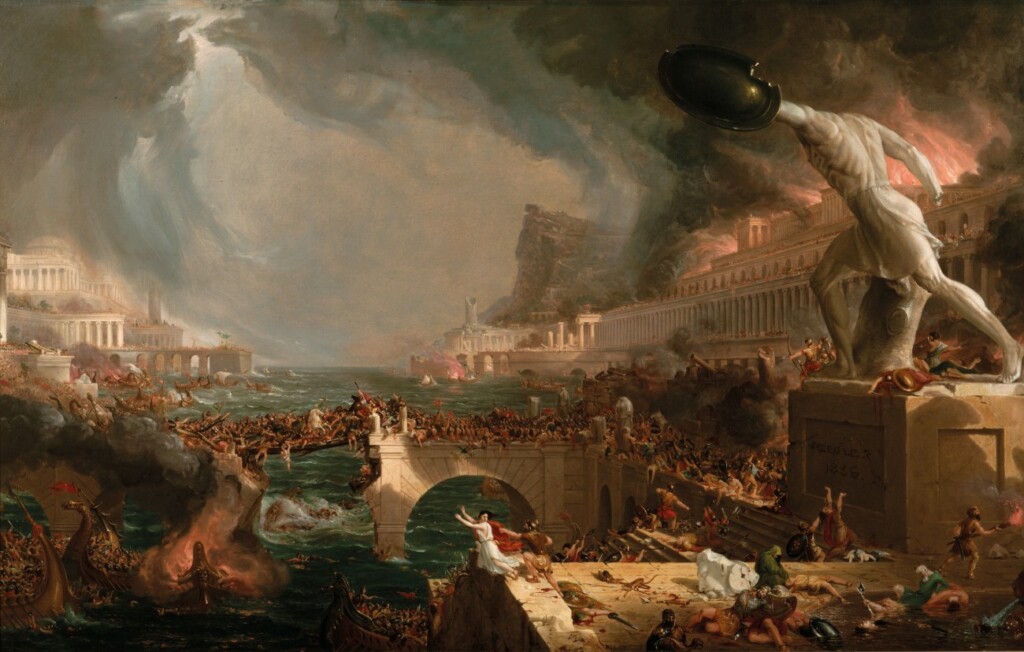
Nineteen twenty-two was a strange year to be alive inside Western civilization. T.S. Eliot published a poem that felt like standing in the rubble of something enormous, cataloguing fragments of European high culture the way an archivist catalogues the belongings of the dead. The poem moves through voices and traditions and mythologies without ever arriving at synthesis, because synthesis is precisely what is no longer available. “These fragments I have shored against my ruins” is not a statement of hope. It is a description of the only activity remaining when creation proper has become impossible. That same year, Spengler’s second volume arrived, completing a diagnosis whose first part had already unsettled the European intellectual world. The coincidence is not merely biographical. It is symptomatic. Two men, working from entirely different disciplines and temperaments, converging on the same sensation: that something has already ended, and what surrounds them is the reverberation.
Walter Benjamin‘s angel does not look forward toward the future. It faces the past, eyes wide open, watching wreckage accumulate at its feet. What we call progress, Benjamin wrote, is the storm that drives the angel backward into a future it cannot see, away from the catastrophe it cannot stop watching. The image arrives from his 1940 “Theses on the Philosophy of History,” written months before his death, and it captures something that Spengler’s morphological system, for all its architectural precision, never quite reaches: the emotional texture of living inside an ending. Not the grand sweep of civilizational cycles but the specific phenomenological weight of being a consciousness that feels the accumulation of the past as something heavier than the future can sustain.
And here is where the question becomes genuinely uncomfortable. Recognizing the pattern — naming the late-stage quality of the cultural moment, identifying the exhaustion beneath the proliferation, understanding Jameson’s logic or Spengler’s morphology or Benjamin’s image — does any of it change the position you occupy? Or does the recognition itself belong to the pattern, one more self-aware gesture in a civilization that has elevated self-awareness to the status of a last remaining art form? The critic who names the crisis is still inside the crisis. The consciousness that perceives the cage is still enclosed within its bars. Spengler himself knew this, which is why his tone never quite arrived at the urgency of a warning. He wrote like a man describing weather — not indifferent, but certain that description and transformation are not the same act, and that sometimes the most honest thing a civilization can produce, at the very end, is someone clear-eyed enough to watch.
🌅 The Twilight of Civilizations: History, Decline, and Meaning
Oswald Spengler’s vision of history as a biological cycle of civilizations rising and falling did not emerge in isolation. It drew from deep wells of philosophy, political thought, and cultural critique that had been accumulating for centuries. These related articles trace the intellectual landscape that shaped — and was shaped by — the Spenglerian worldview.
Johann Wolfgang von Goethe: Life and Works
Johann Wolfgang von Goethe was one of the most decisive intellectual influences on Spengler, who borrowed his morphological method — the study of living forms in their organic development — and applied it to entire civilizations. For Spengler, history was not a sequence of causes and effects but a living organism with its own inner destiny, a concept rooted directly in Goethe’s philosophy of nature. Understanding Goethe is thus essential to understanding the very grammar with which Spengler wrote his monumental work.
GO TO THE SELECTION: Johann Wolfgang von Goethe: Life and Works
Thomas Hobbes: Life and Political Thought
Thomas Hobbes constructed one of the most enduring visions of political order as a fragile achievement wrested from chaos, a theme that resonates deeply with Spengler’s conviction that civilizations inevitably slide toward Caesarism and force in their terminal phase. The Leviathan, with its stark portrait of power and the dissolution of organic community into mechanical state apparatus, anticipates the Spenglerian diagnosis of Western modernity. Reading Hobbes alongside Spengler illuminates how political philosophy has long sensed the shadows gathering at the edges of civilization.
GO TO THE SELECTION: Thomas Hobbes: Life and Political Thought
Jan Assmann and Cultural Memory
Jan Assmann’s theory of cultural memory offers a powerful counterpoint and complement to Spengler’s cyclical morphology of civilizations, exploring how societies encode their foundational experiences into durable symbolic forms. Where Spengler saw cultures as sealed organisms incapable of genuine transmission, Assmann revealed the sophisticated mechanisms by which memory bridges generations and keeps the past alive as a living force. Together, they raise urgent questions about what is truly lost when a civilization declines and what, if anything, survives into the next cycle.
GO TO THE SELECTION: Jan Assmann and Cultural Memory
Mass Social Homologation Today
Spengler anticipated with uncanny precision the cultural homogenization that would come to define late Western civilization, describing the replacement of genuine creativity with mass entertainment and the flattening of individual expression under the weight of urban civilization. The phenomenon of mass social homologation — the erosion of authentic cultural difference in favor of standardized consumption — reads today as a direct confirmation of his darkest prophecies. This article examines how that process has unfolded in contemporary society and what it reveals about the stage of historical development we now inhabit.
GO TO THE SELECTION: Mass Social Homologation Today
Discover Independent Cinema on Indiecinema
If Spengler’s meditation on the fate of civilizations has stirred something in you, independent cinema offers a unique space to continue that journey — through films that dare to ask the questions mainstream culture prefers to avoid. On Indiecinema streaming you will find a curated selection of works that explore history, power, memory, and the human search for meaning with the depth and courage that great art demands. Come and discover a cinema that refuses to decline.
👉 EXPLORE THE CATALOG: Watch Indie Films in Streaming
A vision curated by a filmmaker, not an algorithm
In this video I explain our vision

