
The Puppet and the Man Who Carved Him
You are standing in a room that smells of wet paper and iron, somewhere in Florence in the 1850s, and the man across from you is not yet the man history will make him. He is translating French fairy tales for money, correcting proofs under a lamp that trembles when a cart passes outside on the cobblestones, and if you looked at him then you would see nothing legendary — only a journalist of middling fortune, politically inconvenient to several governments, perpetually short of rent, with ink on his fingers and opinions that cost him more than they paid. He is Carlo Lorenzini, and he will not become Collodi for several more years, borrowing the name from the small Tuscan village where his mother was born, the way a man might put on a coat that fits better than his own skin.

Florence in the nineteenth century was a city undergoing the particular violence of becoming modern. The Grand Duchy of Tuscany, under Habsburg-Lorraine rule until 1859, maintained a cultural atmosphere that was simultaneously refined and suffocating. Lorenzini moved through its salons and editorial offices like a man who knew both sides of every door. He had fought, briefly and idealistically, in the First Italian War of Independence in 1848, and again in 1859 — not because he was a soldier by nature, but because a certain kind of Italian intellectual of that era understood political commitment as inseparable from cultural production. He wrote for the satirical newspaper Il Lampione, which was suppressed by authorities and relaunched and suppressed again, in that rhythm so familiar to dissident journalism that the suppression itself becomes a kind of publication schedule. He founded his own paper, La Lanterna, in 1853. He was not a revolutionary in any clean sense, but he was the kind of man who made governments nervous, which is a different and more interesting thing.
What is rarely examined is how thoroughly his journalistic formation shaped what would later be read as a children’s story. The narrative voice of his most famous work is not warm. It is sardonic, impatient, occasionally cruel in the way that only a very experienced ironist can be cruel — with the precision of someone who has spent decades watching human pretension arrange itself into readable patterns. When he began publishing installments of the story of a wooden puppet in the Roman newspaper Il Giornale per i bambini in July 1881, he was fifty-eight years old. He had not set out to write a masterpiece. He had set out to fill column inches, and he initially intended to end the story after the seventh installment, with the puppet hanged dead from an oak tree. That was the ending. The puppet dies badly, and the story stops. His editors asked for more, and he continued — not from artistic vision, but from professional obligation, which is perhaps the most honest origin story any great work of literature has ever had.
The completed book, Le avventure di Pinocchio, appeared in 1883, published by Felice Paggi in Florence. It sold modestly. Collodi died in 1890 without knowing what the puppet would become, without witnessing the global translation cascade that would eventually make Pinocchio one of the most recognized fictional figures on earth, present in over 260 languages and cultural adaptations so numerous they constitute almost a separate mythology. He died as he had largely lived — not poor exactly, but not comfortable, respected in Florentine literary circles, awarded a small government pension late in life as a kind of institutional acknowledgment that the state had perhaps been wrong to suppress him earlier. The pension did not apologize. Pensions never do.
What the historical record tends to flatten is the texture of the contradiction at the center of his biography: that a man so constitutionally resistant to authority would write a story whose central anxiety is the catastrophic consequences of disobedience.
The Kempinsky Method

Drama, by Federico Salsano, Italy 2020.
The introspective imaginary road movie of a man in the maze of his own mind, his memories of his youth, his never dormant passions and contradictory truths. The road is made of water, the destination is falsely unknown. His traveling companions are three mysterious men, projections of his imagination and of different aspects of his personality: the perennial melancholy, the crazy creative, the introverted child. He is also followed by a female presence that tells the umpteenth human story. At a certain point of the crossing he decides to abandon the boat and his ghosts of him diving into the sea and arrives swimming on a deserted beach, naked, with a small Pinocchio puppet closed by a padlock.
In this splendid film life is like a long sea voyage and the human being is a small creature confronting immensity. Sometimes the ocean is calm, other times there are terrible storms. Sometimes we are captains of a boat with a well-defined route, other times we are shipwrecked in search of a land in which to save ourselves. But despite the long journey and the movement in physical space, there are other questions that resonate in the mind: who are these men I travel with? What is the mystery of this immense mass of water that seems to be made of my memories? You can circumnavigate the whole world but the main question always remains the same: who am I really?
LANGUAGE: italian
SUBTITLES: english, spanish, portuguese, german, french
A Life Built on Borrowed Masks
You learn your real name and then spend the rest of your life deciding whether to use it. Carlo Lorenzini was born in Florence in 1826, the son of a cook and a domestic servant whose employers were the Garzoni family of Pescia — a town nestled in the Valdinievole, in Tuscany, close enough to the village of Collodi to leave its mark on a child’s earliest geography. That village was not his birthplace. It was not even his home. It was simply the place where his mother came from, a small cluster of stone and hillside that meant nothing to the administrative record and everything to the imagination of a man who would later understand that names are not inherited — they are chosen, constructed, and deployed.
When Lorenzini began publishing political satire in the 1848 revolutionary journals he helped found — first Il Lampione, then La Scaramuccia — he was already living in the gap between private identity and public necessity. The Risorgimento was not a movement that rewarded transparency. It was, at its core, a project of collective reinvention, and Eric Hobsbawm’s argument in Nations and Nationalism since 1780 cuts directly into this reality: national identity, Hobsbawm insists, is never discovered but manufactured, assembled from selective memory, strategic myth, and the deliberate suppression of inconvenient particulars. The Italy being dreamed into existence in the mid-nineteenth century needed its intellectuals to perform a unified culture that did not yet materially exist. The pen name, in this context, was not vanity. It was architecture.
Taking the name Collodi — a place, a landscape, a maternal root dressed in the grammar of geography — was a way of anchoring a fluid self to something that sounded permanent. The Tuscan hills do not argue. They do not submit to Austrian censorship or Bourbon repression. By signing himself after a village rather than his father’s surname, Lorenzini accomplished something psychologically precise: he made himself simultaneously more anonymous and more legible, harder to arrest and easier to recognize by those who already knew the code. Political writing under surveillance operates this way — not through outright secrecy but through a kind of open camouflage, a mask worn so naturally it begins to feel like a face.
What makes this particular act of self-naming remarkable is how thoroughly it succeeded in the wrong direction. Lorenzini adopted the name Collodi to protect a political voice; history remembers Collodi exclusively for a children’s story. The disguise outlasted the danger, then outlasted the man himself, then outlasted every cause he had actually been fighting for. There is something quietly catastrophic about this kind of legacy — the mask that adheres so completely it retroactively erases the face beneath. By the time Pinocchio was serialized in the Giornale per i bambini between 1881 and 1883, Collodi was already in his mid-fifties, a man who had volunteered in two wars of Italian unification, who had translated French fairy tales and written satirical travel essays and theatrical criticism, and whose accumulated decades of public life were already dissolving into the single, unstoppable image of a wooden puppet.
The psychology of the pseudonym carries a particular irony in this case, because the story that made the name immortal is itself saturated with anxieties about authenticity and transformation. A being who is not quite human, who wants to become real, who is punished for lying by a body that betrays him — this is not incidentally connected to the life of a man who spent his formative years writing under cover, performing identities, navigating a political landscape where saying the wrong true thing could cost everything. The village of Collodi gave its name to a writer. That writer gave his borrowed name to a puppet. And somewhere in that doubling, the original person — the Florentine son of servants, the young revolutionary — became exactly as difficult to locate as he had once needed to be.

The Pedagogy That Lied to Itself

You are ten years old and you have just been told, for the third time this week, that the story you are reading will make you good. Not happy. Not curious. Good.
There is a particular violence embedded in that word when directed at a child, and nineteenth-century Italy deployed it with the systematic confidence of a state that had only just invented itself. The Risorgimento had produced a unified nation on paper by 1861, but the harder problem remained: how to produce unified Italians, people who would feel the same obligations, share the same moral reflexes, submit to the same civic order. The answer, pursued with extraordinary institutional energy, was the schoolroom, and inside the schoolroom, the book. Children’s literature in this period was not entertainment pretending to be instruction. It was instruction that had stopped pretending entirely.
Michel Foucault, writing in Surveiller et punir in 1975, identified normalization as the central disciplinary technology of modern institutions — not the spectacular punishment of the body but the quiet, continuous calibration of behavior against an invisible standard of correctness. What he traced through prisons and hospitals and barracks was also operating, with particular efficiency, through the pages handed to children. The narrative itself became the examining gaze. The well-behaved child in the story was not a character; he was a measurement against which the reading child was silently weighed and found either sufficient or wanting. Literature became the mirror that taught you to police your own reflection.
Collodi understood this machinery from the inside, because for years he was one of its operators. His satirical newspaper Il Lampione, launched in Florence in 1848 and suppressed the same year by Grand Duke Leopold II, then resurrected in 1860, positioned him as a sharp and irreverent political voice — a man who used language to destabilize rather than to reassure. The Florentine journalism he practiced was built on the assumption that institutions lie, that official language conceals rather than reveals, that the gap between proclaimed virtue and actual behavior is the most fertile territory a writer can inhabit. He was, in this sense, constitutionally unsuited to producing earnest moral fables. And yet the market, the moment, and his own precarious finances repeatedly called him to do exactly that.
The dominant tradition he was writing adjacent to had been shaped decades earlier by figures like Luigi Alessandro Parravicini, whose Giannetto, published in 1837, became one of the most widely circulated pedagogical texts in pre-unification Italy. Giannetto is a boy who listens, obeys, studies, and rises — a sequence presented as natural, as inevitable, as the only legible story a child could have. The book sold in numbers that would alarm a modern publisher, went through dozens of editions, and was endorsed by virtually every educational authority that touched it. It was also, in any honest reading, a manual for the production of a certain kind of human being: compliant, aspirational, incurious about the mechanisms of the world it was meant to inhabit.
What Collodi’s early satirical instincts registered, even when his commissioned work appeared to conform to type, was the fundamental dishonesty of a literature that claimed to love children while actually fearing them. The fear was specific: fear of the child’s appetite, its refusal of sequence, its attachment to pleasure over improvement, its tendency to ask why when the answer demanded was simply yes. Didactic literature did not address children. It addressed the adult’s anxiety about what children might become if left unregimented. The child in those pages was always already a problem to be solved, a soft material to be pressed into a predetermined shape before it hardened into something inconvenient.
The trap Collodi walked into — and this is the part that deserves attention — was not cynicism. He did not simply produce conformist literature while privately despising it. Something stranger happened when he finally sat down to write about a puppet.
What the Wood Already Knew
You are reading a story about a puppet who deserves to die, and you know it, and somewhere beneath your adult literacy you find that conclusion correct. The original serial installment that Carlo Collodi delivered to Il Giornale per i Bambini in July 1881 ended with Pinocchio hanged by the neck from the Oak of the Great Elm, his body swaying, his misadventures concluded. The assassins had strung him up. The cricket was gone. The Blue Fairy was gone. There was no rescue, no transformation, no lesson received and internalized. There was only the wood, still wood, finally still.
Collodi had not miscalculated. He had, in fact, produced the most honest account possible of what happens when a creature built entirely from appetite and impulse meets a world that operates on consequence. The puppet was disobedient, credulous, vain, and lazy across every installment — not endearingly so, not in the way that childhood is sometimes romantically described as wild and free, but in the way that genuine refusal to be shaped by experience is simply a form of self-destruction dressed up in motion. The hanging was not punishment imposed from outside the narrative logic. It was the narrative logic, arrived at cleanly.
What changed was not Collodi’s understanding of his character. What changed was the pressure of a readership that had developed affection for a wooden boy precisely because he was irresponsible, and could not tolerate the implications of that affection being honored honestly. Letters arrived. The editor pressed. And so Collodi continued, producing installments through 1883 that would eventually be collected as the complete novel, in which Pinocchio earns his humanity through suffering, sacrifice, and the rescue of his dying father from the belly of a vast shark. The ending now given to children is a boy who wakes up real, looks at the empty puppet shell on a chair beside him, and laughs. It is one of the most quietly disturbing images in nineteenth-century literature, and it passes almost without comment.
The philosopher Giorgio Agamben, in his 1977 study Stanzas, argued that Western culture has a persistent inability to mourn what it has abandoned — that the desire to transform loss into acquisition, to make grief productive, runs so deep in the tradition that genuine ending becomes nearly unthinkable. Collodi’s forced continuation is a minor but precise demonstration of this. A culture that cannot allow a puppet to remain hanged will also struggle to allow failure to simply be failure, without the promise of a later arc that redeems it retroactively. The resurrection of Pinocchio in installment six was not generosity. It was the readers refusing the weight of their own identification.
There is something specific to serialized form that makes this vulnerability acute. When a story arrives in fragments across weeks and months, the audience accumulates investment that begins to feel like ownership. By the time Collodi’s July ending appeared, readers had already spent five issues with this creature. He had become familiar, which is different from being understood. Familiarity generates a protective instinct that has nothing to do with truth and everything to do with the discomfort of having spent feeling on something that refuses to survive. The readers who demanded continuation were not wrong to love the puppet. They were wrong to believe that love obligated the story to accommodate them.
What the original ending understood, and what the continuation quietly buried, is that wood does not want to become flesh. This is not a metaphor for childhood resistance or adolescent wildness — it is a structural observation about the story’s own material. The puppet in Collodi’s first conception was not on a journey toward humanity. He was a thing that moved, caused trouble, and stopped. The wood already knew what it was. The pressure to forget that knowledge, to turn the story into an education completed, came entirely from outside the text.
The Real Child the Story Cannot Love
A boy sits at a school desk in Turin, 1883, the same year the serial chapters of the puppet’s story were being bound into a single volume for the first time. His teacher has caught him drawing figures in the margins of his arithmetic workbook — horses, not numbers. The ruler comes down on the back of his hand not to break bone but to redirect attention, to enforce the proposition that certain kinds of imagination belong to a wrong place and a wrong time. He does not cry. He learns something more durable than the lesson intended: that the body is an argument, and that adult authority is always prepared to win it.
What Collodi built into the architecture of his most famous work is not a celebration of childhood but a systematic prosecution of it. Pinocchio is not a child who is loved and then guided; he is a problem that requires resolution. Every episode in the narrative functions as a courtroom in which the puppet is arraigned for the crime of desiring the wrong things — freedom, pleasure, company, spectacle, rest — and the verdict is always the same. Transformation into a real boy is not a gift; it is a sentence of conformity that the story presents as grace. The French historian Philippe Ariès, in his 1960 work L’Enfant et la vie familiale sous l’Ancien Régime, demonstrated that the concept of childhood as a distinct and protected stage of human development was itself a modern invention, assembled across the seventeenth and eighteenth centuries to serve the needs of bourgeois family structures and emerging pedagogical institutions. By Collodi’s time, this invention had calcified into dogma: the child existed to become something else, and the speed and docility of that becoming was the measure of both the child and the civilization producing it.
The cruelty inside the story is structural, which is why readers have always been able to feel it without being able to name it. Psychologist Bruno Bettelheim argued in The Uses of Enchantment in 1976 that fairy tales speak to children’s inner conflicts, allowing unconscious fears to find symbolic resolution. But Bettelheim’s framework assumes the story is on the child’s side, that transformation represents inner growth freely arrived at. What Pinocchio actually stages is coercion wearing the costume of love. The Blue Fairy does not love Pinocchio as he is; she loves the version of him that will eventually require no further correction. Her affection is conditional in the most absolute sense — it is withheld until compliance is complete.
This is not an accident of Collodi’s temperament. Italy in the 1880s was a country assembled from pieces that did not easily fit, unified by decree in 1861 but still fractured by dialect, class, and incompatible regional loyalties. The schools established under the Casati Law of 1859 were understood explicitly as instruments of national homogenization — factories for producing citizens where there had previously been only subjects of various crowns. Collodi himself worked as a schoolbook author alongside his literary work, producing texts designed to instill obedience, cleanliness, industry, and gratitude into children who would otherwise have grown into something inconvenient. Pinocchio is the dark twin of those schoolbooks — it tells the same story but shows the machinery behind the wall.
The child who does not transform, who stays wooden, who keeps lying and running and refusing the harness — that child is not a failure of the story. That child is what the story is most deeply afraid of, because that child exposes the premise: that the good child is not discovered but manufactured, and that the manufacturing requires a sustained application of shame precise enough to feel like conscience.
A vision curated by a filmmaker, not an algorithm
In this video I explain our vision
Gramsci’s Nightmare in Wooden Form

You are seven years old and someone is reading you a story about a puppet who keeps failing to go to school. Every time he skips class, something terrible happens to him — he is tricked, he is hungry, he nearly drowns, he is swallowed. Every time he obeys, he is rewarded with the warmth of a home and the approval of an old man who weeps with relief. You are not being entertained. You are being trained.
Antonio Gramsci, writing from a fascist prison cell between 1929 and 1935 in what would become the Prison Notebooks, was preoccupied with exactly this mechanism — the way ruling-class values migrate into the common sense of those they subordinate, so thoroughly that the subordinated begin to enforce those values upon themselves without any visible coercion. He called the process hegemony, and he was particularly alert to the role of popular culture in carrying it out. Children’s literature, folklore, serialized fiction — these were not peripheral entertainments but the molecular infrastructure of consent. Collodi’s Pinocchio, published in serial form in the Giornale per i bambini beginning in 1881 and collected as a book in 1883, arrived precisely at the moment when the new Italian state was attempting to consolidate a national identity across a peninsula of profoundly fragmented regional, linguistic, and class identities. The timing was not incidental.
What the story performs, with extraordinary efficiency, is the conversion of structural obedience into personal virtue. Pinocchio does not learn that school serves the interests of industrialization by producing disciplined, punctual, literate workers — he learns that he is bad when he avoids it and good when he attends. The distinction is not cosmetic. When coercion is experienced as external, it can be resisted, negotiated, resented. When it is experienced as the voice of conscience, it becomes nearly impossible to refuse without feeling like a moral failure. Gramsci understood that the most durable power is the kind that makes you police yourself, and Pinocchio is a near-perfect diagram of how that internalization is installed in a child before they have the conceptual vocabulary to name what is happening to them.
The figure of the Blue Fairy is worth pausing on, not as symbol but as social function. She rewards compliance and withdraws warmth in the face of transgression. She is not a tyrant — she is something far more effective, a loving authority whose disappointment feels like personal devastation. The psychoanalyst Alice Miller, in The Drama of the Gifted Child published in 1979, documented with clinical precision how parental conditional love teaches children to suppress their authentic impulses in order to maintain emotional attachment. The Fairy operates on exactly this logic, and the child reading the story absorbs it as the natural grammar of love, not as a disciplinary technology.
What Gramsci might have found most unsettling about the text is its class specificity masked as universality. Pinocchio’s temptations — the puppet theater, the Land of Toys, the easy company of idlers — are precisely the temptations available to the children of the poor. The wealthy child of nineteenth-century Italy was not choosing between school and a traveling circus; he was choosing between this school and that one. The moral architecture of the book is calibrated for a working-class readership and instructs that readership to read its own poverty as the consequence of insufficient discipline rather than as the condition produced by an economy that required a large supply of obedient, low-wage labor. The story does not say this. It cannot say this. It shows a wooden boy who wants to play instead of work and ends up, repeatedly, suffering for it — until the day he chooses correctly, and his wooden body transforms into real flesh, as if bourgeois virtue were literally the substance of being human.
That transformation is the most ideologically loaded moment in Italian children’s literature, and almost no one has ever asked what it costs to earn it.
The Untranslatable Collodi
You pick up a copy of the story expecting the puppet, and what you find instead is a parable about wanting hard enough. The disobedient child who gets hanged, who watches a friend dissolve into butter, who is swallowed not once but twice by an economy of violence and humiliation — that child has been replaced by a wide-eyed figurine who simply needs to believe in himself. The substitution feels seamless because the replacement arrived before most English-speaking readers ever encountered the original Italian, and by the time the original became available in careful translation, the Disney silhouette had already colonized the imagination so completely that the earlier text read like a dark variant rather than the source.
Carlo Collodi published his story in installments beginning in 1881 in the Roman children’s weekly Il Giornale per i Bambini, and the cruelty embedded in those pages was not incidental texture. It was structural. The Talking Cricket is murdered in the third chapter with a hammer throw. Pinocchio is hanged by assassins and left for dead at the end of an installment Collodi originally intended as the finale — a real ending, not a dramatic pause. The editors demanded continuation, and so the story expanded, but the violence never softened. What runs beneath the comedy is a precisely rendered anxiety about poverty, about the precariousness of artisan life in a newly unified Italy where the rural poor had exchanged one form of servitude for another. Geppetto is a struggling woodcarver in a country where skilled labor had no guaranteed dignity. The puppet’s education is funded by selling a school primer that Geppetto bought by selling his only winter coat. That transaction is not whimsy. It is the grammar of a household that cannot afford both warmth and literacy.
The first significant English translation appeared in 1892, rendered by Mary Alice Murray, and while it preserved much of the narrative architecture, it began the process of tonal laundering that would accelerate over the following decades. American publishers in the early twentieth century, working within a market for children’s literature that had been shaped by the moral certainties of Protestant didacticism and the emerging cult of childhood innocence theorized by figures like G. Stanley Hall in his 1904 study Adolescence, found Collodi’s ambivalence economically inconvenient. The puppet who lies, steals, abandons his father, betrays his friends, and suffers consequences that feel genuinely punitive rather than redemptively instructive — that puppet required management. By the time Walt Disney‘s studio released its adaptation in February 1940, having spent what was then an unprecedented two and a half million dollars on production, the management was total. Jiminy Cricket replaced the murdered one. Conscience became a companion rather than a victim. The nose that grows with lying became a visual joke rather than a grotesque punishment. And the category of “real boy” was repositioned from the reward for sustained moral labor — for enduring, repeatedly, the consequences of failure — into the prize dispensed by wish-granting celestial authority.
What was lost in that translation was not merely darkness for its own sake. It was the social logic that made the darkness meaningful. In Collodi’s Italy, the transition from puppet to person was not a metaphysical event but a class ambition — the aspiration of the artisan poor to produce a child who might escape the vulnerability that defined their own lives. Education, obedience, and suffering were not spiritual exercises. They were the only available instruments of upward movement in a society where the 1861 unification had delivered political nationhood without redistributing any of the material conditions that governed daily survival for millions of Italians. When that context is removed and replaced with a vocabulary of universal optimism, the story does not become lighter. It becomes dishonest about what it costs to become human in a world that has already decided, before you were born, how much you are worth.
What Remains When the Strings Are Cut
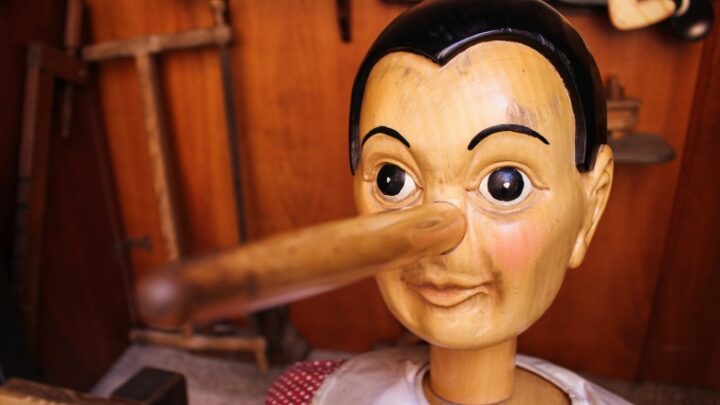
You are sitting with a book in your hands that no longer belongs to the person who wrote it. The cover says one name, but the creature inside has long since outgrown its author, annexed his biography, converted his intentions into raw material for something else entirely. Carlo Collodi published Occhi e nasi in 1878 and Storie allegre in 1887, collections of satirical sketches and comic vignettes that reveal a writer still committed to the biting Florentine wit that had shaped his journalism for three decades. They are sharp, occasionally cruel, technically accomplished. Almost nobody reads them. They exist in the bibliographic record the way a sculptor’s preparatory drawings exist — formally present, historically traceable, essentially invisible beneath the shadow of the single finished object that consumed the light.
What those later works expose, if you read them alongside the chronology, is a man who continued to function as a writer while something fundamental had already shifted beneath him. The puppet had been serialized in Il Giornale per i bambini beginning in 1881, the complete book published in 1883, and by the time Collodi was assembling Storie allegre he was not the same figure in Italian cultural life that he had been before Pinocchio. He had become, in a sense, a footnote to his own creation — still breathing, still producing sentences, but operating in a gravitational field that bent everything toward a single point. The irony is that he had not written Pinocchio as a monument. The first installment ended with the puppet hanged, dead, finished, and Collodi required editorial pressure to continue. The book that would survive everything he ever thought or said about literature was, at its origin, something he almost abandoned in the middle.
There is a philosophical problem embedded in this that Walter Benjamin gestured toward without quite naming in his 1936 essay on mechanical reproduction — the moment when a work detaches from the conditions of its making and begins to circulate as pure cultural mass, absorbing interpretations, national mythologies, and commercial apparatus until the original act of composition becomes almost irrelevant. Pinocchio had become Italian in ways Collodi had not consciously designed. It was taught in schools, cited in nationalist rhetoric, used as a vector for pedagogical ideologies that Collodi’s own satirical intelligence would likely have found sufficiently absurd to merit a cartoon in a Florentine newspaper. The boy who grows real by submitting to discipline became, in the hands of the early twentieth century Italian state, a parable about civic obedience — a reading that requires ignoring almost everything subversive and carnivalesque in the original text.
Collodi died in Florence on October 26, 1890, having spent his final years in relative quiet. He was sixty-seven. There is no dramatic conclusion available, no deathbed statement that resolves the question of what he understood about what had happened to his work. The silence of those last years is not the silence of a man who has said everything but of a man who may have recognized that further speech was beside the point. Some creations do not remain inside the logic of their author’s intentions — they migrate into collective imaginative property and begin to mean things the author neither placed there nor would necessarily endorse.
Whether any writer survives this kind of success is not a question with a comfortable answer. Survival in the biographical sense is trivial — Collodi lived seven years after publication and died with his name known across Italy. Survival in the authorial sense, the sense that matters to anyone who has ever tried to make something that carries their actual thinking, is another matter entirely, and the distance between Carlo Lorenzini the Florentine journalist and satirist and the global symbol of childhood, transformation, and the terror of becoming real is exactly the width of that question.
📖 From Pinocchio to the World of Italian Literature
Carlo Collodi stands at the heart of Italian literary culture, weaving childhood imagination with sharp social critique. His work connects to broader currents of Italian narrative, moral fable, and the struggle between innocence and a corrupting world. Explore these thematically related articles to deepen your understanding of the literary universe surrounding Collodi.
Italo Calvino: Life and Works
Italo Calvino is perhaps the most direct heir to Collodi’s spirit of playful yet profound Italian storytelling. Like Collodi, Calvino transforms fairy-tale structures into vehicles for philosophical exploration and social commentary. His works, from the Cosmicomics to Invisible Cities, continue the tradition of using fantastical narrative to illuminate the human condition.
GO TO THE SELECTION: Italo Calvino: Life and Works
Eco’s The Name of the Rose: Meaning and Analysis
Umberto Eco‘s The Name of the Rose shares with Collodi’s Pinocchio a deep fascination with the labyrinthine nature of truth, deception, and the search for knowledge. Eco constructs a world where signs and symbols lead the protagonist through layers of mystery, much as Pinocchio navigates a world riddled with false promises and moral tests. This article offers a rich analysis of how storytelling can encode philosophical complexity within an apparently accessible narrative.
GO TO THE SELECTION: Eco’s The Name of the Rose: Meaning and Analysis
Carlo Levi: Life and Works
Carlo Levi‘s Christ Stopped at Eboli represents another dimension of Italian literary humanism, one deeply concerned with marginalized voices and the moral weight of social exclusion. Collodi, writing in a newly unified Italy, was similarly preoccupied with poverty, education, and the fate of the vulnerable child in an indifferent society. Reading Levi alongside Collodi reveals a persistent thread of social conscience running through Italian literature.
GO TO THE SELECTION: Carlo Levi: Life and Works
Don Milani’s Letter to a Teacher: Analysis
Don Milani‘s Letter to a Teacher is a passionate indictment of an Italian educational system that abandons the children of the poor, a theme that resonates powerfully with Collodi’s depiction of Pinocchio’s fraught relationship with school and authority. Both works use the figure of the child as a lens through which to expose the failures of adult society. This article explores how Don Milani turned pedagogy into an act of political and moral resistance.
GO TO THE SELECTION: Don Milani’s Letter to a Teacher: Analysis
Discover More Stories on Indiecinema
If these literary journeys have sparked your curiosity, Indiecinema streaming is the perfect place to continue exploring. Our platform brings together independent and auteur films that share the same spirit of depth, imagination, and social conscience found in Collodi’s greatest works. Come and discover a cinema that dares to tell stories that matter.
👉 EXPLORE THE CATALOG: Watch Indie Films in Streaming
A vision curated by a filmmaker, not an algorithm
In this video I explain our vision

