
The Man Who Built Labyrinths to Tell the Truth
You are standing in a bookstore — not browsing, exactly, but drifting, which is a different thing entirely. The shelves press in from both sides and the light is slightly wrong, the way light is always slightly wrong in places that hold too many thoughts at once. Your fingers move along the spines without intention and then stop, arrested by something you cannot immediately name. A title. A thickness. A texture that suggests the book has already been read by someone who needed it desperately. You pull it out and the first sentence does something to you before you have even decided to read it. It does not welcome you. It implicates you.

This is not a metaphor for how literature works. This is precisely how Umberto Eco intended it to work, and he spent the better part of six decades building the theoretical architecture to explain why that arrested moment in the bookstore aisle is not accidental, not romantic, not mystical — but structural. He would say you were not choosing the book. You were being chosen by a system of signs you had been trained to read long before you learned the alphabet.
Umberto Eco was born in Alessandria, in the Piedmont region of northern Italy, on January 5, 1932. He died in Milan on February 19, 2016. Between those two dates he produced a body of work so laterally vast that no single discipline has ever fully claimed it — semiotics reached for him, literary theory reached for him, medieval studies reached for him, journalism reached for him, and popular fiction reached for him last, somewhat surprised to find him already there, waiting, with a knowing expression. He wrote his doctoral dissertation on the aesthetics of Thomas Aquinas in 1954. He published his first novel, The Name of the Rose, in 1980, at the age of forty-eight. It sold over fifty million copies worldwide. These two facts, placed in sequence, contain an entire argument about what serious thought is allowed to become.
The paradox that organizes everything Eco ever wrote is not complicated to state, but it is nearly impossible to fully absorb: he believed that fiction tells more truth than non-fiction, that the labyrinth is a more honest map of reality than any straight line, and that the reader who feels lost inside a text is closer to understanding the world than the one who feels they have understood it. This is not a comfortable position. It offers no firm ground. It suggests that the moment of recognition you feel when a sentence seems written directly for you is simultaneously a product of your own interpretive projections and a genuine encounter with meaning — and that these two things are not in contradiction. Roland Barthes had written about the death of the author in 1967. Eco responded, in effect, that the author never died but learned to hide inside the text more cunningly, leaving trails for the reader to follow and false doors for the ones who followed too confidently.
He was a medievalist who understood the internet before it existed. He was a semiotician who wrote page-turning detective fiction. He was a philosopher who appeared on television and seemed entirely at home there, not because he had simplified himself for the medium but because he understood the medium as a semiotic system like any other, with its own grammar of manipulation and its own possibilities for subversion. Susan Sontag, who was not easily impressed, called him one of the great European intellectuals of the twentieth century. He would have noted, with his characteristic mixture of erudition and mischief, that the category of “great European intellectual” is itself a constructed sign that says as much about those who deploy it as about those it names.
The mirror he held up was never flattering. It was something more unsettling than that. It was accurate.
Venetian Arcanum
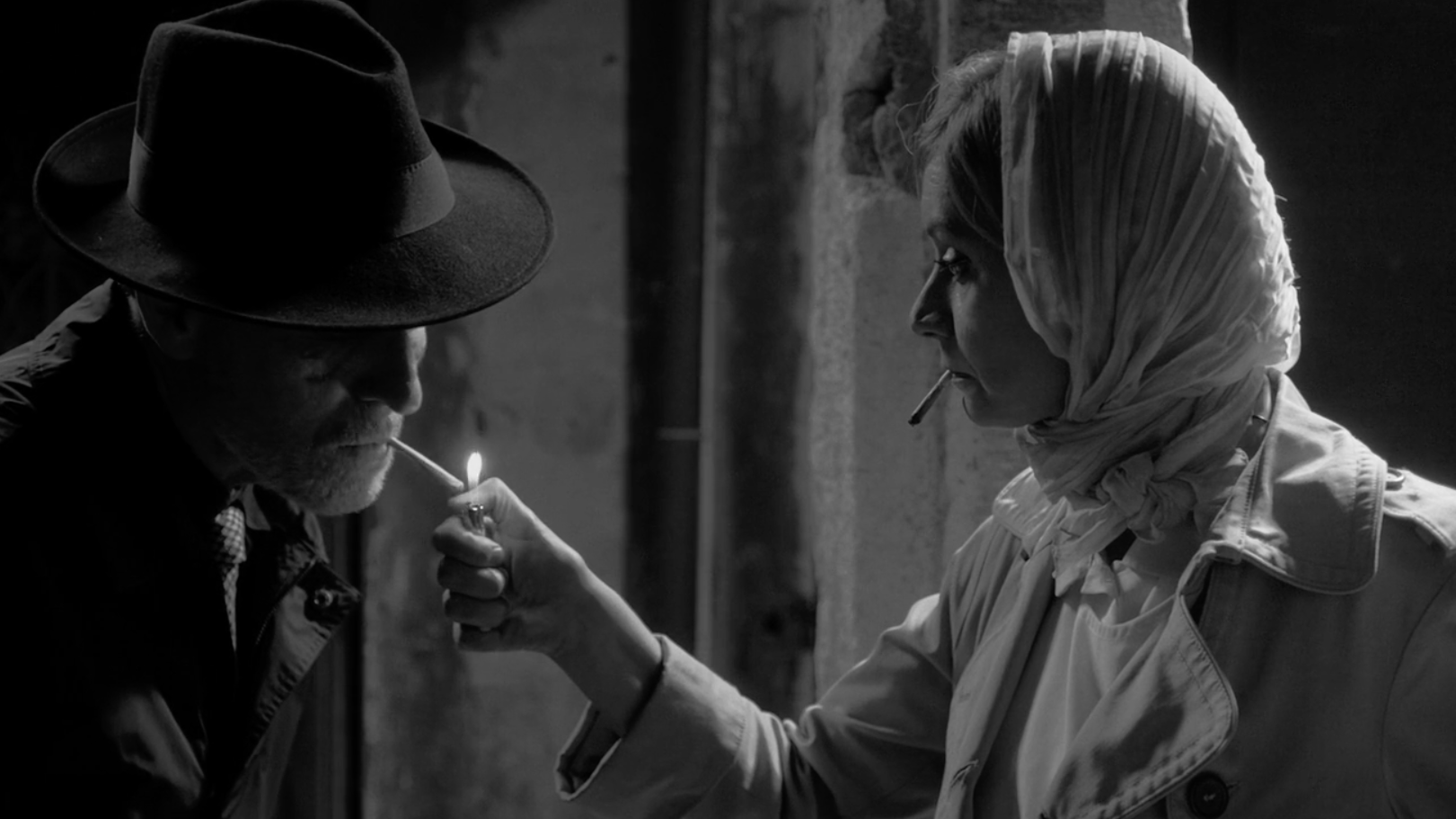
Thriller, by Serge Turgeon, Italy, 2025.
In Venice, a mysterious presence appears once every century or two, haunting the canals and hidden corners of the city. Driven by a sense of destiny, a woman decides to search for it. Following its elusive traces, she is drawn deeper and deeper into the city’s arcane secrets. Reality and myth begin to blur, and Venice itself transforms into a labyrinth of dangers.
LANGUAGE: Italian
SUBTITLES: English
Alexandria before the Fire: Growing Up Between War and Words
There is a photograph that exists in the mind even if you have never seen it: a boy in a black shirt, standing in a row with other boys in black shirts, arm raised, chin lifted, face bright with the particular joy of belonging. He is not performing. He is not afraid. He is happy, genuinely happy, because the ceremony around him feels like the natural order of things, because the songs they are singing are the only songs he has ever known, because the arm raised in salute feels no more ideological than raising your hand to greet a neighbor. This is Umberto Eco at eight, at nine, at ten, in Alessandria, a gray and pragmatic city in Piedmont that he would later describe with the affectionate contempt one reserves for the place that made you.
He was born on January 5, 1932, the son of Giulio Eco, an accountant who worked with the steadiness and silence of someone who understood that stability was not given but constructed. But the deeper inheritance came from his maternal grandfather, a typographer — a man whose hands had touched every letter of the alphabet before assembling them into meaning, who left behind thousands of books as though they were the most natural thing to bequeath. Eco grew up between those two poles: the disciplined arithmetic of his father’s world and the infinite disordered abundance of his grandfather’s library. He learned early that words had weight, that they could be arranged and rearranged, that they were not transparent windows onto reality but objects in themselves, with texture and history and the capacity to deceive.
And yet none of this protected him from the air he breathed. Fascism in Italy by the early 1930s had already ceased to be a political program and become something closer to a climate. Roland Barthes, writing in Mythologies in 1957, identified precisely this mechanism: the way ideology transforms itself into nature, into second nature, into what simply is. It stops presenting itself as a choice and begins presenting itself as biology. You do not adopt it; you metabolize it. The boy in the black shirt is not a victim of propaganda in any simple sense — he is a participant in a world that has successfully erased the line between the constructed and the given.
Eco understood this only much later, and the understanding cost him something. He would write, with the precision of someone who has spent years examining a wound, that he had been a fascist child without knowing it — which is precisely the condition Barthes was describing, the condition in which knowledge is structurally unavailable because the framework for producing it has been occupied. You cannot critique the water when the water is the medium of all your thinking. The youth rallies, the songs, the ceremonies of collective ardor — none of these registered as indoctrination because indoctrination registers only when you already possess a contrasting reference point. He had none.
What broke the spell was not a single revelation but a gradual accumulation of friction. The books his grandfather left him were indifferent to the Fascist syllabus. They contained voices that did not march in formation, ideas that contradicted each other without apology, histories that ran at odd angles to the official story. A library, Eco would later suggest, is by nature subversive — not because of what it contains, but because of what it implies: that there is always more than one version, that the world is not finished, that certainty is a posture and not a destination.
He was a boy who had been given, simultaneously, a state that demanded uniformity and a grandfather who had left him the evidence that uniformity was a lie. The tension between those two inheritances would not resolve in childhood. It would become the engine of everything he ever wrote.

The Middle Ages as a Diagnostic Tool
You walk into a cathedral and something happens to you before you can stop it. The ceiling pulls your eyes upward, the light enters at angles that seem calculated to make you feel small and significant at once, and the stone tells you something — not in words, not in argument — but in sheer accumulated weight. You did not come here to pray. You do not believe in anything the building was designed to consecrate. And yet it works on you. The architecture is doing something that used to require God to accomplish, and God, apparently, is optional.
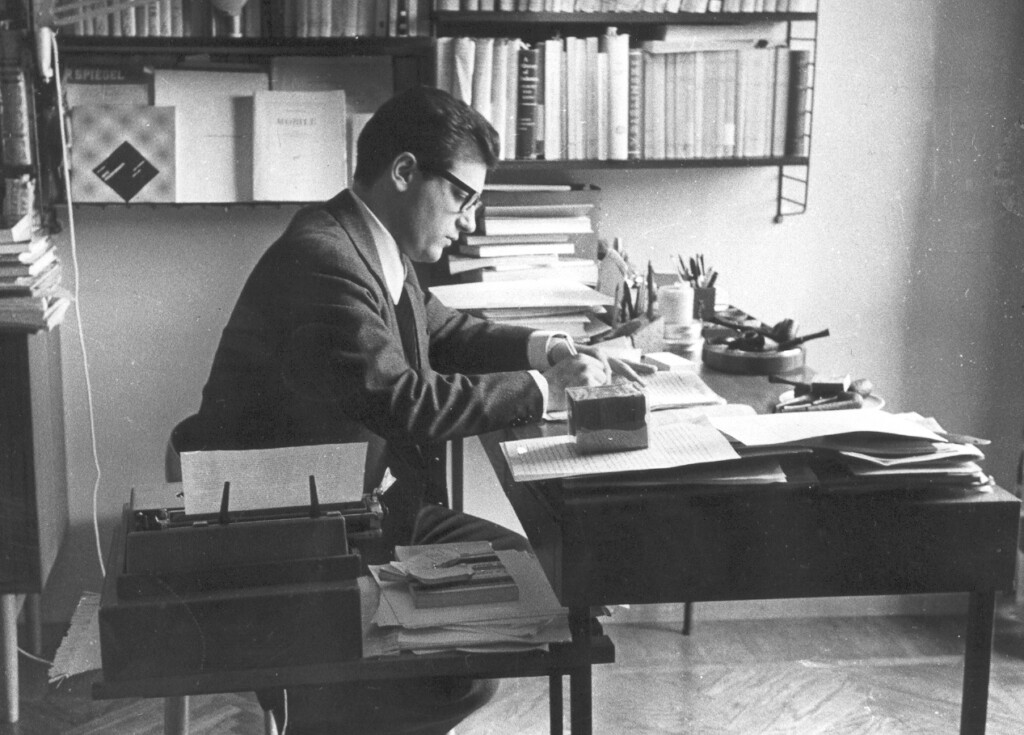
This is precisely what Umberto Eco spent decades trying to explain, and he began explaining it as a young man of twenty-two in Turin, crouched over the Summa Theologiae with the particular obsession of someone who suspects that medieval thought contains not a buried past but a very active present. His 1954 thesis, published as Il problema estetico in Tommaso d’Aquino, was not an act of historical retrieval. It was a diagnostic operation. Thomas Aquinas, for Eco, was not a figure to be admired from a respectful distance but a thinker to be interrogated — because Aquinas had understood something essential about how beauty functions as a vehicle of cognitive order. The integritas, consonantia, and claritas that Aquinas identified as the components of aesthetic experience were not merely theological abstractions. They were a theory of how meaning becomes attached to form, how the perceiving mind is structured by what surrounds it, how a culture manufactures its own sense of the obvious.
Ernst Gombrich had argued in Art and Illusion, published in 1960, that perception itself is historically conditioned — that we do not simply see, we see according to schemas inherited from our cultural moment. Eco took something similar and pushed it further: the Middle Ages were not an era that had ended. They were a structural condition that kept returning, kept reasserting itself beneath the surface of every supposedly modern dispensation. The monastery library, with its controlled access to knowledge and its hierarchical arrangement of texts, was simply the blueprint. Everything built afterward — the university, the encyclopedia, the database, the search engine — repeated the same foundational gesture of deciding what counts as knowledge and what gets archived in the dark.
A man moves through a reconstructed medieval village somewhere in the American Midwest, paying an entrance fee, eating food sold as authentically ancient, watching craftsmen perform trades in costumes. He is moved. He cannot explain why. Something in the arrangement of the stones and the wooden signs and the smell of hay convinces him, briefly, that time is not linear — that the past is not gone but simply waiting behind a door you can pay to open. This is the hyperreal in Eco’s precise sense: not the false as opposed to the true, but the false that has become more real than the real because it has been purified of all the ambiguity and disappointment that actual reality contains. In Travels in Hyperreality, published in English in 1986, Eco argued that this hunger for the reconstructed past, for the absolute fake, was not a modern aberration. It was medieval in its deep logic — the same logic that built reliquaries to house fragments of saints, that made the copy more venerable than the thing copied, that understood representation not as secondary but as primary.
The cathedral had taught this before anyone theorized it. Its stained glass told stories to illiterate congregants, encoding doctrine in color and narrative, making the walls themselves into a controlled information system. Eco had looked at Aquinas and seen not theology but semiotics in its first institutional form — the organized production of the meaningful, the careful architecture of what a community is permitted to understand.
Signs, Lies, and the Science of Everything That Could Be Otherwise
You watch something that moves you completely. Not just emotionally — you feel understood by it, as if whoever made it had been watching your life and decided to encode it back to you. You leave with a certainty so total it barely registers as interpretation. It simply happened. You know what it meant.
Then someone describes the same thing to you, and you feel the floor tilt.
Not because they are wrong, exactly. Because they are entirely right in a way that cannot coexist with your rightness, and yet there you both are, standing on the same ground, having experienced the same sequence of images and sounds, and the thing you each walked away with is as different as two different lives. The unsettling part is not disagreement. The unsettling part is that both of you are describing something real.
This is the problem Eco detonated into Italian intellectual life in 1962 with Opera aperta, and the explosion has never entirely stopped reverberating. The argument was, on its surface, a claim about aesthetics: that the works of the contemporary avant-garde — Berio, Stockhausen, Mallarmé, Joyce — were structured around deliberate openness, around gaps that demanded the reader or listener to move through, complete, close temporarily and reopen. But the deeper argument was about meaning itself, about what happens between a sign and a mind, and it was not gentle. If meaning is not deposited in the text like a letter in a sealed envelope, if it is instead generated in the encounter, then every act of interpretation is also an act of creation, and the author surrenders something irretrievable the moment the work leaves their hands.
Ferdinand de Saussure had already split the sign into signifier and signified, had already argued in the Cours de linguistique générale — reconstructed from student notes after his death in 1913 — that the relationship between a sound and a concept is arbitrary, conventional, held in place not by nature but by collective agreement. The word dog does not resemble a dog. It works because we all agreed, silently and without meeting, to make it work. Charles Sanders Peirce pushed further and stranger: his triadic model of sign, object, and interpretant refused to let meaning settle anywhere stable. Every interpretant becomes itself a sign requiring another interpretant, in an infinite chain he called semiosis, a process with no necessary terminus. Meaning is not a destination. It is a movement.
Eco absorbed both and made them collide productively. By 1968, in La struttura assente, he was already moving toward a semiotics that could account not just for literature but for architecture, advertising, fashion, urban space — for the entire environment of signs that human beings have built around themselves and then forgotten they built. When A Theory of Semiotics arrived in 1976, published in English and immediately absorbed into university curricula across three continents, it was not merely a contribution to an academic field. It was an attempt to describe the machinery underneath all human communication, the hidden structure that makes it possible for anyone to mean anything at all.
What Eco kept returning to, through all of it, was a distinction that sounds technical until it touches your life: the difference between a sign and a lie. His famous provocation — that semiotics is the discipline that studies everything that can be used to lie — is not cynicism. It is precision. A sign that could not deceive could not signify. The capacity for falsehood is not a corruption of meaning; it is the condition of meaning. You can only be misled by something that could have led you truly. The ground that shifts beneath you when someone else’s interpretation lands is not evidence of failure. It is evidence that the sign was real.
The Name That Changed Everything: 1980 and the Novel as Philosophy
There is a kind of certainty that does not announce itself as violence. It arrives quietly, in the form of care — the careful hand that removes a book from a shelf, the deliberate and almost loving gesture of a man who believes he is protecting something sacred by making sure no one else can touch it. You have seen this gesture. You may have performed a version of it yourself, convinced that some knowledge, placed in the wrong hands, becomes a weapon. The instinct feels protective. It feels, in fact, like wisdom.
In 1980, Umberto Eco published a novel that understood this instinct better than most works of philosophy ever had, and then proceeded to incinerate it — along with a library, along with a monk, along with the comfortable idea that the pursuit of truth is an act of heroism rather than an act of devastation. The book sold ten million copies by the mid-1990s and was translated into more than forty languages, numbers that belong to the category of cultural phenomena rather than literary careers. But treating that fact as a story about commercial success is a way of not seeing it at all. Something else happened. Something the reader needed without knowing they needed it.
The question worth asking is not how a semiotics professor wrote a bestseller. The question is why this particular book — dense with medieval theology, Aristotelian logic, labyrinthine architecture and manuscript Latin — found its way into hands that had never heard of Charles Sanders Peirce or Roger Bacon. The answer has nothing to do with accessibility and everything to do with recognition. Eco gave the reader something they already suspected about the world but had never seen articulated with such structural precision: that the most dangerous intellectual act is not ignorance. It is the certainty of having found the final, singular truth.
William of Baskerville is built as a deliberate inversion of every detective the Western tradition had ever produced. Where the classical investigator moves toward revelation — toward the bright, clean moment when all ambiguity collapses into solution — William moves through multiplicity, entertaining false hypotheses with the equanimity of a man who has understood that reasoning is a method, not a destination. He draws on Roger Bacon’s empiricism, on Franciscan epistemological humility, on what Eco himself had theorized in A Theory of Semiotics in 1976 — the idea that signs do not point to fixed meanings but generate endless chains of interpretation, each reading opening onto another rather than closing into truth. And then William solves the mystery. And the library burns. And the old monk who guarded its forbidden center dies clutching the very text he had decided humanity could not survive knowing. The resolution is catastrophic precisely because the reasoning was correct. This is not a detective story with an ironic ending. It is a philosophical argument about what correctness costs.
Jorge of Burgos — the blind guardian of the forbidden Aristotle, the second book of the Poetics, the one concerning comedy and laughter — does not see himself as a censor. He sees himself as a theologian. He is protecting the order of things. Eco’s thesis, embedded in the architecture of the narrative rather than stated as argument, is that censorship is always theological in this sense: it is always performed by someone who believes they are standing between humanity and a truth too dangerous to survive contact with. The mechanism is constant across centuries. What changes is only the name of the sacred principle being defended — God, reason, the revolution, the market, public health, national security. The gesture remains identical. The loving, careful hand removing the dangerous thing from the shelf.
What Eco had understood — and what Roland Barthes had been circling in S/Z a decade earlier, in 1970, when he distinguished between the “readerly” text that closes and the “writerly” text that opens — is that closed systems always require a keeper. Every singular truth produces its Jorge. Every labyrinth needs someone who has decided which corridors must never be walked.
A vision curated by a filmmaker, not an algorithm
In this video I explain our vision
Foucault’s Pendulum and the Paranoid Structure of Belief

It is three in the morning and you cannot stop. The phone screen is the only light in the room and you have been scrolling for two hours now, and somewhere in the last forty minutes something shifted — you stopped reading and started connecting. This politician mentioned that date. That organization shares an acronym with this one. The symbol appears twice, in different countries, in documents forty years apart. Your heart is beating faster than it should be. You feel, and this is the terrible part, genuinely illuminated. The world has just become legible in a way it never was before, and the fact that no one else can see it makes the pattern feel more real, not less.
Eco published his second major novel in 1988 and the critics reached for the word “baroque” the way critics always reach for a word when they mean “I could not follow this and I resent it.” They called it excessive, labyrinthine, a display of erudition for its own sake. They missed the point with a precision that was almost elegant, because missing the point is exactly what the novel is about. Three editors at a vanity publishing house, bored and clever and slightly contemptuous of the conspiracy manuscripts they spend their days processing, decide to invent the ultimate conspiracy — to feed every fragment of occult history, every Templar document, every Rosicrucian pamphlet into a computer and let the connections emerge. They call it the Plan. And then the Plan begins to feel real. And then other people start believing it. And then people start dying for it.
Walter Benjamin wrote about what he called the dialectical image — the moment when a fragment of the past collides with the present in a flash of sudden recognition, what he described in the Arcades Project as the “now of recognizability.” It is not a metaphor for historical understanding but the actual mechanism of it: meaning does not accumulate gradually, it arrives in an instant of collision. What Eco understood, and what makes the novel genuinely disturbing rather than merely clever, is that this same mechanism is how paranoid thinking operates. The flash of recognition that tells you something is true is identical whether the truth is real or invented. The feeling of suddenly seeing through appearances, of grasping the hidden structure beneath the noise — that feeling is the same regardless of whether there is anything there.
The novel’s real subject is the seduction of coherence. The human mind, as the cognitive psychologist Michael Gazzaniga documented extensively in his work on the brain’s left hemisphere, is fundamentally a pattern-completion machine. His research throughout the 1970s and 1980s demonstrated that the interpreter function of the brain will generate explanatory narratives for random stimuli with complete confidence and no awareness that it is confabulating. We are not built to tolerate randomness. Meaninglessness is physiologically uncomfortable in a way that false meaning is not. A world governed by a secret conspiracy is, paradoxically, less frightening than a world governed by nothing at all, because at least the conspiracy can in theory be understood, resisted, defeated. Chaos cannot.
This is where Eco’s warning becomes something sharper than satire. The characters in his novel do not become believers because they are stupid. They become believers because they are intelligent enough to find the connections that are always available to anyone who looks hard enough. The connections are real. The Templars existed. The dates align. The symbols recur. The interpretation is the madness, not the data. And the transition from interpretation to certainty, from pattern to proof, from curious inquiry to the absolute conviction that you alone have seen what others cannot — that transition is seamless, it announces nothing, it leaves no visible seam in the fabric of the thinking.
Eco wrote this in 1988. The internet did not yet exist. The architecture of mass pattern-finding, the infrastructure that would allow three-in-the-morning scrolling and the algorithmic amplification of connection, was still more than a decade away.
The Intellectual as Public Irritant: Essays, Columns, and the Ethics of Saying Things
Every week, for decades, a column appeared in L’Espresso. Not a meditation. Not a cultural reflection offered gently to Sunday readers who wanted to feel intelligent over coffee. Something more like a letter from someone who has decided, once and for all, to stop pretending not to notice what everyone else is pretending not to notice.
Eco understood something that most intellectuals who enter public discourse eventually forget: the moment you accept the invitation to explain the problem, you have already become part of the problem. Neil Postman, in Amusing Ourselves to Death in 1985, gave us the diagnosis with extraordinary clarity — that television does not merely carry content but transforms the very structure of thought, that entertainment colonizes every form of public discourse including the discourse that complains about it. What Postman described as a crisis, Eco treated as a trap. And the trap was not television. The trap was the intellectual standing in front of a camera, speaking with grave authority about the dangers of speaking in front of cameras, reaching millions of viewers who would applaud the critique and change absolutely nothing, including their viewing habits. There is something almost cosmically precise about a man delivering a lecture on the infantilization of public life that is then broadcast as an episode of a cultural program, complete with opening music and a production team.
Eco wrote about this with what you could only call surgical cruelty. Travels in Hyperreality, published in Italian in 1973 and reaching American readers in 1986, had already mapped the territory: a culture that replaces reality with enhanced copies of reality and then insists the copies are more real than what they replaced. The wax museum that is more satisfying than the actual past. The reconstructed historical village that feels more historical than history. What he was describing was not merely an American phenomenon, however convenient it was to locate it there. He was describing a logic that any sufficiently comfortable society will eventually apply to its own intellectual life — replacing the discomfort of genuine thought with the simulation of thought, replacing the disturbance of real ideas with the aesthetic experience of seeming to engage with them.
How to Travel with a Salmon, Five Moral Pieces — these books are often catalogued as lighter fare, as Eco relaxing, as the great semiotician in a playful mood. This misreads them almost completely. The humor in these texts is not the humor of relief. It is the humor of someone who has realized that pointing directly at absurdity no longer surprises anyone, and so has decided to approach it from the side, to let the reader laugh and then sit very still in the silence after the laughter, wondering what exactly they just found funny and why it felt so familiar. Five Moral Pieces, written between 1997 and 1997, addresses war, tolerance, fascism, ugliness, and the internet with a precision that refuses every consolation. There is no path offered out of these problems. There is only the insistence that you look at them without the protective film of comfortable interpretation.
The intellectual’s job, in Eco’s practice, was never to console culture. It was to destabilize it — not through provocation for its own sake, which is merely another form of entertainment, but through the demonstration that the things you have accepted as natural are in fact chosen, that the agreements you have entered into were negotiated without your full awareness, that the ground beneath your certainties is composed almost entirely of conventions that someone, at some point, decided to stop questioning. The column in L’Espresso was not commentary. It was weekly surgery performed on a patient who kept insisting, cheerfully and loudly, that there was nothing wrong with them at all.
The Last Labyrinths: Late Work, Legacy, and the Open Question
There is a man writing in his diary, and he hates. Not in the way hatred is usually rendered in fiction — conflicted, historically explicable, internally redeemed by some flicker of hesitation — but with the flat, administrative consistency of someone who has never once questioned the architecture of his contempt. He records his antisemitism the way others record weather. He is the narrator of a novel, and he is given no exit, no lesson, no authorial rescue. The reader finishes the book and looks for the moral handhold and finds nothing to grip. This is not an oversight. It is the entire argument.
Eco published this novel in 2010, and the discomfort it generated in reviewers was itself a kind of evidence for the thesis embedded in the work. Readers wanted the ugliness framed, contextualized, made safe by narrative distance. What they received instead was a demonstration of how hatred actually functions — not as aberration but as system, not as passion but as constructed meaning, assembled from symbols and repetitions and falsified documents until it feels like memory, like inheritance, like truth. Eco had argued in his earlier theoretical work, drawing from Peirce’s semiotics, that signs do not carry meaning — they produce it, through use, through iteration, through the communities that repeat them. Hatred is a semiotic practice. To understand it, you must enter it without anesthesia.
This was not a late radicalization. It was the logical terminus of a career spent examining how meaning is manufactured and weaponized. His work on the medieval Encyclopaedia, on the aesthetics of Thomas Aquinas, on the limits of interpretation — all of it pointed toward the same uncomfortable recognition: that human beings are not meaning-receivers but meaning-makers, and that this capacity is neither inherently noble nor inherently dangerous, but simply constitutive, inescapable, and therefore requiring the most rigorous possible scrutiny.
His final novel arrived in 2015, one year before his death on February 19, 2016. It was set inside a failing newspaper, narrated by a writer hired to produce a fake history for a fake publication, surrounded by conspiracies that may or may not be real, in a media landscape where the distinction between fabrication and report has become purely aesthetic. The book felt less like a late-career coda than like a warning sent from the future, arriving slightly ahead of schedule. Fake news, manufactured consensus, the industrial production of alternative realities — Eco had watched these mechanisms assembling themselves for decades, had traced their genealogy through the history of forgery and propaganda, had named them with scholarly precision long before they acquired their present political urgency.
What made him an uncomfortable figure for easy canonization was precisely this refusal to offer the consolation of resolution. He did not believe that naming a problem constituted its solution. He did not believe that critical awareness automatically immunized anyone against the traps it identified. He had written in 1964, in Apocalittici e integrati, that mass culture criticism performed a peculiar self-flattery — the intellectual who denounces manipulation thereby exempting himself from it, as though the act of description lifted you above what you were describing. He spent the rest of his career refusing that exemption for himself as much as for anyone else.
The question he never stopped turning over — in semiotics, in fiction, in cultural criticism, in the essays collected across fifty years of restless productivity — was not whether interpretation is possible but what interpretation costs. If every text is open, if signs slide, if meaning is always negotiated rather than given, then the demand for truth is not a discovery of something fixed but an act, a choice, a wager placed against the entropy of signification. And the wager is never made in the abstract — it is made in specific historical moments, under specific pressures, by specific human beings who have reasons to want the world to mean one thing rather than another.
That is not a problem Eco solved. It is a problem he rendered permanently inescapable.
🌀 The Labyrinth of Signs, Meaning, and Culture
Umberto Eco navigated the intersections of semiotics, medieval thought, and postmodern narrative with extraordinary intellectual range. The following articles explore the thinkers and traditions that most closely resonate with his work — from the architecture of the Middle Ages to the philosophy of language and cultural criticism.
Italo Calvino: Life and Works
Italo Calvino, like Eco, made the structure of narrative itself a subject of literary inquiry. His combinatorial fictions and reflections on multiplicity find deep echoes in Eco’s own exploration of the open work and the infinite possibilities of interpretation. Both writers transformed Italian literature into a laboratory of ideas where storytelling and philosophy become inseparable.
GO TO THE SELECTION: Italo Calvino: Life and Works
Calvino’s If on a Winter’s Night a Traveler: Analysis
Calvino’s ‘If on a Winter's Night a Traveler‘ is one of the most radical experiments in self-referential fiction, a hall of mirrors in which the reader becomes a character and reading itself becomes the subject. This metafictional labyrinth shares essential DNA with Eco’s theoretical concept of the open work and his own narrative experiments in ‘The Name of the Rose.’ Both works invite the reader into a game of shifting identities and unstable meanings.
GO TO THE SELECTION: Calvino’s If on a Winter’s Night a Traveler: Analysis
Medieval Art: History and Meaning
Umberto Eco spent years as a scholar of medieval aesthetics before becoming a novelist, and medieval art was one of the foundational territories of his thought. His early academic work on the aesthetics of Thomas Aquinas and the symbolism of medieval culture shaped the intellectual landscape that would later produce ‘The Name of the Rose.’ Understanding medieval art is therefore essential to understanding the depths from which Eco’s imagination drew its most enduring images.
GO TO THE SELECTION: Medieval Art: History and Meaning
Jan Assmann and Cultural Memory
Jan Assmann‘s theory of cultural memory offers a powerful framework for understanding how civilizations encode meaning across time through texts, symbols, and rituals — a preoccupation central to Eco’s entire intellectual project. Eco was deeply interested in the mechanisms by which cultures transmit and transform their knowledge, from the encyclopedic ambitions of the library to the semiotic life of signs across centuries. Reading Assmann alongside Eco reveals the shared obsession with how meaning survives, mutates, and occasionally disappears into the labyrinth of history.
GO TO THE SELECTION: Jan Assmann and Cultural Memory
Discover Cinema That Thinks
If these ideas ignite your curiosity, Indiecinema streaming is the place where thought meets moving image. Explore our curated selection of independent and art-house films that engage with semiotics, philosophy, literature, and cultural memory — films that, like Eco’s labyrinth, reward those willing to get a little lost.
👉 EXPLORE THE CATALOG: Watch Indie Films in Streaming
A vision curated by a filmmaker, not an algorithm
In this video I explain our vision

