
The Room You Never Leave
You are in the middle of a conversation when it happens. Not during silence, not in the gap between two messages, but right there — while someone is still talking, while your phone is still lit, while the room has other people in it and the music is playing and there are seventeen unread notifications pulling at your peripheral vision like small fires. It arrives without announcement: a weight that settles just below the sternum, not pain exactly, more like the pressure of something occupying space inside your chest that was not there a moment ago. You do not reach for a word to name it. You reach for your phone.

This is the first thing modern loneliness teaches you: it does not wait for quiet. It does not require an empty room or a Friday night with no plans. It has learned to move through noise the way water moves through stone — not by breaking it, but by finding every existing crack. The ancient version of this feeling, the one philosophers and poets spent centuries mapping, was understood as absence. You were alone because something or someone was missing. The room was empty. The calendar was blank. The logic was spatial and clean. What has happened in the last two decades is that the architecture of that logic has been quietly demolished, and most people are still trying to live inside the blueprint of a building that no longer stands.
In 2023, the United States Surgeon General Vivek Murthy issued a formal advisory declaring loneliness an epidemic, citing data showing that roughly half of American adults reported measurable levels of loneliness — this in a country where the average person sends dozens of messages a day, maintains connections across multiple platforms, and is, by any historical measure of communication frequency, in near-constant contact with other human beings. The advisory was widely covered and almost immediately absorbed into the background hum of news that matters but does not change anything. What it described was not a paradox to most people. It was a Tuesday.
What sociology has struggled to articulate is what phenomenology already knew: that presence and connection are not the same category of experience. The German philosopher Edmund Husserl spent years between 1913 and the 1930s developing a framework for understanding consciousness as always directed toward something — intentionality, the quality of mental life that means you are never just experiencing, you are always experiencing something. His student Edith Stein extended this into the question of empathy, arguing in her 1917 doctoral dissertation that genuine intersubjective experience requires not just proximity but a specific kind of mutual recognition — a seeing that is also a being-seen. What screens offer is proximity without that circuit ever completing. You are visible to hundreds of people and witnessed by none of them, which is not the same as invisibility but is somehow more destabilizing, because it forecloses the excuse of simply not being there.
The sensation you felt in the middle of that conversation, the weight below the sternum, was not the absence of people. It was the presence of a particular kind of distance that has no name in ordinary language because ordinary language was built for a different topology of human contact. When you are separated from someone by miles, language gives you the word far. When you are separated from someone by the fact that neither of you is actually inhabiting the moment you are both performing, language offers you nothing. You improvise. You say you are tired. You say you have been stressed. You say things have been a lot lately, and the person across from you nods, and you feel the weight shift slightly without lifting, and you both move on, and the conversation continues, and nothing has been exchanged that was not already available, pre-packaged and painless, before either of you opened your mouth.
A Better Life
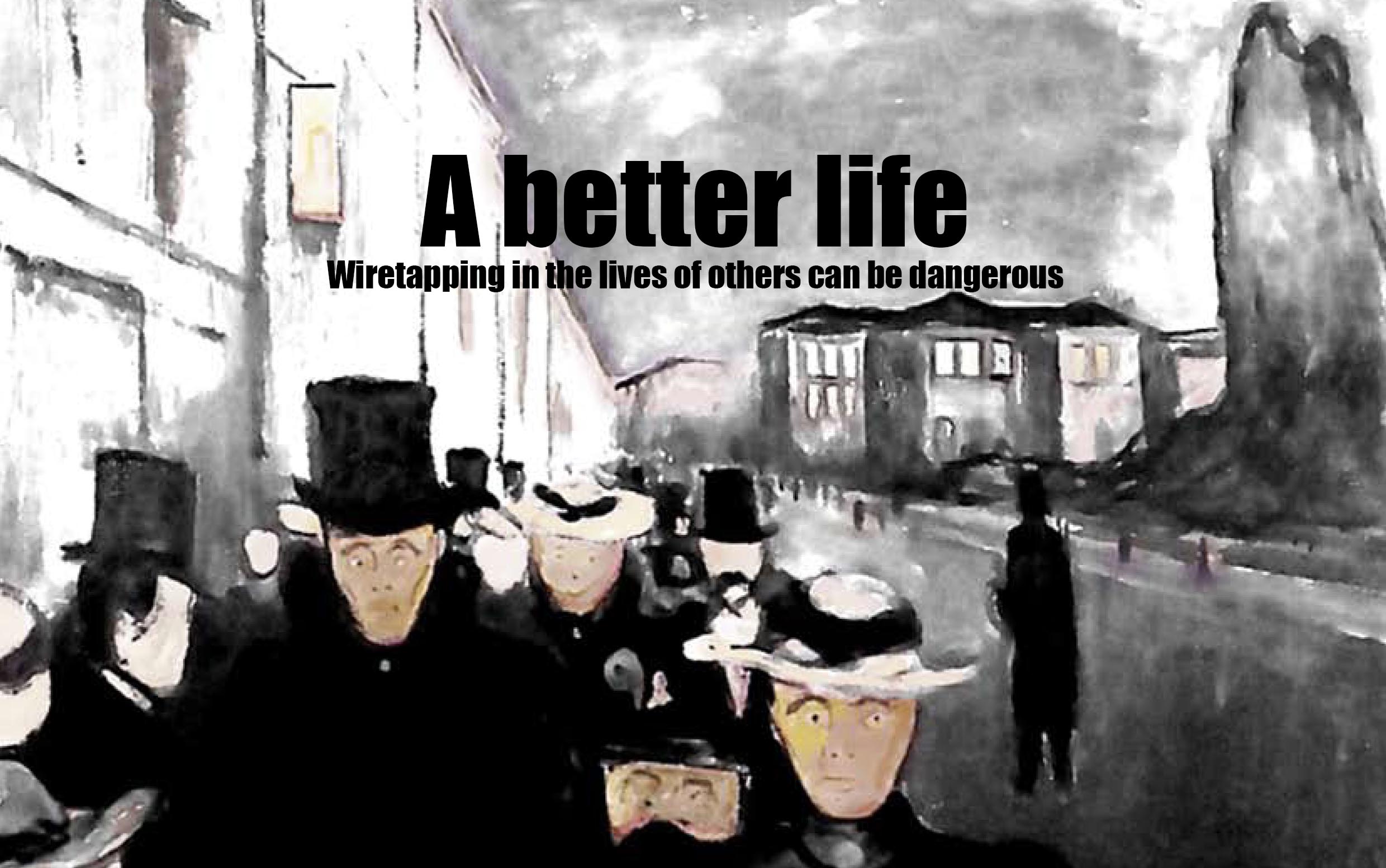
Drama, thriller, by Fabio Del Greco, Italy, 2007.
Rome: Andrea Casadei is a young investigator specializing in audio wiretapping who conducts investigations commissioned by husbands betrayed by their wives, or by parents worried about what their children are doing outside the home. But what interests him most is understanding the human soul, listening to casual conversations in the streets, knowing what people think. He often meets in Piazza Navona with his friend Gigi, a frustrated street artist obsessed with success at all costs, with whom he shares a passion for wiretapping. Shocked by the mystery of the disappearance of Ciccio Simpatia, another street artist common friend, Andrea decides to abandon the commissioned works to seek a better life and reflect on his own and others' existence. He will meet the actress Marina and with a bug he will slowly enter her life until he discovers her most unthinkable secrets. The film deals with an important theme of contemporary Western society: the lack of love. The mysterious and tormented figure of Marina is reflected in a gloomy and soulless Rome.
Director Fabio Del Greco declared about his film: "Perhaps this film is a reflection on the art of observing, of listening, in short, of what one does when one leaves the real world to tell about it. Perhaps he wants to talk about the subtle relationship between the mirages of success touted by today's society, power and the most authentic human relationships.A 'dark cloud' hangs over the city: it is engulfing everyone in a sort of indistinct, uniform mass, where everyone thinks the same things, where everyone they are more alone. Where is the truest part that makes us unique? Maybe you can try to intercept it only secretly."
LANGUAGE: Italian
SUBTITLES: English, Spanish, French, German, Portuguese, Dutch.
The Invention of the Individual
You are standing in a room full of people you chose to be with, and the feeling arrives anyway — not dramatically, not with tears, but as a low-frequency hum beneath everything, the sense that you are watching your own life from slightly behind your eyes. Nobody did this to you. That is precisely what makes it so disorienting.
The self that feels this way — bounded, interior, fundamentally separate from others — is not a biological given. It is a historical product, assembled over centuries with considerable philosophical effort and extraordinary social consequence. John Locke argued in his 1689 Essay Concerning Human Understanding that the person is constituted by consciousness and memory, a continuous thread of self-awareness that each individual carries privately through time. This was not merely a theory of mind. It was an architectural decision about what a human being fundamentally is: not a node in a web of relations but a sovereign unit, prior to and independent of its social world.
The Protestant Reformation had already prepared the ground. When Martin Luther stood at Worms in 1521 and declared that his conscience was bound to Scripture alone, he was doing something far more radical than challenging ecclesiastical authority. He was relocating the site of moral truth from the community and its institutions to the interior of the solitary individual. The unmediated soul — answerable to God without priest, without ritual, without collective interpretation — became the template for a new kind of person. Salvation itself became a private project. And private projects are, by definition, ones you undertake alone.
What followed was not simply theological but economic. Max Weber traced in The Protestant Ethic and the Spirit of Capitalism, published in 1905, the way this inward turn fused with the emerging demands of market society. The disciplined, self-monitoring individual who scrutinizes his own motives, defers gratification, and measures his worth through productive output was not a natural human type. He was a cultural construction that happened to be extraordinarily useful for a particular mode of production. The loneliness embedded in this model was not incidental. It was load-bearing. Autonomous individuals do not redistribute risk communally. They compete, accumulate, and consume — each one sealed inside the unit of the self.
By the time Alexis de Tocqueville toured the United States in the 1830s and published his observations in Democracy in America, he saw clearly what this architecture produced. He coined the term individualism in the modern sense precisely to name a new phenomenon: the tendency of citizens in democratic societies to withdraw into the small circle of family and friends, cutting themselves off from the wider fabric of civic life. He considered it a danger, not a virtue. The word had not yet acquired the heroic connotation it carries now, the cultural gloss of self-reliance and authenticity that makes people defend their own isolation as an achievement.
That gloss was applied deliberately and over time. The Romantic movement of the late eighteenth and early nineteenth centuries aestheticized solitude, transforming what was a social wound into a mark of depth. The solitary figure on the cliff’s edge, turned away from society, became an icon of spiritual seriousness. Rousseau’s confessional voice, Byron’s exiled heroes, the entire machinery of Romantic self-fashioning — these did not merely reflect a cultural shift. They created a preference. They taught people to experience their disconnection as evidence of their specialness rather than as a symptom of something structurally broken.
The result is a population that has thoroughly internalized its own isolation as identity. Loneliness, in this framework, cannot be named as a political condition because it has been successfully reclassified as a personal one — proof of your inner life, your complexity, your refusal to be merely ordinary. The trap is elegant precisely because it flatters the person inside it.

Durkheim’s Unanswered Question

You are at a party where you know almost everyone in the room. You have replied to forty-three messages today. You have been photographed smiling, and the photograph has been liked. And yet somewhere between the third drink and the moment someone calls your name from across the room, a feeling moves through you that is almost geological in its depth — not sadness exactly, not grief, but a kind of groundlessness, as if the floor beneath the social ritual is made of something that doesn’t quite hold weight.
Émile Durkheim spent years trying to name that floor. In 1897, he published what remains one of the most counterintuitive documents in the history of social science — a study of suicide that was not really about death at all, but about the invisible architecture of belonging. His central finding was brutal in its simplicity: people do not come undone because they are isolated. They come undone when the normative structures that give their lives coherent meaning dissolve. He called this condition anomie, from the Greek meaning “without law” — not the law of courts and constitutions, but the unspoken law of shared expectation, mutual orientation, the quiet agreement between a person and their society about what things are supposed to mean. When that agreement breaks down, connection becomes noise. You can be surrounded and still be nowhere.
What makes Durkheim’s diagnosis so difficult to absorb today is that the breakdown he described was, in his time, still legible as breakdown. Industrialization had visibly shattered the village, the guild, the parish — institutions whose loss could be pointed to, mourned, replaced in imagination. The anomic individual of the late nineteenth century had at least the comfort of knowing what had been lost. Contemporary loneliness enjoys no such clarity. The institutions have not disappeared; they have multiplied and accelerated and become frictionless. There is more social infrastructure available to a person in 2024 than at any point in recorded history — more platforms, more forums, more communities organized around every conceivable identity and interest. And yet the American Surgeon General issued a formal advisory in 2023 declaring loneliness a public health epidemic, with data showing that roughly half of American adults report measurable levels of social isolation. Durkheim’s anomie has not been solved by abundance. It has been deepened by it.
The mechanism is not obvious, which is why it keeps being misread. The dominant explanation — that screens have replaced presence, that digital connection is a pale substitute for physical contact — is seductive but insufficient. It locates the problem in the medium when the problem is in the structure. What technology has actually done is accelerate the pluralization of normative worlds. Every platform runs on its own implicit contract about what counts as meaningful, what deserves attention, what constitutes a relationship. A person navigates dozens of these contracts daily, shifting registers so rapidly that no single register ever fully crystallizes into the kind of shared moral grammar Durkheim identified as the precondition for genuine cohesion. The result is not the absence of connection but the absence of weight — interactions that register and vanish, commitments that form and dissolve, the persistent sensation of being in contact without being in consequence.
Robert Putnam traced a version of this in Bowling Alone in 2000, documenting the collapse of American civic participation across the second half of the twentieth century — not in the dramatic registers of revolution or rupture, but in the quiet arithmetic of empty church pews, declining union memberships, PTA meetings that nobody attended. What he was measuring, without quite naming it in Durkheimian terms, was the erosion of the normative connective tissue — the stuff that makes shared life feel like shared life rather than parallel performance. His data preceded the smartphone by nearly a decade, which means the vector was already moving before the technology arrived to accelerate it.
The question Durkheim never fully answered, because it may not be answerable from inside sociology alone, is whether a society can produce new normative structures fast enough to replace the ones it destroys in the process of growing.
The Market for Belonging
You open the app because you feel the pull, that specific gravity in the chest that arrives around nine in the evening when the apartment is quiet and the day has finished spending you. Within forty seconds you have received three notifications, one reaction to something you posted six hours ago, one algorithmic suggestion of someone you might know, one reminder that your “streak” is in danger. The chest feeling does not go away. You scroll for another eleven minutes. The chest feeling does not go away.
What has just been sold to you is not connection. It is the simulation of connection’s preconditions — visibility, response, the sense that someone registered your existence — delivered at a dosage precise enough to interrupt the discomfort without resolving it. This is not a design flaw. Tristan Harris, former design ethicist at Google, described the architecture of these platforms as a “slot machine in your pocket” in testimony before the U.S. Senate in 2019, and the metaphor is more clinical than it sounds. Variable reward schedules, first mapped by B.F. Skinner in his operant conditioning research of the 1950s, produce behavioral persistence precisely because the reward is unreliable. You do not keep pulling because it works. You keep pulling because it almost works.
The economy of attention, a phrase that the sociologist Georg Franck systematized in his 1998 work Mentaler Kapitalismus, operates by capturing the surplus of human longing and converting it into a tradeable asset. Loneliness is not a problem this economy seeks to eliminate. It is the raw material it requires. A person who feels genuinely connected to others, whose social fabric is dense and reciprocal and locally sustained, has little reason to pay fourteen dollars a month for a meditation app that ends each session with a prompt to share your experience with the community, which is itself a feed, which is itself a product. The therapeutic language — community, belonging, wellness — is the packaging. The mechanism underneath is extraction.
Coworking spaces are perhaps the most architecturally honest version of this substitution. They emerged in their current commercial form around 2005, accelerating through the 2010s into a global industry valued at over twenty-six billion dollars by 2023. They are sold explicitly on the promise of mitigating the isolation of remote and freelance work — “work alongside brilliant people,” the marketing copy invariably says — and what they deliver is proximity without obligation, the visual grammar of community without its metabolic cost. You sit near other human beings. No one asks you how you are and means it. The loneliness is aestheticized, given exposed brick and good coffee, and therefore becomes more bearable, which is exactly what makes it more permanent.
What Richard Sennett traced in The Corrosion of Character in 1998 — the dismantling of long-term commitment, the replacement of durable institutions with flexible arrangements — has now been extended inward, into the architecture of how people seek each other. Flexibility, once a feature of economic organization, has become the dominant emotional mode. Relationships are maintained at the level of low commitment, easily exited, algorithmically suggested, never allowed to accumulate the weight that makes them irreplaceable. The market did not impose this on an unwilling population. It offered it to people who were already exhausted by the demands of depth, and the offer was accepted.
There is a particular cruelty in the fact that the same capitalism which dissolved the neighborhood, the union hall, the multigenerational household, and the parish — the non-commercial structures inside which belonging once occurred as a byproduct of shared life — then returned to sell belonging back as a premium product. The dissolution and the replacement were not separate historical events. They were sequential moves in the same logic, and the profit was extracted twice: once when the original structure was dismantled, and once when the simulation was sold to fill the space it left.
What Togetherness Was Actually Doing
You are sitting at a table at Thanksgiving, surrounded by people who have known you your whole life, and you have never felt more carefully watched. Every sentence you risk is measured against a version of you that was decided before you were old enough to object. This is not a failure of love. It is love operating exactly as it was designed to.
The grief many people carry today about the loss of community is real, but it is grieving a construction. The communities that supposedly anchored human life before the internet, before urban anonymity, before the fragmentation of the nuclear family, were not simply warm. They were regulatory. Ferdinand Tönnies wrote about Gemeinschaft in 1887 as the organic unity of pre-industrial life, but even his account, affectionate as it was, could not obscure what that unity required: the surrender of individual will to collective expectation. Belonging, in the traditional sense, was not offered freely. It was extended conditionally, in exchange for legibility. You had to be a kind of person the community already recognized.
The small American town of the mid-twentieth century, which now functions as a kind of emotional shorthand for lost wholeness, maintained its coherence through gossip, which is surveillance without budget. Erving Goffman described in 1963 how stigma operated not through dramatic punishment but through the constant, quiet management of deviance — the sideways glance, the omission from invitation lists, the way a conversation shifted when certain people entered a room. Those who were different did not experience community as shelter. They experienced it as a slow, grinding exposure. Gay men and women in those towns did not feel held. They felt legible in the wrong way, which meant they felt hunted.
The violence does not have to be spectacular to do its work. Between 1950 and 1970, the rate of psychiatric institutionalization in the United States was driven, in part, by the demand of families and communities to remove people who could not perform belonging correctly — people who were queer, or mentally ill in visible ways, or simply eccentric beyond tolerance. The institution was the community’s immune response. What the nostalgia narrative cannot accommodate is that the warmth people remember was, for someone nearby, indistinguishable from confinement.
Women are the most instructive case, because they were so often the ones who produced the feeling of community for everyone else while being most constrained by its terms. Betty Friedan‘s 1963 account of what she called the problem that has no name was not describing a fringe experience. She was describing the internal life of the very domestic arrangements that retrospective memory calls cohesive. The neighborhood coffee, the church group, the tight social fabric of suburb and village — these were also the architecture of a world in which a woman’s intellectual and erotic life was expected to dissolve into function. The community was warm the way a held breath is warm.
There is a particular cruelty in the way nostalgia reassigns authorship. The person who was most damaged by a community’s enforced conformity often ends up mourning its loss, because the years spent inside a structure, even a harmful one, generate memories that are not purely painful. Attachment forms around constraint. This is not weakness — it is how human psychology protects itself from the unbearable recognition that the place you came from was not fully safe. Philip Larkin understood this when he wrote that what will survive of us is love, but he wrote it as elegy, not as reassurance. Survival and safety are not the same category.
The digital isolation that people correctly identify as a modern wound did not replace a paradise. It replaced a compromise — one that many people were already paying for at enormous cost, in silence, without language for what was being extracted from them.
A vision curated by a filmmaker, not an algorithm
In this video I explain our vision
A Soldier Keeps Fighting

There is a couple at a dinner table, and they are talking. They are talking about the repair needed on the guttering, about a colleague who behaved strangely at a meeting, about whether they should visit someone next weekend. The wine is poured at the right moment. The laughter arrives approximately where laughter should arrive. If you watched from outside the window, you would see two people sharing an evening, and you would see nothing wrong. What you cannot see is that one of them stopped being present somewhere around fourteen months ago, and has been running the performance on muscle memory ever since — hitting every mark, delivering every line, sleeping in the same bed with the technical competence of someone who has memorized the geography of a country they no longer love.
This is not a story about a failing relationship. It is a story about the particular species of loneliness that does not announce itself, that has no visible occasion, that cannot be located in any single event or rupture. Jean-Paul Sartre argued in Being and Nothingness, published in 1943, that every attempt by one consciousness to fully grasp another is structurally doomed — not because people are insufficiently attentive or caring, but because subjectivity itself is a kind of sealed chamber. You can present the outside of yourself with enormous fluency. What you cannot do is hand the inside to someone else for safekeeping. What exists between two people, even at the heights of genuine intimacy, is always a negotiation between two opacities. The dinner table performance does not represent a fall from some prior state of full transparency. It represents the moment when a person stops pretending the negotiation is working.
What makes this particular loneliness so corrosive is precisely its invisibility to the social accounting systems that are supposed to detect suffering. You are not alone. You have a person. You have the rituals and the shared grammar and the accumulated shorthand of a life constructed with someone else. The metrics of connection are all present, and so the metrics report connection. Gabriel Marcel, writing in the 1940s and 1950s, drew a distinction between being and having that cuts directly through this — the difference between genuinely inhabiting a relationship as a living encounter and possessing its furniture. You can possess all the furniture and live inside an absolute silence. In fact, the furniture makes the silence louder, because every object in the room is evidence of what used to move through the space and no longer does.
What no one tells you is that this is also a cognitive trap with no clean exit. Leaving the performance requires admitting it has been a performance, which destabilizes not just the relationship but the entire preceding period of your life that you experienced as real. The person running on muscle memory is not cynical. They are, in a very specific sense, protecting both people from the unbearable revelation that presence is not the same as contact. Erving Goffman mapped the architecture of social performance in The Presentation of Self in Everyday Life in 1959, showing how identity is perpetually enacted rather than simply expressed. But Goffman was describing something external and public. What happens at the private dinner table is Goffman’s logic turned inward and weaponized — performance not for an audience of strangers but for the one person you theoretically do not need to perform for.
The soldier who keeps fighting after the war has ended is not delusional. He is loyal to a set of instructions that were once entirely correct and has not yet received, or cannot yet accept, the signal that the ground has changed beneath him. Loneliness within proximity runs on exactly this temporal dislocation — the body present, the rituals intact, and somewhere underneath it all, a person waiting for information that keeps not arriving.
The Neuroscience of Exclusion
You are standing in a room full of people you have known for years, and something is wrong that you cannot name. The conversations feel like transmissions from a frequency you can no longer quite tune into. You smile at the right moments. You answer questions. And yet the entire time, some subcortical machinery in your brain is running a different calculation entirely, scanning for threat, cataloguing micro-expressions, reading exits. You leave earlier than you intended and feel, afterward, not rested but more depleted than before you arrived. This is not shyness. This is not introversion. This is a nervous system that has been structurally reorganized by prolonged isolation, and it is doing exactly what it was rebuilt to do.
John Cacioppo spent decades at the University of Chicago measuring what loneliness actually does to the brain at the level of cellular behavior, and what he found dismantled the comfortable assumption that isolation is simply an emotional state, a mood that lifts when circumstances change. His 2008 book, written with science journalist William Patrick, assembled evidence from sleep studies, immune assays, and longitudinal surveys to argue something far more disturbing: that chronic loneliness rewires the threat-detection architecture of the human brain, specifically the hypervigilance circuits associated with the amygdala and the hypothalamic-pituitary-adrenal axis. The lonely brain does not merely feel unsafe. It begins to perceive social environments as structurally more dangerous than they are, and it does so not through conscious interpretation but through automated biological processes operating below the threshold of awareness.
What makes this finding so difficult to absorb is that it converts a social problem into a neurological one without offering the consolations of medicine. The rewiring is not a dysfunction in the pathological sense. It is adaptive logic, inherited from a Pleistocene environment where exclusion from a group genuinely meant death by predator or starvation. The brain that learned to treat ostracism as mortal threat survived. The problem is that this ancient calibration now operates inside subway cars, office parties, and text message threads, where the stakes are existential in a different register. Cacioppo and his colleagues tracked cortisol levels in lonely versus non-lonely subjects across multiple studies and found that the isolated consistently showed elevated overnight cortisol, meaning the threat response was running even during sleep, even in the absence of any social stimulus at all. The body was rehearsing danger in the dark.
The loop this creates is not metaphorical. Lonely people, because their threat-detection systems have been recalibrated toward hostility, begin to interpret ambiguous social cues negatively. A colleague’s neutral expression becomes evidence of contempt. A delayed reply to a message becomes confirmation of rejection. These interpretations then produce withdrawal behaviors — less initiation, less vulnerability, less risk — which reduce the quality and frequency of social contact, which deepens the neurological recalibration, which makes the next social encounter feel even more hostile. Cacioppo called this the loneliness loop, and its cruelty is structural: the condition generates the evidence that justifies the condition.
This is why telling someone who is chronically lonely to simply go out more, join a club, put themselves out there, is not just unhelpful but a category error. It mistakes a biological state for a motivational deficit. The person who has spent two years in low-grade social isolation is not failing to try hard enough. They are navigating social space with a threat-detection system tuned to frequencies of danger that others around them cannot hear. They are playing a game with rules that have been altered only for them, in a way that nobody else in the room can see, including themselves.
Cacioppo’s research team also found measurable differences in gene expression between lonely and non-lonely individuals, specifically in genes regulating inflammatory response. Chronic loneliness upregulated pro-inflammatory gene clusters and downregulated antiviral response genes — a pattern that mirrors the biological profile of chronic stress and predicts elevated risk for cardiovascular disease, accelerated cognitive decline, and compromised immune function. The body, in other words, does not distinguish between the wound of physical danger and the wound of social absence.
The Unwitnessed Life
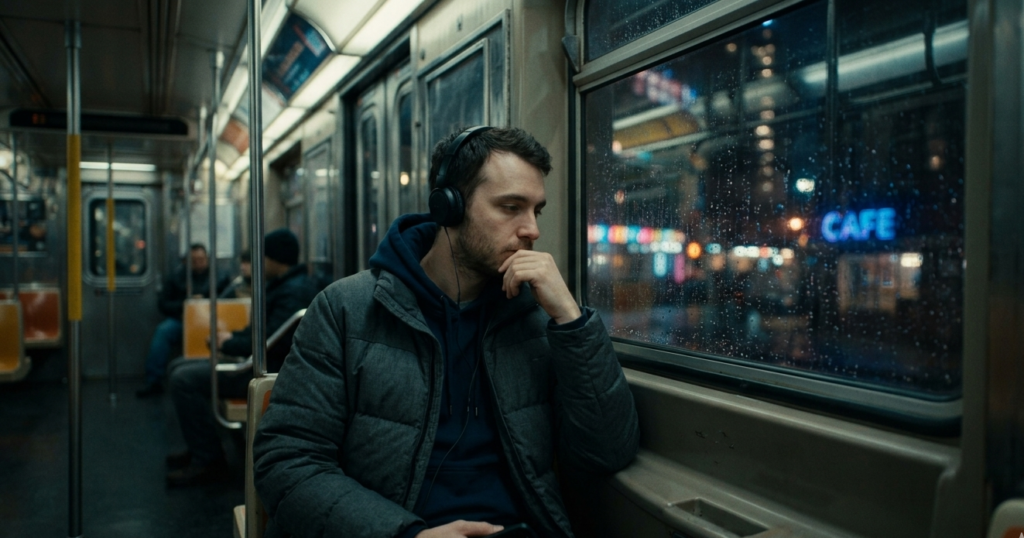
You are at a dinner table surrounded by people who know your name, and still something in you is quietly convinced that nothing happening tonight will leave a mark on anyone. Not cruelty, not indifference — just the soft, terrifying suspicion that you could dissolve between the appetizer and the dessert and the conversation would continue without a grammatical pause.
This is not loneliness as isolation. This is loneliness as ontological emergency.
The philosopher Charles Taylor, in Sources of the Self, identified the modern subject as a being who requires what he called “webs of interlocution” — not merely social contact, but the ongoing confirmation that one’s existence has been received by another consciousness. Not validated, not praised. Received. There is a categorical difference between being seen and being witnessed, and contemporary life has become extraordinarily efficient at producing the former while eliminating the latter. You are seen by algorithms, by CCTV cameras, by the ambient surveillance of digital platforms that know your purchase history and your sleep patterns and the exact hour you stopped scrolling. None of it witnesses you. Witnessing requires that the other be changed by what they perceive — that your existence leaves a residue in another life. Surveillance leaves no such residue. It accumulates data and forgets the person.
What this produces, at the level of lived experience, is something that psychologists have struggled to name precisely because it does not resemble classical depression or anxiety. The clinical literature does gesture toward it: in the 1990s, the developmental psychologist Daniel Stern described the infant’s need not simply to be fed and sheltered but to have its inner states “attuned to” by a caregiver — mirrored back in a way that tells the child its interior world is real. Stern called the failure of this attunement a rupture in the sense of a “core self.” He was writing about infants, but he was describing something that does not stop being true at age three. The adult who goes unwitnessed does not regress — they simply discover that the architecture of the self was never as autonomous as modernity promised.
The modern myth of self-sufficiency is precisely what makes this discovery so destabilizing. Enlightenment philosophy built an entire tradition around the self-grounding subject — the Cartesian ego that establishes its own existence through the act of thinking, that requires no external confirmation, that is, in principle, its own sufficient witness. This was always a philosophical convenience rather than a psychological reality. Spinoza’s ethics of self-preservation, Kant’s autonomous moral agent, the existentialist insistence on radical freedom — all of these frameworks produced an ideal of human selfhood that could in theory sustain itself in complete isolation. What they could not account for is that the self is not a substance but a process, and processes require friction, response, encounter. A mirror reflects nothing in an empty room.
What haunts contemporary loneliness is therefore not the absence of people but the growing suspicion that even presence has become insufficient for witnessing. People sit across from each other while remaining elsewhere. Attention has been so thoroughly fragmented, so relentlessly monetized and redirected, that the capacity to fully receive another person — to let them land, to be genuinely altered by their existence — has become a rare and almost countercultural act. The philosopher Simone Weil wrote in 1943, in Waiting for God, that the capacity to give another person one’s complete attention was the purest form of love, and also one of the most difficult things a human being could do. She meant it as spiritual instruction. It reads now as a description of something close to extinction.
And what remains unresolved is whether the self can genuinely hold itself together in the long absence of that attention — whether coherence is something a person can generate alone, or whether it has always been, quietly and without our consent, something we build together.
🌀 Lost in the Labyrinth of Modern Solitude
Loneliness in contemporary society is not merely an absence of company — it is a profound existential condition explored across centuries of literature and philosophy. The works gathered here trace the many corridors of isolation, from the silence of waiting to the endless mirrors of identity. Each article offers a unique lens through which to understand what it means to be alone in a world full of others.
Samuel Beckett: Life and Works
Samuel Beckett spent his life transforming solitude into a literary form, crafting characters who endure existence in a state of radical isolation. His work resonates deeply with the modern experience of disconnection, where communication fails and presence offers no real comfort. Exploring his life and works is an essential step toward understanding how loneliness can become both subject and structure in art.
GO TO THE SELECTION: Samuel Beckett: Life and Works
Waiting for Godot by Beckett: Analysis
Waiting for Godot is perhaps the most iconic theatrical meditation on loneliness ever written, presenting two figures suspended in time with no one truly arriving for them. Beckett’s play captures the anguish of expecting connection that never materializes, a feeling painfully familiar in today’s atomized societies. This analysis unlocks the philosophical depths of a work that turns waiting itself into a portrait of the human condition.
GO TO THE SELECTION: Waiting for Godot by Beckett: Analysis
Jorge Luis Borges and the Labyrinth of Identity
Jorge Luis Borges used the labyrinth as a central metaphor for the fractured self, an image that speaks directly to the disorientation many feel in contemporary life. In his exploration of identity, individuals wander endlessly through constructs of meaning, never quite finding the center of who they are. This article reveals how Borges transforms existential solitude into an intricate architecture of thought and symbol.
GO TO THE SELECTION: Jorge Luis Borges and the Labyrinth of Identity
In Search of Lost Time by Proust: Analysis
Marcel Proust‘s monumental novel is fundamentally a work about isolation — the isolation of memory, of time lost, and of a consciousness unable to fully bridge the gap between self and others. His narrator retreats inward, constructing an entire world from the private experience of recollection, making connection with others feel perpetually elusive. Reading this analysis illuminates how solitude can paradoxically become the richest space for self-discovery.
GO TO THE SELECTION: In Search of Lost Time by Proust: Analysis
Discover the Cinema of Solitude on Indiecinema
If these literary explorations of loneliness have stirred something within you, independent cinema offers an equally powerful and intimate journey into the human experience of isolation. On Indiecinema, discover a curated selection of bold, personal, and visionary films that dare to explore what it means to be alone — and perhaps, in that aloneness, to find something universal. Stream independent cinema that speaks directly to the soul.
👉 EXPLORE THE CATALOG: Watch Indie Films in Streaming
A vision curated by a filmmaker, not an algorithm
In this video I explain our vision

