
The Price Written in the Ledger Before the Vows
You are sitting at a table you did not choose, in a dress or a suit that cost more than a month of your salary, watching two people exchange vows while their families exchange something else entirely — a silent ledger of assets, debts, expectations, and territorial claims dressed up in floral arrangements and canapés. You can feel it in the room if you know how to read rooms: the way the groom’s father keeps glancing at the bride’s uncle, the way certain handshakes last a half-second longer than affection requires, the way the seating chart itself is a map of allegiances and obligations. The ceremony is real. The emotion may even be genuine. But underneath the music, there is arithmetic.

This is not cynicism. It is history. Marriage as an institution predates romantic love as a cultural priority by several millennia, and the record it leaves behind is almost exclusively financial. In ancient Rome, the institution of the dos — the dowry transferred from the bride’s family to the groom — was a legally codified economic mechanism, regulated under the Twelve Tables as early as 450 BCE, governing not just the transfer of wealth but the conditions under which it could be reclaimed upon dissolution. The emotion of the parties involved does not appear in these documents. Their property does. Their lineage does. Their reproductive utility, measured in heirs capable of inheriting, does. Love, when it appears at all in the historical record of matrimonial arrangements, appears as a bonus, a pleasant accident, something that might or might not accompany the contract but was never its subject.
What is striking is not that this was true in antiquity — it is that the architecture of those arrangements persists with cosmetic modifications into the present, while the language used to describe marriage has been almost entirely purged of its transactional vocabulary. The historian Stephanie Coontz, in her 2005 work Marriage, a History, traced this linguistic laundering with precision: the shift toward romantic love as the stated basis for marriage occurred largely in the late eighteenth and early nineteenth centuries in Western Europe and North America, not because human beings suddenly became more emotionally sophisticated, but because the economic and political functions that marriage had previously served were being redistributed to other institutions — the state, the market, the church. Marriage, relieved of some of its most visible functional burdens, could afford to dress itself in sentiment. It did so aggressively.
The displacement was never complete. Across cultures that did not follow the Western European trajectory, the negotiation remained explicit and unembarrassed. In parts of sub-Saharan Africa, the lobola — bride wealth transferred from the groom’s family to the bride’s — continues to structure marriages in ways that are openly discussed, openly contested, and openly tied to the economic standing of everyone involved. The figure is not hidden. It is negotiated across tables, sometimes over weeks, sometimes involving cattle, sometimes involving wire transfers. What is remarkable, when you look at it without the Western reflex of condescension, is not that such negotiations exist but that the cultures practicing them at least possess the honesty to acknowledge what is occurring. The Western wedding, by contrast, has buried the same calculation under an industry worth over $57 billion annually in the United States alone — a figure that, if you sit with it, reveals something grotesque about the nature of the concealment. The more vigorously a culture insists that its marriages are about love and love alone, the more elaborate and expensive the ritual required to maintain that insistence.
There is something in the extravagance itself that confesses. A simple acknowledgment of a practical arrangement requires no theater. It is only when the practical arrangement must be disguised that the staging becomes baroque, that the flowers multiply, that the guest list inflates, that the cost of a single day reaches figures that would have once purchased the very land a family farmed for generations.
Thirsty
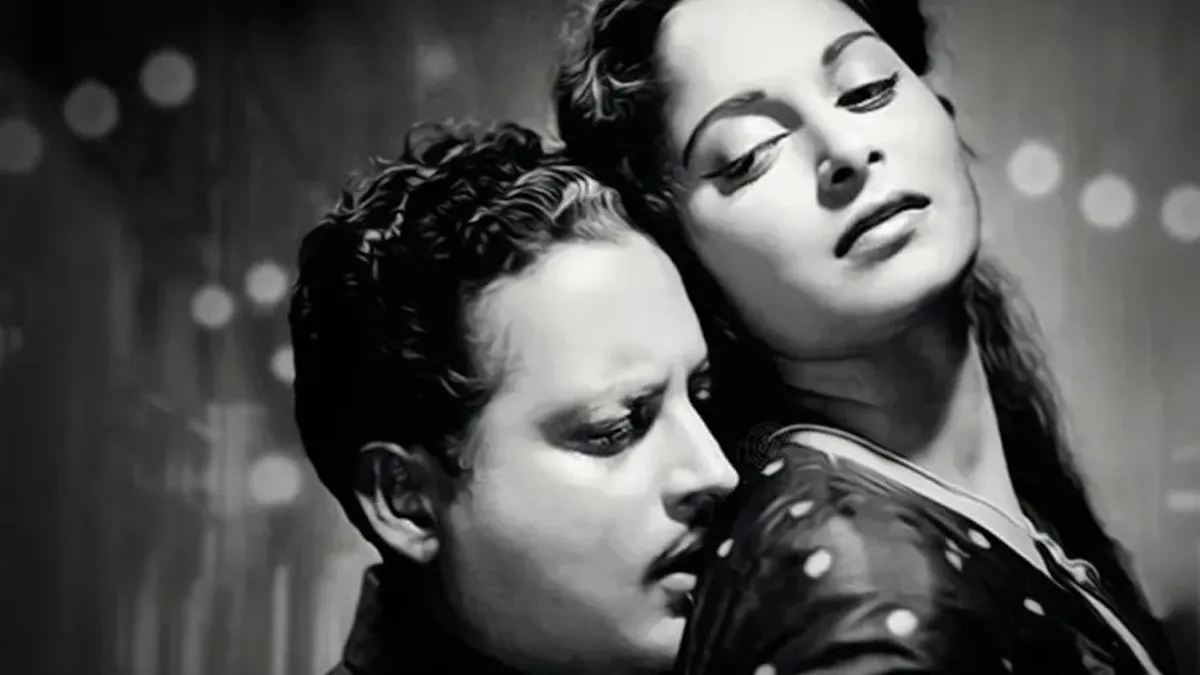
Drama, musical, by Guru Dutt, India, 1957
Thirsty is the heartbreaking story of Vijay, a young poet living in Calcutta who dreams of giving voice to the suffering and injustice of the world through his verses. Idealistic and sensitive, Vijay clashes with a society that despises his art because it is not profitable and does not cater to the tastes of the public. His brothers consider him a failure, the woman he loves leaves him for a marriage of convenience, and his poems are ignored by publishers. Only Gulabo, a prostitute with a pure heart, recognizes the beauty and truth of his words. When a misunderstanding leads everyone to believe Vijay is dead, his name and poetry suddenly become famous, exposing the hypocrisy of those who had previously rejected him.
Watching Thirsty means immersing oneself in a work that goes beyond melodrama, blending poetry, music, and imagery into a profound reflection on the human soul and the value of art. Guru Dutt, director and protagonist, creates one of the most intense and poetic films in world cinema, where black-and-white cinematography, expressive framing, and evocative lyrics produce an atmosphere of poignant melancholy. It is a film about the misunderstanding of the artist, pure love, and society’s hypocrisy, but also a universal critique of materialism and opportunism. Even today, Thirsty moves and provokes thought because it sincerely tells the story of the need to remain true to oneself in a world that measures people’s worth solely by their success.
LANGUAGE: Hindi
SUBTITLES: English, Spanish, French, German, Portuguese
When Property Married Property: The Legal Architecture of Conjugal Ownership
You sign the document and become, in the eyes of the law, a new category of person — not a diminished one, not a restricted one, but in the most precise juridical sense, a non-person.
This is not a metaphor borrowed from feminist theory. William Blackstone wrote it plainly in his Commentaries on the Laws of England in 1765, a text that became the foundational legal education for generations of English and American judges: “By marriage, the husband and wife are one person in law: that is, the very being or legal existence of the woman is suspended during the marriage, or at least is incorporated and consolidated into that of the husband.” Suspended. The word does not soften the mechanism — it describes a precise legal operation, the way a license is suspended, the way a right is held in abeyance. A woman’s legal selfhood did not diminish at marriage; it ceased to exist as an independent entity. She could not own property, enter contracts, sue or be sued, keep her wages, or refuse the management of her own body’s legal consequences. She became, in the technical vocabulary of the doctrine called coverture, a feme covert — a covered woman — sheltered from legal existence by the body of her husband.
What made coverture so durable was not that it was cruel but that it was coherent. It solved a real administrative problem in a world organized around property lineages: how do you transfer assets across generations without fragmenting them through competing claims? Marriage, under coverture, was not a union of persons but a merger of estates. The wife’s property — land, money, personal goods — passed immediately to her husband’s legal control upon marriage. Her future earnings belonged to him. Children born of the union were, legally, his. The emotional architecture of the wedding ceremony, the vows, the witnesses, the flowers, existed as ritual scaffolding around what was, at its core, a property conveyance with a human being as the primary asset transferred.
This is where the historical record becomes uncomfortable in ways that cannot be resolved by attributing everything to the cruelty of particular men. The women who entered these arrangements were often well aware of them. Aristocratic families negotiated marriage settlements — legal instruments drafted before the wedding to carve out protections for a bride’s separate property — with the same deliberation they applied to business contracts. The settlement was the workaround, the private modification of the public law, available only to those with enough property and legal counsel to bargain before the ceremony. For everyone below that threshold, coverture applied in its full and unmitigated form. The law did not pretend the marriage was romantic. The law was honest in a way the ceremony was not.
The American legal inheritance from Blackstone was nearly total. Married Women’s Property Acts began appearing in individual states only in the 1840s, with New York’s act of 1848 representing a landmark fracture in the coverture structure — but even that act was partial, applying to property a woman owned before marriage rather than dismantling the broader framework. Full legal personhood for married women, including the right to control earnings from labor performed during marriage, did not arrive uniformly across American jurisdictions until well into the twentieth century. The emotional experience of marriage evolved far ahead of its legal structure. People fell in love, wrote poetry, made promises under the open sky, while the paperwork they signed placed one of them inside a legal category that had more in common with property acquisition than with partnership.
What this reveals is not simply a historical injustice waiting to be corrected, but something stranger: the law was always more honest about what marriage accomplished than culture was willing to say aloud. The ceremony performed love. The document performed transfer. And the distance between those two performances was not a gap waiting to be closed — it was the entire point.

The Romantic Revolution as Market Correction

You are standing at the altar, and you are certain — more certain than you have been of anything — that this feeling in your chest is proof enough. That the trembling is evidence. That the fact of wanting someone this completely must mean something outside of history, outside of economics, outside of the particular century you were born into. The feeling is real. What you have never been asked to examine is where it learned to speak.
The eighteenth century did not invent love. What it invented was love’s authority — the idea that an interior emotional state could serve as the legitimate foundation for a social contract. Before this, marriage required witnesses, priests, families, property assessors, and notaries. After the Romantic revolution, it required only the feeling itself, which is to say, it required something far more total and far more impossible to refuse. Coercion from outside is visible and can be resisted. Coercion that arrives wearing the face of your own desire is nearly invisible, and almost never resisted at all.
Niklas Luhmann, writing in 1982 in Love as Passion, argued that romantic love was not a liberation from social coding but a replacement of one code with another. The older code was explicit: marriage organized property, alliances, and reproduction, and everyone understood this, including those who complied. The Romantic code operated differently. It persuaded individuals that the institution’s demands — fidelity, permanence, exclusivity, emotional investment, self-subordination — were not demands at all, but natural expressions of a feeling they had freely arrived at. The institution did not disappear. It went underground, into the nervous system, where it became indistinguishable from the self.
This is not a minor philosophical distinction. Consider what actually changed between 1750 and 1850 across Western Europe: almost nothing in the material structure of marriage law, and almost everything in how individuals narrated their entry into it. The same transfer of property occurred. The same legal coverture in England rendered wives juridically invisible, a condition that persisted formally until the Married Women’s Property Act of 1882. The same demographic function was served. What shifted was the emotional vocabulary surrounding these unchanged structures — a vocabulary that made participation feel like self-expression rather than social compliance. Rousseau’s Julie, published in 1761, sold out twelve editions in forty years and was read by people who wept openly at its pages. They were not weeping at the plot. They were weeping at the recognition of something they had been taught to feel as uniquely their own.
The genius of this transformation, if genius is the right word for something so structurally useful to existing power arrangements, was that it made the subject the enforcer of their own captivity. No one needed to tell a young woman in 1820 that she must marry and remain faithful and subordinate her ambitions to household continuity. She had already told herself, because she had already fallen in love, and love — the Romantic version, the version that had by then been circulated through novels and poetry and song for seventy years — carried those requirements embedded within it like instructions sewn into a garment’s lining. You could not pull the love out without pulling the instructions with it.
What Luhmann saw, and what most celebrations of romantic progress consistently miss, is that passion became a technology of governance. The state and the church had previously maintained marriage through enforcement. The Romantic movement handed that function to the individual psyche, which proved far more efficient. A person monitored by their own longing does not need guards. They guard themselves, and often do it with a thoroughness that no external authority could match, and often feel, in the doing of it, that they are finally, for the first time, completely free.
Engels Was Right About the Wrong Thing
You have been told, at some point in your life, that love and money are separate things — that the heart operates on a different currency than the bank account, that what happens between two people in private has nothing to do with who owns the land beneath their feet. Friedrich Engels called this lie by its real name in 1884, and the discomfort his argument still produces is a reliable measure of how little we have actually moved.
In The Origin of the Family, Private Property and the State, Engels made a claim that remains almost unspeakable in polite conversation: that bourgeois marriage, as a legal and economic institution, was structurally indistinguishable from prostitution, differing only in the duration of the contract and the social legitimacy conferred upon it. A woman who exchanged her body, her labor, her reproductive capacity, and her legal personhood for financial security was not, in Engels’s reading, making a romantic choice — she was making the only rational transaction available to someone with no other access to property or income. The romance was the window dressing. The deed transfer was the substance. What stings about this is not that it is cruel. What stings is that when you hold a nineteenth-century marriage contract up to the light, the mechanism is nakedly visible in a way that contemporary arrangements, with their language of partnership and mutual fulfillment, have learned to obscure without actually dismantling.
Where Engels cracked open something true, he also carried inside his analysis a confidence that would eventually become its own form of blindness. His assumption — shared by most materialist thinkers of his era and inherited without sufficient scrutiny by those who followed — was that the distortions of intimate life were downstream of economic conditions. Change the economic base, eliminate private property, give women independent access to wages and legal standing, and the emotional architecture of dependency would dissolve on its own. The revolution would reach the bedroom. Love, freed from financial coercion, would finally become what it was always supposed to be. This is where the argument collapses not from external pressure but from its own internal logic.
By the late twentieth century, the experiment had run long enough to produce evidence. Women in Western economies had entered the workforce in transformative numbers — in the United States, female labor force participation rose from roughly 33 percent in 1950 to over 60 percent by the 1990s. Legal personhood was restored. Divorce became accessible. Contraception decoupled reproduction from sexuality. And yet the patterns Engels identified — the strategic calculation beneath the romantic performance, the asymmetric vulnerability, the way financial precarity shapes whom one is willing to love and how much — did not disappear. They migrated. They became subtler, more psychological, more deeply internalized. The woman in 2005 who stays in a marriage that has become a quiet humiliation because leaving would mean a catastrophic drop in living standard is not operating under the same legal constraints as her counterpart in 1884. She is operating under the same structural logic dressed in the vocabulary of personal choice.
What Engels could not see — because his framework had no room for it — was that emotional dependency is not merely a symptom of economic dependency. It has its own infrastructure, its own history, its own capacity to survive the removal of the material conditions that originally produced it. The psychoanalytic tradition, which Engels’s materialism had no language to absorb, would spend the next century mapping precisely this terrain: the way attachment patterns formed in conditions of scarcity persist long after scarcity is technically resolved, the way a person can be financially free and emotionally captive simultaneously, the way liberation of one register leaves the other entirely untouched. The structures Engels wanted the revolution to dissolve had already been written into the body long before any economic system got hold of them.
The Arithmetic of Hypergamy and Who Pays the Bill
You are sitting across from someone you genuinely believe you chose freely, and somewhere underneath that belief is a number you have never spoken aloud — a floor, a threshold, a minimum that functioned as a filter long before your feelings had a chance to form.
Betsey Stevenson and Justin Wolfers, in their landmark 2007 paper “Marriage and Divorce: Changes and their Driving Forces” published in the Journal of Economic Perspectives, documented something that decades of feminist progress had not managed to dissolve: women in industrialized nations continue to marry men who earn more than they do at rates that exceed statistical chance by a margin too large to attribute to coincidence. This is not a remnant of an era before female economic independence. It persists most stubbornly in precisely the countries where women have the highest educational attainment and the greatest labor market access — Scandinavia, Germany, urban America. The gradient does not flatten when women no longer need the income. It shifts shape, acquires new vocabulary, gets called “ambition” or “drive” or “someone who takes care of things,” but the underlying economic vector points in the same direction it always has.
What this reveals is not that women are mercenary. The accusation is too simple and too convenient for the people who wield it. What it reveals is that desire itself has been formatted by centuries of material logic, and that formatting does not erase itself simply because the material conditions that produced it have partially changed. A woman who earned forty thousand dollars a year in 1975 and married a man who earned eighty thousand was responding rationally to a world where her own earnings were insufficient to guarantee security. A woman who earns a hundred and twenty thousand today and still feels a dulling of interest when she learns that the man across the table earns sixty is not responding to the same material reality — she is responding to the emotional residue of a calculus that once had survival attached to it. The body has a longer memory than the legislation.
The sociologist Arlie Hochschild, writing in “The Managed Heart” in 1983, described the way emotional responses become commodified through repeated social instruction — how people learn not just to perform feelings but to reorganize their interior lives around what the market requires of them. Hypergamy is not simply a behavioral pattern visible from the outside. It is an architecture of desire constructed from the inside, installed so early and reinforced so continuously that it feels like preference, like chemistry, like the ineffable logic of the heart recognizing what it wants. The feeling of attraction to economic status has been made to feel like attraction to a person.
Men are not exempt from this arithmetic — they simply sit on the other side of it. The research Stevenson and Wolfers analyzed showed that male earnings remain one of the strongest individual predictors of marriageability across cultures, while male attractiveness, warmth, and emotional availability rank considerably lower in the aggregate pattern of who actually pairs with whom permanently. This does not mean individual men do not suffer under this system — many of them are crushed by it, defined entirely by a financial metric they cannot meet, their interior life rendered invisible by the single number attached to their professional output. The cruelty here is distributed unevenly but universally: everyone is being reduced to a figure on a spreadsheet that was designed before any of them were born.
What no economist’s regression can quite capture is the specific texture of the moment when financial information changes the quality of a feeling that seemed, only seconds before, entirely spontaneous. The slight recalibration behind the eyes. The way interest modulates not because anything has been said or done but because something has been calculated — quickly, involuntarily, with the precision of a system that has been running far longer than the individual conscience that now hosts it.
A vision curated by a filmmaker, not an algorithm
In this video I explain our vision
The Scene No One Wants to Recognize

You are sitting across from someone you once called the love of your life, and the conversation has the texture of a board meeting. Not because either of you wanted it this way, but because somewhere between the second lease renewal and the joint savings account and the career you quietly shelved so the other person could take that transfer, love became the least precise variable in the equation. You are not arguing about feelings. You are arguing about who absorbs the loss.
What makes this scene almost unbearable to witness — in yourself, in your friends, in the couple at the restaurant table whose silence has a specific weight — is not the conflict but the clarity. Strip away the language of hurt and betrayal, and what remains is a negotiation over sunk costs. The economist Richard Thaler, awarded the Nobel Prize in 2017 partly for his work on exactly this cognitive trap, demonstrated that human beings systematically overvalue what they have already invested. We do not calculate futures; we calculate what we stand to lose from the present position. A relationship framed around shared assets and sacrificed opportunities becomes, structurally, indistinguishable from a failing business neither partner wants to liquidate because the exit costs are too high.
This is where the architecture of the arranged marriage — which Western modernity congratulated itself on abandoning — did not disappear. It relocated. The Victorian family ledger, where a daughter’s value was calculated against a prospective husband’s land holdings, simply became internalized, invisible, disguised in the vocabulary of personal choice. The philosopher Charles Taylor argued in Sources of the Self, published in 1989, that modernity did not eliminate moral frameworks; it drove them underground, converting explicit social obligations into what feel like spontaneous individual desires. You do not think you are honoring a contract. You think you are feeling something. The contract thinks through you instead.
The woman who stays because leaving would mean restarting her career at forty-three is not a victim of an arranged marriage in any recognizable legal sense. But she is operating inside a system of incentives that her great-great-grandmother would have recognized immediately — the calculus of what is survivable alone versus what is bearable together. The difference is that her great-great-grandmother knew the arrangement was an arrangement. There was a kind of dignity in that legibility, however brutal the terms. The modern negotiation masquerades as a conversation about love while conducting itself as a conversation about risk.
Sociologist Arlie Hochschild mapped something adjacent to this in The Second Shift in 1989, documenting how heterosexual couples in dual-income households continued to distribute domestic labor along lines that had nothing to do with preference and everything to do with whose income was larger, whose career was deemed more replaceable, whose sacrifice was structurally cheaper. What she found was not a failure of love but a colonization of love — the emotional domain occupied by economic logic so thoroughly that the two became impossible to separate. Partners genuinely believed they were making free choices. The data suggested they were executing a program written long before they met.
What no one in that modern apartment wants to say aloud is the sentence that would make the whole structure visible: I am not sure I would choose you if leaving were free. Not because it is necessarily true, but because entertaining the question destabilizes the entire emotional narrative both people have built to make the arrangement feel voluntary. The French sociologist Pierre Bourdieu spent much of his career describing how domination reproduces itself most efficiently when it is least recognized as domination — when the dominated participate in their own constraint not through ignorance but through a misrecognition so total that resistance feels like ingratitude. The couple in the apartment is not trapped by anyone’s malice. They are trapped by the story they needed to tell themselves about why they stayed, and that story has now become the walls.
Simone de Beauvoir‘s Unsettling Accuracy
You are sitting across from someone you have chosen, or believe you have chosen, and the word “vocation” does not enter your mind because it belongs to nuns and surgeons, not to people ordering wine on a third date. That distance between the word and the experience is exactly where the deception lives.
In 1949, Simone de Beauvoir published a book that most people who cite it have not finished, and in its second volume she made a claim so structurally precise that it has survived every attempt to dismiss it through progress: marriage, she argued, has historically been the single profession systematically offered to women as a calling rather than a choice — the one path that arrived pre-blessed by culture, family, religion, and economics simultaneously, requiring no justification and absorbing any objection. She was not describing a conspiracy. She was describing an architecture. The difference matters enormously, because conspiracies can be exposed and dismantled, while architectures simply become the shape of the room you live in until you can no longer imagine walls arranged any other way.
What has changed since 1949 is not the architecture but the lighting. Women in most wealthy nations can now own property, hold professional titles, initiate divorce, and earn incomes that do not legally belong to their husbands from the moment of signing. These are not trivial gains — they are the result of sustained and often brutal political struggle, and to minimize them would be its own form of bad faith. But the transaction did not dissolve when formal equality arrived. It migrated inward, became psychological, dressed itself in the language of personal fulfillment. The woman who chooses marriage today is understood to be doing exactly that — choosing — which means the transaction now carries the additional burden of appearing not to be one. She must want it. She must want it genuinely, spontaneously, as an expression of her deepest self. The economic and social scaffolding that makes that wanting more probable for her than for her male counterpart is simply not mentioned, because mentioning it would be impolite, and also because it would suggest that the choice was never entirely free.
There is a specific cruelty in the nominal. When a condition is presented as resolved, the people still living inside it lose the vocabulary to describe their experience. A woman who feels the asymmetric weight of domestic expectation after marriage — who finds that her career is implicitly the flexible one, her social calendar the one that bends, her name the one under question — has no clean framework to hold that feeling, because the framework was supposed to have been retired. So the feeling becomes personal. A failure of communication. A personality conflict. Never a structural residue, because the structure was declared finished.
De Beauvoir’s deeper argument, the one that gets dropped when people quote her in opinion pieces, was about interiority — about how women had been trained to find their transcendence through another person rather than through their own projects in the world. She used the language of existentialism deliberately: transcendence was the human capacity to reach beyond the given, to create meaning through action, and immanence was its opposite, the condition of remaining enclosed within the biological and domestic. Her claim was not that women were incapable of transcendence but that the institution was designed to redirect that energy toward the maintenance of someone else’s. The unsettling accuracy of this is not that it describes the past. It is that it describes the interior logic of arrangements that both parties in 2024 would describe as equal, loving, and freely chosen.
The transaction becomes most invisible precisely at the moment both participants are most convinced of their sincerity. Sincerity was never the variable that dissolved the structure — it was always the variable most efficiently absorbed by it.
Love as the Last Unaudited Currency
You track your own feelings the way a fund manager tracks a portfolio — checking whether the investment is performing, whether the returns justify the exposure, whether it might be time to rebalance toward something less volatile. You do not call it that. You call it being honest with yourself. You call it self-awareness. But the calculus is running constantly, beneath the language you use to describe it, beneath the warmth you genuinely feel when the person you love walks into the room.
Arlie Hochschild spent years studying flight attendants and bill collectors for The Managed Heart, published in 1983, and what she found was that emotional labor — the work of inducing or suppressing feeling in order to sustain the outward expression a situation demands — had become a commodity sold by the hour. The smile was not a smile. It was a deliverable. What nobody wanted to examine was what happened when workers brought that same management apparatus home, when the techniques learned on the job colonized the intimate sphere, when people began performing authenticity rather than experiencing it because the two had become structurally indistinguishable.
The modern relationship asks for emotional availability as a baseline condition, but availability is not the same as presence, and both parties know it, even when neither says so. Reproductive decisions are mapped against mortgage timelines. Vacations are negotiated with the precision of trade agreements. The question of who absorbs emotional distress and who is protected from it follows gendered grooves worn so deep they feel like nature. Women have historically performed the larger share of what sociologists call kin-keeping — the maintenance of family bonds, the remembered birthdays, the managed transitions — and this labor rarely appears in any accounting of what a relationship actually costs each person.
What makes this durable is that the exchange is never named. The moment it is named, the fiction collapses. Two people who explicitly negotiated reproductive labor in exchange for financial security would be seen as mercenary. Two people who do exactly that while agreeing they are in love are seen as having found something real. The difference is entirely in the framing, and the framing is enforced socially with remarkable violence — through pity, through gossip, through the slight recoil in someone’s face when a relationship sounds too transactional to be romantic.
There is a particular cruelty in the way the market for social status runs through the body of the partner you choose. Research on assortative mating — the consistent pattern, documented across decades of demographic data, by which people partner with others of similar educational attainment, income bracket, and class background — shows that the romantic imagination has remarkably reliable preferences. In the United States, the rise in educational homogamy since the 1960s has been one of the primary drivers of income inequality at the household level. Love, in aggregate, widens the gap between those who have and those who do not, because people reliably desire those who already resemble what they are trying to become.
And yet something escapes. Some desire is always slightly wrong for the situation, slightly uncalibrated, aimed at the person who makes no strategic sense, who disrupts the plan, whose presence costs more than any rational accounting would justify. Whether this excess is the residue of something genuinely uncolonized, or simply a more sophisticated product of the same machinery — a feeling generated precisely because its apparent irrationality makes it feel more real, more trustworthy, more like proof — is a question the data cannot answer and intimacy cannot answer either, because asking it inside the relationship changes what the relationship is.
The managed heart manages itself most completely when it no longer notices the management, when the performance has run long enough that distinguishing it from the performer becomes not difficult but meaningless, and desire continues, indifferent to the question of its own origins.
💍 Love, Power & the Price of the Heart
When love becomes a transaction, the boundaries between desire, power, and self-betrayal dissolve into one another. These pieces explore the dark corridors where affection is weaponized, identity is sold, and intimacy becomes a form of social currency — a maze with no easy exit.
Affective Manipulation in Psychology
Affective manipulation is not merely a personal tragedy but a systematic architecture of control that mirrors the logic of market exchange. When emotions become instruments of leverage, the relationship ceases to be a meeting of souls and transforms into a negotiation of power. This article dissects the psychological mechanisms that turn love into a tool of domination.
GO TO THE SELECTION: Affective Manipulation in Psychology
Fromm’s The Art of Loving: Analysis
Erich Fromm‘s landmark analysis of love challenges the transactional myths that modern culture imposes on intimate relationships. For Fromm, love is not something one falls into passively — it is an art demanding discipline, knowledge, and courage. This exploration of his thought reveals how the commodification of feeling corrupts the very possibility of genuine connection.
GO TO THE SELECTION: Fromm’s The Art of Loving: Analysis
Love in Philosophy: From Plato to Fromm
From Plato’s Symposium to Fromm’s existential humanism, philosophers have long wrestled with the question of what love truly is and what it costs us to pursue it. The history of love in philosophy mirrors the history of power — who defines it, who benefits, and who is left impoverished by its absence. This article traces those contested meanings across centuries of thought.
GO TO THE SELECTION: Love in Philosophy: From Plato to Fromm
Maupassant’s Bel-Ami: Analysis
Maupassant’s Bel-Ami is perhaps the definitive literary portrait of a man who converts romantic conquest into social ascent, treating women as rungs on a ladder rather than as human beings. The novel lays bare the cold arithmetic beneath the warm surface of seduction, exposing how desire and ambition become indistinguishable in a society ruled by appearances. Reading it today feels like holding a mirror to the most cynical corners of contemporary culture.
GO TO THE SELECTION: Maupassant’s Bel-Ami: Analysis
Discover Cinema That Dares to Tell the Truth About Love
If these themes of love as power, transaction, and illusion resonate with you, Indiecinema’s streaming catalog is home to independent films that dare to portray intimacy in all its complexity and contradiction. Venture beyond the comfortable lies of mainstream romance and explore stories where the heart pays the highest price — stream them now on Indiecinema.
👉 EXPLORE THE CATALOG: Watch Indie Films in Streaming
A vision curated by a filmmaker, not an algorithm
In this video I explain our vision

