
The Locked Room and the Secret Key
You are clearing out your grandfather’s house when you find it. Not the ring, not yet — that comes later, when you are already unsettled and half-prepared — but first the chest, a wooden box with a brass lock shaped like a compass set against a square, tucked beneath folded military uniforms that smell of cedar and something older, something you cannot name. You open it expecting letters, perhaps photographs, the ordinary archaeology of a life. Instead you find a series of hand-drawn diagrams: a triangle inside a circle, a sun with a human face, a serpent swallowing its own tail, and symbols that look like corrupted Latin or mutilated chemistry. You are not frightened exactly. You are something stranger than frightened. You feel as though you have opened a door in a house you thought you knew completely, and found another house inside.

That sensation — the uncanny recognition of a language you were never taught but somehow almost read — is not accidental. It is the precise effect these systems were designed to produce. Both alchemy and Freemasonry were constructed around a central epistemological principle: that the most powerful knowledge must be simultaneously present and hidden, visible to the uninitiated as decoration or nonsense and legible to the initiate as instruction. This is not merely a practical matter of secrecy. It is a philosophy of knowledge itself, a claim about how transformation — whether of matter or of man — can only occur when the seeker has earned the capacity to see.
Frances Yates, in her landmark 1972 work The Rosicrucian Enlightenment, traced the genealogy of this shared epistemic architecture with a precision that her more credulous successors have rarely matched. What she identified was not a conspiracy but a cultural grammar: a set of inherited assumptions about the relationship between concealment and revelation that ran from the Hermetic revival of the fifteenth century directly into the lodge culture of the seventeenth and eighteenth centuries. By the time the first Grand Lodge of England was constituted in London in 1717, Freemasonry had absorbed so thoroughly the symbolic vocabulary of operative and speculative alchemy that the two traditions had become, at their philosophical core, practically indistinguishable in their underlying logic, even when their practitioners were unaware of the debt.
The chest in your grandfather’s study, then, is not an anomaly. It is an inheritance. The man who built Western civilization’s most prestigious institutions — its universities, its courts, its public architecture encoded with geometry — was often simultaneously the man who believed that base matter could be elevated, that the human soul was a substance subject to refinement, and that this refinement required passage through carefully structured stages of darkness, dissolution, and re-emergence. Carl Jung recognized this in 1944 when he published Psychologie und Alchemie, arguing that the alchemical corpus was not a failed proto-chemistry but a systematic projection of psychological transformation onto material process — an unconscious mapping of inner initiation onto outer experiment. What Jung was describing, without using the term, was the same initiatory epistemology that would later organize itself into lodge ritual, degree structure, and the Masonic myth of the lost word.
The stranger’s ring catches the light across a café table, and you notice the square and compass before you notice anything else about him. You have seen that symbol before. In your grandfather’s chest, yes, but also carved above a courthouse door, embedded in the floor of a cathedral, reproduced in a Renaissance woodcut you once studied without understanding why it seemed to expect something of you. The symbols have always been there. The question is not whether you have seen them. The question is what it means that you were never taught to read them, and who, precisely, decided that.
Lead Into Gold, Stone Upon Stone
There is a moment in the life of every serious student of the hermetic tradition when the boundary between the laboratory and the lodge dissolves so completely that one wonders whether it was ever real. The furnace cools, the athanor sits dormant, and the man who has spent years watching lead resist its own transformation picks up a compass and a square and walks into a room full of men who speak in the same coded grammar of ascent, purification, and hidden knowledge. The costume changes. The obsession does not.
Between the twelfth and seventeenth centuries, the operative stonemason guilds of Europe were already saturated with a language that alchemy would recognize instantly. The cathedral builders who moved from site to site across England, France, and the German territories carried with them rituals of initiation, passwords, and a theology of craft that understood physical construction as moral enactment. To raise a stone was to enact something. The geometry was never merely geometry. When Villard de Honnecourt filled his portfolio in the thirteenth century with diagrams that blur the line between architectural proportion and cosmological diagram, he was not making a category error. He was recording a worldview in which the perfection of the built form and the perfection of the soul were the same ambition expressed in different materials.
By the time the two Rosicrucian manifestos appeared in 1614 and 1615, the Fama Fraternitatis and the Confessio Fraternitatis, the cultural atmosphere was already so thick with alchemical expectation that their appearance felt less like an announcement than a confirmation. These documents described a secret brotherhood founded by a Christian Rosenkreuz who had traveled through the Islamic world absorbing hermetic wisdom, a fraternity dedicated to healing, to the reformation of knowledge, and to a transformation of civilization that was explicitly modeled on alchemical process. The language of solve et coagula, dissolve and recombine, had migrated fully from the laboratory into the social imagination. Frances Yates, in her landmark 1972 study The Rosicrucian Enlightenment, argued with meticulous historical precision that these manifestos represented the convergence of Paracelsian medicine, cabalistic mysticism, and what she called the “Hermetic-Cabalist tradition” into a single reforming impulse that would eventually feed directly into the formation of speculative Freemasonry.
Elias Ashmole is the figure who makes this convergence impossible to dismiss as metaphor. He was admitted to the Freemasons in Warrington in 1646, a date that places him at the very hinge between operative and speculative Masonry, and he was simultaneously one of the most serious alchemical scholars England had ever produced. His Theatrum Chemicum Britannicum, published in 1652, was not a curiosity but a monument, a comprehensive anthology of English alchemical poetry and doctrine that demonstrated his conviction that the Great Work was a genuine path of spiritual and intellectual transformation. That this same man would seek initiation into a fraternity organized around sacred geometry and the allegory of the master builder is not a coincidence requiring explanation. It is the most natural thing in the world, once you understand that both projects were addressing the same wound in the human condition: the suspicion that matter and spirit have been violently separated, and that the work of human life is to reunite them.
The lead that refuses to become gold and the rough stone that refuses to become the perfect ashlar are the same refusal, seen from two different workshops. The alchemist and the Mason were not analogous figures. They were the same figure, caught at different moments in the same long labor, convinced that transformation was not merely possible but obligatory, and that secrecy was the only protection a genuine truth had ever had against a world that preferred its mysteries dead.

The Initiate in the Dark Room
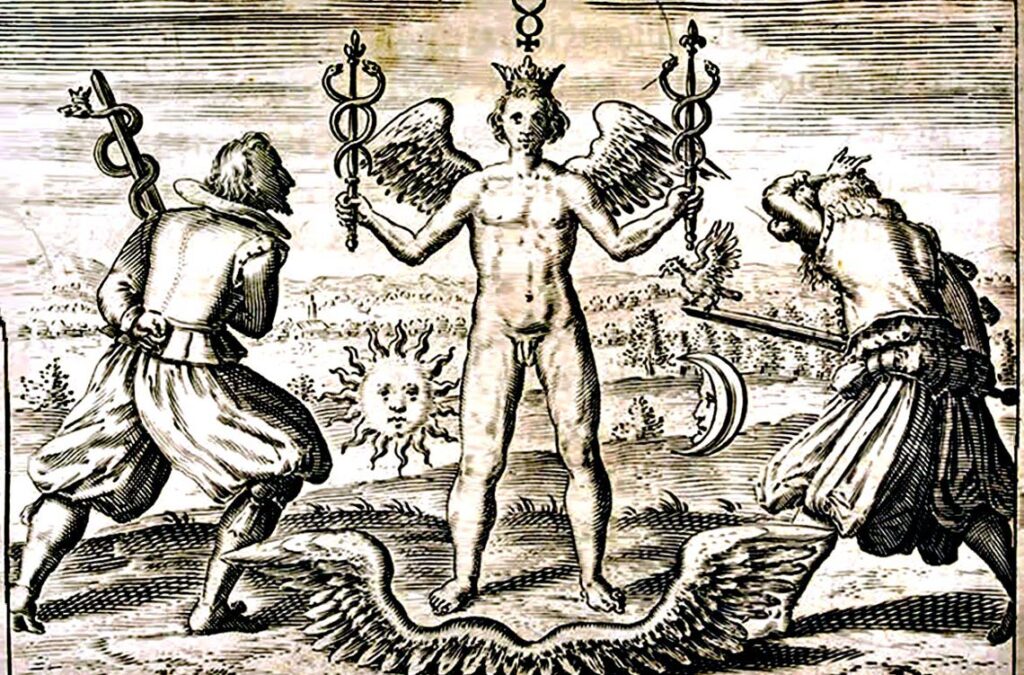
There is a moment, somewhere between the blindfold and the first spoken word, when a man stops being a person with a history and becomes something more like raw material. He does not know this yet. He thinks he is about to learn something. That is the first deception, and it is entirely necessary.
A man stands in a room stripped of every familiar coordinate. His hands have been tied in a gesture that mocks imprisonment but functions as something far more precise: the removal of agency so complete that his only remaining faculty is attention. Someone speaks to him from a direction he cannot locate. The words are strange, formal, borrowed from a grammar that belongs to another century. He feels simultaneously ridiculous and terrified, which is exactly the point. Mircea Eliade, writing in Rites and Symbols of Initiation in 1958, identified this calculated disorientation as the structural core of initiatory experience across every culture he examined, from Australian Aboriginal ceremonies to the mystery schools of the ancient Mediterranean. The initiand must first be unmade. The vessel must be emptied before anything can be poured into it.
What is being poured, however, is never what the initiate expects. He arrives believing that he is about to receive information, a password, a diagram of the universe’s hidden architecture. What he receives instead is a different kind of knowledge, one that cannot be transmitted by speaking it aloud. Carl Jung understood this with unusual clarity. In Psychology and Alchemy, published in 1944, he argued that the alchemical tradition had never primarily been about the physical transformation of metals. The laboratory was a theater, and the real experiment was being conducted in the psyche of the operator. The nigredo, the blackening, the first and most dreaded stage of the Great Work, was not a chemical event. It was the deliberate confrontation with everything in oneself that resists transformation. The medieval alchemist who locked himself in his study for months at a time, watching his materials decompose in the crucible, was watching himself decompose in equal measure, whether he knew it or not.
In the Masonic ritual this process is architecturally explicit. The Chamber of Reflection, where the candidate sits alone before his degree work begins, is furnished with symbols of mortality: a skull, an hourglass, sometimes the letters V.I.T.R.I.O.L., an acronym drawn from a Latin formula meaning, essentially, go into the interior of the earth and there you will find the hidden stone. The candidate is invited to write his will. The instruction is literal and metaphorical simultaneously. Something is expected to die here.
What makes this psychologically sophisticated, even ruthless, is that the initiate cannot be told what is happening to him. The moment the mechanism is explained, it ceases to function. This is why both alchemy and Freemasonry encoded their knowledge in layers, in symbols that meant one thing on the surface and another thing underneath and perhaps a third thing when the symbol was held against lived experience for long enough. Eliade called this the secret of secrets: not a hidden fact but a hidden capacity, the ability to perceive meaning at a depth unavailable to the uninitiated mind, not because that mind lacks intelligence but because it has not yet been broken open in the right way.
A man remembers sitting in a chair, blindfolded, in a room that smelled of candle wax and something older, and feeling for the first time that language might be a costume rather than the body wearing it, that everything he had been told about himself might be provisional, subject to revision by forces he had not yet met. He did not know what to call that feeling. Neither did the men who built the room.
What the Brotherhood Was Actually Protecting
There is a moment that anyone who has ever been let into a confidence will recognize: the slight quickening of the breath, the almost imperceptible straightening of the spine, the sense that the air in the room has changed quality. Someone leans close and says, in a lowered voice, that what follows is not for everyone. And already, before a single word of content has been delivered, something has happened to you. You have been elevated. The information itself is almost beside the point.
Georg Simmel understood this with the precision of a surgeon. In his 1906 essay on secrecy, he argued that concealment does not merely protect content — it produces value. The secret, he wrote, creates an ideal sphere around its bearer, a social distinction that operates entirely independently of what is being hidden. The form of exclusion is the substance. You could seal an empty box with seven locks and hand it to a man with appropriate ceremony, and he would carry it differently through the world. He would feel, for the first time perhaps, that he was carrying something.
Frances Yates, working through the dense archive of Renaissance Hermeticism in her 1964 study of Giordano Bruno and the tradition he inhabited, traced how the transmission of alchemical and Hermetic knowledge was always already entangled with theater, with performance, with the careful management of revelation. The Hermetic texts themselves — the Corpus Hermeticum, translated by Ficino in 1463 on Cosimo de’ Medici’s urgent instruction — were presented as ancient Egyptian wisdom, predating Moses, predating Plato. This attribution was false, as Isaac Casaubon demonstrated philologically in 1614, but the attribution was never incidental. It was structural. The antiquity was not a historical claim so much as a stage prop, and the stage prop was load-bearing.
What Yates found, and what remains uncomfortable to say plainly, is that the tradition of concealment surrounding alchemical knowledge served the social architecture of its keepers far more reliably than it served any metaphysical or even scientific project. When a man knelt in a candlelit room and received his obligations in the early decades of speculative Freemasonry — the Grand Lodge of London constituting itself formally in 1717, though lodges had been operative for decades prior — he was not receiving power. He was receiving the sensation of having been judged worthy of power, which is a different and considerably more potent gift. The Brotherhood was not protecting wisdom. It was manufacturing the feeling that wisdom existed, was exclusive, and had now been partially entrusted to him.
This is not cynicism for its own sake. It is a structural observation about how secret societies have always generated cohesion. A man who believes he holds something precious will defend it not because the content demands defense but because the belief itself has reorganized his sense of self. He is now, partly, the guardian. His identity depends on the reality of what he guards. To question the content is to question his own transformation, and that is a threshold very few people cross voluntarily.
The brother who walked out of the lodge having sworn his oath on the Volume of Sacred Law, having learned his grips and his words and his allegorical charges, was in many ways less free than when he entered. He had taken on the architecture of the secret as a second skeleton. And what is remarkable — what Simmel’s analysis predicts and history confirms — is that this second skeleton did not feel like constraint. It felt like elevation. It felt like having been, at last, seen correctly by the world. The question the Brotherhood was never asked, because the oath precluded the asking, is whether what had been seen was actually there.
The Unfinished Temple

There is a man who has been renovating his house for eleven years. Every weekend he is in the basement or on the roof, measuring, adjusting, sanding something that was already smooth. His wife stopped asking when it would be finished somewhere around the fourth year. He does not ask himself that question either, because on some level he already knows the answer, and the answer frightens him more than the unfinished walls ever could.
This is the oldest structure in the Western esoteric imagination: the work that must not end, because ending it would force a reckoning with what was actually being built. The alchemist spent decades in his laboratory not despite the impossibility of transmuting lead into gold but, in some deeply honest part of himself, because of it. The Great Work, the Magnum Opus, was never merely a metallurgical ambition. It was a cosmological alibi. As long as the furnace burned, the question of what one would do with the philosopher’s stone — what one would actually become upon achieving perfection — remained safely deferred. Carl Gustav Jung understood this with the particular precision of someone who had spent his own life circling the same drain: in his 1944 work Psychology and Alchemy, he argued that the alchemical process was the unconscious mind’s own drama, projected onto matter, and that the gold being sought was always a symbol of the integrated self, the individuation that remains permanently in process because the psyche is not a problem to be solved but a territory to be inhabited.
The Masonic Temple tells the same story in stone. Solomon’s Temple, as the initiatory mythology has it, was never completed — its master architect, Hiram Abiff, was murdered before he could reveal the secrets of its final construction. Every lodge in the world is therefore, by its own founding logic, an unfinished building. The fraternity does not mourn this. It consecrates it. The initiate is told he is a rough ashlar being worked into a perfect ashlar, and the working is the point, not the finishing. Mircea Eliade, in his comparative studies of initiation and sacred space, identified this structure across dozens of traditions: the sacred enclosure is never complete because incompleteness is itself the sacred condition, the threshold state that keeps the initiate in permanent relation to the transcendent. Completion would be expulsion from the temple, not arrival at its center.
What both traditions protect their members from, with considerable architectural ingenuity, is the confrontation that waits at the end of every genuine search: the discovery that the brotherhood was the destination, that the ritual was the meaning, and that there was never a substance beneath the symbol. A man in a darkened room is told he is about to receive the light, and he is led forward, and the light is real, and it illuminates a room full of other men who were also told they were about to receive the light. This is not a fraud. It is the most precise description of human community ever devised. We are all illuminated by our shared search for illumination.
The philosopher’s stone and the completed temple are the same unreachable object: they are the shape that human longing takes when it is honest enough to admit it has no final destination. What the alchemist and the Mason both discovered, in their separate laboratories and their stone-flagged lodges, is that the project of perfecting oneself cannot be completed because the self doing the perfecting changes with every step, and the temple being built is always the builder himself, and no man has ever stood outside himself long enough to lay the final stone.
A vision curated by a filmmaker, not an algorithm
In this video I explain our vision
🔮 Hidden Currents: Alchemy, Hermeticism & Secret Orders
The connections between alchemy and Freemasonry run deeper than historical coincidence — they share a common language of symbols, transformation, and hidden knowledge. Exploring the figures and texts that shaped these traditions reveals a rich network of initiatic thought that has quietly shaped Western civilization for centuries.
What Is Alchemy: History and Origins
Alchemy did not emerge in isolation but grew from a fertile crossroads of Egyptian, Greek, and Arabic philosophical traditions. Understanding its origins is essential to grasping why its symbolic vocabulary was so readily absorbed into the ritual architecture of Freemasonry and other initiatic brotherhoods.
GO TO THE SELECTION: What Is Alchemy: History and Origins
The Philosopher’s Stone: Esoteric Meaning
The Philosopher’s Stone stands as the supreme symbol of alchemical aspiration — a metaphor for spiritual perfection and the transmutation of the self. Freemasons inherited this language of inner refinement, embedding it into their own degrees and symbols as a coded map of moral and spiritual ascent.
GO TO THE SELECTION: The Philosopher’s Stone: Esoteric Meaning
Giordano Bruno and the Hermetic Tradition
Giordano Bruno represents one of the most radical intersections of Hermetic philosophy and early modern esoteric networks. His vision of a universal magic rooted in ancient wisdom directly influenced the currents of thought that would later crystallize into Rosicrucian and Masonic symbolism.
GO TO THE SELECTION: Giordano Bruno and the Hermetic Tradition
Tabula Smaragdina: Text Meaning and Interpretation
The Emerald Tablet, or Tabula Smaragdina, is perhaps the single most quoted text in the entire alchemical tradition, its cryptic axioms echoing through centuries of Hermetic and Masonic literature. Its famous dictum — ‘as above, so below’ — became a cornerstone principle for any initiate seeking to align the material and spiritual worlds.
GO TO THE SELECTION: Tabula Smaragdina: Text Meaning and Interpretation
Discover the Mysteries of Independent Cinema on Indiecinema
If these hidden traditions of knowledge and transformation speak to you, Indiecinema streaming is the place to continue your journey. Our curated selection of independent, esoteric, and visionary films brings to the screen the same depth of inquiry that alchemists and initiates have always pursued — explore it now and let cinema become your next initiation.
👉 EXPLORE THE CATALOG: Watch Indie Films in Streaming
A vision curated by a filmmaker, not an algorithm
In this video I explain our vision

