
The Man Who Saw Too Clearly
You are doing it right now, or you were doing it an hour ago, or you will do it on the way home — thumb moving across the glass, face lit from below, the particular slack quality of the jaw that belongs to someone who is elsewhere while being precisely here. The train car is full of this. A whole civilization of elsewheres, sealed inside individual screens, while outside the window a city continues its ancient and complicated business of existing. Nothing dramatic is happening. That is exactly the point. The ordinary anesthesia of the present moment, chosen freely, renewed compulsively, defended fiercely if anyone dares to name it.

Aldous Leonard Huxley was born on July 26, 1894, into a family that had made a habit of seeing things other people preferred not to see. His grandfather, Thomas Henry Huxley, had stood in the Oxford University Museum in 1860 and argued for Darwin against Bishop Wilberforce with a composure so devastating it became legendary — a man who coined the word “agnostic” not as an evasion but as an act of radical honesty, who understood that intellectual courage means naming the thing you cannot prove rather than pretending certainty you do not possess. His maternal great-uncle was Matthew Arnold, who had already diagnosed the Victorian age’s spiritual vacancy in “Culture and Anarchy” in 1869, who had watched the tide of faith going out and heard only its “melancholy, long, withdrawing roar.” Between these two inheritances — the scientific and the literary, the empirical and the elegiac — Aldous Huxley arrived into the world as something like a genetic inevitability: a mind constituted for discomfort, for seeing arrangements that others had agreed to call natural and recognizing them instead as choices, as constructions, as elaborate performances of normalcy with a trapdoor underneath.
The family gave him everything and then immediately complicated the gift. His mother Julia died of cancer in 1908, when Huxley was fourteen. Three years later, an eye disease — keratitis punctata — left him nearly blind, forcing him to learn Braille and interrupting what had seemed a preordained path toward the sciences his grandfather had so magnificently inhabited. He taught himself to read again with a magnifying glass. He adapted. But the blindness did something to the quality of his seeing that mere optical acuity could never have achieved — it made him mistrust surfaces, made him understand that what we call perception is always an interpretation, a story the nervous system tells itself about uncertain data. The philosopher Maurice Merleau-Ponty would later argue, in his 1945 “Phenomenology of Perception,” that vision is never passive reception but always active construction, that the eye is already a kind of theory. Huxley knew this viscerally, in the body, before he knew it as an idea.
He went to Eton on a scholarship. He went to Balliol College, Oxford, where he read English literature and moved through the same corridors that had shaped the assumptions of an empire. He was tall, almost absurdly so, six feet four and half-blind, moving through rooms full of people who were certain about things, collecting observations with the slightly detached air of someone who has already learned that certainty is a posture adopted for social occasions. Lytton Strachey noticed him. Lady Ottoline Morrell noticed him. He entered the Bloomsbury orbit not quite as a member but as a permanent and slightly unsettling observer, the one at the edge of the photograph whose expression suggests he is thinking about what the photograph will look like in fifty years.
What the family had given him, ultimately, was not a set of conclusions but a methodology — the willingness to follow an idea past the point where it becomes socially comfortable, past the point where it flatters the person thinking it, into the territory where it simply becomes true. That capacity would cost him considerably. It usually does.
I Am Nothing
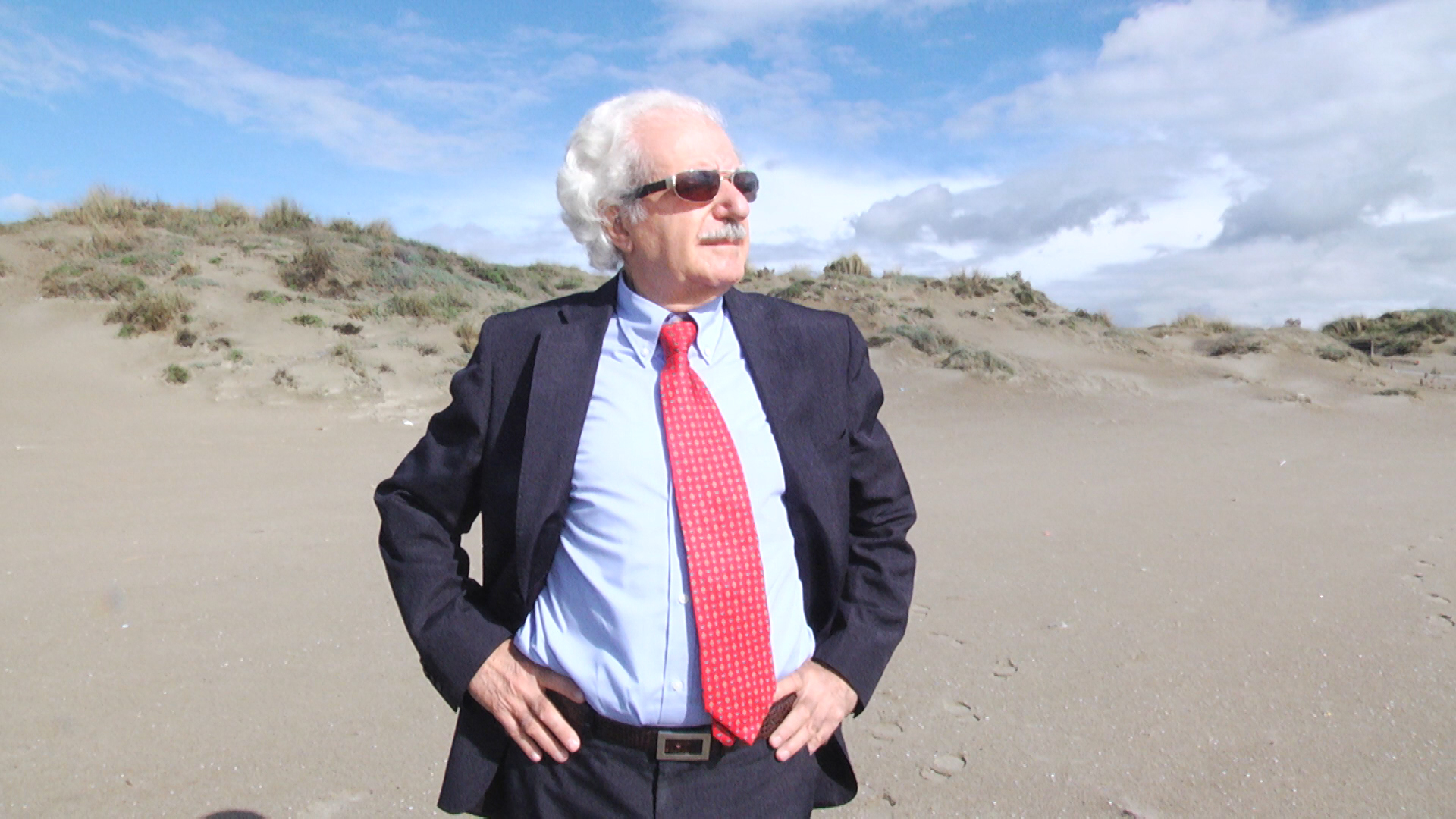
Drama, thriller, by Fabio Del Greco, Italy, 2015.
The story revolves around Vasco, a Roman builder who, at the age of 74, enjoys a life of absolute comfort. His human parable takes a dramatic turn when a mysterious encounter leads him to an ambush. Having survived, but marked by a long coma, Vasco wakes up with a new sensitivity, developing an intimate and poetic bond with nature. This new relationship with the world around him leads him to deeply explore himself, in an internal and external journey. through Italy, the United States and India, in search of a higher meaning and a cure. In parallel, the threat of a planetary cataclysm adds an epic dimension to the story.
I Am Nothing explores universal themes such as time, memory, oblivion and the connection with nature. Fabio Del Greco creates an existential drama full of food for thought. The director skillfully combines different visual materials, mixing archive images with nature photographs and dreamlike visions. This visual experimentation translates into an editing that captures the viewer's attention, guiding him through a cycle of creation and destruction. The sequences that alternate the buildings, Vasco's pride, with Indian landfills and natural landscapes create a hypnotic rhythm, underlining the beauty and fragility of life. Vasco's existential journey is a hymn to transformation and rebirth. The evolution of the protagonist, from unbridled luxury to the rediscovery of purity, represents a powerful metaphor on the meaning of life and the need to reconnect with authentic values. Io sono nulla stands out for its ability to combine introspection and visual experimentation, offering a suggestive and engaging narration. It is a film that invites us to reflect on the human condition, on our relationship with power and nature, and on the possibility of finding ourselves through change. A work that leaves its mark and lends itself to multiple readings.
LANGUAGE: Italian
SUBTITLES: English, Spanish, French, German, Portuguese
A Childhood Interrupted by Grief and Glass
There is a particular kind of silence that settles over a house after a mother dies. Not the absence of sound, but its transformation — every creak of floorboard, every wind through a window, arriving now from a different world, carrying a different weight. Aldous Huxley was fourteen when that silence entered his family home in 1908, and whatever he had been before Julia Arnold Huxley’s death, he was irrevocably something else afterward. She was the granddaughter of Thomas Arnold of Rugby, the niece of Matthew Arnold — literature ran in the family like a mineral through stone — and her disappearance from his life left a vacuum that no amount of inherited intellectual grandeur could fill. Grief at fourteen is not processed so much as absorbed, laid down in the sediment of the personality, where it quietly reshapes everything that grows on top of it.
Two years later, something else was taken. At sixteen, Huxley contracted keratitis punctata, an inflammation of the cornea that left him functionally blind for approximately eighteen months and permanently impaired in both eyes. He learned Braille. He read with his fingertips. He walked through Eton in a condition of near-total sensory withdrawal from the visual world that had always been, for a boy of his background and century, the primary channel through which reality arrived. Think for a moment what that actually means — not metaphorically, but physically. The printed page, the landscape, the faces of people you love, the particular quality of afternoon light through a window: gone, or nearly gone, replaced by texture and memory and the slow grammar of touch moving across raised dots in the dark.
Henri Bergson, whose major work Creative Evolution had appeared in 1907, argued that ordinary perception is not revelation but reduction. The senses do not open us to reality; they filter it, carving out only what is immediately useful for biological action and discarding the rest. Consciousness, in Bergson’s framework, is always larger than what the sensory apparatus allows through — and it is precisely when that apparatus is interrupted, damaged, or bypassed that something more fundamental can emerge. He was not speaking about blindness specifically, but the principle lands with uncomfortable precision on Huxley’s adolescence. Forced inward, denied the easy exit of visual distraction, the young man’s mind had nowhere to go but deeper into itself.
What comes from that depth is unmistakable in everything Huxley would eventually write. The prose does not describe the surface of things so much as press against their interior logic. The satirical novels of the 1920s — Crome Yellow, Antic Hay, Those Barren Leaves — are not books written by someone who finds the visible world sufficient. They are books written by someone who sees through it, who is constitutionally incapable of accepting appearances as conclusions. The characters speak brilliantly and feel nothing, move through elegant rooms and arrive nowhere. This is not a stylistic affectation. It is a way of seeing that was formed, at least partly, in a period when seeing was impossible.
His sight recovered enough for him to read with a magnifying glass, enough to study at Balliol College, Oxford, where he eventually went after Eton. But it never fully returned. For the rest of his life he would remain a man for whom the visible world was something effortful, something requiring instruments and patience, something that did not simply present itself but had to be pursued. And there is a particular irony — almost too neat to be accidental — in the fact that the writer who would spend decades investigating the nature of consciousness and the doors of perception began his intellectual life in a condition where perception itself had become a problem to be solved rather than a given to be trusted.
His mother’s death taught him that the world removes things without warning. The keratitis confirmed it, this time from the inside.

The Satirist Before the Prophet
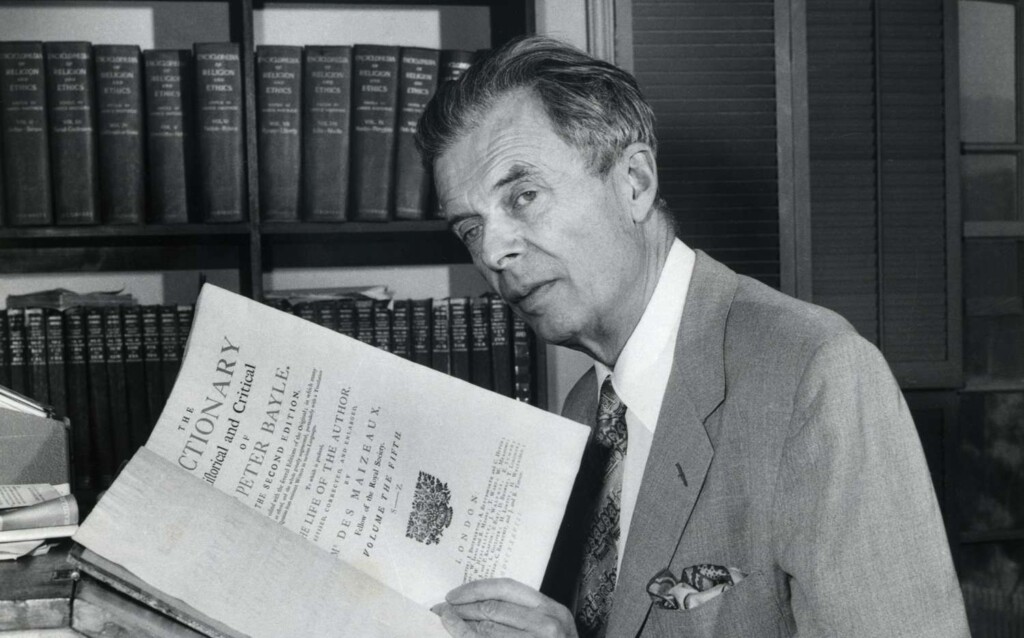
There is a particular kind of dinner party where everyone is performing, and everyone knows everyone else is performing, and yet the performance never stops. The wine is good, the conversation louder than necessary, and someone is always three sentences into a monologue about Wittgenstein or Keynesian theory or the decline of authentic experience, their eyes scanning the room to confirm the audience is still watching. You have been to this dinner. You may have been that person.
Huxley had been to dozens of them. The specific address was Garsington Manor, a stone house in Oxfordshire where Lady Ottoline Morrell gathered the finest minds of interwar Britain into a continuous theatrical production of intelligence. Bertrand Russell arrived. D.H. Lawrence arrived. Lytton Strachey arrived. They argued, seduced, published, betrayed each other in memoirs, and returned the following weekend. Huxley watched all of it with the precision of a lepidopterist observing butterflies who believe themselves to be eagles. By 1921, when Chrome Yellow appeared, he had found the form exactly suited to what he had seen: a novel in which clever people say brilliant things and accomplish absolutely nothing, trapped in a country house where ideas serve as social currency rather than instruments of understanding.
The protagonist wanders through this world like a man who has arrived at a costume party in his actual clothes. Around him, characters discourse on art, philosophy, sexual liberation, the future of civilization, their voices precise and their lives entirely stagnant. The comedy is cold, nearly surgical, because Huxley refuses to satirize stupidity. Stupidity would be easy. What he is satirizing is intelligence deployed as performance, thought wielded as decoration, the mind used not to penetrate reality but to ornament the self.
Thorstein Veblen had already named this mechanism in 1899, in The Theory of the Leisure Class, where he described conspicuous consumption as the use of goods not for their functional value but as signals of status. The wealthy man buys the expensive object not because it performs better but because its expense broadcasts his position. Veblen was writing about silver candlesticks and tailored coats. He might equally have been writing about the drawing room at Garsington. Intellectual display functions by identical logic: the obscure reference, the untranslated Latin phrase, the knowing allusion to a minor Florentine painter — none of these advance thought. They advertise it. They say: I have had the leisure to acquire this. I am not like the people who have not.
Antic Hay, published two years later, pushes this observation into something rawer. A young man moves through postwar London among artists, dilettantes, scientists, and failed idealists, all of them brilliant, all of them fundamentally hollow, their brilliance functioning as a kind of elaborate avoidance. The war has ended. The certainties have dissolved. And these people, who possess every cognitive tool necessary to confront that dissolution, are using those tools instead to build more elaborate performances of themselves. The cruelty in Huxley’s prose is not the cruelty of contempt. It is the cruelty of recognition, the discomfort of a man who knows he is describing people he loves and a world he inhabits, and who cannot make himself stop seeing it clearly.
What makes these early novels more than period pieces is precisely their diagnostic permanence. Veblen described a mechanism, and Huxley dramatized it without knowing he was illustrating Veblen, which is perhaps the best confirmation that both men had located something structural rather than circumstantial. The peacocking of intelligence is not a failure of particular individuals. It is what happens when a society treats the mind as a social instrument while pretending it is a moral one. The dinner party never ended. It simply changed its references, updated its allusions, found new names to drop into the fourth sentence of a monologue no one had asked for.
Brave New World and the Nightmare We Chose
She leans across the table and says exactly the right thing at exactly the right moment, and you know, somewhere below the level of conscious thought, that she has been trained to say it. Not trained by anyone in particular. Trained by the accumulated feedback of a thousand previous encounters, by the invisible optimization of what works, by a culture that has quietly transformed seduction into a branch of logistics. The words land perfectly. The timing is perfect. And the pleasure you feel is real — which is precisely what makes it so difficult to name what has been lost.
Huxley published Brave New World in 1932, the same year unemployment in the United States reached twenty-three percent and the Nazi Party became Germany’s largest political force. Everyone around him was watching the violence. He was watching something quieter and in many ways more durable: the replacement of coercion with satisfaction, the replacement of the whip with the drug, the replacement of the forbidden with the merely unnecessary. His World State does not burn books. It makes reading feel like effort, and effort feel like failure.
The soma tablet is not an invention. It is a forecast made from observable ingredients. By 1932 the consumer economy had already demonstrated that desire could be manufactured, that identity could be sold back to people as a product, that the distance between a need and a purchase could be compressed until they felt like the same thing. What Huxley did was follow that logic to its terminal destination: a civilization in which human beings have been so successfully administered to that they no longer experience the absence of freedom as a loss. They experience it as comfort.
Neil Postman, writing in 1985 in Amusing Ourselves to Death, argued that Huxley had understood something Orwell had not: the real danger was not that the state would hide the truth from us but that we would lose interest in the truth entirely, drowned not in pain but in irrelevance, not silenced but entertained into incoherence. Postman was writing about television. He could not have known he was also writing about the algorithm, the feed, the infinite scroll engineered to keep the eye moving and the mind from settling. The World State’s Feelies — immersive sensory entertainment requiring nothing from the audience except presence — were not a fantasy in 1985 and are barely a metaphor now.
Zygmunt Bauman‘s concept of liquid modernity arrives at the same diagnosis from a different direction. In a liquid world, all solid commitments dissolve: institutions, identities, relationships become provisional, chosen and unchosen with a fluidity that feels like freedom and functions like atomization. The citizens of Huxley’s World State are perfectly liquid. They form no lasting bonds. They accumulate no loyalties. They move between bodies and pleasures with an ease that the novel presents as social hygiene and we might recognize as loneliness engineered out of legibility. You cannot grieve what you were never permitted to name as a loss.
In the novel, a man watches a woman move toward him with the deliberate grace of someone who has never been taught that desire should be anything other than immediate and satisfied. She speaks. The words are warm, practiced, biologically calibrated. He responds. The encounter is pleasurable in a way that leaves no residue, no complication, no trace of the person he might have become through the difficulty of wanting someone he could not so easily have. Pleasure here is not a reward. It is a management strategy.
This is what Huxley meant when he called it a nightmare we would choose. Not a nightmare imposed from outside but one assembled from our own preferences, our own revealed behaviors, our own genuine and documented hunger for ease. The dystopia is not the opposite of what we want. It is the completion of it.
Point Counter Point and the Fracture of the Self
There is a particular kind of dinner party conversation that never resolves, where every person at the table is simultaneously right and wrong, and the accumulated intelligence in the room somehow produces less clarity than any single mind brought to it alone. You have been at this table. You have watched the brilliant man argue one position with complete conviction and the equally brilliant woman argue its opposite with equal conviction, and you have felt something unsettling beneath the social noise: not that one of them must be mistaken, but that both positions are true, and that this is precisely the problem.
Huxley understood this as the central problem of consciousness, and in 1928 he built an entire novel around its impossibility. Point Counter Point is structured as a musical fugue, a form where multiple independent voices develop simultaneously, none subordinate to any other, each pursuing its own logic while weaving against the others. The characters — Philip Quarles, the cold intellectual who dissects everything including his own marriage; Rampion, the vitalist prophet who scorns abstraction; Spandrell, the nihilist engineering his own destruction; Burlap, the spiritual fraud draping sanctimony over appetite — do not represent positions in a debate. They represent the irreducible plurality of a single consciousness that has been, for narrative convenience, distributed across separate bodies. Philip Quarles even keeps a notebook inside the novel in which he describes writing exactly the kind of novel you are reading, a character who is a novelist planning to write a novel about characters who contain contradictions. The recursion is not a stylistic flourish. It is a confession.
William James argued in A Pluralistic Universe, published in 1909, that reality is fundamentally multiverse rather than universe — that the great philosophical error of Western thought has been its insistence on unity, on finding the single thread that holds everything together. For James, experience itself is irreducibly various, and any system that forces it into coherence falsifies it at the root. What Point Counter Point enacts structurally is precisely this Jamesian premise: the self is not a unified subject moving through experience but a temporary coalition of contradictory drives, each one entirely sincere, each one undermining the others. Philip Quarles cannot love his wife with the warmth she deserves not because he is deficient but because the part of him that knows how to love and the part that can only observe are equally real and equally present, and they cancel each other.
Jung, writing in the same decade, identified individuation as the lifelong process by which a person integrates the contradictory components of the psyche into something approaching wholeness. But the crucial word is approaching. In Psychological Types, published in 1921, Jung was careful to describe types not as fixed identities but as dominant tendencies within a psyche that always contains its opposite. The intuitive man suppresses sensation. The thinker suppresses feeling. Wholeness is not achieved; it is endlessly negotiated. What Huxley shows in Point Counter Point is what happens when no negotiation occurs, when the fragments are simply allowed to coexist in their antagonism, and when the novel itself becomes the arena of that coexistence rather than its resolution.
The formal daring of the book has been consistently misread as failure. Critics who wanted the structural unity of a Victorian novel found only noise. But the noise is the point. A fugue does not resolve into a single melody. It holds its tensions until the last note, and what you hear in the silence after is not peace but the memory of irresolution. The death that arrives near the novel’s end — violent, senseless, almost operatic in its excess — does not punctuate an argument. It simply stops one of the voices mid-phrase, and the others continue, as they always do, as if nothing has been settled, because nothing has.
A vision curated by a filmmaker, not an algorithm
In this video I explain our vision
The Perennial Philosophy and the Hunger for the Absolute

There is a particular quality of light in Los Angeles in the late afternoon, a kind of golden indifference, as if the sun itself has agreed not to press too hard on whatever is happening beneath it. You could be sitting in a garden in the hills above Hollywood, eyes closed, breath slowing, while three blocks away someone is being evicted, and six thousand miles away a war is consuming cities whole. The meditation continues. The breath continues. The light holds its quality of not asking.
Huxley arrived in California in 1937, the same year that Guernica was still fresh on canvas and Spain was bleeding. He came for his eyes, which had been failing since adolescence, and he stayed for something harder to name. The encounter with Swami Prabhavananda, the Vedanta Society, the slow immersion into Hindu philosophy and Buddhist practice, Vedic texts and Christian mysticism, all of this produced by 1945 a book that was either his most serious intellectual achievement or his most elaborate evasion, and the difficulty is that it may have been both simultaneously. The Perennial Philosophy is not a mystical tract in any simple sense. It is a work of genuine comparative scholarship, drawing from Meister Eckhart and the Bhagavad Gita, from William Law and Lao Tzu, arguing that beneath the surface differences of all major religious traditions runs a single recognition: that there is a divine Ground of being, that the human soul can come to know it directly, and that this knowing is the only thing worth calling knowledge.
William James had asked the same question forty years earlier with considerably more skepticism. In The Varieties of Religious Experience, published in 1902, James assembled testimony after testimony of mystical states, analyzed them with the scrupulous attention of a psychologist who had himself brushed against something he could not explain, and arrived at a carefully hedged conclusion: that these states are noetic, they feel like genuine insight rather than mere emotion, but that their validity cannot be established from the outside. James wanted to take mysticism seriously without surrendering his empiricism. What he produced was a book that neither the mystics nor the materialists could fully claim, which is perhaps the most honest position available.
Huxley read James. He read him closely. And yet The Perennial Philosophy moves past James’s caution into something more assertive, more architecturally certain. The divine Ground is not a hypothesis. It is a fact that certain disciplines of attention make accessible. This is where the question opens and does not close easily, because what Huxley is describing, the systematic withdrawal of attention from the surface of things in order to encounter what lies beneath, sounds structurally identical to what he had savaged in Brave New World as soma: a chemical, then a contemplative, route to the same destination. Absence from catastrophe. Departure from the friction of the actual.
This is not entirely fair to him, and he knew it was a charge that could be made. He argued that genuine mystical attention is not escape but the most radical possible form of presence, that to touch the Ground is to return to the world with cleaner eyes, with less self-interest distorting perception. Simone Weil, writing at roughly the same moment, made a version of the same claim: that attention in its purest form is an act of love directed at reality, not away from it. But Weil was also starving herself in solidarity with French workers, which is a different kind of argument by example than sitting in a Californian garden while Europe burns.
The man sitting in meditation is not doing nothing. But neither is the world waiting for him to finish. The catastrophe does not pause out of respect for the sincerity of the practice. And the question that will not resolve itself is whether the vision arrived at in stillness belongs to the same world that continued without him, or to another one entirely.
The Doors of Perception and Chemical Revelation
You are standing in the supermarket aisle on a Tuesday afternoon and the fluorescent light above you does something it has never done before: it stops being light and becomes a machine. You see the tube, the flicker too fast for ordinary attention, the cold white frequency engineered to keep you awake and buying. Nothing has changed except that for one unguarded moment the filter slipped, and what was supposed to be invisible infrastructure became the most present thing in the room. Most people have had this moment and quickly closed it. The question Aldous Huxley spent the last decade of his life pursuing was not how to close it, but what it means that we close it at all.
In May of 1953, Huxley swallowed four-tenths of a gram of mescaline sulfate in his Los Angeles home under the supervision of the psychiatrist Humphry Osmond, who had traveled from Saskatchewan specifically for the experiment. What followed over the next several hours was not, by Huxley’s own insistence, a hallucination in any conventional sense. The furniture did not melt. The walls did not breathe with malice. What happened instead was that a small vase of flowers on his desk became inexhaustibly itself — dense with being, radiating what he could only describe as is-ness, a quality of existence so concentrated it seemed impossible that he had ever looked at a flower before and seen anything at all. The essay he published the following year, built from notes and memory and a long sustained argument about the nature of mind, would eventually sell millions of copies and alter the intellectual atmosphere of the twentieth century in ways that proved impossible to fully map.
The argument at the center of that essay was not new to Huxley. He had encountered its skeleton years earlier in Henri Bergson, specifically in the 1896 work Matter and Memory, where Bergson proposed that the brain does not produce consciousness but rather constrains it — that the mind’s primary function is to reduce the totality of what is perceivable to only what is biologically useful for survival and action. The brain, on this account, is a narrowing device. Consciousness in its raw form is something far wider, far more saturated with information and meaning, and ordinary waking life is the result of most of that signal being suppressed. Bergson was writing about memory and perception, not about psychedelics, but Huxley saw immediately that the pharmacological evidence pointed in exactly the same direction: if you interfere with the brain’s filtering mechanism, what you get is not distortion but expansion. Not less reality, but more of it than the ordinary nervous system will permit.
What neuroscience has since done to this argument is both complicate and oddly confirm it. The neuroscientist Anil Seth, working from a framework that would have been recognizable to Bergson in its fundamental structure, has proposed that what we call perception is a controlled hallucination — the brain’s best predictive model of external reality, continuously updated, but always a construction, never a direct transcript. The difference between the Tuesday afternoon supermarket and the mescaline experiment is not that one is real and the other distorted. Both are models. What the chemical does is loosen the predictions, weaken the automatic suppressions, force the model to acknowledge data it was trained to discard. The fluorescent light becomes a machine not because mescaline invents that fact but because it briefly suspends the mechanism that had been hiding it.
Huxley understood this with a clarity that was almost frightening even to him. The reducing valve does not protect you from unreality. It protects you from a reality you have not been equipped to live inside. What you see when the valve opens is not madness. It is what was always there, waiting with inhuman patience for the filter to fail.
Island, the Unfinished Utopia, and the Death That Arrived on Schedule
There is a particular cruelty in writing your final book while the world burns around you — sometimes literally. The house in Bel Air went in 1961, taking with it decades of manuscripts, annotated books, letters irreplaceable by any standard of human accumulation. He watched it from the hillside, this man who had spent forty years building an intellectual architecture of extraordinary density, and reportedly described the experience afterward with an equanimity so complete it unnerved people. Perhaps he had already understood, somewhere beneath the theoretical calm, that the fire was merely the external version of something that had been happening inside his body for years. Maria had died of cancer in 1955, and he had sat with her through it, guiding her — with the same attention he would later bring to his own dying — through meditative techniques drawn from the Tibetan Book of the Dead, whispering instructions for letting go into an ear he hoped was still receiving. By the time he received his own diagnosis, the symmetry must have felt less like coincidence than like grammar.
Island, published in 1962, is the book he wrote inside all of this. It is his only unambiguously positive utopia, and it arrives with the peculiar tenderness of something written against a deadline the author cannot name but can feel. The novel imagines Pala, a small island nation that has somehow managed to synthesize Buddhist philosophy, Western science, genuine ecological balance, and psychedelic pharmacology into a functioning society — not a perfect one, but a sane one. Farnaby, the journalist who washes ashore as the story opens, spends most of the novel being shown what a world organized around human flourishing might actually look like, and the demonstrations are patient, detailed, almost pedagogical in their thoroughness. Critics at the time were cool. The characters were thin, the didacticism undeniable. They were not wrong on the technical merits. They were simply measuring the wrong thing.
William Blake wrote in 1793, in the margin of a book by Lavater, that the man who never changes his opinion is like standing water, breeding reptiles of the mind. Huxley had changed his opinions across five decades with a consistency that looked like inconsistency only to those who expected a thinker to calcify. What Island represents is not a retreat from complexity but an insistence — made with full knowledge of its own improbability — that the question of how to live well is worth answering even when the answer arrives too late for anyone to implement it. The book ends with Pala being invaded and destroyed by a neighboring oil-backed dictatorship. The utopia does not survive. Huxley knew it would not. He wrote it anyway.
He died on November 22, 1963, after asking his wife Laura for an injection of LSD, which she administered as he had requested — consciously, deliberately, meeting the final dissolution with the same experimental curiosity he had brought to mescaline a decade earlier in the experience documented in The Doors of Perception. He died, by all accounts, peacefully. The world was not paying attention. In Dallas, earlier that afternoon, a president had been shot in a motorcade, and the machinery of collective grief immediately consumed every available channel of public consciousness. The obituaries that had been prepared were pulled, buried, or never ran at all. A man who had spent his entire life attempting — through satire, through prophecy, through mysticism, through pharmacology, through fiction, through the sheer relentless pressure of his attention — to wake people up, died on the one day in twentieth-century history when it was structurally guaranteed that no one would hear him go.
Whether that is tragedy, irony, or simply the universe maintaining its customary indifference to human significance may depend entirely on how much you believe the universe reads its own symbolism.
🌿 Visions, Control, and the Doors of the Mind
Aldous Huxley stands at a singular crossroads of literature, philosophy, and social prophecy. His work raises urgent questions about freedom, consciousness, and the mechanisms through which modern societies regulate both. These articles illuminate the intellectual landscape that shaped and was shaped by Huxley’s restless, visionary thought.
George Orwell: Life and Works
George Orwell and Aldous Huxley are the twin pillars of twentieth-century dystopian literature, each diagnosing the pathologies of modernity with chilling precision. Where Orwell feared external coercion and surveillance, Huxley feared a subtler enslavement through pleasure and manufactured consent. Reading their lives in parallel reveals how two brilliant minds, shaped by the same English literary tradition, arrived at complementary and haunting visions of the future.
GO TO THE SELECTION: George Orwell: Life and Works
Huxley’s The Doors of Perception: Analysis
Huxley’s The Doors of Perception stands as one of the most provocative documents of the twentieth century, recounting his mescaline experience as a philosophical and spiritual revelation. It challenged Western assumptions about consciousness, perception, and the boundaries of the self, anticipating the psychedelic culture of the 1960s by more than a decade. This analysis unpacks the layers of mystical, scientific, and literary meaning embedded in Huxley’s incandescent short text.
GO TO THE SELECTION: Huxley’s The Doors of Perception: Analysis
Postman’s Amusing Ourselves to Death: Analysis
Neil Postman‘s Amusing Ourselves to Death draws a direct intellectual line to Huxley, arguing that it is not Orwell’s nightmare of oppression but Huxley’s vision of distraction and triviality that has come to define contemporary culture. Postman contends that television — and by extension all entertainment media — is reshaping human cognition and political life in ways Huxley prophesied in Brave New World. This article explores how Postman transformed Huxley’s literary intuition into a rigorous media-critical theory.
GO TO THE SELECTION: Postman’s Amusing Ourselves to Death: Analysis
The Surveillance Society: History and Theory
The surveillance society is one of the defining themes connecting Huxley’s dystopian imagination to the structures of contemporary life. This article traces the historical and theoretical development of social control, from Bentham’s Panopticon to digital-age data harvesting, situating Huxley’s warnings within a broader genealogy of power and observation. Understanding surveillance theory is essential for grasping how Brave New World’s soft totalitarianism prefigured the world we now inhabit.
GO TO THE SELECTION: The Surveillance Society: History and Theory
Explore Independent Cinema on Indiecinema
If Huxley’s worlds of altered consciousness, social control, and visionary thought have stirred something in you, Indiecinema is the place to follow that thread further. Our streaming platform curates independent and auteur films that dare to ask the same radical questions Huxley never stopped asking. Come and discover cinema that opens doors.
👉 EXPLORE THE CATALOG: Watch Indie Films in Streaming
A vision curated by a filmmaker, not an algorithm
In this video I explain our vision

