
The Man Who Refused to Look Away
You are at a dinner party, and someone says something you know to be false. Not dangerously false, not spectacularly wrong, just quietly, comfortably, conveniently false — the kind of statement that keeps the evening moving and the wine flowing and nobody’s feelings bruised. And you let it pass. You reach for the bread. You change the subject. You tell yourself it wasn’t worth it, that the moment has passed, that you’ll speak up next time. You won’t, and some part of you already knows this.

Most people live entire lives in that reaching-for-the-bread gesture. The unspoken correction, the swallowed observation, the careful social arithmetic that calculates what truth costs against what silence saves. This is not cowardice in any dramatic sense. It is simply the ordinary human preference for warmth over exposure, for belonging over accuracy. The remarkable thing about Eric Arthur Blair — who would publish under the name George Orwell — is not that he was constitutionally incapable of this preference. It is that he recognized it in himself and chose, repeatedly, with full awareness of the cost, to override it.
He was born in 1903 in Motihari, Bengal, the son of a minor colonial official in the Opium Department of the Indian Civil Service. The imperial machinery that would later become one of his great subjects was the water he swam in before he could name it as water. He was sent to England at age one, grew up in a household of genteel poverty — that particularly English condition of having the manners of a class you cannot afford — and won a scholarship to Eton, where he learned firsthand how institutions manufacture consent through ritual, hierarchy, and the slow internalization of who gets to speak and who stays silent.
What he did next was the first of many acts of voluntary discomfort that would define the shape of his life. Rather than proceeding to Oxford or Cambridge, as Eton’s machinery expected, he joined the Imperial Police in Burma in 1922. He spent five years there, enforcing laws he had begun to despise on behalf of a system he was coming to understand as organized violence dressed in administrative language. The experience produced in him something more than political conversion — it produced a specific, physical revulsion. He would later describe the moment of watching a hanging, the way a man about to die stepped around a puddle so as not to wet his feet, and how that small, instinctive act of bodily care in the face of annihilation broke something open in his understanding of what imperialism actually did to human beings, including those who administered it.
He resigned in 1927 and returned to Europe. And then, in a move that puzzled and disturbed the people who knew him, he chose poverty. Not the poverty that happens to you, but the kind you walk into deliberately, with your eyes open — living among tramps in London and Paris, washing dishes in the basement kitchens of expensive hotels, sleeping in doss-houses, learning from the inside what it felt like to be invisible to the people whose floors you scrubbed. Down and Out in Paris and London, published in 1933, was the record of that immersion, but the book was never quite the point. The point was the looking. The refusal to simply theorize about a class of people he had been raised to ignore.
This pattern — the deliberate positioning of his body in the place where the discomfort was greatest — would repeat itself with almost compulsive regularity. The road to Wigan in 1936, the coal mines of Lancashire and Yorkshire, the damp rooms and the coughing men and the women kneeling on stone floors. Then Spain, the trenches of Aragon, the bullet through his throat in 1937 that he survived partly by chance and partly, one suspects, because he had already decided that the story was worth more than his safety.
He died of tuberculosis in January 1950, aged forty-six.
Empire’s Dirty Secret: Burma and the Birth of Guilt
He was twenty-one years old when he arrived in Burma, and the uniform fit perfectly. That is the most insidious part — not that the institution was brutal, but that it was comfortable. The boots, the rank, the deference of the colonized, the shared language of contempt spoken quietly at dinner among men who considered themselves civilized. Eric Arthur Blair, not yet Orwell, not yet anything except a young Englishman doing what young Englishmen of his class and era did: he extended the empire’s reach one small act of authority at a time, in the Irrawaddy Delta, in Moulmein, in Insein, learning the specific grammar of domination the way you learn any language — by immersion, by repetition, until you stop noticing you are speaking it.
Hannah Arendt, writing in 1963 about Adolf Eichmann‘s trial in Jerusalem, coined a phrase that has since been so overused it has nearly lost its edge: the banality of evil. But Arendt’s actual argument was sharper and stranger than its popular reduction. She was not saying that evil is ordinary. She was saying that the most reliable mechanism for producing evil is not hatred or sadism but thoughtlessness — the surrender of moral judgment to institutional function. Eichmann did not think of himself as a murderer. He thought of himself as an efficient administrator. The horror was not in his malice but in his absence. Orwell, in Burma, was not Eichmann. The scale is not comparable and the moral stakes are entirely different. But the psychological structure Arendt identified — the way belonging to an apparatus gradually replaces individual perception with institutional reflex — that structure fits Orwell’s Burmese years with an almost clinical precision.
There is a moment, one he would later reconstruct in prose so controlled it reads like a deposition, where he stands before a crowd of several thousand Burmese people, holding a rifle, facing an elephant that has already ceased to be dangerous. The animal is simply standing in a field, calm, enormous, already returning to itself after the madness that had made it lethal. He does not want to shoot. He knows he does not need to shoot. But the crowd expects it, and the crowd’s expectation becomes its own form of coercion. He shoots. He shoots again. The elephant takes forty-five minutes to die. And he realizes, standing there in what should have been a moment of authority, that he is not the master of anything. The empire has made him into a performing puppet, condemned to act out power for an audience whose gaze has colonized him as thoroughly as he was supposed to be colonizing them. The oppressor, he understood then, constructs his own prison from the bricks of his role.
This is what surfaces in Burmese Days, published in 1934 after rejection and delay — Victor Gollancz refused it, fearing libel, and it appeared first in the United States — not as a novel of adventure or exotic setting but as an anatomy of moral rot that begins before anyone has made a single conscious choice. John Flory, its protagonist, is not a villain. He is something more disturbing: a decent man made complicit by increments, who drinks too much and talks to the wrong people and understands everything and changes nothing, because the machinery of the system absorbs individual conscience the way a river absorbs rain. The book’s rage is internal, suffocated, turned against itself, because Orwell already knew that the most devastating indictment of empire was not the cruelty of its worst servants but the deformation of its best ones.
He left Burma in 1927, officially on medical leave. He never went back. But Burma never entirely left the architecture of how he thought about power, about language, about the precise way institutions teach you not to see what you are doing while you are doing it.

The Anatomy of Poverty: Going Down to Come Back Up
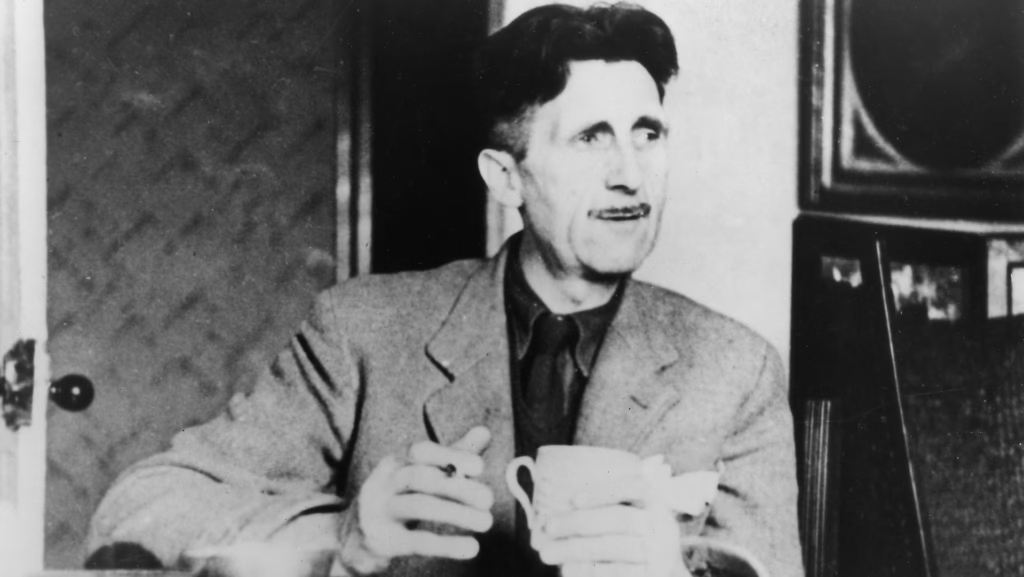
There is a moment when you realize that the city you thought you knew has a second city living inside it, pressed flat against its walls, invisible until you step through a particular door. Not a metaphorical door. A service entrance, grease-filmed, at the back of a restaurant where the dining room gleams with candlelight and the sommelier moves between tables with the unhurried confidence of someone who has never once doubted his place in the social order. Behind that door, in a kitchen running at forty degrees, a man is scrubbing dishes at a pace that would destroy most people within an hour. He has been doing it for eleven hours already. He will not be seen by anyone who matters. The food he helps produce will be described, out front, as an experience. For him, it is indistinguishable from punishment.
Orwell stepped through that door deliberately, in the late 1920s, in Paris. He was not sent there by a newspaper. No editor commissioned the descent. He chose it, with the strange voluntarism of someone who understands that certain truths cannot be learned from the outside, only inhabited. He washed dishes in the basement kitchens of grand Parisian hotels, slept in flophouses, navigated the arithmetic of destitution — the precise calculation of whether you eat today or save the money for a bed tomorrow. What he brought back from those months, published in 1933 as his first book, was not a sociological survey. It was something more unsettling: a portrait of poverty as a total condition, one that reorganizes not just your material circumstances but your relationship to your own body, your sense of time, your capacity to imagine a future.
Pierre Bourdieu, writing decades later, developed the concept he called symbolic violence — the process by which social hierarchies reproduce themselves not through overt force but through the internalized acceptance of one’s own diminishment. The dominated, Bourdieu argued in “The Logic of Practice” (1980), come to experience their domination as natural, even deserved. They carry the social order inside themselves, which is precisely why the order is so difficult to overthrow: the prison has been constructed in the mind before the walls are ever built around the body. What Orwell documented in those Parisian basements is symbolic violence in its most naked form. The plongeur — the dishwasher — occupies a position so thoroughly beneath notice that even he begins to accept his invisibility as a fact of nature rather than a social choice.
The humiliation is never dramatic. That is what makes it so total. It operates through the accumulation of small erasures: the way no one meets your eye, the way your labor is consumed without acknowledgment, the way you learn to move through space as though you have no right to occupy it. Orwell noticed that poverty does something specific to the body’s relationship with shame. You begin to internalize the contempt of those above you. You apologize for existing in spaces where your presence is necessary but unwanted.
In London, tramping through the spike system — the network of workhouses that offered a bed in exchange for labor and total submission to institutional authority — he watched men perform a kind of social death every time they entered. They surrendered their clothes, their names, their autonomy. The institution processed them like material. And the cruelty, he kept insisting, was not in the individual wardens or the particular rules. It was structural, embedded in the assumption that poverty was a moral failing requiring correction rather than a systemic condition requiring analysis.
George Orwell was thirty years old when that book appeared. He had not yet written anything that would make him famous. But he had already understood something that most writers who come from comfort never manage to grasp: that the world has a back entrance, and everything you thought you knew looks entirely different from that side.
Wigan Pier and the Lies We Tell About the Working Class
There is a particular kind of intellectual who has never changed a fuse, never stood in a queue at a labour exchange, never come home with coal dust embedded so deeply under the fingernails that soap becomes a kind of joke — and yet speaks about the working class with the fluency of a native informant. You have met this person. You may, at some uncomfortable angle of self-recognition, have been this person. Orwell knew this person intimately, because he had been trying, with varying degrees of honesty, to shed his own version of that skin.
When he descended into the Lancashire and Yorkshire coalfields in the winter of 1936, unemployment in Britain’s depressed industrial regions was not a statistic but a landscape. In Wigan alone, the unemployment rate hovered around thirty percent of insured workers. The mines were dying, the slag heaps were permanent features of the horizon, and families of five or six were living in back-to-back terraces where damp came through the walls like a second tenant. Orwell recorded all of this with the precision of a journalist and the discomfort of a man who knew he was a visitor. He measured the floor space of lodging rooms. He calculated weekly incomes against the cost of bread, margarine, and tea. He sat at kitchen tables and ate with people and watched them, and he never pretended that watching was the same as belonging.
The first half of the book he published in 1937 is that sociological document — dense, uncomfortable, specific in the way that only genuine presence can make a thing specific. But it is the second half that detonated in the living rooms of the Left Book Club, which commissioned the work and then found itself receiving a grenade wrapped in brown paper. Because Orwell turned from the miners to the people who claimed to speak for them, and what he found there was a species of fantasy so entrenched it had begun to resemble religion.
The socialist intellectuals of the 1930s had constructed a proletariat that did not quite exist — noble, instinctively collective, uncorrupted by the petit-bourgeois anxiety about respectability, unified by shared suffering into a natural revolutionary subject. E.P. Thompson, writing more than two decades later in The Making of the English Working Class in 1963, would demonstrate something far more complicated: that working-class identity was forged through specific historical struggles, through Methodist chapels and friendly societies and the memory of particular defeats, through a culture with its own internal hierarchies and its own deep conservatism alongside its radicalism. It was not the blank canvas onto which progressive intellectuals could paint their desired future. It was a world with its own texture and its own contradictions, and it resisted romantic projection as firmly as it resisted the condescension of those above it.
Orwell, arriving at something like Thompson’s conclusion through instinct and immersion rather than archival research, wrote with a fury that embarrassed his patrons. He said plainly that the typical socialist was a crank drawn to the movement by vegetarianism, sandals, and a free-floating hatred of the existing order that had more to do with personal neurosis than class solidarity. He said that the working-class man, who might have voted for any party or none, who cared about his garden and his dog and the precise temperature of his beer, was not waiting for liberation from people who regarded his tastes as symptoms of false consciousness. He said, most unforgivably, that the Left had made itself easy to despise.
The rage this produced in progressive circles was, characteristically, a confirmation of the diagnosis. Because the thing about being told you have romanticized someone else’s suffering is that the most natural response is to accuse the person telling you of insufficient solidarity rather than to examine whether the romanticization is real.
Spain, 1937: The Moment Ideology Starts Killing Its Own
He arrived in Barcelona in December 1936 and the first thing he felt was not ideology but air. The city was alive with something he had never encountered before — a horizontal society, or something that resembled one closely enough to make him believe it was possible. Militiamen addressed each other without rank. Shops were collectively run. The word “comrade” had not yet curdled into bureaucratic formality. He wrote later that it was the first time he had been in a town where the working class was in the saddle, and that even the bootblacks had been collectivized. He wrote it without irony. That detail about the bootblacks matters more than any political manifesto he ever read, because it was the kind of concrete, ridiculous, human fact that ideology never bothers to notice — and that reality never lets you forget.
By May 1937, he was on a rooftop in the same city, rifle in hand, watching men who had been fighting the same enemy the week before now shooting at each other across the same streets. The Soviet-backed Communist factions had turned on the anarchists and the POUM militias — the independent Marxist organization he had joined — with the particular ferocity that ideological purges reserve for those closest in belief. It is always the almost-ally who must be destroyed most thoroughly. Stalin’s influence over the Republican war effort had by then become the dominant political architecture of the conflict, and it imported directly the logic of the Moscow Show Trials: confess, recant, disappear. Men he knew were arrested on fabricated charges of fascist collaboration. Some vanished entirely. His commanding officer, Georges Kopp, was imprisoned. His wife Eileen, still in Barcelona, destroyed documents before they could be seized. They fled Spain as political fugitives, technically enemies of the Republic they had crossed Europe to defend.
Arthur Koestler understood this mechanism from the inside. His novel published in 1940 reconstructs with almost surgical precision the psychological architecture of what happens to a true believer when the party demands his self-annihilation. The protagonist — a veteran revolutionary, a man who gave everything to the movement — is arrested by the very apparatus he helped build. What the book illuminates is not the cruelty of the interrogators but the internal collapse of the accused: the way a mind trained in dialectical obedience eventually produces its own confession, not under torture but under the deeper pressure of a worldview that has no room for personal truth. He signs because the logic of the system has colonized his capacity to resist it. He believes, in some broken sense, that this is what loyalty requires.
Erich Fromm, writing in 1941, gave this process its psychological name. In his analysis of the authoritarian character, he argued that freedom itself becomes unbearable when it arrives without the structures that give it meaning — that people do not simply submit to totalitarian systems out of fear, but actively flee into them, surrendering individuality as relief from the vertigo of self-determination. The man on the rooftop in Barcelona had glimpsed a society trying to hold that vertigo open, to live inside it without collapsing. What he watched instead was how quickly human beings reach for hierarchy, denunciation, and purge when the weight of horizontal freedom proves too much to carry.
What Orwell brought back from Spain was not disillusionment in the lazy sense — not the cynicism of someone who expected too much and got too little. It was something more precise and more devastating: the knowledge that utopian violence does not merely fail to protect its believers, it specifically, methodically, targets them. The purer your faith, the more dangerous you become to the apparatus that has replaced it. Barcelona in December had felt like proof. Barcelona in June was the correction.
A vision curated by a filmmaker, not an algorithm
In this video I explain our vision
Animal Farm and the Grammar of Tyranny

There is a moment when the sign on the barn wall has been repainted so many times that no one alive can quite remember what it first said. The animals gather in front of it, straining to read, and what they find there confirms exactly what they are told to find. This is not a fable about farm animals. This is a document about the precise mechanism by which language becomes the primary instrument of domination, and about how that mechanism operates so quietly, so incrementally, that by the time you notice it, you have already been using its vocabulary for years.
Orwell completed the manuscript in 1944 and immediately encountered the machinery he had diagnosed in action. Victor Gollancz refused it. Cape refused it after initially accepting, having been warned off by a figure at the Ministry of Information. T.S. Eliot, then at Faber, declined with a letter expressing the view that the pigs’ perspective was insufficiently sympathetic, which is perhaps the most elegant demonstration of the book’s thesis that any rejection letter could provide. The fear was not of the allegory. The fear was of Stalin, then an ally, then sacrosanct, and the cultural vertigo of offending a powerful friend by telling the truth about what friendship with power actually costs. Secker and Warburg finally published it in August 1945, and within a year it had done what four hundred years of political philosophy had struggled to do: it had given ordinary readers a grammar for recognizing manipulation in real time.
Victor Klemperer was conducting a parallel investigation from inside the disaster rather than observing it from outside. His Lingua Tertii Imperii, written between 1933 and 1945 and published in 1947, catalogued the way Nazi vocabulary did not simply describe a political reality but actively manufactured one. Words like Fanatismus, which had carried negative weight, were rehabilitated into terms of honor. The word Volk was stretched until it contained everything the regime wanted and excluded everyone the regime feared. Klemperer understood that when a language changes, it does not announce itself. It seeps. You find yourself using the new word because the old word has quietly disappeared from the spaces where conversation happens, and the new word is simply what is available.
The pigs’ rhetorical inversions work identically. “Four legs good, two legs bad” is not merely a slogan; it is a cognitive simplification designed to make complexity feel like betrayal. The commandment that all animals are equal does not disappear; it mutates, absorbing its own contradiction, adding the qualifier that makes it mean its opposite while retaining the emotional authority of the original declaration. This is what Orwell understood about totalitarian language that liberal commentary consistently underestimates: it does not replace the old values, it colonizes them. It speaks in the name of liberation while engineering submission, in the name of the collective while serving the individual at the top, in the name of history while erasing memory.
The squealing of Squealer is not comic. It is the sound of every press secretary, every party organ, every institutional voice that has ever asked you to trust the process while the process was being dismantled. The genius of the book is that it makes this visible not through argument but through accumulation, through the slow, almost imperceptible drift from one formulation to the next, until you arrive at a place so far from the origin that the origin itself has become unthinkable, unspeakable, counterrevolutionary.
Hannah Arendt, writing about the origins of totalitarianism in 1951, argued that the most devastating effect of totalitarian rule is not what it does to the body but what it does to the capacity for thought, to the faculty she later called “thinking” in its most essential sense. Orwell had already rendered that argument in the shape of a barnyard and a bucket of whitewash. The animals stare at the wall. The words say what they have always said. They are sure of it.
1984: The Room You Already Know Exists
There is a moment you know intimately, even if you have never named it. You begin typing something — a thought, an opinion, a small honest observation — and then you stop. Your finger hovers. You select the text. You delete it. Not because anyone asked you to. Not because a law forbids it. Because something inside you has already calculated the cost, run the social arithmetic, and returned a verdict before you even finished the sentence. That moment, that precise internal flinch, is what Orwell was writing about. Not the future. The present he was already living in, and the one you are living in now.
He wrote it dying. Tuberculosis had been consuming him for years, and Barnhill, the farmhouse on the Scottish island of Jura where he finished the book, was remote and damp in ways that bordered on self-punishment. He typed the final manuscript himself, too ill to find a secretary willing to travel that far, his lungs deteriorating with each chapter. He completed Nineteen Eighty-Four in 1948 and inverted the year for his title. He knew he would not live to see the reviews settle. The book was published in June 1949; Orwell died in January 1950. What he left behind was not a prophecy about telescreens and totalitarian states. It was a diagnosis of the mechanism by which power makes itself unnecessary — because you do the work for it.
Michel Foucault, writing in Discipline and Punish in 1975, would give this mechanism its most precise anatomical description. The panopticon, Jeremy Bentham‘s eighteenth-century prison design in which a central tower surveils all cells while the prisoners can never know whether they are being watched at any given moment, became for Foucault the architectural metaphor of modern power. The prisoner eventually internalizes the gaze. The guard can be absent. The effect persists. What Foucault mapped philosophically, Orwell had already rendered as lived experience, as the sensation of a man who cannot write a diary entry without feeling the walls watch him back.
Doublethink is the concept that tends to attract the most analysis, and it deserves the attention. The capacity to hold two contradictory beliefs simultaneously and accept both, to know something is false while sincerely believing it to be true — this is not a feature of extreme authoritarian societies alone. It is the cognitive posture of anyone who has ever defended an institution they privately despise, praised work they know is mediocre, or expressed enthusiasm for a decision they had no power to refuse. The genius of Orwell’s formulation is that doublethink is not hypocrisy. Hypocrisy at least requires knowing the difference. Doublethink erases the difference itself.
And then there is Newspeak, the engineered contraction of language whose ultimate goal is not to mislead but to make certain thoughts literally unthinkable. If the vocabulary for a concept does not exist, the concept cannot be formed. This is not science fiction. The linguist George Lakoff spent decades documenting how political framing shapes cognitive possibility — how the words chosen to describe a policy determine what responses feel natural or even conceivable. Orwell understood this in 1948 with no formal linguistics training, only the bone-deep instinct of a man who had watched language weaponized in Spain, in Burma, in the British press, in his own party affiliations.
What he built at Barnhill, feverish and alone, was a map of the room you already sense exists inside you. The room where you second-guess the sentence. Where you soften the word. Where you replace the true thing with the acceptable approximation and feel, somewhere below articulation, the small collapse that follows.
You know that room. You visit it more often than you admit. The question Orwell leaves open, the one that does not close, is whether you have started to think of it as home.
The Style as Ethics: Why Orwell’s Sentences Are Political Acts
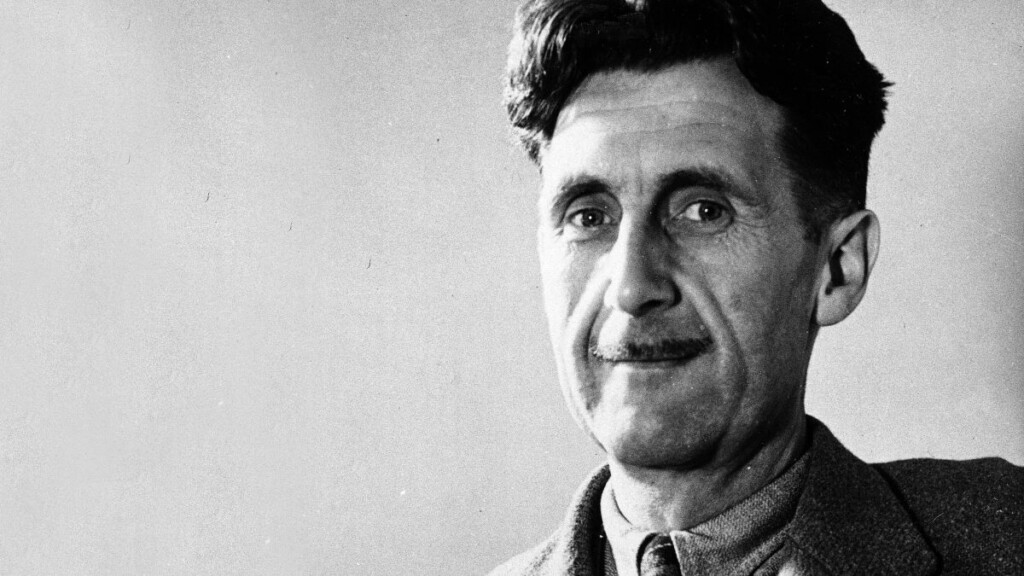
You are reading a government document, a corporate memo, a university policy statement, and somewhere around the third paragraph you realize you have no idea what it is actually saying. Not because the subject is complex. Because the language has been engineered to prevent understanding. The sentences are long, the nouns have been inflated into abstractions, the verbs have been drained of action, and the whole thing produces in you a faint nausea, the feeling of being spoken to and ignored simultaneously.
Orwell named this mechanism with surgical precision in 1946, in an essay that remains, nearly eighty years later, one of the most unsettling diagnoses of how power operates through grammar. His argument was not about style in any decorative sense. It was about moral accountability. When a politician writes that certain areas are being pacified rather than that villages are being bombed, the abstraction is not a failure of communication. It is a success of concealment. The passive voice, the latinate noun, the vague collective subject — these are not stylistic tics. They are ethical evasions, and Orwell insisted they be recognized as such.
His six rules for writing — prefer the short word, prefer the concrete image, cut any word that can be cut, never use the passive where you can use the active, never use jargon if plain language will do, and break any of these rules before saying something barbarous — sound almost naively simple until you try to follow them in a world that rewards the opposite. Every institution, every bureaucracy, every ideological apparatus has a vested interest in language that obscures agency. Who decided? The decision was made. By whom were the cuts implemented? Restructuring was implemented. The grammar performs a vanishing act on the human being who acted, and once that person has vanished from the sentence, they cannot be held responsible for anything.
Roland Barthes, working in a different tradition but arriving at a convergent diagnosis, argued in his 1953 Writing Degree Zero that literary language is never neutral, that every choice of style encodes a politics, a class position, an ideological allegiance that presents itself as transparency while practicing concealment. What Barthes saw in the texture of prose — the way a certain kind of writing naturalizes its assumptions, makes them invisible, makes them feel like common sense rather than argument — Orwell had already recognized as the primary weapon of authoritarian rhetoric. Obscure language is never accidental. It is always, as Barthes understood, in someone’s interest. The fog is manufactured.
This is why Orwell’s sentences hit the way they do. A man may take to drink because he feels himself to be a failure, and then fail all the more completely because he drinks. The clarity is almost violent. There is nowhere to hide inside it. The thought moves forward, the subject acts, the consequence follows, and you are left with something you cannot un-understand. He extended the same discipline to political analysis, to memoir, to fiction, and to the whale’s belly of cultural criticism — never allowing the abstraction to swallow the person, never letting the system erase the body that the system was operating on.
The question his essay leaves open, and leaves deliberately open, is whether this kind of clarity can survive the very systems it is trying to name. Every generation that has tried to speak plainly about power has found the language gradually colonized, the critical vocabulary absorbed, neutralized, rebranded. Transparency becomes a corporate value. Authenticity becomes a marketing strategy. Even Orwell’s own warnings have been turned into a kind of intellectual brand, cited most often by people performing the clarity he demanded rather than practicing it. What endures in his work is not the rules themselves but the refusal behind them — the insistence that when language stops naming reality, it begins replacing it, and that the distance between those two things is the distance between a free mind and a managed one.
🔭 Power, Control, and the Rebel Mind
George Orwell spent his life dissecting the mechanisms of power, propaganda, and the slow erosion of individual freedom. His works resonate deeply with thinkers who questioned authority, mass conformity, and the manipulation of truth. These articles trace the intellectual currents that ran parallel to Orwell’s urgent moral vision.
Postman’s Amusing Ourselves to Death: Analysis
Neil Postman‘s critique of television culture and its numbing of political consciousness echoes Orwell’s fear of a society distracted into submission. Where Orwell imagined a boot stamping on a human face, Postman saw the same oppression delivered through entertainment and spectacle. Together, their warnings form a complete portrait of how freedom can be lost without a single shot being fired.
GO TO THE SELECTION: Postman’s Amusing Ourselves to Death: Analysis
Karl Marx and Alienation: Economic and Philosophical Manuscripts
Karl Marx’s concept of alienation provided one of the foundational frameworks through which Orwell understood the condition of the working class. Orwell, who famously descended into poverty to understand oppression from within, gave visceral literary flesh to what Marx had described in philosophical terms. The Economic and Philosophical Manuscripts remain an essential companion to works like The Road to Wigan Pier and Down and Out in Paris and London.
GO TO THE SELECTION: Karl Marx and Alienation: Economic and Philosophical Manuscripts
Hannah Arendt: the Philosopher Who Unmasked the Banality of Evil
Hannah Arendt‘s analysis of totalitarianism and the banality of evil stands as the philosophical counterpart to Orwell’s fictional dystopias. Both thinkers grappled with how ordinary people become instruments of monstrous systems, stripping away any romantic notion of evil as exceptional or heroic. Reading Arendt alongside Orwell reveals the terrifying normality at the heart of authoritarian machinery.
GO TO THE SELECTION: Hannah Arendt: the Philosopher Who Unmasked the Banality of Evil
Mass Social Homologation Today
The phenomenon of mass social homologation—the flattening of individual thought into collective conformity—was precisely what Orwell feared and dramatized in Nineteen Eighty-Four and Animal Farm. His concept of doublethink anticipated the modern mechanisms by which populations absorb contradictions and surrender critical autonomy. This article explores how those dynamics have deepened in contemporary consumer societies, giving Orwell’s warnings renewed and unsettling relevance.
GO TO THE SELECTION: Mass Social Homologation Today
Discover the Cinema That Thinks
If Orwell’s ideas about truth, resistance, and the human spirit speak to you, Indiecinema’s streaming catalog is your next destination. Explore independent and auteur films that refuse easy answers and dare to look power in the eye—the kind of cinema Orwell himself would have watched with a notebook in hand. Stream them now on Indiecinema.
👉 EXPLORE THE CATALOG: Watch Indie Films in Streaming
A vision curated by a filmmaker, not an algorithm
In this video I explain our vision

