The Morning You Stopped Seeing the World
You are standing in your kitchen. It is a Tuesday morning, or a Thursday, it does not matter — the sameness is the point. You reach for a glass of water, the same glass you have reached for three hundred mornings in a row, and something stops you. Not a sound, not a thought. Something more primitive than either. You look at the glass and for one vertiginous second you do not know what it is. The light through the window catches the water inside it and the whole thing glows, trembles slightly, holds the entire room in its curved surface like a tiny and perfect world. And then the moment closes. The brain reasserts itself, the label snaps back into place — glass, water, kitchen, Tuesday — and you drink and you move on and you will not think about that second again for months, maybe years, maybe never.

But that second was real. And it was, in a way that our ordinary language has almost no tools to describe, more real than everything surrounding it.
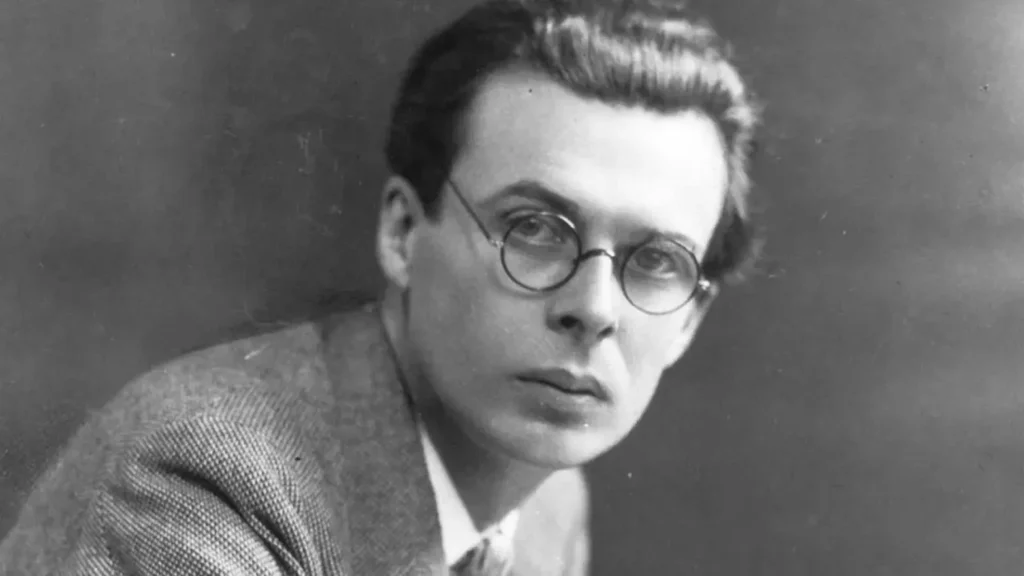
Aldous Huxley spent much of his intellectual life circling that second. Born in 1894 into one of England’s most formidably educated families — his grandfather Thomas Henry Huxley had been Darwin’s most ferocious defender, his brother Julian would become one of the twentieth century’s defining biologists — Aldous seemed almost fated to interrogate the borders of what the human mind could know about itself. But where the family tradition pointed outward, toward nature and empirical science, Aldous turned inward, toward the apparatus doing the observing. By the time he sat down in May 1953 to swallow four-tenths of a gram of mescaline under the supervision of psychiatrist Humphry Osmond in his Los Angeles home, he had already written Brave New World, already survived the near-blindness that plagued him from adolescence, already lived long enough to suspect that seeing and perceiving were two entirely different operations that most people spent their lives confusing for the same thing.
What he wrote afterward, The Doors of Perception, published in 1954, is barely a hundred pages long. It has the physical weight of a pamphlet. It has the intellectual weight of a depth charge.
The central argument Huxley borrows — and transforms — from the philosopher Henri Bergson is this: the brain is not an organ of revelation but an organ of reduction. Bergson had proposed, in Matter and Memory published in 1896, that consciousness filters reality rather than opens us to it, that the nervous system’s primary function is to eliminate the vast majority of what exists in order to leave only what is useful for survival and action. Huxley takes this and pushes it somewhere Bergson did not quite go. He suggests, following also the philosopher C.D. Broad who had developed similar ideas about the brain as a “reducing valve,” that what we call normal waking consciousness is not the fullness of experience but its radical abbreviation. We have been trained, by evolution and culture and language and the relentless social pressure to be functional, to see almost nothing of what is actually there.
Think about that glass again. The one that glowed for one second on a Tuesday morning. You did not imagine that. You did not have a small breakdown. For one unguarded moment, the filter slipped, and something that was always there became briefly visible before the machinery of ordinary consciousness closed it back down.
The question Huxley is really asking is not about drugs, not about mysticism, not about any exotic or transgressive experience. It is a question about the architecture of your mind on an ordinary morning, in an ordinary kitchen, holding something as simple and inexhaustible as a glass of water in your hand.
Return to Planet Underground
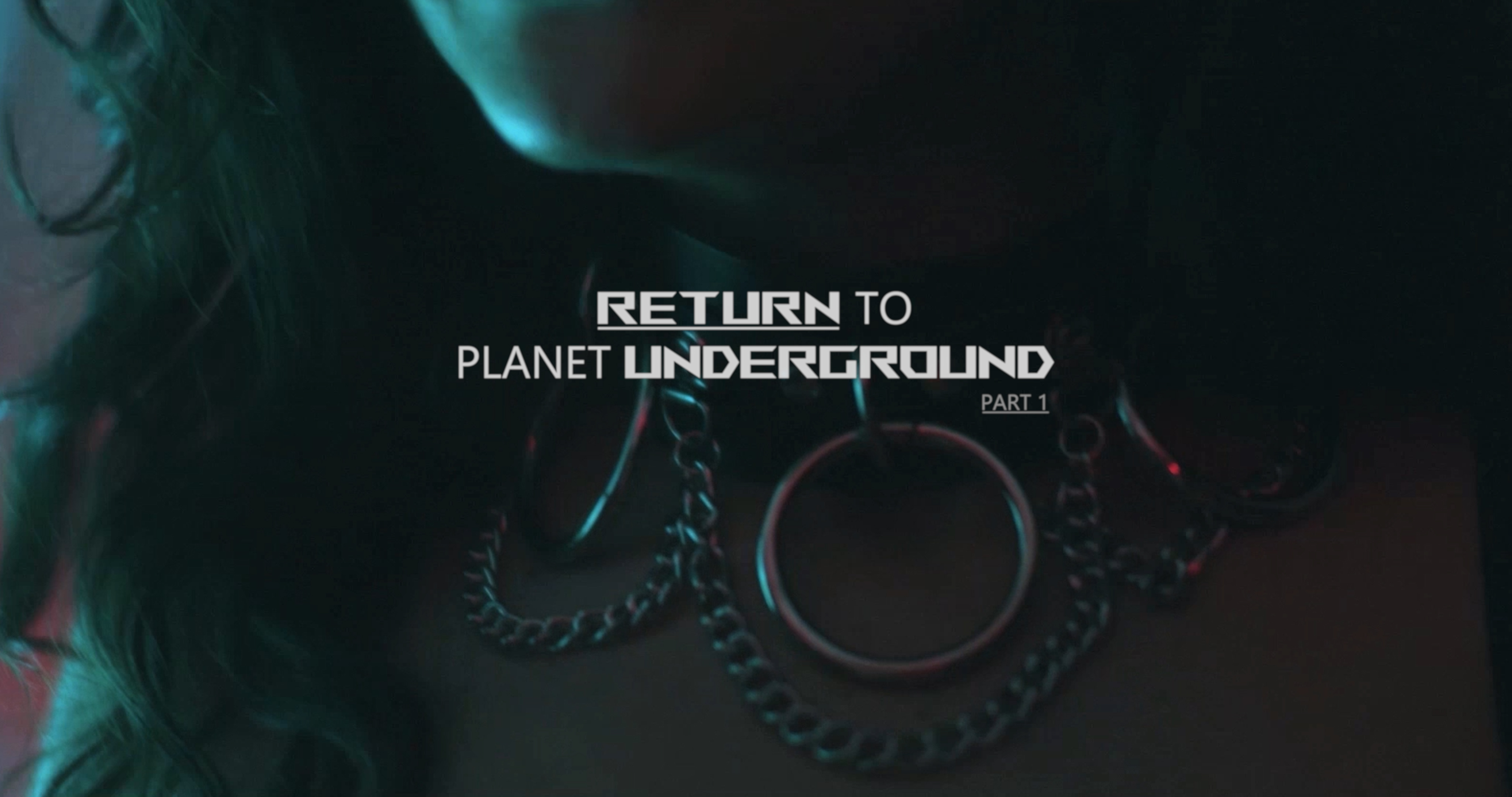
Drama, Thriller, by Gideon Homes, Netherlands, 2025.
A former underground techno DJ working in a large and famous law firm delves into the dark side of society. With one eye on the past and one on the future, he stirs up the ashes of the true underground. The demand of society to function superficially and deliver top performance increasingly clashes with the protagonist's questioning of his own life reality and the values of his past. After being employed for almost six years and being a respected employee, Tyrel falls ill. On top of that, he witnesses a fraud within the company and asks to leave. But the illness creates a complex situation in which his employer starts playing a game of chess with Tyrel.
In "Return To Planet Underground", director Gideon Homes gives the audience a gripping insight into the Dutch underground techno scene, offering a gripping drama set in a dark world, full of intense moments and touching human tragedies. This film is not just a visual feast; it is a gripping exploration that immerses viewers in the lives of its protagonists. Set to a backdrop of thumping techno beats, "Return To Planet Underground" takes audiences on a rollercoaster ride through the highs and lows of human desires, drug-fueled escapades, societal pressures and the pursuit of perfectionism. Drawing inspiration from iconic films such as Trainspotting, Berlin Calling and Human Traffic, Gideon Homes' work stands out for its unique stylistic devices and unconventional storylines. Based on real events and personal experiences, "Return To Planet Underground" faced numerous lawsuits before finally conquering audiences around the world. Prepare yourself for an immersive dive into a world where music, morality and the human spirit collide.
LANGUAGE: English, Dutch
SUBTITLES: Spanish, French, German, Portuguese
Mescaline, May 1953, and the Doors That Were Already There
It is a Thursday morning in May 1953, and a man is sitting in a suburban house in Los Angeles waiting for something to happen. He has already swallowed four-tenths of a gram of mescaline dissolved in water. He is fifty-eight years old. Outside, the California light is doing what California light always does — arriving without apology, flooding everything, making shadows irrelevant. He sits, and waits, and knows more about the history of human consciousness than almost anyone alive on the planet at that moment. He has written novels, essays, poetry. He has corresponded with D.H. Lawrence and sat with Gerald Heard. He has spent thirty years dismantling the comfortable architectures of Western civilization in prose so precise it reads like surgery. And now he is waiting to see what a cactus-derived compound will do to the mind that produced all of that.
This is Aldous Huxley at the midpoint of what he would later understand as the second and stranger half of his life. Born in 1894 into one of England’s most intellectually formidable families — his grandfather was Thomas Henry Huxley, Darwin’s great defender, his great-uncle was Matthew Arnold — he had inherited a world that believed fiercely in the power of reason. He had also, at sixteen, contracted a severe eye infection that left him nearly blind for several years, an event that permanently rewired his relationship to the senses. He learned to read Braille. He trained himself to see differently, to attend to light and color and form with the halting, deliberate focus of someone who knows how easily the visual world can be taken away. By 1953 he wore thick glasses and still could not drive. He had been living in California exile since 1937, drawn there partly by the weather and its effects on his damaged vision, partly by a spiritual restlessness that England could no longer accommodate.
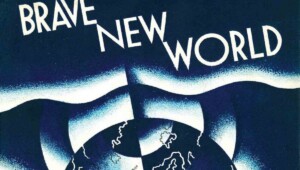
He was also a man who had spent two decades theorizing about exactly what he was about to experience. Brave New World, published in 1932, had imagined a civilization chemically managed into contentment — soma, the perfect drug of social control, bliss administered from above to prevent anyone from feeling too much, thinking too clearly, or wanting something real. That novel was a diagnosis, not an endorsement. But somewhere in the writing of it, and in the twenty years that followed, Huxley had become genuinely obsessed with the question beneath the satire: what is the mind actually capable of perceiving, if you remove the filters that civilization installs so early and so efficiently that we mistake them for the structure of reality itself?
The philosopher Henri Bergson had proposed something that Huxley found permanently persuasive — that the brain functions primarily as a reducing valve. Its job is not to open the world to us but to narrow it, to cut the vast and undifferentiated flood of sensory information down to the manageable trickle we call ordinary experience. Without this reduction, Bergson argued, we would be overwhelmed, paralyzed by a perception too wide for any practical use. Huxley had absorbed this idea and built it into the very foundation of his thinking about consciousness. What mescaline offered, he suspected, was a temporary malfunction of that valve. Not an addition to experience but a subtraction of subtraction. Not something new flooding in, but the usual blockade lifted.
The experiment was supervised by the psychiatrist Humphry Osmond, who would later coin the word psychedelic in 1957. Osmond was thorough, careful, genuinely curious about what would happen when one of the twentieth century’s most disciplined analytical minds encountered a perceptual state it could not analyze its way out of. What happened over the following hours Huxley would render into seventy-nine pages published in 1954, a small book that would travel through Western culture like a slow detonation, arriving in living rooms, university corridors, and recording studios across two decades, changing what people believed was possible inside their own heads.

The Reducing Valve and the Lie of Normal Perception
You have felt it before. Not under any substance, not in any altered state — just at some ordinary moment, waiting for something, looking at nothing in particular, when the familiar surface of things seemed for a fraction of a second about to give way. A crack in the wallpaper of the real. Then someone spoke, or a phone rang, or your own mind produced its next scheduled worry, and the crack sealed itself as if it had never been there.
Huxley would say that sealing is the whole point. That is what the brain is for.
Henri Bergson argued in Matter and Memory, published in 1896, that consciousness is not something the brain produces but something it restricts. The nervous system does not generate experience — it edits it, ruthlessly, selecting from an overwhelming totality only what is actionable, only what permits the organism to move through space without being destroyed by the sheer weight of what is actually there. Bergson’s radical claim was that memory, perception, and attention are all fundamentally subtractive operations. Reality arrives in full; the brain throws most of it away. What remains is the version of the world you can use to eat, flee, reproduce, and plan tomorrow’s meeting.
C.D. Broad extended this in 1925 in his work on the philosophy of mind, coining the phrase that Huxley seized upon and made central to everything: the reducing valve. The brain and the nervous system function as a valve, permitting only a trickle of the total Mind at Large — as Huxley called it — to enter the channel of ordinary waking consciousness. What you experience as normal perception is not the world. It is the residue after an enormous act of filtration. The memo that survived the shredder. The one approved transmission from a station broadcasting on every frequency simultaneously.
Think about what that means for an entire life lived in good faith. Every morning, the light in the kitchen, the texture of a cup, the face of someone you love — all of it processed through a system whose operating principle is reduction. Not revelation. Reduction.
Then consider the folds of a pair of grey flannel trousers.
Under mescaline, sitting in a chair, he looked at his own legs and found that what had been unremarkable cloth had become something he could no longer categorize as minor. The folds did not resemble a landscape. They were not metaphorically vast. They were, in the most literal sense available to him in that moment, inexhaustible. The fabric gathered and fell in configurations that carried the full weight of what he could only describe as is-ness — the Scholastic quiddity, the sheer fact of a thing being itself rather than nothing. He was not hallucinating. The trousers were still trousers. But the reducing valve had partially opened, and what flooded in was not chaos. It was the ordinary, seen without the filter that makes it merely ordinary.
This is the philosophical knife-edge of Huxley’s entire argument. He is not claiming mescaline reveals something supernatural. He is claiming it reveals something natural — natural in the full, terrifying sense — that your brain spends every waking second preventing you from perceiving. The mystical experience is not an addition to reality. It is the removal of an obstruction.
What the trousers showed him was not beauty in the aesthetic sense. It was significance without addressee — meaning that required no interpreter, no use, no narrative justification. The thing simply was what it was at a depth that ordinary consciousness cannot afford to acknowledge, because if it did, you would never get anything done. You would sit in the chair and never leave. The valve exists for a reason.
And that reason, Huxley implies, is not the same as truth.
I Am Nothing
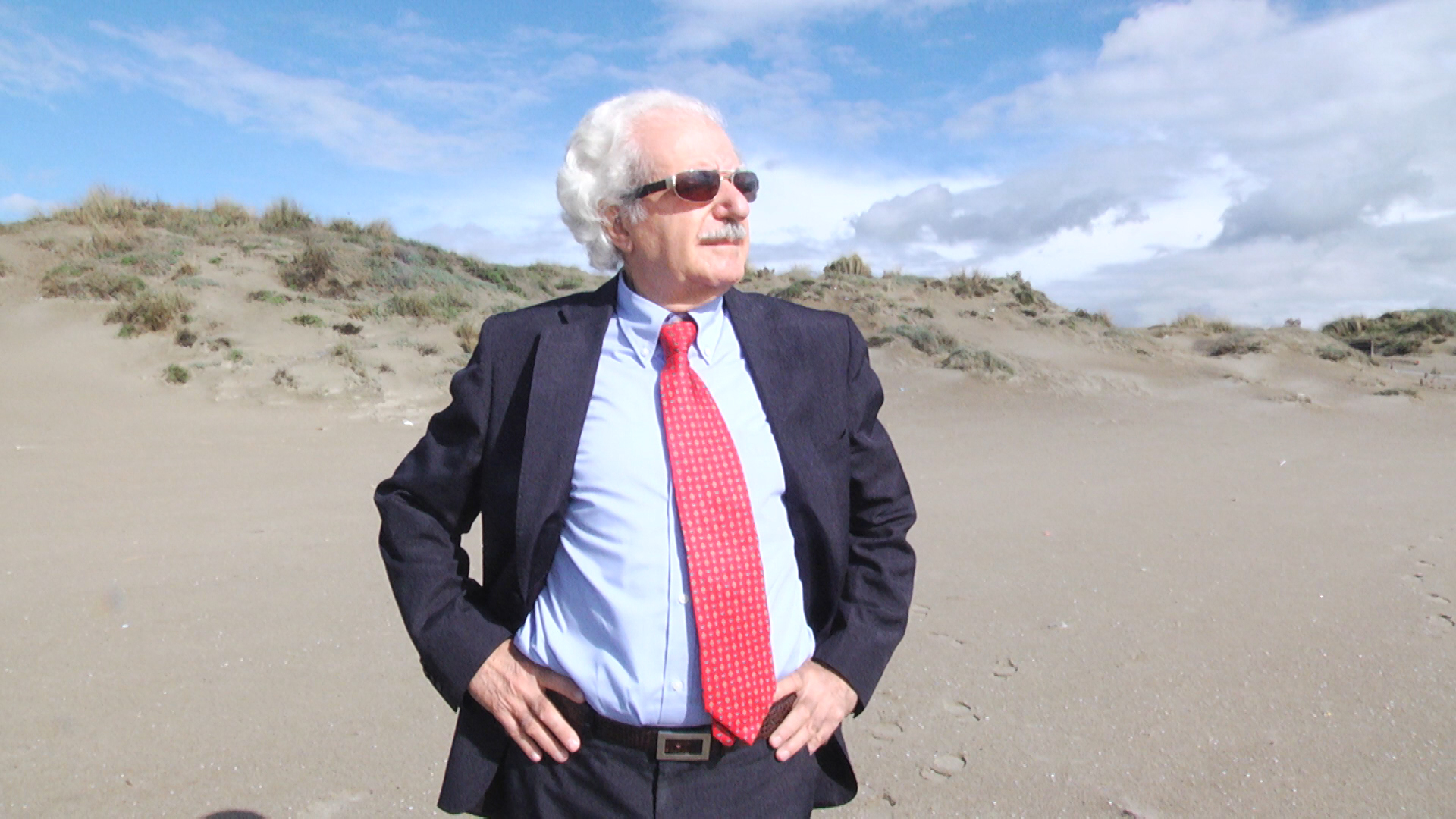
Drama, thriller, by Fabio Del Greco, Italy, 2015.
The story revolves around Vasco, a Roman builder who, at the age of 74, enjoys a life of absolute comfort. His human parable takes a dramatic turn when a mysterious encounter leads him to an ambush. Having survived, but marked by a long coma, Vasco wakes up with a new sensitivity, developing an intimate and poetic bond with nature. This new relationship with the world around him leads him to deeply explore himself, in an internal and external journey. through Italy, the United States and India, in search of a higher meaning and a cure. In parallel, the threat of a planetary cataclysm adds an epic dimension to the story.
I Am Nothing explores universal themes such as time, memory, oblivion and the connection with nature. Fabio Del Greco creates an existential drama full of food for thought. The director skillfully combines different visual materials, mixing archive images with nature photographs and dreamlike visions. This visual experimentation translates into an editing that captures the viewer's attention, guiding him through a cycle of creation and destruction. The sequences that alternate the buildings, Vasco's pride, with Indian landfills and natural landscapes create a hypnotic rhythm, underlining the beauty and fragility of life. Vasco's existential journey is a hymn to transformation and rebirth. The evolution of the protagonist, from unbridled luxury to the rediscovery of purity, represents a powerful metaphor on the meaning of life and the need to reconnect with authentic values. Io sono nulla stands out for its ability to combine introspection and visual experimentation, offering a suggestive and engaging narration. It is a film that invites us to reflect on the human condition, on our relationship with power and nature, and on the possibility of finding ourselves through change. A work that leaves its mark and lends itself to multiple readings.
LANGUAGE: Italian
SUBTITLES: English, Spanish, French, German, Portuguese
What Cinema Knew Before Neuroscience Said It
There is a moment most people have had and never spoken aloud — when a familiar room suddenly refuses to be familiar. The ceiling becomes a surface you have never actually looked at. The grain of a wooden table asserts itself with the insistence of something alive. It lasts perhaps three seconds before the ordinary reasserts its dominion, and you file the experience nowhere because there is no file for it. It belongs to no category your culture has given you.
A man sits in a small apartment in the late afternoon. The light through the window is doing nothing unusual, and yet he cannot stop watching what it does to the wall. The plaster has become an event. The texture of it, the microscopic geography of shadow and relief across its surface, is absorbing him with the same totality that a disaster or a revelation would. He is not frightened yet. He is simply unable to look away, because what he is seeing — really seeing, for the first time without the filter of utility — is that the wall is extraordinary. Then the fear arrives, not because anything has changed, but because he suddenly understands that it has always been extraordinary, and he has never once perceived it. The terror is not of what he sees. It is of how much he has missed.
This is precisely the epistemological crisis Huxley documented in 1954 when he described mescaline dissolving what he called the “reducing valve” of ordinary consciousness. The brain, he argued, is not primarily an organ of perception but of exclusion. Its evolutionary function is to narrow the infinite data of reality down to what is useful for survival. What we call normal perception is, in his framework, a managed poverty — a highly efficient blindness. The neuroscientist Karl Friston, working six decades later with his predictive processing model, would arrive at essentially the same architecture from the opposite direction: the brain, Friston demonstrated, does not passively receive the world but actively generates predictions about it, suppressing sensory information that fails to surprise the model. We do not see what is there. We see what we expect.
Someone walks through a city street they have walked a thousand times. The buildings have not changed. The sequence of storefronts, the quality of pavement beneath the feet, the ambient noise of traffic — everything is identical to every previous crossing. And yet something has cracked. The street is saturated with a presence it did not have before, or rather, a presence it always had and that is now refusing to be edited out. Every pedestrian passing carries an entire interior universe behind their face. The lampposts are not decorative infrastructure but vertical facts of steel and light that have been standing here longer than any memory of them. The ordinary has not become extraordinary — it has revealed that it was never ordinary at all. That ordinariness was a social agreement, a contract of inattention signed so automatically that no one remembers the signing.
And then there is the other kind of rupture, quieter and perhaps more vertiginous. A person stares at their own hands. Not in distraction, not absently — but with genuine attention, the way you would look at something you had found in the street without knowing what it was. The hands are doing nothing. They are simply there, this articulated biological architecture attached to the ends of two arms, and the longer the gaze holds, the stranger the hands become. The strangeness is not psychosis. It is the opposite: it is what happens when the anesthetic of habit is removed and the raw fact of embodiment asserts itself without apology. William James, writing in 1890 in The Principles of Psychology, described the stream of consciousness as something that moves always forward precisely because it cannot afford to stop. These moments are when it stops. And what it finds, standing still, is that being inside a body is among the least understood experiences available to a human being.
William Blake, the Doors, and the Cultural Theft of a Metaphor
There is a line written in fire that most people can now recite without understanding a single word of it. You have probably heard it. You may have quoted it. You may even have it tattooed somewhere, or framed on a wall in a apartment that smells of incense. “If the doors of perception were cleansed every thing would appear to man as it is, infinite.” William Blake wrote this in 1793, in a work he called The Marriage of Heaven and Hell, and he was not writing poetry. That is the first misunderstanding, the one that makes all subsequent misunderstandings possible. Blake was writing epistemology. He was making a precise, almost clinical claim about the architecture of human cognition — that the ordinary mind does not perceive reality but a heavily filtered version of it, a bureaucratic reduction of the infinite into the manageable, the measurable, the safe. The “doors” are not metaphors for spiritual openness. They are the mechanisms of cognitive contraction. The cleansing Blake imagined was not mystical ablution but something closer to what we would now call a radical restructuring of perceptual categories.
Blake arrived at this not through serenity but through prophetic fury. He had watched the Enlightenment systematize the world into Newton’s “single vision,” as he called it, the reduction of existence to what could be weighed and calculated. His response was not to flee into irrationalism but to insist that rational thought, as practiced by his contemporaries, was itself a form of blindness — a culturally enforced narrowing of what the mind could register. Northrop Frye, in his landmark 1947 study of Blake, Fearful Symmetry, argued precisely this: that Blake’s visionary project was not opposed to reason but to the particular tyranny of an impoverished reason that had declared itself the totality of mind. Blake was diagnosing a pathology of perception, and he was doing it with the precision of a philosopher and the rage of someone who found the diagnosis almost unbearable to deliver.
Huxley read Blake. He read him well enough to steal the line entire and place it at the center of his 1954 account of mescaline, not as ornamentation but as the theoretical skeleton of everything he experienced in that living room in Los Angeles. For Huxley, the line was not beautiful. It was accurate. It named what the drug had demonstrated empirically — that ordinary consciousness is not natural but constructed, that the brain’s normal operation is a form of editing so thorough it looks like reality itself.
Then Jim Morrison read Huxley. He was nineteen or twenty years old, in 1964 or 1965, and he took the title of that book and gave it to a rock band. The Doors. It is difficult to be angry about this, because something genuine passed through the chain — Morrison was not an idiot, and there are moments in his lyrics where the Blakean terror genuinely surfaces. But something else happened simultaneously. The metaphor entered the market. It became a brand, a logo, a t-shirt, a greatest hits compilation. The idea that human perception is a prison, that ordinary consciousness is a kind of violence done to the infinite, became the name of something you could buy.
This is what happens to the most destabilizing ideas when they survive long enough. They do not get refuted. Refutation would leave them intact, underground, dangerous. Instead they get curated. They get aestheticized. The philosophical rupture becomes an aesthetic posture, and the posture becomes a consumer identity, and somewhere in that translation the actual claim — the epistemological knife Blake had sharpened for two centuries — goes quietly dull. You can wear the idea on your chest without ever once feeling its edge.
The question is not whether Morrison betrayed Blake, or whether Huxley betrayed Morrison, or whether any of them betrayed you. The question is what it means that the most recognizable version of a radical idea is always its most harmless one.
The Lost Poet
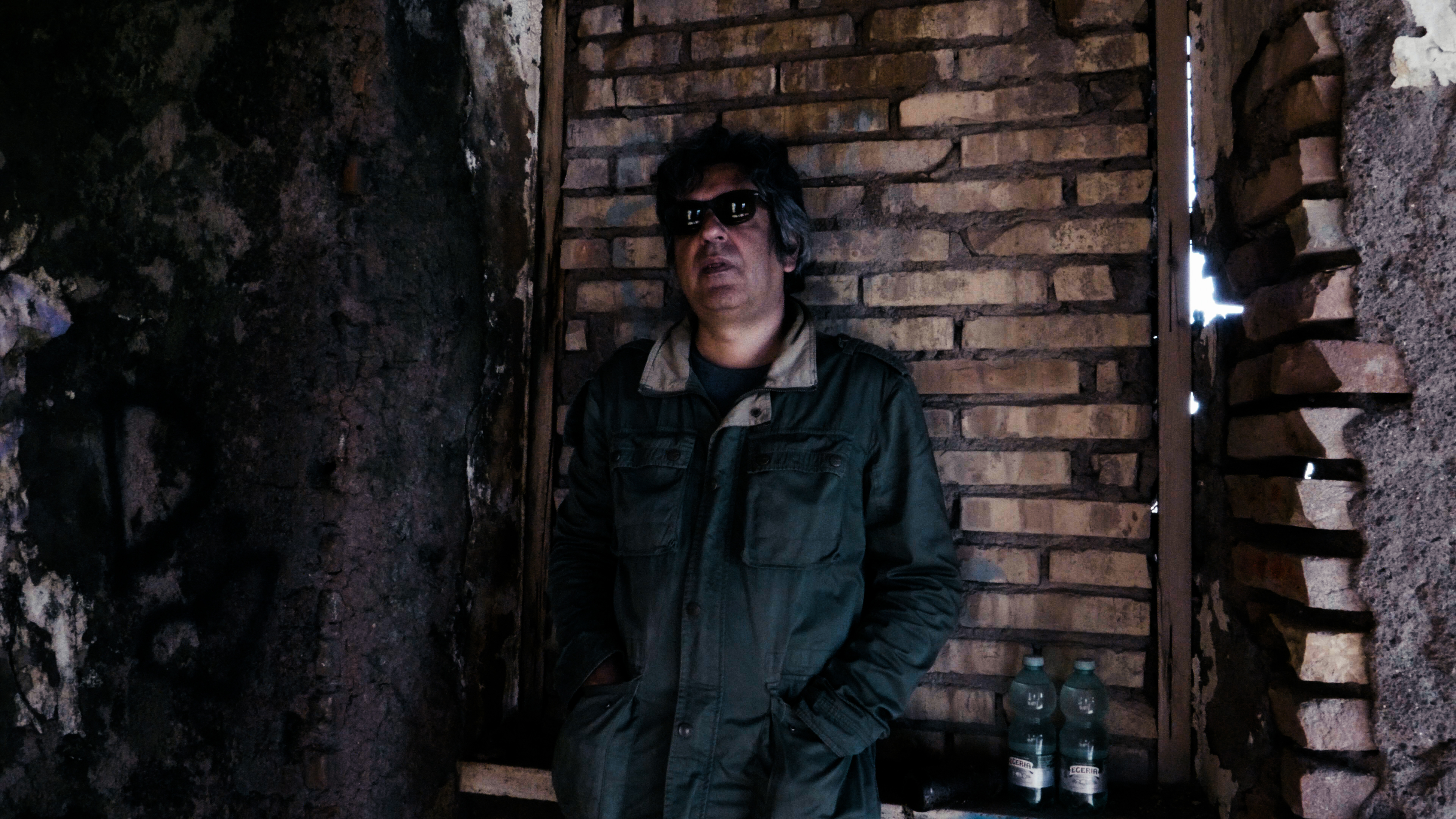
Drama, by Fabio Del Greco, Italy, 2024.
Dante Mezzadri wants to see an old friend, nicknamed the Iguana, whom he has lost sight of for many years, and who has managed to turn their shared youthful passion for poetry into a job, becoming a famous writer and poet. The man escapes from his bourgeois life and his wife to live homeless on the Roman coast, printing and trying to sell his poetry collections. At night he sleeps in a park of old carnival floats, inside a papier-mâché tank, and waits for the opportunity to meet his old friend, who however never shows up for appointments in the places they frequented when they were young, now in ruins. Dante's poetry books do not interest anyone and to support himself he is forced to "change product": he starts selling the infamous "cannibal pill" on behalf of young drug dealers, a new drug that sells like hot cakes and causes sensory and consumerist ecstasy. However, he realizes that this powerful drug is very dangerous for those who take it, he comes into conflict with his ethical conscience and throws all the pills into the sea. However, the dealers want to collect their money.
Shot over a period of 2 years, the film is a reflection on the cultural and artistic rubble of the society in which the protagonist lives, in an increasingly mechanized, consumerist and arid world. Dante Mezzadri is yet another human being who has renounced his inspiration and his creativity, but unlike many he is not willing to give his life to a system that distances him from his true identity. The physical world around him, however, seems constructed in such a way that it seems impossible to escape from this "invisible cage". The enthusiasm of the people he meets is ignited only by sensory gratification, by unreal visions of personal affirmation and success, by "metaverses" that offer an escape into an illusory and destructive reality. The poet's house on the coast, where he met with his friends as a young man, is just a pile of abandoned rubble. What happened to all those who wanted to become poets and ended up becoming something else? Are there internal forces with which that house can be "rebuilt"?
LANGUAGE: Italian
SUBTITLES: English, Spanish, French, German, Portuguese
A vision curated by a filmmaker, not an algorithm
In this video I explain our vision
The Sociology of Altered States: Who Gets to See and Who Gets Locked Up

There is a moment in a courtroom where a man stands before a judge and cannot find the words. Not because he is guilty, not because he lacks intelligence, but because the language required to explain what happened to him that night simply does not exist inside the vocabulary of jurisprudence. He tried to tell them that what he had taken was not an escape from reality but a passage into a more saturated version of it. The judge looks at him with the patience of someone who has already decided. The language of the law and the language of inner experience are two dialects that have never successfully translated each other, and in that gap, entire populations have been swallowed.
Huxley wrote The Doors of Perception from a very specific vantage point, and he never quite acknowledged how specific it was. He was a product of Eton. His grandfather was Thomas Henry Huxley, Darwin’s most ferocious defender. His brother Julian would become the first Director-General of UNESCO. When Aldous sat in his Los Angeles home in May 1953 and ingested four-tenths of a gram of mescaline under the supervision of psychiatrist Humphry Osmond, he did so with a safety net so vast it was practically invisible to him. He had a physician present. He had a tape recorder. He had a literary reputation that would transform the experience into a celebrated text within a year. What he did not have to fear was arrest.
The indigenous communities of the American Southwest and Mexico had been using peyote — the cactus from which mescaline derives — for centuries before Huxley’s afternoon of aesthetic revelation. Richard Evans Schultes, the Harvard botanist who spent decades doing fieldwork among the Mazatec, the Kiowa, the Comanche, documented with painstaking precision a pharmacological tradition of extraordinary sophistication. These were not primitive experiments in hedonism. They were epistemological systems, ways of knowing the world that had been refined across generations. Schultes understood that the Native American Church, which incorporated peyote as a sacrament, represented one of the most coherent frameworks for psychedelic experience ever developed. What it did not represent, in the eyes of the American state, was legitimacy.
Timothy Leary‘s Harvard Psilocybin Project, which ran from 1960 to 1962, began with genuine scientific ambition and ended in expulsion, legal harassment, and eventually federal imprisonment. Leary made errors — strategic, personal, rhetorical — but the force that destroyed him was not his errors. The force that destroyed him was that he tried to make the experience democratic. He gave it to prisoners in the Concord Prison Experiment. He gave it to theology students in the Marsh Chapel Experiment. He suggested, with increasing recklessness, that everyone deserved access to what Huxley had quietly enjoyed in his living room. That suggestion was intolerable.
In 1970, the Controlled Substances Act classified mescaline as a Schedule I substance, placing it alongside heroin in a legal category defined by high abuse potential and no accepted medical use. This happened seventeen years after Huxley’s experiment, four centuries after Spanish colonizers first tried to suppress peyote use among indigenous Mexicans on the grounds that it was demonic. The through-line is not pharmacological. It is political. The question was never whether these substances altered consciousness. The question was always whose consciousness, and under whose authority the alteration would be permitted.
Huxley never wrote that chapter. He described the infinite richness of a fold in his gray flannel trousers. He described Van Gogh and Vermeer and the way flowers breathed. He did not describe the man in the courtroom who cannot translate his knowing into terms the bench will recognize. That man is still standing there, in some version of that room, in some version of that silence, while somewhere in a comfortable house, someone with the right surname and the right physician is seeing the same light and calling it literature.
Brave New World Was the Warning, The Doors of Perception Was the Antidote
There is a particular cruelty in the way Huxley designed soma. It is not forced on anyone. The citizens of his imagined world take it willingly, gratefully, with the relief of someone finally allowed to stop thinking. Half a gramme for a half-holiday, a gramme for a week-end, two grammes for a trip to the gorgeous East — the dosage chart for voluntary self-erasure. What makes it devastating is not the drug itself but the architecture of desire that surrounds it: a civilization so thoroughly engineered that the cage feels like comfort, and the prisoner thanks the warden for the bars.
When Huxley published that novel in 1932, he was diagnosing something he could already smell in the air — not totalitarianism of the boot and the truncheon, but totalitarianism of the pleasant, the easy, the chemically managed. Aldous Huxley writing Brave New World was not imagining a distant dystopia. He was extrapolating from what he saw in advertising culture, in the early pharmaceutical industry, in the creeping conviction that suffering was a problem to be solved rather than a condition to be inhabited. Bertrand Russell had already noted, in The Conquest of Happiness published three years earlier in 1930, that the modern compulsion toward perpetual stimulation was itself a form of flight. Huxley pushed that observation to its logical terminus: a world where the flight is total, where nobody runs because nobody remembers there was somewhere to run from.
Then, eighteen years later, on a May morning in 1953, he swallowed four-tenths of a gramme of mescaline dissolved in water and sat down in his study in Los Angeles to find out what was on the other side of the filter. What he found was not the warm, oceanic contentment of soma. What he found was unbearable precision. The folds of a grey flannel trouser leg became a labyrinth of meaning. A small glass vase holding three flowers — a rose, a carnation, an iris — suddenly existed with a completeness that struck him as almost violent. Not beautiful in any decorative sense. Real. More real than anything the ordinary, utility-focused mind is permitted to perceive.
This is the dialectical heart of Huxley’s entire project, and it is not a contradiction at all. It is the same map drawn from two different altitudes. Soma removes perception. Mescaline, as he experienced and recorded it, restores it — strips away what he called, borrowing from Henri Bergson, the reducing valve of ordinary consciousness. Bergson had argued in Matter and Memory, published in 1896, that the brain’s primary function is not to expand awareness but to narrow it, to filter the torrent of reality down to whatever is useful for survival and social functioning. The mind you walk around with every day is an editing system, not a receiving system. Soma is what happens when that editing system is handed to the state. The mescaline experience, for Huxley, was what happens when you temporarily dismantle it entirely.
The horror of Brave New World is voluntary. That is the sentence that should stop you. Nobody is forced to stop feeling. They choose reduction because reduction has been made to feel like liberation. And the revelation of The Doors of Perception is equally uncomfortable in the opposite direction: what you find when the reduction lifts is not peace or enlightenment or any manageable spiritual reward. What you find is vividness so extreme it verges on terror. The flowers in that glass vase were not pleasant. They were inexhaustible. They demanded everything. There is a reason the reducing valve exists — the unfiltered world is not gentle, and most people, most of the time, are not looking for something that demands everything.
Which raises the question Huxley never fully answered, and perhaps knew he couldn’t: if you have seen through the filter, and you understand now what the filter is protecting you from —
The Infinite in the Ordinary and the Terror of Staying There
There is a moment — you may have had it yourself, in the strange dislocation of a high fever or the edge of sleep or the first seconds after an accident — when the world stops being managed and simply is. The chair in the corner of the room is not furniture. It is mass, grain, shadow, a particular organization of matter that has no obligation to mean anything at all. It is there with a weight that seems almost aggressive. And then, in a few seconds, the brain reassembles its familiar toolkit and the chair becomes a chair again, domestic and inert, and the moment passes, and you let it pass, and you are relieved that it has passed.
Huxley sat in front of a small glass vase holding three flowers — a pink rose, a red and purple carnation, a pale iris — and watched them become something that language was not built to contain. Not beautiful, not symbolic, not consoling. What he described was ontological: the flowers existed at a level of thereness that bypassed every category he had ever been given. They were not metaphors for anything. They were not reminding him of anything. They were simply, and completely, and without apology. He understood in that moment, he wrote, what it might mean for a mystic to perceive the Dharma-Body of the Buddha in the world’s fabric, or for Meister Eckhart to speak of the isness of things — the quiddity that ordinary sight refuses, not because it is not there, but because entertaining it would make daily life ungovernable.
William James, writing in 1890 in his Principles of Psychology, described consciousness not as a stable container but as a stream — continuous, selective, forever in motion, forever choosing what to notice and what to suppress. What he meant, though he did not put it in these terms, is that what you call your mind is largely an editorial operation. An immense quantity of information pours in through every sense at every moment, and what the nervous system does, its primary task, is to reduce that information to a manageable story. The doors Huxley wrote about are not metaphorical doors. They are neurological ones. The brain is not a receiver. It is a filter, and the filter is set, by evolution and by culture and by the daily discipline of functioning, to block out almost everything.
This is not a pathology. It is the condition of being able to act. The man who cannot reduce the world to categories cannot cross the street. The woman who experiences every surface as cosmically present cannot hold a job, raise children, endure Tuesday. There is a reason the reduction exists, and the reason is entirely practical, and the practicality is entirely real. The problem is not that the filter operates. The problem is that we have confused the filtered version with the actual one, and built entire civilizations on that confusion, and then punished anyone who questioned it.
There is a man who has spent years inside a rigid institutional world — a world of bells and schedules and prescribed distances between one human being and another — who, released into ordinary life, finds himself unable to tolerate the chaos that everyone else simply calls freedom. He does not collapse. He rebuilds his walls. He makes them invisible, social, polite. He cannot bear to stay at the threshold any more than the rest of us can. And there is a woman who watches reality television in a bare apartment, her attention fragmented into pieces too small to feel anything fully, and she is not numbed by accident. She has been trained, over decades, by every system she has ever moved through, to tolerate only a thin slice of what is there.
Huxley knew, coming down from the mescaline, that the vase was still extraordinary. He also knew he would not be able to see it that way tomorrow, or perhaps ever again without chemical assistance. The question he did not answer — the one he perhaps could not answer without losing the ability to ask any questions at all — is whether the reduction we live inside is a survival mechanism or a sentence, and whether there is any meaningful difference between those two things.
🚪 Beyond the Doors: Consciousness, Vision, and the Infinite
Aldous Huxley‘s exploration of mescaline in The Doors of Perception opened a philosophical gateway into the nature of mind, perception, and mystical experience. These related articles trace the same labyrinthine paths — through psychology, poetry, mysticism, and altered states — that Huxley himself walked in his most visionary work.
William James and Consciousness: The Stream of Thought
William James, whose radical empiricism deeply influenced Huxley, argued that ordinary waking consciousness is merely one type of consciousness separated from others by the filmiest of screens. His concept of the stream of thought anticipates the dissolution of the ego that Huxley described under mescaline, suggesting that mystical experience is not aberration but expansion. This article explores how James mapped the uncharted territories of mind that Huxley would later enter through chemistry.
GO TO THE SELECTION: William James and Consciousness: The Stream of Thought
Meister Eckhart: Life and Mystical Philosophy
Meister Eckhart‘s mystical philosophy, centered on the annihilation of the self and union with the divine ground, resonates profoundly with Huxley’s mescaline visions of a world stripped of utilitarian meaning and ablaze with pure being. Eckhart’s ‘Godhead beyond God’ bears a striking resemblance to what Huxley called the ‘Mind at Large’ — the unfiltered totality of consciousness. This article illuminates the medieval roots of the visionary experience Huxley sought to articulate in modern language.
GO TO THE SELECTION: Meister Eckhart: Life and Mystical Philosophy
Psychedelic Movies for One-Way Trips
The psychedelic journey as cinematic experience has produced some of the most formally daring films in the history of moving images, from the liquid hallucinations of 2001 to the fragmented realities of Enter the Void. Like Huxley’s prose in The Doors of Perception, these films attempt the impossible: rendering in sensory form what ordinarily lies beyond the reach of language and ordinary perception. This curated selection is an essential companion to understanding how Huxley’s ideas migrated from the page to the screen.
GO TO THE SELECTION: Psychedelic Movies for One-Way Trips
Spiritual Alchemy: Inner Transformation and Symbolism
Spiritual alchemy, with its language of inner transformation, dissolution, and rebirth, offers one of the oldest symbolic frameworks for the kind of ego-death and visionary illumination that Huxley experienced with mescaline. The alchemical stages of nigredo, albedo, and rubedo map onto the darkening, clarification, and radiant revelation that characterize many altered states of consciousness. This article traces the hermetic tradition that secretly underpins Huxley’s philosophical vocabulary in The Doors of Perception.
GO TO THE SELECTION: Spiritual Alchemy: Inner Transformation and Symbolism
Explore the Cinema of Expanded Consciousness on Indiecinema
If Huxley taught us that perception itself can be a doorway to the infinite, independent cinema is the art form that most faithfully keeps that door ajar. On Indiecinema you will find a carefully curated streaming catalog of visionary, psychedelic, and philosophically daring films that push the boundaries of what cinema can show and what the mind can hold. Step through the door — your next transformative viewing experience is waiting.
👉 EXPLORE THE CATALOG: Watch Indie Films in Streaming
A vision curated by a filmmaker, not an algorithm
In this video I explain our vision