
The Finch You Never Noticed
You step over the pigeon without looking at it. This is what you do every morning — the same cracked pavement, the same grey bird with its iridescent neck and its absolute indifference to your schedule, bobbing its head in that mechanical rhythm that somehow never gets old for the pigeon even if it has long since gotten old for you. You don’t see it. Not really. You see an obstacle, a nuisance, a smear of urban texture you’ve learned to filter out the way your brain filters out the hum of refrigerators and the pressure of your own clothes against your skin. The pigeon is simply there, the way the weeds splitting through the concrete at the base of the wall are simply there, the way the dark creeping stain of mold along the northern face of the building is simply there — alive, insistent, pressing itself into every available crack and surface with a patience that has nothing to do with patience because patience implies awareness of waiting, and what those organisms are doing requires no awareness at all. It requires only the relentless logic of survival, repeated across billions of iterations, sculpted by failure into something that works.

What is happening at your feet is the most consequential argument in the history of science, playing out in real time, unobserved. The pigeon you stepped over is a descendant of the rock dove, Columba livia, shaped over millennia by the pressures of urban environments into something that thrives precisely where most birds cannot — not because someone designed it for the city, but because the individuals slightly better suited to noise, proximity, and human food waste left more offspring, and those offspring inherited the slight advantages, and so on, compounding across generations with the slow arithmetic of natural selection. The weed in the concrete is doing the same thing. The mold is doing the same thing. The bacteria colonizing the inside of your gut as you walk are doing the same thing, negotiating territories, competing for resources, dying in astronomical numbers so that the fitted few can persist. You are walking through an argument. You have always been walking through it. You are partly made of it.
And yet the theory feels, to most people, like something that happens in textbooks. Something located in the nineteenth century, in the Galapagos, in the careful notebooks of a man with a beard and a troubled conscience. Charles Darwin published On the Origin of Species on the twenty-fourth of November, 1859, and the entire first printing of 1,250 copies sold out on the day of publication. The booksellers understood, even if they couldn’t articulate why, that something had shifted. What had shifted was not merely a biological hypothesis. What had shifted was the ground beneath the human story, the assumption that living things — including the one doing the assuming — had been placed here with intention, shaped by design, oriented toward a purpose legible from above. Darwin replaced that story not with nihilism but with something stranger and more demanding: a process without a planner, a direction without a destination, a complexity that emerges from the accumulation of tiny differences that mostly end in death.
That this idea still feels remote, still registers as a matter of academic biology rather than lived experience, is not an accident of culture or a simple failure of education. It is, in a precise sense, a cultivated blindness. The pigeon you ignored this morning is inconvenient to certain ways of seeing the world, and inconvenient things have a way of becoming invisible precisely when the social structures around us have the most to lose from their being seen clearly.
Eve of the Irises
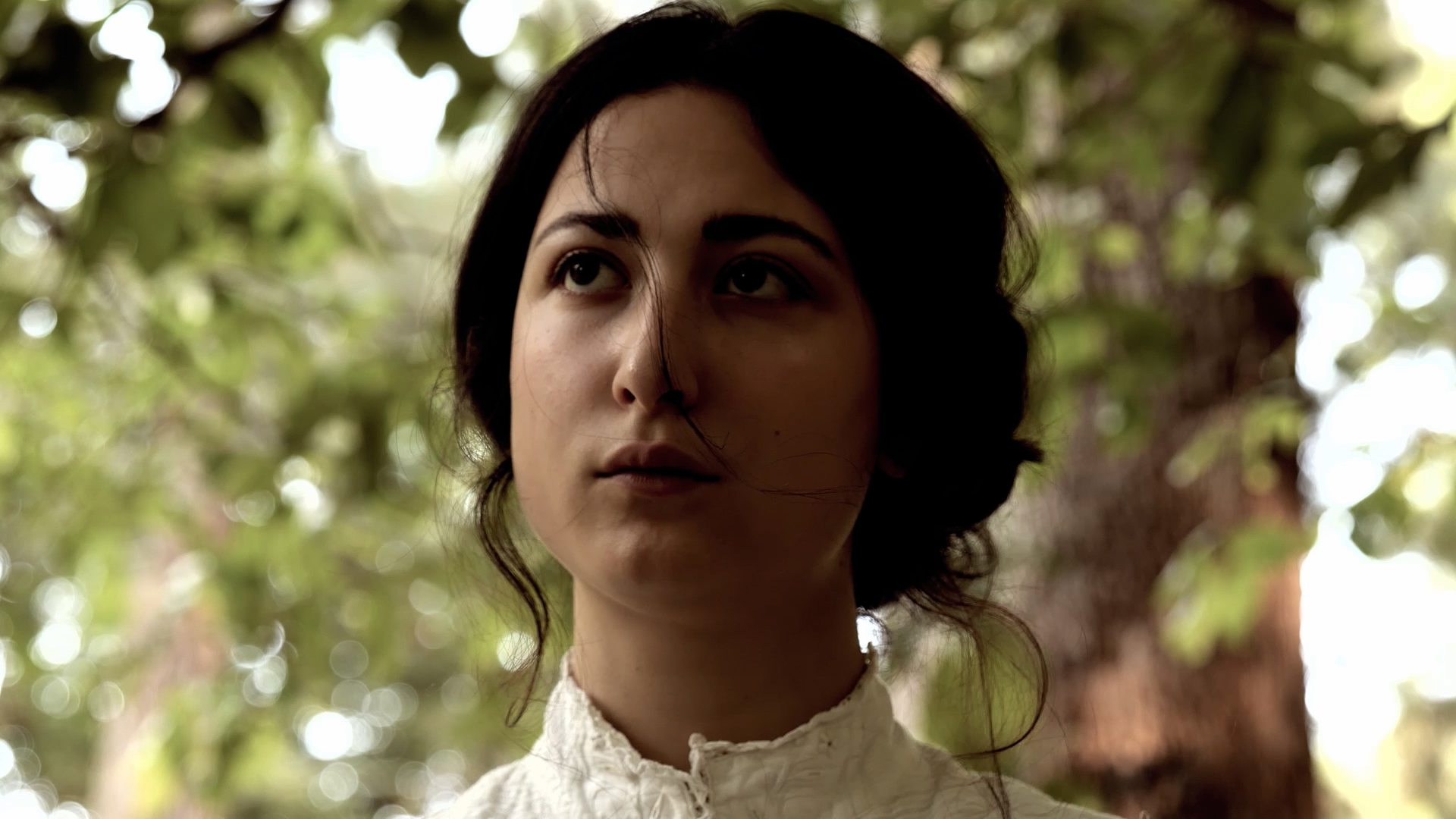
Documentary, by Isabel Russinova, Rodolfo Martinelli Carraresi, Italy, 2026
Eva of the Irises is a historical biographical docu-film about the scientist Eva Mameli Calvino, a botanist and pioneer of environmentalism in Italy, mother of the writer Italo, born in Sassari in 1886. The film, based on a multidisciplinary approach that combines several genres—such as theatre, documentary, cinema, and research—moves between memories, reflections on life, as well as the goals and missions the scholar still wished to achieve.
The multifaceted artistic sensibility of Isabel Russinova is expressed across many fields, from writing to acting, from directing to civic engagement, and finds one of its highest expressions in the docu-film Eva of the Irises, created with Rodolfo Martinelli Carraresi. The film blends scientific rigor and poetic refinement to portray the extraordinary figure of the botanist Eva Mameli Calvino, mother of Italo Calvino but above all an independent protagonist of 20th-century scientific culture. It is told through a combination of archival materials, interviews, and evocative staging capable of elegantly and profoundly conveying her intense human and professional story.
LANGUAGE: Italian
SUBTITLES: English, Spanish, French, Portuguese
What Darwin Actually Wrote, and What We Decided He Meant
You open a book expecting a manifesto and find instead something closer to a naturalist’s obsessive field notes — meticulous, hesitant, crowded with qualifications. The 502 pages Darwin published in November 1859 are not the declaration of war that history decided they were. They are an argument assembled with almost painful caution, the work of a man who had been sitting on his theory for twenty years, terrified of what it would do to the people he loved and the world that had shaped him.
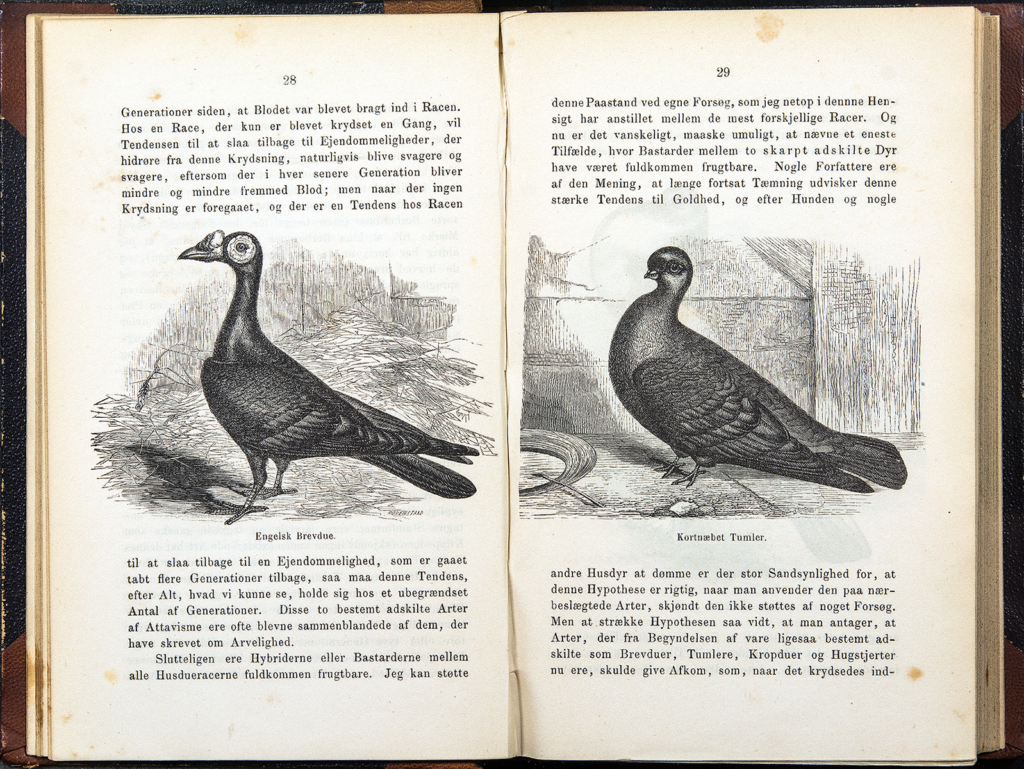
The actual structure of On the Origin of Species is worth inhabiting for a moment. Darwin begins not with a grand thesis but with pigeons. Domesticated pigeons — the varieties produced by breeders in England, their skulls, their tail feathers, their behavioral quirks under artificial selection. He spends considerable time here before moving outward, as if he needs the reader to accept the small and familiar before confronting the vast and disturbing. The mechanism he proposes — natural selection operating on random variation across geological time — is introduced carefully, hedged, qualified. He uses phrases like “I believe” and “it seems probable” with a frequency that his later interpreters apparently found embarrassing, because those phrases largely vanished from the version of Darwin that entered public consciousness.
What Darwin argued, precisely, is this: individuals within a species vary from one another, some of those variations are heritable, more individuals are born than can survive to reproduce, and therefore individuals with variations better suited to their environment will tend to survive and reproduce at higher rates. Over sufficient time, accumulated variation produces new species. The mechanism is not progress. It is not advancement. It is not a ladder. It is a branching, indifferent process with no destination and no preferred outcome. Darwin himself wrote about a “struggle for existence” — but he was careful, in a passage often ignored, to note that he meant this in a “large and metaphorical sense,” including the dependence of organisms on one another, not simply combat.
None of this prevented what came next. Herbert Spencer, the sociologist who had already been using evolutionary language before Darwin published, coined the phrase “survival of the fittest” in 1864, and it adhered to Darwin’s theory like a parasite that eventually became indistinguishable from the host. Darwin, with a mixture of social anxiety and intellectual generosity he would later regret, incorporated Spencer’s phrase into the fifth edition of the book in 1869. The text was altered. The mythology had begun rewriting the source.
The philosopher of science David Hull, in his 1973 analysis Darwin and His Critics, documented meticulously how Darwin’s contemporaries did not so much misread him as selectively excavate him — pulling out the passages that confirmed their existing frameworks and leaving the qualifications buried. Thomas Huxley, Darwin’s most aggressive public defender, stripped the tentativeness from the argument and turned it into the kind of confrontational rhetoric Darwin privately found excessive. Meanwhile, on the other side, religious critics attacked a Darwin they had largely constructed themselves — a nihilist, a materialist, a man who had reduced human dignity to accident. The actual Darwin, who retained throughout his life a complicated and unresolved relationship with the question of design, barely appears in either portrait.
What you are left with, if you go back to the text itself, is something stranger and more interesting than either camp wanted. A book written in the conditional tense about a process that operates across timescales no human being can genuinely perceive, making an argument whose full implications its author understood better than almost anyone and still could not entirely bring himself to state. The book became a crime scene not because something was taken from it, but because everyone arrived with their own story about what the body meant, and the body itself — those 502 careful, hesitant pages — was gradually moved aside to make room for the investigation.

The Slow Violence of Deep Time
You are standing at the edge of a cliff, and the rock beneath your feet is older than anything your mind can hold. Not older than you expected — older than the category of expectation itself. A man once stood in a place like this, somewhere in the American Southwest, and simply stopped walking. His companions moved ahead. He stayed. He pressed one hand against the sandstone face and kept it there for a long time, not in reverence, not in contemplation, but in something closer to vertigo. The stone did not care. That was the thing that undid him. Not its age. Its indifference.
Darwin understood this vertigo better than almost anyone, and he understood it because he had learned to read it from Charles Lyell, whose Principles of Geology, published between 1830 and 1833, gave him the conceptual scaffolding for what would become the most destabilizing move in On the Origin of Species. The move was not natural selection. Natural selection, once explained, has a certain mechanical elegance that the mind can grip. The move was time. Lyell had already proposed that the Earth’s geological features were shaped not by catastrophic divine events but by the same slow, ordinary processes visible today — erosion, sedimentation, uplift — operating across spans of time so enormous they resist comprehension. Darwin took that gift and weaponized it. He asked his reader not merely to accept deep time intellectually but to feel it as a lived pressure, a weight on the chest.
He was explicit about this in the chapter on the imperfection of the geological record. He calculated, roughly, that the denudation of the Weald — a valley in southern England — had required approximately three hundred million years. He was wrong about the specific figure, as later science would show, but the wrongness is almost irrelevant. What mattered was the gesture: the insistence that the reader sit with a number that large and not flinch away from it. Stephen Jay Gould, writing in Time’s Arrow, Time’s Cycle in 1987, identified this as Darwin’s deepest radicalism — not the displacement of humanity from the center of creation, but the displacement of human time from the center of reality. The universe was not organized around the span of a human life, or a civilization, or even a species. It preceded us by an amount that language was never built to express.
Modernity has responded to this revelation by simply ignoring it. The quarterly earnings report covers ninety days. The news cycle, in its current form, barely sustains attention across ninety hours. The political horizon, in most democratic systems, extends to the next election. The sociologist Hartmut Rosa, in his 2013 work Social Acceleration, describes how contemporary life operates under a structural compulsion toward speed — not because speed is desired in itself, but because the economic and technological systems we inhabit require constant acceleration simply to maintain their position. To slow down is to fall behind. To think across centuries is a form of professional negligence.
What this produces, quietly and without announcement, is the erasure of deep time from ordinary consciousness. Not its refutation — nobody publicly argues that the Earth is young, outside of specific theological communities — but its effective disappearance from the way we make decisions, organize societies, and understand consequences. The man with his hand on the sandstone felt something that most people in 2024 are structurally prevented from feeling: that what they are doing right now will leave a mark, or fail to leave one, across a duration so vast it dissolves the urgency of everything they were anxious about this morning.
Darwin did not offer comfort in this. He offered scale. And scale, when you genuinely encounter it, does not make you feel small in a poetic sense. It makes you feel small in a way that briefly reorganizes everything you thought was important.
God in the Gap, Capital in the Garden
The foreman walks the length of the floor slowly, hands clasped behind his back, and there is nothing cruel in his expression. That is the detail that stays with you. Not contempt, not indifference — something closer to serenity. He watches the men at their stations with the composed gaze of a naturalist observing a habitat functioning as it should. The ones who couldn’t keep pace are already gone. The ones who remain have proven something about themselves. This, his posture says, is simply how things are.
The ink on Darwin’s pages was barely dry before two entirely opposite forces lunged at what he had written — one to destroy it, one to wear it like armor.
In June of 1860, at Oxford, Samuel Wilberforce, Bishop of the Church of England, rose to dismantle the theory before an audience of several hundred. His performance was polished, occasionally witty, and almost entirely beside the scientific point. What he was actually defending was not Scripture in any nuanced theological sense but a specific political theology: the idea that the natural order was a moral order, that hierarchy was divinely authored, that the distance between the bishop and the factory worker reflected something written into creation itself. Darwin had not merely proposed a mechanism for species change. He had yanked the keystone from an entire architecture of justification. If species were not fixed by design, if adaptation was blind and cumulative rather than intended, then the arrangement of human beings into classes and castes carried no cosmic warrant. Wilberforce understood this clearly, even if he argued it badly.
What he could not have anticipated — what remains one of the great ironies in the history of ideas — is that within a decade, the industrialists and colonial administrators who had every reason to despise Darwin were instead enthusiastically borrowing his vocabulary. Herbert Spencer, who coined the phrase “survival of the fittest” before Darwin had even published and who applied it with mechanical enthusiasm to economic life, gave the manufacturing class exactly what the bishop had tried to withhold: a naturalized account of inequality. The poor were poor because they had failed to adapt. The colonized were colonized because natural selection had not yet reached them. The wage laborer who died at fifty from lung disease had simply not been fit enough to survive. The theory that threatened the Church was immediately conscripted by the market.
Hannah Arendt, in The Origins of Totalitarianism published in 1951, identified this operation with clinical precision. Ideology, she argued, is not primarily a set of beliefs. It is a way of converting contingent political arrangements into the appearance of natural or historical necessity. The moment you can say “this is how things are” rather than “this is how we have arranged things,” you have performed an ideological act. Social Darwinism was not a misreading of Darwin — it was ideology in Arendt’s exact sense: the transformation of a scientific description of biological processes into a prescription for political life, the naturalization of what was in fact a set of choices, violences, and power relations.
The Church and the factory floor were, in this sense, engaged in the same project from opposite directions. Wilberforce wanted transcendence to anchor hierarchy. Spencer wanted nature to anchor it instead. Both needed the distance between the powerful and the powerless to appear as something other than a human decision. Darwin, who spent most of his adult life quietly appalled by slavery and who never endorsed Spencer’s extrapolations, had handed them tools he never intended to be used this way.
The foreman completes his circuit of the floor. He pauses at the window. Below, in the yard, a man who was let go last week is walking away. The foreman watches him until he disappears, and his expression remains exactly as it was.
Natural Selection as Mirror, Not Verdict
There is a particular kind of person who is terrifying to watch at a dinner party — not because they are cruel or stupid, but because everything they know is correct. Every reference, every judgment, every confident assertion fits together with the precision of something built over decades. And yet the room has quietly moved on. The references land slightly wrong. The certainty reads as rigidity. The person is not failing; they are simply calibrated to a frequency that no longer broadcasts. They are, in the most precise biological sense, exquisitely adapted — to an environment that has dissolved beneath their feet without anyone announcing its departure.
This is what Darwin’s mechanism actually describes, when you strip away the century and a half of ideological barnacles that have attached themselves to it. Natural selection is not a promotion system. It is not a verdict on worth, on complexity, on moral standing, or on destiny. It is something far stranger and more unsettling: a relationship between an organism and a specific configuration of the world at a specific moment. The moment shifts, the configuration dissolves, and what was perfect becomes vestigial. There is no tribunal. There is no progress being tracked. There is only fit, and the quiet brutality of fit becoming misfit when the context rewrites itself.
Stephen Jay Gould spent much of his intellectual life insisting on this, with a persistence that suggests he understood how deeply people did not want to hear it. In Wonderful Life, published in 1989, he used the Burgess Shale — a five-hundred-and-eight-million-year-old fossil deposit in British Columbia — to make an argument that cuts against every intuition we carry about nature’s direction. The organisms preserved in that shale represent an extraordinary diversity of body plans, most of which vanished entirely without issue, without descendants, without any traceable logic of inferiority. They did not lose. They were caught in a particular arrangement of circumstances, and when those circumstances shifted, their designs were not retained. Gould’s central argument was that if you rewound the tape of life and played it again, you would not get Homo sapiens. You would not get anything recognizable. The emergence of human consciousness is not the summit of a process aimed at summits; it is one branch of an explosion of branches, most of which terminated. Evolution is not a ladder. It is a bush, growing in all directions simultaneously, with no privileged tip.
This matters because the ladder image is not innocent. It arrived carrying cargo — the cargo of ranking, of justified hierarchy, of the belief that what survives does so because it deserves to. The man staring at the dinner table, articulate and stranded, was once told implicitly that his mastery of a particular set of skills placed him somewhere on a scale. What Darwin actually described was not a scale but a lock-and-key problem: his skills fit a specific lock, the lock was replaced, and the key’s precision is now irrelevant. The key did not become worse. The door changed.
Gould called this contingency, and he was careful to distinguish it from randomness. Contingency does not mean anything goes. It means that outcomes depend on the particular sequence of events that actually occurred — that history is not destiny’s unfolding but accident’s accumulation. Every trait that persists does so because a specific cascade of circumstances allowed it to. Change one variable early enough, and the cascade reorganizes entirely. What we call adaptation is always retrospective; it is always a description of what happened to work, not a prescription for what was meant to.
Darwin understood this, at least in his more careful moments, better than most of his inheritors would. The phrase “survival of the fittest” appears nowhere in the first edition of On the Origin of Species. He borrowed it reluctantly from Herbert Spencer years later, almost as a concession to a readership that wanted clarity where Darwin had offered something more honest — and far less comfortable.
A vision curated by a filmmaker, not an algorithm
In this video I explain our vision
The Body That Knows It Came From Somewhere

You have felt it. That sudden lurch of the stomach before your mind has caught up. The sharp pull backward from a shadow that turned out to be a coat on a hook, the bristling along your forearms in the cold before you even registered the temperature drop. Your body knew first. It always knows first, and the story you told yourself afterward — the reasoning, the justification, the careful reconstruction of cause and effect — arrived late to a scene that had already concluded without it.
This is not poetry. It is anatomy. The coccyx sitting at the base of your spine is the vestigial remnant of a tail your ancestors used for balance and communication, rendered functionless over millions of years but not yet erased, because evolution is not an engineer with a blueprint — it is accumulation, sediment, patience measured in geological time. The arrector pili muscles embedded in your skin still contract when you are cold or frightened, raising the ghost of fur that no longer exists, producing goosebumps that once made your ancestors appear larger, more threatening, better insulated. The muscles flanking your ears, auriculares superior and posterior, are present in most humans and can still be used to move the ears in people with sufficient practice, a capability that was once essential and is now a parlor trick. Darwin catalogued these structures in extraordinary detail, understanding them not as design flaws but as the most honest argument available: the body carries its history inside itself, stitched into its architecture, legible to anyone willing to look.
Antonio Damasio spent decades making the neurological case for what Darwin intuited anatomically. In Descartes’ Error, published in 1994, and deepened substantially in The Feeling of What Happens in 1999, Damasio demonstrated that the brain is not a single reasoning organ but a layered accretion, each stratum added over evolutionary time and each stratum still operational beneath the next. The ancient brainstem, shared with reptiles, regulates breathing, heart rate, the basic machinery of survival. Wrapped around it is the limbic system, the mammalian inheritance, the seat of social bonding, fear, attachment, desire. Resting above both, the cortex — the part that writes essays, debates philosophy, constructs legal systems. The crucial insight Damasio contributed was that these layers do not function hierarchically, with reason commanding emotion. They function together, and more often than we prefer to admit, the older layers lead. He called the mechanism somatic markers: the body stamps emotional meaning onto experience before conscious thought can evaluate it, and then that bodily state shapes reasoning rather than following from it. You do not decide and then feel. You feel, and the feeling becomes the frame inside which deciding takes place.
There is a man who receives a letter that changes everything. He reads it once, then sets it down with extraordinary stillness. You watch his face and see almost nothing. Then his hand, independent of any apparent decision, crushes the edge of the paper. He smooths it again. He is visibly trying to understand what he has just done, why his hand moved, where that force came from. The explanation comes only later, and even then it is partial, approximate, a story told over the evidence rather than emerging directly from it. What acted in that moment was not reflection. It was something older, something below language, something that recognized threat before threat had been named.
Darwin’s genius was to look at the coccyx and see time. To look at goosebumps and see fur. To look at the human body as a document written in evolutionary ink, every apparent redundancy a record of what we were before we became what we are. You are not a mind that has a body. You are a body that has layered, through improbable accumulation, the capacity for mind. The sequence matters enormously.
What Adaptation Costs the Adapted
Every adaptation carries a hidden invoice. The orchid that evolved to mimic the shape and scent of a female wasp so precisely that male wasps attempt to mate with it — and in doing so transfer pollen — has paid for that extraordinary trick with an almost total dependence on a single species. If the wasp disappears, the orchid disappears. The specialization that made it brilliant made it fragile. Darwin understood this, even if he lacked the vocabulary to name it as a trade-off in the modern sense. Every gain in fitness along one axis represents a foreclosure along another. The organism that becomes exquisitely adapted to one niche becomes, by that very fact, increasingly unable to inhabit any other.
What is true of orchids is true of people. Not biologically — the timescale is wrong and the mechanism is different — but structurally, socially, in the way that Erving Goffman spent his career mapping with almost surgical precision. In his 1956 work on the presentation of self in everyday life, Goffman argued that social existence is a continuous performance, a management of impressions calibrated to what any given audience expects and will reward. You adapt your gestures, your vocabulary, your emotional register, your ambitions. You learn which parts of yourself to display and which to keep offstage. Over time, the performance becomes so habitual that the performer forgets there was ever a distinction between the role and the self. The adaptation completes itself. And what was foreclosed in the process — what was quietly abandoned, suppressed, routed around — remains invisible precisely because it no longer exists in any form that can be named.
Michel Foucault gave this process its institutional architecture. In Discipline and Punish, published in 1975, he traced how modern societies produce normalization not through spectacular punishment but through the constant, ambient pressure of examination, classification, and comparison. The normal is not a natural category. It is a statistical and political construction that functions as a selection pressure. What gets eliminated under normalization is not the biologically unfit. It is the socially inconvenient — the body that moves wrong, the mind that associates wrong, the person whose difference cannot be metabolized by the system without disrupting the system’s self-image.
Think of a man who returns to a small town after years away. He is not weak. He is, by most measures, more capable than many of those who remained. But something about him has shifted — his references have changed, his silences fall in the wrong places, he does not perform nostalgia on cue, he does not laugh at the right moments. No one confronts him directly. No one accuses him of anything. What happens instead is a slow, structural exclusion: the conversation that stops when he enters, the invitations that arrive less frequently, the shared jokes whose context he is never quite given. The violence is architectural. It leaves no marks. And when he eventually leaves again, the community will describe his departure as his own choice, his own restlessness, proof that he never really belonged. The selection pressure presents itself as nature.
This is what Foucault meant when he wrote that power in modern societies operates not by prohibiting but by producing — producing norms, producing subjects who internalize those norms, producing the conditions under which deviation appears to be a personal failure rather than a structural verdict. The adapted survive. But survival is not innocence. Every person who learns to perform adequately within a normalizing system has paid for their inclusion with something — a range of expression, a way of thinking, a refusal that had to be swallowed. The trade-off is never announced. It is simply the price, collected silently, for belonging to the niche at all.
And the niche, like the orchid’s dependency on a single wasp, is never as stable as it appears from inside it.
The Species That Reads Its Own Blueprint
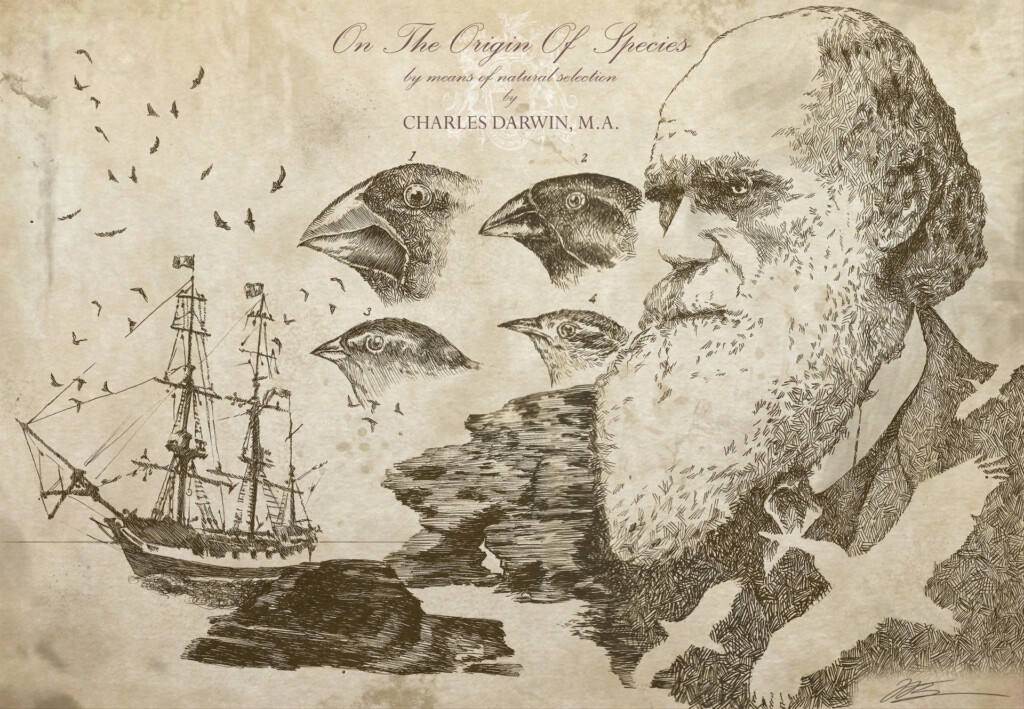
There is a moment, somewhere between waking and full consciousness, when you catch yourself thinking about the fact that you are thinking. It lasts perhaps two seconds before the day floods in and swallows it. But in those two seconds something genuinely strange has occurred: the universe has folded back on itself and looked. Not metaphorically. Literally. You are made of the same carbon forged in stellar collapse as the rock outside your window, and yet the rock does not know this, and you do.
Darwin never quite said this directly. He was too careful, too aware of what was already being asked of his readers. But it is the silent detonation underneath every page of the Origin, the implication that keeps expanding long after the book is closed. We are the only known process by which evolution has become conscious of evolution. And this changes nothing about the process. You are still being selected. Your anxieties, your appetites, your capacity for abstract reasoning — all of it arrived here through the same filter of differential reproduction that shaped the wing of a bat and the shell of a nautilus. The awareness of the mechanism does not exempt you from the mechanism. This is perhaps the most disorienting thing Darwin left behind, more disorienting than the displacement of God, because at least the displacement of God was a subtraction. This is something stranger: an addition that leaves you more exposed, not less.
Richard Dawkins, writing in 1976, pressed this logic to its arithmetical extreme. The individual organism, in his framework, is essentially a vehicle — a temporary survival machine constructed by genes for the purpose of replicating genes. The language is deliberately cold because the coldness is the point. There is no perspective from which the gene cares about your suffering, your love, your sense that your life has weight. The arithmetic of selection is indifferent to the story you tell yourself about it. This is intellectually honest and, in its honesty, vertiginous.
But the mythology that grew around this framework — red in tooth and claw, competition as the master key to biological reality — was always a partial reading, and Darwin’s own notebooks resist it more than his popularizers acknowledge. Pyotr Kropotkin, the Russian naturalist and anarchist who had spent years observing animal behavior across Siberia, published Mutual Aid in 1902 as a direct counter to the social Darwinism already distorting the theory. He documented cooperation, collective defense, shared provisioning across hundreds of species, and he did so not as a sentimental corrective but as rigorous natural history. Darwin had noted similar patterns. The hive, the wolf pack, the murmuration of starlings — these are not exceptions to selection, they are selection operating at a different register, one where the unit of competitive advantage is the group, the network, the relationship. Cooperation is not the opposite of the struggle for existence. It is one of its most successful strategies.
What this means for the species that can read its own blueprint is something neither Dawkins nor Kropotkin fully resolves, because the question may not be resolvable. You can know that your altruism has evolutionary roots and still feel it as real. You can know that your attachment to permanence is a cognitive artifact of a brain that evolved to plan forward and still grieve impermanence with your entire body. Understanding the process does not give you leverage over it. It gives you only the strange, vertiginous privilege of watching yourself be carried.
Darwin stood at the window of his study at Down House for decades, watching the same strip of garden, cataloguing what changed and what persisted. He understood, perhaps better than anyone who came after him, that to see the ground moving is not the same as standing still. You are in the current. The current does not pause because you have finally learned to name it.
🧬 Evolution, Thought, and the Meaning of Existence
Darwin’s On the Origin of Species did not merely transform biology — it shook the foundations of philosophy, theology, and human self-understanding. The ideas it unleashed rippled across centuries of thought, forcing thinkers to reckon anew with existence, mortality, and the nature of reality. These articles explore the deeper intellectual currents that Darwin’s work touches and continues to inspire.
Martin Heidegger: Life and Philosophical Thought
Martin Heidegger spent his life interrogating the fundamental question of what it means to exist, a question Darwin’s evolutionary framework radically reframed. His philosophical excavation of Being, time, and human finitude offers a compelling counterpoint to the biological narrative of natural selection. Exploring Heidegger’s thought alongside Darwin illuminates how science and philosophy each grapple with the strangeness of being alive.
GO TO THE SELECTION: Martin Heidegger: Life and Philosophical Thought
Epicurus: Life and Philosophy
Epicurus built a philosophy of life rooted in the natural world, arguing that understanding nature is the first step toward achieving tranquility and freedom from fear. His materialist view of the universe — atoms, chance, and impermanence — anticipates in striking ways the worldview that Darwin would later ground in empirical evidence. Reading Epicurus after Darwin reveals how ancient philosophy intuited truths that science would take millennia to confirm.
GO TO THE SELECTION: Epicurus: Life and Philosophy
Albert Camus: Life and Philosophical Thought
Albert Camus confronted the existential vertigo that arises when human beings recognize their smallness within an indifferent universe — a vertigo that Darwin’s theory of evolution intensified for modern consciousness. His philosophy of the absurd wrestles with how to live meaningfully in a world governed by blind natural forces rather than divine purpose. Camus and Darwin, read together, form a profound meditation on humanity’s place in an unmapped cosmos.
GO TO THE SELECTION: Albert Camus: Life and Philosophical Thought
Schopenhauer: Life and Philosophical Thought
Schopenhauer’s vision of life as driven by a blind, striving Will bears a haunting resemblance to the impersonal forces of natural selection that Darwin would later describe through the lens of biology. Both thinkers saw existence as fundamentally purposeless at its core, shaped by struggle and survival rather than divine intention. Their parallel visions make Schopenhauer an essential philosophical companion for anyone seeking to understand the deeper implications of evolutionary theory.
GO TO THE SELECTION: Schopenhauer: Life and Philosophical Thought
Discover Independent Cinema on Indiecinema
The great questions raised by Darwin — about life, change, purpose, and our place in nature — have long inspired filmmakers working outside the mainstream. On Indiecinema, you’ll find a curated streaming selection of independent and avant-garde films that explore these very themes with depth, courage, and artistic vision. Join us and let cinema become your next journey into the unknown.
👉 EXPLORE THE CATALOG: Watch Indie Films in Streaming
A vision curated by a filmmaker, not an algorithm
In this video I explain our vision

