
The Mountain That Refuses to Leave You
You are standing at the edge of something that has no interest in you. The wind moves across the plateau in long indifferent sweeps, bending the grass the way water bends, and for a moment the usual noise inside your head — the unfinished conversations, the obligations, the continuous low hum of your own name — goes completely quiet. Not because you found peace. Because you became briefly unnecessary. The mountain does not register your presence. The rock face does not soften for you. The sky does not arrange itself into meaning. And in that gap between what you expected to feel and what you actually feel, something fundamental shifts. You are not the center of this. You never were. And the strangest part is that this does not feel like loss.

Most people retreat from that moment as quickly as possible. They take a photograph. They name what they are looking at. They reach for the consoling story that humans tell about nature — that it is beautiful, that it is healing, that it is there for us in some diffuse spiritual sense. The naming restores the hierarchy. The photograph puts the landscape back inside the frame of human experience, manageable, portable, suitable for sharing. The vertigo passes. You return to being the subject of your own life.
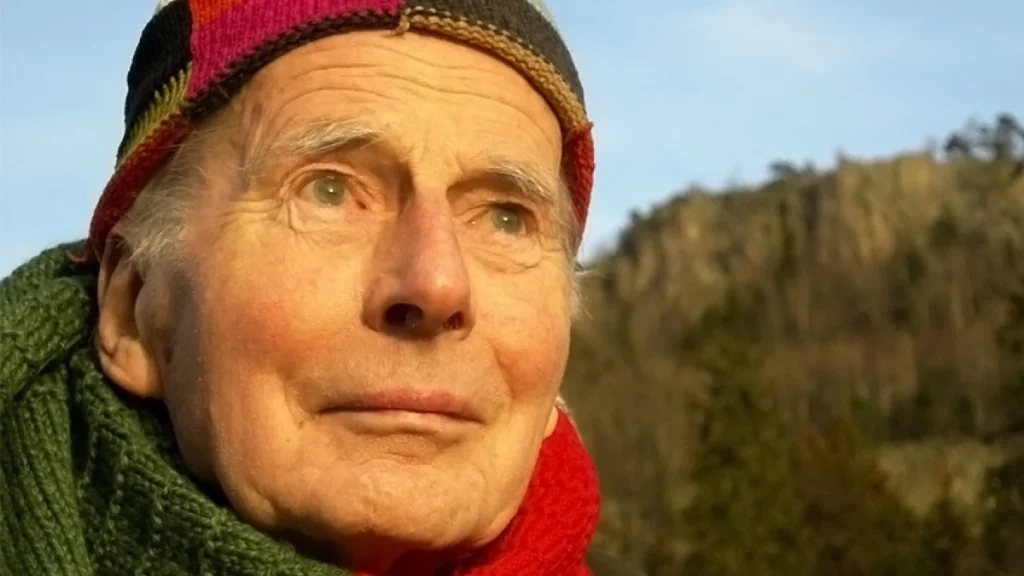
Arne Næss did not retreat. Or rather, he retreated physically — you have to come down from a mountain eventually — but he never managed to restore the old hierarchy in his mind. Something had cracked open during the years he spent in the Norwegian highlands, and especially after 1950, when he was part of the first expedition to summit Tirich Mir in the Hindu Kush, nearly 7,700 meters of rock and wind and altitude that does not negotiate with human ambition. He came back to Oslo, back to his position as a philosopher at the University of Oslo where he had been the youngest full professor in the institution’s history at just thirty years old, and he found that the conceptual tools his discipline offered him were insufficient. Not wrong, exactly. Insufficient. Philosophy as it was practiced in the European tradition — even the analytic philosophy he had trained in, even the empirical semantics he had spent years developing — kept placing the human mind at the center of every question worth asking. And he had been somewhere that made that centering feel like a provincialism.
What Næss built over the following decades was not a system in the grand architectural sense that European philosophy tends to admire. It was something stranger and more honest than that. It was a philosophy shaped by the experience of being made small — not humiliated, not diminished in the way that power diminishes, but relativized, placed in proportion, returned to a scale that the modern world works very hard to obscure. He called it deep ecology, a term he introduced in a 1973 paper that would eventually reorient the entire field of environmental ethics, and the word that mattered most in that phrase was not ecology but deep. The shallowness he was diagnosing was not ignorance. It was a failure of identification. A refusal to let the boundary between self and world become porous.
He lived for extended periods in a small stone cabin he built himself, called Tvergastein — Crossstone — high in the Hallingskarvet mountains, writing and thinking at an altitude where comfort is not guaranteed and where the landscape imposes itself on your consciousness whether you invite it or not. This was not romantic primitivism. It was a methodology. He was testing something. And what he was testing was whether a different kind of self — less fortified, less insistent on its own separateness — might actually perceive the world more accurately than the defended, boundaried, sovereign self that Western modernity had decided was the only serious option.
Eve of the Irises

Documentary, by Isabel Russinova, Rodolfo Martinelli Carraresi, Italy, 2026
Eva of the Irises is a historical biographical docu-film about the scientist Eva Mameli Calvino, a botanist and pioneer of environmentalism in Italy, mother of the writer Italo, born in Sassari in 1886. The film, based on a multidisciplinary approach that combines several genres—such as theatre, documentary, cinema, and research—moves between memories, reflections on life, as well as the goals and missions the scholar still wished to achieve.
The multifaceted artistic sensibility of Isabel Russinova is expressed across many fields, from writing to acting, from directing to civic engagement, and finds one of its highest expressions in the docu-film Eva of the Irises, created with Rodolfo Martinelli Carraresi. The film blends scientific rigor and poetic refinement to portray the extraordinary figure of the botanist Eva Mameli Calvino, mother of Italo Calvino but above all an independent protagonist of 20th-century scientific culture. It is told through a combination of archival materials, interviews, and evocative staging capable of elegantly and profoundly conveying her intense human and professional story.
LANGUAGE: Italian
SUBTITLES: English, Spanish, French, Portuguese
The Self That Keeps Expanding
You already know where your self ends. It ends at your skin. Maybe at the edge of your property, or the boundary of your opinions, or the last line on your résumé. This is not a philosophical position you chose — it was installed in you before you had language for it, and it sits so deep that questioning it feels not like intellectual inquiry but like vertigo.
The Western tradition built this container carefully. Locke grounded personhood in property. Descartes sealed the self inside the skull. By the time liberal economics needed a unit of account — a discrete, interchangeable atom of preference and interest — the architecture was already there, waiting. The self as a bounded object: measurable, taxable, mortal in a clean and final way.
Næss looked at this construction and found it not merely philosophically thin but ecologically catastrophic. The 1973 paper he published in the journal Inquiry — “The Shallow and the Deep, Long-Range Ecology Movement” — was short, almost spare, barely eight pages. But what it actually did was draw a line between two entirely different kinds of question. Shallow ecology asked how we manage resources more efficiently, how we reduce pollution without disturbing the underlying assumption that nature exists in relation to human welfare. Deep ecology asked something else entirely: what is the self that stands apart from nature and claims to manage it? Is that separation real, or is it a story we tell so successfully that we have forgotten it is a story?
The philosophical foundation Næss reached for was Spinoza. Not the Spinoza of undergraduate survey courses, flattened into a footnote about pantheism, but the Spinoza of the Ethics, of conatus — the drive in every thing to persist in its own being, to express itself outward into the world. For Spinoza, the individual was not a sealed unit but a mode, a temporary intensification of a single substance, and the boundaries between things were real but not absolute. Næss read this not as mysticism but as ontology with practical consequences. If the self is a process rather than a thing, then its edges are not fixed. They move. They breathe.
The convergence with certain currents of Buddhist thought was not accidental. The concept of anatta — non-self, the dissolution of the hard boundary between subject and world — offered a different language for the same intuition. Not the annihilation of the individual, but the recognition that the individual was never as individual as it believed. You are not a noun. You are a verb, temporarily conjugated.
What Næss proposed he called Self-realization — capitalized, to distinguish it from the therapeutic self-improvement that the word usually describes. The trajectory of a mature human life, he argued, was not the consolidation of a tighter, more defended identity but the expansion of identification outward. First to family, then community, then species, and further: to other species, to watersheds, to the slow chemistry of decomposition that turns a fallen tree back into soil. This was not metaphor. It was, for Næss, a description of what actually happens when cultural narrowing is removed — when you stop performing the self as property and start experiencing it as process.
The scandal was not the conclusion but the implication. Because if the self genuinely includes the river, then damage to the river is not an external cost, not a management problem, not a policy question. It is self-harm. The entire architecture of environmental law, carbon credits, sustainability frameworks — all of it rests on the premise that humans and nature are separate parties negotiating across a table. Næss was saying the table itself is the problem. He was saying there is no outside.
And that is the kind of thought that does not make you feel enlightened. It makes you feel the ground shift beneath everything you assumed was solid.

Shallow Water and Deep Cuts
You stand at the kitchen sink, rinsing the last traces of tomato sauce from a glass jar before placing it in the recycling bin with a precision that borders on ceremony. The labels separated, the caps unscrewed, the plastic film peeled away from the cardboard. Outside, the sky carries that particular orange tint that used to mean sunset and now means something else entirely. You finish, wash your hands, and feel, if not innocent, at least partially absolved.
This is the architecture of shallow environmentalism. Not a conspiracy, not a cynicism — something more insidious than either. A system of gestures that satisfies the moral need to act while leaving untouched every structure that makes the acting necessary. Arne Næss saw this clearly enough in 1973, when he published the paper in Inquiry that divided the entire ecology movement into two irreconcilable directions. The shallow fight, he wrote, is the fight against pollution and resource depletion, but only in service of human health and affluence in developed countries. It does not question the hierarchy. It does not ask who benefits. It recycles the jar while the factory that made it negotiates its next tax exemption.
The deep position starts somewhere else entirely. It starts with the premise that life on Earth has value independent of its usefulness to human beings, that the richness and diversity of living forms are values in themselves, and that humans have no right to reduce that richness except to satisfy vital needs. Næss called this biocentric equality, and when he and George Sessions formalized it into the eight-point platform in 1984, they were not writing a policy document. They were issuing a philosophical indictment. The platform insisted on a fundamental change in basic economic, technological, and ideological structures, and it named this change as necessary — not desirable, not aspirational, but necessary. The difference in language is the difference between reform and rupture.
What shallow environmentalism does, functionally, is absorb the energy of ecological alarm and redirect it toward consumer behavior. It transforms a structural crisis into a lifestyle question. Naomi Klein documented this capture with forensic precision in This Changes Everything, published in 2014, where she traced how the mainstream environmental movement of the 1980s and 1990s made a series of catastrophic compromises with corporate power, accepting market-based solutions — carbon trading, green branding, corporate sustainability pledges — that preserved the economic logic driving the crisis while producing the appearance of response. The result was not a slowed catastrophe but an accelerated one dressed in recyclable packaging.
There is a man in a small apartment who has spent twenty minutes sorting his waste into four separate containers. He does this with genuine care. Meanwhile, just three companies — ChevronExxonMobil, and Saudi Aramco — have been responsible for over fifty percent of global industrial greenhouse gas emissions since 1988, according to the Carbon Disclosure Project’s 2019 analysis. The arithmetic of individual virtue against institutional scale is not merely discouraging. It is a category error. Næss understood this, and so did the Frankfurt School before him. Herbert Marcuse, writing in One-Dimensional Man in 1964, described how advanced industrial society integrates opposition into itself, neutralizing critique by offering it a sanctioned channel — one that changes nothing at the root.
The deep ecology platform is uncomfortable for precisely this reason. It does not tell you to buy differently or consume more consciously. It tells you the problem is the value system underneath consumption, underneath growth, underneath the assumption that the nonhuman world exists as resource. It tells you that a civilization organized around human dominion over nature will not be saved by its own citizens rinsing their jars more carefully. It tells you the water is shallow, and that you have been standing in it, performing the motions of depth.
Spinoza in the Norwegian Snow
There is a moment, sometime in the early 1970s, when a man sits in a stone cabin on a Norwegian mountain at roughly 1,400 meters above sea level, surrounded by ice and wind and an almost aggressive silence, and reads Spinoza. Not for the first time. He has been reading Spinoza for decades, returning to the Ethics the way other people return to a landscape they cannot stop trying to understand. But something clicks now with a different kind of force. The proposition that every finite thing is a mode of the one infinite substance — every rock, every lichen, every human thought, every gust of wind cutting across the plateau — lands not as metaphysics but as description. As the most literal account of what he can see from the window.
Næss published his systematic engagement with Spinoza in 1975, in a book whose full title already contains a philosophical argument: Freedom, Emotion and Self-Subsistence. The subtitle points toward Spinoza’s definitions. And what Næss found there was a concept of freedom that the liberal tradition had spent three centuries carefully misreading. Freedom, for Spinoza, is not the absence of constraint. It is not doing whatever impulse suggests. A free entity, in the precise technical sense Spinoza develops across the propositions of Part IV of the Ethics, is one that acts from its own nature rather than being driven by external causes. You are free insofar as your actions follow from what you most essentially are. You are enslaved insofar as you are pushed around by forces that have nothing to do with your deepest constitution. This is a rigorous definition, not a romantic one, and its implications are vertiginous. It means that a tree bending in its proper direction toward light is, in this precise sense, freer than a human being running anxiously after desires manufactured by others.
Næss took this seriously in a way that was almost unfashionable. While philosophy in the English-speaking world was largely treating freedom as a problem of choice architecture and political permission, Næss was asking what it would mean to act from your deepest nature — and then asking what your deepest nature actually is. His answer, developed through the concept of the ecological self, is that the self which acts freely is not the biographical ego with its preferences and anxieties, but something wider and more porous, something that includes its relationships with other beings as constitutive rather than incidental. This is Spinoza transposed into the Norwegian fjords, into the community of organisms, into a philosophy that had not yet been named ecology when Spinoza was writing in Amsterdam in the 1670s.
The crucial move — the one that separates Næss from mere romanticism about nature — is the insistence that intrinsic value is not assigned. It does not flow from human recognition or human need. Every mode of the one substance has its conatus, its drive to persist in its own being, its own expression of the infinite through a finite form. This is not mysticism. It is the most rigorous materialism available: the claim that value is not projected onto the world by minds, but is a structural feature of existence itself. When the philosopher Holmes Rolston III was developing his own account of intrinsic value in natural systems during the same decade, he arrived at a similar conclusion from a different direction. But Næss had gotten there through Spinoza, through a philosopher who died in 1677 and who had never heard the word ecology but had nevertheless described its deepest premise — that the world is one substance expressing itself in infinite modes, none of which is merely instrumental to any other.
Sitting in that stone cabin, reading those propositions, something else was also becoming clear: that the philosophical tradition had not failed to see nature’s value because it lacked the right concepts. It had looked away on purpose.
Tvergastein and the Art of Living Exposed
There is a moment, somewhere in the long Norwegian winter, when a man stops moving around the interior of a small stone hut and simply stands still. The wind outside has been building for hours. The single window offers nothing but white. The stove ticks. And in that absolute reduction of circumstance, something surfaces that no city, no schedule, no ambient noise of social life had ever allowed to surface before. Not peace, exactly. Something older and more demanding than peace. The recognition that the silence was never empty. That he had been filling it, desperately and continuously, because what lived inside it frightened him more than any noise.
Arne Næss built Tvergastein in 1937 on the Hallingskarvet massif, at 1,505 meters above sea level, and he returned to it for decades as other men return to the only honest relationship of their lives. The name means roughly “the place of crossing stones,” and he chose it not as a retreat from the world but as the precise location where thinking became possible. The hut was small, uninsulated by the standards of comfort, reached only by a climb that discouraged the casual visitor. There was no telephone for most of its life. The library was real but limited. The conditions were what another century would have called austere, though Næss himself would have resisted the word, because austerity implies deprivation, and deprivation implies that what is absent should have been present.
This is the distinction that almost everyone misreads when they encounter Næss’s biography. The simplicity of Tvergastein was not self-punishment. It was not the Protestant guilt of a man who believed pleasure required penance. It was something closer to what the philosopher called clarity, a paring away of distraction until the object of attention became visible in its own right. William James, whose radical empiricism Næss had absorbed early and never entirely discarded, wrote in 1890 that attention is the taking possession by the mind of one out of what seem several simultaneously possible objects or trains of thought. Næss understood this not merely as psychology but as ethics. What you give your attention to, you become. What you surround yourself with crowds out or invites what you are capable of thinking. The mountain did not make him wise. It made him available.
And from that availability he constructed what he called Ecosophy T, the “T” standing for Tvergastein, a deliberate marker of the personal and the located. This is perhaps the most philosophically honest gesture in his entire career. He was not offering a system. He was offering a demonstration. Here is how one person, in one particular place, following one specific set of intuitions and commitments, built a coherent philosophical dwelling for himself. The “T” was the anti-universal signal, the explicit admission that what worked at 1,505 meters in Norway might require translation, transformation, or complete reinvention for anyone else. Where most philosophical systems silently assume their own universality, Næss built the limitation into the name.
The core of Ecosophy T was the principle he called self-realization, but stripped of its individualist Western inheritance. Not the self-realization of the therapeutic culture, not the curated identity of late capitalism, but the expansion of the self outward into relation, until the boundaries between organism and environment became porous enough to feel. Erich Fromm had written in 1976, in To Have or To Be, that the fundamental conflict of modern life was between modes of existence, and that the having mode systematically destroyed the capacity for the being mode. Næss was doing something adjacent but more radical. He was suggesting that even the being mode, as Fromm conceived it, still imagined a being that was fundamentally separate from what surrounded it.
At Tvergastein, separation was simply not available as an illusion. The cold came through the walls. The mountain was not a view. It was the condition of every thought he had.
A vision curated by a filmmaker, not an algorithm
In this video I explain our vision
Biocentric Equality and the Violence of Hierarchy

There is a moment when two people stand in front of a very old tree — a cedar, let us say, wide enough that two people holding hands could not encircle it — and one of them says: we need to cut it down to build something useful here. The other goes quiet in a way that is not hesitation but refusal, as though the question itself has revealed something irreversible about who they each are. The argument that follows is not really about the tree. It is about whether the tree has a claim on existence that precedes human need, or whether its value begins and ends with what humans decide to do with it.
This is precisely the ground on which Næss planted his most radical flag. Biocentric equality — the assertion that all living beings possess intrinsic value independent of their usefulness to humans — is not a poetic sentiment. It is a philosophical claim with consequences so sweeping that most people who encounter it immediately begin softening it, qualifying it, translating it back into something more manageable. Næss himself acknowledged in Ecology, Community and Lifestyle that the principle did not mean all organisms must be protected equally in every practical decision. But he insisted the baseline remained: no form of life is ontologically inferior to another simply because it is inconvenient, inarticulate, or small.
Paul Taylor, in Respect for Nature published in 1986, built perhaps the most rigorous philosophical scaffolding for this claim. Taylor argued that every organism has a good of its own — what he called a teleological center of life — and that this alone generates a prima facie moral duty of non-interference. Not because the organism feels pain, not because it is conscious in any way we recognize, but because it is oriented toward its own flourishing. A bacterium striving to live is, in Taylor’s framework, morally considerable on precisely the same metaphysical grounds as a child striving to grow. This is not comfortable. It indicts agriculture as a sustained act of hierarchical violence. It indicts urban planning, pharmaceutical development, pest control, the hospital that administers chemotherapy by declaring war on cells that are, by their own internal logic, doing exactly what life does: persisting.
The argument standing beside that cedar is never purely practical because the practical question — do we need shelter more than we need this tree — always conceals a cosmological one: who gets to rank needs? Val Plumwood, whose feminist environmental philosophy sharpened and troubled deep ecology from within, saw this question clearly and without mercy. In Environmental Culture, published in 2002, she argued that the deep ecology movement, for all its biocentric ambitions, had sometimes reproduced the very dualisms it claimed to dissolve. The human-nature binary, rather than being dismantled, was often simply romanticized — wilderness elevated, culture diminished, and the colonized, racialized, and gendered bodies that had always been placed on the nature side of the divide left exactly where they were. Plumwood named this the problem of the indistinguishable other: when you declare all life equal without attending to the specific histories of domination that have made some lives cheaper than others, you are not dismantling hierarchy. You are aestheticizing it.
Back at the cedar, the quieter person may understand something about this that the argument cannot hold. That the tree’s claim is not abstract. That it stands in a specific place, with a specific history, in a specific ecosystem that has been diminished in measurable ways — species counts, soil composition, watershed integrity — by specific human decisions made by specific people with specific interests. Biocentric equality does not erase these particularities. It makes them more urgent, not less, because it removes the one justification that made them comfortable: the idea that only human interests count as interests at all.
The Identification Problem
There is a moment you may recognize, even if you have never named it. You are walking and you see a bird on the ground, wing dragging, circling in the small panicked geometry of injury. And what you feel is not pity. Pity keeps its distance, pity observes from a position of relative wholeness. What you feel is closer to a collapse of the membrane between you and that creature — something in your own chest drops, something in your own movement wants to compensate, to limp alongside. You are not feeling for the bird. You are, in some functional sense, feeling as it.
Arne Næss spent decades trying to give rigorous philosophical language to precisely this experience, and the word he chose — Self-realization — was deliberate in its capitalization and its distance from what that phrase had come to mean in the therapeutic culture surrounding him. Abraham Maslow’s self-actualization, occupying the apex of his famous 1943 hierarchy, was still a project of the individual ego: become more fully yourself, unlock your potential, ascend. Næss meant something structurally opposite. The capital S in Self-realization signals an expansion outward, not a refinement inward. The self that realizes itself, in Næss’s sense, is not the biographical self — the accumulated preferences and wounds and social roles — but something closer to what Spinoza called conatus, the striving inherent in all living things, recognized as continuous rather than bounded.
In Ecology, Community and Lifestyle, published in 1989 and developed from decades of Norwegian university lectures and mountain retreats, Næss writes with uncomfortable directness that violence against nature is always also self-violence. This is not a metaphor. He means it structurally. If identification has genuinely expanded — if the rivers and forests and animals are experienced as extensions of what you are rather than backdrop to what you do — then their degradation lands in you as damage. The ecological crisis, on this reading, is not primarily a political or technological failure. It is a crisis of identification, a collective shrinkage of the self back into the skin.
There is a man standing at a window watching a horse in a field. The horse is dying slowly, collapsing and rising, collapsing again. The man’s face does not perform sympathy. He does not weep in the performative sense. What happens to him is more like a structural event — his body registers the horse’s struggle as something happening in shared space, shared tissue. He cannot turn away not because he is emotionally disciplined but because turning away would require a separation that no longer exists for him. This is not anthropomorphism. The horse is not humanized. The man is, in some sense, unhuman-ized, extended beyond the container of his own story.
Neuroscience has since approached this territory from a different angle. The discovery of mirror neurons in the mid-1990s by Giacomo Rizzolatti’s team at the University of Parma demonstrated that the nervous system does not cleanly distinguish between observed and performed action — the same neural architecture activates in both cases. What Næss was describing philosophically, the dissolution of the boundary between self and other through identification, turns out to have correlates in how the brain actually processes the world. Ecological grief — the documented psychological distress arising from environmental loss, studied systematically since Glenn Albrecht’s work on solastalgia in the early 2000s — follows the same logic. People do not grieve ecosystems the way they grieve furniture. They grieve them the way they grieve limbs.
What Næss understood, and what the therapeutic tradition systematically obscured, is that the question of where you end and the world begins is not settled at birth. It is a philosophical and experiential practice, continuously negotiated. And the answer you live with — the radius of your identification — determines not just your ethics but your suffering, your capacity for damage, and whether destruction anywhere registers as destruction at all.
What the Rocks Remember

There is a moment that happens to almost everyone who has lived long enough — you return to a place that shaped you, a hillside, a stretch of coastline, a particular bend in a river where you once sat for hours doing nothing, and you find it not destroyed but altered in some way that is harder to name than destruction. The trees are still there but arranged differently. The light falls wrong. A road has been widened by six meters, or a fence erected where there was none, and suddenly the entire grammar of the place has shifted, the way a single word changed in a familiar sentence makes the whole meaning slide. You stand there and feel something that has no adequate political category, something that cannot be channeled into a petition or a protest, something closer to the grief you feel when a person you loved changes so completely that their face becomes a kind of mask over someone you no longer recognize. This is not nostalgia. Nostalgia is about you. This is about the place.
Næss would have understood this without needing it explained, because his entire philosophical project was built on the premise that this grief is not sentimental weakness but accurate perception. When you mourn an altered landscape, you are mourning part of yourself — not metaphorically, not poetically, but in the most literal ontological sense he could construct. The self that formed in relation to that hillside, that river bend, was not separate from those things. It included them. Their alteration is your alteration. What deep ecology attempted to name was precisely this: that the sealed self, the self that ends at the skin and regards the world as backdrop, is a philosophical fiction, and a recent and catastrophic one.
He died in January 2009 at ninety-six years old, still writing, still thinking through problems he had first posed in the mountains decades earlier, still carrying in some fold of his mind the face of Hallingskarvet as he had known it at twenty. The twentieth century, which he had watched almost entirely from beginning to near end, had moved in almost every measurable direction away from what he had argued. Between 1973, when he published his foundational distinction between shallow and deep ecology, and the year of his death, global extraction of fossil fuels had not declined but accelerated. The speed of economic life had not slowed but compounded. The philosophical premise that nature exists as resource — as standing reserve, as Martin Heidegger had called it in 1954, with the particular dread of someone who saw what was coming — had not been seriously challenged at the level of policy but had instead been absorbed so completely into common sense that to question it felt eccentric, impractical, the province of hermits and idealists.
And yet the question his work leaves behind is not what we should do. Every century has enough instructions. What it leaves is something harder and stranger: the question of what kind of being we are willing to become. Whether the contraction of the self into its defended, consuming, sealed form is a destiny or a choice. Whether identification — real identification, not the performed empathy of a campaign slogan, but the dissolution of the boundary between your suffering and the suffering of something outside your skin — is still possible in nervous systems shaped by the speed and noise of a world that profits from their isolation.
The mountain that Næss climbed for the last time at eighty-five was there before the Norwegian language had a word for mountain, before the concept of property had divided it from the air above it, before anyone had thought to call it a resource or a view or an asset. Whether it will wait long enough for the question to be answered is not a metaphor. It is the only thing being asked.
🌿 Philosophy, Nature, and the Depth of Being
Arne Næss dedicated his life to questioning humanity’s relationship with the natural world, building a philosophy rooted in ecological interdependence and the intrinsic value of all living beings. His thought resonates deeply with other thinkers who dared to reframe existence, meaning, and our place in the cosmos. Explore these related articles to trace the philosophical currents that converge with deep ecology.
Heidegger’s Being and Time: Guide to Reading
Martin Heidegger‘s Being and Time is one of the most demanding and transformative philosophical texts of the twentieth century, exploring the nature of existence, temporedness, and our being-in-the-world. Næss was significantly influenced by Heidegger’s ontological perspective, particularly the idea that human beings are never separate from their environment but always already embedded within it. Reading this guide offers an essential key to understanding the deeper philosophical roots of ecological thinking.
GO TO THE SELECTION: Heidegger’s Being and Time: Guide to Reading
Martin Heidegger: Life and Philosophical Thought
Martin Heidegger‘s life and thought represent a complex and unavoidable chapter in the history of continental philosophy, one that profoundly shaped how we understand humanity’s relationship to nature, technology, and dwelling on Earth. Næss drew on Heideggerian concepts to articulate his vision of ecological selfhood and the critique of industrial modernity. Understanding Heidegger as a thinker is therefore indispensable for grasping the philosophical architecture behind deep ecology.
GO TO THE SELECTION: Martin Heidegger: Life and Philosophical Thought
Epicurus: Life and Philosophy
Epicurus developed one of antiquity’s most radical philosophies of life, arguing that true flourishing depends on simplicity, natural limits, and freedom from unnecessary desire. His emphasis on living in harmony with nature and the community of living beings finds surprising resonance with Næss’s vision of ecological wisdom and voluntary simplicity. This article traces Epicurean thought as a precursor to modern environmental philosophy.
GO TO THE SELECTION: Epicurus: Life and Philosophy
Buddhism and 3 Documentaries to Understand it
Buddhism offers one of the world’s most profound frameworks for understanding the interconnectedness of all sentient life, a vision that parallels Næss’s concept of the ecological Self extending beyond individual human boundaries. The Buddhist principle of dependent origination, which holds that no being exists in isolation, deeply informed deep ecology’s critique of anthropocentrism. This article and its documentary selections provide a meditative entry point into traditions of ecological and spiritual interdependence.
GO TO THE SELECTION: Buddhism and 3 Documentaries to Understand it
Discover Independent Cinema on Indiecinema
If the philosophy of Arne Næss has stirred something in you — a desire to see the world differently, to question the boundaries between self and nature — then independent cinema is your next frontier. On Indiecinema, you will find films that dare to ask the same deep questions: documentaries, essays, and visionary works that no algorithm will recommend to you. Come explore a streaming space built for curious, free, and restless minds.
👉 EXPLORE THE CATALOG: Watch Indie Films in Streaming
A vision curated by a filmmaker, not an algorithm
In this video I explain our vision

