
The Laboratory as Mirror: Waking Up Inside Someone Else’s Formula
You do the same thing every morning. The alarm sounds and before consciousness fully assembles itself, your hand is already reaching, already silencing, already beginning the sequence. Coffee measured to the same line. The same side of the sink. The same route, the same sequence of tasks, the same posture in the same chair. And somewhere around the third or fourth repetition of some gesture — stirring, buttoning, logging in — something tilts. A gap opens. You catch yourself mid-motion and think: who taught me to do this? Not as a philosophical question. As a genuine, slightly nauseating uncertainty. Because you cannot remember learning it. It arrived already installed, the way a language arrives, the way a fear arrives, the way a whole personality arrives — long before you had any say in the matter.

This is where alchemy actually begins. Not in a laboratory. Not with crucibles and furnaces and the patient distillation of metals. It begins in that half-second of vertigo when the routine cracks and you glimpse, behind the familiar gesture, someone else’s intention running through your body like a script you never agreed to read.
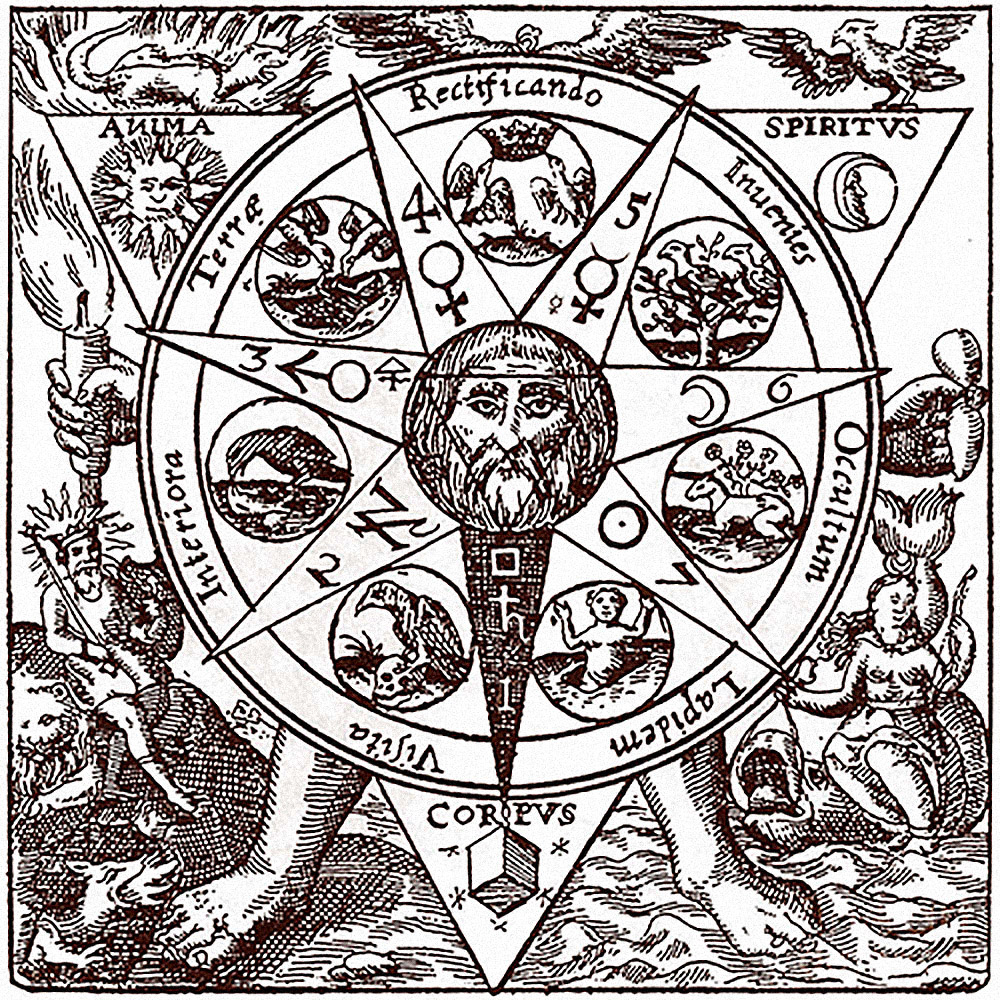
Basil Valentine is a name that floats at the edge of historical certainty, which is precisely what makes him the right figure to introduce here. He is attributed to the Benedictine order, said to have worked in the monastery of Saint Peter in Erfurt sometime in the fifteenth century, and credited with texts of extraordinary cryptic density — the Twelve Keys foremost among them, a work of alchemical symbolism so layered that scholars centuries later still cannot agree on whether its imagery is chemical instruction, spiritual allegory, or both simultaneously. The problem is that no monastery in Erfurt has any record of him. The name Basil Valentine appears in print only in 1599, nearly a century and a half after his alleged death. Historians like Lawrence Principe, in his meticulous The Secrets of Alchemy published in 2013, have argued persuasively that Valentine was almost certainly a literary construction, a pseudonymous author or perhaps a collective fiction, assembled to lend ancient authority to ideas that were, at the time of publication, dangerously new.
And yet the ideas survived. The Twelve Keys survived. Not because they contained instructions for making gold — no alchemical text ever actually produced gold, and anyone working seriously in the field understood this — but because they contained something more disturbing: a systematic account of what must be destroyed in a human being before anything genuine can be built. The prima materia, the raw chaotic substance that alchemists described as the starting point of all transformation, was never simply lead or mercury or antimony. It was the unexamined self. The self that wakes up and follows the sequence without asking who installed it.
Jung understood this with the precision of someone who had spent decades watching people disintegrate in his consulting room. In Psychology and Alchemy, published in 1944, he documented the degree to which alchemical imagery corresponded not to external chemistry but to the internal drama of psychological individuation — the terrifying process by which a person separates from the collective formulas they have absorbed and begins, for the first time, to encounter something actually their own. The horror he describes is not metaphorical. It is clinical. People did not want to undergo this process. They came to him already running their sequences, already turning their fixed gestures into something they called identity, and they fought with tremendous energy to keep those formulas intact.
What Valentine’s Twelve Keys proposed — whether he existed or not, whether the text is fifteenth century or sixteenth, whether it describes chemistry or consciousness — was that the raw material does not know it is raw material. The lead does not know it is lead. The prima materia sits in its impure, unworked state and experiences itself as finished. This is the first principle. Not a metaphor. A diagnosis. The morning ritual that feels like self-expression is, in this framing, indistinguishable from a prison whose walls you have learned to call home.
Mystery of an Employee
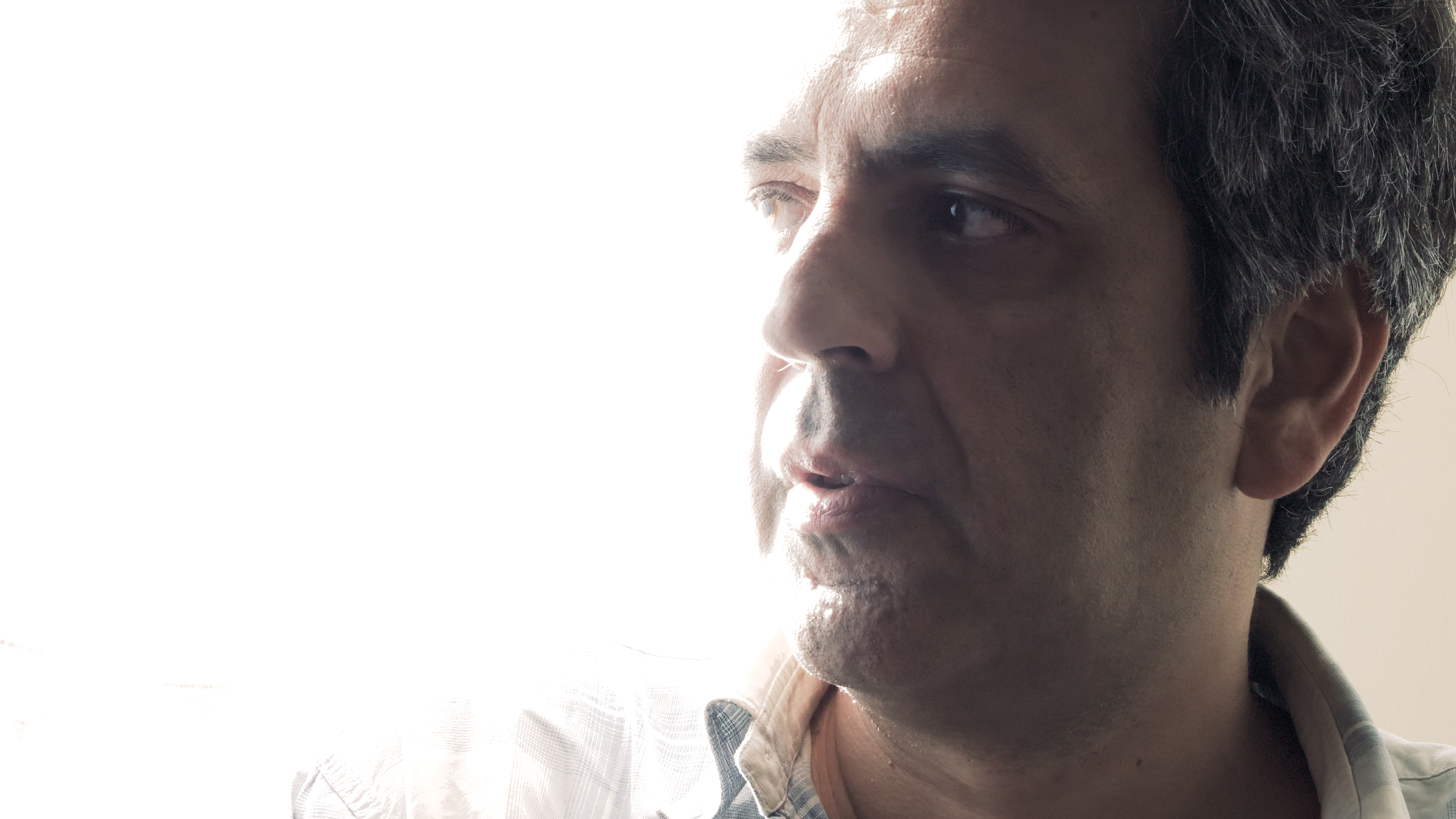
Drama, thriller, by Fabio Del Greco, Italy, 2019.
Someone wants to control the life of the employee Giuseppe Russo: the products he buys, his political and religious faith, his private life, even his dreams. But he will do anything to escape control and find his true self. Giuseppe is a man of around 45, married, with a stable job and a home of his own. His life flows seemingly peacefully when he meets a mysterious tramp who gives him some old VHS video cassettes. Giuseppe begins to see video tapes in which he is filmed in some moments of his life since he was a child, then as a teenager and as a young man. Who shot those videos that he remembers nothing about? Giuseppe has the strange sensation of being constantly observed and begins to investigate what is happening. Through his investigation of him, he begins to rediscover his true identity and become aware of who he truly is.
Employee's Mystery is a film that highlights the danger of social control and shows a society where everyone is constantly monitored and conditioned in their deepest selves. The film is also an analysis of human nature and identity. Fabio Del Greco, who plays Giuseppe, gives an engaging performance. Equally good is Chiara Pavoni, in the role of Giada Rubin and Roberto Pensa in the role of the tramp. Employee's Mystery is a film that addresses important themes in an original way, a psychological thriller that keeps the viewer glued to the screen until the end: a metaphor for contemporary society, in which people are increasingly monitored and conditioned by the media and technologies . It is a courageous and provocative work, which addresses important themes in an original way.
LANGUAGE: Italian
SUBTITLES: English, Spanish, French, German, Portuguese
Sulphur, Mercury, Salt: The Three Principles as a Map of Human Contradiction
There is a kind of person you have almost certainly met — perhaps been — who enters every room as though something needs to be ignited. They speak first, commit loudly, fall in love with the velocity of their own conviction. They take on projects the way kindling takes on flame: completely, immediately, without reservation. And then, at some point that arrives with the reliability of physics, the fuel runs out. What remains in the aftermath is not defeat exactly. It is something harder to name. A residue. A fine grey powder at the bottom of every container they have ever filled and emptied.
Basil Valentine, writing in the fifteenth century from the shadows of Erfurt, described this not as biography but as cosmology. The three principles he articulated — sulphur, mercury, and salt — were never meant to denote substances in any modern chemical sense. They were meant to denote forces. More precisely: they were meant to denote the three irreconcilable forces that make up every living thing, and whose refusal to cohere is not a failure of character but the very condition of being human. When Paracelsus systematized these principles in the Opus Paramirum of 1530, he made explicit what Valentine had implied: that these are the categories of inner contradiction, the grammar of the divided self long before psychology invented its own vocabulary for the same thing.
Sulphur is will. It is the combustible principle, the part of a person that wants, that insists, that moves toward its object with the single-mindedness of fire. It does not negotiate. It does not wait. A man in his mid-thirties watches his marriage quietly collapse over the course of eighteen months, and what is remarkable is not the collapse but how little he notices it while it is happening, because sulphur does not look backward. It is constitutionally incapable of inventory. He is already planning the next project, already explaining to someone new why this time will be different, already burning with the particular brightness of someone who has never considered that brightness is also consumption. Sulphur, Paracelsus wrote, is the principle of fixity in the volatile — the paradox of something that destroys in order to claim permanence.
Mercury is something else entirely. It is fluidity, adaptability, the capacity to take the shape of whatever container holds it. But Valentine knew what Paracelsus confirmed: mercury is also the principle of deception — not malicious deception, but the deeper kind, the self-deception of a substance that has no fixed form and therefore cannot be held accountable to any single one. The same man, in conversation, becomes whoever the room needs him to be. He is eloquent about his wounds when eloquence serves connection. He is silent about his wounds when silence serves the same. He does not lie exactly. He is simply mercurial in the old sense, which means he is impossible to fix in place long enough to be truly known.
Carl Jung, in Psychology and Alchemy published in 1944, spent considerable effort demonstrating that the alchemical tradition was not primitive chemistry but primitive psychology — a system of symbols that encoded what the modern self could not yet consciously articulate. His reading of mercury as the trickster-figure, the anima, the part of the psyche that refuses stable identity, maps precisely onto this phenomenon. Jung understood that the mercurial person is not shallow. They are, in fact, profoundly sensitive — sensitivity being the very mechanism that produces constant adaptation. The problem is that adaptation, taken far enough, begins to dissolve the self entirely.
And then there is salt. Salt is what remains. Not what was built, not what was burned, but what survived the burning. It is the accumulated residue of every fire that sulphur lit and mercury fled. Valentine called it the principle of preservation — the thing that holds its form precisely because it has already been through the transformation that destroys softer things. But in a living person, salt is not triumphant. It is quiet. It sits at the bottom. It is the knowledge that comes too late to prevent the next fire, and remains too present to allow forgetting.

The Antimony Question: What We Refine and What We Destroy in the Process
There is a particular kind of silence that follows a performance review. Not the silence of completion, but of rearrangement — the quiet in which a person reorganizes themselves according to specifications they did not write. The manager closes the folder. The employee nods. Something has been extracted, something considered impure, something the organization identified as inefficiency or misalignment or, in the gentler vocabulary of human resources, a development area. The person who walks out is measurably more useful and measurably less whole.
Basil Valentine understood this process with a precision that should disturb us. His Currus Triumphalis Antimonii, published in 1604 and almost certainly compiled from earlier manuscripts attributed to him, is not simply a metallurgical treatise. It is a sustained meditation on a substance that heals by nearly killing — antimony, which Valentine called the great purifier, which induces violent vomiting, which expels what the body holds, which was administered to monks who were suspected of overeating, of excess, of being too much. The cure worked by catastrophic evacuation. What remained was leaner, more disciplined, more aligned with the requirements of the institution. The body had been refined. The question Valentine never quite answered, and perhaps never asked, was what exactly had been lost in the refinement.
René Girard argued in his 1972 work La Violence et le Sacré that every community generates its coherence through the expulsion of a designated impurity — a mechanism so ancient and so embedded in social architecture that we rarely recognize it operating in real time. The scapegoat is not arbitrary. It carries something genuine, some excess or difference or uncontrollable vitality that the group cannot metabolize. What Girard understood, and what Valentine’s antimony makes viscerally literal, is that the purification ritual does not eliminate the problem. It eliminates the person who embodied it visibly. The community survives. The designated carrier does not, or survives transformed into something the community can finally tolerate.
Michel Foucault, tracing the archaeology of clinical medicine in Naissance de la Clinique in 1963, showed how the emergence of modern medical knowledge was inseparable from the emergence of institutional power over the body. The hospital was not simply a place of healing. It was a place of normalization, of observation, of the systematic production of the docile patient who submits to the gaze and cooperates with the correction. Valentine’s physician, moving through the sixteenth century’s proto-clinical imagination, is already this figure — the one who knows what the body requires better than the body itself, whose authority to administer poison as cure is indistinguishable from the authority to decide what purity means.
There is a man sitting across from a therapist, not in crisis but in what the intake form called adjustment difficulties. He has been referred by his employer. The sessions are productive, the therapist competent, the framework evidence-based. By the twelfth session he has acquired a vocabulary for his reactions, a structure for his responses, a set of behavioral modifications that make him, by every measurable standard, more functional. He returns to work. His performance metrics improve. He no longer experiences what he used to experience on Sunday evenings, that specific dread that he had quietly come to understand as the only honest response to his situation. The dread has been refined away. What has been refined away along with it is the part of him that knew something was wrong.
This is Valentine’s antimony administered at scale. The triumphal chariot does not ask whether what it expels deserved to stay. It asks only whether the host organism is now more governable, more productive, more aligned with the external criteria of health. Girard’s scapegoat and Foucault’s patient occupy the same position in the same logic — the individual as raw material for a collective or institutional coherence that requires, periodically, the ritual sacrifice of whatever cannot be standardized.
What antimony reveals, in the laboratory and in the performance review alike, is that transformation is never neutral. Every refining process has a residue. Every cure leaves something on the floor of the crucible that no one bothers to examine, because the examination might complicate the meaning of the cure.
The Twelve Keys: Initiation as Controlled Disorientation

There is a particular moment, familiar to anyone who has passed through a serious rupture, when the people around you need to know which kind of story this is. They need to know whether you are falling or flying, whether this is breakdown or breakthrough, whether they should call someone or send congratulations. The pressure is not malicious. It is structural. We have built a social grammar around transformation that demands legibility at every stage, a continuous narration of progress, a visible arc. What cannot be named as either destruction or renewal makes others profoundly uncomfortable, because it refuses to perform the story they already know how to witness.
Basil Valentine’s Twelve Keys refuses exactly this comfort. Read as a sequential recipe, the text appears to promise accumulation: each key unlocking a door, each door revealing a corridor slightly more luminous than the last. But the actual movement of the work is something far stranger and more unsettling. The second key dismantles the conceptual stability established by the first. The fourth introduces a principle that directly contradicts what the third seemed to confirm. By the seventh, the reader who has been following faithfully discovers that they are holding a map whose cardinal directions have been quietly reversed. This is not sloppiness. It is architecture.
Arnold van Gennep, writing in 1909, identified the tripartite structure underlying virtually every human rite of passage: separation, transition, incorporation. What he called the liminal phase, the middle territory, is the zone of dissolution — the initiate has been removed from their former identity but has not yet been granted a new one. They are, in the precise anthropological sense, nobody. Victor Turner extended this insight considerably, arguing in his work on ritual process that liminality is not a corridor between two rooms but a condition unto itself, a state of structured ambiguity that the society around the initiate finds deeply threatening precisely because it cannot be classified. The liminal figure, Turner noted, is simultaneously polluting and sacred. They carry the danger of the unresolved.
A man sits in a rented room in a city that is not his city, surrounded by boxes he has not unpacked, because unpacking would mean something about permanence he is not prepared to declare. His phone contains two separate threads of conversation: one from people who have decided this is the year everything broke, and one from people who have decided this is the year everything finally started. He reads both threads and recognizes that neither group is describing him. They are describing the story they need this to be. He has stopped correcting them, because the correction would require him to explain a condition for which the language has not yet fully arrived.
Valentine understood this. Each of his keys performs what it describes. The text does not merely instruct the reader to calcine, to dissolve, to separate — it forces the act of reading itself into those operations. You reach a passage that seems to confirm your understanding, and then three lines later the confirmation is withdrawn. The ground that felt solid reveals itself as the next material to be subjected to fire. This is controlled disorientation, not confusion. There is a difference, though from the inside the distinction is almost impossible to feel.
The alchemical tradition never promised that the path through the work would feel like progress. The nigredo, the blackening, the stage of putrefaction that must precede any conjunction, was understood to be the moment of maximum danger precisely because it most resembles total failure. The matter in the vessel has lost every property that formerly defined it. It has not yet acquired the properties that will eventually define it. From outside the vessel, there is no way to distinguish a successful nigredo from simple rot.
What the social grammar demands, and what the Twelve Keys systematically deny, is the ability to read the verdict before the process is finished. The people standing around the vessel want to know now. The work insists that now is exactly the wrong time to ask.
False Authorship and the Masks History Wears: Who Was Basil Valentine, Really?
There is a particular kind of vertigo that arrives not when the ground shakes but when you realize the ground was never there. A woman in her late forties, someone who had spent two decades studying a tradition she believed carried the weight of centuries, sits with a photocopy of a scholarly paper spread across her kitchen table. The coffee has gone cold. The paper is technical, archival, written in the dry language of historians who deal in watermarks and handwriting analysis and provenance chains. But what it says, stripped of its academic restraint, is simple: the man whose ideas organized her intellectual life probably never existed.
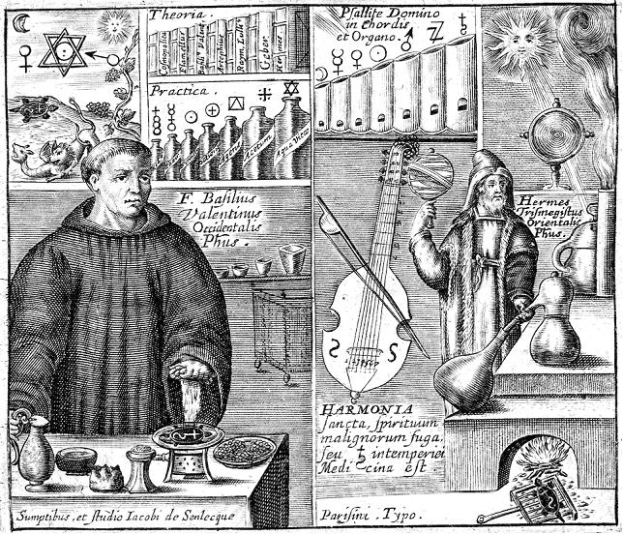
The figure known as Basil Valentine, the Benedictine monk of Erfurt whose writings on antimony and the triadic principles of matter became foundational texts for centuries of alchemical and early chemical thought, is now considered by most serious historians to be a literary invention. Researchers at the Max Planck Institute for the History of Science have placed the composition of the key manuscripts — including the Triumphal Chariot of Antimony and the Twelve Keys — not in the fifteenth century where Valentine allegedly lived, but firmly around the year 1600. The man most likely responsible was Johann Thölde, a salt merchant and minor industrialist from Thuringia, who published the first editions and claimed to have merely discovered the ancient manuscripts, hidden inside a stone pillar in the Erfurt cathedral after being revealed by a lightning strike. This is not metaphor. This was the actual story offered to readers as historical fact.
Walter Benjamin, writing in 1935 in his essay on the work of art and mechanical reproduction, described what he called the aura of origin — that quality of authority and authenticity that adheres to an object or idea precisely because of its perceived age, its rootedness in a remote and unreachable past. Benjamin was thinking about paintings and architecture, but the mechanism he identified operates with equal precision in intellectual history. The older a text appears, the more untouchable its authority becomes. To claim that Basil Valentine wrote in the 1430s was not merely to establish a biography. It was to place his ideas beyond the reach of contemporary challenge, to give them the gravity of deep time.
Thölde, or whoever orchestrated the fabrication, understood this with remarkable sophistication. By attributing the texts to a monk who predated Paracelsus, the manuscripts could be used to suggest that Paracelsian chemistry had ancient Benedictine roots, lending theological respectability to ideas that were, in 1600, still dangerously heterodox. Hannah Arendt, in her 1971 essay Lying in Politics, argued that the most effective lies are not the crude inversions of truth but the careful fabrications that fill a gap in the historical record, that supply exactly what an audience already wants to believe. A medieval monk who discovered the secrets of antimony before anyone else had thought to ask — this was not a random invention. It was a precision tool, constructed for a specific cultural moment.
What makes this more than an academic curiosity is what it reveals about the nature of intellectual lineage itself. The woman at the kitchen table had not built her understanding on a fraud in the simple sense. The ideas themselves — the sulfur-mercury-salt triad, the principles of dissolution and coagulation, the philosophical framework that later informed figures from Robert Boyle to Carl Jung — these had real weight, real explanatory power. They worked on the mind and on matter in ways that remained generative long after their alleged author was exposed as a fiction. But something shifts when you discover that the authority you inherited was performed rather than earned, that the robe of antiquity was sewn in a provincial workshop around 1600 by a man who sold salt.
The question it leaves open is not whether the ideas were false. The question is what it means to have needed the monk in the first place — what hunger, exactly, required that the truth wear such an elaborate disguise before anyone would consent to receive it.
A vision curated by a filmmaker, not an algorithm
In this video I explain our vision
The Residue That Remains: Salt, Memory, and the Substance That Survives Transformation
There is a street you can return to after twenty years and feel your throat close before you understand why. Not a dramatic closing, not the kind that announces itself — just a quiet tightening, the body saying something the mind has not yet formulated into words. You walked this block a thousand times at an age when you did not yet know you were accumulating anything. And now here you are, standing at the corner where nothing particularly extraordinary ever happened, and your chest is doing something that has nothing to do with the present tense.
Basil Valentine called this Salt. Not metaphorically, not as a convenience of language, but as a precise designation for the third principle of matter — that which survives every transformation, the residue that neither fire nor dissolution can eliminate. Sulfur burns, Mercury evaporates and reconstitutes, but Salt remains. It is the body of the thing, the mineral memory, the substance that holds the shape of everything that happened to it even after the happening is long over.
Bessel van der Kolk spent decades documenting what Valentine had named in the fifteenth century without a laboratory in sight. His work, published in 2014 as The Body Keeps the Score, arrived with the weight of clinical evidence behind a truth that bodies have always known: trauma does not live in narrative. It does not reside in the story you tell about what happened. It lives in the tissues, in the startle response that fires before cognition can intervene, in the specific tension that settles into a jaw or a shoulder blade or the small muscles around the eyes. The body encodes what the mind rationalizes away. And the encoding is not symbolic — it is chemical, structural, mineral in its stubbornness.
Maurice Merleau-Ponty, writing in his Phenomenology of Perception in 1945, had already dismantled the Cartesian fiction that the body is merely the vehicle for a thinking thing located somewhere above the neck. For Merleau-Ponty, the body is not the container of experience — it is the very medium through which the world becomes intelligible. Memory is not a file retrieved from mental storage. It is a posture, a reflex, a way of inhabiting space that was learned at a time when the learning was total and unconscious. What we call remembering is often just the body resuming a shape it was trained into.
A man once walked back into the apartment building where he had spent his childhood, years after everything inside it had changed — the wallpaper replaced, the family scattered, the rooms subdivided and rented to strangers. He stood in the hallway for less than a minute. He did not cry. He did not think anything particularly coherent. But he left with a heaviness in his sternum that stayed for three days, and no amount of reasoning could explain it away, because it was not located in his reasoning. It was located in him, in some layer below language, in the precise depth where Salt accumulates.
Valentine’s alchemical system insists that this residue is not failure. The operation of calcination — the burning that reduces a substance to its mineral base — was not meant to destroy. It was meant to isolate what is essential, to strip away everything accidental until only the indestructible core remains. Salt is what you are made of at the level that cannot be performed, cannot be narrated into a different shape, cannot be therapized into non-existence. It is the mineral record of a life — every transformation undertaken, every burning survived, every dissolution and reconstitution leaving its trace in the crystalline structure of what persists.
And yet here is the question that Valentine’s system raises but does not answer, the one that a fifteenth-century monk could not have resolved and that we have not resolved since: whether the Salt in your chest is the wound that never healed or the foundation on which everything you actually are was built, and whether there was ever a moment in which those two things were genuinely separable.
⚗️ The Hidden Fires of Alchemical Tradition
Basil Valentine stands as one of the most enigmatic figures in the history of alchemy, his writings bridging practical laboratory work with profound spiritual philosophy. To truly understand his alchemical principles, one must explore the broader constellation of thinkers, symbols, and traditions that shaped Western esoteric thought. These related articles illuminate the deeper currents flowing beneath Valentine’s cryptic teachings.
Paracelsus: Life and Alchemical Thought
Paracelsus shares with Basil Valentine a deep commitment to transforming both matter and the human soul through alchemical practice. His revolutionary synthesis of Hermetic philosophy and empirical medicine created a framework that profoundly influenced Valentine’s own approach to the three primes: salt, sulfur, and mercury. Understanding Paracelsus is essential to grasping the intellectual world in which Valentine’s principles took root.
GO TO THE SELECTION: Paracelsus: Life and Alchemical Thought
Magnus Opus: nigredo albedo rubedo
The Magnum Opus — with its stages of nigredo, albedo, and rubedo — forms the very backbone of the alchemical journey that Basil Valentine encoded in his writings. Each stage represents not only a chemical process but a spiritual ordeal, a death and resurrection of the alchemist’s inner being. Valentine’s antimony-centered work maps directly onto this tripartite transformative arc.
GO TO THE SELECTION: Magnus Opus: nigredo albedo rubedo
Tabula Smaragdina: Text Meaning and Interpretation
The Tabula Smaragdina, or Emerald Tablet, provided the foundational axiom — ‘As above, so below’ — that underpins all of Valentine’s alchemical reasoning. Its compressed cosmological language echoes throughout Valentine’s treatises on the prima materia and the quest for the Philosopher’s Stone. Reading the Emerald Tablet alongside Valentine reveals the shared mythic grammar of the entire Western alchemical tradition.
GO TO THE SELECTION: Tabula Smaragdina: Text Meaning and Interpretation
The Philosopher’s Stone: Esoteric Meaning
The Philosopher’s Stone is the supreme goal toward which all of Basil Valentine’s alchemical principles ultimately point, a symbol of both material perfection and spiritual illumination. Valentine’s work with antimony was long interpreted as a coded path leading to this legendary substance, capable of transmuting base metals and healing the human body. Exploring the esoteric meaning of the Stone deepens one’s appreciation of the spiritual stakes embedded in Valentine’s laboratory instructions.
GO TO THE SELECTION: The Philosopher’s Stone: Esoteric Meaning
Discover the Alchemy of Independent Cinema
Just as Basil Valentine sought hidden truths beneath the surface of matter, Indiecinema invites you to explore the transformative power of independent film. On our streaming platform, you will find works that challenge, illuminate, and transmute the way you see the world — rare cinematic gold waiting to be discovered.
👉 EXPLORE THE CATALOG: Watch Indie Films in Streaming
A vision curated by a filmmaker, not an algorithm
In this video I explain our vision

