
The Wound as Artistic Medium
You are sitting in a gallery in Düsseldorf sometime in the late 1960s, and a man wrapped in felt is speaking to a dead hare. Not performing madness. Not illustrating a concept. Doing something that has no clean category, something that makes you feel the floor is slightly less solid than it was when you walked in. The felt is not a costume. The hare is not a prop. And the man — Joseph Beuys — is not interested in your comfort or your aesthetic judgment. He is working, in the oldest and most serious sense of that word.

The origin of that seriousness is inseparable from a story that may or may not have happened exactly as Beuys told it. In 1944, his Stuka dive-bomber was shot down over the Crimean steppe. He survived. According to his own account — repeated, elaborated, refined over decades — Tartar nomads found him half-frozen in the wreckage, packed his broken body in animal fat, and wrapped him in felt to retain his heat. Whether this is biographical fact or strategic myth is a question that occupied critics for years, and it is also, in a precise sense, the wrong question. What matters is that Beuys chose this story as the grammar of everything he made afterward. Fat and felt did not enter his work as symbols or references. They entered as substances with memory — materials that had, in his account, performed the most fundamental act any material can perform: they had held a living body together at the threshold of death.
The philosopher Hans-Georg Gadamer argued in Truth and Method, published in 1960, that aesthetic experience is not the passive reception of beautiful objects but an event — something that happens to a person and leaves them altered. Beuys took this further and more literally than Gadamer likely intended. He insisted that art was not a domain separate from life requiring special institutional access, but a continuous process coextensive with being alive and making decisions. The wound was not the subject of his art. The wound was its method. Trauma, processed not psychologically but materially, became the raw condition of production itself.
This is not a familiar logic in Western aesthetics, which has generally organized itself around the separation of the artist from the work, the self from the object, the biography from the aesthetic judgment. Kant’s entire framework in the Critique of Judgment rests on disinterestedness — the idea that genuine aesthetic experience requires the suspension of personal stake. Beuys demolished this not by arguing against it but by making work that made the argument irrelevant. His stake was absolute. His body had been the first material. Everything else followed from that.
By the time he was appointed professor at the Kunstakademie Düsseldorf in 1961, he had already begun developing what he would later theorize as social sculpture — the idea that every human being is an artist in the sense that every conscious act shapes the social body as surely as a chisel shapes stone. But this was not a democratic platitude. It was a claim with edges. It meant that the failure to act consciously, the surrender to inherited scripts and institutional grooves, was itself a sculptural act — one that produced a particular, identifiable, and damaged social form. The trauma of the crashed plane was not, in this framework, an exceptional event that left an exceptional mark on an exceptional individual. It was a concentrated, visible version of something that happens to everyone at lower temperatures and slower speeds, something the culture prefers to manage through distraction rather than through the full, difficult attention that art at its most serious demands.
There is a kind of fat in every life. Most people never learn its name.
Fat, Felt, and the Refusal of Beauty
You are standing in a room that smells wrong. Not aggressively, not dramatically — just subtly, persistently wrong, the way a butcher’s apron smells after a long shift, or a hospital corridor after someone has been in it too long. The walls are lined with grey felt. In the corner, a mass of yellowish fat is wedged into the angle where floor meets wall, solid and patient, doing nothing. There is no instruction panel close enough to read. You are not sure whether you are supposed to feel something or simply endure.
This is not an accident of curation. Joseph Beuys selected fat and felt with the same deliberateness that a medieval painter ground lapis lazuli — except where lapis lazuli was chosen precisely because it was rare, precious, and optically overwhelming, Beuys chose substances that repel aesthetic pleasure almost constitutionally. Animal fat carries rancidity as a structural feature, not a side effect. Felt is acoustically deadening, visually inert, texturally resistant to the eye’s usual appetite for differentiation. These materials do not ask to be admired. They ask to be metabolized, in the oldest sense of the word.
The thermodynamic logic here is neither metaphor nor mysticism, despite how readily Beuys has been accused of both. Fat stores and releases energy. It is one of the most efficient biological energy-storage systems available to warm-blooded organisms, and Beuys understood this with something closer to an engineer’s precision than a poet’s vagueness. In his 1964 installation “Fat Chair,” a single wooden chair carries a wedge of fat at its back, accumulating and directing heat in a geometry that is simultaneously absurd and clinically serious. The chair is a human object, scaled to a human body, designed for the transfer of weight and fatigue — and the fat transforms it into a thermal diagram of what bodies actually do, which is generate, store, and lose heat in an environment that is mostly indifferent to their survival.
Anthropologically, the choice goes further than thermodynamics. In Marcel Mauss’s 1925 essay “The Gift,” one of the foundational texts of economic anthropology, exchange economies built around animal products — fat, hide, bone — are shown to constitute forms of social obligation and communal survival far older and more structurally binding than monetary systems. Beuys was working after the Second World War in a Germany that had literally burned through its fat reserves — human and animal — in ways that the language of aesthetic experience was completely unequipped to process. Formal art materials, the oils and marbles and bronzes of the Western tradition, arrived loaded with a history of patronage, surplus wealth, and leisured contemplation. You cannot contemplate felt. It surrounds you and absorbs your sound.
Copper and sulfur enter the vocabulary later and extend it into a different register. Copper conducts. Sulfur burns, or rather, it smolders — it is the element historically associated with volcanic transformation, with the alchemical stage of nigredo, with processes that are neither creation nor destruction but something uncomfortably between. In Beuys’s 1985 work “Plight,” the felt-lined rooms again appear, but what they are lining is a concert grand piano — the supreme object of European bourgeois musical culture, the instrument through which Beethoven, Schumann, and Brahms entered the domestic interior as civilizational accomplishment. Felt does not enhance the piano. It silences it. The instrument becomes a monument to sound that cannot escape, culture that cannot transmit, beauty that has been insulated from its own consequences.
The refusal encoded in these material choices is not nihilism. Beuys never argued that beauty was wrong. He argued, with a consistency that ran across three decades of work, that beauty had become a social anesthetic — a way of experiencing form so pleasurably that the conditions producing that form never required examination. The materials that smell wrong, that deaden sound, that store heat without releasing it on demand, resist the anesthetic function at the molecular level.

Social Sculpture and the Dissolution of the Artist
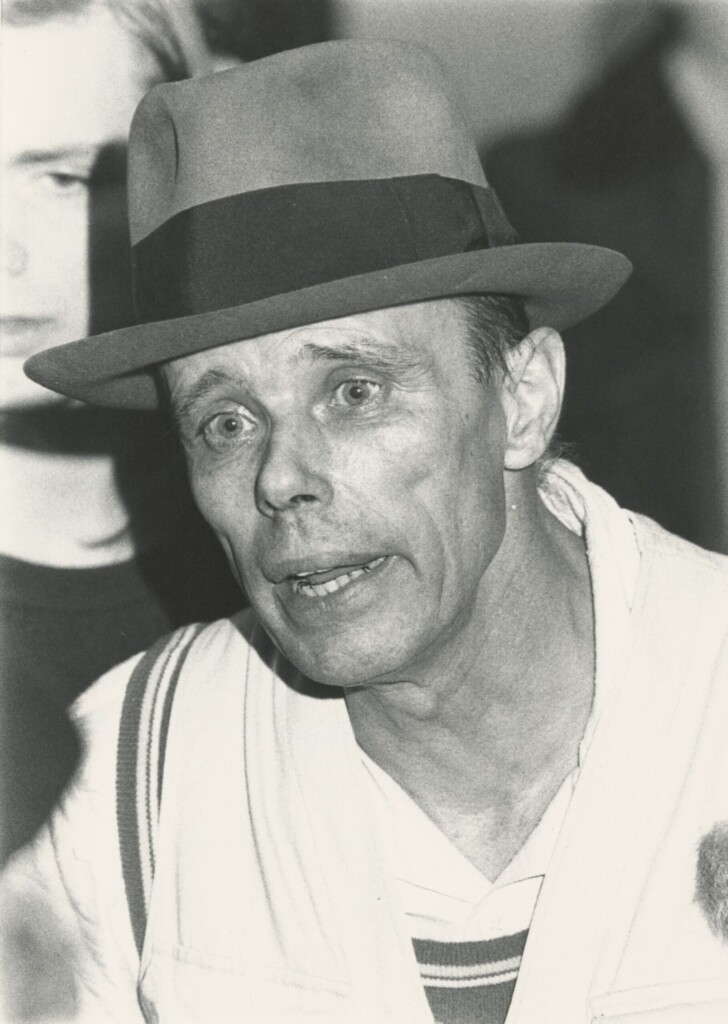
You are sitting in a room that looks nothing like a gallery. The chairs are mismatched, the air smells of coffee and argument, and the person speaking has chalk dust on his hands and a felt hat that has seen better decades. He is not lecturing you. He is insisting, quietly and with the ferocity of someone who has already died once and decided to use the remaining time poorly, that you are already making art whether you recognize it or not.
Beuys arrived at the concept he called soziale Plastik — social sculpture — not as a metaphor but as an ontological claim. Every deliberate act by which a human being shapes the world, negotiates meaning with another person, or commits thought to form is, in his framework, a sculptural act. The concept did not emerge from aesthetic theory but from a reading of Rudolf Steiner‘s anthroposophy filtered through Beuys’s own post-war experience of obliteration and reconstruction. Steiner had argued in 1919, in the lectures that became the basis for Waldorf pedagogy, that artistic activity was the only form of cognition that could unite thinking, feeling, and willing without the falsification that abstract rationalism introduces. Beuys took this and radicalized it past anything Steiner had envisioned: if art is the fullest exercise of human cognitive freedom, then restricting its practice to credentialed specialists inside institutional spaces is not curation — it is amputation.
The political bite of this becomes visible only when you understand what it was aimed at. By the early 1970s, Western democracies had successfully absorbed the counterculture as aesthetic product while neutralizing its structural demands. Protest had been made legible, even decorative. Herbert Marcuse had already diagnosed in One-Dimensional Man, published in 1964, the capacity of advanced industrial society to co-opt its own negation, to let dissent circulate as lifestyle rather than force. Beuys’s response was not to make more provocative objects but to dissolve the category of the art object altogether as the site of meaning, relocating agency into the act of collective thought formation itself.
This was the logic that produced the Free International University for Creativity and Interdisciplinary Research, which Beuys co-founded in 1973 alongside the novelist Heinrich Böll and others who shared a conviction that the existing educational apparatus was structurally incapable of producing the kind of thinking a damaged civilization required. The FIU was not a university in any accreditable sense. It held sessions at Documenta 6 in Kassel in 1977, operating for one hundred days as an open discussion space where economists, ecologists, trade unionists, and artists argued without hierarchy or predetermined conclusion. The form was the content: a demonstration that the organization of human dialogue is itself a creative medium, that how people are permitted to speak to one another produces realities as material as bronze.
What this destabilized was not just the art world’s economy of prestige but the deeper assumption that political agency belongs to a separate domain from creative life. The modern liberal settlement had been quietly insisting since at least the Enlightenment that the aesthetic and the civic were complementary but distinct — art as counterweight to power, not power itself. Beuys refused the counterweight position entirely. He ran for political office, joined the German Green Party in its founding period, and treated every parliamentary candidacy as a sculptural action continuous with his studio practice. The distinction between the artist and the citizen was, in his view, a bureaucratic fiction maintained by institutions that benefited from keeping those categories separate.
The discomfort this produces in anyone trained to appreciate art correctly — to move through galleries in the right posture, with the right receptive silence — is not incidental. It is the work. Because if creativity is not a talent distributed to exceptional individuals but a capacity suppressed in ordinary ones by ordinary arrangements of power, then the gallery’s white walls are not neutral space.
Fluxus, Performance, and the Economy of Attention
You are sitting in a room where nothing is happening, and that is the event. Not the preparation for it, not the documentation afterward — the room itself, the air inside it, the fact that time is passing and no one has asked you to do anything with it. This was the operative condition of Fluxus, the loose international network of artists, composers, and provocateurs that crystallized around George Maciunas‘s manifestos in the early 1960s and found its sharpest theoretical grounding in John Cage‘s 1952 composition 4’33”, which had already demonstrated that silence organized by intention is a different substance than silence by default. Beuys arrived at this current already formed by his own private mythology, and he absorbed the Fluxus logic quickly — the dissolution of borders between art and everyday gesture, the demotion of the precious object, the insistence that the audience was not a passive receptor but an irreducible element of the work itself.
What Fluxus offered was a critique of commodity. What it sometimes failed to escape was the lightness of its own gesture, a wit that could become decorative precisely because it asked nothing that lasted longer than the performance did. The Fluxus event was often structured as a joke with philosophical pretensions, and jokes, however sharp, resolve. They end. The tension they create is discharged in the moment of recognition, and you walk away intact, slightly more knowing, essentially unchanged. Beuys understood this structural limit not as a failure of Fluxus but as the outer boundary of what aesthetic disruption could accomplish when it remained indifferent to duration.
The conceptual turn came through his engagement with Joseph Beuys’s own biography as material — the felt, the fat, the wound — but it sharpened into a distinct practice through his confrontation with the question of what an audience owes a work and what a work owes an audience in return. By the time he arrived in New York in May 1974, wrapped in felt and carried in an ambulance directly to the René Block Gallery without once touching American soil, he had transformed the logistics of presence into a philosophical argument. For five days, he shared a room with a live coyote, a stack of copies of the Wall Street Journal delivered fresh each morning, and nothing else. The felt cape. The walking stick. The animal’s unpredictable attention.
What made this action irreducible to Fluxus was precisely what made it difficult to write about: it refused the economy of meaning that art criticism depends upon. There was no moment of resolution, no punchline, no image that summarized the event without destroying it. The coyote did not represent America. It did not represent wilderness or indigenous dispossession, though those resonances were available and Beuys knew it. It was an animal in a room with a man, and the room was the work, and the work was five days long, and most people who speak about it were not there. The displacement of meaning from object to duration was total. You could not own the residue. You could purchase the felt, as collectors later did with related materials, but the felt was not the work any more than the script is the performance.
This distinction mattered structurally to Beuys because it attacked the art market at its metabolic center — the transformation of experience into property. The market can absorb almost any content, any scandal, any politics, as long as the result is an object with provenance. Duration resists this. A work that exists only while it is happening cannot be retrospectively owned, only retrospectively narrated, and narration always arrives as a lesser thing, already a translation into the currency the original refused. Whether Beuys believed this refusal was permanent, or whether he understood that the market would eventually find a way to monetize even its own exclusion, is a question the five days inside that room did not answer.
The Blackboard as Epistemological Territory
You are sitting in a lecture hall in Düsseldorf sometime in the early 1970s, and the man at the front of the room has been writing on the blackboard for forty minutes without once turning around to face you. The chalk moves in bursts — a word, then an arrow pointing nowhere obvious, then a circle enclosing a fraction that seems to reference something he said twenty minutes ago but which has since been buried under three layers of other marks. By the time he turns around, the board behind him looks less like a lesson and more like the interior of a mind caught in the act of thinking, which is precisely what Beuys intended it to be.
His blackboards were not instructional tools in any recognizable pedagogical sense. The diagrams he produced during actions and lectures — accumulating across exhibitions like the 1972 Documenta 5 in Kassel, where he spoke for one hundred days consecutively — operated on a logic closer to what Gregory Bateson, writing in Steps to an Ecology of Mind in 1972, called the “pattern that connects”: a refusal to let knowledge settle into inert categories, insisting instead that meaning lives in the relationship between things rather than in the things themselves. Beuys drew arrows between “capital” and “warmth,” between “Christ” and “creativity,” between “democracy” and “sculpture,” and the arrows were not explanations. They were invitations to tolerate the unresolved.
What makes this formally radical is that Beuys almost never erased. The boards accumulated without correction, each new inscription layered over the residue of earlier ones, so that the epistemological surface itself became a record of time passing through thought. Ernst Bloch, in The Principle of Hope, argued that genuine utopian thinking must remain structurally incomplete — that the moment it closes, it becomes ideology rather than vision. Beuys seems to have understood this architecturally: closure was the enemy, and the blackboard’s provisional surface, easily erasable but deliberately left dense and stratified, was a material argument against the finished statement.
When the Städtisches Museum Abteiberg acquired and preserved several of these boards as autonomous artworks, something philosophically uncomfortable happened. Objects designed to perform incompletion were frozen into permanence, hung on walls, protected behind glass. The chalk dust, which Beuys had sometimes smudged with his palm mid-lecture, stopped being gesture and became artifact. This is the tension that haunts every museum’s relationship to his practice: the institution metabolizes the resistance, absorbs the provisionality, and converts the unfinished into the canonical. By 1979, when the Guggenheim retrospective catalogued his work across fifteen years, the blackboards occupied a central room — venerated, static, exactly what they had refused to be in the moment of their making.
What Beuys was actually practicing, without using the vocabulary, was something close to what the philosopher of science Isabelle Stengers would later describe as an “ecology of practices” — a mode of knowledge-production that refuses the hierarchy between disciplines, between intuition and proof, between the political and the aesthetic. His diagrams collapsed economics into thermodynamics, theology into social theory, without irony and without apology. The arrows going in multiple directions simultaneously were not a failure of rigor. They were a demonstration that rigor applied too early kills the question.
There is a particular kind of intellectual violence in the demand for clarity before the thinking is done, and Beuys used the blackboard to make that violence visible by refusing to perform it. Each diagram he produced was also a kind of self-portrait — not of what he knew, but of how knowledge moved through him in real time, incomplete, associative, fired by conviction and shot through with the gaps that conviction always leaves.
A vision curated by a filmmaker, not an algorithm
In this video I explain our vision
Capital, Energy, and the Misreading of Beuys

You stand in front of a vitrine at a major auction house preview — climate-controlled glass, spotless white gloves, a placard announcing an estimate of four million euros — and inside the case sits a lump of fat and a roll of felt, materials that Joseph Beuys chose precisely because they were not precious, because they belonged to the thermal logic of survival rather than the symbolic economy of rarity. The irony does not announce itself. It simply waits, sealed inside the glass.
Beuys spent the better part of three decades insisting that capital was a congealed form of human creativity — dead labor, in a vocabulary he borrowed and warped from his reading of Rudolf Steiner‘s threefold social order. His 1973 concept of social sculpture, formalized in conversations with Heinrich Böll and later in the founding documents of the Free International University, proposed that economic life had to be reorganized around what he called “warm capital” — energy that flows, circulates, and transforms, rather than energy that accumulates and stiffens into property. The felt was not metaphor. It was a thermodynamic argument made tactile: a substance that holds heat, slows loss, refuses the sharp edge of commodity exchange. When Sotheby’s sold “The Pack” in 2016 for 3.4 million euros — twenty-four sleds loaded with felt, fat, and flashlights spilling from the back of a Volkswagen bus — the market did not misunderstand Beuys. It understood him perfectly, and neutralized him with the same gesture.
This is the mechanism that Pierre Bourdieu mapped with clinical precision in “The Rules of Art” (1992): the art field generates its own form of capital — symbolic capital — which converts antagonism into distinction. A work that attacks the institution becomes, upon acquisition by the institution, evidence of the institution’s sophistication and self-awareness. The critique is not refuted; it is digested. The Museum of Modern Art, the Guggenheim, the Tate — all of them hold major Beuys collections, and each acquisition performs a kind of cultural antibody response, making the host more resistant to the very disease the work was meant to spread. What was meant to be a transmission becomes a trophy.
The deeper problem is temporal. Beuys believed urgently in the present tense of artistic action — the performance, the lecture, the conversation as the actual substance of the work. His “7000 Oaks” project, initiated at Documenta 7 in Kassel in 1982, planted trees paired with basalt columns across the city, the stones to be removed one by one as each tree grew — a durational work whose completion was structurally tied to the passage of living time. He died in 1986, before the last oak was planted. His widow Eva Beuys completed the project. The living material kept growing, indifferent to auction cycles, and yet the photographs of the planting, the remaining basalt columns, the documentation — all of it has since entered the market as discrete, tradeable objects. Duration was extracted and flattened into image.
What the market does to Beuys is not simply commodification in the crude sense — it is something more precise and more corrosive. It severs the energetic logic of his practice from the objects his practice left behind, and then sells the corpse at a premium because the corpse once housed something dangerous. The fat hardens. The felt becomes a relic. And the institutions that purchase these relics can credibly claim they are preserving radical thought, funding education, democratizing access — all of which is true, and none of which touches the original demand that creativity be returned to every human being as an economic right rather than a cultural privilege granted by curators and collectors.
The question Beuys was actually asking was never about art. It was about who gets to shape the world — and whether that capacity can be owned.
Mythology, Shamanism, and the Danger of Sacred Narrative
You have probably seen the photograph without knowing what you were seeing: a man wrapped in felt, carrying a dead hare through a gallery while whispering to it, moving past paintings with the deliberate slowness of someone performing surgery on invisible tissue. The visitors watched through a glass window. They could not enter. They could not touch. They could only witness, and that enforced distance — that structural prohibition — was doing most of the work.
Beuys understood something that anthropologists had been circling since at least Bronisław Malinowski’s fieldwork in the Trobriand Islands, published in 1922 as “Argonauts of the Western Pacific”: that ritual efficacy depends not on the content of the gesture but on the social architecture surrounding it. The shaman is not powerful because he heals. He heals because the community has already agreed, collectively and in advance, to grant him the category of healer. The felt, the fat, the hare, the hat — these were not symbols pointing toward some transcendent meaning. They were credentials, worn on the body the way a doctor wears a white coat, and they operated through the same mechanism: the visual shorthand that converts a person into a function and suspends ordinary skepticism.
What makes this complicated is that Beuys was not cynically manufacturing authority. His interest in Siberian shamanic traditions, in Celtic animism, in Rudolf Steiner‘s anthroposophy — which Steiner developed between roughly 1902 and his death in 1925 into a sprawling spiritual cosmology that attempted to synthesize mysticism with scientific rigor — was genuine, in the sense that genuineness can coexist with strategic deployment. A person can believe deeply in something and simultaneously understand that the performance of that belief generates social capital. These are not mutually exclusive conditions. They are, in fact, the ordinary condition of every charismatic figure in recorded history.
The danger is not that Beuys believed his own mythology. The danger is that his audiences did, and that their belief short-circuited exactly the kind of critical friction that art is supposed to generate. By positioning himself within a pre-rational symbolic register — the wounded healer, the intermediary between worlds, the man who had died and returned — he placed his practice in a zone where ordinary evaluative criteria feel inappropriate, even disrespectful. You do not argue with a shaman. You receive. And receiving, passive and reverent, is the opposite of the active democratic consciousness that Beuys claimed, explicitly, to be cultivating through his concept of social sculpture. The gap between his stated political philosophy and the phenomenology of his actual reception was vast and largely unexamined.
This is where the biography becomes structurally significant in a way that biography rarely is. Beuys claimed that in 1944, after his Stuka dive bomber was shot down over the Crimea, Tartar nomads saved his life by wrapping his body in fat and felt. Historians have systematically dismantled this account: the records show he was recovered by a German search unit, treated in a military hospital, and survived injuries consistent with a crash but not with the extended frozen-wilderness ordeal he described. The felt and fat were not memories. They were retroactively installed as memories, woven backward into his biography to give his materials the weight of survival, of transformation, of the literal body rebuilt from animal and mineral substance. He did not merely make art about death and return. He claimed to have died and returned. The persona consumed the person, and then the persona was offered to the public as the person, and the public — hungry, as publics always are, for figures who have crossed over and come back — accepted the offering.
What this means for the work itself is not that it collapses into fraud, but that it asks the viewer to locate their own desire for sacred narrative, and to ask what that desire costs them in clarity.
7000 Oaks and the Politics of Deep Time
You drove past the last of them without knowing it was art. A basalt stone, dark and upright beside a young oak somewhere on a Kassel street, no placard, no velvet rope, nothing announcing that this pairing of mineral and sapling was the residue of a decision made in 1982 by a man who understood that the most radical gesture available to an artist was to make something that would outlive every person in the room when he announced it.
Joseph Beuys launched “7000 Oaks” at Documenta 7 in Kassel with a single theatrical provocation: he deposited a vast triangular mound of 7000 basalt stones in front of the Fridericianum museum, a cairn of geological time squatting against the facade of institutional culture, immovable and frankly ugly, daring the art world to call it finished. The project’s logic was structural inversion. Each stone would be removed only when a donor funded the planting of a corresponding oak tree somewhere in or around Kassel, so that the artwork’s visible form was its own gradual erasure, the pile shrinking over years as the city greened. The last stone was planted in 1987, the year after Beuys died, driven into the ground by his son Wenzel beside the final tree, completing a work the artist never saw whole.
The art market operates on a timescale calibrated to the human heartbeat. Auction cycles, retrospectives, the careers of critics, the tenure of curators — all of these rhythms compress meaning into seasons, into the span of attention a single living person can sustain. What Beuys did in Kassel was to propose a completely incompatible unit of measurement. An oak planted in 1982 will not reach full canopy for roughly eighty years. The ecological consequence of 7000 such trees — their oxygen production, their soil stabilization, the corridors they create for urban fauna — unfolds across centuries, accumulating in increments no human nervous system is wired to perceive as dramatic. This is not a limitation Beuys overlooked. It was the entire argument.
Gregory Bateson, whose 1972 collection “Steps to an Ecology of Mind” circulated heavily in the intellectual communities Beuys moved through, had already diagnosed the central pathology: the unit of survival in Western modernity was the individual organism competing for short-term advantage, when the actual unit of survival, biologically and culturally, was always the organism-plus-environment across generational time. Beuys translated this diagnostic into an art practice that forced galleries, collectors, and city administrators to become unwilling participants in a logic they had no framework to monetize. You cannot hang a growing tree in a collector’s living room. You cannot photograph the ecological impact of an oak in 2060 for a 1982 catalogue.
What destabilizes even further is recognizing that “7000 Oaks” was not environmentalism in any decorative or symbolic sense. Beuys explicitly called it “social sculpture,” by which he meant that the transformation of collective space through collective decision — who pays, who plants, where the tree goes, who tends it — was itself the artistic medium. The citizenry of Kassel did not consume the work. They were conscripted into its authorship across decades, made responsible for a living thing that would outlast their own memory of ever agreeing to care for it.
The stones are still there, each one anchored beside its tree, a basalt witness to a transaction made between a dead man’s vision and a city that mostly forgot it was participating in anything. The oaks keep growing. They do not know they are art, and that categorical indifference to the institutional frame is precisely what makes them the most uncompromising thing Beuys ever set in motion — a work that achieves its fullest meaning at the exact moment every human being who called it art is no longer alive to say so.
🎨 Art, Action, and the Boundaries of the Human
Joseph Beuys redefined what art could be — not a finished object, but a living act of transformation. These articles explore the worlds of thought, creativity, and social vision that surrounded and extended his radical legacy.
Contemporary Sculpture: History and Protagonists
Contemporary sculpture did not emerge in a vacuum — it grew from the provocations of artists like Beuys, who insisted that materials carried spiritual and political weight. This article traces the evolution of three-dimensional art from modernism to the present, mapping the key figures and movements that reshaped how we understand objects in space. Understanding this history is essential to grasping what made Beuys so profoundly disruptive.
GO TO THE SELECTION: Contemporary Sculpture: History and Protagonists
Craftsmanship as Art Form: History and Philosophy
Beuys famously blurred the line between artisan knowledge and high art, insisting that every human being is an artist capable of shaping the world through their hands and intentions. This article explores the philosophical roots of craftsmanship as an art form, drawing on thinkers who saw manual work as a form of intelligence and dignity. It offers a rich companion perspective to Beuys’s own expanded conception of creativity.
GO TO THE SELECTION: Craftsmanship as Art Form: History and Philosophy
Healing Through Art: History and Theory
Few artists embodied the therapeutic and transformative power of art more forcefully than Joseph Beuys, who believed creative action could heal both individuals and society. This article examines the history and theory behind art as healing, from early shamanic practices to contemporary art therapy. It illuminates one of the deepest currents running through Beuys’s entire life and work.
GO TO THE SELECTION: Healing Through Art: History and Theory
Pierre Bourdieu and the Artistic Field
Pierre Bourdieu‘s analysis of the artistic field provides a crucial sociological lens for understanding how Beuys navigated — and deliberately subverted — the institutions of the art world. Bourdieu showed how taste, cultural capital, and institutional power shape which artists are recognized and celebrated. Reading Beuys through Bourdieu reveals the strategic brilliance hidden inside his apparently mystical gestures.
GO TO THE SELECTION: Pierre Bourdieu and the Artistic Field
Discover the Art of Independent Cinema on Indiecinema
If the visionary world of Joseph Beuys has stirred something in you, Indiecinema is the place to continue the journey. Our streaming platform gathers the finest independent and avant-garde films that dare to treat art, thought, and human transformation as radical acts. Come and explore a cinema that, like Beuys himself, refuses to stay within the frame.
👉 EXPLORE THE CATALOG: Watch Indie Films in Streaming
A vision curated by a filmmaker, not an algorithm
In this video I explain our vision

