
The Architecture of Inherited Power
You walk through a doorway that has not changed in six hundred years, and the stone around you holds a cold that has nothing to do with altitude. The walls of Castel Presule do not merely enclose space — they compress it, calibrate it, make you feel the specific weight of a room designed not for comfort but for the communication of permanence. You are in the Dolomites, above the village of Fiè allo Sciliar, and the castle sits on its promontory the way authority has always preferred to sit: elevated, visible for miles, requiring effort to reach. That effort is not incidental. It is the architecture speaking.

The conflation of stone with legitimacy is one of the oldest political technologies in European history, and the South Tyrolean nobility understood it with a precision that would have impressed any theorist of power. What appears to the contemporary visitor as a remarkably well-preserved medieval castle is, in structural terms, a fossilized argument — an argument about who owned the land, who controlled movement across it, who collected dues from those who farmed it, and who had the legal standing to dispense or withhold justice. Marc Bloch, writing in his 1939 Feudal Society, described the castle as primarily a functional object in a landscape of coercion, not an aesthetic one, and Castel Presule confirms this reading with unusual candor. Its towers were not decorative. Its position above the Sciliar plateau was a jurisdictional statement inscribed in topography.
The documented origins of the castle reach back to the thirteenth century, to a period when the fragmentation of imperial authority in the Holy Roman Empire produced a ferocious local competition for territorial footholds. The first recorded mention of the structure appears in sources from around 1200, placing it within that wave of fortified construction that swept across the Alpine arc as ecclesiastical and secular lords scrambled to anchor their claims in mortar and granite. The Sciliar region was not peripheral to this contest — it sat along routes connecting the Italian peninsula to the Germanic north, which meant that whoever held the high ground above those routes held something of genuine strategic and commercial value. The castle was, from its inception, less a home than a toll booth with pretensions.
The Fiè family — the Vögte von Völs in the German documentation — emerged as the dominant force in this landscape across the fourteenth and fifteenth centuries, absorbing the castle into a patrimony that grew through a combination of strategic marriage, ecclesiastical patronage, and the kind of patient accumulation that feudal genealogy rewarded above almost every other virtue. By the time the family’s control over Castel Presule was fully consolidated in the late medieval period, the castle had become the administrative nerve of a territorial system that extended across villages, forests, and agricultural estates throughout the broader Sciliar zone. The records of this consolidation are not romantic. They are ledgers, boundary agreements, and jurisdictional disputes — the paperwork of domination.
What the dynastic historiography tends to obscure is that this accumulation operated through mechanisms that were, by any honest accounting, forms of organized extraction. The peasants farming the slopes below Castel Presule did not participate in the aesthetic of noble stewardship that later centuries would project backward onto this landscape. They paid. They worked. They appealed to lords whose interest in justice was structurally inseparable from their interest in maintaining the conditions that made payment and labor possible. The castle above them was not a symbol of protection in any neutral sense — it was the physical anchor of a system that required their subordination to function at all, and its beauty, which is genuine and considerable, was built on precisely that requirement.
The Witches of Mount Sciliar
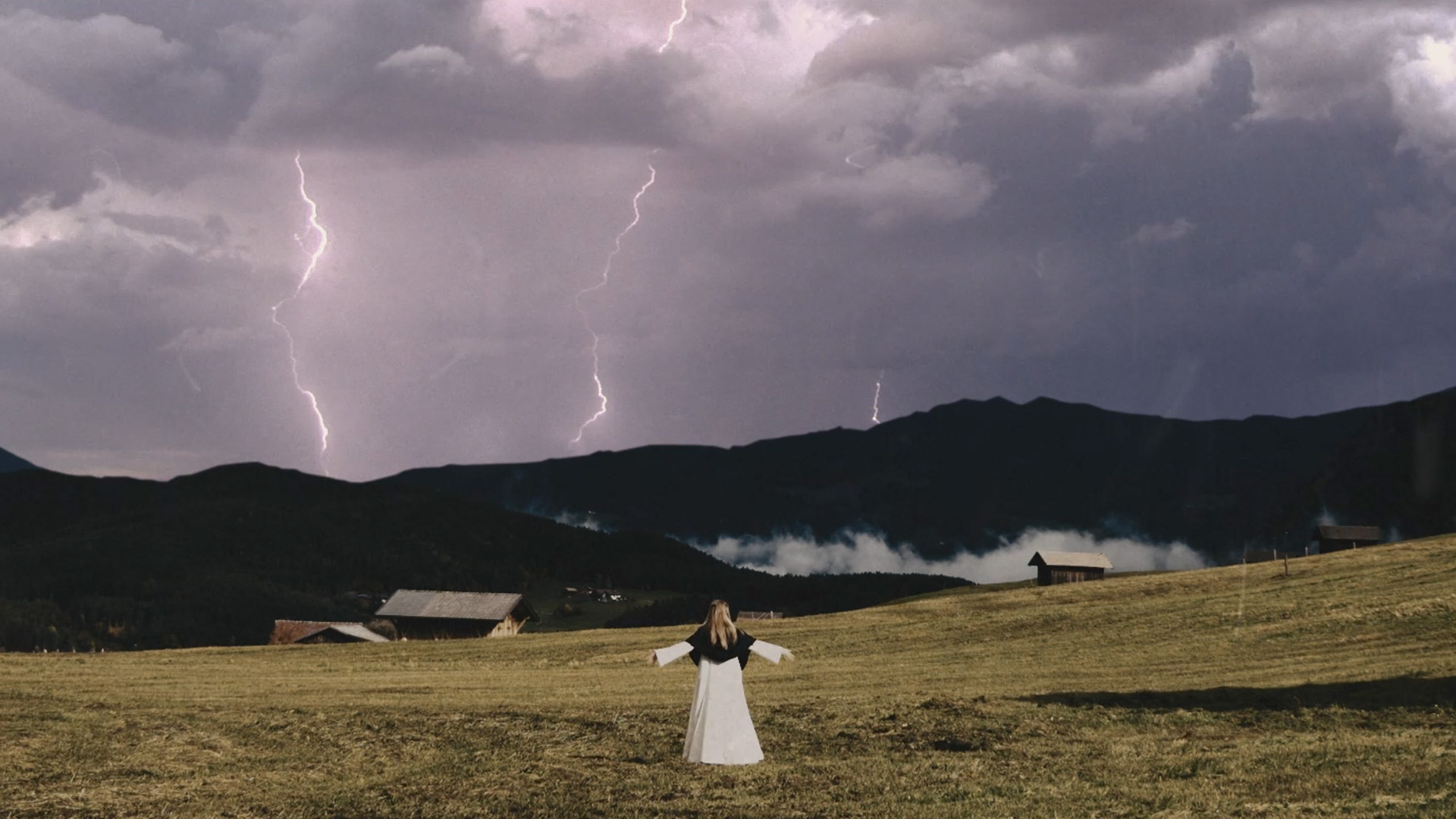
Docufiction, by Andrea Dalfino, 2022, Italy.
The Witches of Scillar is a documentary that delves deeply into the trials that took place in Alto Adige, in Castel Presule and surrounding areas at the beginning of the 16th century, following which more than 10 were condemned to the stake on charges of witchcraft, becoming the real and precursors of the infamous Witch Hunt. Starting from the analysis of the historical context and intertwining local legends with actual events and analyzing the locations of the events with the help and guidance of experts, this film offers a new historical perspective on what happened, culminating with the exposition of what remains of the witches in South Tyrol today and how the crimes of the inquisition are judged in retrospect today.
Alto Adige is a land full of mystery, where history and legend are intertwined, with its magical and fascinating scenarios that push the mind and imagination to wander, investigate, discover. Here is the Sciliar, a suggestive mountain massif located in the natural park of the same name against the backdrop of the Dolomites, and no other mountain is so full of myths and legends as this one, on which it is said that fairy creatures and spirits of all sorts live , and in the Middle Ages it was held up as a meeting place for witches and devils. Here, during the time of the Inquisition, 10 women accused of witchcraft were tried and killed. Director Andrea Dalfino made the documentary The Witches of the Sciliar, enriching the film with fictional scenes that retrace the intricate events of the Fiè trial.
LANGUAGE: Italian
SUBTITLES: English, Spanish, French, German, Portuguese
Leonardo di Fiè: The Myth of the Just Lord
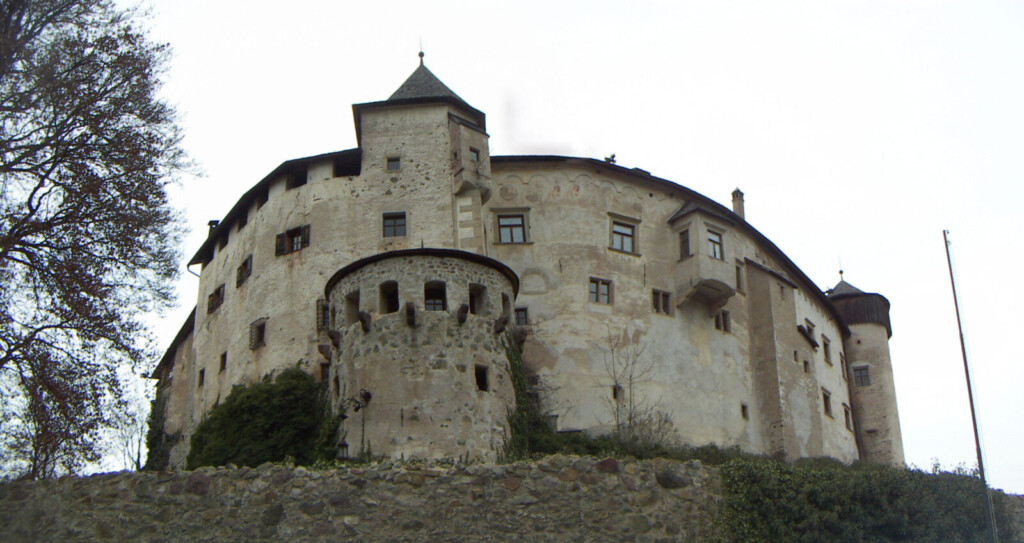
You have probably heard his name spoken the way people in mountain valleys speak of weather that never quite arrives — with a reverence that has no memory attached to it, only atmosphere. Leonardo di Fiè, lord of Castel Presule in the South Tyrolean Dolomites during the late fifteenth century, has been folded so completely into regional folklore that the actual man — litigious, calculating, jurisdictionally aggressive — barely survives beneath the amber of local pride. What remains is a silhouette: the just lord, the protector of the valley, the one who kept order when order was fragile. That silhouette is a fabrication assembled over generations, and its seams are worth pulling apart.
The documented record tells a different story. Leonardo was involved in sustained legal disputes with the Bishop of Bressanone over jurisdictional rights in the Fiè am Schlern area — conflicts that were not, despite later romantic retellings, noble disagreements between equals over principle. They were contests over revenue, over who could tax whom, over whose courts would adjudicate which crimes and therefore collect which fines. The bishopric of Bressanone in the fifteenth century was itself a territorial power with its own fiscal logic, and Leonardo’s challenges to its authority were not acts of local autonomy in any liberating sense. They were competing claims to extraction dressed in the language of legitimate sovereignty. Land appropriations attributed to his tenure follow the same pattern: the absorption of smaller holdings into the Presule domain, documented in regional cadastral records, carried out through legal instruments that were technically valid and practically coercive in the way that all instruments of that period were — because the man who wrote the law and the man who enforced it shared a surname.
Giorgio Agamben, in Homo Sacer published in 1995, describes how sovereign power constitutes itself not through the normal operation of law but through the exception — the moment in which the sovereign steps outside the legal order precisely to demonstrate that the order depends on him. What makes this insight so uncomfortable when applied to figures like Leonardo is that it strips away the fiction of natural authority. The just lord is not just because he possesses justice. He is just because he has successfully staged the conditions under which only he can provide it. You remove the bandits from the road — bandits who may operate under your tacit tolerance — and the valley remembers the removal, not the tolerance. The exception becomes the proof of indispensability, and indispensability hardens, across generations, into myth.
This mechanism was not peculiar to the Dolomites. Across the late medieval Alpine corridor, local lords navigated between the eroding authority of the Holy Roman Empire and the expanding ambitions of ecclesiastical powers by positioning themselves as the only stable point in an otherwise volatile landscape. The jurisdictional conflict with Bressanone was, in this sense, a performance as much as a dispute — a way of asserting that Leonardo’s authority was not derived from the bishop, not granted by the emperor, but rooted in something more immediate: the land, the people, the valley itself. That rootedness was a narrative he produced, not an inheritance he received.
What the romanticized memory of Leonardo di Fiè cannot accommodate is the ordinary texture of his power — the ledgers, the boundary disputes, the calculated use of legal ambiguity to consolidate territory. Nostalgia requires a certain blurriness, and the archive is its enemy. When regional identity is built on the image of the just lord, the archive becomes not merely inconvenient but structurally threatening, because what it reveals is not a protector but an operator — someone who understood, with considerable sophistication, that legitimacy is not found but manufactured, and that the best place to manufacture it is in the gap between what people fear and what they are told they would fear without you.

Violence Codified as Tradition
You are standing in a room where the ceiling has been painted to suggest heaven, and the floor has been laid in stone quarried by men who would never sleep indoors. This is not metaphor. The great hall of a feudal residence was a machine for producing consent, and its beauty was not incidental to that function — it was the function.
The question historians have learned to ask only recently is not what violence looked like, but how it disappeared from view while still operating at full force. Carlo Ginzburg, in his 1976 reconstruction of a sixteenth-century miller’s cosmology, demonstrated that the texture of ordinary belief contains within it the pressure marks of structures far larger than any individual life. His method was not to read chronicles from above but to follow the grain of a single, marginal document until it cracked open an entire world. Applied to a place like Castel Presule, that method demands attention not to the dramatic moments of rebellion or punishment, but to the unremarkable ones: the annual rendering of grain, the compulsory labor on the lord’s harvest before one’s own, the slow erosion of time that belonged, juridically, to someone else.
Serfdom in the Tyrolean alpine context was never simply a southern import or a Carolingian remnant preserved in amber. It was a living administrative technology, calibrated and recalibrated across centuries to extract maximum yield while minimizing the friction of open resistance. The lords of Fiè held jurisdictional authority that compressed three distinct forms of power into a single person: they adjudicated disputes, collected tithes, and commanded military service, which meant that any grievance a peasant might hold was addressed to the very body that profited from the grievance. The circularity was not a flaw in the system. It was its load-bearing wall.
Norbert Elias, writing in 1939 from exile as Europe rehearsed its most spectacular regression, argued that what we call civilization is precisely the internalization of constraints that were once enforced externally. Table manners, emotional restraint, the management of bodily functions — each of these migrated, across the medieval and early modern period, from the sword’s edge into the nervous system itself. What Elias traced in courtly etiquette applies with brutal precision to the peasant who no longer needed to be told he owed three days of unpaid labor to his lord in September, because his grandfather had told his father, and the obligation had long since ceased to feel like obligation and began to feel like the shape of October itself.
The ius primae noctis — the alleged right of a lord to spend the first night with a new bride before her husband — has been dismissed by most contemporary historians as a legal fiction, a polemical invention, a fantasy projected backward by Enlightenment critics who needed feudalism to be grotesque in order to condemn it cleanly. What this dismissal tends to obscure is that the underlying structure it describes, the lord’s claim over the reproductive and domestic life of his dependents, was real and extensively documented in other forms: the requirement to obtain permission to marry outside the estate, the fines levied for unauthorized unions, the capacity of the lord to dissolve households or redirect labor according to his agricultural calendar. The metaphor, even if invented, mapped onto an architecture of control that required no single dramatic act to sustain itself.
This is where the castle’s aesthetic becomes something more than backdrop. The towers of Presule were not built to intimidate through ugliness. They were built to make the sky behind them look borrowed, to place the permanence of stone against the brevity of any individual grievance, and to make the man walking past the gate each morning feel, not threatened, but located — placed inside a structure so ancient and so large that resistance would require not courage but a kind of ontological rebellion he had no language to name.
The Historiography of Selective Memory

You inherit a version of the past that was designed to make you feel at home in it. That is not metaphor — it is editorial policy, archival strategy, and in some cases the deliberate destruction or reclassification of documents that complicated the portrait a region needed to believe about itself. The historiography of South Tyrol in the nineteenth and early twentieth centuries was not a neutral accumulation of evidence. It was a project, pursued with the quiet urgency of people who understood that cultural survival and political legitimacy are functions of narrative control.
When Eric Hobsbawm and Terence Ranger assembled their 1983 volume on invented traditions, their central provocation was not that traditions are false — it was that their invention accelerates precisely when the social fabric they claim to represent is under threat or has already been torn. The Scottish Highland tradition they examined, with its clan tartans and bagpipes retroactively assigned to ancient lineages, was almost entirely a construction of the late eighteenth and early nineteenth centuries, manufactured at the moment Scotland’s absorption into British political life made genuine autonomy impossible. The tradition compensated for what history had already taken. The mechanism is transferable, and the transfer to Tyrolean regionalist historiography after 1919 is not difficult to trace.
The annexation of South Tyrol to the Kingdom of Italy following the Treaty of Saint-Germain-en-Laye imposed an abrupt identity crisis on a German-speaking population that had oriented itself — culturally, linguistically, administratively — toward Vienna for centuries. Austrian imperial nostalgia did not emerge as mere sentiment. It became a structuring principle for how local historians selected, framed, and canonized figures from the feudal past. Aristocratic families whose castles had survived, whose names remained legible in the landscape, were elevated into cultural anchors — symbols of a continuity that the present was violently interrupting. Leonardo di Fiè, lord of Castel Presule in the fifteenth century, accumulated symbolic weight in this climate that bore little relationship to the documentary record of his actual conduct.
What survives in the Bolzano State Archives regarding the fiefdom of Presule is itself a shaped object. Researchers working through the Tyrolean nobility collections — particularly the Adelsarchiv holdings and the feudal correspondence catalogued under the Tiroler Landesfürstliche Reihe — encounter a pattern that archivists themselves have noted with some discomfort: the documentary density around figures like Leonardo is highest precisely where it concerns ceremonial transactions, property transfers, and ecclesiastical patronage, and thinnest where it might illuminate the texture of coercive lordship — labor obligations extracted under threat, disputes with peasant communities, the enforcement mechanisms of serfdom. This is not accidental silence. Archival gaps of this specific shape, concentrated around the friction points of feudal power, correspond to the curatorial priorities of a regionalist historiography that needed its aristocrats to appear as stewards rather than extractors.
The Fascist period accelerated the distortion in a different register. Mussolini’s Italianization campaign — which between 1923 and 1939 suppressed German-language schooling, renamed towns, and banned public use of German — paradoxically intensified the investment of the German-speaking community in its own mythologized past. Historical figures who could serve as proof of ancient Germanic rootedness in the territory became politically indispensable, which meant that anything in the archival record complicating their moral stature was a liability. A lord who coerced, who extracted, who administered violence through the routines of feudal jurisdiction, was not useful to a community trying to establish the nobility of its historical presence against an Italian state denying that presence altogether. Leonardo di Fiè needed to be a patron of art and a steward of landscape, because the alternative — a man whose authority rested on the same mechanisms of domination that structured every feudal lordship in fifteenth-century Europe — served no one’s survival narrative.
What this produced was not exactly falsification. It was something more durable and harder to dislodge: a selective fidelity to the archive that made the archive itself appear to confirm the portrait it had been arranged to produce.
What the Stone Does Not Confess
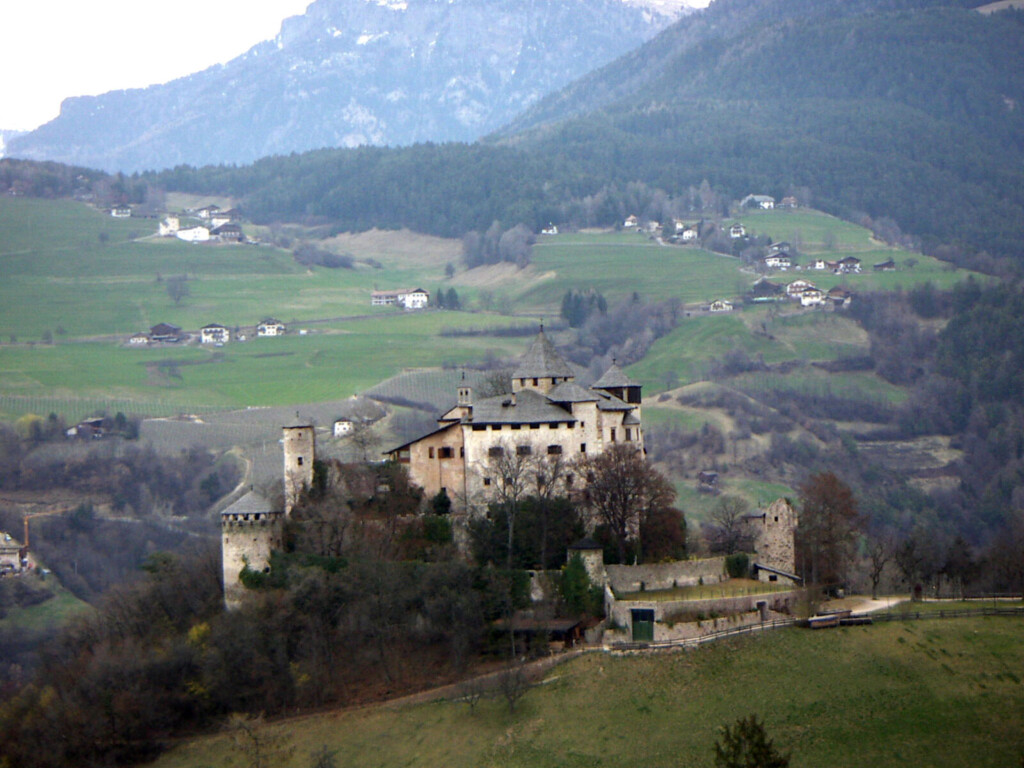
Someone walks through the great hall of Castel Presule on a Tuesday morning in late August, audio guide pressed to one ear, sunlight cutting clean angles across the flagstone floor. The restoration is immaculate. The furniture is period-appropriate, the explanatory panels are tastefully mounted, and nothing in the room indicates that the administrative decisions made within these walls — about labor, about obligation, about who owned the harvest and who received a portion of it — were decisions that one party had no power to refuse. The visitor photographs a window. The castle receives them as a guest. It has been designed to do exactly that.
Michel Foucault described heterotopias in his 1967 lecture “Des espaces autres” as real places that function as counter-sites, spaces where the normal rules of social order are simultaneously represented, contested, and inverted. What he could not have anticipated — or perhaps precisely anticipated — is how thoroughly the heritage site performs this inversion in reverse: instead of contesting the social order it houses, it aestheticizes it, frames it, admits it into a category of collective appreciation that strips it of its operational meaning. The castle no longer administers power. It administers charm. And the visitor, paying an entrance fee at the gate, participates willingly in this conversion, receiving the architecture as spectacle while the history that made the architecture possible recedes into atmosphere.
David Lowenthal argued in his 1985 study that the past is not merely distant but structurally foreign — that we cannot access it without translation, and that every act of translation involves choices about what to carry forward and what to leave at the border. Heritage institutions make those choices institutionally, professionally, and above all economically. What gets preserved is what draws visitors. What draws visitors is what can be made beautiful, narratable, and safe. The serf who worked the land surrounding Presule and was juridically bound to it by the very man whose portrait hangs in the upper gallery does not draw visitors. He has no portrait. He left no inventory of possessions elaborate enough to fill a display case.
The epistemological trap is not that the curators are lying. It is that they are doing something more insidious: selecting among truths until the remainder looks complete. Leonardo di Fiè’s castle survives because it was maintained by people who had reasons to maintain it, resources to maintain it, and the legal standing to ensure its continuity across centuries. The built environment is always, in this sense, a testament to the winners of whatever contest shaped it — and when we treat it as neutral cultural inheritance, we accept the winners’ account of what was worth saving.
There is a particular violence in the phrase “common heritage,” deployed so readily around Alpine castles and Tyrolean estates, because it implies a community of inheritors who share equally in both the legacy and its meaning. But the descendants of those who were administered through Presule’s ledgers — taxed, obligated, fined, or conscripted — did not pass down the castle. They passed down other things: a manner of surviving winter, a learned suspicion of documentation, a knowledge of which requests were worth making and which were not. Those inheritances are not on the audio guide.
What the stone does not confess, the visitor is not invited to ask. The architecture holds its shape, indifferent and magnificent, and the entrance fee buys a particular kind of peace with history — the peace of looking without being required to look at the people who looked up at these same walls from outside them, from the field side, from the side that left no rooms for August tourists to walk through with sunlight at their backs.
A vision curated by a filmmaker, not an algorithm
In this video I explain our vision
🏰 Shadows, Power and the Gothic Soul of History
The dark legacy of Leonardo di Fiè and Castel Presule opens a labyrinth of themes that echo through centuries of culture: the weight of aristocratic power, the uncanny resonance of ancient places, and the psychological shadow cast by history upon the living. These four articles trace the hidden corridors connecting castle walls to the deepest chambers of the human mind.
Genius Loci: When Places Have a Soul
Every ancient castle carries an invisible presence that cannot be reduced to stone and mortar alone — it breathes with the accumulated memory of those who lived, suffered, and ruled within its walls. The concept of Genius Loci explores precisely this idea: that places possess a soul shaped by history, emotion, and time. Castel Presule, with its feudal shadows and the enigmatic figure of Leonardo di Fiè, is a vivid embodiment of this uncanny territorial spirit.
GO TO THE SELECTION: Genius Loci: When Places Have a Soul
Horace Walpole and The Castle of Otranto
Horace Walpole’s invention of the Gothic novel was itself born inside a castle — Otranto — where aristocratic power, ancestral guilt, and supernatural dread fused into a new literary form. The Gothic tradition has always used the castle as a symbol of oppression, secrets buried under centuries of noble violence, and the sins of the fathers haunting the present. Understanding Walpole’s founding gesture illuminates why places like Castel Presule continue to exert such a dark imaginative pull.
GO TO THE SELECTION: Horace Walpole and The Castle of Otranto
Carl Gustav Jung and the Shadow: The Dark Side We Don’t Want to See
Carl Gustav Jung described the Shadow as the dark side of the psyche that powerful individuals and institutions systematically refuse to acknowledge — projecting it outward onto others or burying it beneath layers of social respectability. The historical figure of Leonardo di Fiè, associated with violence and the abuse of feudal authority, can be read as a biographical embodiment of this Jungian archetype made flesh. Confronting such figures honestly means confronting the shadow not only of one man, but of an entire social order.
GO TO THE SELECTION: Carl Gustav Jung and the Shadow: The Dark Side We Don’t Want to See
Edgar Allan Poe and the Cursed House: Architecture of Terror
Edgar Allan Poe understood that architecture itself could be a psychological landscape, with crumbling walls and dark towers externalizing the terrors of a haunted inner life. His vision of the cursed house as a living organism that mirrors the decay of its inhabitants remains one of the most powerful metaphors in Western literature. The brooding atmosphere of Castel Presule and the legend surrounding Leonardo di Fiè inhabit this same Gothic territory, where stone becomes memory and memory becomes dread.
GO TO THE SELECTION: Edgar Allan Poe and the Cursed House: Architecture of Terror
Discover the Cinema That Dares to Go Deeper
If these dark corridors of history and psychology have stirred something in you, Indiecinema is the streaming platform where independent cinema explores exactly these obsessions — power, shadow, memory, and the haunted places we inhabit. Step beyond the mainstream and discover films that transform history into lived experience, available now on Indiecinema.
👉 EXPLORE THE CATALOG: Watch Indie Films in Streaming
A vision curated by a filmmaker, not an algorithm
In this video I explain our vision

