
The Boy Who Never Grew Up, and the Man Who Could Not Stop Drawing
You pick it up because there is nothing else to do. The waiting room is the kind of place designed to make you feel suspended — bad lighting, chairs that discourage comfort, a table with magazines nobody chose. And there it is, a folded newspaper or a paperback collection with a creased spine, and on the page a small round-headed boy is standing in a field looking at the sky with an expression that should not be possible in four ink lines. He is not sad exactly. He is something more precise than sad. He is the person who already knows the disappointment is coming and has decided to stand still and receive it anyway. You feel, for a fraction of a second, entirely exposed.

That fraction of a second is the whole of Charles Schulz.
He was born in Minneapolis in 1922, the son of a barber, and he died in Santa Rosa, California, in February 2000, the night before his final strip was published — a timing so exact it suggests either fate or a man who understood that the work and the life were the same object. In between, he drew Peanuts for nearly fifty years without a single week’s interruption, producing over seventeen thousand strips entirely by his own hand, refusing to allow assistants to ink or letter for him, because the line — the specific trembling, slightly uncertain line — was not style. It was testimony.
What made Schulz singular was not the sentiment, though the sentiment was real and often overwhelming. It was the refusal to resolve anything. Charlie Brown never kicks the football. He knows he will not kick it, Lucy knows she will not hold it, and yet the scene repeats because that is what certain psychic patterns actually do — they do not end, they cycle, and the cycling is the content. Erik Erikson wrote in the 1950s about the way identity forms through repetition and crisis rather than through smooth progression, and Schulz seemed to understand this not as a therapeutic framework but as the fundamental grammar of conscious life. You do not outgrow certain failures. You learn their rhythm.
The empire that grew from this sensibility is almost grotesque in its scale. By the 1970s, Peanuts was the most widely syndicated comic strip in history, running in over two thousand five hundred newspapers across seventy-five countries. The merchandise revenue reached into the billions. Snoopy became the NASA Apollo 10 lunar module’s call sign in 1969 — a beagle sent toward the moon, which is either the most American thing ever to happen or a kind of accidental poetry about ambition and absurdity sharing the same vessel. And Schulz, at the center of this, kept saying in interviews that he was lonely. That he had always been lonely. That the success had not touched it.
People assumed this was modesty, or performance, or the particular neurosis of the very famous. It was none of those things. It was a precise diagnostic statement about the structure of his inner life, which he had been accurately reporting through his characters since 1950. The loneliness was not a wound waiting to be healed. It was the medium through which he perceived everything.
This is what makes him difficult to write about in the conventional biographical sense. He does not fit the arc of the artist who suffers and then transcends, or the American self-made figure who converts pain into triumph. The pain did not convert. It stayed liquid, kept flowing, and he kept drawing inside it. A man sitting at a tilted drafting board in Sebastopol or later in Santa Rosa, producing every morning, for decades, the same boy standing in the same field, looking upward at something the reader cannot see and the boy cannot reach.
The strip ends. The feeling does not.
Slow Life
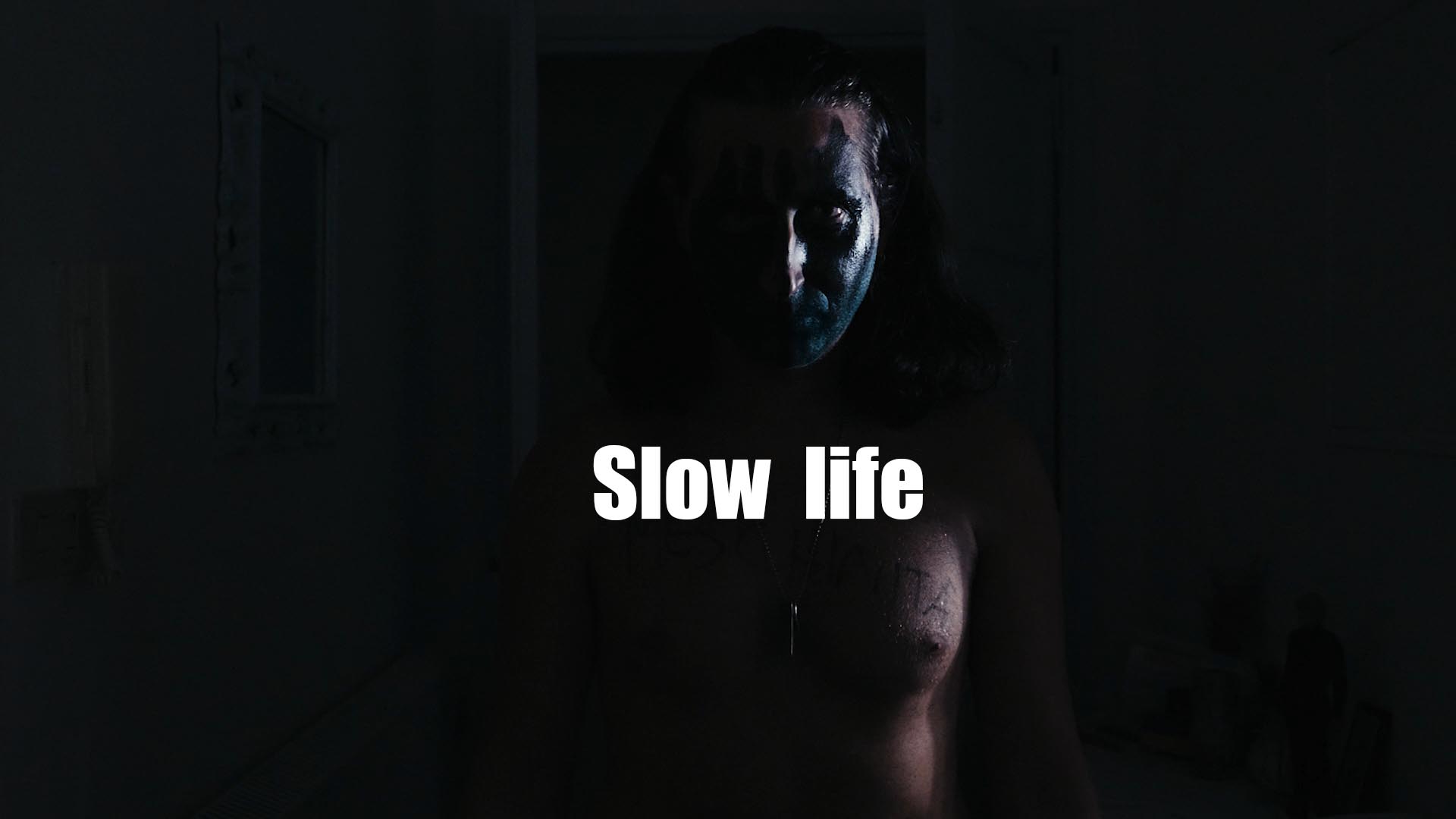
Drama, comedy, thriller, by Fabio Del Greco, Italy, 2021.
Lino Stella takes a period of vacation from his alienating job to devote himself to relaxation and his passion: drawing comics. But he did not foresee certain disturbing elements: the intrusive administrator of the building where he lives, the postman who delivers crazy fines and tax bills, an overbearing security guard, a very enterprising real estate agent, the old lady downstairs who raises the feline colony of the condominium. These characters will make his vacation hell.
Food for thought
The larger a social group is, the more rules and bureaucracy are needed, which often do not respect the individual. You have to learn to live with annoying people, but sometimes the social pressure and arrogance can become intolerable. The only laws that always come to our aid are the laws of Nature.
LANGUAGE: Italian
SUBTITLES: English, Spanish, French, German, Portuguese
Red-Haired Girls and Rejection Slips: The Architecture of Desire Denied
The letter arrived on a Tuesday. Or perhaps it never arrived at all — perhaps it was the silence that arrived, which is worse, because silence has no postmark and no clear date of delivery. Charles Schulz had spent the better part of two years working up to asking Donna Mae Johnson to marry him, and when she said no, when she chose instead a firefighter named Al Wold, Schulz was twenty-eight years old and had just, in that same autumn of 1950, placed his comic strip in seven newspapers. Two things happened simultaneously: his professional life began, and something in his personal life closed. He would spend the next fifty years drawing from the wound.
This is not metaphor. Schulz said it plainly, more than once, to interviewers who perhaps expected more distance from the confession. The little red-haired girl in Peanuts — the one Charlie Brown watches from across the schoolyard, the one he can never approach, the one who remains perpetually on the other side of an uncrossable social geometry — was Donna. Not inspired by her, not loosely based on her. Her. Transformed into a structural principle, yes, but the origin was biographical fact rendered in India ink.
What Schulz understood, perhaps without the vocabulary for it, was what Simone de Beauvoir articulated in The Ethics of Ambiguity in 1947: that desire which cannot complete itself is not a lesser form of experience but a distinct mode of being in the world. De Beauvoir was not interested in consoling the lovesick. She was identifying something more unsettling — that the person who perpetually reaches without grasping has chosen, consciously or not, to remain in a state of pure projection, where the other person never becomes actual enough to disappoint. Charlie Brown never speaks to the red-haired girl. This is not cowardice. It is preservation. The moment he speaks, she becomes a person with opinions and moods and the capacity to wound. Kept at the distance of longing, she remains perfect, which is to say, she remains entirely his invention.
There is something unbearable and honest about that arrangement. A man watches another person from across a field, never moving closer, never turning away. He carries his lunch bag. He does not eat. The distance between them is not geographical.
Schulz had other rejections, of course. Before syndication, he had submitted his work to various publishers and been turned away — the most pointed of these being his rejection from Walt Disney Studios, which declined to hire him. The specific cruelty of that particular door closing is hard to overstate: a man who would eventually become the most widely read cartoonist in history, with Peanuts appearing in 2,600 newspapers across 75 countries at its peak, was considered not quite good enough for someone else’s vision of what drawing could be. He kept the rejection slips. He talked about them openly. There is a psychological consistency here that goes beyond mere biographical detail.
What Schulz constructed, across fifty years and 17,897 strips, was a philosophy of the unanswered approach. Charlie Brown runs to kick the football. Lucy pulls it away. Charlie Brown writes a letter to the red-haired girl. He tears it up before sending it. He stands at the mailbox and retrieves nothing. The structure repeats not because Schulz lacked imagination but because the structure was true. Repetition in Peanuts is not a stylistic tic. It is testimony.
Erik Erikson wrote about the developmental crisis he called intimacy versus isolation — the stage in which a person either learns to open themselves to genuine connection or retreats into a managed solitude that feels safer than vulnerability. What Schulz made visible was the space between those two options, the threshold where a person stands indefinitely, hand raised, never quite knocking.
Donna Mae Johnson married Al Wold. They had children. Schulz drew the strip for five more decades.

Minneapolis, the War, and the Grammar of Loss
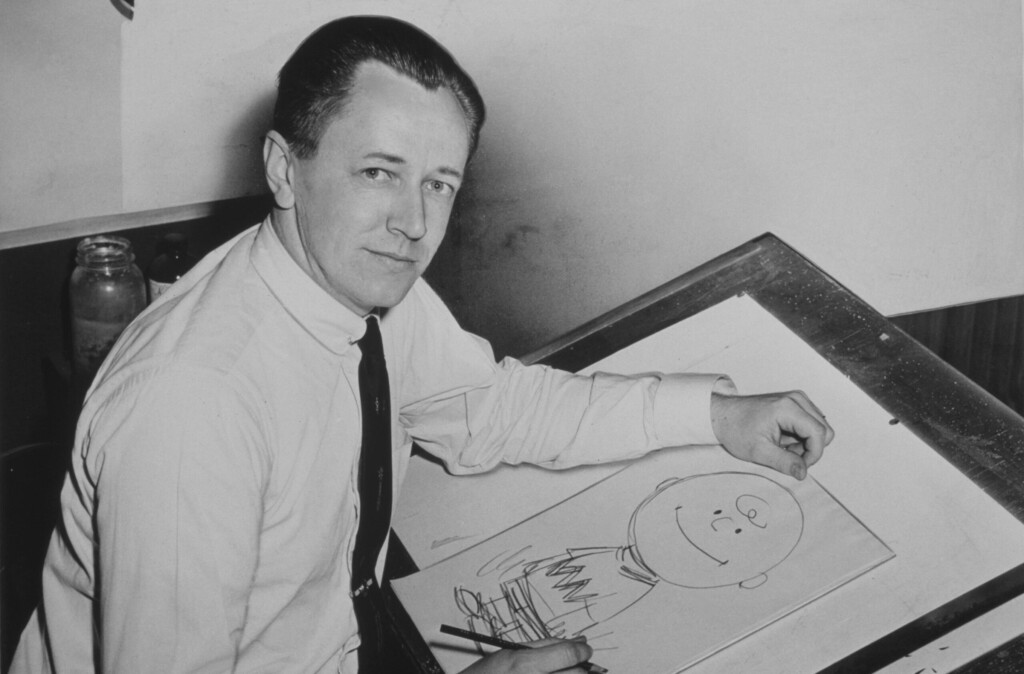
The barbershop smelled like talcum powder and warm leather, and the boy who sat in the corner drawing on scraps of paper while his father worked was already learning something no one had named for him yet: that the world moves forward without asking, and that the only dignified response is to watch it very carefully.
Carl Schulz ran his one-chair shop in St. Paul, Minnesota, through the slow financial drowning of the 1930s, cutting hair for men who sometimes couldn’t pay. Charles was born in 1922, two days after Christmas, a timing his mother Dena noted made him twice cheated — presents combined, celebrations collapsed into one. The Depression was not a backdrop for his childhood. It was the atmosphere, the pressure at a specific altitude that a body learns to breathe without realizing it shapes the lungs. Erik Erikson, whose 1950 work “Childhood and Society” built a vocabulary for understanding how historical crisis inscribes itself into the formation of individual identity, argued that the self does not develop in isolation but in intimate negotiation with the historical moment pressing against it. The child in the barbershop was not separate from the economic catastrophe outside the window. He was partially made of it.
There was a teacher at Richard Gordon Elementary School named Minette Paro who told him his drawings were good. That sentence — that small administrative fact — lodged somewhere permanent. Not because it resolved anything, but because it created a first coordinate: here is a person who sees what you do, and names it. Schulz would spend the next seven decades drawing as if trying to earn that sentence again, to hear it confirmed, to make it definitively true through accumulation. The drive was not confidence. It was its opposite — the compulsive repetition of someone who cannot quite believe they deserve the thing they most want to be.
His mother Dena was diagnosed with cervical cancer in the early 1940s. She died on February 29, 1943 — a date that only exists every four years, as if the calendar itself could not bear to revisit it — the day before he left for the Army. He did not grieve in any form that those around him could recognize. He reported for duty. He shipped to Europe. He became a staff sergeant in a machine gun squad that moved through France, Austria, and Germany in the final years of a war that killed fifty million people and reorganized the moral geography of the century. He never fired his weapon at a human being, he said later. He watched others who had. He saw what entering a liberated concentration camp does to the face of a young man from Minnesota who has never been more than a few hundred miles from his father’s barbershop.
Erikson’s framework insists that identity formed through rupture is not destroyed but reorganized around the wound. What Schulz brought home from Europe was not trauma in any theatrical sense — no visible dysfunction, no collapse. What he brought home was a permanent, structural hollowness, the kind that looks like shyness at a party but is actually something more fundamental: a learned certainty that happiness is episodic at best, that connection is perpetually interrupted, that the ground beneath any moment of warmth is thin ice over very cold water.
That hollowness is not a theme in the Peanuts strips. It is the architecture. The negative space around every failed attempt to kick a football, every letter that doesn’t arrive, every kite consumed by a tree that wins without effort or malice. Schulz did not transform his losses into meaning. He did something stranger and more honest — he drew them repeatedly, at the same scale, in the same ink, as if repetition itself might eventually yield an answer that the event never provided.
It never did. He kept drawing anyway.
October 2, 1950: A Strip Lands and Nobody Notices
Seven newspapers. On October 2, 1950, that was the entire world Peanuts entered — seven papers carrying the first strip, a number so thin it barely constituted a professional debut. No fanfare, no advertising campaign, no editor’s note calling attention to something new. The strip simply appeared, small and quiet, between whatever else was on the comics page that morning, and most readers turned the page without stopping.
The syndicate had already managed to diminish it before anyone saw it. United Feature Syndicate held the rights and held, along with them, the right to name it. Schulz had been drawing these characters under the title Li’l Folks for the St. Paul Pioneer Press since 1947, and he wanted that name kept. The syndicate refused — there was already a strip called Little Folks, close enough to cause legal friction — and replaced it with Peanuts, a word Schulz would spend decades calling the worst title he could imagine for what he was doing. He never reconciled with it. The name evoked smallness, triviality, the inconsequential. Which was, in a way, a precise accident: the strip was about all three things, and about none of them.
Roland Barthes, writing in Camera Lucida in 1980, made a distinction that explains something Schulz achieved before Barthes named it. Barthes separated the studium from the punctum in a photograph — the studium being the general field of information and cultural interest, everything you can decode and appreciate with competent attention, and the punctum being the detail that escapes intention, that pricks, that wounds without warning. The studium is what you analyze. The punctum is what finds you. Most comic strips of that era operated entirely in the studium: they were legible, competent, amusing, culturally coded entertainment. Peanuts carried something else. There was always a detail — a pause, a posture, the angle of a child’s shoulders when nobody had chosen them for the team — that arrived before comprehension did, that made the body respond before the mind understood why. That is the punctum working, and Schulz, who never read Barthes, was producing it instinctively in every other strip.
Charlie Brown does not fail in ways that are dramatic or legible. He fails in ways that are structurally ordinary — he stands at a mailbox on Valentine’s Day, he waits for the phone, he misses the kick. The genius is in the waiting, in the strip before the failure, when hope is still technically possible. That moment before the football is pulled away is the punctum. Not the fall. The hope.
Readers in 1950 had no framework for what they were encountering. They only knew that the strip did something to them that Blondie did not, that Li’l Abner did not, that the funnier, louder, more technically accomplished strips did not. Recognition is not the same thing as laughter. What Peanuts produced was closer to recognition — the sensation of seeing something about your own interior life rendered without your permission, with accuracy you had not requested and could not argue with.
By 1956 the strip was in approximately 40 papers. By the early 1960s that number was climbing toward several hundred. The growth had no single inflection point, no marketing genius behind it. It spread the way privately meaningful things spread: one reader showed another, not because it was entertaining but because it was true. By the time Schulz died in February 2000, Peanuts ran in 2,600 newspapers across 75 countries, translated into 21 languages. None of that was built. It accumulated, the way sediment accumulates, because something real was at the bottom of it.
The syndicate’s chosen title was a diminishment, and the diminishment turned out to be irrelevant. What readers kept was not the name.
Snoopy as Escape Hatch, Charlie Brown as Trap
Snoopy does not dream. That is the thing people miss when they watch him climb atop his doghouse and become, in one blink, a World War I flying ace banking through clouds above the Western Front. He does not imagine being someone else. He simply becomes. There is no hesitation, no internal negotiation, no moment where the fantasy pauses to apologize for itself. The scarf whips behind him. The Sopwith Camel cuts through fog. The Red Baron is somewhere ahead, and Snoopy is completely, catastrophically present in the life he has invented for himself. This is not escapism in the pejorative sense that adults use to dismiss children’s games. It is something more radical: a self that performs its own freedom without asking permission from the circumstances that should make that freedom impossible.
Charlie Brown watches this from the ground.
That distance — the few feet of grass between a beagle’s doghouse and a boy standing with his hands in his pockets — is one of the most precise psychological diagrams Schulz ever drew. Throughout the mid-1960s, as the strip reached its cultural peak and Snoopy’s personas multiplied (the novelist typing “It was a dark and stormy night,” the tennis champion, the world-famous hockey player), Charlie Brown’s immobility deepened in almost exact proportion. The more elaborately Snoopy performed, the more Charlie Brown stood still, watching, commenting, occasionally smiling with a kind of tender bewilderment at something he could not access and did not know how to want.
The British pediatrician and psychoanalyst D.W. Winnicott spent decades mapping what happens to a person when the environment around them in early life fails to reflect back who they actually are. The result, he argued, is a split: a constructed, compliant self that interfaces with the world’s expectations, and a buried self that retreats because exposure has always meant danger. What matters here is not the clinical apparatus but the strip itself, which enacts this division with an almost uncomfortable literalness. Snoopy has no social obligations to anyone. He does not attend school. He is not waiting for the Little Red-Haired Girl to notice him. He owes nothing to the accumulated weight of his own history of failure. He can be a World War I flying ace precisely because no one has spent years confirming that he cannot. Charlie Brown, by contrast, has been shaped by every person who has pulled the football away, every teacher who has mispronounced his name, every kite that has found the one tree in a field. He knows what he is because the world has told him, repeatedly, in the specific grammar of small humiliations.
What Schulz understood, and what made the strip something more than comedy, is that readers did not choose between these two figures. They loved Snoopy with a kind of vicarious relief and recognized Charlie Brown with something closer to dread. The recognition was not affectionate. It was the recognition of the mirror that shows you what you have been managing not to see. In the thousands of letters Schulz received through the 1960s, adults wrote about Charlie Brown the way people write about a secret — not fondly, but with the particular intensity of something finally named. Snoopy was the self they performed at parties. Charlie Brown was the self that lay awake at 3 a.m. cataloguing the evidence.
The strip held these two figures in permanent, irresolvable tension. Schulz never allowed Snoopy’s freedom to rescue Charlie Brown, and he never allowed Charlie Brown’s gravity to ground Snoopy. They coexist without synthesis. This is not a flaw in the strip’s architecture. It is the strip’s entire argument about human psychology: that the escape hatch and the trap are not opposites. They are the same person, drawn on opposite sides of a panel line, each one making the other necessary.
A vision curated by a filmmaker, not an algorithm
In this video I explain our vision
The Business of Vulnerability: Merchandising the Wound

There is a coffee mug on your desk right now, or there was one in your childhood kitchen, or there is one in the break room at work — and on it, Charlie Brown slumps with that expression of his, that particular downward pull at the corners of the mouth that communicates something just short of despair. You have poured hot liquid into that expression a thousand times without once thinking about what it cost the man who drew it.
By 1970, Peanuts merchandise was generating more than one hundred and fifty million dollars annually. Not from the strip itself. From the wound as product. From the reproduced image of inadequacy screenprinted onto mugs, lunchboxes, greeting cards, plush toys, and eventually the hull of a Macy’s Thanksgiving Day Parade balloon large enough to shadow an entire city block. The Met Life Insurance Company adopted Snoopy as its mascot in 1985 and kept him for decades — the logic being, apparently, that a beagle who dreams of being something he is not is the appropriate face for a product sold on the premise that the worst will happen to you and you should pay now to be ready for it. NASA put Snoopy on mission patches for its safety program. The Apollo 10 lunar module was named after him. A cartoon dog conceived inside one man’s loneliness was floating, in name, toward the moon.
Guy Debord wrote in 1967 that in societies dominated by modern conditions of production, all of life presents itself as an immense accumulation of spectacles, that everything directly lived has moved away into representation. What Debord could not have fully anticipated — because the scale was still assembling itself — was the specific efficiency of commodifying not pleasure or aspiration but alienation itself. Charlie Brown does not sell you a fantasy of what you could become. He sells you a mirror of what you already feel, and then he charges you for the reflection. The genius and the violence of it are identical.
Schulz understood this at some level he never fully articulated. He retained control over his characters with a ferocity that bordered on the pathological — no other artist ever drew them officially during his lifetime, no studio hand, no assistant, no ghost. Every strip that appeared in two thousand six hundred newspapers across the world for nearly fifty years came from one hand. He described this as a matter of integrity. It was also, perhaps, a man keeping his wound proprietary. If the loneliness was going to be sold, it would be sold from the source. The original suffering would remain legible inside the reproduction, like a watermark.
And yet the reproduction does what reproduction always does: it dilutes, distributes, normalizes. By the time Charlie Brown’s face is on a billion objects in a hundred countries, the specific gravity of what that face means — the clinical depression Schulz described living inside most of his adult life, the fear of rejection that never resolved itself no matter how many people confirmed their love for his work, the grief over his mother’s early death, the loneliness that preceded success and survived it entirely — all of that has been smoothed into a brand tone. Wistful. Gentle. Safe enough for children’s bedrooms, safe enough for insurance companies, safe enough to carry your afternoon tea.
This is what the spectacle does to authentic expression: not destroy it but preserve it past the point of danger. The sharpness is kept, the outline is kept, the recognizable sadness is kept — but the thing that made it dangerous, which was its particularity, its origin in one specific human being’s unresolved interior life, is quietly evacuated. What remains is the aesthetic of vulnerability without the cost of actually being near it.
Schulz drew this every day. He cashed the checks. He reportedly never stopped being unhappy.
The Television Specials and the Sound of Vince Guaraldi’s Piano
December 9, 1965. Roughly half the television sets in the United States were tuned to the same broadcast. Not a news event, not a political address — a cartoon about a depressed boy who could not understand why Christmas made him feel worse instead of better.
The network executives who had commissioned it were not pleased with what they received. They had expected something bright, quick, reassuring — the kind of animated entertainment that moved in cheerful arcs toward resolution. What Schulz delivered sat still. It let silences breathe. A small boy stood in a empty auditorium and spoke aloud a passage from the Gospel of Luke with no irony and no apology, and the executives wanted it cut. They wanted a laugh track inserted, because without it they feared the audience would not know when to feel comfortable. They wanted the jazz score replaced with something more conventional, more celebratory, more like what a Christmas special was supposed to sound like. Schulz refused each request. The broadcast aired as he had made it.
What Vince Guaraldi had composed was not background music in any recognizable sense. The piano in “Linus and Lucy,” in the quieter transitional pieces, in the skating sequence, operated at a frequency that cartoons had never previously attempted — spare, syncopated, genuinely melancholic in the way that jazz can be melancholic without being mournful, holding sorrow and pleasure in the same phrase without resolving the tension between them. There was no orchestral swell to tell you how to feel at the end of a scene. The music did not explain the emotional content. It was the emotional content, formalized, made present in sound rather than declared through it.
This is precisely what Susan Sontag was attempting to articulate in “Against Interpretation,” published that same year, when she argued that the deepest function of modern art was not to translate feeling into meaning but to make feeling formally present — to give it a body, a surface, a sensory existence that could be encountered rather than decoded. Art, in her formulation, was not a message wrapped in aesthetic packaging. The form was the experience. To strip the form away in search of content was to destroy the thing you were trying to understand. What the executives wanted when they asked Schulz to add a laugh track was precisely this destruction — the conversion of a formally achieved emotional state into a set of instructions about how to receive it.
The Biblical recitation that they wanted removed was not, in context, a religious intrusion. It was a structural decision. Linus walks to the center of the stage, asks for a spotlight, and recites from memory — not performing the text but delivering it with the same flat sincerity he brings to everything. The simplicity of the delivery is what makes it land. A child who believes what he is saying, in a world where adults have turned Christmas into a commercial transaction and a child has noticed the gap between the advertised feeling and the actual one. The recitation does not resolve Charlie Brown’s depression. It offers him a frame. Whether the frame holds is not answered.
That ambiguity was what the network feared. American television in 1965 was built on the premise that discomfort must be followed by relief, that emotional weight must be discharged before the commercial break. Schulz understood that some weight does not discharge, that the piano note that does not resolve into the expected chord is not a mistake but a fact, and that half an audience — nearly fifty million people — would sit with that fact for an hour on a December night and recognize something in it they had not previously found named anywhere.
The special has aired every year since. Not because it comforts. Because it doesn’t, quite, and people keep returning to the exact shape of that.
The Last Strip and the Question That Does Not Answer Itself
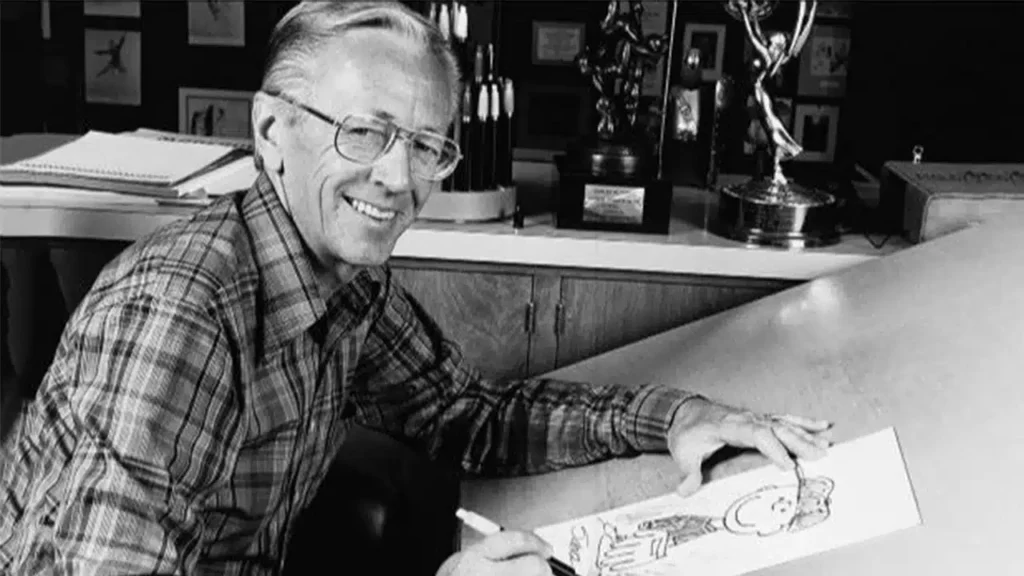
The pen was still warm, in a manner of speaking. Somewhere in the sequence of hours that close a life, he had finished the last drawing, set down the instrument, and that was that — though nobody framed it that way until the morning after, when the phone calls began and the news moved through the world in the particular silence that follows the death of someone who had been, for most people alive, simply always there.
On February 13, 2000, readers opened their Sunday papers and found a strip unlike any other in the nearly fifty-year archive. He spoke directly to them — not through Charlie Brown, not through the voice of a beagle dreaming on a rooftop, but as himself, Charles M. Schulz, the man behind the line. He thanked them. He said goodbye. He broke the only wall he had spent a lifetime carefully maintaining, and he did it once, at the end, the way certain people save their most honest sentence for the last moment they are heard. He had died the night before. The farewell was already in print before he was gone.
Seventeen thousand eight hundred and ninety-seven strips. Drawn by his hand alone, every line, without assistants touching the work that was his alone to make. Ernest Becker argued in The Denial of Death, published in 1973 and awarded the Pulitzer Prize the following year, that the fundamental engine of human culture is the terror of annihilation — that we build, create, perform, and inscribe ourselves into lasting forms because we cannot bear the knowledge that we will disappear entirely. The heroism Becker described is not the heroism of battle but of making: the artist, the writer, the builder who encodes their aliveness into something that might outlast the body. The strip was that thing. Not a hobby, not a career in the way accountancy is a career. A daily proof of existence, repeated for half a century with the regularity of breathing.
He said in interviews, more than once, with the directness that characterized him when he was not deflecting through his characters, that without the strip he did not know who he would be. That sentence, which could be read as devotion or as confession, is actually neither — it is a diagnosis. When the work is the self, not a product of the self but the self rendered legible, its ending is not retirement. It is something that does not have a clean name in the vocabulary of professional life.
Charlie Brown never kicked the football. The strip ended before he could. Fifty years of that gag, that precise geometry of hope and betrayal, and Schulz closed the sequence without resolution because resolution was never the point. The point was the approach, the run-up, the moment before the pull, which is the only moment in which belief is still structurally possible. Becker would have recognized that instantly — the immortality project is not in the conclusion but in the perpetual motion of reaching toward one.
What ended on that February morning was not simply a comic strip, though it was that too, and its absence left a specific shape in the culture, a Sunday-morning silence that millions felt without being able to say why. What ended was the daily act of a man insisting, through ink and paper, that his consciousness had passed through time and left a mark. The readers who grieved were not only mourning Schulz. They were recognizing, in the abruptness of that ending, something about the nature of all the marks any of us make — how completely they depend on the living hand that draws them, and how the line, however clean, however beloved, does not continue itself.
🎨 Art, Identity, and the American Imagination
Charles Schulz built a universe of profound humanity through the deceptively simple world of Peanuts, touching on loneliness, identity, and the quiet comedy of everyday life. These related articles explore the broader cultural and intellectual landscape from which his work emerges — from the psychology of belonging to the philosophy of artistic creation.
Mass Social Homologation Today
Mass social homologation is a phenomenon that Schulz understood intuitively and challenged through his characters’ stubborn individuality. Charlie Brown’s perpetual outsider status is a pointed commentary on the pressure to conform within American consumer culture. This article explores how standardization shapes identity in modern societies, offering essential context for reading the deeper meanings in Schulz’s strips.
GO TO THE SELECTION: Mass Social Homologation Today
La Bohème: History and Myth of the Poor Artist
La Bohème and the myth of the poor, misunderstood artist resonates deeply with Charles Schulz’s early years of struggle before Peanuts became a cultural institution. The tension between artistic sincerity and commercial success is a theme that runs through both the bohemian tradition and Schulz’s complex relationship with his own fame. This article traces the romantic mythology of the artist who sacrifices comfort for creative truth.
GO TO THE SELECTION: La Bohème: History and Myth of the Poor Artist
Pierre Bourdieu and the Artistic Field
Pierre Bourdieu‘s analysis of the artistic field illuminates how cultural legitimacy is constructed, contested, and commodified — a framework remarkably useful for understanding how Schulz transformed a newspaper comic strip into a globally recognized art form. Schulz operated at the intersection of popular culture and genuine artistic ambition, navigating the hierarchies Bourdieu describes with uncommon skill. This article examines the sociological forces that shape artistic recognition and value.
GO TO THE SELECTION: Pierre Bourdieu and the Artistic Field
Problematic Adolescence is Not a Developmental Disorder
The world of Peanuts is populated almost entirely by children who carry adult anxieties — anxiety, self-doubt, existential dread, and the desperate search for acceptance. Schulz drew on his own difficult adolescence to give his characters an emotional authenticity rarely found in popular entertainment. This article reflects on how adolescent experience is often misread or pathologized, echoing Schulz’s compassionate and nuanced portrayal of young inner lives.
GO TO THE SELECTION: Problematic Adolescence is Not a Developmental Disorder
Discover Independent Cinema on Indiecinema
If the themes of creativity, identity, and the human comedy in Schulz’s work speak to you, Indiecinema is the streaming platform where independent cinema brings these same questions to life on screen. Explore films that challenge, move, and inspire — far from the mainstream, close to what truly matters.
👉 EXPLORE THE CATALOG: Watch Indie Films in Streaming
A vision curated by a filmmaker, not an algorithm
In this video I explain our vision

