The Gaze That Does Not Look Away
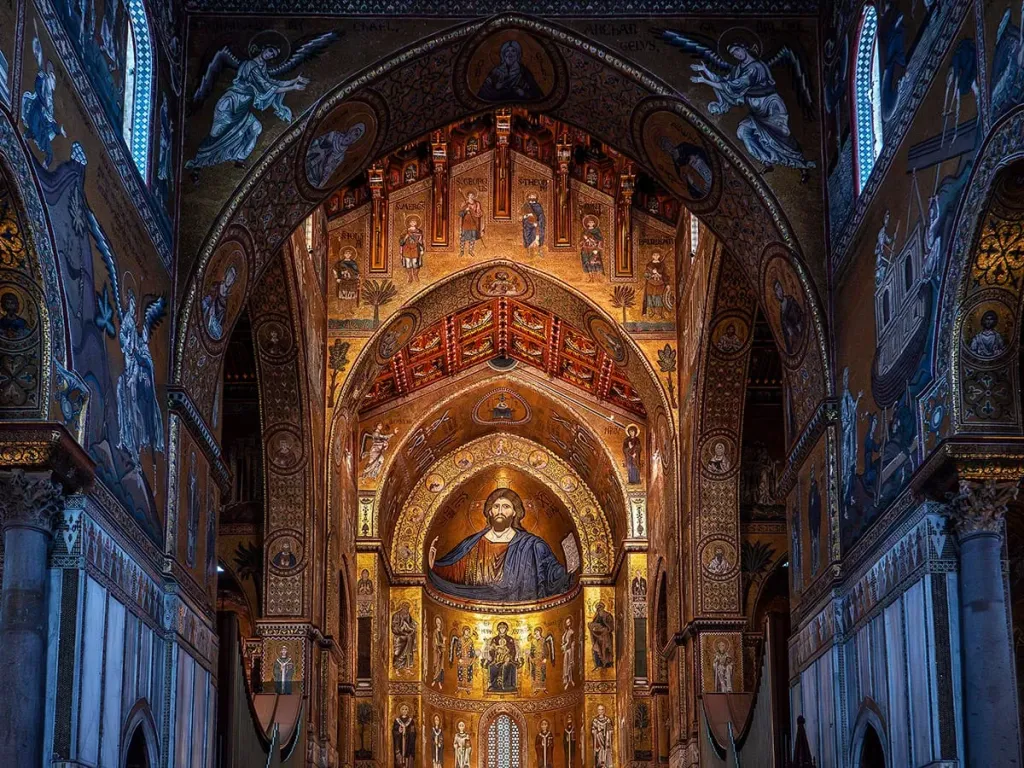
You walk into the apse and the light changes. Not because the candles are different here, not because the gold tessera catches the morning at a particular angle, though it does — but because something is looking at you, and it was looking at you before you arrived. The face suspended above the altar is enormous, calm, and completely without mercy in the way that only absolute certainty can be without mercy. You feel it before you identify it. A tightening somewhere between the sternum and the throat, a slight involuntary adjustment of your posture, as if you have been caught doing something you had almost convinced yourself was acceptable.

This is what the Pantocrator does. This is what it was built to do.
The word itself arrives from Greek, Pantokrator, the All-Ruler, the One who holds all things in his grasp, and the theological weight of that etymology is not decorative. When Byzantine craftsmen embedded this image into the dome or the conch of the apse — Monreale, Cefalù, Daphni, Constantinople — they were not illustrating a story. They were installing a presence. The difference matters enormously and almost no one visiting these spaces today registers it, because we have been educated out of the capacity to receive images as presence. We have learned to receive them as content.
Look more carefully at the face. One side is not the same as the other. This is not accident, not technical limitation, not the inevitable imprecision of hand-cut stone and glass. The asymmetry is deliberate, theologically encoded, and it is the thing that most disturbs you without your knowing why. The right side of Christ’s face — traditionally the side of mercy, of the sheep, of the blessed — tends toward softness, toward a faint inclination that might, in another context, become compassion. The left carries something harder. The brow is heavier. The eye does not yield. Byzantine iconographers understood that the face of the Pantocrator had to hold two irreconcilable truths simultaneously: that this figure loves you with a completeness no human category can contain, and that this same figure sees you with a clarity you cannot survive if you look at it honestly.
The art historian Hans Belting spent decades arguing, most fully in his 1990 work Bild und Kult, that the sacred image in pre-modern culture was never primarily an aesthetic object. It was a locus of power, a site where the divine became accessible, which also means a site of genuine danger. Belting’s insight was not merely historical. It was a diagnosis of what modernity had dismantled. We moved the icons into museums, lit them from below, wrote catalog numbers beside them, and congratulated ourselves on preservation. What we actually did was neutralize them. We placed the gaze behind glass and told ourselves we were protecting the art. What we were protecting was ourselves.
Because the gaze of the Pantocrator is not a gaze that flatters. Every pictorial tradition that followed the Byzantine — the Renaissance softening of Christ’s face, the sentimental devotional images of the nineteenth century, the warm-eyed Jesus of contemporary evangelical iconography — represents, in some measurable sense, a retreat from this. A negotiation. An attempt to make the face more bearable, more like the face of someone who, fundamentally, agrees with you. The Pantocrator does not agree with you. It does not disagree either. It simply sees, with that terrible, asymmetric, undeflectable attention, and it does not look away when you become uncomfortable.
You were trained to call this beautiful. You were not trained to ask what it means that beauty, here, feels so much like exposure.
Pantocrator: What the Word Actually Means When You Say It Slowly
Say the word slowly enough and something shifts. Pan-to-kra-tor. Not a name, not a title handed down through bureaucratic habit, but a claim — a compressed philosophical assertion about the nature of reality itself. The Greek carries it plainly: pan, all things, and kratos, power, dominion, the kind of force that doesn’t merely govern but constitutes. The ruler not of a territory or a people but of the structure of existence. When early Christian theologians reached for this word, they were not decorating their faith with impressive vocabulary. They were staking a metaphysical position that had immediate and dangerous political consequences.
The Council of Nicaea in 325 AD was not primarily a spiritual gathering. Constantine had unified an empire fractured by civil war, and a church splitting over the question of Christ’s divine nature threatened the ideological coherence he needed. The Arian position — that Christ was created, subordinate, the first and greatest of God’s works but not coeternal with the Father — had enormous popular support across the eastern provinces. What Nicaea imposed, with the emperor’s full weight behind it, was the Nicene formulation: Christ as homoousios, of the same substance as the Father. And embedded in that creed, repeated to this day, was the word Pantokrator — applied not only to God the Father but structurally transferred to the Son through the logic of consubstantiality. If they share the same substance, they share the same dominion over all things.
This was not merely theology. It was a statement about legitimate power in a universe where cosmic and political authority were understood to mirror each other. The theologian Ernst Kantorowicz, in his landmark 1957 study The King’s Two Bodies, traced how medieval political thought built itself precisely on this correspondence — the earthly ruler as image and delegate of the heavenly Pantokrator. But that correspondence began much earlier, in the visual programs of the Byzantine court, where the image of Christ enthroned with the gospels in one hand and the gesture of blessing in the other was not distinguished in its formal logic from the image of the emperor. Both held dominion. Both were framed by the same golden light. The theological claim and the political claim occupied the same visual language.
What happened over the following centuries was a slow domestication of something that had been, at its origin, violent in its implications. Liturgical repetition does something particular to words that carry metaphysical weight. Hear Pantokrator enough times in the same incense-laden space, in the same chanted register, and the word begins to mean something closer to benevolent grandfather than ruler of all being. The kratos softens. The pan recedes. What remains is a feeling of warmth in a high-ceilinged space, which is precisely what ritual is designed to produce and precisely what erases the original terror of the concept.
But the image, lodged in the apex of the dome directly above the congregation, resisted that softening more than the word did. The gaze in those mosaic faces — Daphni in particular, from the late eleventh century, where the tessera work achieves something almost anatomically unsettling — does not offer comfort. It watches. The asymmetry that scholars and restorers have noted in many Pantokrator faces, one side severe and the other more yielding, has been interpreted as theological symbolism, the dual nature of divine justice and mercy. But there is another way to read it: as the unresolved tension between what the image was built to assert and what centuries of devotional use wanted it to become. A claim about total dominion over all created things does not easily transform into a reassuring presence. The image holds both, uncomfortably, in the same face looking down from the center of the vault, and it has never quite decided which one it is.

A Face Assembled From Power, Not From Love
There is a moment when you stand close enough to an ancient face — painted, encaustic, surviving fire and iconoclasm and six centuries of incense smoke — and something shifts. Not spiritually. Physically. The face is watching you differently depending on which side you approach. The left eye carries a softness, a slight opening, something that might be called mercy if you were in the mood to call it that. The right eye is different in a way that takes a moment to name: it is set harder, the brow marginally more contracted, the geometry of the face just slightly asymmetrical in a direction that reads, without any conscious translation, as judgment. You feel assessed. You feel the difference between being seen and being measured.
This is not accident. The asymmetry in the oldest surviving panel of this type — painted in encaustic on wood, preserved in an Egyptian desert monastery that the seventh-century Arab expansion somehow elected not to destroy — is the result of deliberate iconographic construction. The two halves of the face were meant to do different work. Theologians and art historians including Kurt Weitzmann, who examined the Sinai collection systematically in the 1970s, have noted that this bilateral tension encodes a doctrinal duality: the Christ who forgives and the Christ who returns to judge are not two figures but one face, and the face is arranged so that neither half lets you rest. You cannot settle into mercy without the judgment eye finding you. You cannot accept the judgment without the softness on the other side making it intimate rather than distant. The image locks you in a relationship you did not choose and cannot exit simply by looking away.
The right hand is raised in a gesture that functions less like a greeting than like a signal. The specific position of the fingers — the ring and little finger curled, the index and middle extended, the thumb crossing — encodes the Greek letters IC XC, the Christogram, so that the blessing is simultaneously a signature. The hand is not reaching toward you. It is marking something, signing something, the way an official document is signed. In the left hand, the codex. Always the codex, bound, closed or formally presented, the text as object of authority rather than invitation. The book is not being offered to you to read. It is being held as evidence of what has already been written, what is already decided.
The halo presents itself as light, as radiance, as the visible overflow of divine presence. But the gold that Byzantine craftsmen used — and the encaustic painter of this early icon used it with a precision that reads almost as metallurgical — is the same gold that surrounded imperial busts, administrative portraits, the formalized faces of power that lined the walls of civic and judicial spaces in the late Roman world. Ernst Kitzinger, writing on Byzantine art in 1954, traced the iconographic grammar of the Pantocrator directly to imperial portraiture, demonstrating that the visual language of divine sovereignty was borrowed wholesale from the visual language of earthly sovereignty. The halo is not a poetic metaphor for transcendence. It is an administrative insignia transferred upward.
This matters because it tells you who the image was made for and what it was designed to do to the body standing before it. Not the mind, the body. The slightly elevated position of the icon, the scale, the direct frontal gaze that follows you without anatomical justification — these are the formal properties of a figure that holds jurisdiction over the space. You do not enter this image’s presence as a visitor. You enter as a subject entering the presence of a sovereign. The mercy in the left eye does not soften this. It intensifies it. A sovereign who is also capable of mercy is more powerful than one who merely threatens, because you can never be certain which mode you are encountering at any given moment.
When the Emperor and the Christ Became the Same Silhouette
You are watching a politician speak and something bothers you that you cannot name. It is not what he says. It is the hand — raised, open-palmed, fingers slightly spread, held at chest height and then slowly extended toward the camera as if offering something invisible. The stillness of the face behind the gesture. The way the gaze does not move, does not search, does not doubt. You have seen this before. Not on television. Somewhere older.
Paul Zanker spent decades tracing exactly this mechanism. In his 1987 study of Augustan imagery, he demonstrated that Roman imperial power was never merely administrative — it was manufactured through a systematic visual language that colonized every surface it touched: coins, reliefs, statuary, the proportions of a forum. Augustus did not simply govern; he was made to look like a man the gods had already chosen, and that look was engineered with the precision of a military campaign. The face serene, the gesture deliberate, the body proportioned to suggest not a human being making decisions but a cosmic principle made flesh. Zanker called it the power of images, and what he meant was that images do not illustrate power — they constitute it.
When Constantine moved the empire’s center eastward in 330 CE and began the long, complicated process of christianizing a political apparatus that had functioned for centuries on the grammar of divine kingship, he did not dismantle that grammar. He translated it. The visual lexicon that had made emperors legible as sacred figures — the frontal gaze, the raised hand in the gesture of speech or blessing, the hierarchical scaling of bodies, the gold that surrounded sovereignty like an atmosphere — was not abandoned. It was transferred. André Grabar, whose research on the origins of Christian iconography remains essential reading, documented with extraordinary precision how the earliest representations of Christ in majesty borrowed not metaphorically but structurally from imperial portraiture. The enthroned Christ of the fifth and sixth centuries is compositionally identical to the enthroned emperor: the same axial symmetry, the same suppression of movement, the same eye that looks outward without seeing you specifically, without seeing anyone, which is another way of saying it sees everyone equally and with the same absolute authority.
Justinian understood this with a clarity that is almost uncomfortable to contemplate. The mosaic program at Ravenna, completed in the mid-sixth century, places the emperor and Christ in visual rhyme so precise that the theological argument becomes almost redundant. You do not need to be told that earthly and divine sovereignty are unified. You see it. The gold ground that surrounds both figures is the same gold. The gesture of benediction and the gesture of imperial proclamation have become a single gesture. Grabar noted that this was not corruption of Christian imagery but its deliberate formation — the church did not resist the imperial visual vocabulary because the church needed what that vocabulary could deliver: immediate, visceral, unquestionable authority legible to anyone who walked through a door.
This is what you are watching when you watch the politician with the raised hand. Not a man who has consciously studied Byzantine iconography. Something older than consciousness. A grammar so deeply embedded in the visual culture of the West that it operates below the threshold of decision. The stillness of the face is not composure — it is the formal suppression of the personal, the erasure of the contingent human being in favor of the figure, the type, the icon. When a leader learns not to fidget, not to glance sideways, not to show the small movements of doubt or calculation that make a face human, he is not learning rhetoric. He is learning iconography. He is learning to hold the pose that Zanker traced back to the Forum of Augustus and that Grabar traced forward into the apse of every basilica where a golden Christ sits with open palm and eyes that do not blink.
The silhouette was always the same. Only the name above it changed.
The Hagia Sophia Deesis and the Unbearable Tenderness of the Unfinished
There is a face that stops you in the upper gallery of a building that has been, at various points in its existence, a cathedral, a mosque, and a museum — a face so unexpectedly tender that the first response is not reverence but something closer to alarm. The eyes are not commanding. They are tired. The mouth holds no pronouncement. The gold that surrounds the figure seems almost ironic against the softness of what it frames, as if the material insistence on divine splendor were quietly contradicted by the expression it was meant to glorify. This is the Deesis mosaic, completed somewhere in the late thirteenth century, likely after the catastrophic Latin occupation of Constantinople that ended in 1261, and it does something no previous image of the Pantocrator had quite dared: it makes the all-ruler look as though he might relent, not from strength but from something resembling weariness.
The theological structure of the Deesis is intercessory — Christ flanked by the Virgin and John the Baptist, both turned toward him in postures of plea, and the composition is meant to evoke the Last Judgment, that final moment of cosmic reckoning. But the figure at the center does not look like a judge. He looks like someone who has already heard too much. The gaze does not sweep the viewer with authority; it meets you with a particularity that is almost unbearable, as if the image had decided, against all iconographic convention, to be personal. Andrei Rublev, working a century and a half later in a tradition that considered the icon a window rather than a mirror — a transparent surface through which the divine looks out, not a reflective one in which the human sees itself — would have recognized immediately what this mosaic was doing and perhaps why it was dangerous. A window implies distance, transcendence, the irreducibility of what lies beyond. But the Deesis face collapses that distance. It does not open onto the eternal; it leans toward you across it.
Hans Belting, in his foundational 1990 study of the image before the era of art, argues that the medieval sacred image existed in a condition of what he calls living presence — it was not a representation of the holy but a location of it, not a sign pointing elsewhere but a body occupying space. The image did not illustrate the sacred; it housed it. What Belting traces with extraordinary care is the slow historical process by which that certainty began to erode, in which the image started to become aware, as it were, of its own mediation, its own insufficiency as a vessel. The Deesis mosaic sits precisely at that threshold. It arrives in the aftermath of conquest and theological humiliation, in a city that had been looted of its sacred objects by crusaders who treated Byzantine devotion as superstition and Byzantine gold as portable. The image, in this context, is no longer simply authoritative. It has survived something. It carries the memory of having been doubted.
And this survival shows in the face. The Christ of the Deesis is rendered with a naturalism that breaks with the flattened, frontal severity of earlier Pantocrators — the flesh has weight, the shadows beneath the eyes are not decorative but descriptive, the asymmetry of the features suggests a face that has moved through time rather than stood outside it. This is a figure who looks as though he has considered the possibility of failure and has not entirely dismissed it. That is not heresy. It may be the most theologically honest thing Byzantine art ever produced. The icon, Rublev insisted, was a practice of seeing, not a substitute for what cannot be seen. But this mosaic suggests a third possibility: that the image might also be a practice of mourning, a way of holding in gold and pigment what the mind can no longer be certain of, what the institution can no longer guarantee, what the face — almost human, almost willing to look away — can no longer wholly contain.
A vision curated by a filmmaker, not an algorithm
In this video I explain our vision
What You Were Taught to Feel Standing Still
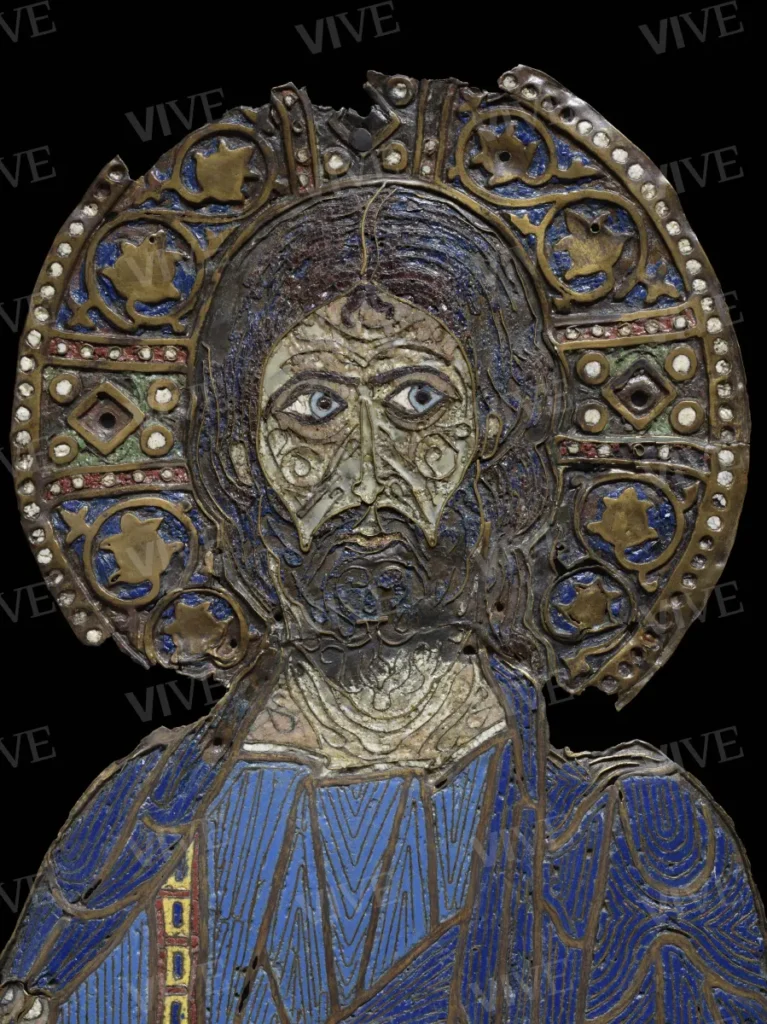
You slow down before you even reach the threshold. Something in your body shifts — the shoulders drop a fraction, the breath quiets, the eyes adjust to a different kind of looking. You have not yet seen the image. You have simply recognized the type of room you are entering, and your nervous system has already begun its performance.
A woman stands in front of a Byzantine icon displayed behind museum glass. She has been standing there for four minutes. Her head is slightly tilted. Her hands are clasped in front of her, not in prayer exactly, but in something that resembles prayer closely enough to pass. She cannot tell — and this is the precise difficulty — whether something is actually happening inside her, or whether she is executing a script so deeply rehearsed that the execution and the experience have become indistinguishable. The gold ground of the image reflects a dim institutional light back at her. The eyes of the Pantocrator hold their absolute, unnerving stillness. She feels something. She is almost certain of it. But she cannot locate where it ends and the choreography begins.
Pierre Bourdieu spent decades mapping how social structures are not merely imposed from outside but are absorbed into the body itself, becoming what he called habitus — a system of durable dispositions that generate perception, feeling, and action without any conscious deliberation. In his work on the sociology of taste, developed most rigorously in Distinction published in 1979, Bourdieu showed that what we experience as natural response — the shiver of aesthetic emotion, the sense of elevation, the feeling of being in the presence of something greater — is inseparable from the social and institutional conditions that trained that response into us. This is not cynicism. It is something more unsettling than cynicism, because it does not leave open the comfortable exit of simply being more honest. The conditioning is pre-reflective. It runs beneath the level where honesty operates.
Sacred space in particular functions as a precision instrument of this conditioning. The architecture does it first — the vertical axis pulling the gaze upward, the controlled acoustics dampening ordinary sound, the management of light through stone and glass until the air itself seems to change quality. The Christ Pantocrator placed at the apex of a Byzantine dome or mounted in a museum replicating those conditions does not wait for you to arrive at reverence. The spatial grammar has already begun working on your body before the image is visible. By the time you are standing before it, the hushed voice you use to speak, the slowed pace you walk, the sense that something weighty is required of you — all of this has been installed by centuries of institutional repetition, passed from body to body the way a posture is passed, without words, without argument.
The face that meets you from the gold ground was itself constructed under institutional pressure of an extraordinary kind. The Council of Nicaea in 787 AD did not merely permit images — it mandated a theological position about their function, ruling that the honor given to an icon passes to its prototype. The image was never meant to be aesthetically free. It was engineered to produce a specific response in a specific body standing in a specific posture before it, and the engineering has worked so thoroughly across fourteen centuries that most people standing in that posture believe they arrived there on their own.
The woman unclasp her hands. She looks at the image again, this time trying to look at it without performing looking at it, and discovers almost immediately that she does not know how. The habit is the experience. The choreography has no outside from which you might watch yourself performing it. And the eyes in the gold ground continue their watching, unchanged, requiring nothing, offering nothing back except the question of who, exactly, is looking at whom.
The Pantocrator in the Age of the Reproduced Face
You have seen it happen, and you have probably done it yourself. You stand before a mosaic the size of a building facade, the gold tiles catching light at an angle that makes the surface seem to breathe, and you raise your phone. The screen frames the face. For a second, maybe two, there are two gazes in the room: the one that has been looking out from that curved apse for nine centuries, and yours, looking at it through a rectangle of glass. Then you press the button and pocket the moment.
Walter Benjamin understood in 1935, with a clarity that still feels prophetic, that mechanical reproduction does not merely copy an image — it dismantles the conditions under which that image was meaningful. He called it the aura: that singular, unrepeatable quality of a thing present in a particular place at a particular time. An icon of the Pantocrator was not simply a picture. It was a theological object whose power was inseparable from its location, its liturgical context, the incense that had darkened its surface across generations, the prayers directed at it by people who believed, without metaphor, that the gaze looking back at them was alive. Benjamin’s argument, developed in “The Work of Art in the Age of Mechanical Reproduction,” was not a lament for lost beauty. It was a diagnosis of how reproduction transforms the social function of an image entirely, evacuating its ritual authority and replacing it with something else — exhibition value, political utility, aesthetic currency.
Susan Sontag pushed further. In “On Photography,” she observed that to photograph something is a form of acquisition, a way of taking possession of the world that simultaneously reduces it. The photograph of an icon is not an encounter with the icon. It is a trophy of the encounter, a proof of proximity, a souvenir of a gaze you were not quite ready to sustain. Sontag wrote that the camera is taught to us as an instrument of knowledge, but functions more often as an instrument of distance. You photographed the face so that you would not have to stay inside the discomfort of being looked at by it.
And yet the image circulates. The Pantocrator appears on phone cases sold outside the Hagia Sophia, on postcard racks in Thessaloniki, silk-screened onto tote bags in monastery gift shops, tattooed onto the forearms of Greek nationalists and devout grandmothers alike, reproduced on political murals in Serbia where the face of absolute authority has been conscripted into ethnic identity. In each new surface, something happens to the gaze. Not its destruction, exactly. Something more complicated. The face that was designed by the theology of the Eastern Church to be inescapable — to be above you in the dome, to hold the entire space of the church inside its field of vision — becomes portable, repeatable, reducible to a pattern. The all-seeing becomes a decorative element. The Pantocrator becomes content.
But the man standing in front of the mosaic with his phone — let him stand there a moment longer, without irony, without the easy critique. His face is lit from below by the screen. The icon’s face is lit from above by centuries of theological intention. Both faces are looking. Both gazes are active. What passes between them in that fraction of a second before the shutter fires is not nothing. It is not simply the death of the aura, not simply the reduction of the sacred to the photographic. It may be the only form of encounter that modernity has left available: abbreviated, mediated, documented, and still somehow unable to fully neutralize what it documents. The gold does not disappear into the jpeg. Something in the composition of that face resists flattening, presses back against the screen, refuses to become entirely background.
Whether that resistance is theological or merely aesthetic is a question the image itself will not answer.
The Right Hand Raised, the Question It Never Answers
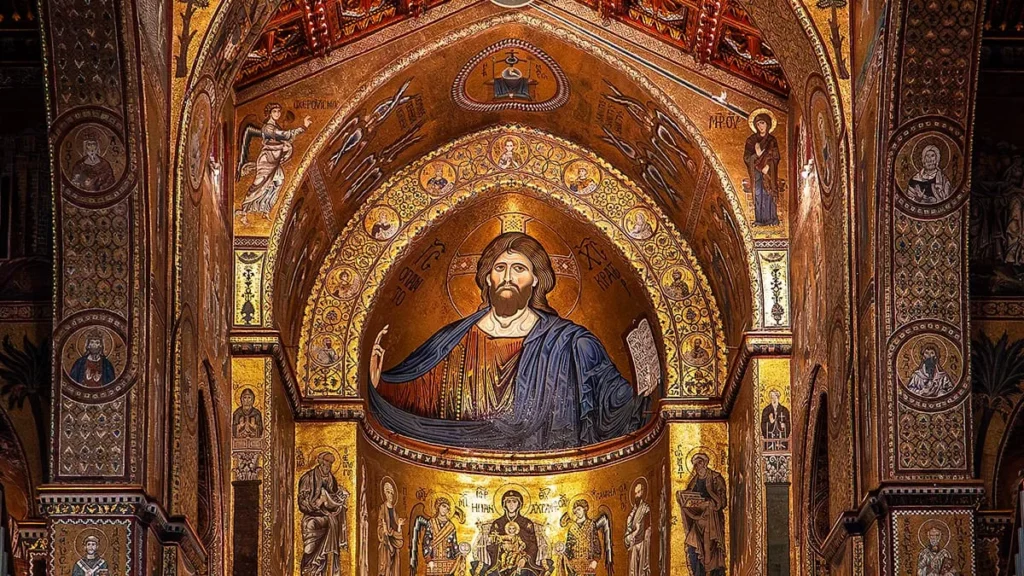
There is a moment, recurring across centuries and continents, when you stand beneath a dome and the hand above you stops you cold. Not because it is threatening, not because it is warm, but because you genuinely cannot tell which one it is. The fingers are raised, slightly curved, the thumb crossing the ring finger in that precise configuration that spells out the Greek initials of a name — and you stand there, tilting your head almost imperceptibly, trying to read the intention behind a gesture that has been frozen in gold and plaster for fifteen hundred years.
The Byzantine blessing posture is not the open-palmed gesture of welcome we recognize from other traditions, nor is it the flat commanding hand that means stop. It occupies a third space, a grammatical middle voice that neither language nor body language has ever fully domesticated. Art historians have spent considerable energy documenting its origins — the overlap between late Roman imperial gesture, the rhetorical adlocutio of generals addressing troops, and the liturgical inheritance of Jewish priestly blessing — but documentation does not resolve the ambiguity. It names its sources without explaining what the hand is actually doing in the moment you meet it.
Erwin Panofsky, writing in the 1930s on the distinction between iconography and iconology, argued that meaning in sacred images operates on a layer beneath conscious intention, where cultural symbols carry weight that neither the artist nor the viewer can fully articulate. He called it the intrinsic meaning, the level at which a civilization’s deepest assumptions about the world become visible in form. The raised hand of the Pantocrator operates precisely at that level. You do not decode it intellectually. You feel it in the chest before you have found words, and what you feel is not one thing.
There is a man who spent three years restoring mosaics in a Byzantine church in the south, and he told someone once that the hand was the last thing he worked on, and the first thing that kept him awake. He had cleaned the tessera, regrouted the borders, matched the gold leaf to within a fraction of the original. But the hand resisted him. Every angle of light changed what it said. In the morning it seemed to be halting, authoritative, a command issued from a sovereign who expects compliance. By afternoon, the same hand, the same angle of the same fingers, looked like an invitation, a slow opening toward something the visitor was meant to walk into rather than obey.
Hans Belting, in his monumental study of the image before the era of art, published in German in 1990, argued that Byzantine icons were not representations of the sacred but presences of it — that the image did not point toward the divine but was understood as a site where the divine actually resided. If Belting is right, then the ambiguity of the hand is not a failure of communication but a feature of presence. Presence does not explain itself. It arrives, and you orient yourself around it, and the orientation differs depending on what you bring to the encounter.
What you bring is everything. If you come in fear, the hand confirms authority. If you come in longing, it opens. If you come in exhaustion, it might look like the one gesture that neither demands nor dismisses — the hand of someone who has seen everything and is still, somehow, there. The IC XC carved into the fingers is not decoration. It is identification, the name folded into the body of the gesture, the claim that this particular hand and no other is the one from which the world hangs.
And still, after fifteen centuries of mosaics, of frescoes, of carved ivory and illuminated vellum, of restoration and theological commentary and the accumulated weight of every human being who has stood beneath that dome and looked up, the hand remains exactly what it was on the first day someone rendered it in gold: a question addressed to you, personally, that has never once offered to answer itself.
✝️ Sacred Images: Art, Faith, and Medieval Symbolism
The Christ Pantocrator is one of the most powerful and enduring icons in Christian art, expressing divine authority through a precise visual language developed over centuries. To fully understand its meaning, it helps to explore the broader world of medieval art, iconography, and architecture that gave it life and context.
Medieval Art: History and Meaning
Medieval art is the essential framework within which the Christ Pantocrator image was conceived and transmitted. This article explores the history and symbolic language of medieval visual culture, tracing how theological ideas were translated into form, color, and sacred imagery across centuries of Christian civilization.
GO TO THE SELECTION: Medieval Art: History and Meaning
Medieval Sculpture: History and Iconography
Sacred sculpture and iconographic programs were central to the religious experience of medieval worshippers, and the Pantocrator figure frequently dominated apse compositions and portal tympana. This article examines how medieval sculptors encoded theological meaning into stone, and how iconographic conventions like those surrounding Christ’s image were established and repeated across Europe.
GO TO THE SELECTION: Medieval Sculpture: History and Iconography
Romanesque Art: History and Characteristics
Romanesque art provided the primary stylistic context in which the Christ Pantocrator reached its most iconic formulations, particularly in mosaic and fresco. This article traces the characteristics of Romanesque artistic production, including the hieratic frontality and symbolic use of gesture that define the Pantocrator’s commanding visual presence.
GO TO THE SELECTION: Romanesque Art: History and Characteristics
Gothic Cathedrals: History and Symbolism
Gothic cathedrals inherited and transformed the iconographic programs of earlier Romanesque sacred spaces, continuing to place Christ’s sovereign image at the heart of their symbolic architecture. This article explores how the theology of divine majesty was embedded in the very structure of Gothic sacred buildings, offering a rich complement to understanding the Pantocrator tradition.
GO TO THE SELECTION: Gothic Cathedrals: History and Symbolism
Discover the Sacred in Cinema on Indiecinema
Art, spirituality, and the search for meaning have always found a home in independent cinema. On Indiecinema streaming you can explore a curated selection of films that illuminate the sacred, the mystical, and the deeply human — stories that resonate with the same timeless questions raised by icons like the Christ Pantocrator.
👉 EXPLORE THE CATALOG: Watch Indie Films in Streaming
A vision curated by a filmmaker, not an algorithm
In this video I explain our vision