
The Room Where the World Began
There is a particular quality to the silence inside stone walls that have never known warmth. Not the silence of a forest or a field, which carries within it the possibility of sound, the held breath before a bird calls or wind shifts through grass. This is a different silence — dense, accumulated, the silence of a space that has been designed to absorb a human being completely and give nothing back. You know this silence even if you have never been confined, because your body knows it before your mind does. Something in the chest contracts. The throat registers it before the ears do.

In the autumn of 1895, a thirty-one-year-old man named Adolf Wölfli was admitted to the Waldau psychiatric clinic outside Bern, Switzerland, and placed in a cell that measured, in its essential dimensions, approximately the boundaries of a life. He had arrived there through a sequence of catastrophes — childhood poverty, the death of both parents before he reached adolescence, years of itinerant farm labor, multiple convictions for sexual offenses against young children — that form, taken together, the biography of a man whom the nineteenth century had decided, at every turn, to discard. Waldau received him not as a person but as a problem that had finally been solved by containment. The paperwork was filed. The door closed.
What happens to a human consciousness when the external world is reduced to stone, routine, and the particular cruelty of institutional care in the 1890s is something that the clinical literature of the period was wholly unequipped to describe. Emil Kraepelin, whose foundational work on classifying psychiatric disorders was reshaping European medicine during precisely these years, had produced taxonomies of madness that were architecturally elegant and humanly hollow. His Lehrbuch der Psychiatrie went through multiple editions between 1883 and the turn of the century, becoming the scaffolding on which asylums organized their understanding of the people they contained. The patients were symptoms. The symptoms were categories. The categories were managed.
Wölfli was managed. He was violent in his early years at Waldau, frequently isolated, subjected to restraints. He inhabited the absolute bottom of the social order that the asylum reproduced within its walls, which was itself the bottom of the social order outside. He had been poor before he was mad, and powerless before he was institutionalized, and the cell at Waldau was simply the logical conclusion of every room he had ever been assigned to by forces that considered his existence a disruption to be contained rather than a life to be understood.
But here is what the paperwork could not account for, what the Kraepelinian categories had no drawer for, what the stone walls were not designed to produce: sometime around 1899, Wölfli began to draw. With whatever he could find — pencils, eventually colored pencils obtained through the charity of his psychiatrist Walter Morgenthaler — he began to fill paper with marks. Not tentatively. Not as therapy, not as communication, not as anything that the institution could have anticipated or named. He began to construct a world.
This is where the story refuses to behave like the story it appears to be. Because the room where the world began was not a studio, not a library, not a place of privilege or education or cultivated solitude. It was a cell in which a man classified as dangerous and discarded as unredeemable reached for a pencil and began the work of creating an alternative universe so vast, so internally coherent, so obsessively detailed that it would eventually fill approximately forty-five volumes, nearly three thousand individual pages, and constitute one of the largest and most complex works of art ever produced by a single human being.
The door had closed. Something else had opened.
Don Barry: A Quixotic Exploration
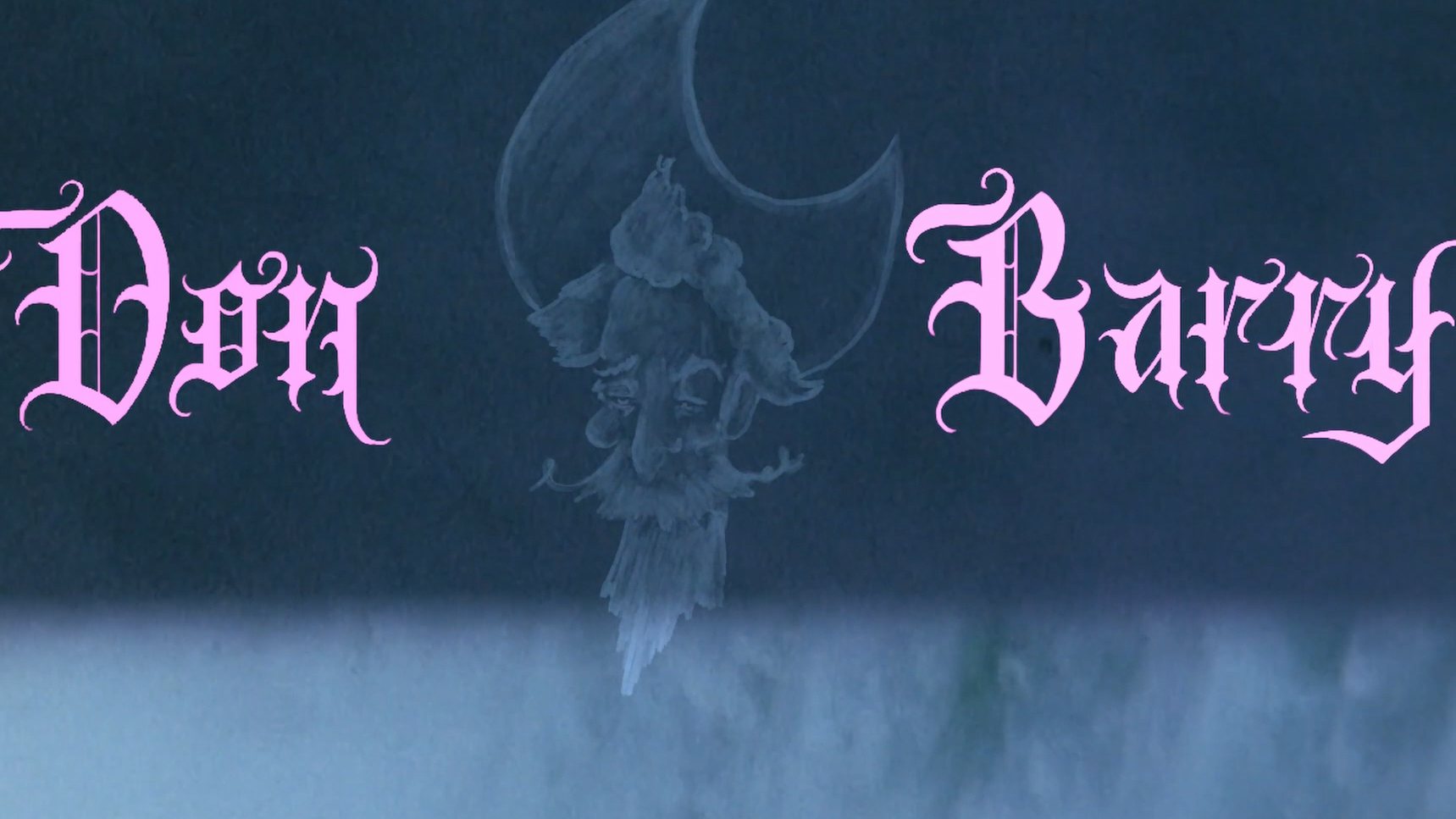
Docufiction, Experimental, by Paul Smart, Mexico, 2026.
Don Barry: A Quixotic Exploration is a debut feature that places the biography of an eighty-year-old experimental filmmaker and artist, Barry Gerson, within the metanarrative of Miguel de Cervantes’ Don Quixote. Don Barry was filmed in the city of Guanajuato during the 51st edition of the Cervantino Festival, as well as during the vibrant Day of the Dead celebrations held in the city’s UNESCO-listed tunnels. The film honors the director’s long friendship with artist Barry Gerson, drawing inspiration from Cervantes’ Don Quixote. Paul Smart’s directorial choices create something new that celebrates life and goes beyond conventional storytelling. A search for magic in our real lives. A moving film about the meaning of life, art, and death. Not to be missed.
Paul Smart is a proud outsider filmmaker with a long history of film screenings. In the 1980s, he emerged in New York’s vibrant youth art scene, working in theater production and later filmmaking, before retreating to rural upstate New York, in the Catskill Mountains, where he made a living writing and screening independent films in old parish halls for rural audiences, many of whom had never seen a film.
LANGUAGE: English
SUBTITLES: Spanish, French, German, Portuguese
A Childhood That Was Never Allowed to Happen
He was born in 1864 in Bowil, a village in the canton of Bern so small it barely interrupted the landscape. His father, a stonecutter, abandoned the family early enough that his absence became the first architecture of Adolf’s life — not a wound but a founding condition, the way a house built without a floor is still called a house. His mother died when he was seven. After that, the state stepped in, which is to say: no one did.
What followed was a series of foster placements that the historical record describes with the bureaucratic neutrality of ledger entries. Different households, different cantons, agricultural labor beginning in early childhood. He worked for food and shelter in homes where he was a mouth to feed before he was a person to consider. The Switzerland of the 1870s was not uniquely cruel — it was simply organized around a principle that has never entirely disappeared: that orphaned children are problems to be distributed, costs to be minimized, labor to be extracted. The poverty was structural. The indifference was institutional. The damage was personal.
Donald Winnicott, writing nearly a century later, gave a name to what Wölfli never had. The holding environment — that sustained, attuned presence of a caregiver who allows a child’s self to form without collapsing under the weight of the world’s demands — is not a luxury in Winnicott’s framework. It is the precondition for psychological existence itself. Without it, what develops is not a self but a set of survival strategies wearing the shape of a self. The child learns to perform coherence rather than inhabit it. He becomes, in Winnicott’s phrase, a false self: an adaptive surface over a void that was never given the chance to fill.
By his early twenties, Wölfli was working as a farmhand, drifting between positions, barely literate, socially isolated in the way that a person raised without consistent attachment is always isolated — not because he chose distance but because proximity had never been taught to him as safe. And then, between 1890 and 1895, he was arrested twice for sexual assault of young girls. He was convicted. He served time. These are facts that cannot be softened, and this text will not attempt to soften them. What they represent, however, is not simply the biography of a dangerous man. They represent the endpoint of a particular chain — the place where structural abandonment, unprocessed trauma, and the complete absence of any therapeutic or social intervention finally discharged themselves onto someone else, onto children who were even more powerless than he had been.
This is the mechanism that societies prefer not to examine. It is far more comfortable to locate evil in the individual, to treat the perpetrator as a rupture in the social fabric rather than as its product. The philosopher Judith Herman, in her 1992 work Trauma and Recovery, documented with clinical precision how untreated traumatic experience does not remain contained — it migrates, it reproduces, it seeks expression in the bodies and lives of others. A child who is never held does not simply grow up unhold; he grows up without a reliable internal model of what it means not to violate. This is not exculpation. It is a more demanding form of accountability — one that refuses to let the institution off the hook by condemning only the man.
What Wölfli carried into his twenties was not character. It was weather — the accumulated pressure of a childhood that had been systematically refused to him by every structure that should have sustained it. And when that pressure finally broke, it broke in the direction of those with even less power than he possessed, which is almost always how these things work, and almost always what we choose not to say out loud.

What the Diagnosis Cannot Hold
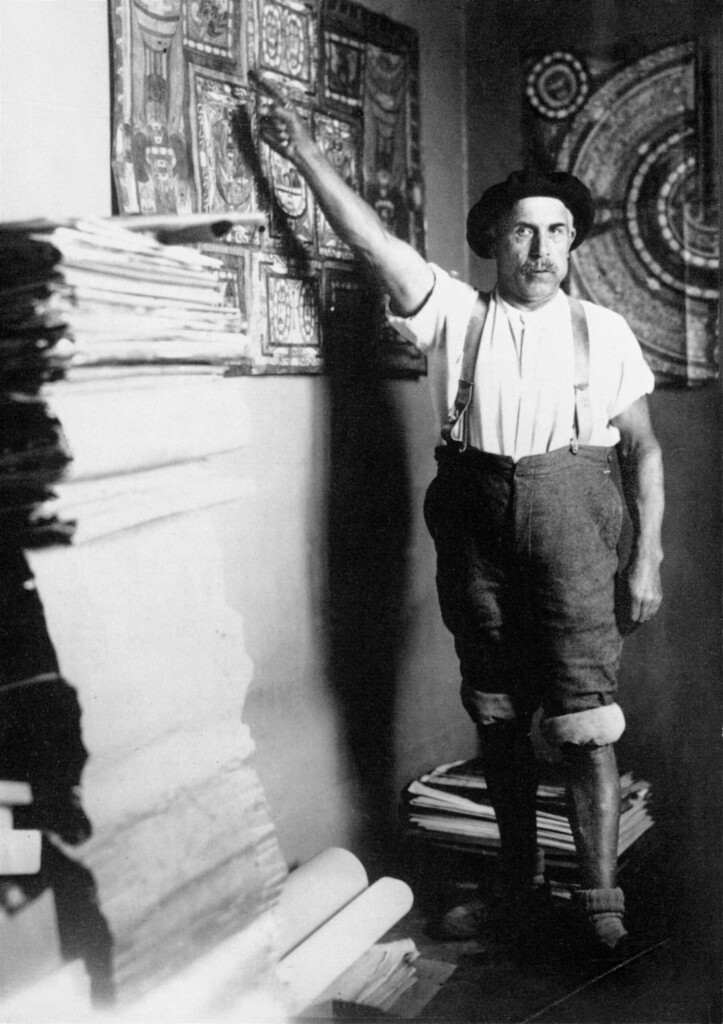
There is a particular kind of rescue that works by removing everything else. You know this. The hospital that keeps you alive by keeping you still. The job that funds your survival by consuming the hours in which you might have become yourself. The relationship that offers safety at the cost of the self who needed saving in the first place. Wölfli lived this paradox at its most literal and most brutal extreme: the institution that committed him in 1895, classifying him as dangerous and mentally deranged, also gave him the only sustained peace he had ever known. A room. Meals arriving at intervals. No children to abuse him, no poverty grinding at his bones. The Waldau Psychiatric Clinic outside Bern was his prison and it was, in the most unsparing sense, his studio.
Walter Morgenthaler was the psychiatrist who noticed. Not in the patronizing sense of a collector spotting raw material, but in the way one notices something that refuses to be ignored. By the time Morgenthaler published his 1921 monograph, Ein Geisteskranker als Künstler — A Mental Patient as Artist — Wölfli had already produced thousands of pages of densely interlocked imagery, text, musical notation, and what can only be described as cosmological autobiography. Morgenthaler’s book was the first serious attempt to treat the work as work, not as symptom, not as curiosity, not as evidence. It arrived into a European art world already trembling with the discovery that the boundaries between the pathological and the creative were far less stable than anyone had wanted to believe. Jean Dubuffet would later build an entire aesthetic philosophy on this trembling, coining the term Art Brut in 1945 and collecting Wölfli’s work for the Compagnie de l’Art Brut. But Morgenthaler was first, and what he saw was not a madman who drew. He saw a man who was, fundamentally, an artist who had been diagnosed.
The diagnosis itself was schizophrenia, applied according to the frameworks of early twentieth-century psychiatry that were as much instruments of social management as they were medical categories. Michel Foucault argued in Madness and Civilization, published in 1961, that the great confinement of the seventeenth and eighteenth centuries was not primarily a medical project but a moral and economic one — the removal of those who could not be absorbed into productive social order. What Foucault mapped historically, Wölfli embodied personally. He was not confined because he was understood. He was confined because he was illegible, unmanageable, a man whose interior life exceeded every category available to contain it. The diagnosis gave the institution its justification. The institution, inadvertently, gave the art its conditions.
This is the paradox that sits at the center of Wölfli’s life and that no amount of retrospective celebration can dissolve. Every single piece he made — and there were roughly 25,000 pages of work by the time he died in 1930 — was made inside confinement. The creativity was not despite the walls. It was threaded through them, pressed against them, structured by the very fact of limitation. He was given paper as a therapeutic concession, then produced a universe from it. He was silenced by classification and responded with an entirely private language that has outlasted every bureaucratic notation filed about him.
What the psychiatric record cannot hold is not the madness. It is the coherence. The internal logic of Wölfli’s world — his invented geography, his recurring self-portrait as the child Saint Adolf II, his intricate musical scores for instruments that do not exist — possesses a consistency that clinical language has no framework for honoring. Consistency, after all, is supposed to belong to the sane. But Wölfli maintained his cosmology across decades, across seizures, across whatever interior weather the diagnosis gestures toward without ever quite reaching.
The Lost Poet
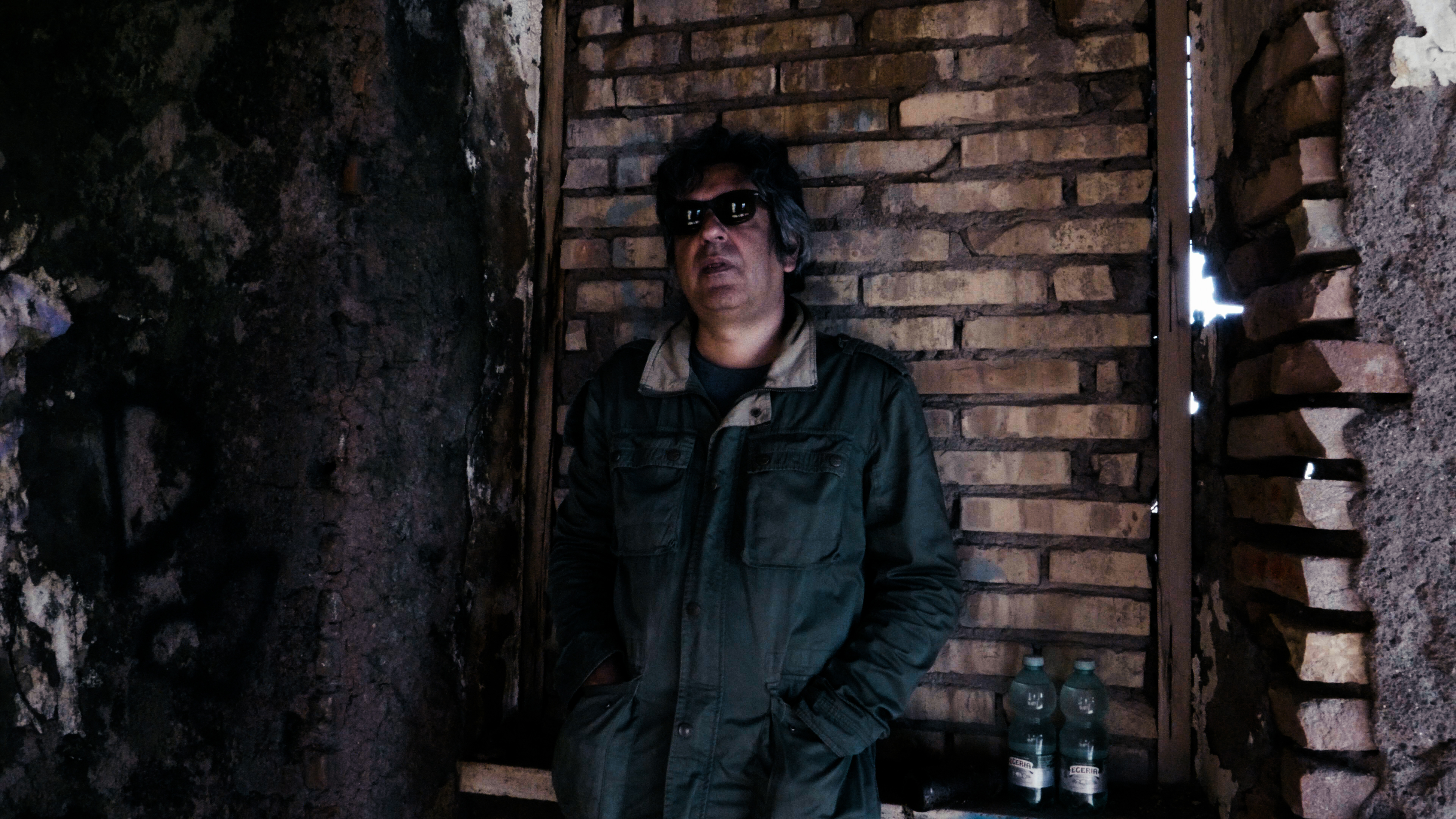
Drama, by Fabio Del Greco, Italy, 2024.
Dante Mezzadri wants to see an old friend, nicknamed the Iguana, whom he has lost sight of for many years, and who has managed to turn their shared youthful passion for poetry into a job, becoming a famous writer and poet. The man escapes from his bourgeois life and his wife to live homeless on the Roman coast, printing and trying to sell his poetry collections. At night he sleeps in a park of old carnival floats, inside a papier-mâché tank, and waits for the opportunity to meet his old friend, who however never shows up for appointments in the places they frequented when they were young, now in ruins. Dante's poetry books do not interest anyone and to support himself he is forced to "change product": he starts selling the infamous "cannibal pill" on behalf of young drug dealers, a new drug that sells like hot cakes and causes sensory and consumerist ecstasy. However, he realizes that this powerful drug is very dangerous for those who take it, he comes into conflict with his ethical conscience and throws all the pills into the sea. However, the dealers want to collect their money.
Shot over a period of 2 years, the film is a reflection on the cultural and artistic rubble of the society in which the protagonist lives, in an increasingly mechanized, consumerist and arid world. Dante Mezzadri is yet another human being who has renounced his inspiration and his creativity, but unlike many he is not willing to give his life to a system that distances him from his true identity. The physical world around him, however, seems constructed in such a way that it seems impossible to escape from this "invisible cage". The enthusiasm of the people he meets is ignited only by sensory gratification, by unreal visions of personal affirmation and success, by "metaverses" that offer an escape into an illusory and destructive reality. The poet's house on the coast, where he met with his friends as a young man, is just a pile of abandoned rubble. What happened to all those who wanted to become poets and ended up becoming something else? Are there internal forces with which that house can be "rebuilt"?
LANGUAGE: Italian
SUBTITLES: English, Spanish, French, German, Portuguese
The Universe in Pencil and Crayon
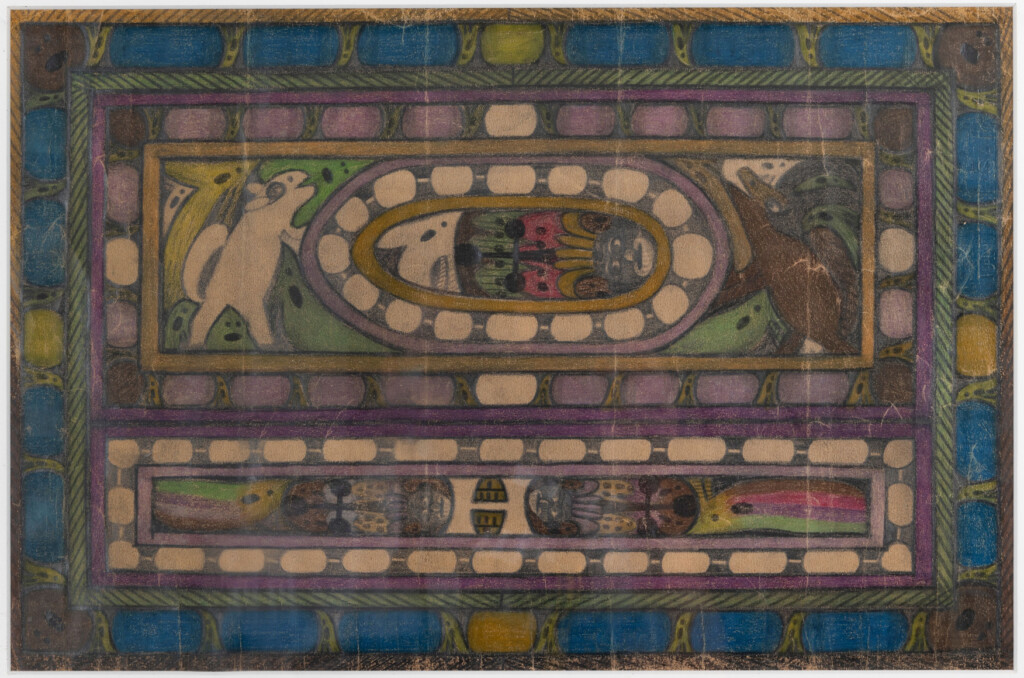
The pages are enormous. Not large in the way a painting is large, commanding a wall and expecting your gaze from across a room, but large in the way a map is large, demanding that you lean into it, that your eyes travel rather than rest. Some sheets measure nearly a meter across. Every centimeter is occupied. There is no negative space, no breath left unclaimed by line or symbol or the dense cursive script that winds around images the way ivy winds around iron — not decorating it, not explaining it, but becoming indistinguishable from it.
The manuscript he worked on for the last three decades of his life runs to something in the range of twenty-five thousand pages. This is not a metaphor for obsession. This is a physical object that exists in archives, that has weight and smell and the particular texture of paper worked so intensively that the surface has changed character under the pencil and crayon. He began this accumulation around 1908, and he did not stop until his hands would no longer cooperate. The work has a title that reads like a novel of the nineteenth century, sweeping and autobiographical in its ambition: it narrates the entire arc of a life, from origin to extinction, except that the life it narrates is both his and not his, a life inflated to cosmic scale, populated by invented continents, fictional saints, armies of numbers and musical staves that no musician has ever been able to render into actual sound.
Those staves are perhaps the most unsettling element, not because they are chaotic but because they are coherent in their own grammar. They follow a logic that feels almost playable, almost translatable, and yet remains perpetually on the threshold of meaning. Walter Morgenthaler, the psychiatrist who first gave sustained attention to this body of work, understood something essential: the notation was not failed music. It was something else entirely, a system that used the visual language of music to do something music cannot do, which is to hold space still, to anchor the page against the terror of blankness.
Hans Prinzhorn, who assembled an extraordinary collection of work made by patients across European institutions and published his analysis in 1922, argued something that still cuts against the grain of how we speak about outsider art. He was not interested in pathology as explanation. He was interested in what he called the drive toward configuration, the impulse to impose form on experience as a fundamental human need that illness does not destroy but sometimes, in very particular conditions, accelerates and intensifies. He was not saying that suffering produces art. He was saying something more precise and more disturbing: that the need to make form is so deep in human beings that it persists even when everything else has been stripped away, even when language has fractured, even when the self has shattered into incompatible fragments. What you see in those pages is not the product of madness. It is evidence of a mind refusing, through whatever materials it can reach, to dissolve entirely.
The self-portraits return throughout the manuscript obsessively, and in them he appears not as a broken man in an institution but as Saint Adolf II, a figure of immense ceremonial authority, robed, surrounded by the iconography of power and holiness, positioned at the center of the invented cosmology as its creator and its subject simultaneously. This is not delusion recorded on paper. This is a man rebuilding, in the only space available to him, the sovereignty that was taken from him before he could even name what was being taken. The pencil was not a tool of expression. It was a tool of reconstruction. Every filled centimeter was an argument against annihilation, made silently, page after page, in a room he did not choose, with materials someone else decided to give him.
The Market Discovers What the Asylum Contained
There is something almost ceremonial about the way institutions arrive late. The man has been dead for years, the work has been sitting in boxes or on walls nobody looked at twice, and then someone with the right vocabulary and the right connections walks in and says: this is art. And from that moment, it is.
Jean Dubuffet coined the term Art Brut in 1945, fifteen years after Wölfli died in Bern. The concept was elegant in its way — raw art, unmediated creation, work produced outside the circuits of training and market and social expectation. Dubuffet meant it as a provocation aimed at the cultural establishment, a way of saying that the most vital creative energy in the twentieth century was not coming from the salons or the academies but from psychiatric wards and prisons and the margins where people had been deposited and forgotten. He was right about that. What he did not question, and what almost nobody questioned in the decades that followed, was what it meant to celebrate the product while remaining entirely incurious about the conditions of its production.
Wölfli had been confined to the Waldau Psychiatric Clinic since 1895. He worked in a cell. He was given paper when paper was available. He was given bread, and when he produced something that the clinic’s director Walter Morgenthaler found sufficiently interesting, he was sometimes given tobacco or sugar as payment. These were the terms of the transaction. Morgenthaler published his study of Wölfli in 1921, the first serious clinical and aesthetic examination of the work, and even then the framing was essentially one of astonishment — here was a madman who had made something extraordinary. The astonishment was genuine. But astonishment is not the same as justice, and it does not ask the harder question: extraordinary under what constraint, and at what cost, and for whose eventual benefit.
The Collection de l’Art Brut in Lausanne, which opened in 1976 and now holds a substantial body of Wölfli’s work, is a remarkable institution. The work it preserves is genuinely important. None of that is in dispute. What is worth sitting with, uncomfortably, is the mechanics of how cultural recuperation operates — how the art world absorbs what it once excluded without ever acknowledging the exclusion, without ever really accounting for the distance between the man producing the work and the institution eventually celebrating it. The sociologist Pierre Bourdieu spent much of his career describing exactly this process: the way cultural fields consecrate certain objects and certain names, transforming them into symbolic capital, and the way that consecration almost always serves the consecrating institution as much as it serves the consecrated. His concept of the field, developed across works like The Rules of Art in 1992, makes visible something the art world prefers to leave invisible — that the recognition of genius is never a neutral act of perception but always a social operation with beneficiaries.
Think of what it looks like from one angle: a man works obsessively for over thirty years, producing thousands of pages of densely interwoven image and text and musical notation, building a cosmology of staggering complexity, and the compensation he receives is tobacco and sugar. Then he dies. Then the work becomes part of a consecrated collection in a Swiss city, reproduced in catalogues, discussed in academic papers, acquired by museums. The symbolic value generated by that work travels entirely in one direction. It accumulates in institutions, in scholarly reputations, in the cultural prestige of a city and a country. The man himself received tobacco and sugar.
This is not an argument that the work should not be preserved or studied or celebrated. It is an observation about the silence that surrounds the celebration — the way the art world learned to say Wölfli’s name without ever being willing to say what his life actually was.
A vision curated by a filmmaker, not an algorithm
In this video I explain our vision
The Grammar of Obsession
There is a moment when you stand before one of his pages and something uncomfortable happens to your eyes. Not uncomfortable in the way of ugliness or distress, but uncomfortable in the way of excess — the sensation of trying to drink from something that has no bottom. Every square centimeter is occupied. Not decorated, not filled: occupied, as though the surface itself is under siege from meaning that has nowhere else to go. Your gaze enters at one point and immediately fractures into seven directions, each one equally urgent, each one pulling with the same gravitational insistence. You cannot find the edge of the composition because the composition has no edge in any functional sense. It simply stops where the paper stops, and you understand instantly that this is an accident of paper, not of intention.
Viktor Shklovsky, writing in 1917 in his essay “Art as Technique,” argued that the purpose of art is to restore sensation to objects that habit has made invisible — to make the stone stony again, to force perception back into slowness, into difficulty. He called it ostranenie, defamiliarization, the deliberate roughening of form so that seeing costs something. What Shklovsky could not have anticipated is a maker for whom defamiliarization was not a technique but a metabolic condition, someone for whom the familiar world had already been so thoroughly shattered that every mark on paper was an act of reconstruction, every line a refusal to let reality settle into its usual arrangements. Standing before one of these pages, you are not being made to see differently. You are being shown what it looks like when someone has no choice but to see differently, always, without respite.
The horror vacui — the terror of empty space — reads in most contexts as anxiety, as the compulsive need to cover and control. Here it reads as something closer to the opposite: as generosity so total it becomes disorienting. Susan Sontag, in her “Notes on Camp” from 1964, identified a sensibility that privileges style to the point where it becomes substance, where the excess of form is not decoration but the actual content of the work. She was writing about a very different world, about artifice and irony and the knowing wink. But her insight about radical form — that it does something to the viewer that moderate form cannot, that it reorganizes the hierarchy between surface and depth until the distinction collapses — lands here with unexpected precision. These pages do not hide meaning beneath decoration. The decoration is the meaning. The spiraling borders, the masks embedded in margins, the birds that become letters that become architectural details that become birds again: none of this is ornament over content. It is content that has taken the only form available to it.
Then there is the language. He invented words, hundreds of them, and embedded them in the visual field with the same authority as the images. You cannot read them but you cannot dismiss them either, because they are written with the confidence of someone who knows exactly what they say. And running through sections of the work, there are musical scores, actual notated music, integrated into the visual composition not as illustration but as structural element, the staves becoming part of the grid, the notes becoming ornamental nodes in the larger pattern. The work refuses to belong to any single sense. It addresses the eye and the ear simultaneously, it generates meaning through visual rhythm in the same gesture that it generates music through visual structure, and the result is something that defeats the categorical habits your education built into you.
You keep looking because the work will not release you. Not because it is beautiful, though it is, but because it keeps becoming something new in the second before you think you have understood it.
Genius, Madness, and the Stories We Need to Tell

There is a moment you recognize, even if you have never consciously named it. You are standing in front of a work that overwhelms you, something vast and intricate and clearly made by a mind that operated outside the ordinary permissions of human attention, and somewhere beneath your genuine awe a quieter thought moves: what must it have cost him. And that thought is not entirely compassionate. It carries something else inside it, something closer to relief. The suffering explains the transcendence, and the transcendence retroactively justifies the suffering, and the whole arrangement allows you to admire without having to ask the harder question, which is what you are actually doing when you consume a man’s psychosis as aesthetic experience.
Wölfli’s story has been conscripted into one of Western culture’s most durable and most dishonest narratives, the one in which madness and genius are not merely correlated but causally bound, each validating the other in a closed economy of romantic necessity. Kay Redfield Jamison, whose 1993 work Touched with Fire examined the relationship between mood disorders and artistic temperament across centuries of creative biography, was careful to distinguish between what the data actually shows and what the culture desperately wants it to show. The statistical associations she documented between certain affective disorders and creative output are real but narrow, specific to particular diagnostic categories, and they tell us nothing remotely resembling what the myth insists on, which is that the wound is the gift, that you cannot have one without the other, that the suffering is not incidental but constitutive. Louis Sass, writing in Madness and Modernism in 1992, pushed even further into the discomfort by demonstrating that schizophrenic experience shares formal and structural qualities with certain strands of modernist art and thought, not because madness is secretly creative, but because both involve a particular kind of hyperreflexive detachment from the assumed solidity of the world. The implication is unsettling in precisely the opposite direction from the romantic myth: the resemblance does not ennoble the illness, it implicates the art.
What you are left with, when you hold Jamison and Sass together, is a portrait of Wölfli that the galleries and the catalogue essays and the outsider art market have largely preferred not to look at directly. He was a man who experienced genuine terror. He heard voices that functioned as persecutors. The grandiose cosmology he built across more than twenty-five thousand pages was not a creative choice but a survival mechanism, a structure erected against interior annihilation. Think of a man sitting in an asylum room, drawing concentric rings around figures that might consume him if they escape the page, filling every margin with musical notation that no instrument can play, writing himself as Saint Adolf II across galaxies he has invented because the alternative is to be nothing, to be the abandoned child on the road, the farmhand who was assaulted, the prisoner without recourse. The work does not transcend that reality. It is that reality, translated into a form that outlasted the body.
And yet you need the story of the mad genius. You need it because it provides the suffering with a purpose, and purpose is the thing you cannot tolerate withdrawing from another person’s pain when you are the one benefiting from it. There is a version of attention that is indistinguishable from exploitation, dressed in the language of celebration. The visionary confined, the raw talent untrained and therefore authentic, the mind so far outside convention that convention institutionalized it rather than admit its own poverty, this is a story that has never really been about Wölfli. It has been about what those who stand outside the institution need to believe about what happens inside it, and about what art costs, and about whether the price is one they would ever be willing to pay themselves.
What Remains When the Name Is Finally Said
There is a particular kind of silence that follows a name being spoken for the first time by people who were never in the room. When curators began lifting Wölfli’s drawings from the archive at Waldau and carrying them into galleries across Europe and America, they were performing an act that contained its own contradiction: here is a man, they were saying, here is a genius, here is a life — and the man himself had been dead for decades, had died in the same building where he had been confined since 1895, had never once chosen the frame around his own image.
Jean Dubuffet understood this contradiction perhaps better than anyone who came after. When he coined the term art brut in the mid-1940s, and when he began assembling what would become the Collection de l’Art Brut in Lausanne, he was simultaneously liberating artists like Wölfli from obscurity and constructing a new category that carried its own set of enclosures. To be named art brut is to be named outside, and outside is still a position defined entirely by its relation to inside. Dubuffet argued passionately that these works possessed a rawness, an uncontaminated creative force that professional training had destroyed in academic artists — but the argument, however well-intentioned, still required the figure of the untrained, the mad, the institutionalized, to serve as a mirror in which cultivated culture could see its own exhaustion reflected. Wölfli’s 46,000 pages of drawings, text, and musical notation became evidence in someone else’s argument about what art should be.
The influence is real and it is vast. The entire field now called outsider art, a term that replaced art brut in Anglo-American contexts with slightly different cultural freight but the same structural logic, owes its institutional existence in part to the weight of Wölfli’s archive. Contemporary scholars working on figures like Henry Darger, the Chicago janitor who produced 15,145 pages of an illustrated novel discovered only after his death in 1973, are working within a critical framework that Wölfli’s rediscovery helped make possible. The conversation about what constitutes legitimate artistic practice, about whether formal training is a prerequisite or a contamination, about whether the art world’s validation machinery enriches or simply appropriates — all of it runs through Waldau, through those corridors where a man spent 35 years making a world because the world had been taken from him.
But there is something the 46,000 pages cannot contain, and it is not mystical or ineffable. It is simply the life that was not lived. The man who walked into Waldau at thirty-one years old had already survived things that would have destroyed most people, and the institution did not save him from himself so much as it removed him from the possibility of any other self. The musical compositions he created — intricate, formally inventive, marked with a notation system he invented because no existing system could hold what he heard — were never performed during his lifetime. The cosmologies he built across thousands of sheets were never read as literature by anyone who treated him as a literary mind. He died in 1930 in the same rooms where he had been placed in 1895, and the question of what he might have become with different circumstances is not sentimental speculation but a precise historical indictment.
What we owe to people whose suffering we convert into culture is something we have never found a satisfying way to say. We exhibit their work, we write their names in catalog essays, we cite them in arguments about the nature of creativity and the violence of institutions, and all of it is true, and none of it returns a single day to the man who made Saint Adolf II from a cell in Bern.
🌀 Between Madness, Vision, and the Inner Labyrinth
Adolf Wölfli’s visionary universe, born from confinement and mental anguish, connects deeply with the broader tradition of esoteric imagination, outsider consciousness, and the symbolic languages humans have invented to map invisible worlds. These articles explore parallel territories where art, mysticism, and the transformation of the self converge in unexpected ways.
The Unconscious and its Relationship With Cinema
The unconscious mind, as explored through the lens of cinema, reveals the same hidden architectures that Wölfli externalised onto paper in his densely packed visions. Psychoanalytic and Jungian readings of film illuminate how symbolic imagery erupts from depths that rational thought cannot contain. Understanding this relationship helps us appreciate how outsider art and cinematic language share a common root in the uncharted territories of the psyche.
GO TO THE SELECTION: The Unconscious and its Relationship With Cinema
Jungian Alchemy: Jung and Alchemical Psychology
Carl Gustav Jung dedicated much of his later work to the symbolic systems of alchemy as mirrors of psychological transformation, a journey Wölfli unknowingly echoed in his obsessive self-mythologising and cosmological imagery. Jungian alchemy frames the creative process as a series of inner deaths and rebirths, stages that resonate powerfully with the biographical arc of the Swiss outsider artist. This article offers a conceptual bridge between clinical psychology, esoteric tradition, and the raw visionary art that Wölfli produced across decades of institutionalisation.
GO TO THE SELECTION: Jungian Alchemy: Jung and Alchemical Psychology
Spiritual Alchemy: Inner Transformation and Symbolism
Spiritual alchemy speaks of the transmutation of suffering into meaning, a process that lies at the very heart of Adolf Wölfli’s extraordinary output. His compulsive imagery, filled with self-invented saints, cosmic geometries, and elaborate musical notations, can be read as a private alchemical opus performed entirely within the walls of an asylum. This article explores how inner transformation and symbolic language intertwine across mystical traditions, shedding new light on what it means to create from the depths of the self.
GO TO THE SELECTION: Spiritual Alchemy: Inner Transformation and Symbolism
The Avant-Garde Cinema: Movies to Watch
The avant-garde cinema tradition shares with outsider art a radical refusal of conventional representation, privileging instead the raw force of personal vision over academic technique. Films gathered under the avant-garde banner, like Wölfli’s drawings, construct autonomous worlds governed by their own internal logic and visual grammar. Exploring these films alongside the life and works of Wölfli reveals how the margins of official culture have consistently produced some of its most enduring and unsettling masterpieces.
GO TO THE SELECTION: The Avant-Garde Cinema: Movies to Watch
Discover the Cinema of Vision and Freedom on Indiecinema
If Adolf Wölfli’s journey into the depths of imagination has moved you, Indiecinema is the streaming platform where you can continue exploring. From visionary avant-garde films to documentary portraits of outsider artists and mystical thinkers, Indiecinema gathers the independent cinema that dares to go where mainstream screens never venture. Join us and let the labyrinth unfold.
👉 EXPLORE THE CATALOG: Watch Indie Films in Streaming
A vision curated by a filmmaker, not an algorithm
In this video I explain our vision

